AI Visibility 101: Why Solo Founders Can't Ignore ChatGPT
Learn what AI visibility really means, why ChatGPT and other AI engines now shape buying decisions, and how solo founders can track their brand mentio
AI Visibility for UK Solo Founders: Why You Can't Ignore What ChatGPT, Gemini, and Perplexity Say About Your Business
In short: AI visibility measures whether tools like ChatGPT, Gemini, and Perplexity mention your business — and describe it accurately — when someone asks a question in your industry. If you're invisible or inaccurately described, you can lose enquiries that never appear as a session, a bounce, or a form-fill in your analytics. The practical fix is to test ten realistic prompts this week, correct any inaccurate public information you find, and repeat the check monthly.
I've spent a good deal of time studying how AI search and chat systems retrieve, summarise, and cite information, first out of curiosity, then professionally while building the monitoring tooling behind MentionOwl. Below, I'll explain what AI visibility actually means, what the evidence genuinely supports versus what's still directional, and how to check your own standing this week without spending a penny. 🦉
One honest caveat before I go further: the evidence for AI-generated answers reshaping research-stage buying decisions is real and growing, but it's stronger on some points than others, and UK-specific data is still thin. I'll flag exactly where the data holds up and where I'm extrapolating, rather than blend different kinds of evidence into one dramatic claim.
What is AI visibility?
AI visibility is the extent to which your business is accurately represented in answers generated by AI search and chat systems. For a solo founder, it means being visible, correctly described, and appropriately recommended when a potential customer asks an AI tool about your product, service, or local market.
It's worth separating three things people lump under this one term, because they behave differently:
- Chatbot answers: a direct conversational response from ChatGPT, Claude, or Gemini, where your brand might be named, described, and compared to competitors within the flow of a conversation.
- AI-generated search summaries: Google's AI Overviews and AI Mode, which sit on top of a traditional results page and can absorb a click before the user scrolls to the blue links.
- Citation-led answer engines: Perplexity, in particular, builds answers from a visible panel of cited sources, more like a curated reading list than a single authoritative voice.
Google's Search Central documentation on AI features confirms that brand mentions, citations, and source attribution feed into how its own AI Overviews and AI Mode answers get constructed, though that's scoped to Google's own products, not a universal standard for how every AI system works. No such universal standard exists yet, and I'd be cautious of anyone who tells you otherwise.
This piece focuses on ChatGPT, Perplexity, and Gemini because they cover the large majority of AI-search usage for many solo founders today. Claude and Microsoft Copilot exist and matter for some audiences, particularly B2B and enterprise-adjacent buyers, but the retrieval mechanics and the checking process I describe below apply to them too. You're simply adding more platforms to the same question set.
How AI visibility differs across platforms
A business can appear reliably in Perplexity's citation panel while being entirely absent from ChatGPT's conversational answers to the same question. These systems retrieve from different sources and are prompt-dependent in ways traditional rankings aren't.
OpenAI's documentation on ChatGPT search notes that results vary by wording, location, and conversational context: the same brand can appear for one phrasing and vanish for a near-identical one. That's why checking one AI tool once gives you a false sense of security. AI visibility also doesn't replace your conventional web presence: standard search fundamentals such as crawlability, indexability, and useful content still apply underneath it.
A practical AI visibility measurement model
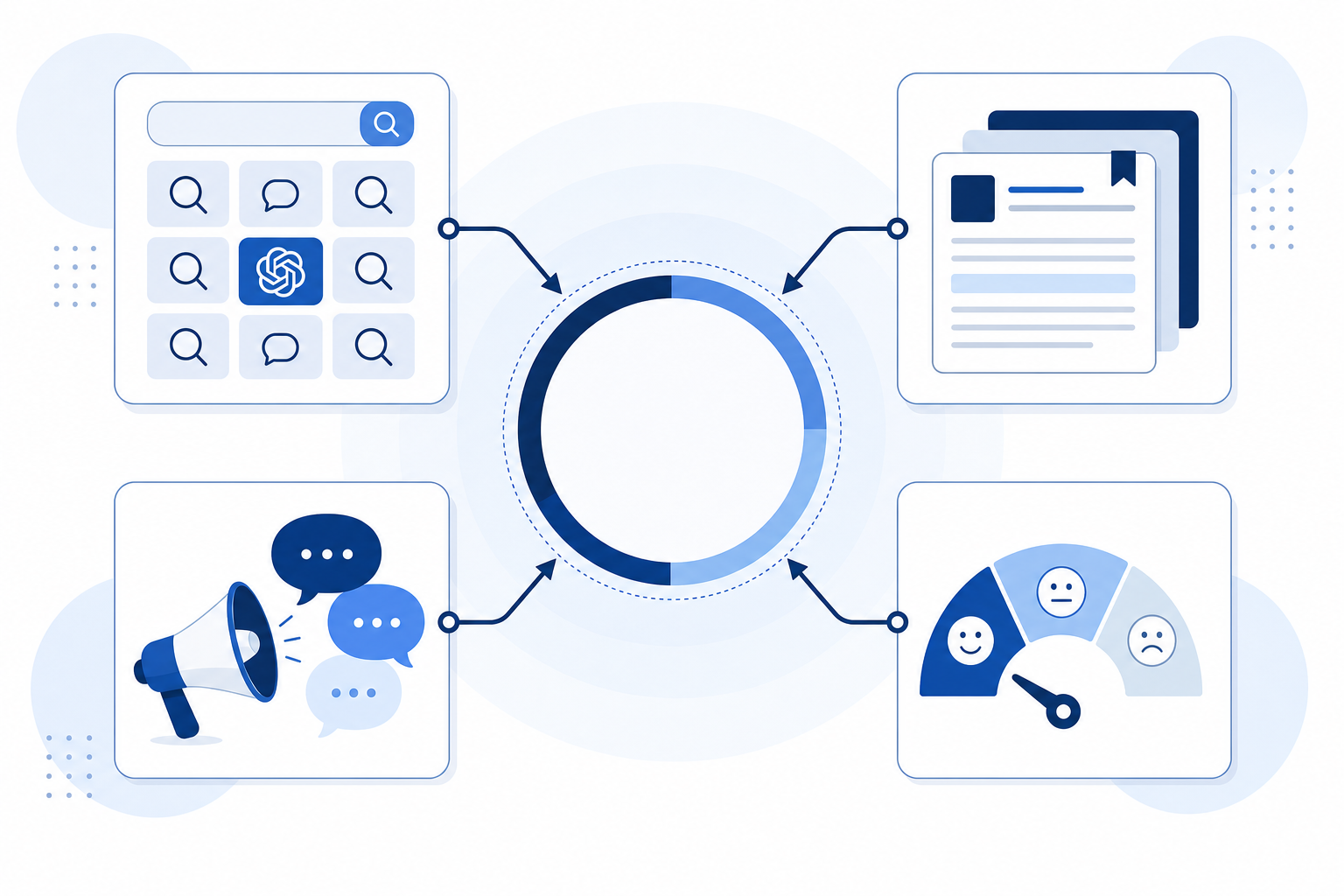
At MentionOwl, we built a scoring framework to make AI visibility trackable: four measurable components rolling up into a 0–100 visibility score. I want to be upfront that this is our internal model, built for trend-tracking and competitive comparison within a fixed prompt set, not an industry-standard metric. It's only meaningfully comparable when the same prompts, platforms, and weightings are held constant across measurements.
- Query coverage (35%): the share of your question set that surfaces your brand at all.
- Position-weighted citations (25%): whether you're named in the first third of the answer, the middle third, or the final third, averaged across mentions.
- Share of voice (25%): your mention count against a defined list of named competitors, across the same questions, expressed as a percentage of total mentions.
- Sentiment (15%): the tone attached to your mention, scored per unique mention as positive, neutral, or negative, with borderline cases flagged rather than forced into a bucket.
Here's a worked example. Say we run ten prompts for a Bristol-based accountancy firm across three platforms, alongside three named competitors:
| Component | Result | Weighting | Contribution |
|---|---|---|---|
| Query coverage | Mentioned in 6 of 10 prompts (60%) | 35% | 21.0 |
| Position-weighted citations | Named in the first third in 4 of those 6 mentions | 25% | 16.7 |
| Share of voice | 6 mentions vs. 9, 7, and 5 for competitors — 6 of 27 total mentions (22%) | 25% | 5.5 |
| Sentiment | Mostly neutral, one positive, no negative | 15% | 11.3 |
| Approximate score | ~55/100 |
A score like that tells you two things clearly: coverage is decent but not dominant, and share of voice is the weakest input here — competitors are simply being named more often than you across the same questions. It doesn't tell you why, and it can't isolate revenue impact on its own; for that you still need to read the underlying answers. Treat this example as illustrative of how the components combine, not as a benchmark to compare your own score against.
Why AI search answers influence buying decisions
I want to keep four different types of evidence separate here, because they measure different things and shouldn't be combined into one number.
| Evidence type | Source | Finding | Date | Geography |
|---|---|---|---|---|
| Observed behaviour | Pew Research Center | An AI summary appeared in ~18% of sampled Google searches; when one appeared, users clicked a traditional result in ~8% of visits (vs. 15% without one); clicks inside the summary itself happened in ~1% of visits | Mar 2025 | US Google search sample |
| Stated preference | Capgemini Research Institute | 58% of surveyed consumers said they now prefer generative AI over traditional search for recommendations; 71% expect generative-AI-style interactions in the buying journey | 2025 | 8,000 consumers, 12 countries |
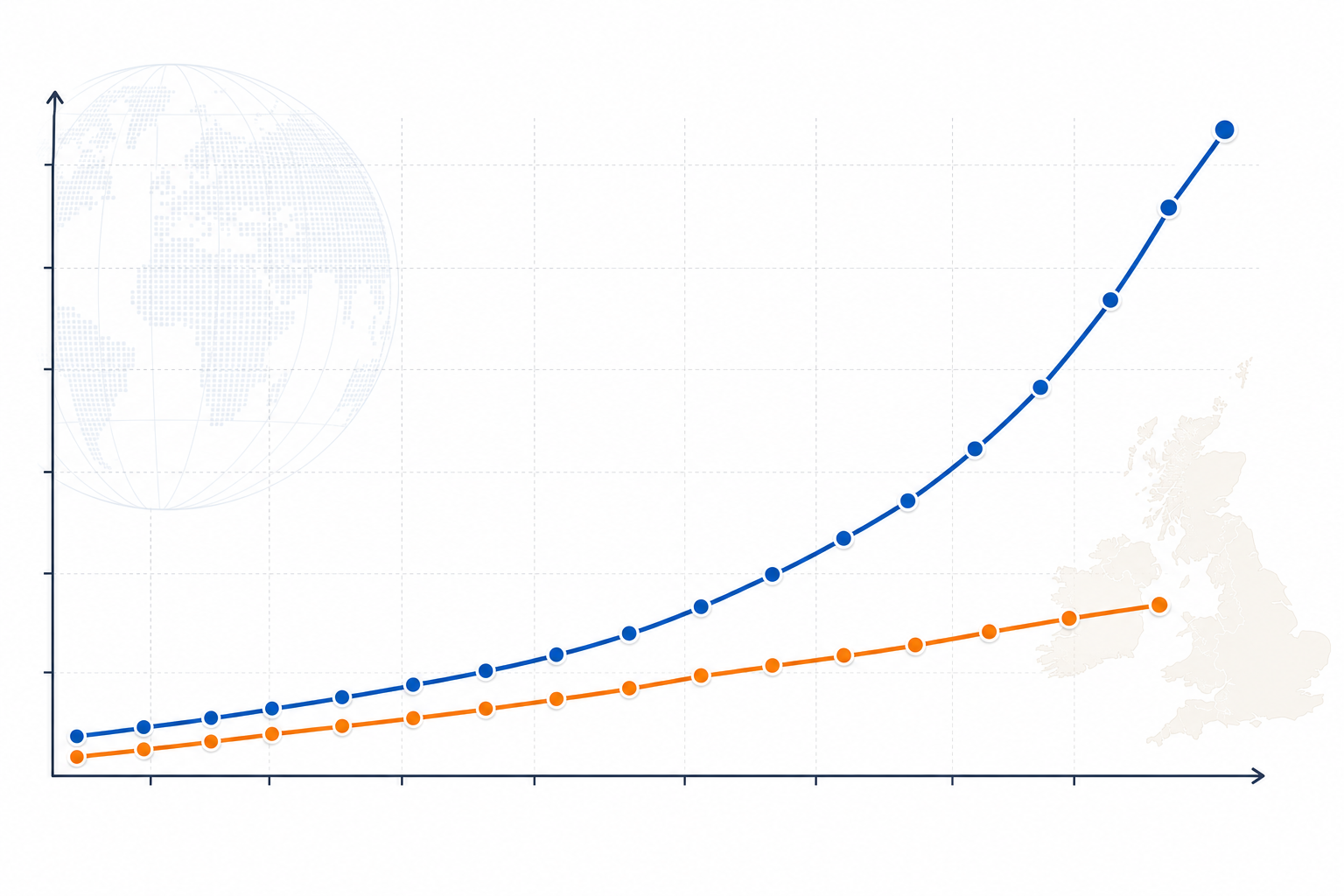
| Platform scale | OpenAI | ChatGPT passed 400 million weekly active users in Feb 2025, then 500 million by Apr 2025 | Feb–Apr 2025 | Global |
| Referral performance | Adobe Analytics | Generative-AI-referred traffic to US retail sites rose ~1,300% year-over-year in the 2024 holiday season, converting 9% higher than other referral sources | 2024 | US retail |
What this evidence doesn't prove: none of these figures can be added together to produce a single UK revenue-impact estimate. Three of the four are US or global; the fourth is stated preference, not measured behaviour. They point in the same direction, but that's not the same as proof.
Robust UK-specific data on how often British consumers use AI chatbots at the research stage is still thin. Ofcom's Online Nation research tracks UK AI adoption generally but doesn't yet break out purchase-research behaviour with Pew's granularity. That gap is itself informative: this is an emerging measurement field in the UK, not a settled one. I'd expect UK behaviour to broadly follow the same direction, given how global these platforms are, but that's a reasoned expectation, not a measured UK fact.
The practical pattern worth planning for is simple: someone asks ChatGPT, "who are the best [service] providers in [UK town]?" or "what's a good alternative to [competitor] for small businesses in the UK?" The answer, accurate or not, can shape the shortlist before a single Google search happens.
How solo founders lose customers through poor AI visibility
A lost AI-mediated customer never generates a session or a form-fill. You simply never see them. These are common failure patterns I look for when auditing an account, not a statistically representative ranking. One anonymised example: for "best small business accountant in [UK town]," ChatGPT named three larger competitors and skipped the client entirely, despite the client having stronger Google reviews. The reason came down to language: competitors' sites described services in plain, question-shaped phrasing a model could lift directly, while the client's site used jargon-heavy headings.
Competitor substitution
The AI names competitors instead of you because your site doesn't clearly answer the query in plain language. You're not being penalised, you're simply invisible to retrieval. Fix: rewrite core service pages to directly answer specific customer questions.
Stale pricing, opening hours, or business details
The AI has learned from an old directory or cached page and states outdated prices, hours, or service areas. Fix: audit third-party listings quarterly; consistency across sources matters more than one perfect page.
The wrong category or use case
You've repositioned, but the AI still describes your old offering. Fix: publish a clear, dated page on your current positioning, and update or retire pages describing the old one.
Negative or lukewarm sentiment
An old, unrepresentative review can end up colouring how a model describes you, folded into an answer that sounds far more authoritative than it deserves. Fix: build a steady stream of recent, genuine reviews. Fresh positive signals may dilute an old negative one over time, though there's no guaranteed way to force a model to drop a source.
Share-of-voice erosion
A competitor more active in PR or content gradually takes a larger share of mentions across your question set, so you drift from first to third without anything about your business changing. Fix: this is exactly why a one-off check isn't enough. Only repeated brand monitoring shows the drift before it becomes a problem.
Each of these problems is fixable once you know about it. But you can't fix what you can't see.
Manual AI visibility checks vs automated brand monitoring
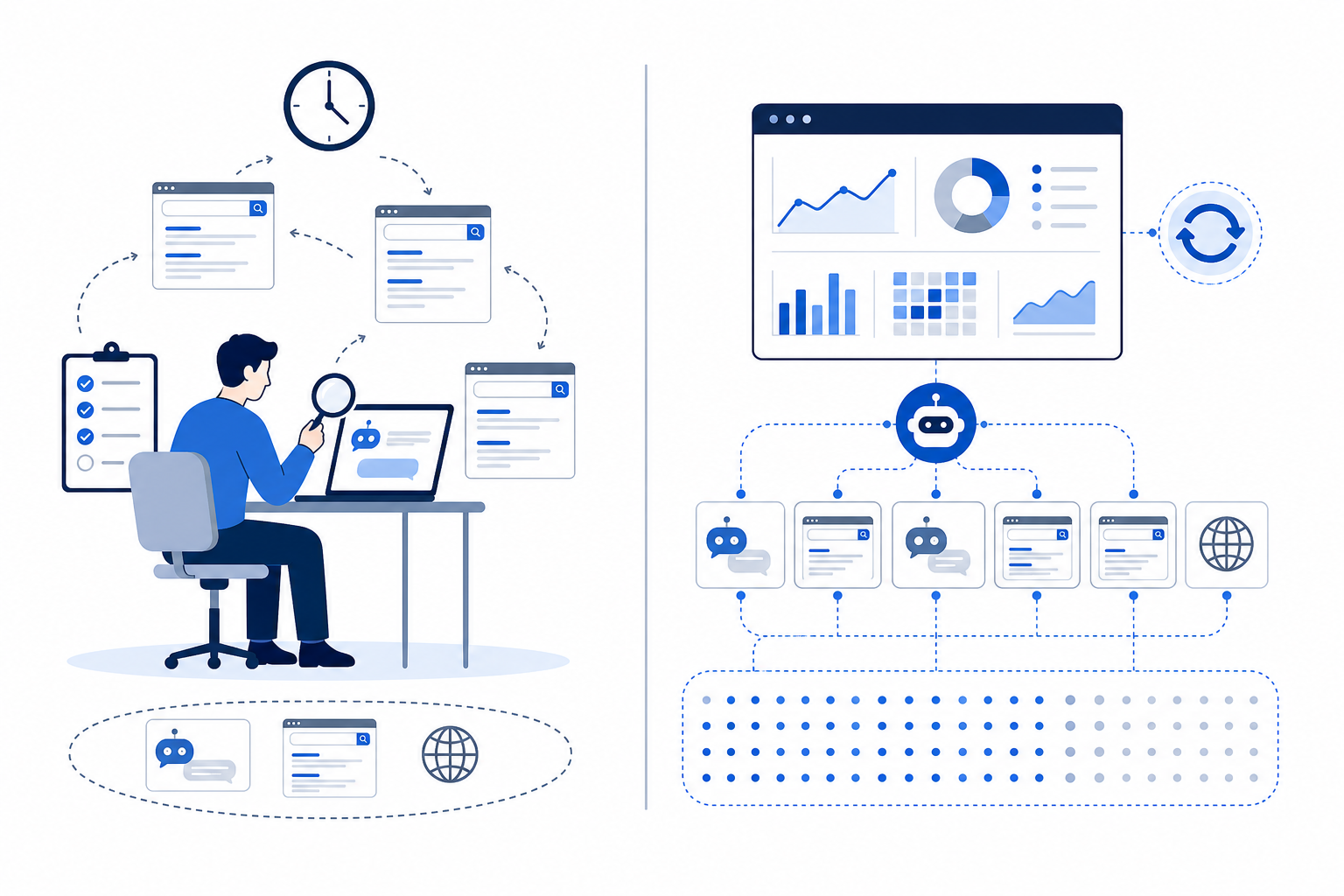
You don't need a tool to get started. You need a repeatable process.
| Approach | Effort | Repeatability | Historical tracking | Competitor monitoring |
|---|---|---|---|---|
| Manual checking | High — log answers yourself | Depends on your discipline | None, unless you build a spreadsheet | Manual, easy to forget |
| Spreadsheet + calendar reminder | Medium | Improves with a recurring block | Basic, if logged consistently | Possible with discipline |
| Automated monitoring (e.g. MentionOwl) | Low, once set up | Consistent by design | Built in, shows trend | Structured, against named competitors |
How to check your AI visibility manually
A sensible manual baseline is to pick eight to ten realistic questions, mixing broad and specific, and run them through ChatGPT, Perplexity, and Gemini once a month. Use a simple template:
| Prompt | Platform | Brand mentioned? | Accurate? | Cited? | Competitors named | Next action |
|---|---|---|---|---|---|---|
| "best [service] in [town]" | ChatGPT | No | — | — | Three named | Rewrite service page in plain language |
| "[your brand] pricing" | Perplexity | Yes | No — outdated | Old directory | None | Update directory listing |
Monthly is a sensible cadence for a manual baseline. On the automated side, our checks actually run daily behind the scenes, but we compile results into a weekly digest: daily raw data, weekly summary, because that's frequent enough to catch drift without drowning you in noise. If you want to test this without commitment, we run a $1 seven-day trial so you can see your own auto-generated question set and results before deciding whether ongoing AI brand monitoring earns its keep.
Is AI visibility different from traditional SEO?
Yes, in important ways, but the two are complementary.
| Traditional SEO | AI visibility | |
|---|---|---|
| Primary output | Ranking, clicks, traffic | Whether and how you're mentioned or cited |
| Measurement unit | Page-level | Answer-level and brand-level |
| User outcome | Click-through to your site | Whether the AI answer alone satisfies the user |
| Foundation required | Crawlability, backlinks, content quality | Same foundation, plus structured, current brand information |
| Volatility | Relatively stable | Highly prompt-dependent |
You'll sometimes see this called generative engine optimisation, or GEO. It's an emerging umbrella term, not a settled standard, and there's no guaranteed method for securing inclusion or citation from any model. The concrete steps behind it are familiar: crawlable pages, plainly worded service descriptions that answer specific questions, consistent business information across your site and listings, and genuine third-party mentions. If your site is thin or hard to crawl, that hurts you in both worlds at once.
How to measure and improve your AI visibility score
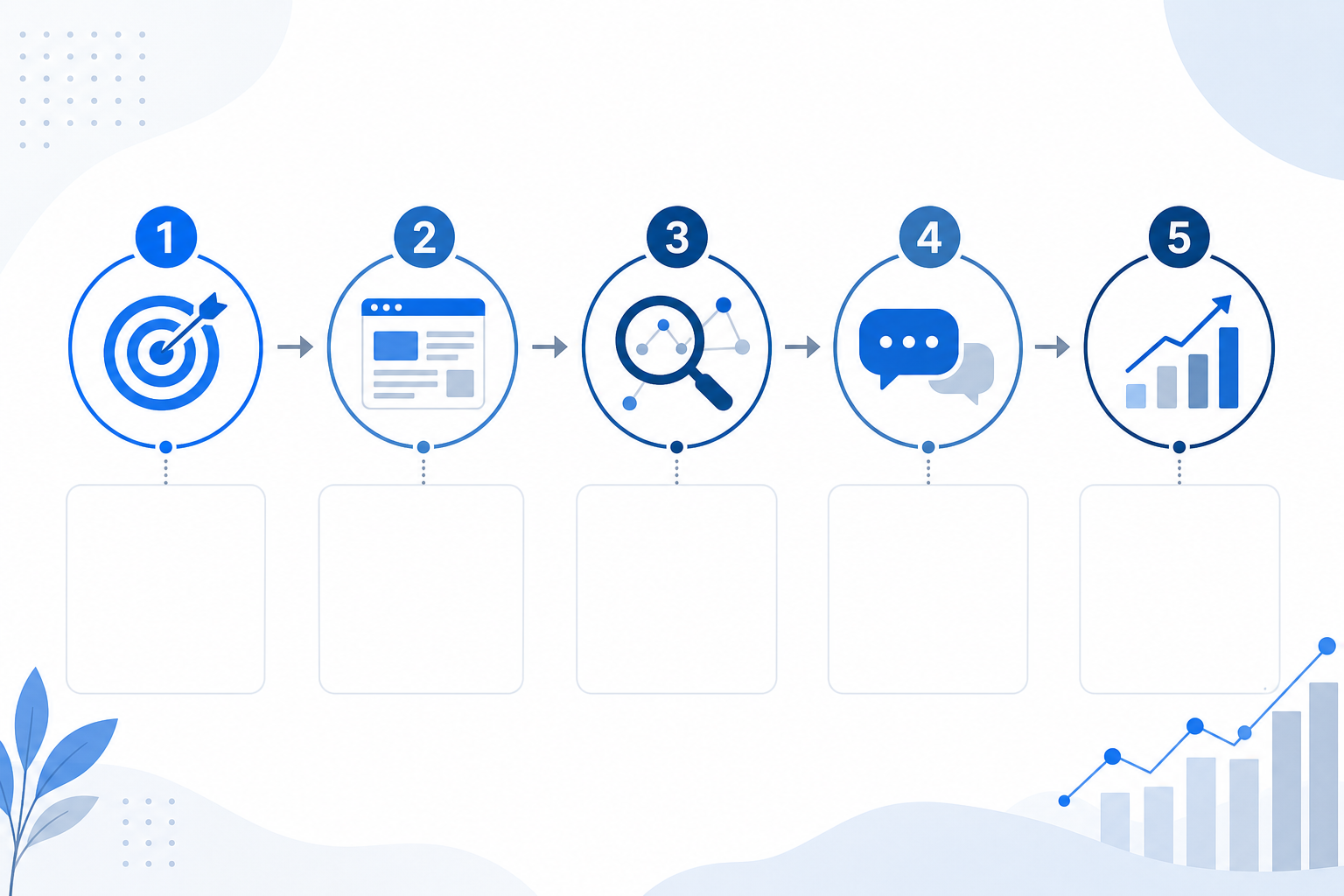
- Build your question set. Choose eight to fifteen questions a genuine prospect might ask, mixing broad and specific, generic and location-based queries.
- Run them manually first. Use free tiers of ChatGPT, Perplexity, and Gemini to see where you stand before spending anything.
- Name three to five real competitors so any comparison is meaningful.
- Audit and fix in priority order: inaccurate business facts such as pricing, hours, and location first, since these are the most fixable and most damaging; absent or unclear service descriptions second; inconsistent third-party listings third; competitive share-of-voice erosion last, since it requires sustained content and PR work rather than a quick correction.
- Set a monthly review cadence at minimum — answers shift as models update and as your own content changes.
If the monthly admin isn't sustainable, that's the specific gap our $1 seven-day trial is built to test.
Frequently asked questions about AI visibility
What does AI visibility actually mean for my business?
It means whether tools such as ChatGPT and Perplexity mention your business accurately for relevant questions, including whether competitors are named instead, and what tone is attached to any mention.
How do I know if ChatGPT is mentioning my brand?
Ask the kinds of questions a prospect would, using varied wording, across several sessions. Results are prompt-dependent, so one query isn't enough. You need a consistent set run repeatedly.
Is AI visibility different from regular SEO?
It shares the same technical foundation but measures a different outcome: whether an AI answer represents you well, not whether a page ranks and gets clicked.
Can I check AI visibility manually without a tool?
Yes — a monthly manual check across two or three AI tools, using a fixed set of realistic questions, can surface the biggest problems at no cost beyond your time.
Does a good AI visibility score guarantee more leads or revenue?
No. It measures mention frequency, prominence, share of voice, and sentiment across a defined question set: a diagnostic and comparison tool, not a certified revenue metric. Judge commercial impact through your own sales conversations and enquiry sources.
Does personalisation or location affect what I see?
Yes. Model version, wording, account history, and location can all change the answer, which is exactly why a fixed, repeated question set matters more than any single check.
Why AI visibility matters for UK solo founders
AI answer engines are becoming something close to a new front page for research-stage buying decisions, not a replacement for your website, but an additional gatekeeper standing in front of it. The evidence is real but uneven: strong on exposure and platform scale, still directional on UK-specific behaviour, and dependent on your industry for how much it matters today.
My recommendation is to test manually first using the template above, then fix any inaccurate public information you find. That's the most fixable driver of poor visibility. Only move to automated monitoring if your manual baseline reveals a recurring problem worth tracking on an ongoing basis. That's a decision you can make with evidence in hand, not before it.