How ChatGPT Picks Which Local Businesses to Recommend (And Why It Might Not Be You)
Learn How ChatGPT Picks Which Local Businesses to Recommend, why competitors get named, and what clearer content, reviews and citations can do.
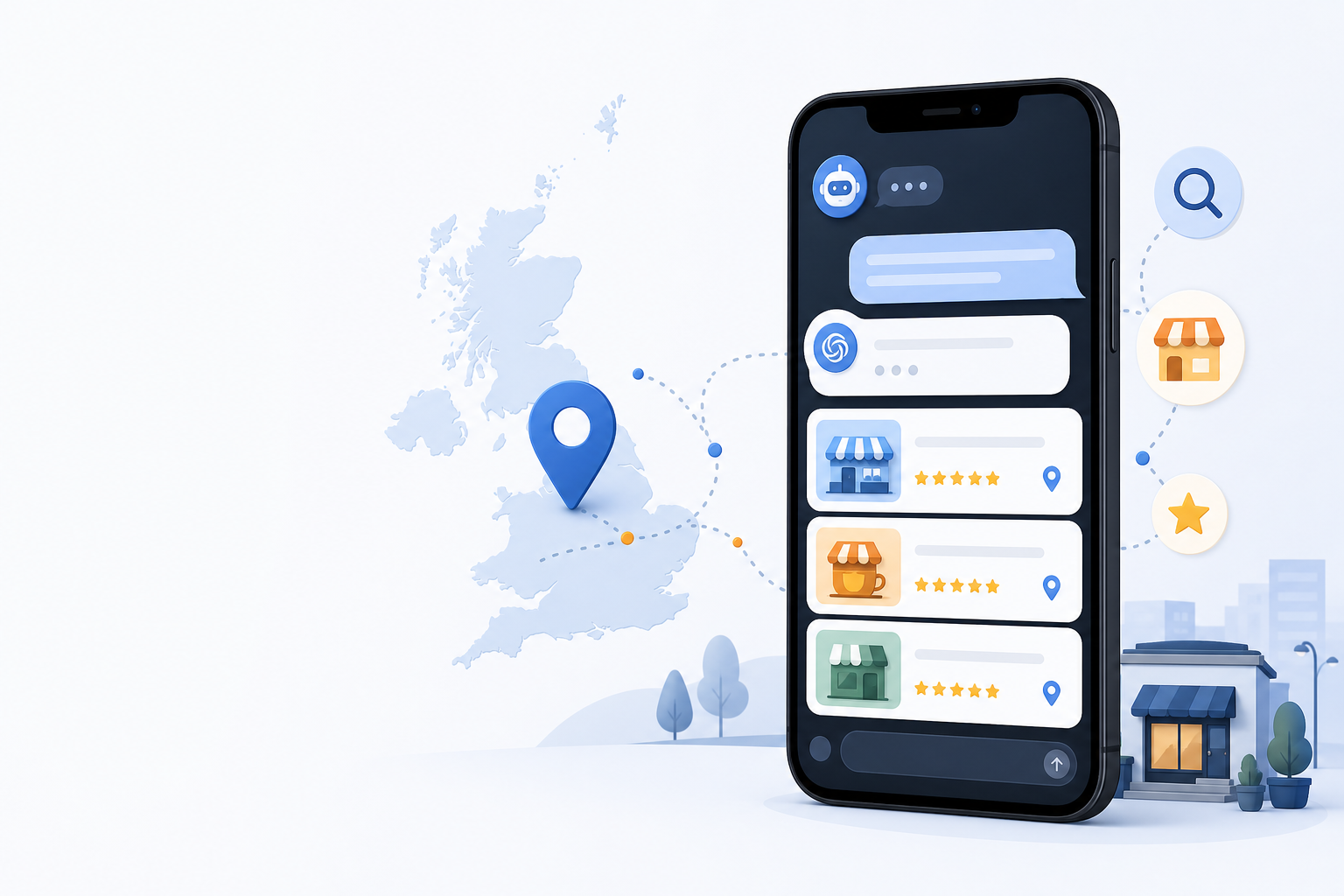 Alt text: Illustration of a phone screen showing a ChatGPT conversation recommending a local business, with a UK map pin icon. Caption: A conceptual illustration — ChatGPT's local recommendations draw on training data and live web retrieval, not a dedicated business directory.
If you've typed “best bakery near me” or “most reliable plumber in Leeds” into ChatGPT and watched it recommend your competitor instead of you, you're not imagining a conspiracy. How ChatGPT Picks Which Local Businesses to Recommend starts with a simple distinction: ChatGPT doesn't pull local business recommendations from a live directory in the same way Google Maps does. When ChatGPT's search feature is active, it works from retrieved web pages combined with whatever it already knows from training. OpenAI has never published a Google-style ranking formula that weighs star ratings against proximity.
What this means for your business, in three lines: you can't game a ranking algorithm that hasn't been published. You can make your business easier for these systems to find, parse and describe accurately. That's the whole game, and the rest of this article explains how ChatGPT chooses which local businesses to recommend.
I write this as part of the team at MentionOwl, where we build AI-visibility tracking tools for local businesses. Everything below is either something OpenAI or Google has documented, something I'm inferring from general web-retrieval mechanics, or a pattern from our own tracking data — and I've labelled each claim so you know which is which.
Methodology, briefly, so the labels below mean something. Our “MentionOwl observation” tags come from roughly 1,400 UK local-search prompts run across ChatGPT, Claude, Gemini, Copilot and Perplexity between March 2024 and the present. The prompts covered trades, hospitality and professional services businesses in six UK cities. We varied phrasing, location signals and browsing settings where the product allows it, and logged whether a business was retrieved, cited or actively recommended in each response. This is internal analysis with a modest sample, not peer-reviewed research. It shows correlation within our dataset, not proof of how any model actually ranks anything, and results shift as models and search providers change.
Four outcomes worth separating, because the rest of this article depends on the distinction: retrieval means a source was found by the search provider; citation means ChatGPT referenced it in the answer; recommendation means your business was actively suggested, not just mentioned; prominence means how much detail or how early in the response you appeared. A business can be retrieved without ever being cited, and cited without being recommended. Conflating these four is where most confusion about “AI SEO” comes from.
How ChatGPT Picks Which Local Businesses to Recommend
Breaking the process into four steps avoids collapsing documented behaviour together with guesswork.
Step one: your prompt and location context. (Documented, with real gaps.) ChatGPT reads your question along with whatever location signal is available — shared location, device or account settings, or other context the product surface provides. This varies by platform, region and whether you're using the app, website or API. OpenAI hasn't published one definitive account of how location is determined, so treat any specific claim here, including mine, with some scepticism.
Step two: query rewriting and retrieval. (Documented.) OpenAI confirms that when search is active, the model may rewrite your question into one or more targeted queries before sending them to search providers. This matters: “best plumber near me” and “emergency plumber available weekends” are different searches under the hood, even though a customer might treat them as roughly equivalent.
Step three: which sources come back. (Documented that retrieval happens; selection logic is not published.) Search providers return pages, review platforms, directories and news mentions that happen to be indexed and crawlable at that moment. Appearing in this set is retrieval, not necessarily a weighted ranking signal — it may simply be the most parseable option available.
Step four: synthesis. (Documented as a general mechanism; the weighting between retrieved content and training knowledge is not published.) The model combines what it retrieved with anything relevant from training and writes a response. This is the least predictable step, since it depends on phrasing, context and the model's own judgement about relevance. It is also where retrieval turns into citation, or doesn't.
What ChatGPT's local recommendations look like in practice
Here's a simplified worked example from the kind of comparison we run for clients — illustrative only, not a validated trend. A fictional Leeds plumbing business, “Riverside Plumbing”, tested two prompts on the same day with browsing enabled:
| Prompt | Browsing | Businesses named | Riverside cited? | Date | Location used |
|---|---|---|---|---|---|
| “best plumber near me” | On | 4 | No | 12 Mar | Leeds (approx.) |
| “same-day boiler repair in Leeds” | On | 3 | Yes | 12 Mar | Leeds (approx.) |
One day's data proves nothing on its own. The value comes from running many phrasings across many days and logging the pattern, which is what the seven-day plan later in this article walks through.
It's also worth being explicit about the Google comparison. (Documented for Google; inference for ChatGPT.) Google's local ranking documentation states plainly that relevance, distance and prominence are its three primary factors. ChatGPT has no equivalent public statement. Google-indexed content may surface during ChatGPT's web research, but that doesn't mean Google's ranking logic has been imported wholesale into ChatGPT's answers.
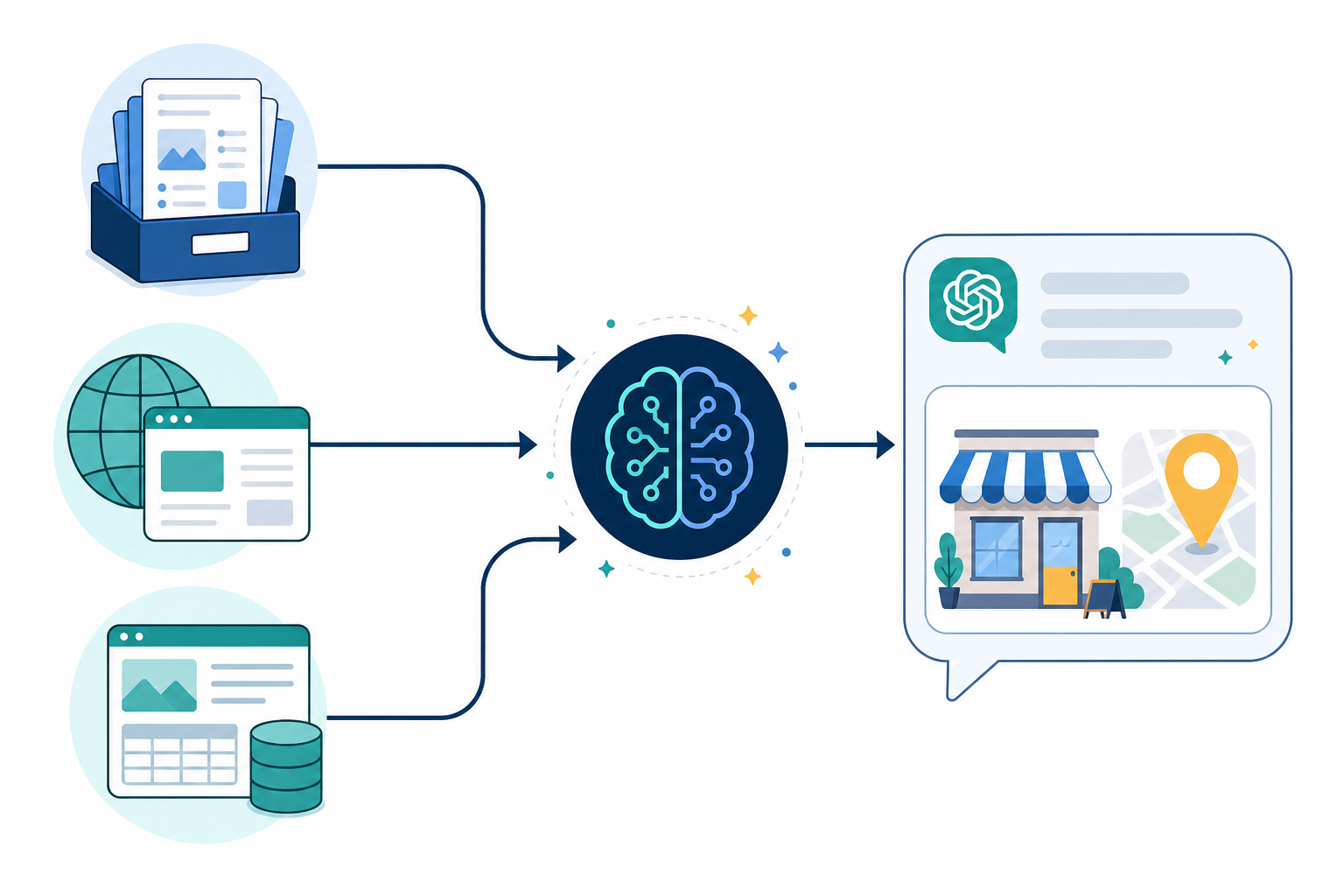 Alt text: Flow diagram showing training data, live web browsing, and structured website data feeding into a ChatGPT response that recommends a local business. Caption: Conceptual illustration of the inputs that can feed a ChatGPT local recommendation; OpenAI has not published the exact weighting between them.
How Your Website and Reviews Affect ChatGPT Recommendations
Once ChatGPT is synthesising information from whatever it can find and parse, the practical implications become clearer. For each point below, I've separated why it's good practice generally from what our limited tracking specifically suggests about AI visibility. Much of this is sound local SEO regardless of what any AI system does with it.
- Specific service pages are more useful than vague “About Us” copy. Good practice generally: a page titled “Emergency plumbing call-outs in Leeds” is clearer to any reader, human or machine, than generic marketing copy. What our tracking suggests: in the businesses we've followed, specific service-and-location pages were cited more often than generic ones. (MentionOwl observation.)
- Structured data helps clarify your business information. Good practice generally: Google's structured data documentation confirms that LocalBusiness, Organization and PostalAddress markup helps search engines interpret your business correctly. What our tracking suggests: it's reasonable to infer this reduces the chance of an AI system merging or misidentifying you, but we don't have isolated evidence that it specifically changes ChatGPT citations. (Reasonable inference, not confirmed.)
- Review consistency and volume across platforms provide useful context. Good practice generally: BrightLocal's 2024 Local Consumer Review Survey found 91% of consumers read online reviews when researching local businesses, and 73% specifically value reviews from the last three months. That's consumer behaviour, not ChatGPT logic. What our tracking suggests: businesses with matching details across Google, Trustpilot and Yell appeared more consistently in our logged responses than businesses with fragmented or outdated listings. (MentionOwl observation.)
- Fresh information is more trustworthy. Good practice generally: stale content gives any reader less reason to trust current information. What our tracking suggests: sites without meaningful updates in years were referenced less often in our sample — our working theory, not a confirmed mechanism. (MentionOwl observation.)
- FAQ-style content matches natural-language searches. Good practice generally: answering real customer questions in plain language is good writing. What our tracking suggests: pages structured as natural-language questions and answers were referenced more often in our logs, likely because customers phrase ChatGPT prompts in a similar way. (MentionOwl observation.)
One more data point from the same BrightLocal survey: 80% of consumers said they were more likely to use a business that responds to every review, versus one that responds to none. That's a reason to manage reviews well regardless of AI, and a signal of legitimacy that compounds over time.
A guardrail worth stating plainly: ask customers for honest, unscripted feedback, and follow each review platform's guidelines on soliciting reviews. Incentivised or scripted reviews risk platform penalties and undermine the trust you're trying to build.
Why ChatGPT Recommends Some Local Competitors and Not You
The concept we use internally is share of voice: how often, and how prominently, a business is cited across sources ChatGPT can retrieve, relative to its competitors. This is MentionOwl's own measurement framework, not a term or mechanism OpenAI has confirmed. As a rough worked example: if “Riverside Plumbing” was cited in 12 of 40 logged Leeds-plumber prompts and its nearest tracked competitor in 27 of the same 40, Riverside's share of voice in that sample is 30% against the competitor's 68% — a gap, not a guarantee, and specific to that sample.
In our tracking, businesses cited across more sources — review sites, local press, directories and industry roundups — tend to appear in ChatGPT's answers more often than businesses with a thin footprint. (MentionOwl observation.) It resembles how prominence works in Google's local algorithm, except it plays out across the open web rather than one indexed database. This is our interpretation of a pattern, not a mechanism OpenAI has confirmed.
Position also seems to matter. (MentionOwl observation.) Across logged queries, being named first or described in more detail correlated with more consistent appearances in follow-up tests than a passing mention at the end of a list. We call this position-weighted citations internally — a metric built for our own client reporting, not a term OpenAI uses or a proven causal factor.
Then there's the sentiment gap, which tends to surprise people. (MentionOwl observation.) In our sample, even neutral or slightly negative mentions appeared more often than complete silence, plausibly because the model has nothing to say about a business it can't find data on at all. A business with a few lukewarm reviews but a genuine web presence often appeared where a business with excellent service and almost no discoverable footprint did not. Absence functioned as a competitive disadvantage in our data — it isn't neutral.
What this does not mean: none of these three metrics predicts a specific outcome for your business, and none of them is something OpenAI has confirmed exists inside its systems. They describe patterns in our sample, useful for prioritising effort, not for guaranteeing a result.
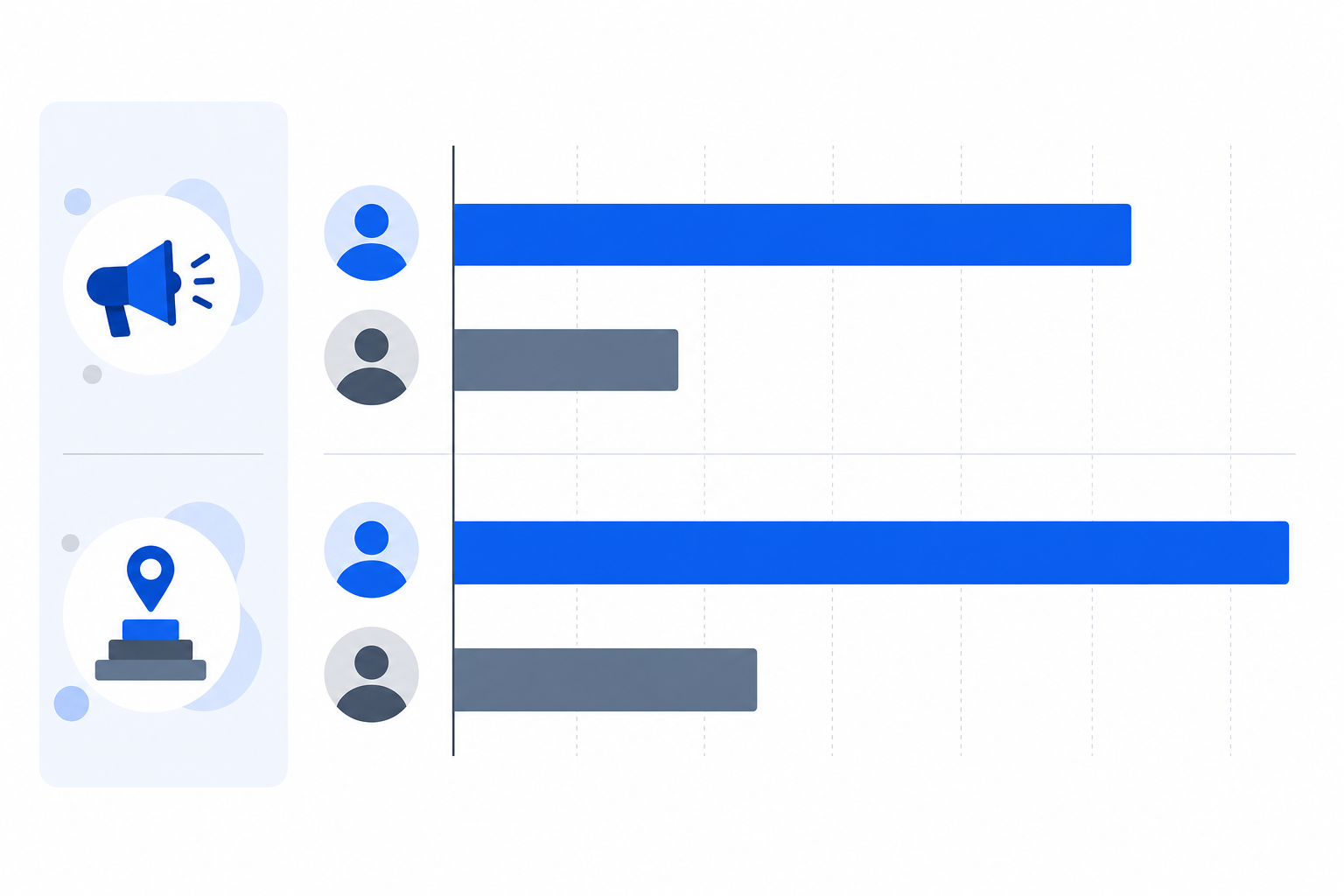 Alt text: Bar chart comparing two fictional local businesses on share of voice and position-weighted citations, with Business A scoring higher on both metrics. Caption: Conceptual illustration using fictional data. Share of voice and position-weighted citations are MentionOwl's internal metrics, not figures published by OpenAI.
Signals That May Increase Your Chances of Being Recommended
None of this guarantees a mention — there's no publicly confirmed formula to game — but it improves the odds by making your business easier to find and describe accurately. I've marked the evidence category for each.
- Publish specific, question-answering content. (MentionOwl observation.) Write pages around how customers actually ask — “best plumber for emergency call-outs in Leeds” rather than generic “Leeds Plumbing Services”. Write naturally, for real customers.
- Keep your name, address and phone number identical everywhere. (Reasonable inference from general local SEO practice.) Match exactly across your website, Google Business Profile and every directory listing. Inconsistency is one of the most common, and most fixable, causes of a business being misidentified or skipped.
- Encourage detailed, honest reviews, not just star ratings. (MentionOwl observation, with an ethical guardrail.) A written review gives retrieval systems actual content to summarise. Ask for genuine feedback, don't script it, and follow each platform's review policies.
- Make your content accessible to crawlers. (Reasonable inference from general technical SEO practice.) Broken schema, blocked crawlers and content that only renders through JavaScript can make it harder for retrieval tools to read your site. Server-rendered or accessible markup is sensible practice regardless of any AI-specific claim.
- Build genuine third-party mentions. (MentionOwl observation.) Press coverage, local blog features and industry directory listings compound your share of voice over time. This is not a quick win, but it is one of the more durable patterns we've observed.
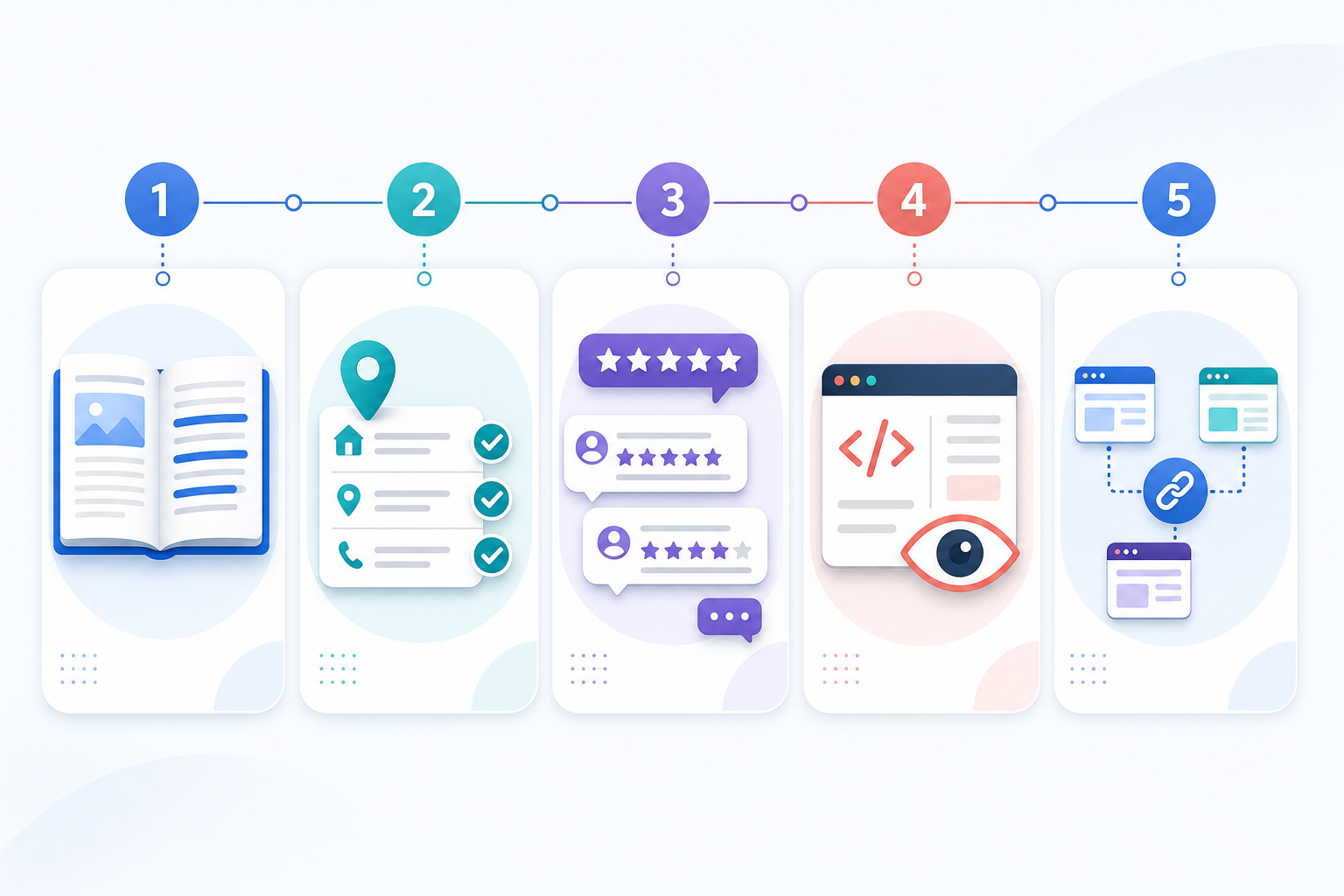 Alt text: Numbered checklist infographic showing five icons for content clarity, NAP consistency, detailed reviews, technical legibility, and third-party mentions. Caption: Five discoverability signals, ordered by how consistently we've seen them correlate with citations in our own tracking.
What You Can Do This Week to Improve ChatGPT Visibility
You don't need a six-month strategy to start. Here's what I'd do in the next seven days.
- Set a baseline before changing anything. Pick three or four realistic customer prompts. Run each five times across a week — roughly 20 runs in total — varying nothing except the date, and log whether you appear, where you appear and which competitors are named. Note that this is a small, noisy baseline: enough to spot a pattern, not enough to prove causation. Model or search-index changes can shift results independently of anything you do.
- Log results in a simple spreadsheet. Include columns for prompt, date, model, browsing status, approximate location, whether you appeared and which other businesses were named.
- Audit your structured data, either with free schema-testing tools or through a proper technical review.
- Check review consistency across at least three platforms — Google, Trustpilot and Yell are obvious UK starting points.
- Retest after two to four weeks, keeping the same prompts, locations and models where possible. Responses can shift from week to week, not just at model release cycles, which is why continuous tracking beats a one-off audit. The spreadsheet above will get you most of the way without specialist tooling.
A quick diagnostic: symptom, likely explanation and action
| If you notice… | Likely explanation | What to try |
|---|---|---|
| You never appear for any phrasing | Thin footprint — retrieval isn't finding you at all | Build third-party mentions; check that you're indexed and crawlable |
| You appear for broad prompts but not specific ones | Your content doesn't match specific service language | Add pages answering exact customer phrasing |
| A weaker competitor outranks you consistently | Their business details and reviews are more consistent, not necessarily their service | Audit and align details across all platforms |
| You appear briefly at the end of lists | You were retrieved but not prominent — low position-weighted citation | Increase detail and specificity in your own content |
This discipline is increasingly called generative engine optimisation, or GEO. It's young enough that most competitors in most local markets haven't taken it seriously yet. That's an advantage while it lasts — though this is about improving discoverability, not controlling what a language model decides to say.
Key takeaways about ChatGPT local recommendations
- ChatGPT doesn't rank local businesses in the same way Google Maps does; there's no published formula to reverse-engineer.
- Being absent, being cited and being actively recommended are three different outcomes — don't assume one implies the other.
- Clear, consistent, crawlable business information correlates with more frequent citations in our own tracking, though this isn't a confirmed OpenAI mechanism.
- Test multiple real prompts over time; don't judge your local business visibility from a single response.
Three things to prioritise if you only do three: make your services and location explicit in your own words, get your business details to agree across every platform, and test your visibility with multiple real prompts before assuming you know where you stand.
Frequently Asked Questions About ChatGPT Business Recommendations
Why does ChatGPT recommend my competitor instead of me?
OpenAI hasn't published a ranking formula, so no one can say this with total certainty. In the queries we've tracked, it usually comes down to consistency and clarity of information, not necessarily who's the better business. If your competitor has more consistent business details, more descriptive reviews and content that directly answers common customer questions, our data suggests they're more likely to be cited. We've seen smaller businesses outrank larger ones simply because their content matched the query phrasing more closely.
Does ChatGPT use Google reviews?
There's no publicly documented, guaranteed live feed into Google's review database as of this writing. When browsing is enabled, or when review content has been indexed and published elsewhere — on your own site, an aggregator or a press mention — that content can end up in what ChatGPT retrieves and how it describes your business. Think of it as an indirect path through the open web rather than a direct integration, and be aware that search-provider integrations can change over time.
Can I influence what ChatGPT says about my business?
You can influence the underlying signals: clearer website content, structured data, consistent reviews and genuine third-party mentions. You can't buy placement in the same way you can with search ads, and no specific change guarantees a specific result. Based on what we've observed, visibility tends to compound over weeks and months rather than happen overnight.
How often does ChatGPT update local business information?
It depends on whether ChatGPT is answering from training knowledge or live browsing. Training data updates periodically with model releases. Browsing-enabled responses can reflect changes to your site once it has been recrawled and indexed by the underlying search provider, though the exact timing varies and isn't something OpenAI publishes precisely. That uncertainty is exactly why we recommend testing periodically rather than assuming a single check will stay accurate for long.