AI SEO vs Traditional SEO: Why Ranking #1 on Google Won't Get You Cited by ChatGPT
AI SEO and traditional SEO now diverge for SaaS brands. Learn how AI search ranking actually works, why Google rank #1 doesn't guarantee ChatGPT citat
AI SEO vs Traditional SEO: Why a #1 Google Ranking Doesn’t Guarantee an AI Citation
Meta description: Ranking #1 on Google doesn’t guarantee that ChatGPT, Perplexity, or Gemini will cite you. Learn how traditional SEO and AI SEO differ, where they overlap, and how UK SaaS and DTC brands can build a dual strategy.
Ranking #1 on Google no longer guarantees a citation in ChatGPT, Perplexity, or Gemini. That’s the central argument of this article, so here’s the short version before we unpack it.
What differs: Google ranks pages, while AI answer engines retrieve a set of sources and generate a synthesised answer from them. What still transfers: technical SEO health, topical authority, and clear answers to buyer questions help in both systems. What to do first: audit whether OAI-SearchBot and other AI crawlers can access your site. It’s the single most concrete, fixable step in this article, and I’ll return to it with a checklist.
I want to be upfront about the evidence base. This article draws on Google’s published documentation, OpenAI’s crawler policy, and a small set of comparisons I’ve run against live SaaS and DTC queries. It is not a large-scale or peer-reviewed study. Where I’m stating documented provider policy, I’ll say so. Where I’m describing a pattern I’ve observed but that no provider has confirmed, I’ll say that too — but only once per claim. 🔍
Does Ranking #1 on Google Guarantee an AI Citation?
A concrete AI search test — with its limitations stated plainly
In November 2024, I ran the query “best CRM software for small business” against ChatGPT with browsing enabled, Perplexity, and Claude. I was logged out, used UK region settings, and ran one test per engine on the same day. I also checked Google’s top organic result for the identical phrase within the same session.
The brand holding the #1 Google position didn’t appear in any of the three AI responses. A mid-tier competitor — with a comparison page containing explicit pricing and feature claims, a stronger G2 review count, and more frequent mentions across Reddit threads — was cited by two of the three engines.
I want to be precise about what this test is and isn’t. It’s a single-day, single-run, three-engine test, not a controlled study, and I didn’t screenshot every output for a public record. AI engines update constantly, so treat this as an illustrative, time-stamped snapshot rather than proof of a universal rule.
What it does show is that Google rankings and AI citations can diverge, and that a brand relying only on rank tracking would never have noticed. That’s the operational point: build a monitoring process that would catch this if it happened to you, which I’ll cover in the dual SEO strategy section below.
Traditional SEO remains necessary — you cannot skip it — but it isn’t sufficient on its own for AI search visibility. Let’s look at why, starting with what Google’s own documentation says.
How Traditional SEO Ranks Pages in Google
Google’s documented process is crawl, index, and serve: automated systems discover pages through links and sitemaps, process and store the content, then retrieve and rank eligible pages against a query. A sitemap aids discovery; it doesn’t guarantee crawling, indexing, or ranking. This is a distinction teams still miss when they treat Search Console submission as a finish line rather than a starting point.
It’s important not to oversimplify this from the outset. Google does not return one single best-matching URL. A results page can include multiple organic listings, featured snippets, People Also Ask boxes, and increasingly AI Overviews, all at once. Google’s systems use passage-level and semantic understanding to match content to search intent, not crude keyword matching.
Google states that its ranking systems assess relevance to the query, content quality and reliability, usability, context, and the meaning of the words used (Google Search Essentials, accessed 2024).
Link analysis remains part of this infrastructure. Google’s Search Essentials guidance advises using crawlable links and descriptive anchor text, while independent industry studies have long placed backlink-derived authority among the more influential ranking factors. Google has never published an exact weighting, however, and has repeatedly cautioned against over-indexing on any single signal.
The more useful distinction, once you compare traditional SEO with AI answer engines, isn’t “one URL versus many sources.” It’s this: conventional Google organic results present a ranked, discrete list for the user to choose between. AI Overviews, when triggered inside the Google results page, start to behave differently by pulling from multiple sources to generate a synthesised passage, closer to how standalone AI answer engines work.
Google’s documentation describes AI Overviews as a Search feature that can show supporting links, but one that runs through a different underlying process from conventional organic ranking.
Meeting technical SEO requirements makes a page eligible for consideration. It doesn’t guarantee indexing, a ranking position, a featured snippet, or an AI citation. That word “eligible” is doing a lot of work in Google’s own guidance, and it’s worth sitting with.
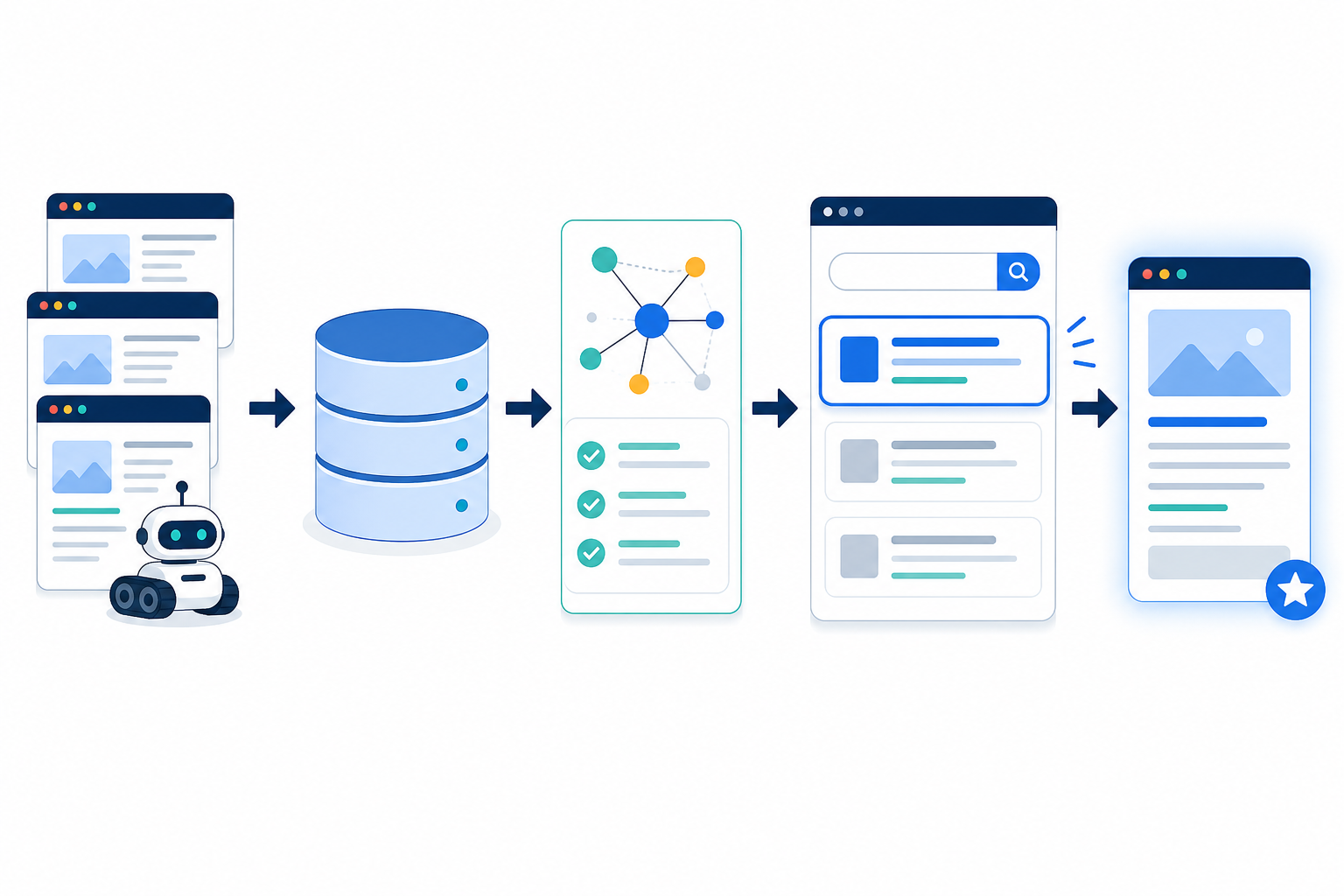 Caption: A simplified view of Google’s crawl–index–rank process. In practice, a single Google results page can include multiple organic listings, SERP features, and AI Overviews simultaneously — this diagram illustrates the core ranking mechanic, not the full range of what a results page can show. Alt text: Flowchart showing crawl, index, and rank stages leading to a ranked results list.
How AI Answer Engines Select Sources for Citations
AI answer engines use retrieval and generation rather than pure ranking. Instead of returning a ranked list of URLs, systems such as ChatGPT, Perplexity, Gemini, and Copilot retrieve a set of potentially relevant sources, weigh the evidence within that set, and generate a synthesised answer with citations attached.
That retrieval set isn’t identical to Google’s organic results. This is one reason a page ranking first on Google isn’t automatically pulled in as supporting evidence for an AI-generated answer.
How ChatGPT, Perplexity, Gemini, and Copilot differ
Collapsing all four engines into one “AI SEO mechanism” is where much of the confident-sounding advice online goes wrong. Here’s where they currently stand, as of late 2024 and early 2025. Verify these details against current documentation before acting, because provider policies and systems change quickly:
| Engine | Live web retrieval | Crawler | What’s documented | What’s undisclosed |
|---|---|---|---|---|
| ChatGPT (Search/browsing) | Blends training data with live browsing | OAI-SearchBot (search), GPTBot (training) | Crawler purpose and robots.txt behaviour | Exact citation weighting |
| Perplexity | Primarily live retrieval at query time | PerplexityBot | Crawler exists, documented in its help pages | Source-ranking logic |
| Gemini | Live retrieval via Google’s index | Google-Extended | Opt-out mechanism for training | AI Overview versus standalone Gemini citation logic |
| Copilot | Live retrieval via Bing’s index | Bingbot | Crawler policy and Bing Webmaster guidance | Citation selection criteria |
The practical implication is that the same brand can be prominently cited in one engine and invisible in another for an identical question. That gap can also shift with any model update. Treat every snapshot of engine behaviour, including my CRM test above, as time-stamped rather than permanent.
AI crawler access is the one non-negotiable
OpenAI distinguishes OAI-SearchBot, which retrieves content specifically for ChatGPT Search, from GPTBot, which is used for potential model-training access (OpenAI crawler documentation, 2024).
If you’ve blocked OAI-SearchBot in robots.txt — which some teams do inadvertently while trying to restrict training-data scraping — you can remove your site from ChatGPT Search citations entirely, regardless of your traditional SEO performance. This is the one item in this article I’d call close to non-negotiable rather than a hypothesis. Check it this week.
Google’s query fan-out adds a further wrinkle
Google’s documentation on AI Overviews describes a process in which the system may run multiple related sub-searches to answer different parts of a broader query. Content that directly addresses one specific sub-question can therefore be cited even when it doesn’t dominate the original broad keyword. Keyword rank tracking alone won’t reveal this opportunity.
AI citation selection: three patterns worth testing
This is the least documented part of the picture, so frame each pattern as a hypothesis to test on your own content rather than a rule to follow blindly:
| Observed pattern | Hypothesis | How to test it |
|---|---|---|
| Unambiguous, extractable claims — such as clear headings and explicit numbers — get quoted more often than generic copy | Extractability helps retrieval systems parse and cite a page | Rewrite one comparison page with direct “X costs £Y and does Z” statements; re-run your query set after 4–6 weeks |
| Claims corroborated across multiple independent sources appear cited more often than single vendor assertions | Cross-source corroboration signals reliability to the retrieval layer | Track whether pages also cited on G2 or Reddit are selected more often than owned-only pages |
| Structured data and consistent entity signals — such as product name, author, and date — seem to help interpretation | Clean entity data reduces ambiguity for the model | Add or validate schema on core pages, then compare citation rates with a control set without changes |
Google is explicit that structured data doesn’t guarantee a particular search appearance or AI citation. It may improve the odds, but it doesn’t lock them in.
I’d describe AI legibility — how easily a page’s claims and structure can be extracted and quoted — as a new consideration alongside classic on-page SEO, not a replacement for it. 📊
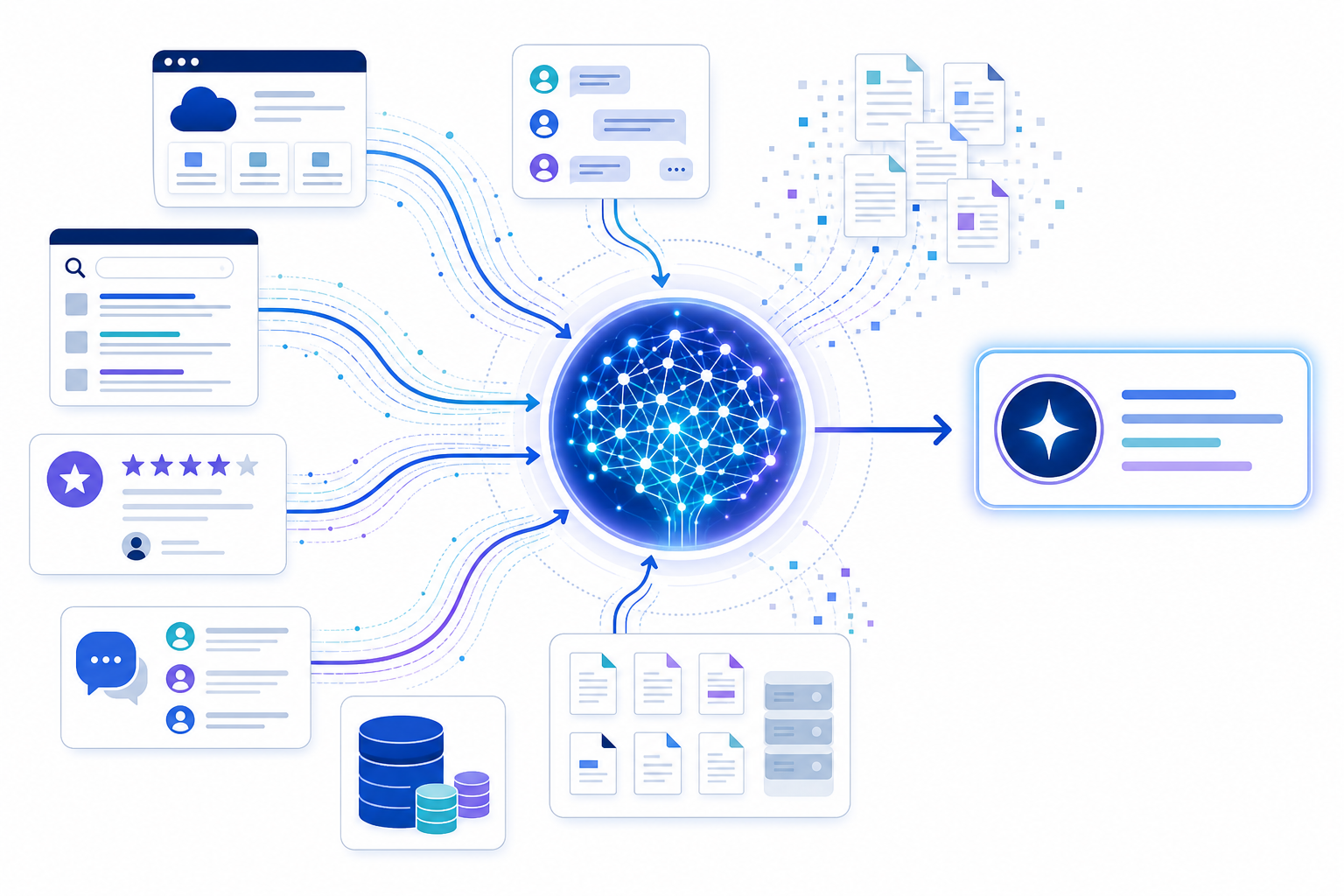 Caption: A conceptual illustration of multi-source synthesis. Exact retrieval and weighting mechanics vary by engine and aren’t fully disclosed by providers. Alt text: Diagram showing web sources, review sites, and training data converging into a single generated AI answer.
Where Traditional SEO and AI SEO Overlap
It would be a mistake to conclude that traditional SEO has become irrelevant. The two systems share important foundations:
- Topical authority still compounds. Both systems appear to reward content built consistently over time around a coherent subject, rather than isolated pages chasing individual keywords.
- Technical SEO fundamentals help both crawlers. Fast load times, clean HTML, and valid schema make it easier for Googlebot and AI retrieval crawlers such as OAI-SearchBot to parse a site. Neither system can cite content it can’t access; this part is documented, not speculative.
- Domain trust plausibly carries over, partially. A backlink profile that builds Google’s trust in a domain may inform how an AI model treats that brand, whether through training exposure or live retrieval. This is a reasonable hypothesis based on how these models are built, not a mechanism any provider has confirmed in detail.
- Direct, jargon-free answers work well everywhere. Content that clearly answers “what does this do?” or “how much does this cost?” — including UK pricing in £, VAT status, and regional availability — tends to perform well in both systems.
- Freshness signals relevance. Regularly updated content can improve standing with Google’s crawlers and increase the odds of being pulled into an AI engine’s live retrieval index, particularly for products with changing pricing, features, or stock availability.
Don’t abandon your technical SEO checklist. It’s still the foundation of search visibility: necessary, just not sufficient.
Where AI SEO and Traditional SEO Diverge for SaaS Queries
For comparison-style B2B queries such as “best project management tool for remote teams” and “best CRM software for small business”, the divergence becomes commercially significant because these questions sit at the purchase decision.
In the SaaS queries I’ve tracked, AI engines have pulled from independent review aggregators such as G2, Capterra, and Trustpilot, along with Reddit threads and comparison blogs, more often than from vendor-owned landing pages. I’d want a larger, longer-running dataset before calling that a fixed rule rather than a strong observed tendency, but it’s consistent enough to plan around.
The practical risk is that a competitor’s comparison page, which you don’t control, can cite you favourably or unfavourably in an AI answer regardless of where you rank organically. Traditional SEO strategies built almost entirely around owned-page optimisation rarely account for this.
How AI Search Differs for DTC Product Queries
DTC brands face a related but distinct version of this problem, and it deserves its own treatment rather than a passing mention. Consider queries such as “best vitamin C serum UK” or “best running shoes for flat feet UK”.
For these queries, I’ve seen AI engines lean on a different mix of sources from the SaaS examples above:
- Retailer and marketplace pages such as Boots, Cult Beauty, and LookFantastic, with structured product data, ingredient lists, and verified review counts.
- Editorial roundups from UK publications and affiliate sites, which often state direct “best for X” recommendations that are easy to extract.
- Community discussions, including Reddit’s skincare and running communities, where genuine before-and-after claims and comparative feedback can be corroborated across independent posters.
- Regulatory and formulation detail, including INCI ingredient lists, patch-test claims, and cosmetic regulation compliance relevant under UK CTPA guidance. This information may matter more for engines summarising efficacy claims, since overstated claims are an area providers are cautious about repeating.
The commercial implication for DTC teams is clear: your product page needs to state, in extractable language, what the product does, what it costs including VAT, what’s in it, and how it compares. However, the citation itself may be more likely to come from a retailer listing, review aggregator, or community thread than from your own site.
That’s a harder channel to influence directly, and it means DTC brands need genuine relationships with reviewers and community spaces, not just an owned-content strategy.
Traditional SEO vs AI SEO: Key Differences at a Glance
| Dimension | Traditional SEO | AI SEO / Generative Engine Optimisation |
|---|---|---|
| Retrieval model | Ranked list of pages plus SERP features; AI Overviews sit inside this but synthesise information | Multiple sources synthesised into one generated answer |
| Evidence status of ranking factors | Google publishes broad guidance; exact weighting is undisclosed | Providers publish crawler policies; citation logic is undisclosed |
| Commonly cited sources — SaaS | Your own product and comparison pages | G2, Capterra, Trustpilot, Reddit, and third-party comparisons |
| Commonly cited sources — DTC | Your own product pages and category landing pages | Retailer listings, ingredient and specification data, editorial roundups, and community threads |
| Content optimisation target | Keyword relevance within a page | Extractable, quotable facts and direct “best X for Y” statements |
| Success metric | Ranking position and organic traffic | Query coverage, citation frequency, sentiment, and share of voice |
| Who typically controls visibility | Largely your own site | Often a competitor’s page, retailer, or third-party review site |
The “who controls visibility” row is the most consequential for both SaaS and DTC teams. It’s the row a pure keyword-ranking strategy has no answer for.
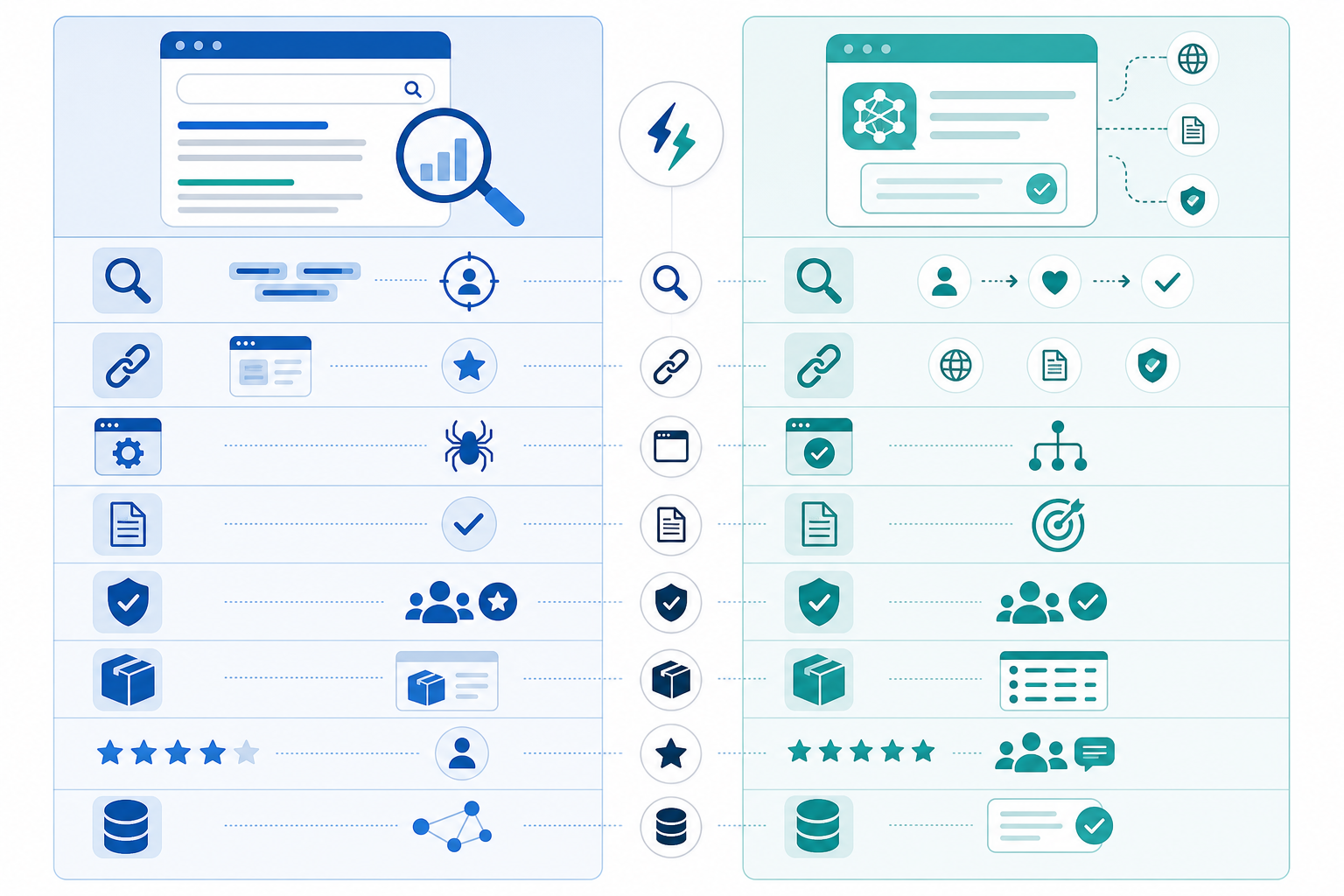 Caption: Factors are grouped by observed tendency, not confirmed algorithmic weighting, and are split by SaaS and DTC source patterns. Alt text: Two-column comparison graphic contrasting traditional SEO factors with AI SEO citation factors.
How to Build a Dual SEO Strategy: A 30-Day Plan
I’ve split this plan by who controls the action and how confident I am in the underlying evidence. Conflating technical fixes with reputation-building creates unrealistic expectations.
Week 1: Fix owned technical SEO and AI access issues
- Audit robots.txt and crawler access. Confirm that OAI-SearchBot, Googlebot, PerplexityBot, and Bingbot aren’t inadvertently blocked. This is the single most concrete, fixable item in this article.
- Run an AI legibility pass on core product and comparison pages. Check structured data, heading clarity, and whether key claims — such as “costs £X per month”, “includes Y feature”, or “contains Z% vitamin C” — are stated directly rather than buried in marketing copy.
Weeks 2–3: Improve content and third-party visibility
- Keep investing in technical SEO fundamentals. Site health, backlinks, and keyword-targeted content still drive organic traffic and provide baseline credibility. Don’t reallocate your entire budget away from traditional SEO.
- Build a manual measurement baseline before buying a tool. List 15–30 real purchase-decision questions your buyers ask. Run them against ChatGPT, Perplexity, Gemini, and Copilot on a set date, logged out, with UK settings. Record the query, engine, whether you were cited, and sentiment in a spreadsheet.
- Identify and engage the third-party sources that get cited in your category. For SaaS, these may include G2, Capterra, and Trustpilot. For DTC, they may include retailer listings, ingredient databases, and community forums. “Engage” means providing accurate product data, generating genuine reviews, and offering responsive customer service — not soliciting favourable mentions. Editorial independence is the point; gaming the process can be detectable and reputationally costly.
Ongoing: Track AI search visibility weekly
- Set a weekly rather than quarterly tracking cadence. AI engines may update citations and sentiment more frequently than Google reshuffles organic rankings, so infrequent checks risk missing commercially relevant shifts.
- Monitor how each engine describes your brand and named competitors. The engines disagree often enough that single-platform monitoring provides an incomplete view of AI search visibility.
Once your manual baseline exists, dedicated tracking tools can automate parts of this process. I’ve used a tool called MentionOwl on client accounts for this: it crawls a site, generates candidate customer questions, and runs them against several engines to produce a visibility score.
I have no commercial relationship with MentionOwl; I’m naming it because I’ve used it, not endorsing it as the best option. Its scoring methodology isn’t independently published, so treat any single tool’s output — MentionOwl or otherwise — as a directional signal to check against your own manual spot checks, not as ground truth. Other approaches include manual spreadsheet tracking, which is free but slower, and newer entrants in this space, which I’d expect to proliferate as the category matures.
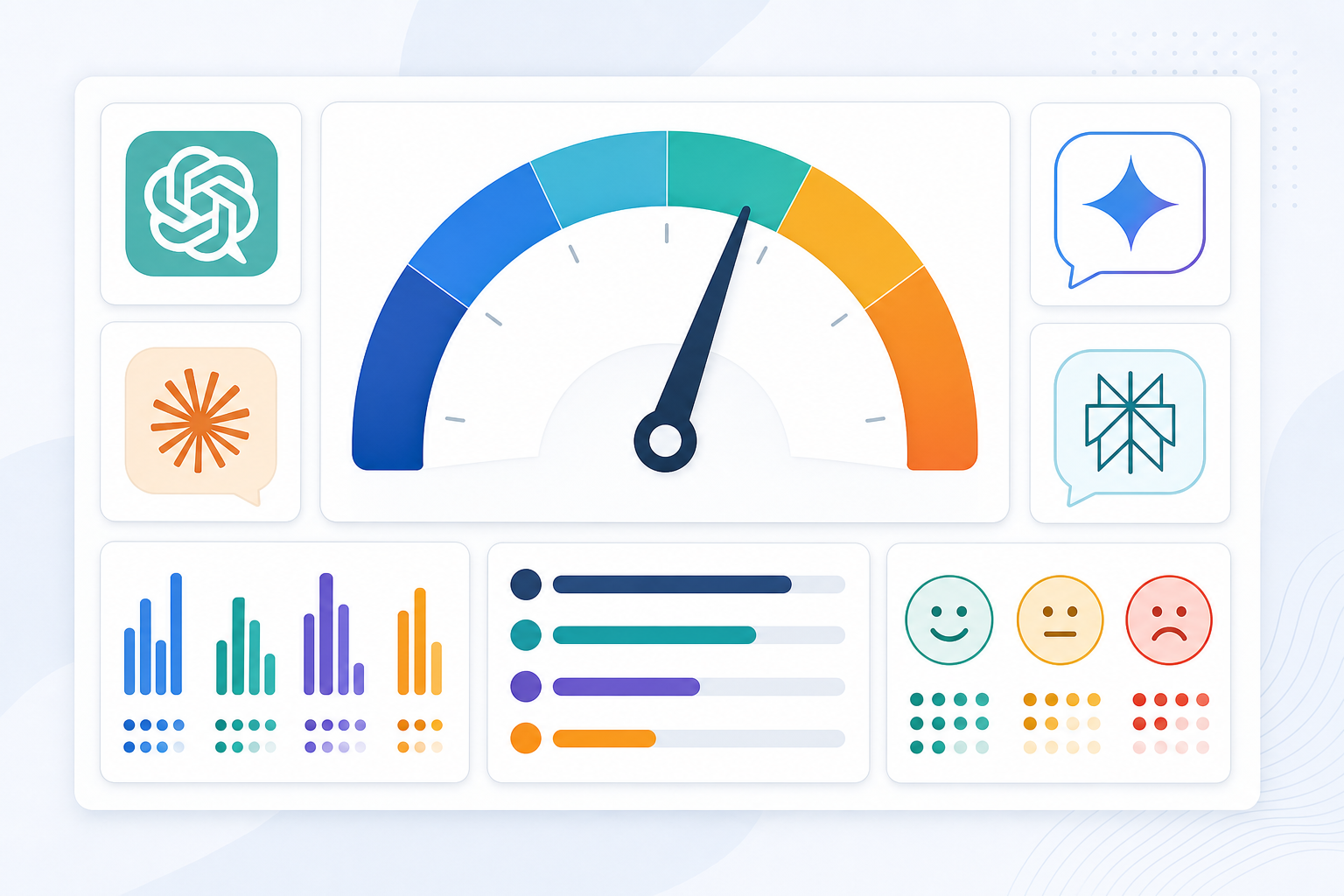 Caption: Illustrative dashboard concept only — no 0–100 AI visibility score is a standardised industry metric. Validate any vendor score against manual spot checks before treating it as a KPI. Alt text: Dashboard mockup showing a 0–100 AI visibility score, citation counts, and sentiment bars across major AI engines.
AI SEO and Traditional SEO FAQ
If I rank #1 on Google, will ChatGPT cite me too?
Not necessarily. Google’s ranking reflects relevance and link authority within a ranked-results model, while AI engines synthesise answers from multiple sources and appear to weight third-party sentiment and extractable facts differently.
In one informal test I ran in November 2024, a #1 Google position for “best CRM software for small business” produced zero citations across three AI engines. That’s a single snapshot, not a universal rule, so run your own equivalent test before drawing conclusions for your category.
Do backlinks matter for AI citations?
Probably indirectly. Backlinks build the domain authority that helps Google trust a page, and that trust may partially carry over into how an AI model treats a brand, although no provider has published the exact mechanism.
For direct citation in an AI-generated answer, third-party mention frequency and sentiment appear, in observed cases, to matter more than raw backlink volume. Treat that as a hypothesis to test on your own content, not a confirmed rule.
Should I change my content structure for AI search?
Yes. This is one of the higher-confidence recommendations in this article. AI answer engines favour content with direct statements of fact, explicit comparisons, well-labelled headings, and structured data that’s easy to extract.
Run an AI legibility audit on your core pages. Check schema markup, answer-first paragraph structure, and whether claims are stated in one clear sentence rather than three paragraphs of context first.
How do I measure AI SEO success separately from Google rankings?
Build a manual baseline first: define a set of purchase-decision queries, check them against named engines on a set date, and record citation status and sentiment. Google Search Console and traditional rank trackers won’t capture this because they measure a different retrieval system.
Automate ongoing tracking once your baseline exists, but validate any tool’s score against your own spot checks.
Sources and Notes
- Google Search Essentials — crawl, index, and rank documentation (developers.google.com/search/docs/essentials)
- Google documentation on AI Overviews and query fan-out (Google Search Central)
- OpenAI crawler documentation — OAI-SearchBot and GPTBot policy (2024)
- Independent industry ranking-factor studies on backlink correlation; Google has not published exact weightings
- CRM query test: informal, single-day, single-run comparison across ChatGPT, Perplexity, and Claude, November 2024, UK region settings, logged out
This subject changes quickly. Verify provider-specific claims against current documentation before making budget decisions, and treat this article’s date-stamped observations as observations, not permanent facts.
The Bottom Line: Build for Google Rankings and AI Citations
Traditional SEO and AI SEO are related disciplines, not interchangeable ones. Google’s crawl–index–rank process is well documented; the citation logic inside ChatGPT, Perplexity, Gemini, and Copilot is far less transparent.
For UK SaaS and DTC brands competing in comparison-style queries, the practical response isn’t to abandon technical SEO. Keep that foundation, add a genuine AI legibility and monitoring layer, and start this week with the action fully within your control: check whether your robots.txt is quietly blocking the crawlers that could cite you in the first place.
Target keywords: AI SEO, generative engine optimisation, traditional SEO, AI search ranking