AI Shopping Assistants: What E-commerce Brands Must Know to Avoid Invisible Exclusion
AI shopping assistants now shape product shortlists. Learn how UK brands can audit visibility, fix product data, and earn inclusion in AI recommendati
AI Shopping Assistants: The New Discovery Gatekeeper UK Brands Can’t Afford to Ignore
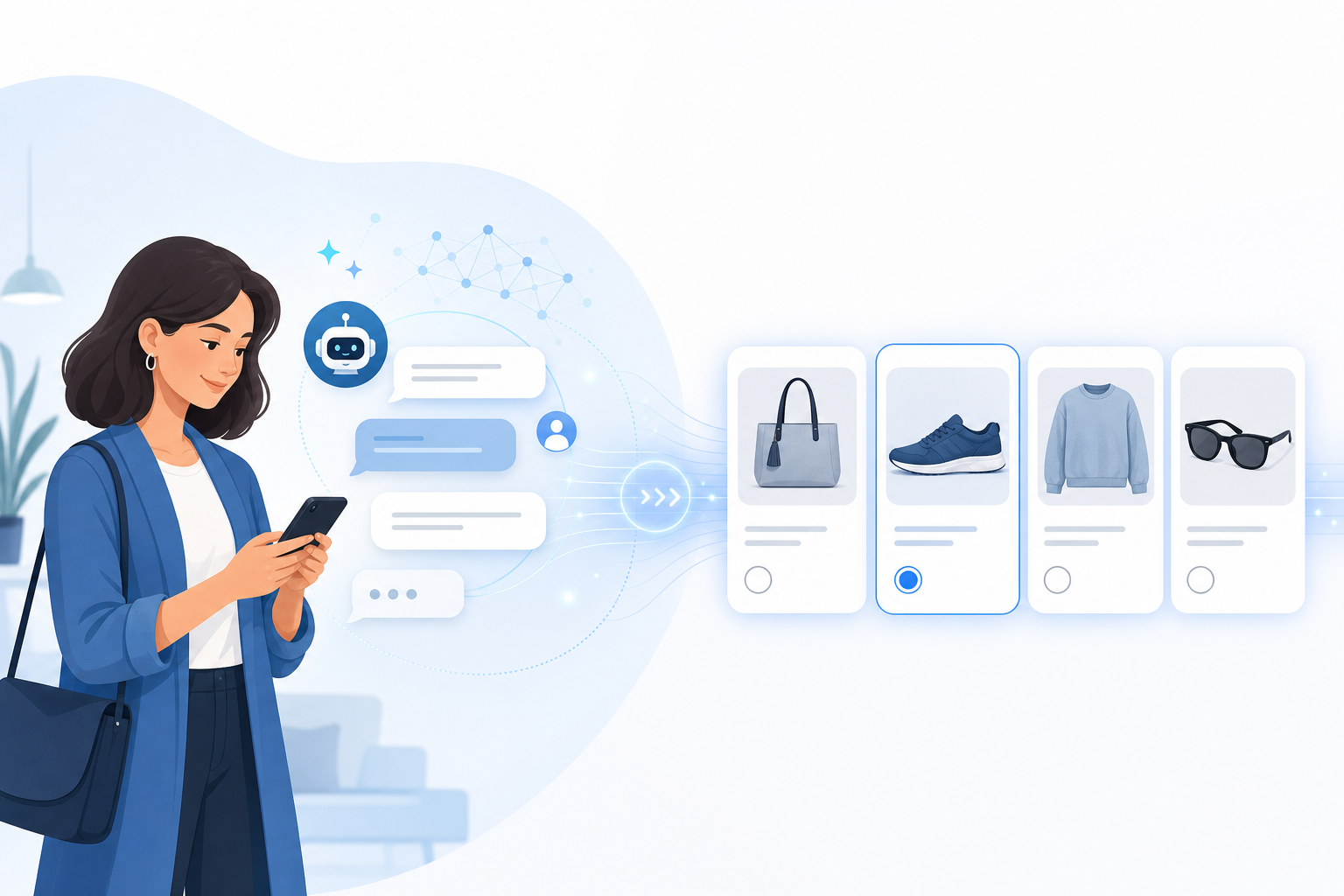
AI shopping assistants — including ChatGPT, Perplexity, Gemini, Amazon’s Rufus, and a growing list of other tools — are increasingly deciding which products a shopper hears about before they reach a search engine or category page. They aren’t blocking anyone’s payment; nobody is losing the ability to check out. What’s changing is product discovery.
When a shopper asks a natural-language question instead of typing a search term, only three to five named products may make the shortlist. A strong Google ranking is no guarantee that your brand will be one of them. I’ve audited roughly 40 product catalogues since early 2024, and the pattern is consistent: brands that dominate organic search frequently have no idea whether they appear when the same question is put to an AI chatbot.
This article explains what AI shopping assistants are, how they build product recommendations, why brands can be silently excluded, how to test your own visibility, and what UK e-commerce businesses can do about it through structured content and generative engine optimisation (GEO).
A quick note on the evidence. AI visibility is platform-dependent and changes week to week, so most of the hard numbers available right now are US or global rather than UK-specific. I’ve labelled the geography and data type of each figure below so you can weigh it accordingly rather than treat it as a single settled statistic.
| Metric | Geography | Data type | Source |
|---|---|---|---|
| 1,300% YoY increase in generative-AI referral traffic to retail sites, Nov–Dec 2024 | US retail | Measured web traffic | Adobe Digital Insights, 2024 Holiday Shopping Report |
| 53% of shoppers say they already use generative AI for product discovery | Global consumer survey | Self-reported attitude | Salesforce, Connected Shoppers Report, 2024 |
| 58% say they already use generative AI instead of traditional search for recommendations | Global consumer survey | Self-reported behaviour | Capgemini Research Institute, 2024 |
| Generative-AI-referred shoppers viewed 12% more pages and converted 9% more often | US retail | Measured web traffic | Adobe Digital Insights, December 2024 |
These numbers establish that AI-assisted shopping is growing fast and that this traffic tends to be engaged rather than casual. None of them measure whether any specific brand is included in or excluded from AI shortlists — that’s a different question, and it’s the one testing your own queries actually answers.
What Are AI Shopping Assistants?
An AI shopping assistant is a conversational or agentic tool that helps a shopper discover, compare, and sometimes buy products using natural language instead of a traditional search box. There are three broad types, and they behave differently because they draw on different data sources:
| Type | Examples | Data source | Live pricing/stock? |
|---|---|---|---|
| General-purpose AI chat | ChatGPT, Perplexity, Gemini, Copilot | LLM + live web retrieval | Sometimes, via retrieval |
| Retailer-owned assistant | Amazon Rufus, Walmart Sparky | Retailer’s own catalogue and inventory | Yes, direct access |
| Marketplace/fintech agent | Klarna AI Assistant | Merchant feeds + third-party data | Partial, feed-dependent |
Google’s and OpenAI’s own technical documentation confirm that most general-purpose tools pair a language model with a retrieval layer rather than answering purely from training data. However, not every AI shopping assistant updates on the same schedule or sees the same product information. Rufus, for example, can see live Amazon inventory that ChatGPT simply cannot.
The structural difference from traditional search holds across all three types: there are no ten blue links and no pagination. Ask, “What’s the best waterproof hiking boot under £150?” and you’ll typically get three to five named products with a synthesised recommendation. If you’re not on that list, you haven’t dropped a ranking position — you’ve disappeared from that shopping conversation entirely.
How AI Shopping Assistants Are Changing Product Discovery in the UK
I haven’t found a published, UK-specific study measuring how many UK shoppers use generative AI for product discovery. What we do know is that UK consumers use the same platforms as their US counterparts, Rufus is live on Amazon UK, and UK retailers compete inside the same Google Shopping Graph — which Google reported held more than 35 billion product listings as of September 2023 — that feeds several of these tools.
Two UK-specific factors matter for testing and remediation:
- Regulatory context: The ASA and CMA’s rules on disclosed and undisclosed endorsements apply to any third-party review coverage you pursue to build AI visibility, so paid or incentivised reviews carry compliance risk as well as manipulation risk.
- Feed context: Google Merchant Center feed accuracy — including correct GBP pricing, GTINs, and UK stock status — directly affects whether feed-reading assistants can surface your products, separately from what your website content says.
Until UK-specific behavioural research catches up, treat the direction of the US and global data as broadly applicable, but test your own UK-facing queries directly rather than assuming the percentages transfer one-to-one.
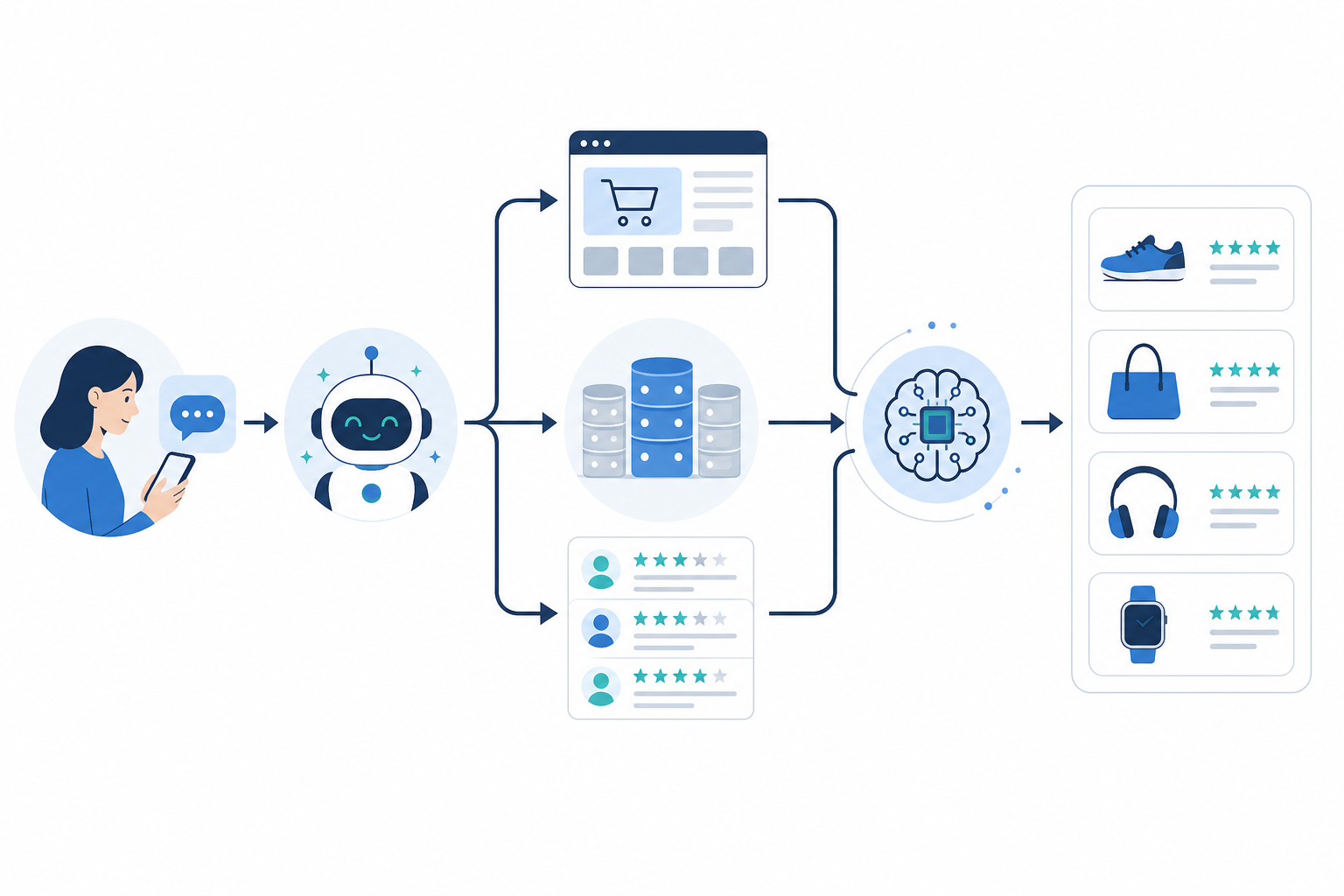
How Do AI Shopping Assistants Build Product Shortlists?
There’s no single, publicly confirmed ranking formula across ChatGPT, Perplexity, Gemini, Copilot, and Rufus. Here’s a working model, split by how confident we can actually be in each stage.
Documented (confirmed in vendor documentation):
- Intent interpretation: The assistant parses the request, which may bundle budget, size, materials, and delivery location at once.
- Candidate retrieval: It pulls products from an index, feed, or crawled page, distinct from the model’s original training data.
- Constraint filtering: Hard requirements such as price and availability eliminate products before softer signals matter.
Observed in my own repeated testing, not confirmed by any vendor:
- Evidence weighting: Assistants appear to favour sources with direct, extractable facts that are corroborated elsewhere.
- Sentiment influence: Third-party mentions from review sites and forums seem to affect whether a brand is framed positively, neutrally, or not at all.
The result can also be personalised. Location, delivery requirements, previous conversation context, account state, language, and the assistant’s available retailer integrations may change both the eligible products and the order in which they are presented. Two shoppers asking an almost identical question may therefore receive different shortlists. That makes a single screenshot a weak basis for judging visibility.
Google has stated that no special schema markup is required purely for AI-feature eligibility — clean, accurate, crawlable content matters most. However, technically crawlable content does not guarantee inclusion. The product also needs to sit inside the assistant’s accessible corpus for that specific query and carry enough supporting evidence to compete with other products.
Product structured data still has a practical role even when it is not a guaranteed eligibility signal. Consistent Product, Offer, Review, and availability details can make important facts easier for search systems and other retrieval layers to interpret. They must match the visible page and the merchant feed; contradictory prices, stock statuses, or product identifiers create ambiguity rather than an advantage.
I use “AI legibility” throughout this article as a practical concept: how easily an AI model can extract accurate facts from your page. It is not a confirmed, universally weighted ranking factor.
Why Are Some Brands Missing From AI Shopping Shortlists?
Across my approximately 40 audits of outdoor equipment, home electronics, and homeware catalogues — mostly UK and US mid-market retailers — five causes recur. Most affected brands show at least two at once. This is directional evidence from my own sample, not a controlled industry study.
- Thin or unstructured product content. If a model can’t cleanly extract material, dimensions, or use cases, it may move to a competitor whose product page answers more directly.
- No presence in trusted third-party sources. AI shopping assistants often use review sites and forums for corroboration. A minimal external footprint gives the model little evidence to validate against.
- False confidence from Google rankings. Strong SEO tells you nothing about AI share of voice. These systems use different retrieval methods, corpora, and logic.
- Multiple technical barriers. Blocked crawlers, unrendered JavaScript, and feed errors are three separate problems. OpenAI distinguishes GPTBot, used for training, from OAI-SearchBot, used for search surfacing. Permitting one does not guarantee inclusion, while retailer-owned assistants such as Rufus may bypass your website entirely and read from a structured feed.
- Competitors investing in generative engine optimisation. Other brands may be building structured data, review coverage, and citation patterns that AI systems can use while your team focuses entirely on traditional SEO.
A related problem is inconsistent brand and product identity. If the same product has different names, model numbers, dimensions, or variant information across your site, feeds, marketplaces, and review coverage, an assistant may fail to connect those references. Keep canonical product names, GTINs, manufacturer part numbers, variant attributes, and brand details consistent wherever the product appears.
A quick example from testing: A mid-sized UK outdoor retailer I audited ranked on page one of Google for “best waterproof hiking boots UK” but had thin specifications and a JavaScript-rendered size chart. Across 15 runs on ChatGPT and Perplexity for that exact query, it appeared in zero shortlists. A competitor with plain-language specifications and coverage on three UK gear-review sites appeared in 12 of 15 runs. Neither brand’s Google ranking moved. Only one was being discovered through the growing share of shopping journeys that start with a conversational question.
Gartner has forecast that traditional search volume could decline by 25% by 2026 as consumers shift towards AI chatbots. That’s a forecast, not a settled fact, but the direction is consistent with the wider evidence and worth planning around even if the exact figure proves optimistic.
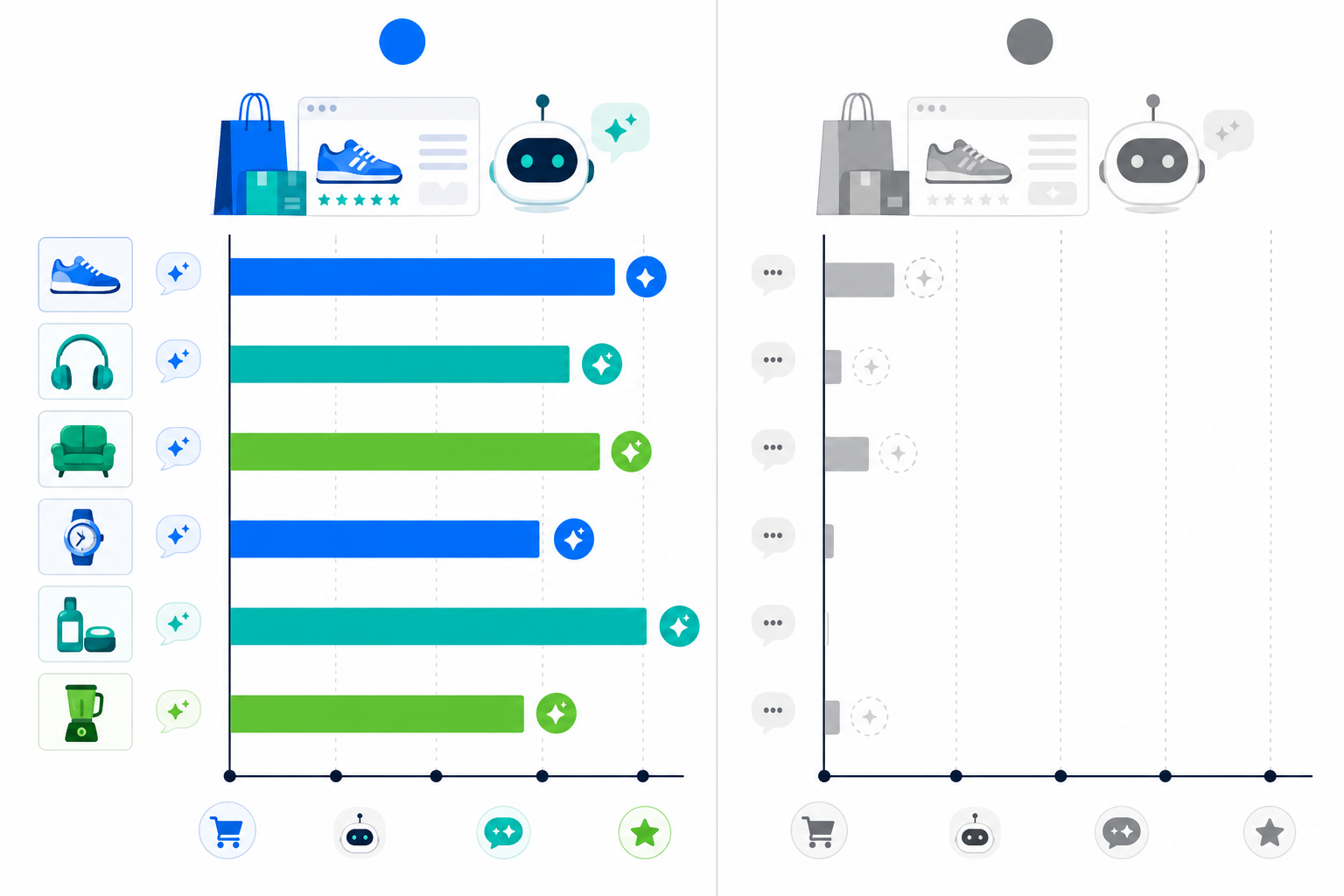
What Is the Cost of Being Excluded From AI Recommendations?
There’s no notification when this happens. Google Search Console tells you when rankings drop; nothing tells you when ChatGPT quietly stops mentioning your brand for a query it previously answered with your product included.
A simple illustrative model: if 5,000 people a month search a category-relevant question through AI assistants, and you’re currently included in roughly 20% of those answers compared with a leading competitor’s 80%, that 60-point gap represents real lost consideration. This is before factoring in that generative-AI-referred shoppers convert around 9% more often than other traffic, based on Adobe’s US retail data.
The commercial impact is not limited to direct clicks. Being absent from an early shortlist can reduce branded searches, comparison opportunities, assisted conversions, and the chance that a shopper encounters your product before forming a preference. These effects are harder to isolate than referral sessions, so treat them as measurement questions rather than assumed outcomes.
The exact numbers will vary by category, but the mechanism is the same: you don’t lose a ranking position; you lose the conversation entirely.
It’s plausible that once an assistant repeatedly surfaces a competitor as the go-to answer, that pattern could take sustained work to shift. However, retrieval-augmented systems draw on live feeds that can change faster than a model’s trained associations. Treat “hard to dislodge” as a hypothesis worth planning around rather than a proven rule.
How Can You Check Whether Your Products Are Being Excluded?
A single query result tells you almost nothing. AI shopping assistants are stochastic and can return different answers minutes apart. Start small, then scale up.
One-hour AI visibility audit
- Pick your three highest-revenue products.
- Ask ChatGPT and Perplexity one realistic purchase question per product, including a GBP budget, UK delivery requirements, and a specific use case.
- Record whether you appear, which sources are cited, and which competitors are named.
Where possible, also compare what the assistant says with your live product page, feed, and stock system. Note incorrect prices, outdated availability, missing variants, or claims that cannot be substantiated. Visibility without accurate product information can create customer-service, compliance, and conversion problems rather than useful demand.
Quarterly generative engine optimisation audit
Use a test log with these columns:
| Query | Platform & version | Date | UK location set | Your position | Cited source | Accurate? | Sentiment | Competitors named |
|---|
Run each query at least three times per platform, using a UK location setting, both signed-out and signed-in. Calculate an inclusion rate — the percentage of runs where your brand appears at all — and a citation rate — the percentage of runs where your own domain, rather than a marketplace, is cited.
Those two numbers, tracked over time, matter more than any single “visibility score”. There is currently no standardised industry metric for AI visibility, so treat any score from any provider as directional only.
Also connect tests to business data where possible. Use tagged links, server logs, analytics referral data, and assisted-conversion reporting to identify AI-referred sessions, while recognising that some assistants may not pass a reliable referrer. Compare changes in inclusion and citation with organic traffic, branded demand, conversion rate, and feed errors; do not treat a rise in AI mentions as proof of incremental revenue by itself.
How Can UK Brands Get Included in AI Product Recommendations?
Immediate actions: this week
- Rewrite your top 10 product pages so specifications read like “waterproof to 15,000mm hydrostatic head, sizes 4–12 UK” instead of vague marketing copy. AI models extract facts more reliably from direct statements.
- Audit your Google Merchant Center feed for accurate GTINs, GBP pricing, and stock status. This affects feed-reading assistants specifically and is separate from live-crawling tools such as Perplexity.
Actions for the next 30 days
- Fix technical legibility issues, including blocked crawlers, unrendered JavaScript specifications, and missing structured data. Check live crawlers, training crawlers, and feed ingestion separately: they are three different pipelines.
- Pursue genuine third-party coverage through independent review sites, comparison content, and category forums. Use real product submissions and substantive responses rather than paid placement, which risks ASA and CMA scrutiny as well as manipulation flags.
- Standardise product identity across your website, feeds, marketplaces, and external coverage. Check product names, GTINs, manufacturer part numbers, variants, prices, and availability for conflicting versions.
Ongoing AI visibility work
- Monitor competitor mentions to see which brands are winning share of voice and why.
- Track your inclusion and citation rates on a fixed schedule. I’ve used MentionOwl in my own audits to automate this across platforms; it’s simply the tool I have direct experience with, not a claim that it is the best option available.
- Measure progress with concrete outputs, including feed error rate, the percentage of specifications that are machine-extractable, inclusion rate, and citation accuracy — not the calendar alone.
- Review recommendation accuracy and commercial outcomes alongside visibility. The objective is not to appear for every question, but to be represented accurately for relevant UK shoppers and constraints.
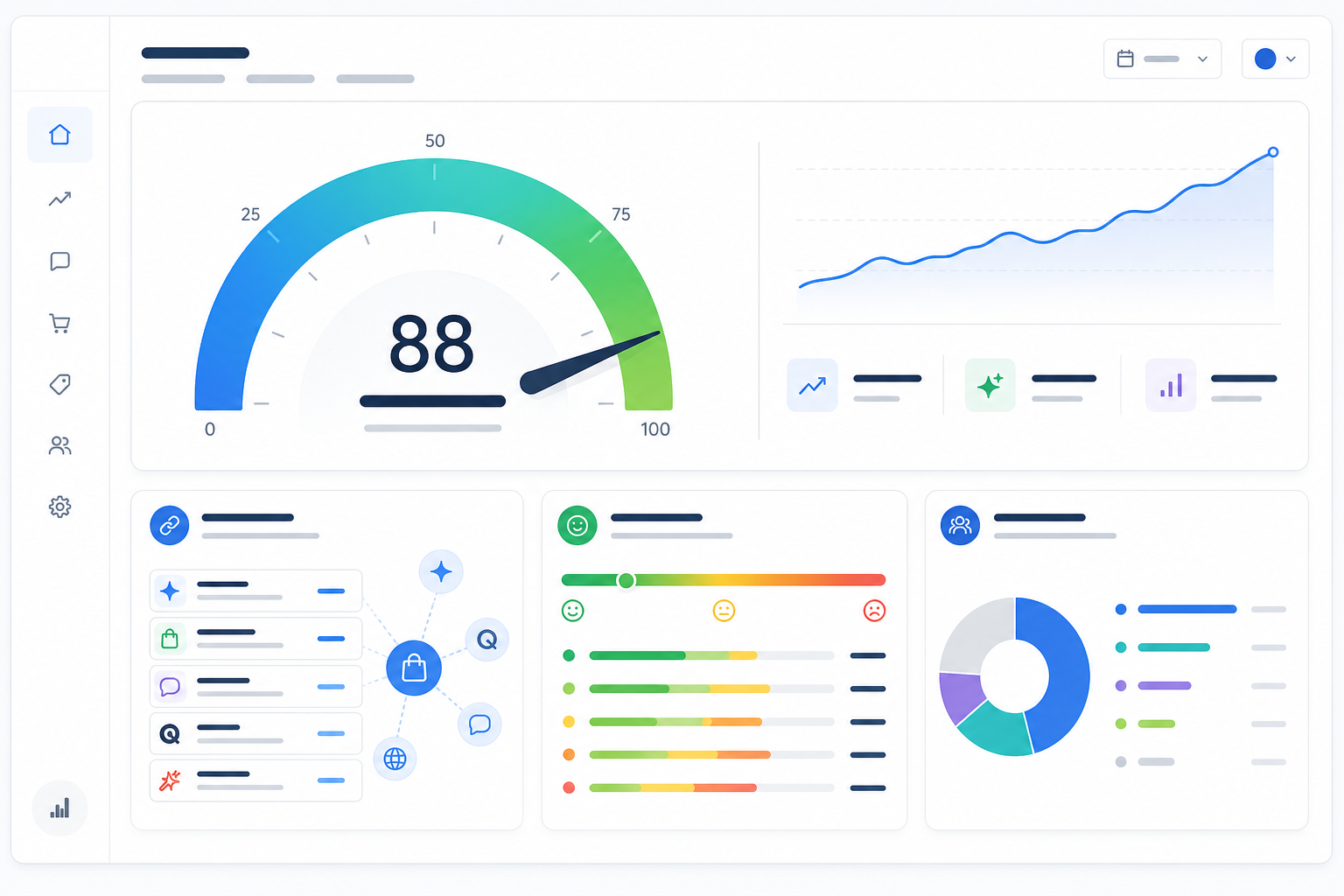
Note: the dashboard image above is an illustrative mockup. Treat any visibility “score” as directional — no industry-wide measurement standard currently exists.
FAQ: AI Shopping Assistants and Product Discovery
What is an AI shopping assistant, exactly?
An AI shopping assistant is a conversational or agentic tool — such as ChatGPT and Perplexity, retailer-owned assistants such as Rufus, or checkout-embedded agents — that answers a purchase question with a short, named product shortlist instead of a page of search results. There’s no scrolling through ten blue links: you’re either in the answer or you’re not.
How does an AI decide which products to recommend?
There’s no single published formula. Systems combine retrieval from a catalogue or crawled content with constraint filtering for price and availability. They also appear to favour products with clear, corroborated facts and positive third-party sentiment, although that weighting is based on observed testing rather than confirmed platform guidance. Location, account context, delivery requirements, and available retailer integrations can also alter the result.
Could my products be silently excluded from AI answers?
Possibly, and the bigger issue is that very few brands have tested their products across multiple AI shopping platforms. A strong Google ranking says nothing about AI visibility. Test realistic purchase questions repeatedly, because a single query is not reliable evidence either way.
Does my product feed matter as much as my website content?
Yes, but through a separate pathway. Retailer-owned and marketplace assistants often read structured product feeds rather than crawling your website. A feed error — such as an incorrect GTIN, stale stock status, or mismatched price — can exclude you even when your product page content is excellent.
How do I check if my products appear in AI shopping shortlists?
Run realistic shopping questions through ChatGPT, Perplexity, Gemini, and Copilot several times each. Use a UK location setting and log your position, sentiment, cited sources, and competitors named. Calculate an inclusion rate and citation rate instead of relying on one test run. Compare the assistant’s claims with your live pages and feed so you can identify inaccurate or outdated product information as well as outright absence.