The Rise of AI Shopping Assistants: What E-commerce Brands Need to Know Before Being Left Off the Shortlist
AI shopping assistants are changing how UK shoppers discover products. Learn how they build shortlists, what exclusion costs, and how AI visibility an
AI shopping assistants: why e-commerce brands should act now
AI shopping assistants are becoming a real discovery channel. They recommend a short list of products instead of pages of links, so a brand missing from the answer is unlikely to be considered at the moment of decision. 🦉 In this guide I set out the evidence for the shift, explain how these assistants appear to select brands, and show how you can measure your AI visibility and start generative engine optimization (making your brand easier for AI systems to find, understand and cite) without committing to a large or speculative programme.
A caveat about the evidence: this article is written for UK e-commerce teams, but I have not found a reliable, current UK figure for assistant-led shopping, and I will not present US or global survey results as if they measured UK behaviour. Where I cite a statistic, I give the source, date, geography and what it does and does not measure. I treat the international figures as a rough indicator of direction, not as a UK adoption rate. For UK context on general generative AI use and online shopping, check the latest releases from Ofcom and the Office for National Statistics. Both publish on those topics, but neither, to my knowledge, breaks out assistant-led product research. Please confirm each figure against the linked publisher before building a business case, because several of these sources update their pages.
From search bars to chat boxes: how AI shopping assistants are changing discovery
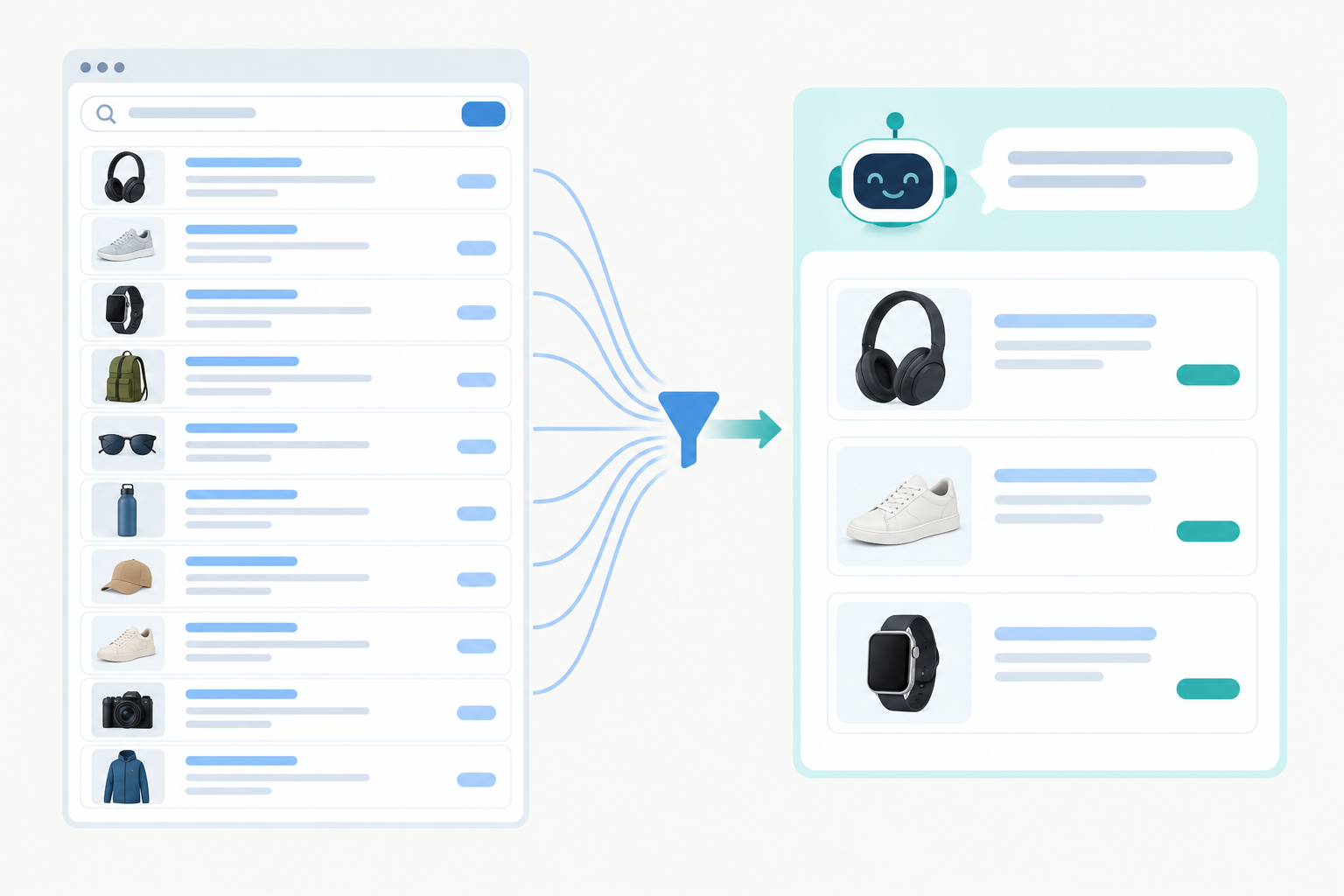
The core change is easy to describe. A shopper who once typed 'best waterproof walking boots' and scanned ten blue links now asks an assistant for the same thing, adds a budget, a terrain and a preference for wide fittings, and gets a conversational answer naming a handful of products. The assistant has done the comparison work that the shopper used to do across a dozen tabs.
Are people really shopping through AI assistants yet?
Adoption is uneven, and it helps to separate three things: general use of generative AI, research-stage shopping use (comparisons, 'best for' questions and shortlist building), and completed purchases inside the chat. The evidence is strongest for the first two and weakest for the third, which remains far less common even though platform product work points in that direction. None of the figures below is UK-specific, so read them as an international proxy.
- Capgemini Research Institute, 2024 (consumers surveyed across multiple countries): 58% said they had replaced traditional search engines with generative AI tools for product or service recommendations, up from 25% in 2023. This is self-reported behaviour from a survey sample, not a measure of all shopping searches. The Capgemini Research Institute publishes the report and its country breakdown.
- Adobe, survey of US consumers ahead of the 2024 holiday season: 39% had used generative AI for online shopping and 53% planned to. That measures reported and intended use, not confirmed transactions. Details are on Adobe's newsroom.
- Gartner, February 2024 forecast: traditional search engine volume would fall 25% by 2026 as users move to chatbots and virtual agents. This is a forecast, not an observed decline, and it is not specific to e-commerce. See Gartner's press release.
The honest summary for a UK retailer is that AI shopping assistants are plausibly part of customers' research journeys, that nobody has measured the size of that effect in your category, and that measuring it directly is the sensible first step.
AI shopping features are expanding across platforms
What the providers build matters as much as what surveys say, because product launches show commercial intent. Amazon introduced its Rufus assistant to US customers in beta in February 2024, and Perplexity launched shopping features with product cards in November 2024. Walmart introduced its Sparky assistant in 2025, Google has added shopping capabilities to AI Mode, and OpenAI has introduced shopping research in ChatGPT, which compares products and links to retailer and publisher sources. Several of these launched in the US first. I have not confirmed the UK status of each feature as of writing, so check the official announcement pages (for example Amazon's newsroom, Google's Search blog and OpenAI's announcements) for the date and UK availability before relying on any of them.
Why AI shopping recommendations matter more than search volume
Even if raw volume were modest, the format changes the economics of discovery. A page of search results lets ten brands compete for attention. A chat answer squeezes the consideration set down to perhaps three to five names, so fewer brands are seen, and those that are seen carry considerably more weight.
The Pew Research Center analysed the browsing of 900 US adult Google users in March 2025. Those users clicked a traditional result in 8% of visits when an AI summary appeared, against 15% when it did not, and clicked a link cited within the summary in only 1% of visits. That is general search behaviour in the US, not shopping behaviour in the UK, but it shows how much value can sit inside the answer itself.
How AI shopping assistants build their shortlists
The question I am asked most often is how these assistants pick which products to show. The platforms do not publish ranking criteria, so what follows is a set of observed patterns, backed where possible by platform documentation. It is not a formula.
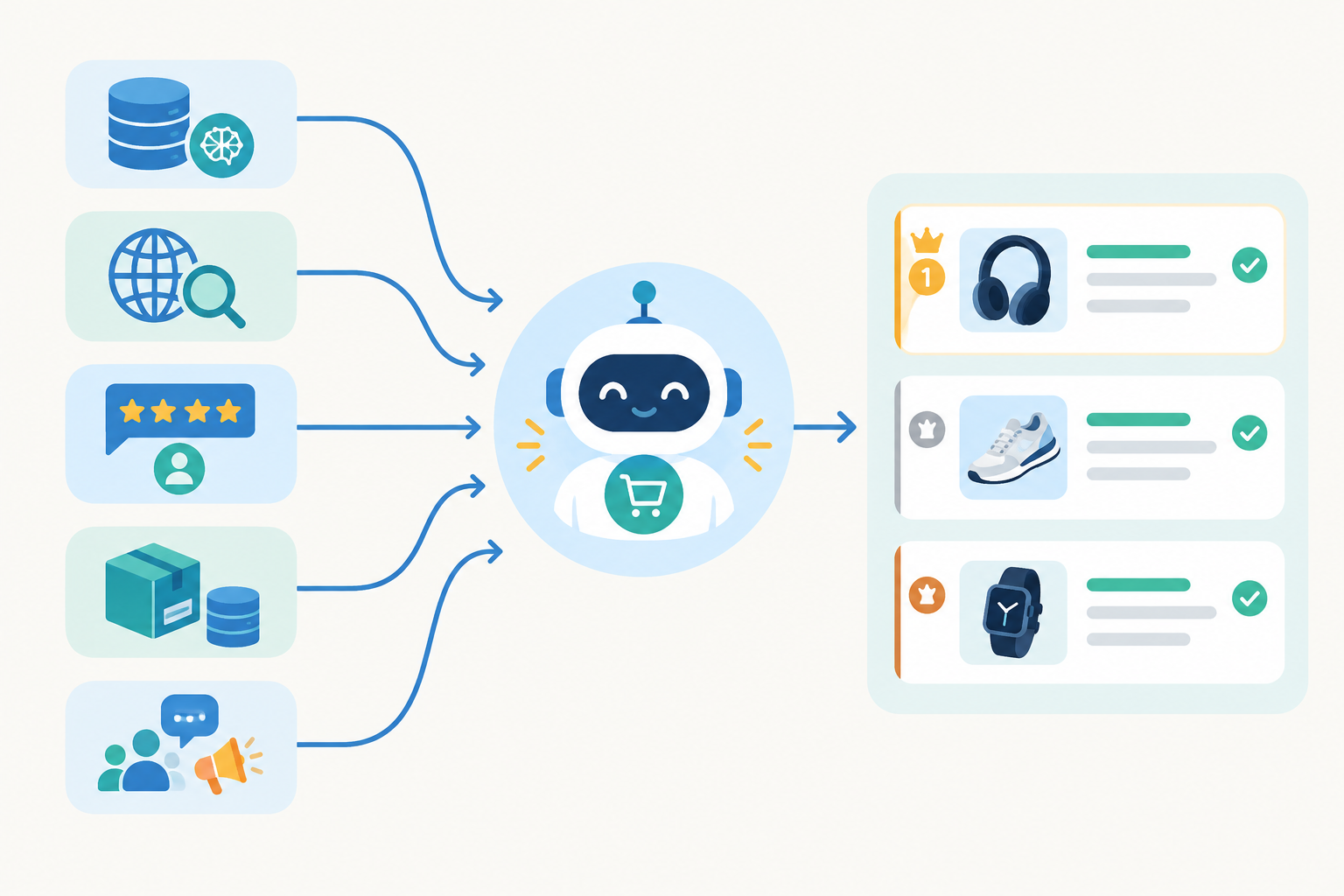
Broadly, there are two inputs. The first is knowledge absorbed during model training, which reflects how a brand was described across the web up to the training cut-off. The second is live retrieval, where the assistant searches the web or a product catalogue when search is enabled. Google describes a technique it calls 'query fan-out', in which its AI features break a question into several related searches across subtopics and data sources, then combine the results into one answer (see Google's guidance on AI features). The implication is that AI visibility depends on whether useful, consistent information exists across the questions an assistant explores. One page ranking for the original query is not enough.
Signals that may influence which products assistants recommend
Platform documentation and observed behaviour suggest these signals matter. None guarantees inclusion.
- Third-party reviews and editorial roundups. Amazon says Rufus draws on its product catalogue, customer reviews, community Q&As and information from across the web. That is a concrete example of an assistant combining structured product facts with user-generated evidence.
- Consistent product data. Google's Merchant Center product data specification calls for accurate titles, descriptions, price, availability, brand and identifiers such as GTIN, kept consistent with the landing page. Conflicting or stale data makes an offer harder to evaluate, particularly when a shopper specifies a budget, size or delivery date.
- Clear on-site descriptions. Specific product and category pages, descriptive headings and plain-language answers to common comparison questions are easier for a system to retrieve and verify.
- Structured data. Product markup helps machines interpret a page. Google states that no special schema is required for AI Overviews or AI Mode and that foundational SEO practices still apply, so treat markup as sound groundwork, not a requirement or a shortcut.
- Mentions across forums and comparison sites. Corroboration from independent sources gives an assistant more to draw on than your own claims.
AI legibility: can assistants access and understand your product pages?
If crawlers cannot access or parse your pages, the assistant has little to cite. Two issues are worth keeping apart. Technical accessibility covers whether bots can reach and render your content. Typical failures are AI crawlers blocked in robots.txt, product details hidden behind heavy JavaScript rendering, and pages that fail to load for automated visitors. Page clarity covers whether the content, once reached, says plainly who a product is for and what it does, and vague copy is a common weakness. Structured data sits alongside these as an aid to interpretation, not a universal inclusion requirement. An AI legibility audit checks these fundamentals, and the principle holds on any platform. (MentionOwl, the tool we build, includes a 16-point audit of this kind, but you can run the same checks manually.)
Citation, recommendation and soft mention: three types of AI visibility
These are different things, and each contributes to visibility in its own way.
- A citation is a linked source supporting the answer, and it can drive referral traffic.
- A recommendation is a named product or brand presented as a suggested option.
- A soft mention is a brand referenced without a link. It can still shape perception, even though conventional analytics will not record it.
Why one AI visibility check proves nothing
Answers vary by platform and by run. Ask ChatGPT the same question on three occasions and you may get three different shortlists, and Gemini or Perplexity may differ again. A manual spot check is therefore an anecdote. Reliable LLM monitoring needs repeated sampling of realistic questions, tracked by platform and market.
What happens when your brand is left off an AI shopping shortlist
The cost is hard to see. If an assistant does not mention you in a given conversation, you are unlikely to be considered in it, and a sale lost at that stage never shows up in your analytics as a lost sale. There is no abandoned basket, no bounce, no exit page. The shopper simply never arrived. How often this happens in your category is an empirical question, which is why measurement matters.
Why traditional dashboards miss AI-driven discovery
Rankings can hold steady and organic traffic can look healthy while AI-influenced discovery shifts elsewhere. Referral traffic from assistants is often poorly attributed, because some arrives without a clear referrer and some assistant-influenced visits show up later as direct or branded search.
Salesforce reported that AI and agents influenced 19% of global online orders during the 2024 holiday season, representing $229 billion in sales (see Salesforce's holiday shopping data; confirm the current wording and methodology there). That figure measures influence on shopping journeys across a global sample, not orders completed solely through assistants. Even so, it shows how much activity conventional channel reports can fail to attribute properly.
Measure AI share of voice in shopping answers
The most useful metric I know for this problem is share of voice. When a shopper asks ten typical purchase questions in your category, in how many do you appear, compared with your three closest competitors? It turns a vague worry into a number you can track and improve.
A worked example (hypothetical scenario)
The following numbers are illustrative only. They do not describe any real brand and are not an estimate of lost sales.
- Assume ten representative category questions. Your closest competitor appears in 5 of them (50% coverage) and you appear in 3 (30%). That is a 20-point coverage gap, and it is the only figure here that the share-of-voice method actually measures.
- To turn that gap into revenue you have to make further assumptions, and each one is uncertain. Suppose 2,000 assistant-led queries a month are spread evenly across the ten questions (they will not be). The gap then represents up to 400 answers in which the competitor appears and you do not.
- Only some of those answers will lead to a visit or a considered purchase. Assume 10% to 30%, a conversion rate of 1% to 3%, and a £60 average order value.
Under those assumptions the monthly gap is worth somewhere between roughly £24 (400 × 10% × 1% × £60) and £216 (400 × 30% × 3% × £60). The width of that range is the lesson. Appearing in an answer is not the same as winning a consideration event, query volume is rarely evenly distributed, and conversion cannot be inferred from appearance alone. A credible estimate needs your own data: real query volumes, your referral and branded-search trends, and observed conversion from AI-referred sessions.
The sentiment risk: when an assistant describes your brand inaccurately
Absence is not the only danger. An assistant may mention you with outdated pricing, wrong specifications or a lukewarm summary drawn from an old review. Being described inaccurately can be worse than not being described at all, which is why sentiment analysis belongs alongside coverage in any monitoring approach.
Early signals that AI shopping is accelerating
Is this big enough to act on now? I prefer to answer with several pieces of evidence pointing the same way rather than one headline statistic, and to be explicit about what each signal can support.
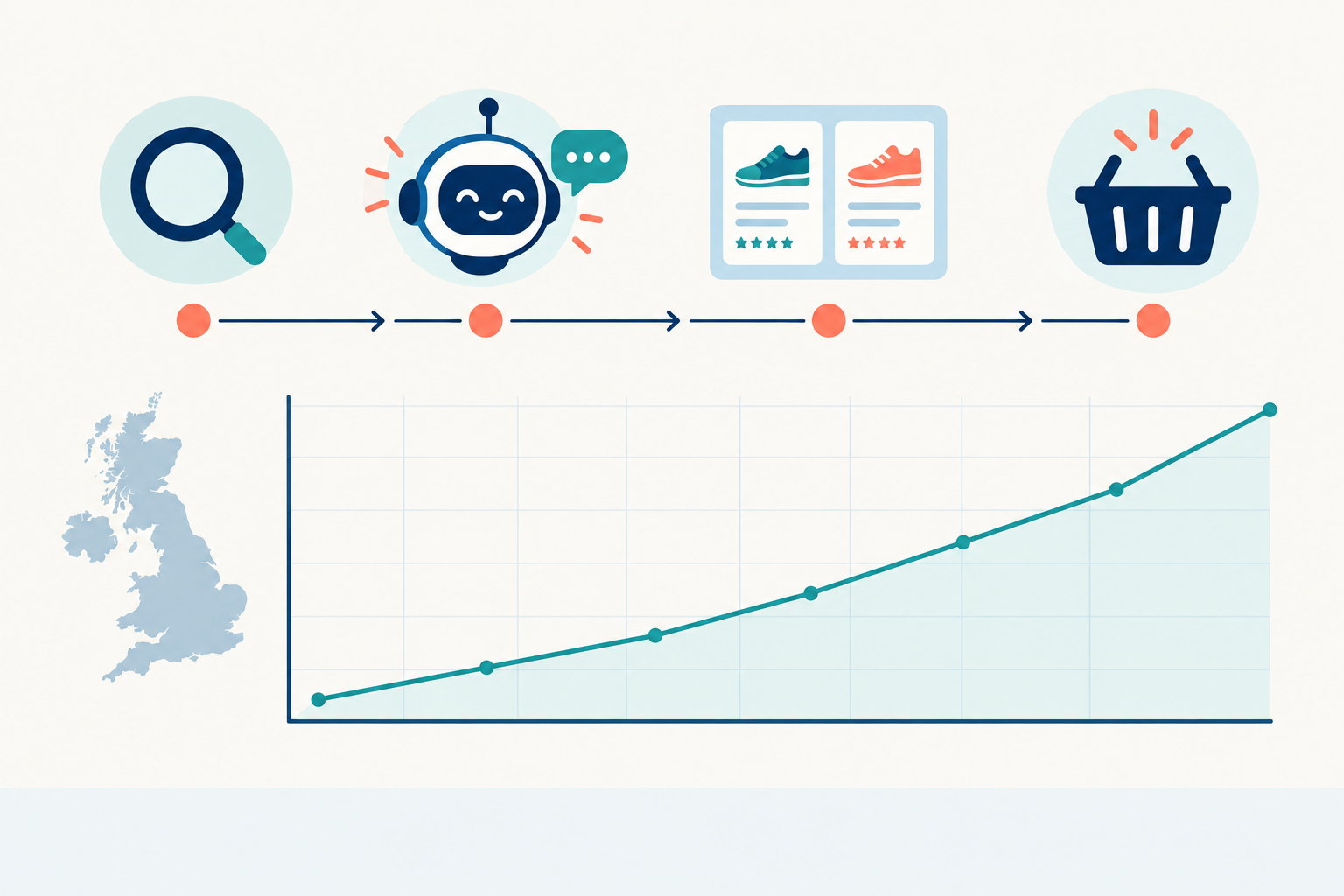
- Platform investment. Over roughly the past two years, Amazon, Perplexity, Google, OpenAI and Walmart have each added shopping, product-card or comparison features. Providers do not build commerce tooling without commercial intent, although UK availability varies.
- Consumer behaviour (US and multi-country). The Capgemini and Adobe survey figures above point to rapid growth in reported use. Adobe Analytics also measured a 1,300% year-on-year increase in generative AI referral traffic to US retail sites over the 2024 holiday period (see Adobe's report; verify the current page). That growth came from a comparatively small base and does not show share of total visits.
- Reach of AI search. Google said in 2025 that AI Overviews had more than 1.5 billion monthly users across more than 200 countries and territories (Google). That is a general adoption signal, not a shopping-specific one.
- Retail responses. Amazon's Rufus and Walmart's Sparky show incumbents building assistants into their own journeys. Amazon has also said that customers using Rufus were 60% more likely to complete a purchase during a session. That is a company-reported comparison of users and non-users, which may simply reflect who chooses to use the tool, so it is not an independent estimate of the assistant's effect. Check the original Amazon statement for its context.
What the evidence means for UK e-commerce brands
I should state plainly that the absolute share of purchases influenced by AI is probably still modest in most categories, and that most of the data above is not UK-specific. The case for acting now does not rest on current size. It rests on the direction of travel and on the fact that the first steps, measuring your baseline and fixing basic accessibility, are inexpensive.
The risk of waiting: why e-commerce brands should optimize for AI now
The strongest argument for starting early is also the most defensible: you cannot recover data you did not collect. Brands that begin LLM monitoring now will hold months of baseline data on visibility, sentiment and competitor mentions, so they can tell whether a change in content, reviews or site access moved anything. That history cannot be reconstructed retrospectively.
A second argument is plausible but, in my view, still a hypothesis. Citations and third-party mentions may accumulate over time, and models trained on (or retrieving from) a web that already describes some brands well may favour them, which would make late entry harder. I am not aware of rigorous published evidence that this compounding effect holds across platforms, and it will likely vary by platform, category and how each system retrieves information. Treat it as a reason to monitor, not as a settled law.
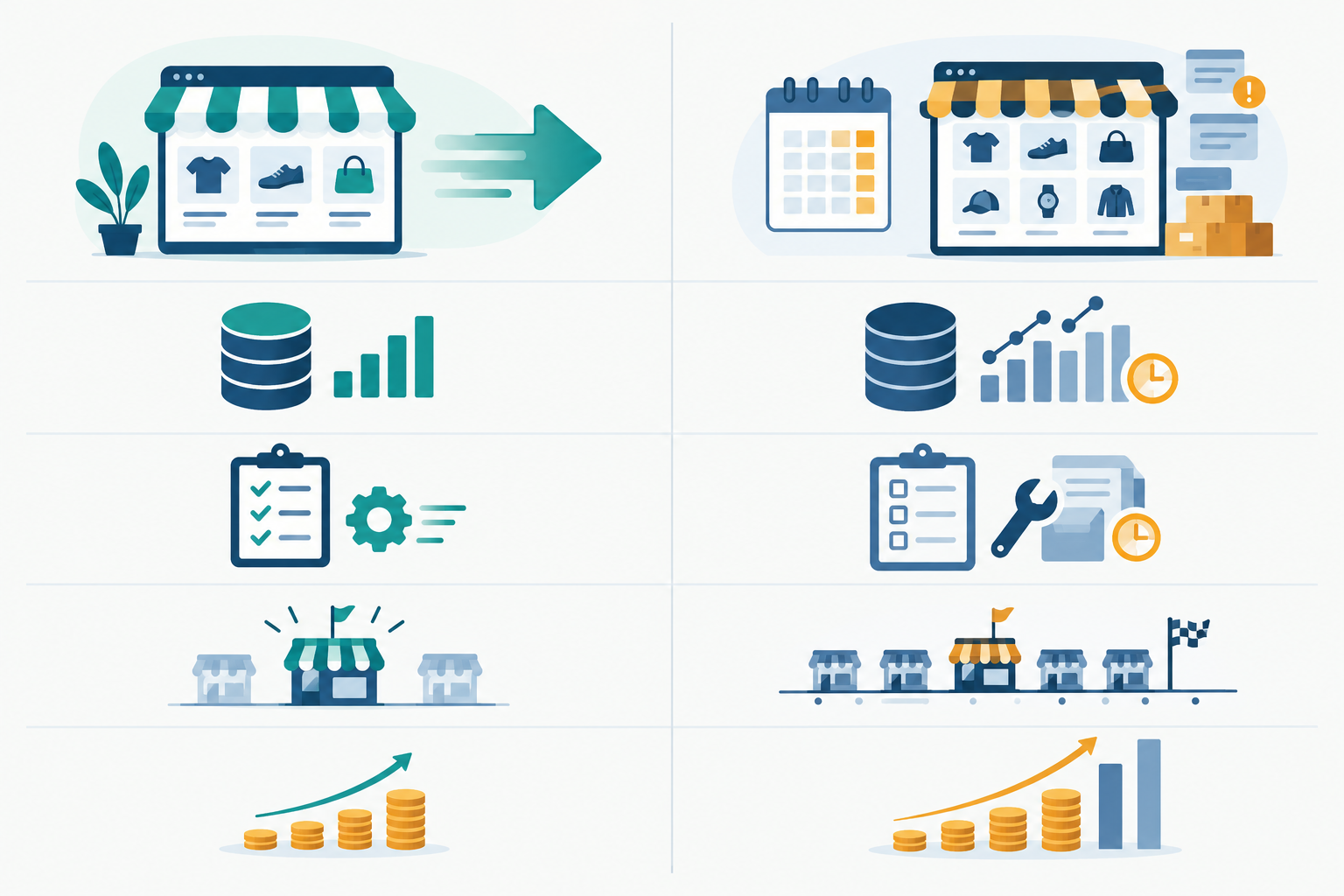
| Factor | Act now | Act in 12 months |
|---|---|---|
| Baseline data | Months of visibility, sentiment and competitor history | Starting from zero, with no record of what changed or why |
| Effort | Incremental fixes to crawl access, product pages and reviews | Possibly a larger catch-up programme, depending on how far competitors have moved |
| Cost | Low; mostly existing content and technical work | Uncertain; could be higher if competitors' citations and corroboration have accumulated |
| Competitive position | Opportunity to shape how your category is described while it is still fluid | May need to displace brands the models already associate with your category (a hypothesis, not a proven effect) |
| Learning | Time to test what moves your visibility score | Compressed learning under competitive pressure |
Low-regret AI optimization moves versus speculative ones
Early action does not require a large bet. The low-regret moves also help conventional search and ordinary shoppers: fixing crawl access, clarifying product pages, keeping price and availability consistent, and earning genuine reviews. The speculative moves, such as restructuring a whole catalogue around one platform's current behaviour, can wait until your monitoring data justifies them.
How to get ahead: a practical AI visibility plan for e-commerce brands
Here is the sequence I would follow.
- Establish a baseline. List the 20 to 50 questions real customers ask in your category and record which brands each major assistant names, repeating the questions over several days because answers vary. You can do this by hand in a spreadsheet, or use a monitoring tool to automate it.
- Score the result. Use a composite measure covering query coverage (the share of your questions in which you appear), citations weighted by how prominently they are placed in the answer, share of voice and soft mentions. That lets you track progress as a single 0-100 figure instead of a pile of screenshots.
- Audit AI legibility. Check bot access, rendering, page clarity and structured data, and fix any accessibility blockers first.
- Close content gaps with generative engine optimization. Publish clear product comparisons, specification detail, FAQs that match conversational queries, and proof points that third parties can cite. None of this guarantees inclusion, but it makes your information easier to retrieve and verify.
- Build off-site corroboration. Earn authentic reviews, editorial coverage and credible directory listings relevant to UK buyers. Avoid anything resembling fabricated reviews, or incentivised reviews without disclosure, which carry regulatory and reputational risk under UK consumer protection rules.
- Monitor weekly and tie it to outcomes. Track competitors and sentiment, and measure AI-referred traffic with analytics that do not rely on cookies (so visits are counted even when users decline cookie tracking), so you can link effort to results.
A disclosure, and some optional tooling: I work on MentionOwl, a platform that automates steps 1, 2 and 6 by generating questions from your site and running them daily across ChatGPT, Claude, Gemini, Copilot and Perplexity, recording answers, citations, sentiment and competitor mentions. It is one option among several, and a spreadsheet will establish a first baseline. If you want to try it, it offers a seven-day trial priced in US dollars ($1), so check the current price in pounds at checkout. Whichever route you choose, tooling measures the problem. It does not replace the content and corroboration work that actually changes the answer.
Frequently asked questions about AI shopping assistants
Is generative engine optimization the same as traditional SEO?
They overlap but are not identical. Strong technical foundations, quality content and authoritative mentions help both, and Google states that foundational SEO practices apply to its AI features. The difference is the goal. Generative engine optimization aims at being cited and recommended within a synthesised answer rather than ranking in a list of links, so it puts more weight on clarity, corroboration across sources and measuring mentions directly.
How can I tell whether ChatGPT or other AI shopping assistants recommend my brand?
Manual spot checks give a rough idea, but answers change between runs and platforms, so a reliable view needs repeated sampling of realistic customer questions. You can do this in a spreadsheet, or use a monitoring platform such as MentionOwl to automate it and record citations, sentiment and competitor mentions over time.
Can small e-commerce brands appear in AI shopping recommendations?
Often yes, particularly in niche queries. Assistants frequently answer specific 'best for' questions, where detailed, well-corroborated product information can outweigh sheer brand size. I cannot promise a result, but the practical move is to be clear about who your products are for and to have credible third-party evidence.
Do I need to block or allow AI crawlers?
If you want to be recommended, you generally need to let relevant AI crawlers access your product and category pages. This is a business decision with trade-offs around content use, so review each crawler's purpose and your robots.txt rules deliberately rather than leaving them on default settings.