ChatGPT vs Perplexity vs Gemini: How Each AI Engine Sources Its Answers
Compare how ChatGPT, Perplexity and Gemini source answers, then learn how SaaS and DTC marketers can prioritize AI search and track visibility.
AI Search: ChatGPT vs Perplexity vs Gemini and How Each Engine Sources Answers
ChatGPT, Perplexity and Gemini do not source answers the same way. ChatGPT blends training data with selective web retrieval. Perplexity searches the live web for most queries and puts its citations front and centre. Gemini draws on Google's index and the wider Google ecosystem, though how it does so depends on whether you are using the Gemini app or Google's AI search features. For most UK SaaS and DTC brands, the practical approach is to build crawlable, specific content that third parties back up, which serves all three engines, and then use monitoring data to decide which one deserves extra investment.
I spend most of my time in query-level visibility data, so throughout this guide I label each claim as documented (stated by the vendor), reported (a company or third-party figure) or observed (what I see in monitoring, which you should validate yourself). 📊
Why AI search sourcing mechanics matter for brand recommendations
How an engine retrieves information decides whether your brand is cited, mentioned or ignored when a buyer asks a purchase-decision question. If an engine answers from memory, your presence depends on how consistently the web described your brand before training. If it searches live, your presence depends on whether your pages, and pages about you, are crawlable, relevant and persuasive at the moment of the query.
There are three outcomes, they behave differently, and I track them separately:
- Citation: a linked source in the answer.
- Mention: your brand is named in the answer text, with or without a link.
- Soft mention: your product is described or implied (for example, 'a UK-based tool that tracks AI visibility') without being named or linked.
This is the real shift behind generative engine optimization (GEO). In classic search you competed for a ranked position. In AI search you compete to be selected as a source, or recalled as a brand, inside one synthesised answer. The original GEO paper (Aggarwal et al., arXiv, November 2023, later published at ACM SIGKDD 2024) built a benchmark of 10,000 queries and reported that methods such as adding quotations, statistics and cited sources improved visibility in generative responses by up to 40% in its experiments. That is a best case under test conditions, not a promised lift. Still, it supports a principle that has held up: how content is presented affects whether it gets used.
One caveat applies to everything below. Models, retrieval systems and citation interfaces change often, so I focus on mechanics that last rather than tactics that break. Re-check any specific behaviour before you build a plan on it, and remember that a citation shows a page was used, not that it supports every claim beside it.
How ChatGPT sources information and uses citations
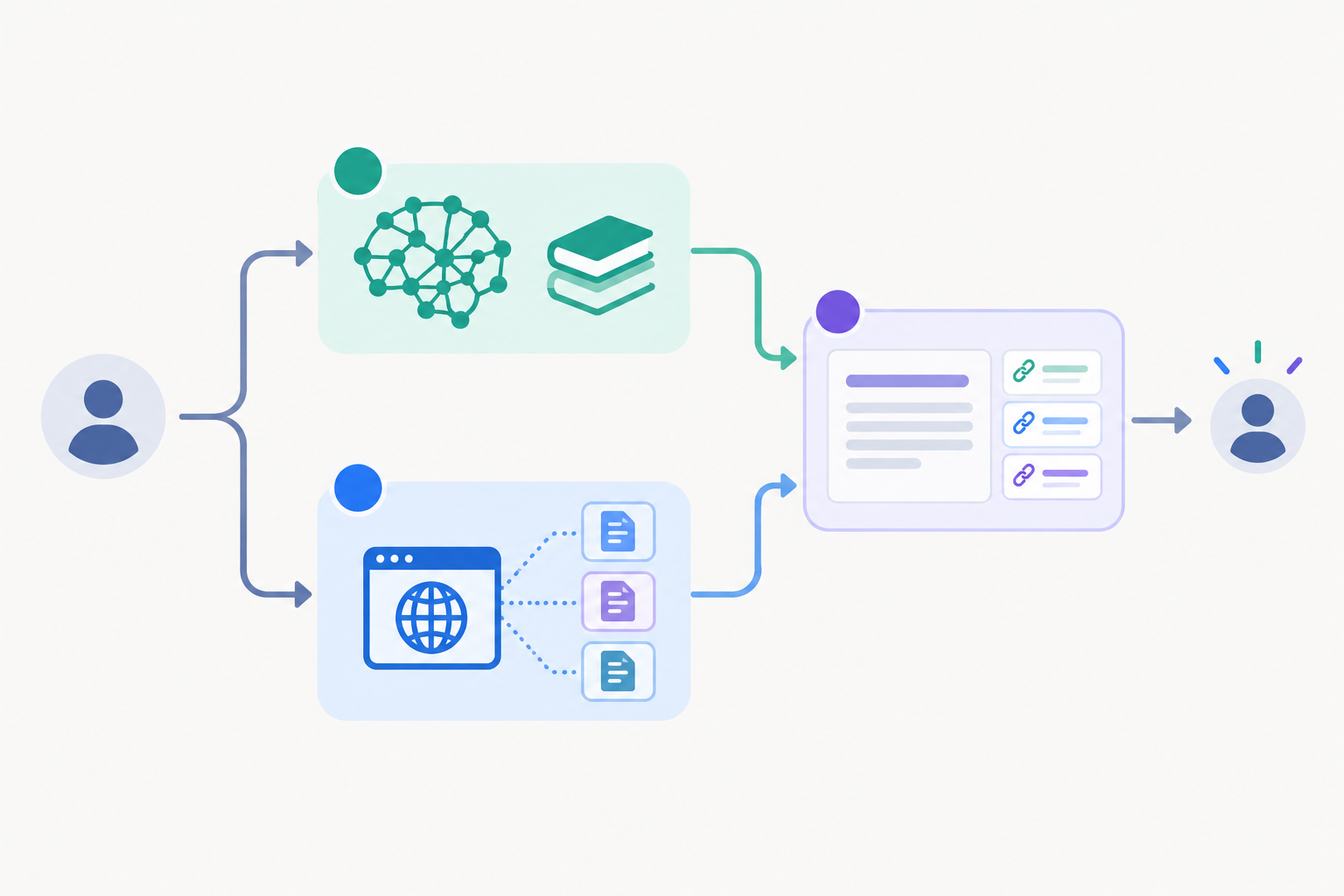
ChatGPT works in two layers. The first is parametric knowledge, which is what the model learned in training. The second is live retrieval through ChatGPT search, launched on 31 October 2024. Documented: ChatGPT may search automatically when a question would benefit from current information, or the user can request a search. When search is used, answers can carry inline citations and a sources panel. When it is not, the answer comes from learned knowledge and may have no citations at all.
When ChatGPT search is likely to trigger
OpenAI does not publish a trigger list, so what follows is observed inference. Queries about current pricing, recent releases or comparisons of named products tend to prompt retrieval. Broad, evergreen questions tend to be answered from memory. A query like 'what is a good project management tool for a ten-person agency' may lean on what the model already associates with your category, while 'compare Tool A and Tool B pricing' is far more likely to pull live pages.
What ChatGPT citations tend to favour
Observed: in our monitoring, ChatGPT citations lean towards established publishers, review sites, product documentation and well-structured comparison pages. Third-party citation studies point the same way, but their percentage breakdowns depend on the query set, the date and the product mode tested, so I would not quote any single figure as a rule. My reading is that a polished brand site on its own rarely supplies the independent evidence these systems seem to look for. OpenAI also says it works with search providers and content partners, which strengthens the case for getting coverage in sources those partners already index.
There is a technical eligibility step to check first. Documented: OpenAI publishes separate crawlers. OAI-SearchBot is used to surface sites in ChatGPT search, and GPTBot is associated with model training. You can allow one and disallow the other in robots.txt. If you or your CDN block OAI-SearchBot, you have removed yourself from search consideration however good the content is. Allowing it is necessary but not enough on its own.
Why consistent brand descriptions matter in AI search
When a user names no brand, the model draws on what it has absorbed about categories and companies. If your homepage, review profiles, directory listings and press coverage describe you in conflicting ways, the picture gets blurry. Specific, consistent statements of what you are, who you serve and how you differ make both recall and retrieval easier.
Perplexity's real-time AI search approach
Perplexity describes itself as an answer engine. It searches the web, synthesises what it finds and shows numbered, clickable citations alongside the answer. That answers the question many readers ask first: does Perplexity cite differently from ChatGPT? Yes, by design. Perplexity makes live retrieval and visible attribution central to nearly every query. ChatGPT cites only when its search feature is used, and the system decides when that is, so its attribution is more selective.
Which sources Perplexity tends to cite
Observed, and reported in third-party studies: Perplexity answers often draw on recent articles, forum discussions (Reddit appears frequently), YouTube and technical documentation. Proportions vary by topic and study, so treat this as a hypothesis to test for your category. In practice, Perplexity tends to reward current, clearly structured pages that answer the question directly, and it often surfaces community validation next to editorial coverage.
Why smaller brands may gain visibility faster in Perplexity
Because Perplexity retrieves at query time, a well-structured, recently updated page can be selected without years of presence in training data. Documented: Perplexity describes two agents. PerplexityBot discovers and indexes content, and Perplexity-User fetches pages in response to user requests. Check robots.txt and server logs for both rather than assuming one rule controls every form of access.
In our experience, content changes can show up in Perplexity within days, but that comes from our own tests and is not a guarantee. It does make Perplexity a good testing ground: publish a clearer comparison page, then see whether the citations change. Whether that signal carries over to ChatGPT or Gemini is a separate question to measure, not assume.
Gemini's integration with Google's search index
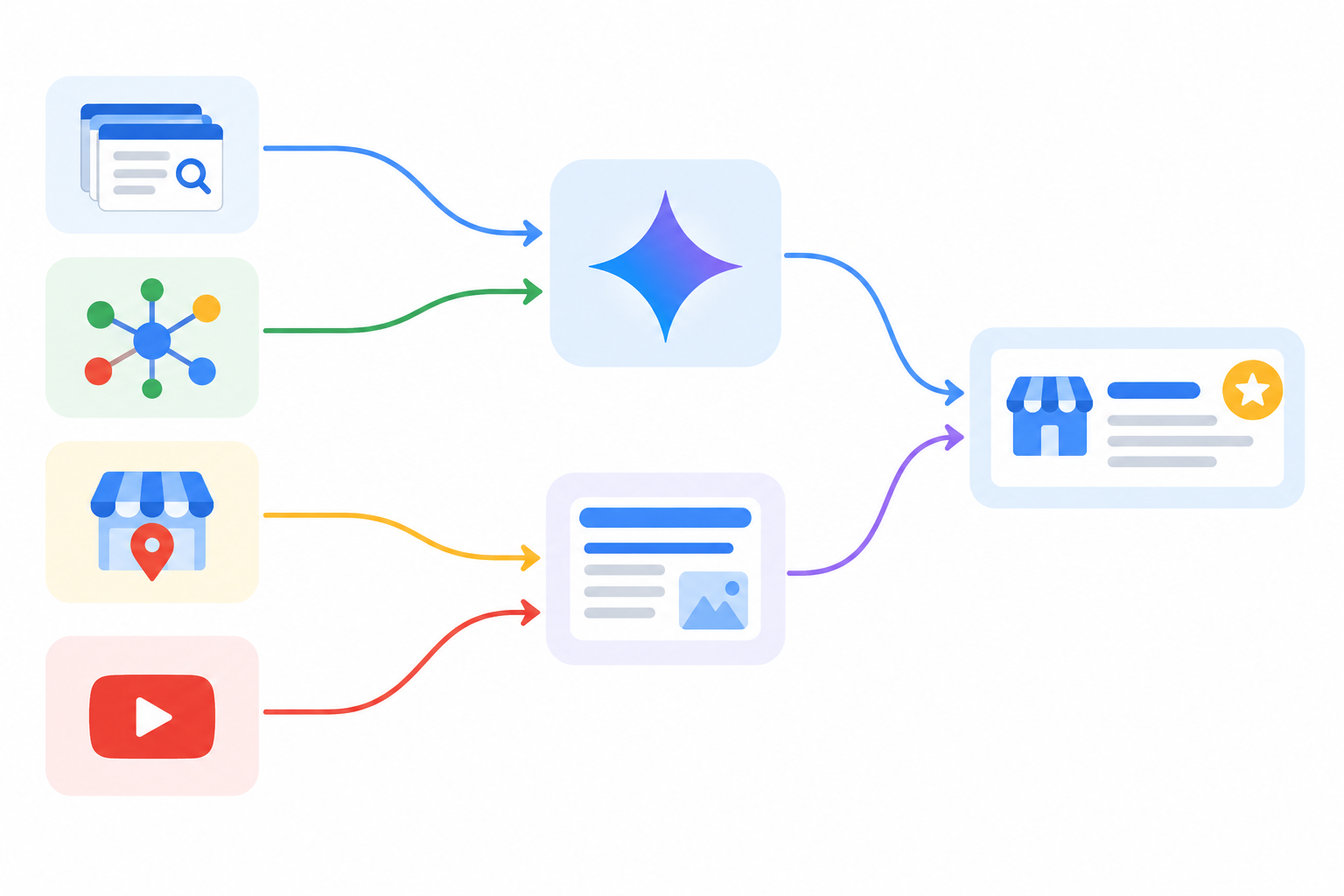
'Gemini' covers more than one surface, and the evidence differs for each, so I treat them separately.
AI Overviews and AI Mode (Google Search). Documented: Google's guidance on AI features says these features use Gemini models alongside Search systems, and that AI Mode can use query fan-out, which means issuing multiple related searches across subtopics and then synthesising the results. One question can therefore reflect several search paths, which rewards pages that cover a topic's adjacent questions. Google also states there are no additional technical requirements or special schema for these features beyond being indexed and eligible to appear in Search with a snippet. Its advice favours people-first content, key information available as text, and structured data that matches visible content. Indexing does not guarantee inclusion, but an unindexed page has no chance.
The Gemini app. Documented: it can use Google Search grounding to give web-based answers with links, and Google cautions that a linked source may not support every claim. Not every answer in the app is necessarily search-grounded.
It is tempting to go further and say that Business Profile, YouTube or E-E-A-T-style signals directly determine inclusion. I have not seen public evidence of that. They are sound foundations for Search performance and entity clarity, so treat their effect on AI answers as a hypothesis to test, especially for local queries.
Gemini and AI search: scale and UK considerations
Reported by Google: AI Overviews reached 1.5 billion monthly users and the Gemini app passed 400 million monthly active users, both in May 2025. They measure different things and cannot be compared directly.
Google also announced in 2025 that AI Overviews were expanding to more than 200 countries and territories. Availability does not imply identical behaviour everywhere, so run your queries from a UK location, record the results and verify what UK users actually see.
One data point should temper any rush to celebrate visibility. A Pew Research Center analysis (July 2025) of US Google users found that people clicked a traditional result in 8% of visits where an AI summary appeared, against 15% without one, and clicked a link within the summary in about 1% of visits. It is US data, not UK, but it shows why being named is not the same as being visited.
ChatGPT vs Perplexity vs Gemini: AI search comparison
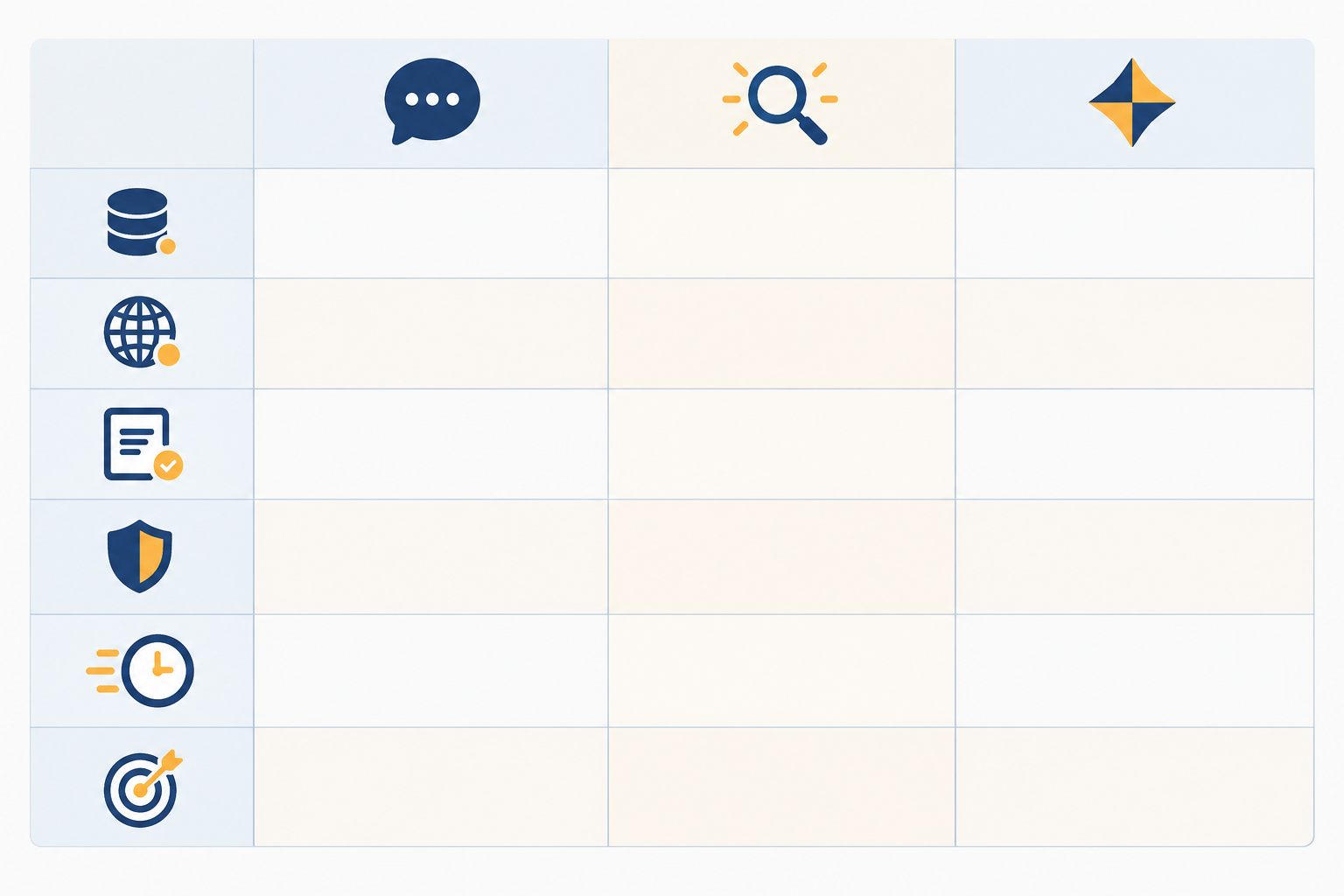
The table shows typical patterns, not guarantees. The first three rows rest largely on vendor documentation. The last four combine documentation with my own observation.
| ChatGPT | Perplexity | Gemini | |
|---|---|---|---|
| Primary knowledge source | Training data plus selective search | Live web retrieval | Google's index; the app may also use grounding |
| Live retrieval | When the system judges it useful, or the user asks | Most queries | Search-based for AI Overviews and AI Mode; varies in the app |
| Citation visibility | Inline links and sources panel when search is used | Numbered citations on most answers | Links in AI Overviews; links in the app when grounded |
| Typical source-type lean (observed) | Publishers, review sites, documentation, comparison pages | Recent articles, forums, video, documentation | Pages that already perform in Search |
| Typical speed of influence (observed) | Slower for recall; faster when search triggers | Often fastest, sometimes days | Tied to crawl and index cycles |
| Closest SEO analogue | Brand authority and digital PR | Freshness and answer-focused pages | Technical and on-page SEO |
| First action | Confirm OAI-SearchBot access; build third-party coverage | Publish and refresh clear comparison and FAQ pages | Confirm indexing and structured data accuracy |
Audience figures are not like for like. Reported: ChatGPT had 400 million weekly active users (OpenAI, February 2025), the Gemini app 400 million monthly active users (Google, May 2025), and Perplexity handled about 780 million queries in May 2025 according to its CEO. Weekly users, monthly users and queries cannot be ranked against each other, so use them as context rather than a league table.
A worked example: how the engines might source an answer
To show how the differences play out, imagine a fictional UK invoicing tool, 'LedgerLark', and a buyer in Manchester asking: 'best invoicing software for a five-person UK agency'. This is a hypothetical, built to show what to record when you run a real test.
- ChatGPT might answer from memory with a short list of well-known brands. LedgerLark appears only if the model already associates it with UK agencies, and without a search there may be no citations to inspect. The action is to fix descriptions and earn independent coverage.
- Perplexity might retrieve a recent roundup, a forum thread and a pricing page, then cite all three. LedgerLark appears only if one of those pages mentions it. The action is to publish a dated, specific comparison page with £ pricing and VAT handling, and to seek inclusion in the roundups being cited.
- Gemini in AI Overviews might reflect pages that already rank for related queries. LedgerLark appears only if its pages are indexed and relevant to the fan-out searches. The action is to confirm indexing and cover adjacent questions such as MTD for VAT compatibility.
On a real run, log the query, location, date, engine surface, and which brands and sources appeared or were omitted. Repeat it over several days before drawing conclusions.
Which AI search engine matters most for your industry?
Choose engines by how your customers discover and evaluate products, not by a popularity ranking. These are starting hypotheses, and each comes with a way to validate it:
- B2B SaaS: research-heavy buyers may use ChatGPT and Perplexity for shortlists and comparisons. Validate: add 'which AI tools did you use?' to your demo-booking form for a month.
- DTC and ecommerce: Gemini's closeness to Google Search and Shopping may make it important, alongside ChatGPT's shopping features. Keep attributes, prices, availability and returns policies consistent across your site and feeds. Reported: Adobe Analytics found US retail traffic from generative AI sources up 1,200% in February 2025 versus July 2024, from a small base. Validate: segment AI referrals by landing page in your analytics.
- Developer tools: documentation, GitHub and community sources may weigh heavily in Perplexity and ChatGPT answers. Validate: check which docs pages appear in citations for technical queries.
- Local or UK-focused brands: Google's ecosystem, including Business Profile, may matter more. Validate: run local-intent queries from a UK location and compare results across surfaces.
How to check your own audience
Three sources beat guesswork. First, review AI referral traffic in your analytics, ideally with cookieless analytics that attribute visits where referrers go missing, which also suits UK privacy rules on consent. Second, ask new customers and prospects which assistants they used. Third, review query-level visibility data to see where you appear and where competitors dominate.
A prioritisation rule for AI search investment
Weight each engine by audience usage, visibility gap against rivals, and cost to improve. High usage, a large gap and low cost goes first. Gartner forecast in 2024 that traditional search volume would fall 25% by 2026 as users shift to chatbots and agents. It is a forecast, not an observed result, but it is a fair argument for measuring AI search now.
Should you optimise for all AI search engines at once?
Mostly yes, at the foundation level. Crawlable content, clear entity descriptions, third-party mentions, and comparison and FAQ pages that answer real buyer questions benefit every engine. Google says there is no special AI markup, and OpenAI and Perplexity both rely on crawlers and retrieval, so this is where most of your return should sit.
Start with an AI legibility audit you can run yourself:
- Check robots.txt and CDN rules for OAI-SearchBot, GPTBot, PerplexityBot, Perplexity-User and Googlebot.
- Confirm key pages are indexed in Google Search Console.
- View pages with JavaScript disabled to confirm that pricing and product details render as text.
- Validate structured data against visible content.
- Check that your brand description matches across your site, review profiles and listings.
Fixing a blocked crawler or an unrendered pricing table helps every engine at once. Engine-specific work comes second: freshness for Perplexity, Google signals for Gemini, brand authority for ChatGPT. The risk is fragmentation. Chasing quirks that may vanish after the next update dilutes effort better spent on quality that lasts.
Building a multi-engine AI search monitoring strategy
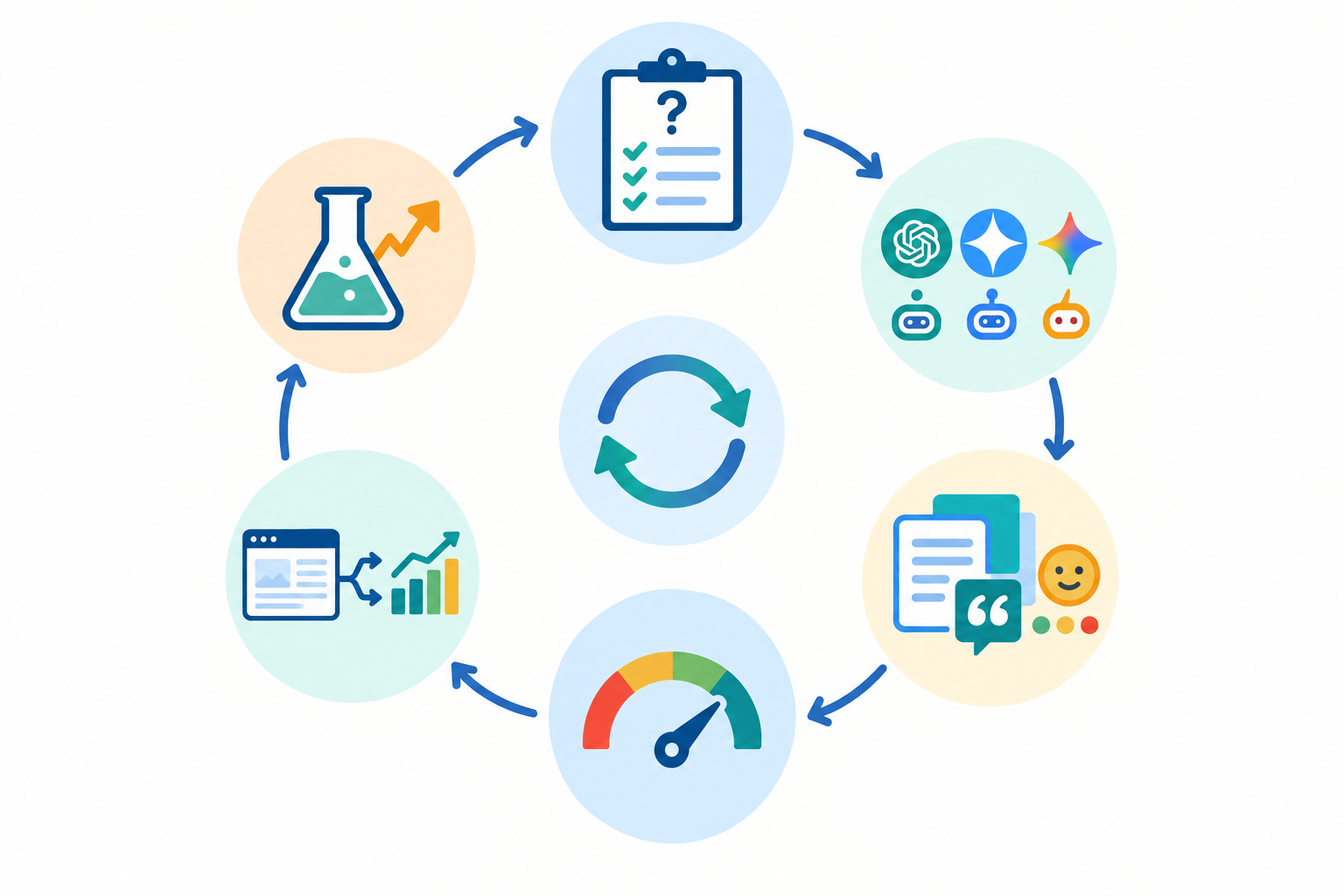
Answers vary between runs, so one manual check is an anecdote, not a measurement. A repeatable process looks like this:
- Define the real questions. List the prompts customers use: category ('best X for Y'), comparison ('A vs B') and alternatives ('alternatives to A'). Mine sales calls and support tickets for the wording.
- Run them consistently. Use the same prompts, location and settings across ChatGPT, Perplexity and Gemini. Daily runs help, but frequency alone does not make results statistically reliable. Fixed prompts, logged settings and enough repeats per prompt matter more, and you should report appearance rates, not single outcomes.
- Record the detail. Capture citations, sentiment, competitor mentions and position, and track share of voice against named rivals. Check accuracy too, since being described wrongly can be worse than being absent.
- Combine results into one score. A composite index, typically built from query coverage, position-weighted citations, share of voice and soft mentions, makes progress easier to track. Whatever method you use, document the weights so the number stays comparable over time.
- Link mentions to visits. Given the Pew finding that source-link clicks are rare, pair visibility data with cookieless AI traffic analytics to see whether visibility produces sessions.
- Review weekly and experiment once. Find the engine with the largest gap, then run one focused content experiment at a time so you can attribute any change.
Common mistakes when comparing AI search engines
- Treating one prompt as representative. A single screenshot proves little.
- Assuming Google rankings translate directly into ChatGPT citations, or the reverse. They overlap through shared sources, but the systems differ.
- Ignoring sentiment and accuracy. An inaccurate mention can quietly cost sales.
- Overlooking competitor tracking. Seeing which rivals win the citations you want shows which sources and formats to target.
- Optimising for one engine's quirks. Tactics tied to a single interface expire, whereas accurate, evidence-rich content that others independently validate keeps working.
FAQ: AI search and answer sourcing
Which AI engine should I prioritise first?
Start where your buyers already are. Check analytics for AI referral traffic and ask recent customers which assistants they use. Without that data, baseline all three. Depending on your market and query types, Perplexity may show changes sooner because it retrieves live content, while ChatGPT may reach more of your audience, but neither is a safe assumption until you measure it.
Does Perplexity cite sources differently than ChatGPT?
In design, yes. Perplexity retrieves live web results for most queries and shows numbered citations consistently. ChatGPT searches when it judges it useful and may answer from training knowledge with fewer visible sources.
How does Gemini's search integration change things?
AI Overviews and AI Mode are built on Google Search systems, so indexing, accurate structured data and strong traditional SEO are prerequisites. The Gemini app can use search grounding but does not always, so monitor the app and Google's AI search features separately.
Should I optimise for all engines at once?
Build the shared foundations first: crawlable pages, consistent brand descriptions, comparison content and third-party mentions. Then add engine-specific work only where monitoring shows a meaningful gap.
How often do AI engines change how they source answers?
Frequently. Models, retrieval systems and citation interfaces are updated often, which is why continuous monitoring is more reliable than a one-off study.
Want a baseline without building the process yourself? MentionOwl can crawl your site, generate buyer questions and track visibility across engines; a 7-day trial is available from $1.