Why Being Mentioned by AI Isn't Enough: How Sentiment Shapes Your Real AI Visibility Score
Mention counts tell leadership nothing about brand perception. Learn how sentiment analysis across ChatGPT, Gemini, and Perplexity reveals whether AI
Why AI Mentions Aren’t Enough: How Sentiment Shapes Your Real AI Visibility Score
Meta description: Raw AI mention counts can mislead UK marketing teams. Learn why sentiment, recommendation strength, citations and share of voice matter more for AI visibility and brand monitoring.

A high mention count from ChatGPT, Gemini, or Perplexity means almost nothing on its own. The short answer: sentiment, recommendation strength, and citation quality determine whether AI visibility drives consideration and revenue — not raw frequency. Over the past year, I've reviewed several hundred AI-generated responses across client accounts — an informal, non-random sample rather than a peer-reviewed study, but a pattern consistent enough to take seriously — where a brand appeared prominently, was named early and was named often, yet was framed as a cautious second choice, a budget alternative, or something considerably worse.
This is why any serious brand monitoring approach for AI platforms needs sentiment scoring sitting alongside share-of-voice data, not bolted on afterward as a footnote for the marketing team to mention if someone asks. But I want to be upfront about a limitation in how this topic usually gets discussed, including in earlier drafts of this piece: sentiment alone is not a complete measurement model. It tells you tone, but not position, citation quality, or whether the AI is actually recommending you rather than merely describing you. I'll walk through why the mention-versus-sentiment distinction matters, what produces negative tone in AI-generated answers, and how to build a fuller reporting structure — one that goes beyond sentiment alone — so leadership gets an honest picture rather than a flattering one.
Why AI Visibility Matters More in the UK Market
The UK presents a particular version of this problem. British consumers have historically been heavy users of third-party review platforms — Trustpilot, founded in Denmark but headquartered in London, built much of its early scale on UK retail and services reviews — and that review volume increasingly becomes training and retrieval material for AI engines regardless of whether a brand actively manages it. Industry surveys on local search behaviour, such as BrightLocal's Local Consumer Review Survey, have repeatedly found that the overwhelming majority of consumers read online reviews before choosing a local business. UK respondents also consistently show some of the highest reliance on review content in comparative international surveys.
If your sector is subject to UK advertising standards, the ASA's guidance on misleading claims applies to how you respond to AI-driven mischaracterisations too. A defensive PR statement can create more regulatory exposure than a quiet content correction. For UK marketing teams, this means AI visibility reporting needs to account for a reviews-heavy information environment and a regulatory backdrop that rewards factual correction over reputational spin.
The Vanity Metric Trap: Why Raw AI Mention Counts Mislead Leadership
Mention frequency correlates weakly with purchase intent once framing is properly accounted for. A brand named 40 times across a set of AI queries can underperform a competitor named just 15 times, purely because the competitor's mentions are direct, confident, and unhedged, while the higher-volume brand's mentions are wrapped in comparative qualifiers or positioned as the fallback option.
This mirrors a long-established principle in social listening research. Brandwatch's social listening benchmarking work and Nielsen's brand equity studies have both argued, in different ways, that share of voice — the relative measure of how often a brand appears versus competitors — tells you nothing on its own about whether that appearance was a recommendation, a criticism, or an incidental example buried in a longer answer. Treat the specific figures below as illustrative rather than universal; AI platforms update constantly, and any benchmark is a snapshot, not a constant.
Here's an illustrative example drawn from patterns I've observed repeatedly across client audit work, not a single controlled study: two brands with near-identical mention volume can show visibility score gaps of 20 points or more once sentiment weighting is applied. Picture a hotel mentioned 40 times across “best hotels in London” queries, where 25 of those answers surface complaints about cleanliness or hidden fees. That hotel has high raw visibility paired with weak effective visibility. A competitor mentioned only 20 times but recommended in 18 of those answers holds a dramatically stronger commercial position, even though its raw mention count is lower.
This matters for how leadership reads reporting decks. A simple “we were mentioned X times this month” slide creates false confidence because the metric hides tone entirely. In my view, this is one of the riskiest habits in AI visibility reporting today — it sets leadership up to believe performance is strong right before a competitor's more favourably framed answer starts quietly winning the customers who matter.
Framing research on contrastive language is reasonably consistent on one point: a negative mention inside a high-intent prompt — “best,” “safe,” “reliable,” “worth it,” or “alternatives to” — tends to carry more commercial weight than several neutral mentions in low-intent, informational queries. Weighting by prompt intent isn't optional if you want the number to mean anything.
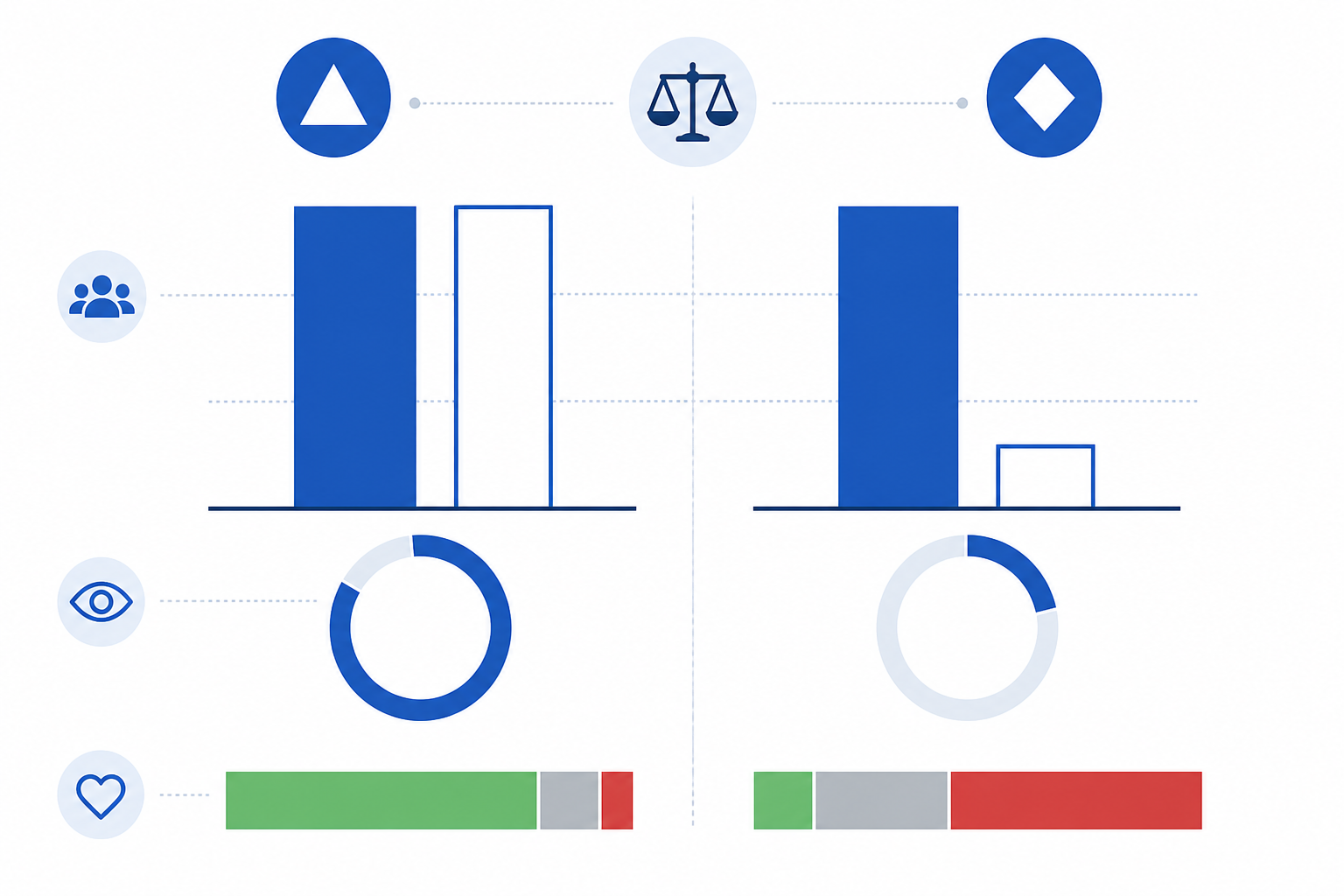 Alt text: Bar chart contrasting two brands with identical mention volume but divergent sentiment splits, illustrating why raw mention count alone misrepresents commercial impact. Figures are illustrative examples for explanatory purposes, not verified client data.
AI Mentions vs Meaningful Recommendations: What’s the Difference?
A mention is any instance where an AI engine names your brand in response to a query, regardless of context or tone. A meaningful recommendation is narrower and more valuable: a mention positioned as the primary or confidently endorsed answer.
To be specific about thresholds rather than leaving this vague, a response typically qualifies as a meaningful recommendation when it meets most of the following criteria: the brand appears among the first two named options, the language is affirmative and unhedged, with no “but”, “although”, or “however” attached to the brand name, and the claim is backed by a source the AI explicitly points to or paraphrases closely. Mixed cases — where a brand is named first but immediately qualified — should be scored as partial recommendations rather than forced into either category. Treating every mention as binary loses exactly the nuance this analysis is trying to capture.
Soft mentions, where a brand appears inside a list without elaboration or comparative context, deserve meaningfully different weighting from citation-backed, position-one recommendations. This is the core argument for combining query coverage, position-weighted citations, sentiment, and share of voice into a single AI visibility scoring approach rather than treating every mention as equally valuable.
| Dimension | Mention | Meaningful Recommendation |
|---|---|---|
| Position in response | Anywhere, often mid-list or buried | Early, typically first or second named |
| Tone | Neutral, descriptive, or unexamined | Affirmative, confident, unhedged |
| Citation strength | Often uncited or weakly sourced | Backed by a clear, credible source the AI points to |
| Comparative framing | May be positioned as an alternative or fallback | Positioned as the primary answer to the query |
| Impact on consideration | Low — exposure without endorsement | High — functions as an implicit third-party recommendation |
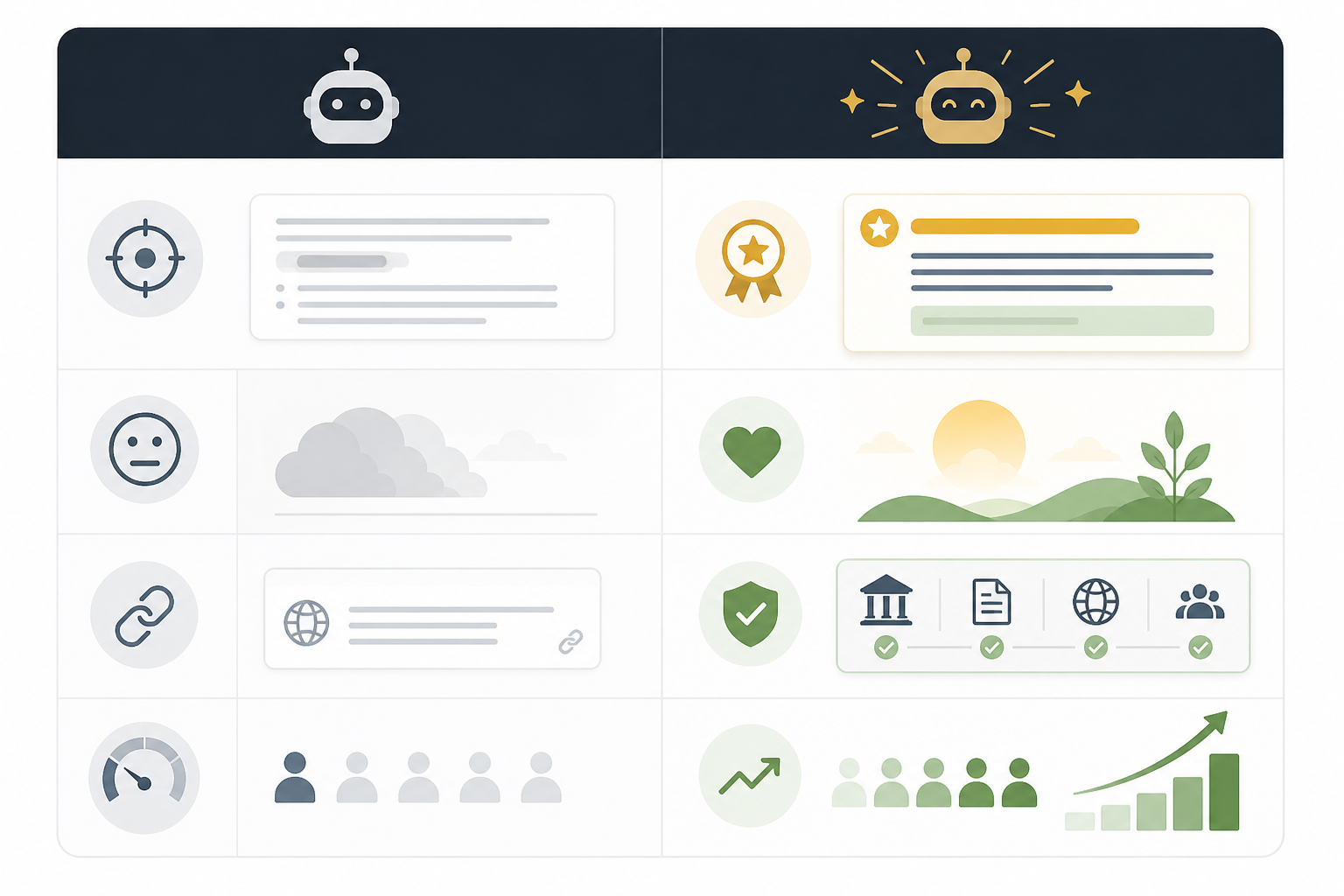 Alt text: Table comparing a generic AI mention against a meaningful recommendation across position, tone, citation strength, comparative framing, and consideration impact.
Beyond Sentiment: Build a Fuller AI Visibility Scorecard
It's worth stating plainly: sentiment is necessary but not sufficient. A response can be positively worded and still commercially weak if it is buried in position four, uncited, or answering a low-intent query that nobody asks before buying. A complete AI search visibility scorecard, in my view, needs to track at least these dimensions separately before any blending happens:
- Mention rate — how often the brand appears across a representative query set.
- Position — where in the response the brand appears, since first-named answers get disproportionate attention.
- Recommendation stance — whether the mention functions as an endorsement, a neutral description, a comparison, or a criticism.
- Sentiment — the tone of the language used, independent of position or stance.
- Query intent — whether the query signals purchase readiness, such as “best” or “worth it”, versus general research.
- Citation quality — whether the AI is pointing to your own current content or outdated or third-party sources.
- Factual accuracy — whether the response contains claims that are simply wrong, which needs correcting regardless of tone.
- Competitor-relative performance — how your scores compare to named competitors across the same query set, since an isolated trend line tells you less than a relative one.
A defensible way to combine these into a single leadership-facing number is a weighted average rather than an opaque black box. For example, score each dimension from 0–10, apply heavier weights to position, stance, and query intent, and publish the weighting alongside the output so stakeholders can interrogate it rather than simply trust it. The exact weights should be documented and revisited periodically. I'd treat any tool that produces a single AI visibility score without disclosing its formula with some scepticism, including tools I use myself.
A labelled example, not a universal claim: Across a sample of accounts I've monitored, brands with near-identical mention rates but a 15-point gap in combined position-and-stance scoring showed meaningfully different conversion patterns from AI-referred traffic over a three-month window. This is a single observational pattern from a limited, non-random sample — useful as a hypothesis to test on your own data, not a guarantee of the same result elsewhere.
Can AI Say Something Technically True but Still Negative?
One of the more uncomfortable realities in AI visibility monitoring is that AI can say something technically true and still damage your brand's consideration. The statement doesn't need to be false to hurt you — it just needs the wrong framing. Here are recurring patterns, annotated the way an analyst should classify them.
Example response: “X is an option, though many users report it's better suited to larger teams.”
- Sentiment: Mildly negative, via the word “though”.
- Stance: Hedged recommendation, not a clear endorsement.
- Position: Assume named second.
- Caveat: Team-size suitability — factually defensible, commercially damaging if your buyer is a small business.
- Commercial impact: Moderate-to-high for SMB-focused brands, low for enterprise-focused ones.
Comparative subordination: “Y is the most popular choice, though X offers a cheaper alternative.” Your brand appears, but only in the competitor's shadow. The stance here is “fallback”, not “recommended”, regardless of positive-sounding words such as “cheaper”.
Caveat-stacking: This involves pairing your brand name with multiple qualifiers, such as “limited support”, “steeper learning curve”, or “fewer integrations”, even when those caveats are outdated or exaggerated relative to your current product. This is a citation-quality problem as much as a sentiment issue — it usually means the AI is pulling from stale source material.
Omission framing: These are technically true statements that leave out your strongest differentiators simply because the AI hasn't indexed content that clearly states them.
I've seen brand case-study language that was more positive than anything an AI engine was generating about the same company — not because the brand's reputation was genuinely poor, but because the model wasn't citing the right source material. This is consistent with a well-documented pattern in framing research: contrastive structures using words such as “but”, “although”, “despite”, or “however” make negative attributes disproportionately memorable, even when every individual fact in the sentence is accurate.
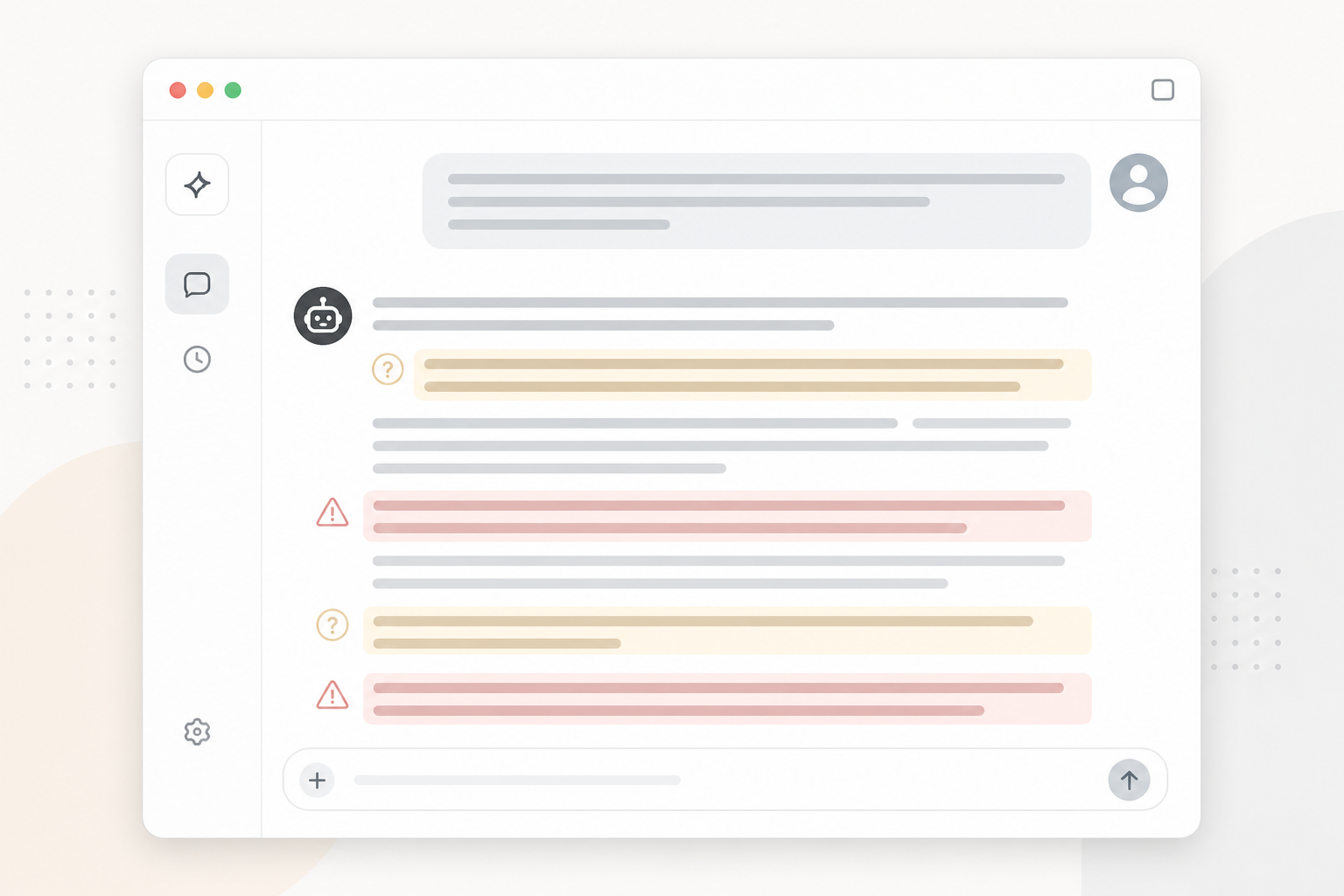 Alt text: Mock AI chat response for a fictional brand, with hedging words like “though” and “however” highlighted to show how factually accurate text can still read as a weak recommendation.
How AI Tone Is Determined Across Different Platforms
Understanding why sentiment skews the way it does requires separating several distinct mechanisms. They don't all work the same way across platforms, and conflating them leads to overconfident claims.
Pretraining data composition. The proportion of positive versus critical content about your brand across forums, review sites, and news coverage that a model absorbed during training shapes its default framing, somewhat independently of anything happening on your website today. This effect is strongest for information baked into the base model and weakest for platforms that lean heavily on live retrieval.
Live retrieval in RAG-based systems. Platforms such as Perplexity, and Microsoft Copilot in many configurations, generate answers grounded in documents retrieved at query time. The specific pages cited can therefore shape sentiment directly. If your site lacks fresh, authoritative content addressing a given query, stale or negative third-party pages may be surfaced instead, and the model can inherit their framing. This doesn't apply uniformly: not every AI product uses the same retrieval architecture, and retrieval behaviour changes with product updates.
Prompt phrasing. Comparative queries such as “is X better than Y?” tend to produce more hedged, qualified language than direct queries such as “recommend a tool for X.” The same brand can receive noticeably different tone depending purely on how the question was asked, which is why query-level analysis matters more than aggregate sentiment scores.
Recency bias. Several AI engines appear to favour more recently indexed content, though the degree and mechanism vary by platform and are not always publicly documented. Outdated pricing pages, old complaints, or stale case studies can anchor sentiment downward even when your current offering has improved, simply because the model or its retrieval index has not caught up yet.
Aggregated third-party review sentiment. Several engines appear to weight review-site sentiment when forming comparative judgments between competing brands. This is worth treating carefully: AI output reflecting aggregated review sentiment is not the same as genuine public opinion, since review populations skew towards people with strong positive or negative experiences rather than the average customer.
BrightLocal's Local Consumer Review Survey has repeatedly found that the large majority of consumers read online reviews before choosing a local business. That volume of content becomes training and retrieval material whether a brand actively manages it or not, even though it is not a statistically representative sample of all customers.
The upshot is that tone is rarely about whether your brand is “good” in some abstract sense. It is about what content the model has been exposed to, through which mechanism, how recently, and how that content was framed relative to competitors. Those mechanisms differ enough by platform that a single explanation rarely covers all five major engines.
How to Build Sentiment Tracking Into Your AI Visibility Reporting
Once you accept that sentiment, stance, and share of voice need to be reported together, the question becomes operational: how do you build this into a reporting cadence that leadership can rely on? Here's a sequence that works, along with a simple scoring rubric you can adapt regardless of which monitoring tool you use.
- Establish a baseline across the major engines — ChatGPT, Claude, Gemini, Copilot, and Perplexity — before making any content changes. Sentiment varies by platform because of differing training data and retrieval methods, so a single-engine baseline can mislead you.
- Segment by query type. Purchase-intent queries, comparison queries, and general informational queries each produce distinct tonal patterns and deserve separate tracking lines rather than being averaged together.
- Pair sentiment scores with competitor tracking data. Leadership needs relative positioning, not just whether your own sentiment moved up or down in isolation. A flat sentiment score that is still well ahead of competitors tells a very different story from a flat score that is falling behind.
- Build trend lines into a weekly or fortnightly digest rather than treating this as a one-off audit. Model updates and re-crawls can shift tone within days or weeks depending on the platform.
- Translate the full scorecard into a single leadership-friendly number from 0–100, but publish the weighting formula alongside it. A sample rubric is Position (25%), Recommendation Stance (25%), Sentiment (20%), Query Intent Weighting (15%), and Citation Quality (15%). Executives need one number they can track over time, but it has to be a number whose construction is visible rather than a black box that hides the underlying nuance.
A note on methodology: I use a platform called MentionOwl that automates this kind of daily multi-engine query testing in my own work, and the rubric above reflects how it approaches the problem — but the method itself doesn't depend on any specific tool. The same logic can be built manually with a spreadsheet and a consistent query list if you're testing this on a smaller scale first.
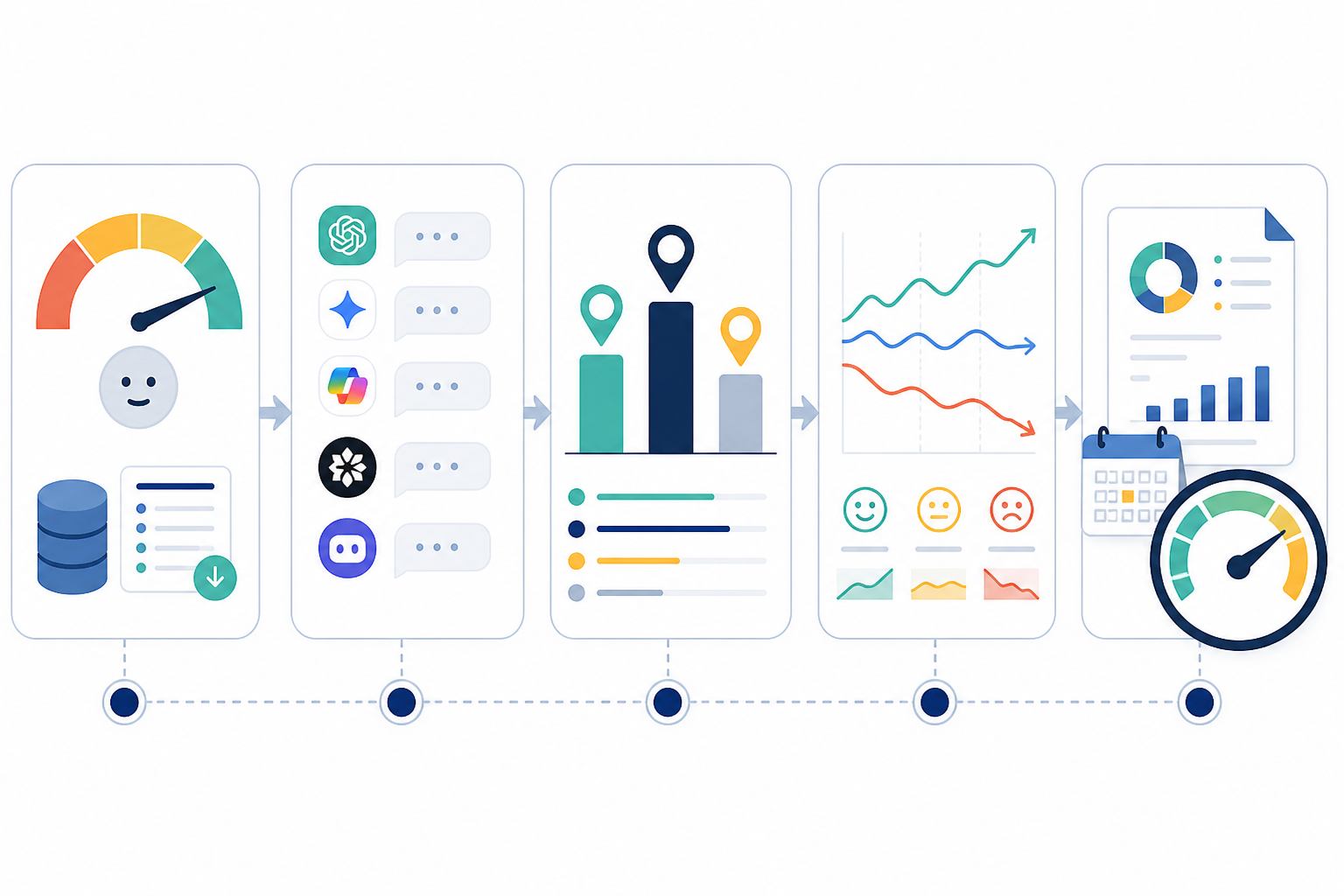 Alt text: Five-step flow diagram showing baseline capture, query segmentation, competitor pairing, weekly trend tracking, and a final weighted visibility score.
How to Respond When AI Sentiment Turns Negative
When sentiment data comes back negative, the instinct in many marketing teams is to treat it as a reputational emergency. In my experience, that instinct is almost always wrong — but the right response depends on verifying what is actually happening first. A simple decision sequence is:
- Verify the underlying claim. Is the AI's criticism factually accurate? If your product genuinely has a weaker feature set in a given area, the fix is product or pricing, not content.
- If the claim is outdated or false, identify the source. Audit which pages the AI engines are actually citing when sentiment is negative, then update or supersede those specific pages with clearer, more current language that addresses the caveat directly rather than avoiding it.
- Rule out a technical indexing problem. Poorly structured pages, missing schema, or thin content can cause AI engines to default to outdated third-party sources instead of your own site. A legibility audit — checking how cleanly your pages can be parsed and cited by AI crawlers — is worth running before assuming the issue is reputational.
- Publish transparent, evidence-based content rather than purely promotional rebuttals. If “expensive” keeps surfacing and your pricing genuinely is higher, a clear comparison page explaining the value difference will do more than a page that simply asserts you are not expensive.
- Track sentiment after the change with realistic timelines. Re-crawl and retraining timing varies meaningfully by engine. Some retrieval-based platforms can reflect updated source content within days, while shifts tied to base-model training can take considerably longer. Measure in weeks, not days, and don't assume a single audit closes the loop.
Resist treating negative AI framing as a PR crisis requiring a public statement in most cases. The AI isn't reporting public opinion in any statistically rigorous sense — it is reflecting what it has retrieved or been trained on, which is a narrower and sometimes less representative thing than “what customers think”.
Frequently Asked Questions About AI Visibility and Sentiment
Can AI say something technically true but still be negative for my brand?
Yes, and this is one of the most common blind spots in AI visibility reporting. An AI engine can describe your product accurately while still framing it as the more caveated or less confident choice compared with a competitor. The statement does not need to be false to damage consideration — it simply needs to be framed with hedges, qualifiers, or subordinate positioning relative to another brand. This is why stance and position need to be tracked separately from sentiment, rather than assuming positive wording automatically means a positive commercial outcome.
How do I measure sentiment consistently across multiple AI platforms?
You need a standardised scoring methodology applied identically to responses from ChatGPT, Claude, Gemini, Copilot, and Perplexity, since each platform has different training data, retrieval behaviour, and update cadence. Whether you build this manually with a fixed query list and a shared scoring rubric or use a monitoring tool that automates daily querying across engines, the key requirement is consistency: the same queries, the same scoring criteria, and a fixed schedule. This allows you to compare tone on equal footing rather than relying on manual spot-checks that vary by reviewer and by day.
What typically causes negative sentiment in AI-generated answers?
The most common causes are outdated or thin content on your own site that fails to clearly counter known objections, strong competitor content that AI engines cite more readily, aggregated negative review sentiment from third-party sites, and recency effects where stale pages continue to anchor the model's output even after your product has improved. None of these mechanisms works identically across platforms, so a diagnosis that fits one engine may not explain another.
Can sentiment be improved without triggering a new PR crisis?
In most cases, yes, though it is best to avoid promising guaranteed or universal timelines. Sentiment shifts driven by AI citation patterns are typically addressed through targeted content updates and technical legibility fixes rather than public reputation management, provided the underlying criticism is not actually accurate. If it is accurate, the real fix is product or pricing, not messaging.
Identifying which pages the AI is citing, then clarifying or correcting that specific content, resolves a substantial share of negative framing issues over a period of weeks. Propagation speed varies by platform, however, and some cases take longer than others.
What if the AI’s claim is ambiguous, mixed, or simply hallucinated?
Not every negative-sounding response fits neatly into “true but badly framed” or “false and needs correcting”. Sometimes an AI engine blends an accurate detail with a fabricated one, or hedges in a way that does not map to any real source. In these cases, treat the response as a citation-quality problem first: identify whether the AI is citing anything at all.
If it is not, that absence itself is diagnostic. It suggests the model is relying on pretrained pattern matching rather than current retrieved content, which usually means the fix is publishing clearer, more citable source material rather than trying to correct a specific claim that has no traceable origin.