Share of Voice in AI Answers: The New Marketing Metric Leadership Actually Wants to See
Learn how to define, calculate and report AI share of voice in the UK, using AI visibility scores and brand monitoring to track performance over time.
AI Share of Voice: How to Define, Calculate and Report It
Meta description: A UK-focused guide to AI share of voice: how to define it precisely, calculate it with one clear formula, and report it in a way that survives scrutiny.

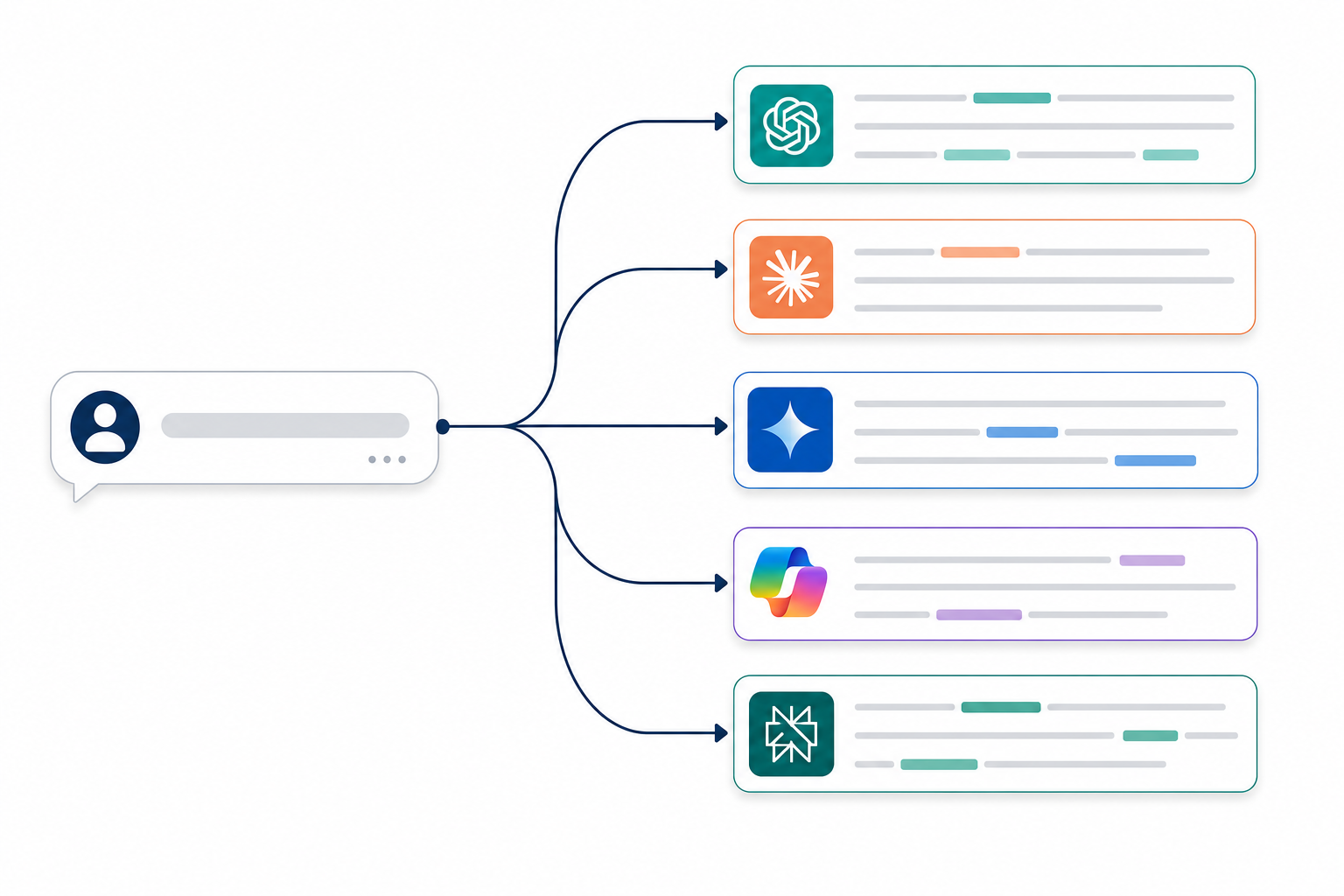
AI share of voice measures how often your brand is mentioned, cited or recommended in generative AI answers across ChatGPT, Gemini, Claude, Copilot and Perplexity. It compares your visibility with named competitors for the questions your buyers actually ask those systems.
The Recommended AI Share of Voice Formula
Mention share (%) = (your brand's qualifying mentions across the query set ÷ total qualifying mentions of all tracked brands across the same query set) × 100
Citation share, recommendation share, sentiment and weighted visibility are useful diagnostics that explain why mention share is moving. They aren't competing headline numbers. Put mention share on the leadership slide, then use the other measures to answer follow-up questions.
I've spent the past year pulling this data for UK marketing teams, and the pattern is consistent: boards that got comfortable with search share of voice as a proxy for competitive health are now asking what's happening inside ChatGPT and Perplexity. They want evidence, not anecdote.
This is a practical guide to AI share of voice: what it is, how to calculate it with a formula you can defend under questioning, and how to report it to a CFO who has never heard the term "generative engine optimisation".
A disclosure, upfront: I work on MentionOwl, a platform that automates parts of this measurement. I've kept product references to a single, clearly marked section below.
What Is AI Share of Voice in AI Answers?
"AI share of voice" gets used as if it were one number, but it's really a family of related measures with different denominators. Naming which measure you're reporting matters, because they can move in opposite directions and tell different stories about your AI visibility.
| Metric | Denominator | What it answers | When to lead with it |
|---|---|---|---|
| Mention share | All qualifying mentions of all tracked brands | Are we present relative to named competitors? | Primary KPI — the headline number |
| Citation share | All hard citations logged across the query set | Are we the source models actually link to? | Diagnostic — quality of presence |
| Recommendation share | Answers containing an explicit "best" pick | Are we the top pick, not just present? | Diagnostic — commercial strength |
| Answer presence rate | All tracked queries | Do we appear anywhere at all? | Coverage check, most forgiving measure |
| Weighted visibility score | Normalised 0–100 scale | Composite with positional weighting | Internal trend tool, not a cross-tool benchmark |
Within each measure, separate hard mentions (a direct citation with a link, or an explicit recommendation naming your brand) from soft mentions, where your brand is named in passing without being the primary answer. A soft mention might read "other options include [Your Brand]", buried at the end of a longer recommendation for someone else.
Log citation status, recommendation strength, answer position and sentiment as four separate fields per response, rather than collapsing them into one "mention" bucket. That collapse is where much of the confusion in AI visibility reporting starts.
The mechanics are straightforward: pull buyer-intent questions from real website content, support queries and category research rather than guessed keywords. Then run them repeatedly against major AI models and log each response against the fields above: mentioned, cited, positioned, and the tone the model took towards you and your named competitors.
Why Traditional Market Share Metrics Fall Short
Traditional market share metrics measure sales, revenue or category penetration. Traditional search share of voice measures keyword rankings and SERP feature ownership across a fixed, visible list of results. Neither was built to answer the question that now matters: when a buyer asks an AI system for advice, does it mention your brand?
Generative engines don't return a ranked list, so there's no visible position one versus position ten. Click-through-weighted search SOV models break down here. Instead, AI models compress reviews, forums, retailer pages and structured data into a single narrative answer.
Here's the available evidence, labelled by type so you can weigh it accordingly:
Methodological grounding, not a market audit: The 2024 GEO (Generative Engine Optimisation) paper from Princeton, Georgia Tech, IIT Delhi and the Allen Institute for AI (Aggarwal et al.) argues that because answers are synthesised rather than ranked, visibility needs to be measured at the level of the individual prompt and response. It tracks mention, position, recommendation and sentiment. The paper measures optimisation tactics against synthetic test answers, so treat it as strong grounding for how to measure, not as evidence of live market behaviour.
Observed evidence, narrow scope: Pew Research Center's 2025 analysis of Google search logs found that when a Google AI Overview appeared on a results page, users clicked through to a traditional web result in roughly 8% of visits, versus roughly 15% when no AI Overview appeared. That's a US-market finding about one product, not a global statement about all generative answers. It does, however, support the underlying point that a direct AI-generated summary can reduce clicks to underlying sources.
Forecast, not an observed outcome: Gartner's 2024 prediction that traditional search engine volume could fall by 25% by 2026 as consumers adopt AI chatbots is exactly that: a forecast from an analyst firm, not measured traffic. Treat it as a signal of where attention may be heading, not as something that's already happened.
In my experience running this data for UK teams, stable conventional market share can mask a shifting position in the AI consideration set well before it shows up in quarterly revenue. That's a hypothesis worth acting on early rather than waiting to prove, but it isn't yet a demonstrated causal chain.
The practical response, AI SEO or generative engine optimisation, is about optimising content and structured data for how models synthesise and cite sources, not just for how crawlers index pages. Measurement built for AI answers gives you evidence to act on that shift instead of guesswork.
How to Calculate AI Share of Voice
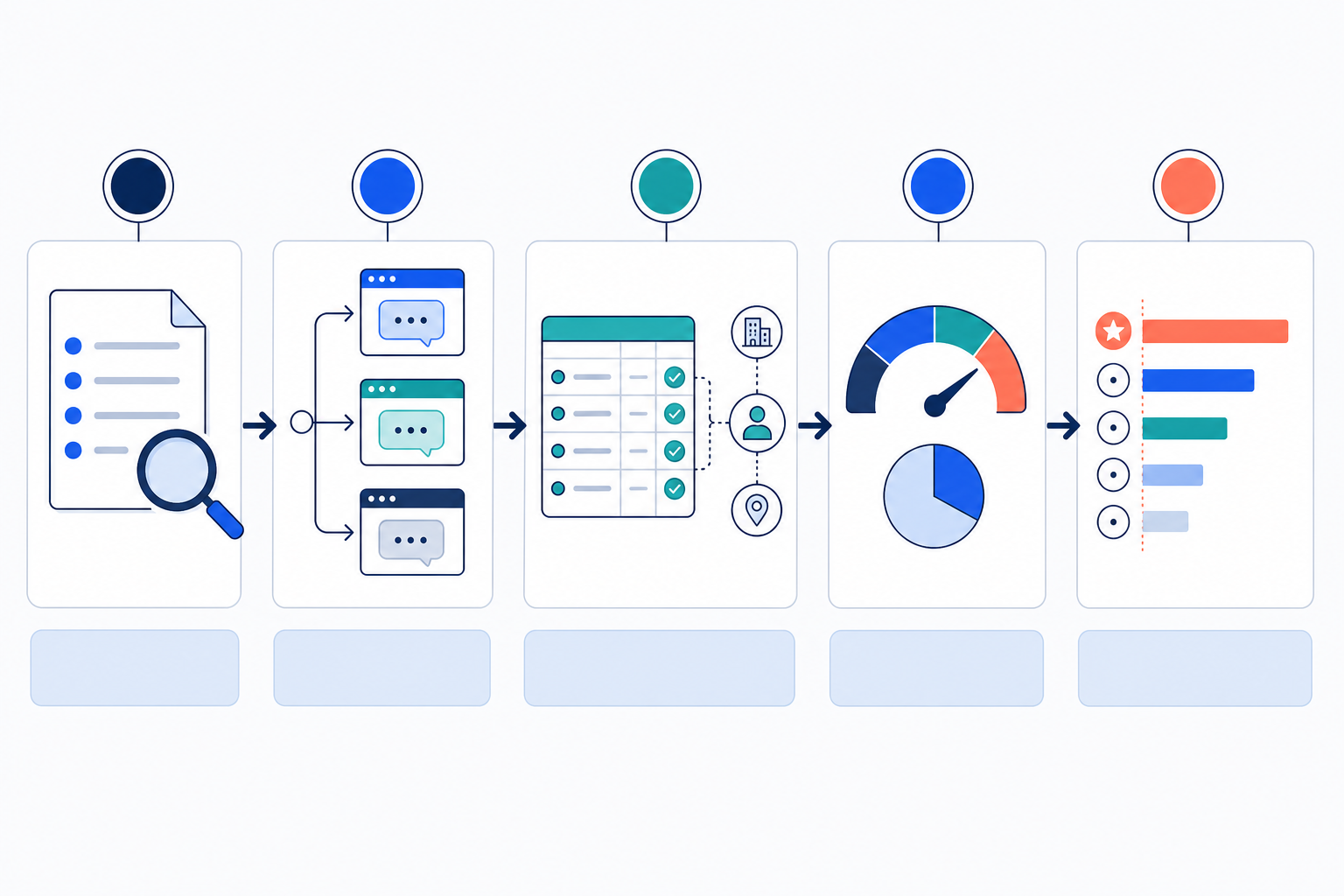
A vague formula is where much of the reporting on this metric falls apart under questioning. Use the following five-step process to build a repeatable AI share of voice measurement.
1. Define Your Competitor Set
Name three to six brands buyers would realistically compare you against for this query set. Anything outside that set stays out of the denominator. Include irrelevant brands and you'll inflate presence for matches that don't matter commercially.
2. Build and Stratify the Query Set
Source real buyer-intent questions from website analytics, support tickets and category research rather than guessed keywords. Stratify the queries into:
- Category questions, such as "best accounting software for UK freelancers"
- Comparison prompts, such as "alternatives to [category leader]"
- Direct brand checks, such as "is [Brand A] any good"
Aim for at least 20–30 distinct queries. With fewer, one changed answer can move your headline percentage by several points.
3. Run Controlled Prompts Across AI Platforms
Log the following for every run:
- Platform
- Model and version (GPT-4o and GPT-4.1, for example, may answer differently)
- Region and language setting
- Logged-in state
- Whether browsing or search grounding is enabled
- Exact prompt wording
- Timestamp
Run each query multiple times per session across several days, then average the results. A single day's answer is noise, not a finding.
4. Code Mentions, Citations and Recommendations
For every response, record whether each brand was mentioned, whether it was cited with a link, where it appeared in the answer, and what sentiment surrounded it.
Fix your entity-matching rules before you begin. Decide how to treat brand variants, parent and subsidiary names, and multi-line competitors, then apply those rules consistently.
If a query returns zero tracked-brand mentions, log it anyway. It counts toward your answer-presence denominator but stays out of mention share, since there's no brand to compare it against. That distinction is what keeps the numbers honest.
5. Calculate and Report the Results
Lead with raw mention share. Report weighted visibility alongside it as a diagnostic, using a documented and consistent weighting scheme.
I use first-cited = 1.0, second-cited = 0.6, third-cited = 0.3, mentioned without citation = 0.15 and not mentioned = 0. That said, this is an illustrative internal model, not a validated industry standard.
The specific values matter less than testing your scheme for sensitivity. Try an alternative, such as 1.0/0.5/0.25/0.1, and check whether your competitive ranking changes. If it doesn't, the scheme is doing its job.
Worked Example: Calculating Mention Share and Weighted Visibility
Six buyer-intent queries are tested across three brands: yours (A), and competitors B and C.
| Query | Brand A | Competitor B | Competitor C |
|---|---|---|---|
| Best accounting software for UK freelancers | Soft (0.15) | Cited first (1.0) | — |
| Alternatives to [category leader] | Soft (0.15) | Cited first (1.0) | — |
| Is [Brand A] any good | Cited first (1.0) | — | Soft (0.15) |
| Most reliable option for a small fleet | — | Cited first (1.0) | — |
| Cheapest option in category | Soft (0.15) | — | Cited first (1.0) |
| Best free trial in category | — | — | — |
Brand A appears in four of six tracked queries, giving it an answer presence rate of 67%. The sixth query returns no tracked-brand mention, so it's excluded from the mention-share denominator (nine qualifying mentions across the first five queries), but it stays in the presence-rate calculation as a genuine content gap.
Raw mention share: 4 ÷ 9 = 44.4%.
Apply the weighting and Brand A's weighted total is 0.15 + 0.15 + 1.0 + 0.15 = 1.45. Competitor B scores 3.0 and Competitor C scores 1.15. Brand A's weighted visibility share works out to 1.45 ÷ 5.6 = 25.9%.
That's nearly 20 points below the raw figure, because most of Brand A's presence is soft mentions tacked onto the end of another brand's recommendation. The gap between raw and weighted share is often the most useful number in the whole exercise: it tells you whether you have a coverage problem or a positioning problem, and those need different fixes.
Minimum data to log per response: platform, model and version, region, prompt wording, timestamp, grounding state, brand mention, citation status, answer position, sentiment and the entity-matching rule applied.
Should You Automate AI Share of Voice Tracking?
Running this process manually across five platforms, dozens of queries and multiple daily runs isn't realistic for most in-house teams. This is the one section where I'll note that MentionOwl and similar tools exist to automate query generation, multi-platform runs, mention logging and weighted scoring, while storing the underlying responses so the number can be checked against evidence.
One caution applies no matter which tool you use: the 0–100 visibility score any platform produces is a proprietary composite, not an industry standard. When comparing tools, compare the underlying raw mention and citation data, not the composite scores.
How to Use AI Share of Voice to Prioritise Content
- Start with zero-visibility queries: buyer questions where you sit at 0% and a competitor is consistently recommended instead. These are your highest-priority content gaps.
- Look at the raw-versus-weighted gap. A large gap points to a positioning problem, usually a need for better, more citable content, rather than a coverage problem.
- Read sentiment alongside both percentages. Low share of voice with negative sentiment needs a different fix than low share of voice with neutral sentiment, where your brand may simply not be surfaced yet.
- Check technical AI legibility before assuming it's a content-quality problem. Confirm the page is crawlable and renderable without JavaScript, that it has schema markup clearly identifying the brand and product entity, and that headings and answers are unambiguous enough for a model to lift cleanly.
- Prioritise high-value questions. AI-specific query-volume data doesn't yet exist at scale, so use estimated search volume, support-ticket frequency and sales-team feedback as proxy signals, and fix the highest-priority, lowest-share questions first.
- Watch competitor movement. If a rival's share of voice is climbing, check whether it has published new content, improved its structured data, or is simply being cited more often, then reverse-engineer what's working.
How to Report AI Share of Voice to Stakeholders
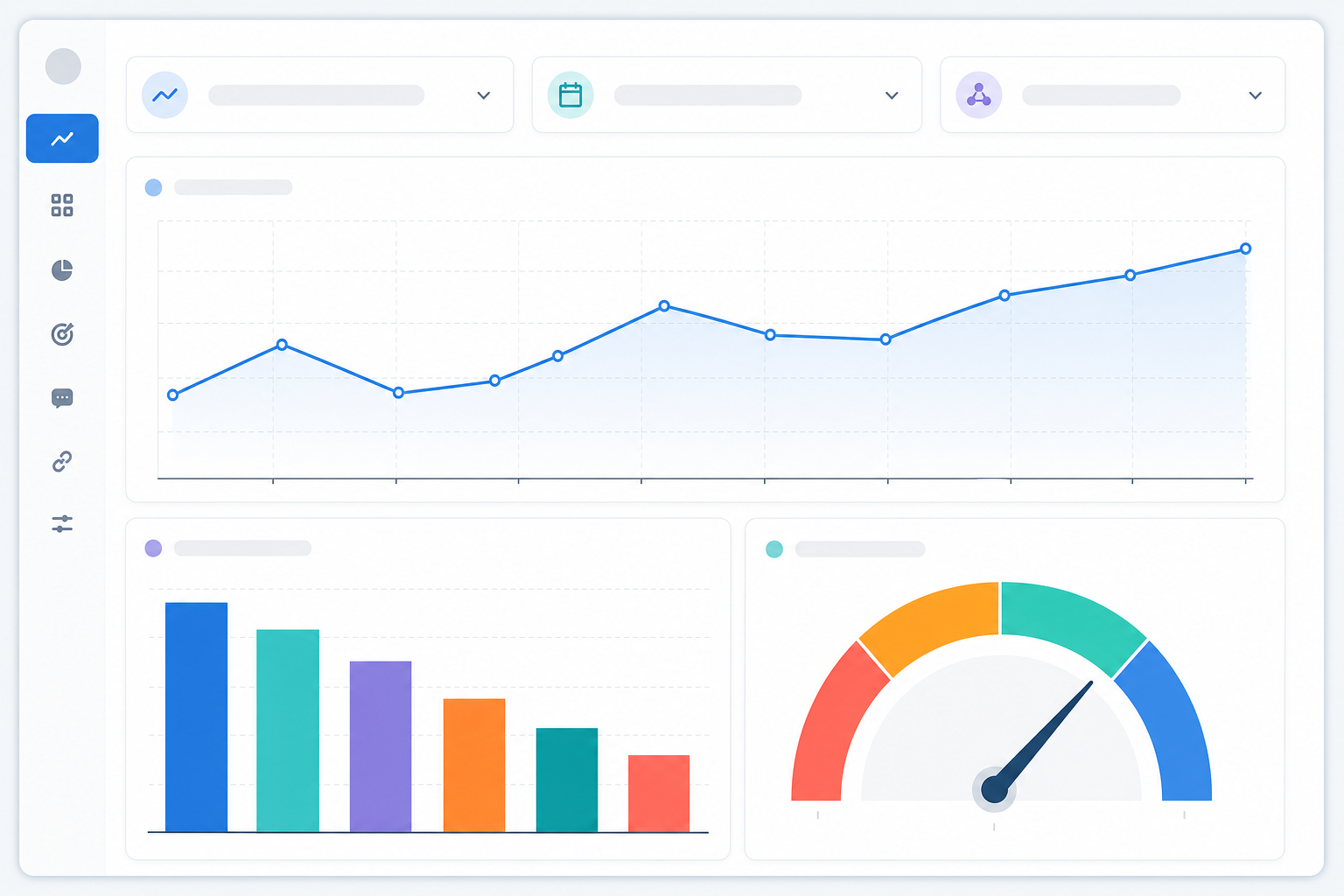
Lead with the trend line rather than a single day's snapshot. A one-day dip or spike is noise, so show a rolling average with a visible range.
Pair raw mention share with weighted visibility for context. A 20% raw share means something different depending on whether those mentions are hard citations or footnotes at the end of a competitor's recommendation.
Always include a named-competitor comparison. Leadership wants to know whether you're gaining or losing ground against a specific rival, not an abstract percentage sitting on its own.
A One-Slide AI Visibility Report Structure
A practical leadership slide should include:
- Headline mention share with a trend arrow
- Weighted visibility score alongside it
- A named-competitor delta
- Confidence range, including the query count and number of runs behind the figure
- Your top three wins
- Your top three zero-visibility gaps
- One logged transcript as evidence
Expect the measures to disagree sometimes, and prepare for it. Rising answer presence alongside falling recommendation share usually means you're mentioned more but trusted less. That's a positioning problem, best addressed with more citable content rather than simply producing more of it.
High share of voice concentrated in low-value queries, while zero-visibility gaps pile up on your highest-intent questions, means the headline number is flattering you.
How Often Should AI Share of Voice Be Reported?
Use a weekly digest built from averaged, multi-run data for operational tracking. Use a monthly or quarterly review to connect movement to specific content or technical changes made during that period.
Tie AI visibility to downstream metrics such as branded search demand, AI referral traffic and lead conversion. Visibility is an exposure metric, not proof of incremental revenue. I haven't seen a robust published correlation between AI share of voice and pipeline yet, so be sceptical of anyone claiming a firm number this early.
A logged transcript of ChatGPT recommending a competitor over you, timestamped and annotated with the model version and query wording, often lands harder with leadership than any chart. The timestamp lets a sceptical CFO check the claim is current rather than cherry-picked.
AI Share of Voice FAQ
How Is AI Share of Voice Different from Search Share of Voice?
Search share of voice is calculated from keyword rankings, SERP feature ownership and estimated click-through rates across a fixed set of results. AI share of voice measures how often your brand is mentioned, cited or recommended within the generated text of an AI answer, where there's no visible ranking list and the model may cite zero, one or several sources in a single response.
The two can diverge sharply. A page-one Google ranking doesn't guarantee a mention in an AI-generated answer to the same query, and the reverse can be true too.
What Is a Healthy AI Share of Voice Benchmark?
There's no universal benchmark yet, and it's worth being wary of anyone claiming there is. Treat AI share of voice as most useful relative to your own category. Track it against your two or three closest named rivals for your highest-value buyer-intent queries, and aim for steady month-on-month improvement in weighted visibility share rather than chasing an industry-wide number.
How Often Should AI Share of Voice Be Reviewed?
Daily or near-daily runs let you average out model variance and catch sudden shifts, but a single day's answer should never be reported as your share of voice on its own.
Use weekly, averaged data for operational tracking and monthly or quarterly reviews for stakeholders. Focus on trend direction rather than any one data point.
How Do I Improve AI Share of Voice Over Time?
The reliable levers are closing content gaps on zero-visibility and low-weighted-share queries, fixing technical AI legibility issues that prevent models from parsing and citing your pages, and consistently publishing content that directly and clearly answers the questions in your query set.
Improvement tends to be gradual and compounding rather than immediate. AI models don't re-crawl and re-rank instantly the way search engines can, so a single content update rarely moves weighted share within a week or two.
Should Mentions in Cited Sources Count the Same as Mentions in the Generated Answer?
No. Log them separately. A brand appearing as a linked source the model drew on is a stronger signal than a brand named only in the model's synthesised text without a citation. Collapsing the two overstates the weaker form of visibility.
This is exactly what the hard-mention and soft-mention split, together with the citation-status field, is designed to capture.