Stop Manually Checking ChatGPT: How to Automate Your AI Visibility Score Tracking
Track your AI visibility score automatically, monitor ChatGPT citations, and save UK solo founders hours every week with automated AI tracking.
AI Visibility Score Tracking: Stop Checking ChatGPT Manually
Meta description: Compare manual and automated AI visibility score tracking for solo founders in the UK. See the real time calculation, ChatGPT citation workflow, and what to check before subscribing to a tracking tool.
If you're a solo founder manually typing questions into ChatGPT to see whether your brand shows up, you're likely losing several hours a week to a task that automated AI visibility tracking tools can handle daily, across multiple AI engines, with far less manual input. Platforms like MentionOwl — one of several tools in this category, and the one I've spent the most time testing — run your customer questions against ChatGPT, Claude, Gemini, Copilot, and Perplexity on a fixed schedule, scoring your AI visibility from 0-100 and flagging ChatGPT citations, competitor mentions, and sentiment shifts.
I want to be precise about what "automated" actually means here: the collection and flagging are automated, but you — or someone on your team — still needs to read the digest and decide what to do about it. No tool removes the thinking; it removes the repetitive typing.
I've spent enough time analysing how solo founders and small marketing teams handle this problem to say with confidence that the manual approach isn't just tedious — it's structurally limited in what it can prove, no matter how many hours you put into it. Below, I'll walk through why that is with an actual worked calculation, what a properly built AI visibility tracking system monitors, how to set one up, what to do with the data once it arrives, and how many hours you genuinely get back once you account for setup and review time on both sides.
The Problem With Manual AI Visibility Checks
Here's the uncomfortable truth about typing a single question into ChatGPT and checking whether your brand appears: that one check tells you very little on its own. OpenAI's documentation on how ChatGPT generates responses confirms that outputs can vary based on prompt wording, conversation history, location, language, account settings, enabled tools, and model version (platform.openai.com/docs). So when you ask "best project management software for a 50-person remote team" on Monday and see your brand cited, then ask a slightly different version on Thursday and don't, you haven't necessarily detected a real change in your AI visibility. You may simply have detected the normal variance built into how large language models generate answers — though it's also possible something did change. A single query can't tell you which.
This is also why there's no universal, officially defined "AI visibility score" published by OpenAI, Google, or Microsoft. Commercial platforms each calculate the metric differently, typically blending prompt coverage, citation frequency, citation position, and sentiment. That's not a flaw in the concept — it's a reason to treat any score as one tracking indicator built on a stated methodology, rather than proof in itself, and to ask any vendor exactly how their number is built before you trust it.
Now let's put a real figure on the time cost, rather than repeating a headline number. Say you're testing a moderate workload: 15 customer-style prompts, across 3 platforms (ChatGPT, Claude, Gemini), checked twice a week to catch changes. At roughly 3 minutes per prompt to open the response, read it, note whether you're mentioned, and record the citation — that's 15 × 3 × 2 = 90 checks, at 3 minutes each, which comes to 4.5 hours a week, before you separately track named competitors. Scale that to a more thorough setup — 25 prompts across 4 platforms, checked three times weekly — and you're at roughly 12.5 hours. This is why estimates in this range of 4-8+ hours a week show up so consistently across founder workflows I've reviewed: the exact number depends entirely on prompt count, platform count, and check frequency, so treat any single figure — mine included — as a scenario, not a universal constant. Most solo founders skip competitor tracking entirely at this point simply because it doubles or triples the workload for a task that already doesn't fit into a working week.
And here's the part that should worry any founder relying purely on occasional manual spot-checks: because you're only sampling now and then, you have a real chance of missing a genuine sentiment shift or an incorrect citation. If a competitor starts appearing where you used to, or an AI engine starts describing your product inaccurately, you won't know until you happen to ask the right question at the right time — which, given the hours involved, could be weeks away. To be fair, automated daily checks aren't immune to noise either — a fixed prompt run daily can still return a false negative on a given day because of model-side variance, so the advantage isn't perfect knowledge, it's a far larger, more consistent sample size to spot real patterns against.
 Illustrative mockup — not a representation of any specific product's actual interface.
What an AI Visibility Score Actually Monitors
A properly built AI visibility system doesn't just count mentions. It tracks several distinct dimensions that, together, give a more defensible picture than any single manual check could produce. Some of what follows describes general good practice across this tool category; where I'm describing something specific to MentionOwl, I've flagged it as such.
- Query coverage — the range of customer questions tested regularly, built from realistic purchase-decision language rather than a handful of prompts you thought up yourself. This is standard practice across most AI visibility tools, not unique to any one platform.
- Position and prominence of brand mentions — not just whether you're mentioned, but roughly where in the answer, and whether the mention links to your own site or a third-party page discussing you. Note that not every engine exposes citations the same way — Perplexity and Copilot surface source links more explicitly than ChatGPT's default consumer interface, for example, so "citation tracking" means slightly different things depending on the engine.
- Share of voice — how your visibility compares against named competitors across the same query set, so you can see whether you're gaining or losing ground over time, not just in a single snapshot.
- Sentiment analysis — how AI engines are actually describing your brand, since a mention with negative or inaccurate framing is a very different signal from a genuine recommendation.
- Technical legibility checks — MentionOwl specifically states it runs 16 checks covering things like structured data, crawlability, and content clarity, which affect whether AI crawlers can read and cite your site correctly in the first place. I'd treat the number 16 as a MentionOwl-specific detail rather than an industry standard — other tools run their own version of this with different check counts and criteria, so ask any vendor what their checks actually cover before assuming parity.
This separation matters because a brand can receive mentions while still being described incorrectly or ranked below competitors — presence, prominence, and accuracy are three different things, and collapsing them into a single number without explaining the methodology is how a score becomes misleading rather than useful.
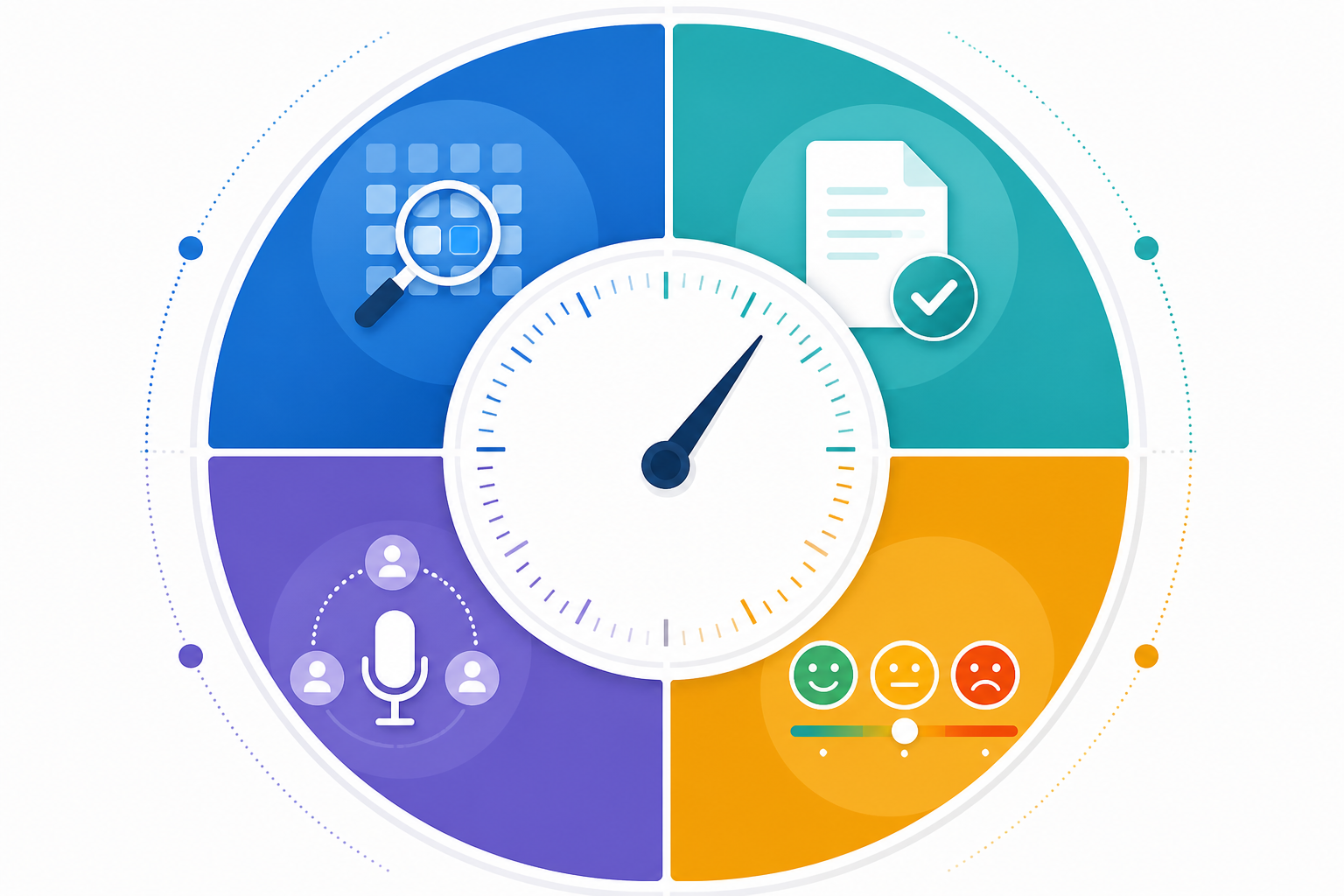 Conceptual diagram of scoring components — actual weighting varies by vendor and should be confirmed against their published methodology.
How to Set Up Automated AI Visibility Tracking Across Multiple Engines
Here's how this typically works, using the same underlying logic MentionOwl and comparable tools apply:
- Crawl your website so the system understands your actual offer, positioning, and the language your customers use — this grounds the exercise in your real business rather than generic assumptions.
- Auto-generate realistic purchase-decision questions that mirror what a prospective customer would type into an AI assistant, rather than the narrow set of prompts you'd think to test manually.
- Run those questions on a fixed schedule against multiple engines — MentionOwl covers ChatGPT, Claude, Gemini, Copilot, and Perplexity daily — which is the kind of repeatable measurement manual checking struggles to sustain.
- Record answers, citations, and competitor appearances, preserving the full response and any citation URLs so results are comparable over time rather than relying on memory or a stray screenshot.
- Feed everything into a single AI visibility score (0-100) so you get an at-a-glance read on trajectory without reconstructing the story from dozens of disconnected checks.
Before you automate anything, it's worth checking a few practical points with any vendor: can you customise or add your own prompts, do you get access to the raw AI responses (not just the summarised score), how is your data retained and handled — an important question for a UK-based business given UK GDPR obligations around any customer-language data you feed in — and can you export results if you switch tools later.
On the causal question directly: running a fixed prompt library on a consistent schedule makes it easier to detect when something changes, because you're comparing like-for-like queries over time rather than random spot-checks. It does not, on its own, prove why a score moved. Model updates, changes in how an engine retrieves sources, your location, and normal answer variance can all shift a score independently of anything you did. The practical fix is to annotate your own timeline — note when you publish content, when a competitor launches a campaign, when you notice a citation change — and cross-reference that against the score movement, then check the raw response before drawing a firm conclusion. Consistency gives you a cleaner signal to interpret; it doesn't remove the need for interpretation.
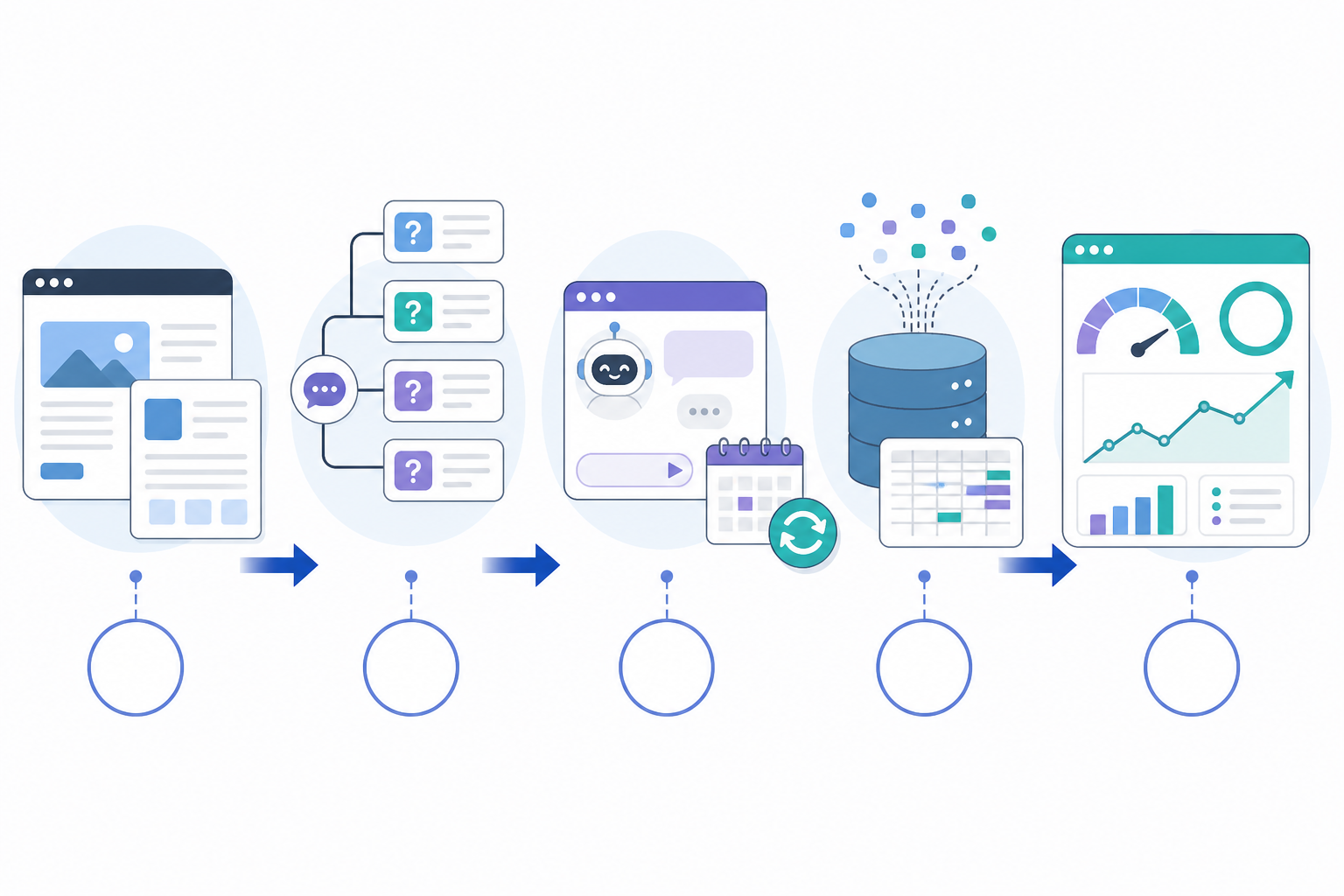 Process overview diagram — implementation details vary by provider.
What to Look for in a Weekly AI Visibility Digest
Once tracking is running, the human task shrinks to reviewing a digest. A well-built weekly digest should cover:
- How your score moved week over week, and whether that's a sustained trend or a single-week blip
- Movement in share of voice, which often signals competitor activity — a drop can mean a rival has published new content, earned new coverage, or started appearing in comparison-style queries where you previously led
- New competitor mentions or citation losses, flagged early enough to investigate the source page and respond
- Sentiment trends, so a subtle shift in how your brand is described gets caught while it's a minor anomaly rather than a reputational problem
Here's a sample of what that might look like in practice: your score drops from 68 to 61 over a week, share of voice against your main competitor falls from 40% to 32%, and the digest flags a new citation on a third-party "best tools" listicle that now ranks the competitor above you. The useful response workflow looks like this: first, open the flagged citation and read it in full rather than trusting the summary; second, classify the issue — is this a content gap on your site, an outdated page the AI is citing, or simply a competitor's stronger recent coverage; third, act accordingly — update the relevant page, pitch a comparison piece, or note it and monitor; fourth, recheck after 7-14 days to see whether the change was a blip or the start of a genuine trend. Not every flagged change needs same-day action — a single-day dip is usually noise, while a sustained two-to-three-week decline in share of voice is worth investigating properly.
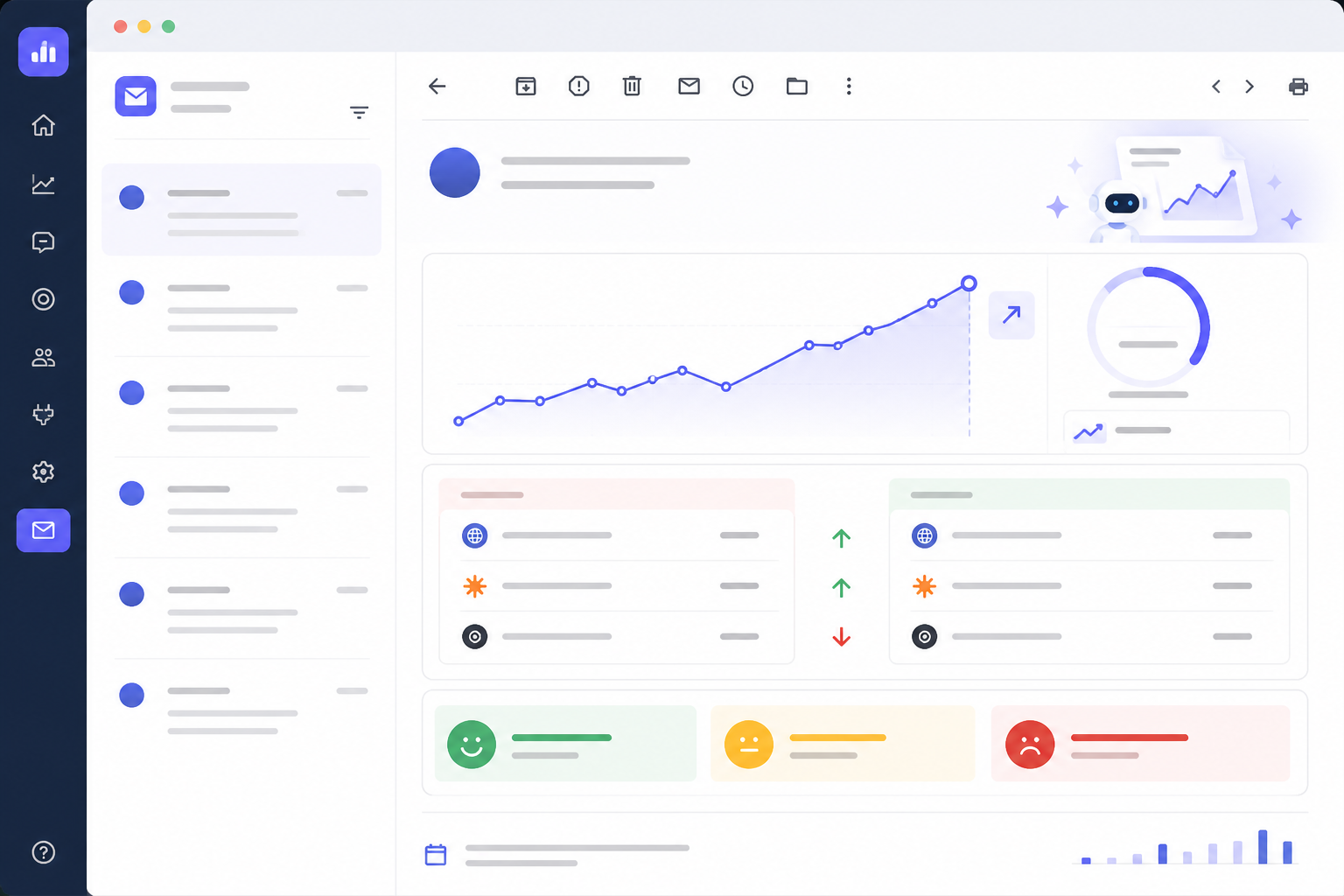 Illustrative mockup for explanatory purposes — not an actual product screenshot.
How Much Time Can Automated AI Tracking Save?
To compare fairly, both sides of this table use the same workload: 20 prompts, checked across 3-5 platforms, weekly.
| Manual Checking | Automated Tracking | |
|---|---|---|
| Time per week (review only) | 4-8 hours, depending on prompt count and frequency | 15-30 minutes reviewing a digest |
| Initial setup time | None, but no structure either | 30-60 minutes to configure prompts and crawl your site |
| Platforms covered | Usually 1-2, inconsistently | 3-5 engines, run on a fixed schedule |
| Competitor tracking | Rarely done — doubles the manual workload | Included as part of the same run |
| Citation detail | Often just "mentioned or not" | Position, sentiment, and source URL, where the engine exposes it |
| Reliability | Single snapshots, high variance | Larger, repeatable sample — still subject to model-side variance |
The gap is still substantial once setup time is included: roughly 4-8 hours weekly for manual checking versus well under an hour for automated review. For a solo founder, that reclaimed time typically goes toward sales calls or product work rather than repetitive competitive research.
This matters more by the month, not less, as AI-driven discovery grows as a source of traffic. Adobe Analytics recorded a 1,300% year-on-year increase in generative-AI referral traffic to US retail sites during the 2024 holiday period (Adobe Analytics, cited via Adobe's 2024 holiday shopping report). I haven't seen an equivalent UK-specific figure published yet, but given similar AI assistant adoption patterns in the UK market, treating this as an early but fast-moving channel — worth a repeatable tracking habit now rather than a scramble later — seems the sensible read of the data available.
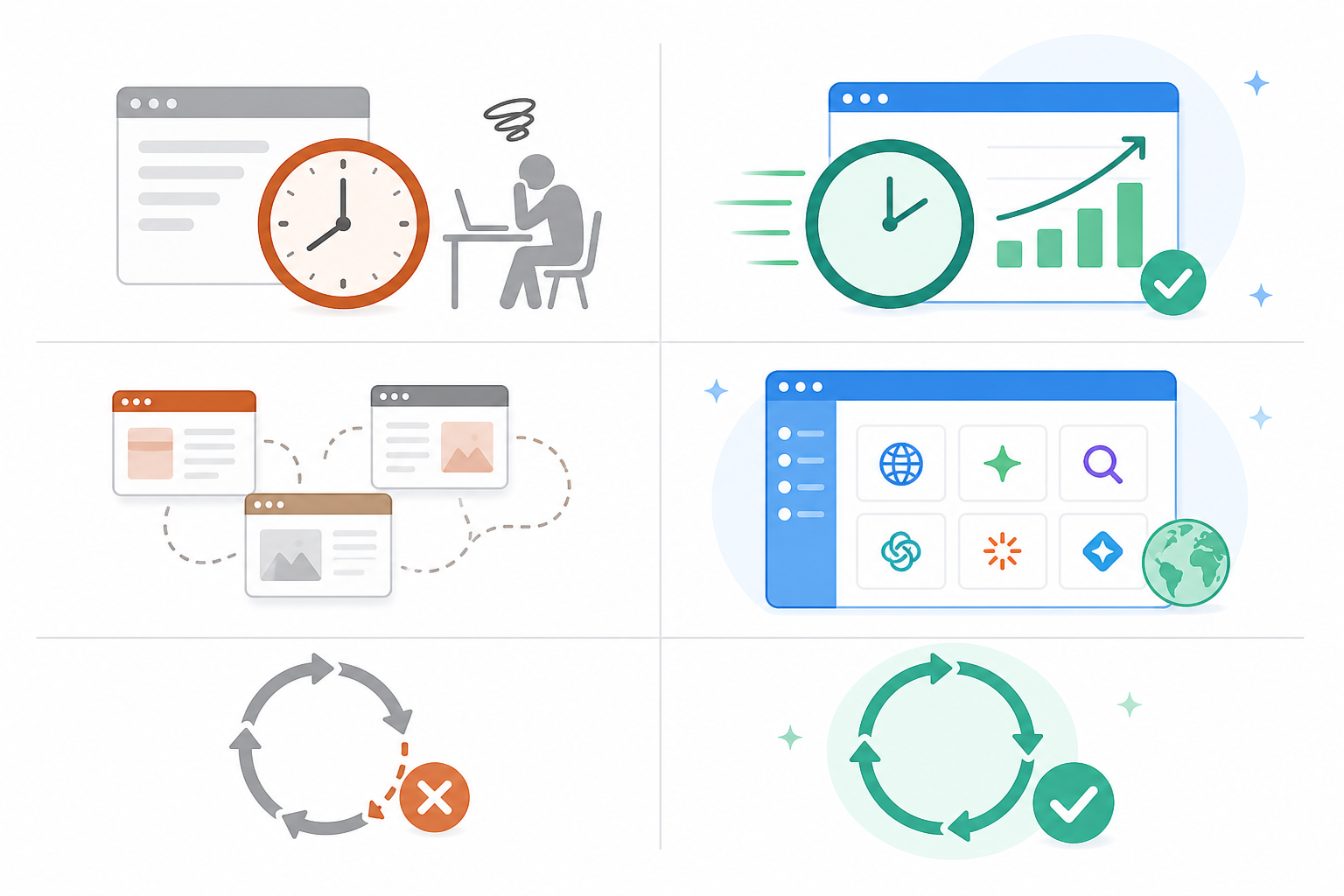 Summary graphic based on the workload comparison above; figures are scenario-based, not universal averages.
Who Should Pay for Daily AI Visibility Monitoring?
If you're a solo founder or small team relying on organic and AI-driven discovery for a meaningful share of new customers, daily or near-daily monitoring across several engines is worth the modest subscription cost, purely on time-saved grounds — even a conservative 4 hours a week reclaimed is significant against a monthly fee. If AI referral traffic is currently a negligible part of your funnel and you're pre-revenue, a lighter weekly manual check across one or two platforms may be enough for now, with a plan to revisit as the channel grows.
If you want to test this yourself: MentionOwl offers a 7-day trial for £1 (confirm current pricing on their site, as terms can change). Start by crawling your site and generating your prompt set on day one, let it run for the full week, then compare the digest against whatever manual checking you were doing before — specifically, check whether it surfaced a citation or competitor mention you'd have missed. That's a fairer test than the headline score alone.
FAQ: AI Visibility Score Tracking and ChatGPT Citations
How much time does manual AI checking actually take?
It depends heavily on prompt count, platform count, and how often you repeat checks. A moderate workload — 15 prompts across 3 platforms, checked twice weekly — works out to roughly 4.5 hours; a more thorough setup can push past 12 hours. Most people skip competitor tracking entirely because it roughly doubles the workload.
Can I automate tracking across multiple AI platforms at once?
Yes. Automated AI visibility platforms run a set of auto-generated customer questions against several engines — commonly ChatGPT, Claude, Gemini, Copilot, and Perplexity — on a fixed schedule, giving you comparable data across engines rather than a single manual snapshot from one chatbot.
What does a weekly AI visibility digest include?
Score movement, new or lost citations, share-of-voice changes against named competitors, and sentiment shifts. The useful digests also make clear which changes are single-week noise versus a sustained multi-week trend worth acting on.
Is automated AI tracking affordable for a solo founder, and is it worth it?
For most founders relying on AI-driven discovery, yes — the time saved (often several hours weekly) tends to outweigh a modest monthly fee. MentionOwl, for example, offers a 7-day trial for £1, which is a reasonably low-risk way to test whether it surfaces anything your manual checks were missing before committing further.
What about data privacy and GDPR?
If you're UK-based, ask any vendor directly how customer-language data and your crawled site content are stored and processed, and whether that processing falls under UK GDPR. This detail varies by provider and should be confirmed in their terms rather than assumed.
Can the AI visibility score be wrong or give false positives?
Yes. Even daily automated checks are subject to the same model-side variance that affects manual queries — a single day's result can be noise. Treat a one-off dip or spike with caution and look for a pattern over one to two weeks before treating it as a real signal, and check the raw AI response behind any flagged change rather than relying on the score alone.
Can I customise the prompts being tracked?
Most tools in this category, including MentionOwl, generate an initial prompt set from your site content and allow some editing. If prompt control matters to you, confirm the specific customisation options before subscribing, since this varies by provider.
What happens after the trial ends?
Check the vendor's specific terms — typically you'd move to a paid monthly plan or the tracking pauses. Confirm cancellation terms and whether historical data remains accessible if you decide not to continue.