Automating AI Mention Tracking: How Busy Founders Reclaim Hours Every Week
I break down the real time cost of manually checking ChatGPT, Claude, and Gemini for brand mentions, then show what automated AI mention tracking repl
AI Mention Tracking: The Real Cost of Checking ChatGPT, Claude, Gemini, Copilot and Perplexity Manually
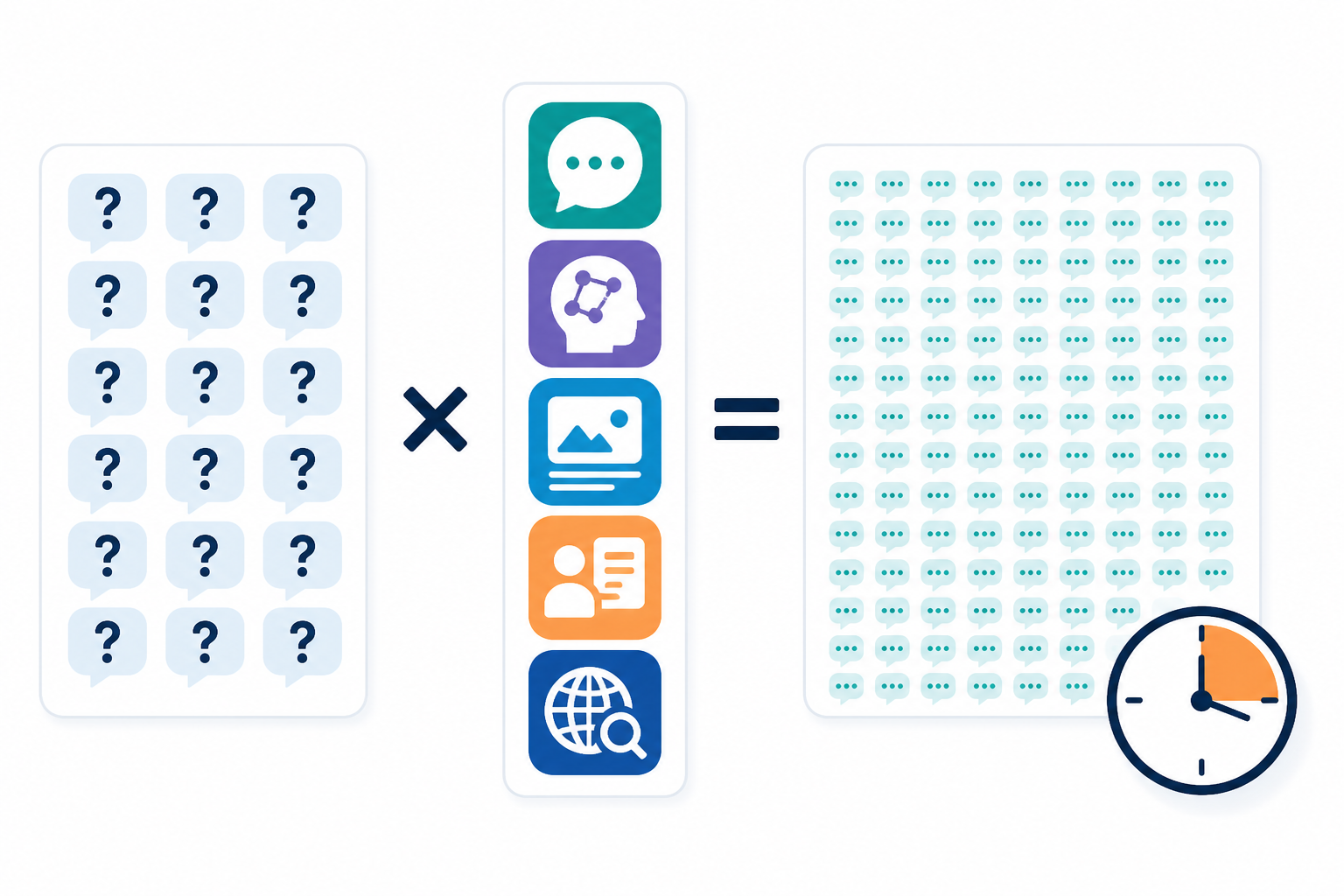
I ran the numbers on manual AI mention tracking properly, because the arithmetic is worth showing rather than just asserting. If you wanted genuine daily coverage of your AI visibility across ChatGPT, Claude, Gemini, Copilot, and Perplexity, you'd need to run 15-25 realistic customer questions on each of those five platforms every day. That's what it takes to catch shifts in citations and sentiment before a competitor quietly overtakes you.
That's 75-125 individual queries a day. At a realistic 4-6 minutes per query - reading the response, checking citations, noting sentiment - full daily coverage works out to 5-12.5 hours per day, or roughly 25-62.5 hours across a working week. That's not a part-time task for a solo founder or a one-person marketing team. It's close to a full-time job on its own.
Because that workload is obviously unsustainable, most founders who try to stay on top of it do a scaled-down version instead: a handful of queries, on one or two platforms, a few times a week, rather than the full set daily. That partial approach lands closer to 8-12 hours a week, and it still only covers a fraction of the real query volume.
Here's the comparison laid out plainly:
| Approach | Queries | Frequency | Time per query | Total time |
|---|---|---|---|---|
| Full manual coverage (5 platforms, 15-25 questions) | 75-125/day | Daily | 4-6 min | 25-62.5 hrs/week |
| Realistic partial manual approach (what most founders actually do) | 10-20/week | 2-3x/week | 4-6 min | 8-12 hrs/week |
| Automated daily tracking | 75-125/day | Daily | 0 hrs (manual) | Weekly digest review only |
That gap between what full coverage would cost and what founders actually manage is the real story here, and it's why automated AI mention tracking exists as a category. I want to walk through how I arrived at these figures, what "good enough" manual checking actually looks like in practice, and where automated brand monitoring earns its place versus where a manual spot-check is still perfectly reasonable.
The manual way founders currently check AI mentions
I've spoken with enough solo founders and one-person marketing teams to recognise the pattern immediately. It usually goes something like this: you open ChatGPT, type something like "best invoicing software for freelancers" or "alternatives to [competitor name]", read the response, and if your brand shows up, you feel a small jolt of relief. Maybe you screenshot it. Maybe you mention it in a Slack message to yourself or a co-founder. Then you close the tab and move on with your day.
The trouble is this happens sporadically rather than on any fixed schedule. It's usually triggered by anxiety - you saw a competitor's tweet about being "recommended by AI" and want to check your own standing, or a customer mentioned finding you through Perplexity and you got curious. There's rarely a calendar reminder or a repeatable process behind it. It's reactive, not systematic.
More importantly, most founders only test two to four queries in a sitting. That's nowhere near the volume needed to represent how prospects actually behave when they turn to AI assistants for purchase decisions. Real customers don't ask one canonical question. They ask variations shaped by their specific use case, their budget, their industry, and their stage of research. "Best CRM for small teams", "CRM alternatives to Salesforce for under 10 people", and "is [competitor] worth it for a solo consultant" are distinct queries that can surface completely different answers, different citations, and different competitor sets.
This creates a false sense of security worth naming directly. A good result on one query - say, ChatGPT citing you favourably for "best project management tool for freelancers" - tells you nothing about the other twenty-plus questions your prospects are actually asking. You could be winning that single query beautifully while quietly losing ground on ten others you've never thought to test.
It's also worth being precise about what "mention" even means here, because these are different signals: a citation (a formatted, clickable source link), a soft mention (your brand named in the answer text without a link), a sentiment reading (favourable, neutral, or hedged), and AI-referred traffic (someone actually clicking through to your site from an AI answer) are four separate things. A founder who says "I checked and we're mentioned" is usually only seeing one of these, and rarely the whole picture.
How many queries do you need to check manually for full AI visibility?
To answer this properly, I looked at how MentionOwl approaches query generation, because the process illustrates the scale of the task even if you never use the tool itself. Worth being upfront: the 15-25 figure below is MentionOwl's own operating benchmark, not an independently audited industry standard. I'm using it as a working illustration of realistic query volume, not a universal law.
When MentionOwl crawls a client's website, it auto-generates realistic customer questions that prospects are likely typing into AI assistants - not generic industry queries, but ones shaped by the actual products, use cases, and comparison angles present on that specific site. A UK-based invoicing tool for freelancers, for example, might generate questions like "best invoicing software for sole traders in the UK", "[competitor] alternative for self-employed contractors", and "is [competitor] worth it for a one-person business". In practice, this typically lands between 15 and 25 questions per business, depending on how many distinct product lines, customer segments, or competitor comparisons exist.
A single-product, narrow-niche business might sit at the lower end; a business with multiple offerings and several well-known competitors will sit higher. Whether this range holds for your specific business is something worth testing rather than assuming.
Multiply that by the five AI platforms most commonly discussed in this space today - ChatGPT, Claude, Gemini, Copilot, and Perplexity - and 20 questions across five platforms gives you 100 individual queries. At the conservative end (15 questions), you're at 75 queries. At the higher end (25 questions), you're at 125.
I'd flag that platform relevance varies by market and product category. A UK-based B2B SaaS founder may find Perplexity and ChatGPT drive most of their AI-referred traffic, while Copilot matters more in Microsoft-heavy enterprise contexts. Treat "five platforms" as a reasonable starting set to test against, not a fixed rule for every business.
Here's the part that surprises most founders: a single check on a single day isn't the full picture, because large language models are non-deterministic by design. The same question can return a different answer, a different set of citations, or a different sentiment framing on different days, even without any change to your website.
I've seen this myself when testing identical queries 24 hours apart. The cited sources shift, the phrasing changes, and sometimes a competitor appears who wasn't mentioned the day before. That said, non-determinism alone doesn't automatically mean daily checking is the only valid frequency - it means a single snapshot has more noise in it than founders often assume.
I'd separate this into three distinct jobs: baseline discovery (a one-off deep check to understand where you stand today), periodic trend monitoring (repeated checks to see if visibility is genuinely moving, which needs enough repetition to separate signal from noise), and incident alerts (catching a sudden, meaningful change - a competitor appearing or a sentiment flip - as close to real time as your risk tolerance requires).
Daily tracking makes the most sense for the second and third jobs, particularly once AI-referred traffic is material to your business. It's less essential for a founder who's simply trying to understand their current standing for the first time.
Why manual AI mention tracking doesn't scale past a handful of queries
Once you understand the real volume required, it becomes obvious why manual checking breaks down almost immediately, and why the partial 8-12 hour approach still leaves real gaps. A few specific failure points stand out:
- Query fatigue. After 10-15 manual checks, most people stop reading carefully and start skimming. This is exactly the point where subtle sentiment shifts or a new competitor mention slip past unnoticed, because the eye is scanning for the brand name rather than absorbing the full context of the answer.
- No historical record. Without logging every result in a structured way - query text, platform, date, cited or not, competitor names present, sentiment rating - you have no way to tell if your share of voice is improving or declining over time. You end up comparing today's vague impression against an even vaguer memory of what things looked like a month ago. That's not data. It's a feeling.
- Platform inconsistency. ChatGPT, Claude, Gemini, Copilot, and Perplexity each source and cite information differently, and each weights recency differently too. A spot-check on ChatGPT tells you precisely nothing about how Perplexity or Copilot are representing your brand, because their underlying retrieval and citation behaviours simply aren't comparable.
- Competitor blind spots. Manual checks tend to focus narrowly on your own brand name, rarely extending to systematic tracking of how often named competitors appear in the same answers. Share of voice erodes quietly this way - you're not necessarily losing citations outright, you're just appearing alongside an increasing number of competitors you haven't noticed creeping in.
- Opportunity cost. Even the realistic 8-12 hours a week spent on partial manual checking is time not spent on product development, sales conversations, or the actual work that grows a one-person business. For a sole trader or solo founder, that's arguably the most expensive line item on this list.
Can you just ask ChatGPT about your brand once a week?
This is the compromise I see most founders land on, and I understand the logic. It feels like a reasonable middle ground between doing nothing and doing everything. Let me be precise about what it does and doesn't cover, though, rather than reaching for a single headline percentage.
A weekly check on ChatGPT alone covers one of the five platforms typically worth monitoring. If you're only testing a handful of questions rather than the fuller 15-25 set, you're also seeing a small slice of the realistic query volume. Combine both gaps - one platform out of five and a few questions out of fifteen-plus - and you can end up seeing well under a fifth of the total signal, though the exact fraction depends entirely on how many questions you personally test and how much the platforms disagree with each other in your specific niche.
Given how differently Claude, Gemini, Copilot, and Perplexity source and cite information, a favourable result on ChatGPT tells you nothing about how the other platforms are representing you or your competitors.
There's also a timing problem. AI answers can shift meaningfully within days, not months. Models get updated, competitors publish new content that gets picked up and cited, and the underlying sources an AI platform draws from can change without warning. A weekly snapshot on one platform is closer to reassurance than actionable data. It tells you "things looked fine on Tuesday" without telling you what happened on Wednesday through Monday.
I'd frame this as a reasonable starting habit for founders who aren't ready to automate yet, particularly if AI-referred traffic is still negligible for the business. It's not a substitute for broader, repeated multi-platform tracking once AI search behaviour is genuinely shaping buyer decisions in your market, but it's a legitimate place to start, not a mistake.
What automated AI mention tracking actually looks like
Here's how the process replaces the manual workflow, using MentionOwl as the working example. I'll flag the parts of this that are the product's stated methodology rather than something I've independently audited:
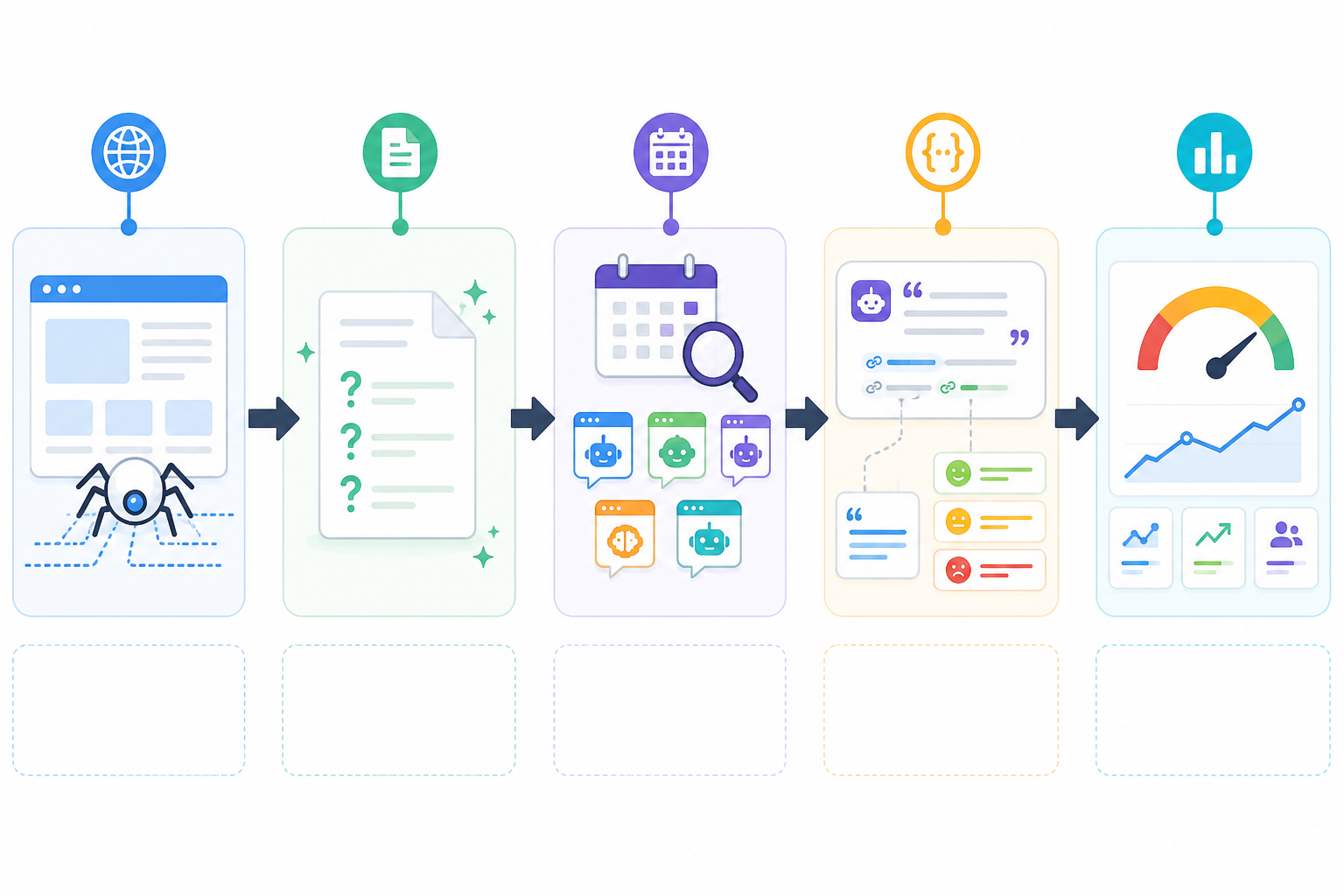
- Crawl and question generation. Once your site is connected, MentionOwl crawls it and auto-generates realistic customer questions based on your actual products, use cases, and competitive landscape.
- Daily multi-platform queries. That full question set runs automatically against ChatGPT, Claude, Gemini, Copilot, and Perplexity every day, with zero manual input required from you.
- Response parsing. Each answer is parsed for citations, sentiment, and competitor mentions, then rolled into a proprietary visibility score from 0-100, built from query coverage, position-weighted citations, and share of voice.
- Historical storage. Results are stored over time, so you can see whether your visibility score, citation frequency, or sentiment is genuinely trending up or down across weeks and months, rather than guessing from memory.
- Weekly digest. A summary lands in your inbox showing what changed, which questions you gained or lost ground on, and where competitors are appearing that you're not.
Worth noting honestly: automated querying isn't immune to the same non-determinism I described earlier, and any platform running this at scale has to account for occasional failed or throttled requests, API access limits, and the general messiness of parsing free-text answers into structured citation and sentiment data.
The value of automation isn't that it eliminates noise. It's that it runs enough queries, consistently enough, that the noise averages out into a trend you can actually read, rather than a single data point you're stuck interpreting alone.
What does an automated AI visibility report actually show?
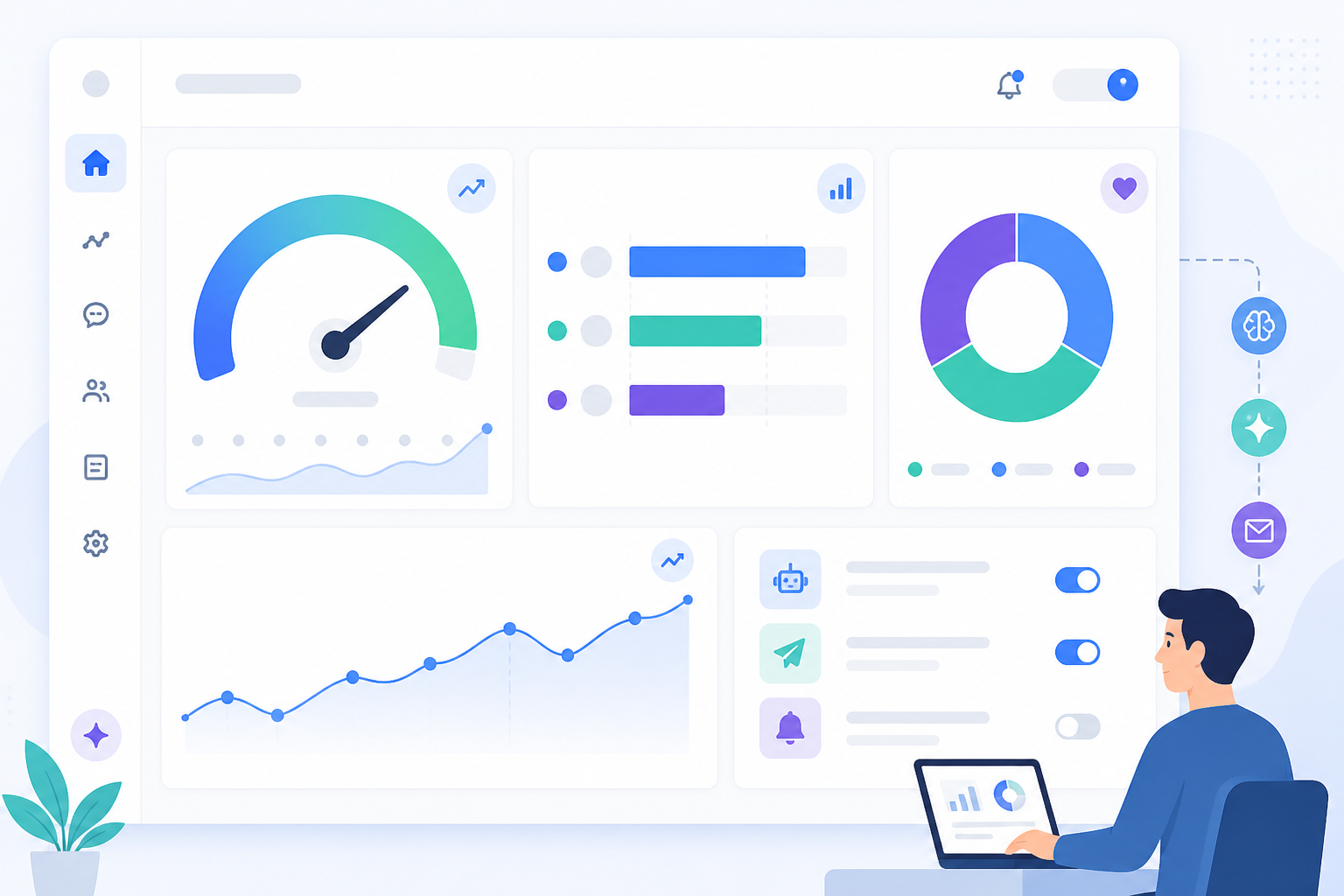
A proper report goes well beyond "were we mentioned, yes or no?" Based on MentionOwl's stated approach, the detail that matters includes:
- Your AI visibility score (0-100) and how it's moved since the previous report
- Which specific customer questions you're being cited for, and which ones a competitor is winning instead
- A sentiment breakdown - whether AI platforms describe your brand positively, neutrally, or with reservations
- Share of voice relative to named competitors across the identical query set
- Soft mentions - references to your brand within an answer that aren't formatted as a direct citation link, which standard SEO tools won't catch at all
- AI legibility findings from 16 technical checks, flagging structural issues on your site that may be limiting how easily AI crawlers can parse and cite your content
A fair caveat: a visibility score is a useful proxy, not a guaranteed predictor of revenue. It tells you how often and how favourably you're showing up in AI answers - it doesn't automatically prove those answers are driving clicks, sign-ups, or sales. Treat it as a leading indicator worth watching alongside your actual AI-referred traffic, not as a replacement for it.
Setting up automated brand monitoring alerts
The real endpoint of automation isn't a better dashboard. It's the shift from active checking to passive monitoring. In MentionOwl, this works through configurable thresholds rather than fixed rules: you decide what counts as significant, and the system flags it.
Example triggers worth setting up include a competitor appearing in a query where they previously didn't show up at all, a sentiment shift on a high-value question that used to return favourable language, or your visibility score dropping by more than a defined margin (say, 10 points) week-on-week.
For founders who want AI mention data flowing directly into their own systems, MentionOwl also offers a REST API and an MCP server, so the data can feed into existing dashboards or AI agent workflows rather than requiring a separate tool check. These integration options are available but optional. The weekly digest alone is enough for most one-person teams.
This is the practical outcome I'd point to: you stop hunting for problems and start reacting only when something genuinely needs your attention.
Is automated AI mention tracking worth it for a one-person business?
I'd frame this around a decision, not a foregone conclusion. Here's a simple way to work it out: take your realistic weekly monitoring hours, multiply by what your time is worth per hour, and compare that to the cost of a tool. If manual tracking realistically costs 8-12 hours a week even at the partial level, and you value your own time at even a modest £25-£40/hour, that's £200-£480 a week in opportunity cost.
That makes most monitoring tools look inexpensive by comparison, provided AI search is actually relevant to how your customers find you.
Two worked scenarios make this more concrete:
- Low AI-referral founder. If AI-referred traffic is currently negligible - a handful of sessions a month at most - weekly manual spot-checks on one or two platforms are genuinely sufficient for now. Automation is a "when", not a "now", for this founder.
- AI-dependent founder. If you're already seeing regular AI-referred traffic, or you operate in a category (SaaS comparisons, "alternatives to X" queries, or freelancer tools) where AI assistants are increasingly the first stop for research, the 8-12 hours a week of partial manual checking is both expensive and incomplete at the same time. You're paying the time cost without getting the coverage.
MentionOwl's $1 seven-day trial exists for this reason: it's a low-risk way to see actual query coverage and a visibility score for your own brand before committing further. Note that the trial is priced in US dollars rather than sterling, so UK founders should check the converted amount and whether VAT applies at checkout before starting.
Not every solo founder needs daily tracking from day one. But automated tracking tends to earn its cost the moment a founder notices any AI-referred traffic at all, because that's the signal AI search is already influencing buyers, whether or not you've been watching closely.
Reclaiming hours per week: a quick AI visibility decision framework
Rather than restating the time-versus-automation trade again, here's a short framework to decide where you sit:
- Check your AI-referred traffic. If it's near zero, weekly single-platform spot-checks are reasonable for now.
- Estimate your realistic manual hours. Be honest - most partial manual approaches land at 8-12 hours a week, not the 25+ hours full daily coverage would actually require.
- Multiply hours by your hourly value. If that number comfortably exceeds a monitoring tool's monthly cost, automation likely pays for itself within the first month.
- Test before committing. Run a trial, let the crawl and question generation complete, and compare the resulting visibility score against what your own manual checking would realistically have surfaced in that same week.
That comparison, more than anything I can assert here, will tell you most of what you need to know.
Frequently asked questions about AI mention tracking
How often does MentionOwl actually run queries against AI platforms?
Daily, according to its stated process. Once your site is crawled and the relevant customer questions are generated, MentionOwl runs that full query set against ChatGPT, Claude, Gemini, Copilot, and Perplexity every day, aiming to show genuine day-to-day movement rather than an occasional snapshot.
Do I need technical knowledge to set up automated AI mention tracking?
No. The crawl and question generation happen automatically once you connect your site, and the weekly digest is written in plain language. The REST API and MCP server exist for founders who want to pull the data into their own systems, but they're optional.
Will automated tracking catch mentions that don't include a direct citation link?
Yes, this is one of the areas where manual checking falls short. MentionOwl tracks soft mentions - references to your brand within an AI answer that aren't formatted as a clickable citation - which standard SEO or backlink tools typically miss entirely.
How is the 0-100 AI visibility score calculated?
According to MentionOwl's methodology, it's built from four components: query coverage (how many relevant questions you're cited for), position-weighted citations (how prominently you appear), share of voice (how you compare to named competitors on the same questions), and soft mentions (references without a formal citation).
Does a high visibility score mean I'll get more traffic or sales?
Not automatically. A visibility score measures how often and how favourably AI platforms mention you. It's a leading indicator, not a guarantee of clicks or revenue. It's worth tracking alongside your actual AI-referred traffic rather than in isolation.
Are the results from a single query run reliable, or could they be a fluke?
A single run can be affected by the non-deterministic nature of large language models, which is exactly why repeated, aggregated tracking over time matters more than any one snapshot. Treat individual days as data points within a trend, not standalone verdicts.
Does this involve sharing any private business data?
The crawl works from your public website content to generate questions, and the queries themselves are run against public AI assistant interfaces. It's worth checking any tool's specific data handling policy directly if this matters for your business.