How to Pitch AI Visibility Monitoring as a New Client Service: A Guide for Agencies
A practical guide for UK agencies on pitching AI visibility monitoring to clients: how to frame the problem, run a free audit, handle ROI objections a

How to Pitch AI Visibility Monitoring to Agency Clients: A UK Guide
The most effective way to pitch AI visibility monitoring is to show clients how ChatGPT, Gemini, Perplexity and other AI engines currently describe their brand versus competitors, rather than telling them. Open with a free audit. Position the service as an extension of the SEO and brand monitoring work you already do, anchor it to a defined visibility score and share of voice, and package it as a recurring retainer with transparent reporting. That puts the ROI conversation on data instead of speculation.
The rest of this guide sets out how I would structure that pitch: how to frame the problem without scare tactics, what a first audit conversation looks like (including a worked example), how to answer the objections you will hear, and how to price the service as a defined line in your retainer menu. Every external figure below links to its original source and carries its date and geography. Most of the best-known numbers come from US or EU studies, or are forecasts, rather than UK measurements, so treat them as directional context and re-check them before they go into a client deck.
Framing the AI visibility problem for clients who haven't noticed yet
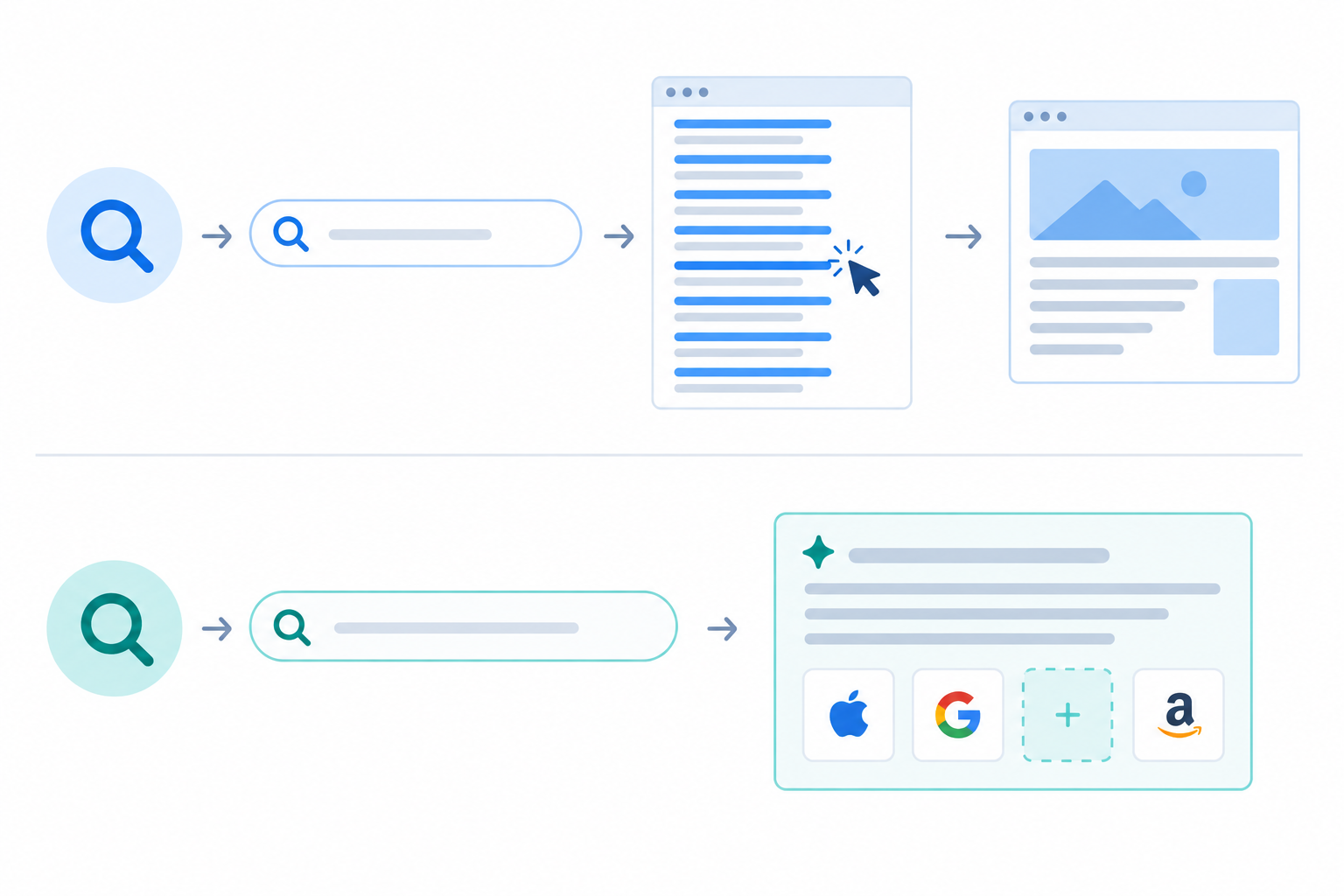
Most clients have not noticed the problem because their dashboards cannot show it. Buyers increasingly put purchase-decision questions to AI assistants, and the synthesised answer often names two or three brands and ignores the rest. A client can hold a healthy position in conventional rankings and still be absent from the answer a prospective customer actually reads.
Why existing analytics miss AI visibility
AI answers frequently produce no click, so rank trackers and referral reports record nothing when a competitor is recommended instead of your client. The evidence below supports that picture, but each source measures something slightly different, so I state the scope of each one:
- SparkToro and Datos (2024) found that 58.5% of US Google searches and 59.7% of EU searches ended without a click to the open web. That describes Google search generally, not AI answers, and it covers the US and EU rather than the UK, so I use it as context rather than proof.
- Pew Research Center (July 2025) analysed 68,879 Google searches by 900 US adults in March 2025. Users clicked a traditional result in 8% of visits when an AI summary appeared, against 15% when it did not, and clicked a link inside the summary in about 1% of visits.
- Ahrefs (2025) associated the presence of an AI Overview with a 34.5% lower average click-through rate for the top-ranking page. This is an observational finding, not a guaranteed loss for any individual client.
- Gartner (February 2024) forecast that traditional search engine volume would fall 25% by 2026. It is a forecast, and I label it as one.
What UK evidence is available?
I have not found a UK-specific measurement of AI search behaviour that I can cite with the same confidence as the studies above, and I would rather say so than imply the US and EU figures describe UK buyers. Ofcom's Online Nation reports and your clients' own Search Console and GA4 data are the best UK-relevant places to look. If a client's UK analytics show falling click-through on informational queries, that is far more persuasive than any external statistic.
How to explain AI visibility in plain English
I define AI visibility as how often, how prominently and how favourably generative AI engines mention, cite or recommend a brand. Clients will immediately ask what counts, so I separate three things:
- A hard citation: the engine links to the brand's page as a source.
- A recommendation: the engine actively suggests the brand as an option for the user's need.
- A soft mention: the brand is named without a link.
These differ in commercial value, and a good monitoring service reports them separately instead of blending them into one unexplained figure.
There is also a reputational angle that appeals to agencies already doing brand monitoring. Generated answers can misstate product details, policies or associations. In Moffatt v. Air Canada (2024 BCCRT 149), a British Columbia tribunal held the airline responsible after its own website chatbot gave a customer inaccurate bereavement fare information. That was a company's own chatbot rather than a third-party AI search tool, and it was a Canadian ruling, but it shows why generated claims about a brand deserve monitoring.
I would avoid scare tactics entirely. The honest framing is that this is an emerging channel with no settled measurement standard, that brands which start measuring now will understand it sooner than those that wait, and that Google's own guidance says the same foundational SEO practices apply to its AI features. Nobody needs to panic, but everybody should measure.
Using a free AI visibility audit to open the conversation
An audit works better than a slide deck because it replaces opinion with the client's own data. To be clear about what 'free' means here: the audit is free to the prospect, while the agency bears a small cost. You can produce a baseline manually by sampling prompts yourself, or use a tool. In this walkthrough I use MentionOwl, which at the time of writing offers a $1, 7-day trial, so the agency's outlay for a baseline is minimal but not zero. Confirm current plan terms with the provider before you plan around them.
One caveat on the steps below. Steps 1, 3 and 6 are general best practice that works with any tooling, whereas steps 2, 4 and 5 describe MentionOwl functionality as I understand it, so check the provider's current documentation before you describe those features to a client.
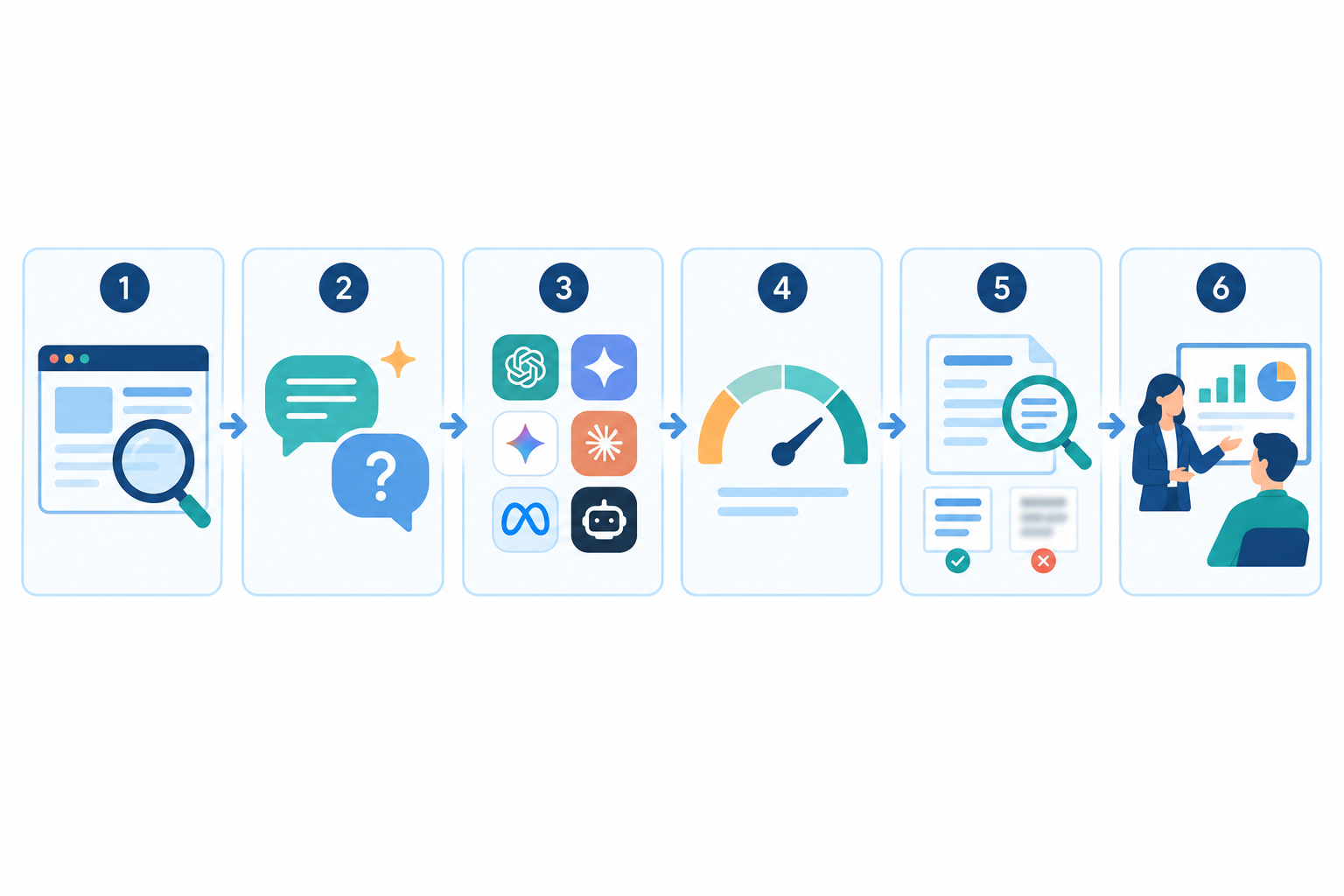
- Pick the prospect carefully. Favour clients with a clear competitor set and purchase-decision queries where an AI recommendation could plausibly influence revenue. A local solicitor, a SaaS vendor or a specialist retailer makes a stronger first audit than a brand with no comparable alternatives.
- Generate 20 to 30 realistic customer questions. MentionOwl can crawl the client's website and auto-generate questions of the kind a buyer would genuinely type into ChatGPT, Claude, Gemini, Copilot or Perplexity. Whatever the source, review them for realism and add any you know from sales calls.
- Run the queries across the major platforms and log the conditions. Record the answers, citations, sentiment and which competitors appear. For every run, note the platform and model version where shown, the location setting (use UK settings for UK clients), whether you were logged in, the date, and the exact prompt wording. No measurement standard is universally adopted for this work, so transparent documentation is what makes your findings credible.
- Calculate a baseline AI visibility score. MentionOwl produces a 0 to 100 score, and you should check its documentation for the current method. Present whichever score you use as a house metric rather than an industry standard, and show the components beside it so it is never a black box. The worked example below shows one transparent formula you can adopt or adapt.
- Add an AI legibility check. MentionOwl runs a set of technical checks (16 at the time of writing, per the provider) on how readable a site is to AI crawlers. In a pitch, their value is that they turn diagnosis into a short list of concrete fixes.
- Present the audit in a 20-minute call. Lead with two or three screenshots of real AI answers where a competitor is recommended and the client is absent. Nothing else in the meeting will be as persuasive.
A worked mini-audit (hypothetical)
The figures below are invented purely to show how to calculate and interpret a result. Imagine a UK conveyancing firm audited with 25 prompts across 3 platforms, giving 75 responses. One example prompt might be: 'Which conveyancing solicitors in Leeds are best for first-time buyers?'
| Brand | Responses mentioning brand (of 75) | Appearance rate | Share of voice |
|---|---|---|---|
| Client | 9 | 12.0% | 9.5% |
| Competitor A | 41 | 54.7% | 43.2% |
| Competitor B | 28 | 37.3% | 29.5% |
| Competitor C | 17 | 22.7% | 17.9% |
A few definitions first. Appearance rate is responses mentioning the brand divided by total responses. Share of voice is the brand's mentions divided by all mentions of all tracked brands (95 in total here), so it measures how much of the conversation a brand holds, and its denominator changes if you add or remove competitors. Of the client's 9 mentions, 5 were recommendations (6.7% of responses) and 3 were hard citations (4.0%).
For an illustrative house score, I use: Score = 50% × appearance rate + 30% × recommendation rate + 20% × citation rate. For this client that is (0.5 × 12.0) + (0.3 × 6.7) + (0.2 × 4.0) = 6 + 2.0 + 0.8, or roughly 9 out of 100. The weights are a judgement call, which is exactly why you should state them in the report.
Here is how I would read it. The client is mentioned in about one response in eight, while Competitor A appears in more than half. The gap, not the absolute score, is the story. From there I would examine which prompts the client wins, whether the 3 citations point to a single page, and whether competitors' cited pages are comparison or local-guide content the client lacks.
Variation needs handling too. Repeating each prompt several times helps characterise how much answers vary, and it lets you report a range rather than a single result. It does not eliminate volatility, and platform differences, personalisation and model updates still affect comparability. Treat a missing or failed response as a flagged gap rather than silently counting it as a non-appearance, and keep prompts and conditions constant between reporting periods.
A 90-second script for the first AI visibility pitch
This is the structure I suggest, adapted to your own voice:
'Before I show you anything, I want to check I have your priorities right: [restate their top commercial goal]. Now, we asked ChatGPT, Gemini and Perplexity the questions your customers actually ask when choosing a [category]. Here is what they said. In this answer, two of your competitors are recommended by name and you are not mentioned. Across 25 questions, you appear in [X], and your closest competitor appears in [Y]. That is your starting point, and there are clear things we can work on. The rest of this call is about what is driving it and what we would do over the next 90 days.'
The script moves from 'here is what your customers see' to 'here is what we can do about it'. It has no jargon and makes no claim of control over the models.
What does a first AI visibility audit conversation look like?
A fixed structure keeps the meeting disciplined and the client engaged. This is the sequence I would follow:
- Open by confirming the client's top three commercial priorities before showing any data, so every finding maps to something they already care about.
- Reveal the visibility score, share of voice against named competitors, and two or three striking examples.
- Diagnose the main drivers, such as weak citations, missing structured content, thin comparison pages, or negative sentiment in specific answers. Flag any factual inaccuracies as items to verify and correct through owned content or the relevant channels, without promising that a model will change its answer quickly.
- Lay out a 90-day roadmap covering content fixes, legibility improvements and ongoing monitoring.
- Close by proposing a pilot, not a long contract, with a defined review date.
There are three mistakes I see most often:
- Overloading the client with metrics. Three numbers and three screenshots are plenty.
- Over-promising control over AI outputs. You influence the inputs, but you do not control the models.
- Presenting a single run as definitive. Answers vary between runs, so show a range or trend, and choose a cadence your budget supports. Weekly runs suit most retainers, and daily runs only make sense where the prompt set and fee justify the cost.
Positioning AI visibility monitoring as an extension of SEO services
The easiest sale is one that does not ask the client to believe in something new. Google's documentation on AI features states that no special technical requirements or special schema are needed to appear in AI Overviews or AI Mode; pages must be indexed and eligible to appear in Search with a snippet. That supports presenting generative engine optimization as an evolution of sound SEO with a new measurement layer on top. It does not mean good SEO reliably produces AI visibility. The foundations are shared, but the outcome in any given AI answer is not guaranteed.
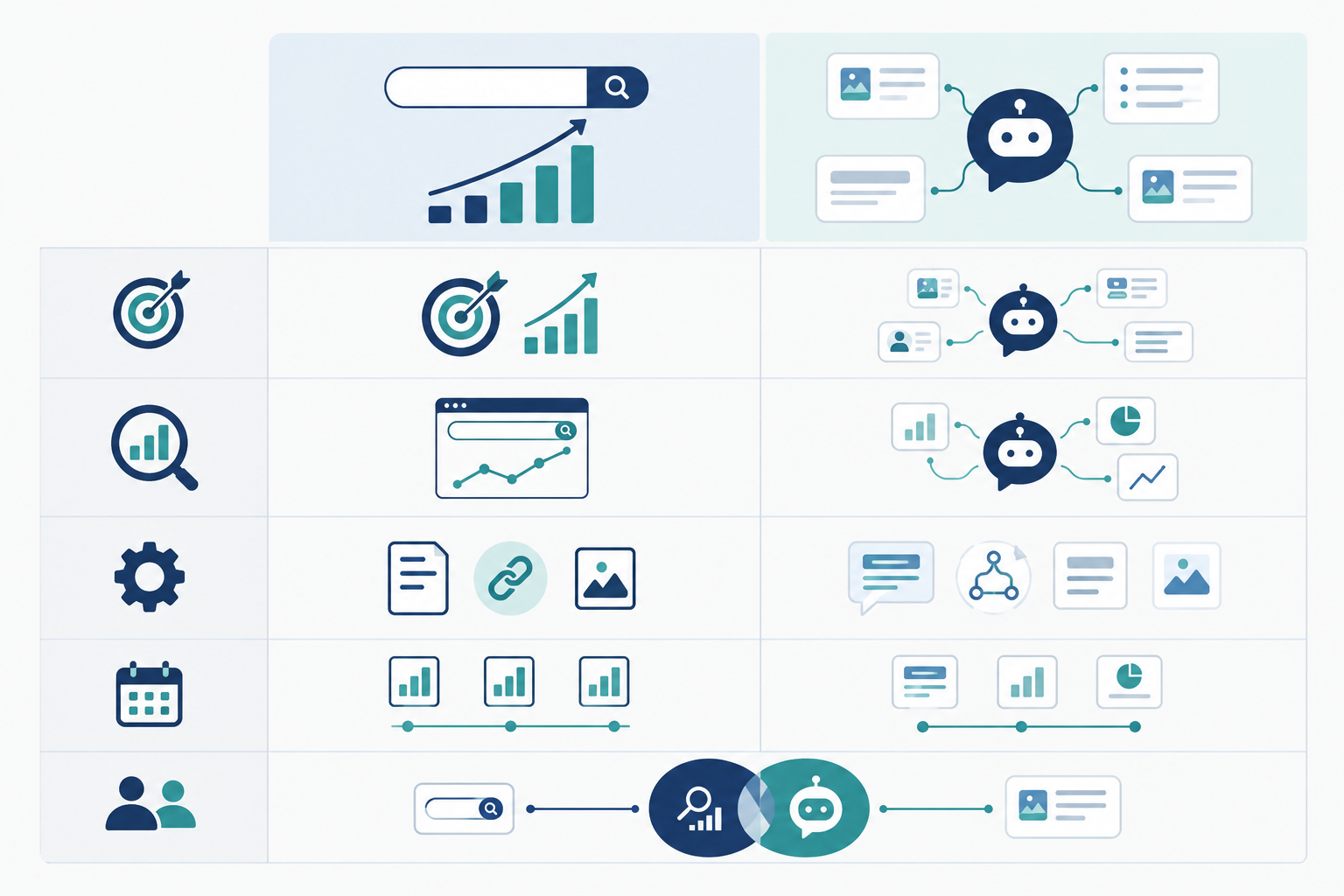
| Dimension | Traditional SEO | Generative engine optimization |
|---|---|---|
| Goal | Rank and earn clicks from search results | Be mentioned, cited and recommended inside AI answers |
| Key metrics | Rankings, impressions, clicks, conversions | Visibility score, share of voice, citations, sentiment |
| Typical deliverables | Technical fixes, content, links | Prompt-level tracking, legibility fixes, content and citation gaps |
| Reporting cadence | Monthly | Weekly digest plus monthly narrative |
| Overlap | Technical hygiene, authoritative content, structured data, digital PR | The same foundations feed both channels |
What is genuinely new in generative engine optimization?
The additions are LLM monitoring, prompt-level tracking, competitor tracking inside AI answers, sentiment analysis and AI referral analytics. Existing tools only partly cover this ground. Per the Google documentation linked above, AI-feature traffic is counted within the Search Console Performance report's overall web search data rather than as a separate category. Microsoft has also announced AI-related reporting in Bing Webmaster Tools, which you should check for current availability. Platform reporting is moving in this direction, but it covers individual platforms only, which is why a cross-platform view still adds value.
Frame the offer as protecting existing SEO investment, since organic gains may be worth less if AI engines recommend rivals instead. Address brand monitoring directly too: AI answers are a new surface where reputation forms, alongside press, reviews and social.
Finally, assess internal readiness. Decide who owns reporting, who owns content fixes, and whether your team needs training before the first client signs.
Handling client objections about AI visibility ROI
The sensible approach is to treat visibility measures as leading indicators and connect them to referral visits, qualified leads and revenue where tracking allows. Never promise that monitoring alone will cause revenue growth. These are the objections I would prepare for:
- 'AI search is too small to matter yet.' Acknowledge it is smaller than traditional search, then offer evidence of direction. Adobe Analytics reported that generative AI referral traffic to US retail sites rose 1,300% during the 2024 holiday season versus 2023. That is US retail referral growth from a small base, not a measure of total AI influence or of revenue impact for your UK client. It shows a trackable channel emerging, and your client's own referral data is the better test.
- 'We can't measure revenue from it.' This is partly true, and it is better said first by you. Use AI referral analytics, referral patterns (ChatGPT search referrals can carry a utm_source=chatgpt.com parameter), branded search lift and a 'how did you hear about us' question in sales calls. Be clear that referral visits capture only part of AI visibility, because many exposures never generate a click.
- 'AI answers change constantly.' They do, which is why you report ranges and trends over consistent prompt sets instead of single snapshots.
- 'Can't we just check ChatGPT ourselves?' Manual sampling cannot match the coverage across platforms, the consistency of repeated prompts, or the competitor tracking.
- 'We already pay you for SEO.' Show the incremental scope and explain that it helps protect existing spend, since the Pew data show fewer clicks on traditional results when an AI summary appears (US users, March 2025).
- 'Is this just a fad?' Answer honestly. The exact platforms may shift, and nobody can promise how large the channel becomes, but AI-assisted discovery is now a normal part of how many people research purchases.
A practical AI visibility ROI framework
Agree a baseline score, a target score and a share of voice goal, then set leading indicators at 30, 60 and 90 days as planning assumptions rather than guarantees. At 30 days, look at technical and legibility fixes completed and any early movement in query coverage. At 60 days, look at citation growth and sentiment. At 90 days, look at share of voice against named competitors and commercial signals such as branded search and enquiries. Propose a time-bounded pilot before any promise of return.
Structuring and pricing AI visibility monitoring as a service
Price against controllable work and scope, such as brands, markets, platforms, prompts and reporting cadence, not against guaranteed mentions or citations. Outputs vary by platform, prompt, location and time, and no agency controls the models. It also helps to separate monitoring from implementation, so the retainer covers measurement and recommendations while content, digital PR and technical work are scoped as defined tiers.
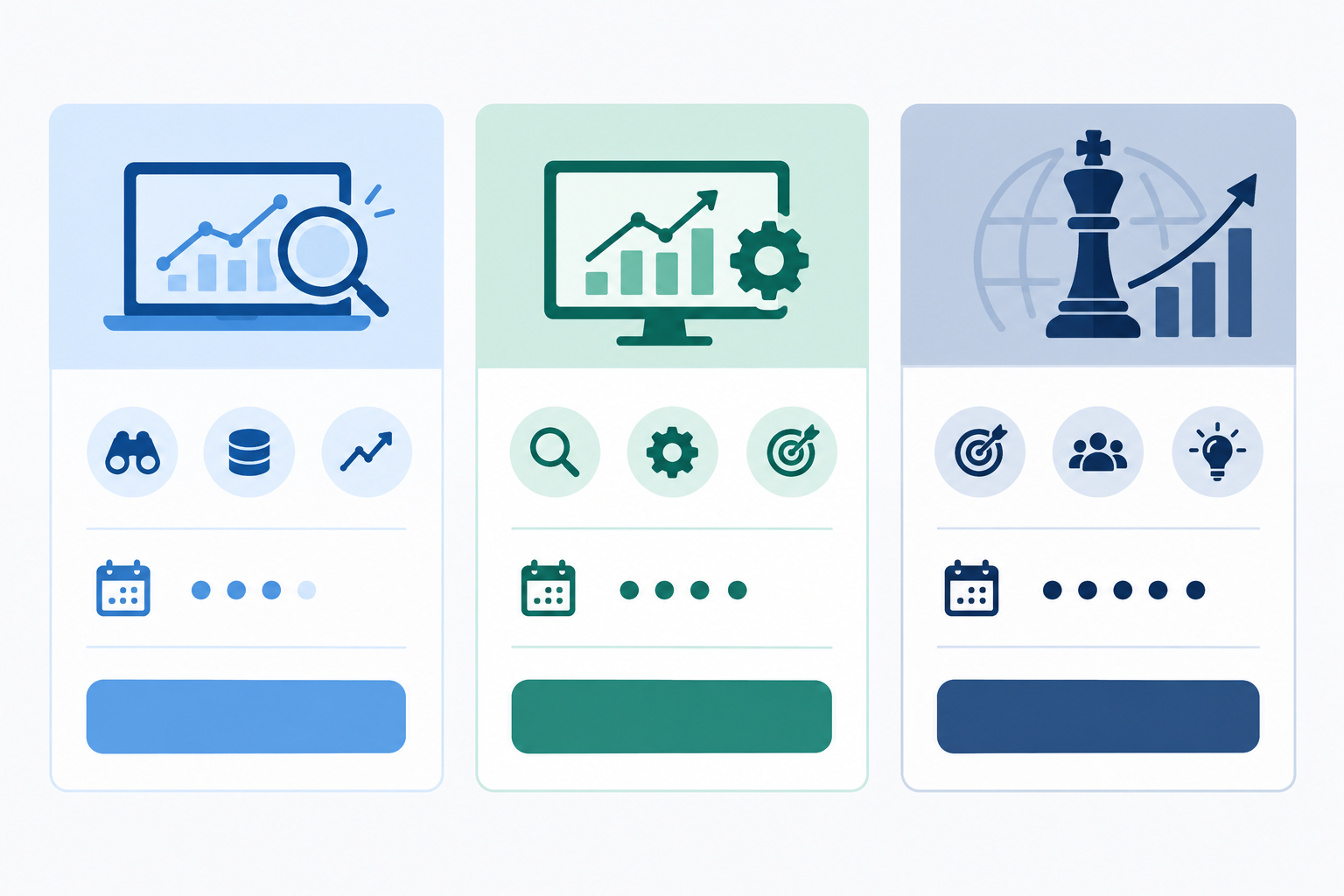
| Monitor | Optimise | Lead | |
|---|---|---|---|
| Scope | 1 brand, UK market, 25 prompts, 4 platforms | 1 brand plus 3 named competitors, 50 prompts, 5 platforms | Up to 3 brands or markets, 100 prompts, all major platforms |
| Includes | Tracking, weekly digest, quarterly review | Monitoring plus legibility fixes and content recommendations | Full generative engine optimization programme with competitor strategy |
| Reporting | Weekly digest, quarterly review | Weekly digest, monthly narrative report | Weekly digest, monthly report, strategy sessions |
| Indicative analyst time | 2 to 3 hours per month | 6 to 10 hours per month | 12 to 20 hours per month |
| Excludes | Content production, digital PR, technical development | Content production beyond agreed briefs, digital PR | Digital PR and large-scale content unless separately quoted |
| Illustrative price | £250–£500 per month | £750–£1,500 per month | £2,000–£4,000+ per month |
These scopes, hours and ranges are illustrative examples only, not market benchmarks. Validate them against your own costs, your analyst hours and your local market before publishing a rate card.
How to price an AI visibility monitoring service
Build the price from four inputs: platform cost per client, analyst hours, reporting time, and the value of the outcome. Then add a sensible margin. A one-off setup or audit fee, perhaps £300 to £750 as an example, can be credited against the first retainer to keep the entry point attractive. I suggest 3-month minimum terms as a starting assumption, because visibility changes tend to be gradual and a shorter term rarely gives a fair read, but adjust to your client base.
For technically minded clients, MentionOwl lists a REST API and an MCP server for AI-agent workflows, which can support custom dashboards. Resale and white-label arrangements depend on the provider's current plan terms, so check those, along with the current feature list, directly with the provider before building an offer around them.
AI visibility service proposal checklist
- Scope, including brands and markets covered
- Queries tracked and how they were chosen
- Platforms covered
- Reporting cadence and format
- Success measures, expressed as leading indicators
- Exclusions, such as content production and digital PR unless a higher tier is chosen
Reporting AI visibility results to retain clients
Retainers survive on reporting that clients actually read. I use weekly digests for operational updates and a monthly narrative report that lists the actions taken and the visibility changes that followed. The report shows sequence, not proof of causation, and it says so plainly. Share of voice trends against named competitors come first, since clients grasp that metric fastest.
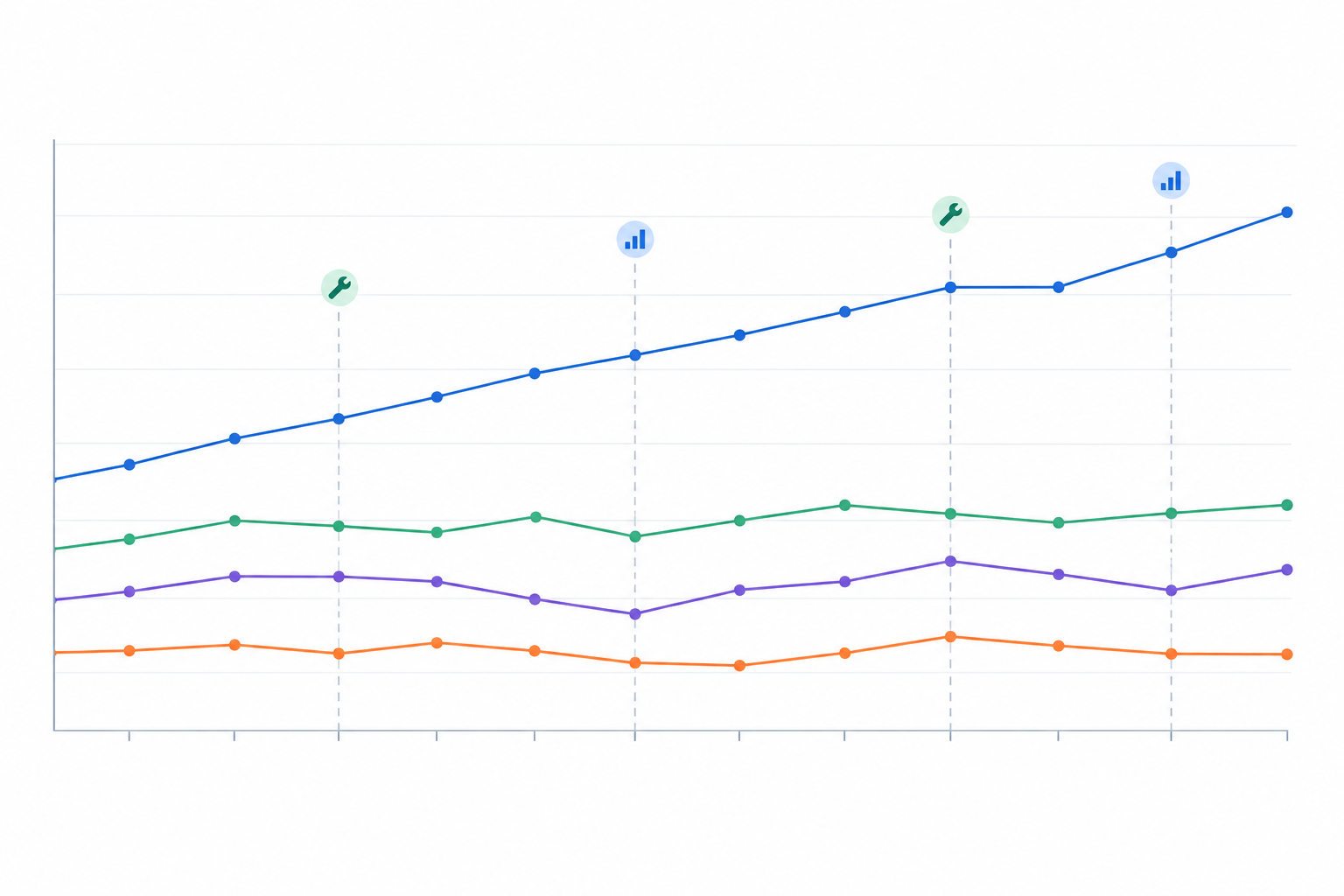
Flag wins and losses at query level so clients see the specific questions where they gained or lost recommendations. Explain normal variation in advance, so a single weak week does not damage credibility, and document any change to prompts or methodology. Where possible, triangulate with commercial indicators such as branded search, enquiries and AI referral traffic, and be candid that these links are indicative rather than proven attribution.
A 30-day plan to launch AI visibility monitoring
- Week 1: select three to five pilot clients with clear competitor sets and run baseline audits.
- Week 2: build a short pitch deck and a one-page service menu with the three tiers.
- Week 3: hold audit conversations, capture every objection, and refine your script accordingly.
- Week 4: convert pilots, set the reporting calendar and document the delivery process so it can be repeated.
After the first quarter, review your pricing against the real delivery effort. Reporting time is easy to underestimate at the outset, and your own time logs will show where to adjust.
Frequently asked questions about AI visibility monitoring
How do I explain AI visibility to a sceptical client in one sentence?
AI visibility is how often and how favourably tools like ChatGPT, Gemini and Perplexity mention or recommend your brand when your customers ask them for advice. The most persuasive follow-up is a screenshot of a real answer in which a competitor is named and the client is not.
Is AI visibility monitoring the same as traditional SEO rank tracking?
No. Rank tracking measures positions in a list of search results, whereas AI visibility monitoring records what generative engines actually say, which sources they cite, how they describe the brand and which competitors they recommend. The two complement each other, and the same technical and content foundations support both.
How long before a client sees improvement in their visibility score?
There is no reliable benchmark. As a planning assumption, technical fixes such as legibility improvements may show early movement within weeks, while changes in share of voice often take a quarter or longer, and some clients may see little change. I recommend setting expectations around leading indicators at 30 and 60 days and avoiding firm promises about outcomes you cannot control.
Can I resell AI visibility monitoring under my own agency brand?
Many agencies package monitoring data into their own reports and dashboards, and a REST API can support that. Whether you can formally white-label a given tool depends on its current plan terms, so confirm these with the platform provider before building the offer around it.