AI Brand Reputation Management: A Guide for Agencies Building a New Service Line
A data-backed playbook for UK agencies adding AI brand reputation management to their services—covering platform monitoring, client reporting, sentime
AI Brand Reputation Management for UK Agencies: A Practical AI Visibility Playbook
Building AI brand reputation management into a genuine service line comes down to three things: a repeatable method for tracking how ChatGPT, Claude, Gemini, Perplexity, and Copilot represent each client against named competitors; a reporting workflow that turns raw citation and sentiment data into decisions a client can act on; and a pricing model that treats AI visibility monitoring as its own retainer rather than a free add-on to existing SEO work.
- Monitoring: a fixed, repeated query set run across all five major AI search platforms, with search state and region logged every time
- Reporting: a workflow with defined inputs, outputs, and thresholds, not just a monthly dashboard export
- Commercials: tiered pricing built from actual analyst and content-production hours, not package labels alone
Over the last eighteen months, client conversations have shifted from “are we ranking?” to “what is ChatGPT saying about us?” I won't claim this is a guaranteed growth line for every agency — adoption data supports the need, but results depend on execution and client mix — but the evidence below makes a reasonably strong case that it's worth building now rather than waiting for UK-specific benchmarks to catch up.
Disclosure: I work with MentionOwl and it's the tool I use day-to-day, so some examples below reference it directly. Where I do, treat it as one implementation option among several — spreadsheet-based manual querying and custom API pipelines are legitimate alternatives, and I've tried to separate tool-specific claims from claims about the discipline generally.
What Does AI Brand Reputation Management Include?
Before the mechanics, it's worth being precise about scope, because agencies taking this on need to know where the line sits. AI brand reputation management combines three layers: monitoring (tracking how often and how a brand appears across AI platforms), sentiment interpretation (reading whether that representation is accurate and favourable), and remediation (the content and technical work that closes gaps). It does not include attempting to manipulate model outputs directly — there's no legitimate mechanism for editing what a model says, only for improving the sources it draws from.
Remediation ownership should sit with the agency's content and technical teams, with client sign-off on any factual correction before it's published. Corrections to third-party sources — including review sites, directories, and forums — typically require outreach rather than direct control. Setting this expectation with clients at the pitch stage avoids the awkward conversation later about why a single blog post didn't change what ChatGPT says by Friday.
Why UK Clients Need AI Brand Reputation Management Now
Gartner's February 2024 research note forecast that traditional search-engine volume could fall by 25% by 2026 as consumers shift toward AI chatbots and virtual agents. That's a forecast, not observed behaviour, and forecasts of this kind have a mixed track record — I'd cite it as directional pressure on the category, not as settled fact.
Adobe Analytics reported a 1,300% year-on-year increase in US retail site traffic referred from generative-AI sources during the 2024 holiday shopping season, with AI-referred shoppers viewing 12% more pages and spending 23% more time on-site than shoppers from other channels (Adobe, December 2024). That's large percentage growth from a small base, and it's US retail data, so I'd treat it as evidence that AI-referred traffic behaves differently — more research-intensive — rather than proof of UK-scale volume.
On adoption specifically, Pew Research Center found that 34% of US adults had used ChatGPT as of mid-2025, up from 23% two years earlier, and Google has stated its AI Overviews feature reaches over 1.5 billion people monthly across 100+ countries (Google, Q1 2025 earnings commentary). Both are global or US figures, not UK ones, but they establish scale.
On the UK side, I want to be direct about a limitation: robust, precisely quantified UK figures for AI-assisted product research are still thin. Ofcom's Online Nation research has tracked rising use of AI chatbots among UK internet users, skewed toward the 16–34 age group, and Deloitte's UK Digital Consumer Trends survey has reported that a meaningful share of UK consumers have tried generative AI tools, with product research among the more common use cases. I'd check the latest published editions of both before quoting exact percentages in a client deck, since figures even six months old may understate current adoption.
What the UK data supports confidently, even without a precise headline percentage, is direction: a growing share of UK consumers are using AI tools somewhere in their research journey, and that share isn't shrinking.
The underlying mechanism matters more than any single statistic. Large language models synthesise brand information from scattered sources — reviews, forums, old press releases, and outdated directory listings — that most clients have never audited. A model doesn't distinguish between a price that changed eighteen months ago and one that's current unless the retrieval layer surfaces the newer source with sufficient authority. Because AI answers are probabilistic, a client can be described accurately in one session and inaccurately in the next — discontinued products, superseded pricing, or wrong differentiators repeated confidently as fact.
The clearest cautionary example is a 2024 Canadian tribunal case in which Air Canada was held responsible after its own chatbot gave a customer incorrect bereavement-fare information; the tribunal rejected the argument that the chatbot was a separate entity from the airline. It's a Canadian ruling, not UK precedent, so I wouldn't tell a client it applies directly here. What it does illustrate, by analogy, is a principle UK consumer protection law and the ASA's stance on misleading claims are built on regardless of medium: whatever a brand's AI-facing content says, customers attribute it to the brand. Any claim involving pricing, regulated products, or personal data should go through proper UK legal review rather than resting on an overseas case.
The opportunity cost for agencies is straightforward: clients are pouring budget into ranking on page one of Google while remaining invisible, or misrepresented, in the ChatGPT and Perplexity answers their prospects are actually reading. That gap is the service line.
Which AI Search Platforms Should Agencies Monitor?
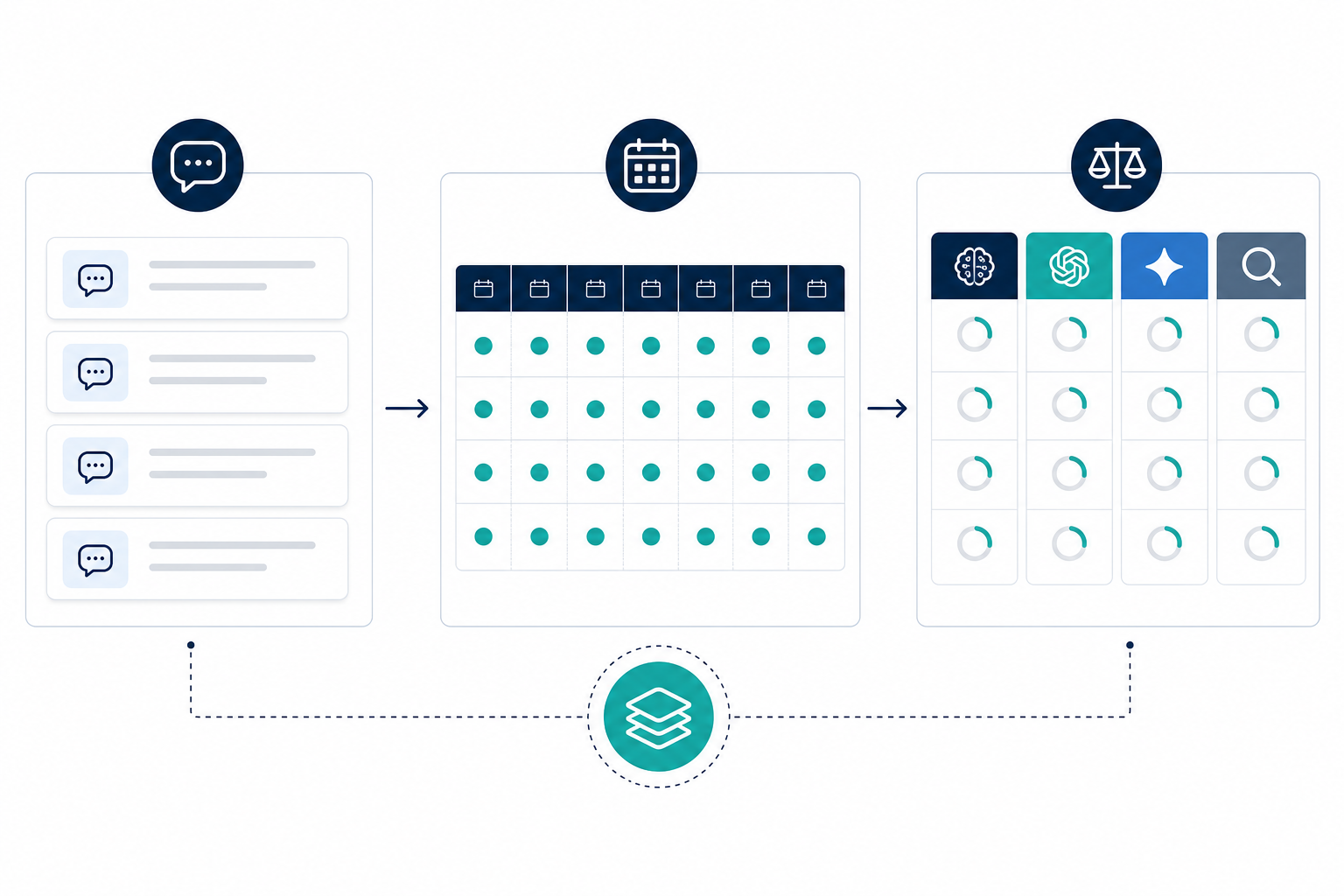
Treating this as a single channel — running a handful of ChatGPT prompts and calling it done — is the most common mistake I see. All descriptions below reflect product behaviour as tested in mid-2025; these platforms change features, browsing defaults, and citation formats often enough that agencies should re-verify quarterly.
ChatGPT Search retrieves current web information with inline citations, but answers vary by prompt wording, location, model version, and whether search is triggered at all for that query. Claude added web search in March 2025; when active it shows citations, but search isn't always triggered, so monitoring needs to record search-on/off state. Gemini is coupled to Google's search ecosystem through grounding, and its consumer-facing surfaces — the standalone app, Search AI Overviews, and Workspace integration — present sources inconsistently, so these should be tracked as distinct surfaces rather than one product. Perplexity is built as an answer engine first, and its citation-heavy interface makes it the easiest platform to audit. Copilot sits inside Microsoft's Bing ecosystem, so its citations are shaped by Bing's index and UK region settings rather than the sources ChatGPT or Gemini might pull from.
Share of voice looks genuinely different on each platform as a result. A brand might dominate Perplexity's citation-heavy answers on the strength of publisher coverage while barely registering in Copilot because Bing's index weights different sources. Checking one platform and extrapolating is a methodological error — any monitoring approach needs to hold region, device context, and prompt wording constant across platforms for the comparison to mean anything, and log the model version and search state at the time of each query.
| Platform | How it sources answers | Citation behaviour | As-tested notes | Agency implication |
|---|---|---|---|---|
| ChatGPT | Web search when triggered, plus training data | Conversational, often lighter on inline links | Record whether search triggered for that session | Track mention rate even without citations |
| Claude | Web search (added March 2025) when active | Citations shown when search used | Log search-on/off state, model version | Confirm search state before drawing conclusions |
| Gemini | Google Search grounding | Varies by surface; sources not always visible | Note which surface generated the answer (app / AI Overviews / Workspace) | Cross-reference with Search Console data |
| Perplexity | Live web retrieval, answer-engine model | Link-heavy, transparent sourcing | Note Pro vs free tier | Best platform for auditing source pages |
| Copilot | Bing index and Microsoft ecosystem | Web citations tied to Bing's index | Confirm UK region setting | Monitor Bing-specific listing signals |
How to Build an AI Visibility Reporting Workflow for Clients
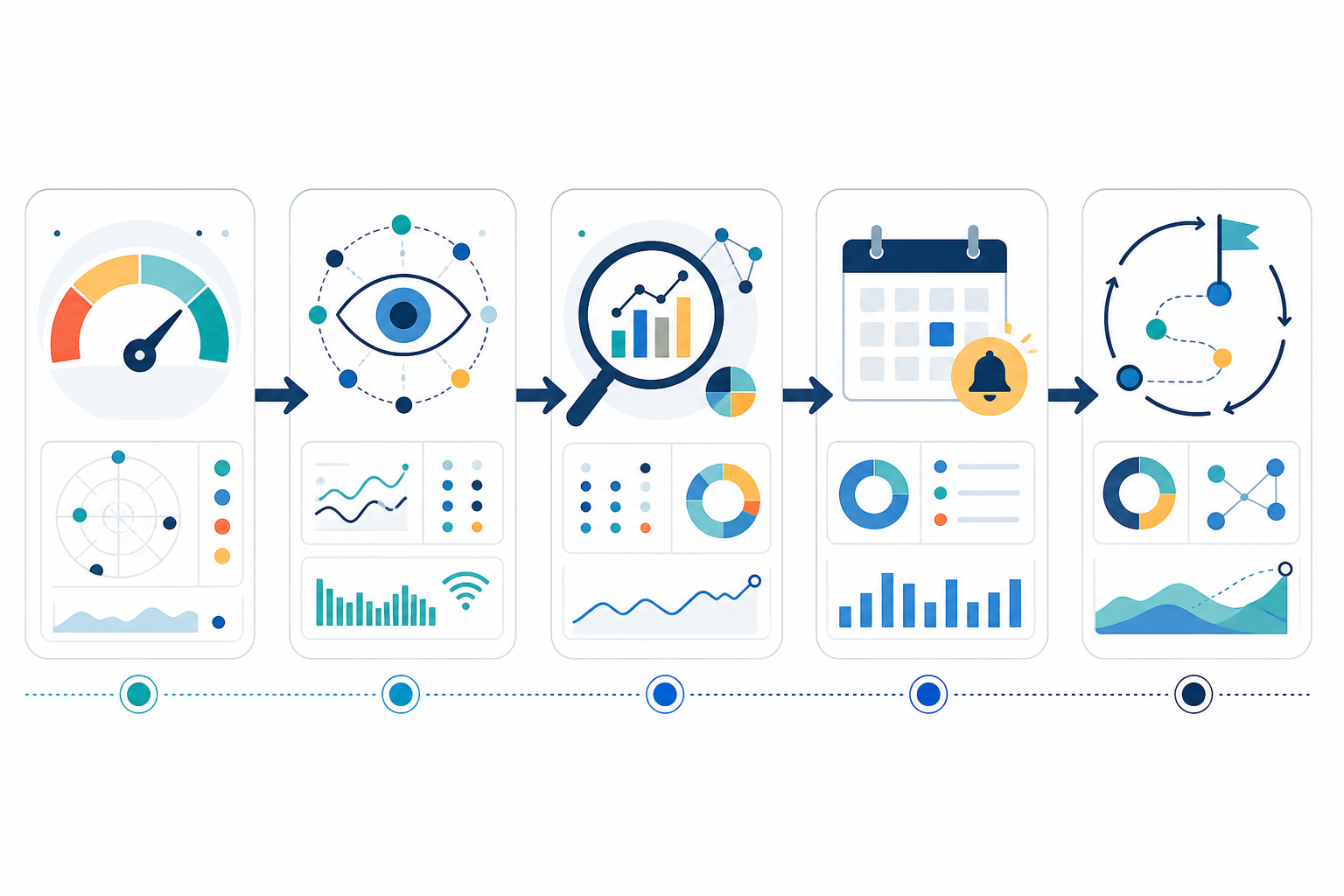
The agency's value comes from how monitoring data gets structured into something a client can act on. Here's a five-step workflow with defined inputs, outputs, and owners.
- Baseline visibility score. Input: 20–40 customer-style queries per client (brand, comparison, “best for” intents), run across all five platforms, repeated three times over one week to smooth session noise. Output: a composite score plus the raw metrics behind it — see the worked example below. Owner: agency analyst. Cadence: once, then monthly.
- Monitoring cadence with a control group. Daily capture, weekly client digest, monthly strategic review. Hold back two or three “control” queries the agency isn't trying to influence — if those move in the same direction as targeted queries, the shift is likely model or index drift, not agency work.
- Segment by query type. A sample taxonomy: 10 brand queries, 10 comparison queries against named competitors, 10 “best for [use case]” queries, and 5–10 objection queries (“is X reliable,” “is X worth the price”). Output: a table by segment, not just one overall score.
- Competitor tracking on every report. A mention count in isolation tells a client little; showing a competitor appears in 60% of comparison queries against the client's 20%, sampled the same way in the same week, shows where the gap actually is.
- AI legibility audit as a supporting signal, not a diagnosis. A checklist covering structured data, page markup, and content clarity can explain part of why visibility is low, but it's one hypothesis among several — see the caveats below before writing briefs from it alone.
A worked scoring example. Say a client runs 30 queries across five platforms (150 total checks). The brand is mentioned in 96 of those checks — a mention rate of 64% (96/150). Of the queries where a mention occurred, 51 included a visible citation to a client-owned page — a citation rate of 53% among mentions. On the 10 comparison queries specifically, the named competitor was cited in 6 out of 10 checks per platform on average, versus the client's 2 out of 10 — a share of voice of roughly 25% against that competitor on comparison intent specifically.
A composite 0–100 score that blends these figures with position weighting is useful as a single trend line, but the weighting itself is vendor-defined — I'd ask any tool exactly how it's calculated. Always report the raw mention rate, citation rate, and segment-level share of voice alongside the composite score, not instead of it.
A concrete example of how this plays out: a monitoring run flags the client absent from six of ten comparison queries against its main competitor. The analyst re-runs those six queries three times over three days to rule out session noise. It holds. Checking Perplexity's citations (the most auditable platform) shows the competitor's own comparison page being cited repeatedly, with no client equivalent. That becomes a specific brief — “write a comparison page addressing X vs [competitor], structured with clear headings and a comparison table” — assigned to the content team, with a re-test scheduled four weeks out.
AI Visibility Measurement Caveats
A few things are worth stating once, clearly, rather than repeating throughout every section: model outputs are probabilistic, so any single-session result should be treated as a sample, not a fact — run comparisons at least three times before trusting a change. A score movement can't be attributed to a specific content fix unless the agency also tracked whether the model version, region setting, or underlying index changed in the same window.
Document the test window, query set, and any known platform updates before reporting a result as a win, and repeat the re-test once more before calling it conclusive.
How to Turn AI Sentiment Data Into Action Items
Raw sentiment and citation data only becomes useful once translated into a brief, and this is the step where causal claims most often outrun the evidence.
- Sentiment and citation frequency are separate metrics. A brand can be mentioned often but described neutrally or negatively — high visibility with poor sentiment is arguably a worse position than low visibility, since the brand is being talked down to a large audience.
- Convert findings into specific briefs. An outdated claim repeated in answers is a content-correction task. Absence from comparison queries is a comparison-content gap. Failure to address a common objection is an objection-handling page waiting to be written.
- Treat soft mentions as a diagnostic signal, not a confirmed cause. A soft mention — referenced without a citation or link — is often read as weak structured data or insufficient authority. That's one plausible explanation among several: it could also be that platform's citation policy for that query type, the freshness of the source the model drew from, or simply how that interface chooses to display sources. Before writing a structured-data brief off a soft-mention pattern, check whether the same query produces citations on a different platform. If it does, the cause is more likely platform-specific display behaviour than a genuine authority gap.
- Prioritise by query volume and commercial intent, not by how alarming one answer looks. A single strange response can trigger client panic, but prioritisation should follow how many prospects are actually asking that type of question.
- Re-test after every content change, following the measurement caveats above rather than repeating them here.
How to Pitch AI Visibility Monitoring as a New Retainer Service
I'd resist folding this into an existing SEO retainer for free — daily monitoring, cross-platform querying, and interpretation work justify a separate line item — but agencies need real numbers, scoped clearly, not just tier names. The bands below are illustrative UK figures based on typical agency time costs and monitoring licence costs; adapt them to your own delivery cost, not the other way round.
Baseline tier — roughly £450–£750/month. Includes: monitoring across all five platforms for one brand, a fixed 20–30 query set, monthly digest, and 2–4 analyst hours. Excludes: competitor tracking, content production, and legibility audits. Margin here is thin because most of the cost is tooling licence; treat it as a foot-in-the-door offer.
Mid tier — roughly £900–£1,500/month. Adds: tracking against 2–3 named competitors, a 40–60 query set, quarterly strategy session, and 6–10 analyst hours. Excludes: content or technical production beyond briefs. This is usually where margin improves, since incremental tooling cost per additional query is small relative to the fee.
Top tier — roughly £2,000–£4,000+/month. Adds: full legibility audits, expanded query coverage, and content or technical production to close gaps — a single comparison or objection-handling page can absorb 4–8 hours of writer and editorial time. Price this closer to a content retainer than a monitoring fee, since most of the cost sits in production, not tooling. Define overage rules upfront (extra queries, extra competitors, and extra pages) rather than absorbing scope creep.
A one-off setup fee of £500–£1,500 for query taxonomy design, baseline scoring, and competitor selection is worth charging separately, since that discovery work doesn't repeat.
When choosing an AI visibility monitoring tool — whether MentionOwl or an alternative — the criteria that matter most are: platform coverage and how often it's updated, whether raw responses (not just scores) are exportable, whether model version and region are logged per query, historical data retention, and cost per query at the volume you'll actually run. A low-cost trial period, structured around your own fixed query set rather than a vendor demo, is the fastest way to generate a real number for a prospect before any commitment is made. The same effect can be achieved manually with a half-day of structured querying if you'd rather not rely on a third-party trial.
Expect three recurring objections: budget, ROI scepticism, and confusion about how this differs from SEO spend. I'd address the SEO-difference objection head-on since it's usually the real blocker (see the comparison below). For ROI scepticism, a client seeing their visibility score move from 34 to 41 in a month is a useful illustration of what movement looks like in the reporting — I'd present it as a reporting example, not as proof of commercial return, since attribution depends on the confounder-tracking discussed above.
AI Visibility Reporting vs Traditional SEO Reporting
| SEO reporting | AI visibility reporting | |
|---|---|---|
| Data source | Search Console, rank trackers | Repeated structured querying (no equivalent first-party dashboard) |
| Variability | Location, device, personalisation | All of the above, plus model version, search-trigger state, session |
| Core KPI | Rankings, impressions, CTR | Mention rate, citation rate, share of voice, sentiment |
| Attribution | Easier to isolate a single change | Requires confounder tracking (model/index updates) |
| Action | Content and technical SEO fixes | Content, technical, and third-party source correction |
SEO signals aren't perfectly stable either, but they're more directly observable and commonly instrumented than AI answers, where the same platform can cite a brand in 70% of sessions for a query and omit it in the other 30% an hour later for the same person. The two disciplines share inputs — content quality, structured data, and authority signals — but need separate KPIs, cadence, and, commercially, a separate line on the invoice.
30-Day AI Brand Reputation Management Launch Checklist
- Week 1 — Pick a pilot client and build the query taxonomy. Choose a client with reasonable brand awareness and an identifiable competitor. Draft 20–30 queries across brand, comparison, and “best for” intents.
- Week 1–2 — Run the baseline three times. Capture the score and the raw metrics behind it, documenting search state per platform.
- Week 2 — Build the reporting template. Create a segmented report, competitor view, and legibility checklist before the first real deliverable.
- Week 3 — Deliver the first report and first briefs. Translate the two or three most commercially relevant gaps into specific briefs, prioritised by query volume and intent.
- Week 4 — Price the pilot and decide packaging. Use actual hours from weeks 1–3 to sanity-check tier fit, then set your own rate card from real cost rather than the illustrative bands above.
FAQ: AI Brand Reputation and AI Visibility for Agencies
How do agencies monitor multiple AI search platforms at once without doing it manually?
Manually querying ChatGPT, Claude, Gemini, Perplexity, and Copilot daily for every client isn't sustainable past two or three accounts. Tools such as MentionOwl automate this by running a fixed query set against all major AI engines daily and recording answers, citations, sentiment, and competitor mentions in one place. A spreadsheet run weekly by an analyst works for one or two pilot clients but won't scale or capture daily volatility as reliably.
What should I include in a client AI visibility report?
At minimum: mention rate and citation rate (not just a composite score), a breakdown by query type, competitor share of voice on the same queries, sentiment analysis, and a short list of prioritised action items tied to specific briefs. Include a brief methodology note — query count, platforms covered, testing dates, and how many repeated samples informed the numbers — so the client understands what the score does and doesn't capture.
Can I realistically offer AI brand reputation management as a new service line?
Yes, framed as a genuine opportunity rather than a guaranteed one. Adoption data supports the need; individual results depend on execution and client mix. The barrier to entry is lower than expected — monitoring and scoring tools already exist, so the agency's value-add is interpretation, strategy, and content execution rather than building tooling from scratch.
How is AI visibility reporting different from the SEO reporting I already do?
SEO reporting relies on more directly observable signals — rankings, impressions, and CTR — from tools like Search Console. AI visibility reporting measures something more variable: how often and how favourably a brand appears in AI-generated answers, which shifts with phrasing, model updates, region, and retrieval behaviour. They share inputs like content quality and structured data but need separate KPIs and separate client conversations.
What does AI brand reputation monitoring cost, roughly?
Indicative UK monthly retainers run from roughly £450 for basic multi-platform monitoring to £4,000+ for monitoring plus content and technical remediation, with a £500–£1,500 one-off setup fee for taxonomy and baseline work. Calibrate your own rate card against a pilot client's actual hours rather than these figures directly.
Does UK regulation affect how agencies run AI reputation management services?
Monitoring what AI platforms say publicly about a brand doesn't typically raise GDPR concerns when you're querying general models rather than processing personal data — though if prompts or outputs involve identifiable individuals, normal data-protection principles still apply. On consumer protection, UK principles around misleading claims apply to client-facing AI content regardless of medium, but this is general information, not legal advice. Any client-facing correction involving pricing, regulated products, or personal data should go through proper UK legal review rather than relying on analogies to overseas cases.