Simple Ways Small Businesses Can Improve AI Recommendations: A Practical UK Guide
Wondering if ChatGPT or Gemini recommends you over local rivals? Here are five low-effort, non-technical ways UK small businesses can improve their AI
AI Visibility for Small Businesses: 5 Practical Ways to Improve AI Recommendations
In my analysis, the most reliable ways to improve AI visibility are also the simplest. Keep your business details identical everywhere they appear. Answer real customer questions plainly on your website. Build genuine reviews on the platforms AI engines draw from, and publish specific, up-to-date content. Then measure the effect, because AI answers shift constantly and what you cannot see you cannot improve. None of this requires a developer, and most businesses can start this week.
The rest of this guide covers each step with UK examples, a realistic timeline and a seven-day plan. I have also tried to be careful about what the evidence does and does not support. AI SEO is a young field with plenty of confident claims and very little certainty.
Why AI Visibility Matters for Local Businesses Right Now
Picture a customer typing "Who is the best plumber near me in Leeds?" into ChatGPT, Gemini or Perplexity. The assistant answers with a short list of names, a sentence of reasoning for each, and perhaps a few linked sources. The question that should keep a small business owner awake is a simple one: is your name in that answer, or is a competitor's?
This differs from traditional search in one important way. A results page offers ten blue links and lets the customer choose. A generative AI engine assembles a single synthesised answer from web pages, directories, reviews and citations, and it often names only two or three businesses. There is far less room on the podium, and a business that is absent from the answer is effectively invisible to that customer.
I call the measure of how often and how favourably you appear AI visibility. The practice of improving it goes by several names, including AI SEO and generative engine optimization. The label matters less than what you actually do, and what you do is reassuringly familiar.
The scale of the shift is hard to dismiss, though the figures need careful reading:
- Ofcom's Online Nation research found that 31% of UK online adults had used a generative AI tool in 2024. That measures tool use, not the share of people asking AI for business recommendations.
- OpenAI reported more than 400 million weekly active users of ChatGPT in 2025, and Google said in 2024 that AI Overviews had reached over 1 billion monthly users. Both are global figures, not UK-only counts.
- BrightLocal's 2024 survey found that 87% of surveyed US consumers had used Google to read reviews of local businesses. It is a US figure, but it shows how established review-checking is in local discovery.
None of these numbers proves that a given plumber will lose work to a chatbot. Taken together, though, they point to a large and growing discovery surface, and it favours businesses with clear, consistent, verifiable information.
Google itself offers a useful reality check. Its guidance on AI features says websites do not need special technical optimisations to appear in AI Overviews or AI Mode, and that the usual fundamentals still apply: crawlability, indexability and useful, people-first content. So the five habits below are low-effort practices rather than technical projects, and results remain probabilistic. Nobody can guarantee them. 🦉
1. Make Your Business Information Consistent Everywhere
When an AI engine decides whether to name a business, it is weighing confidence. Say your website claims you are open until 6pm, your Facebook page says 5pm and an old Yell listing says you closed in March. The system is handed contradictory evidence and has to guess. Google's local ranking guidance stresses complete and accurate Business Profile information, and consistent facts make it easier for both people and automated systems to work out what is current.
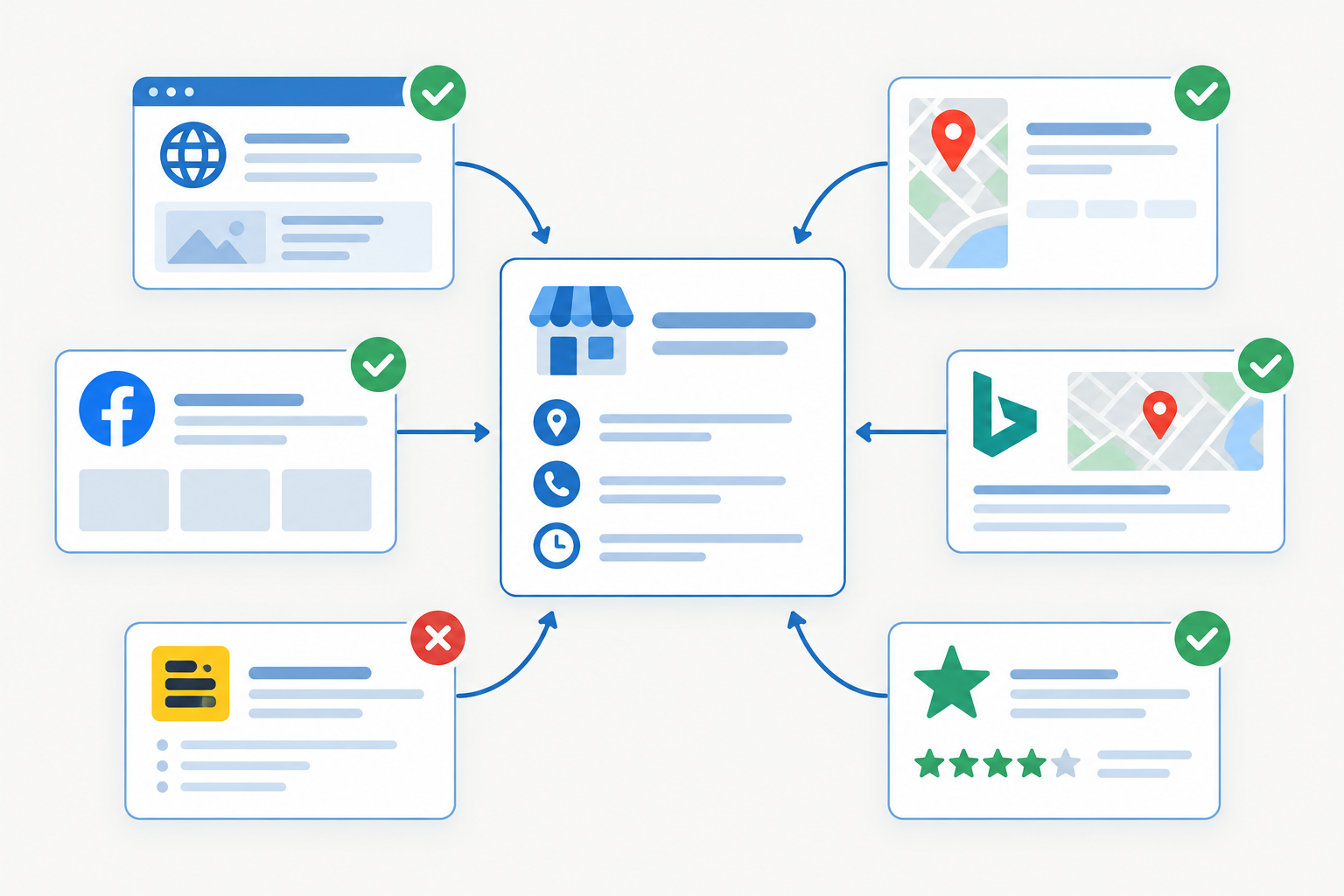
How to Audit Your Business Details Step by Step
- Write down your canonical version. In a simple spreadsheet, record one definitive version of your business name, address, phone number, opening hours, services and a one-line description.
- List every place you appear. Start with your website footer and contact page, Google Business Profile, Facebook, LinkedIn, Bing Places, Yell, Trustpilot, relevant industry directories and your local chamber of commerce listing.
- Compare each listing against your canonical version. Add one row per listing and one column per detail, and mark any mismatch.
- Correct the mismatches at source using each platform's edit screen. No code is involved, so you can settle the developer question early: you do not need one for this.
- Recheck quarterly. Listings drift, and directories sometimes overwrite your details with scraped data.
UK Business Listing Errors to Look For
- Old trading names that survived a rebrand
- "Ltd" on some listings and not others
- Outdated postcodes after a move
- Mismatched bank holiday and Christmas opening hours
- Service descriptions that differ between your website and your Facebook About section
Business Information Consistency Checklist
- Business name written identically everywhere
- Address and postcode identical everywhere
- Phone number in the same format everywhere
- Opening hours, including bank holidays, match on every listing
- Service list and areas covered match your website
- One-line description is the same (or clearly equivalent) across platforms
2. Answer Common Customer Questions on Your Website
People ask AI assistants questions, so a page that states a clear answer in plain language is easier to quote and cite than one that makes the reader hunt for it. To be clear, this makes your information easier to interpret. It does not guarantee that any AI system will cite or recommend you.
Where to Find Real Customer Questions
- Customer emails and phone calls
- Questions in your Google Business Profile Q&A
- Social media comments and direct messages
- What your staff already know from talking to customers
- Google Search Console, which shows the queries already bringing visitors to your site
How to Structure a Helpful Question-and-Answer Page
Use the question as the heading and give a direct answer in the first sentence or two. Then add the supporting detail, such as price ranges, areas covered and timescales. GOV.UK's content design approach is a good model here, with direct headings and concise explanations built around practical tasks.
Specificity is what separates a helpful page from a useless one. "We serve the local area" tells a machine almost nothing. "We cover Leeds, Bradford and Harrogate, with emergency call-outs available within two hours in LS postcodes" tells it a great deal. A UK trades business might publish a "Service areas and call-out fees" page, while an independent online retailer might answer questions on delivery times by UK region, returns, sizing and warranty cover.
A word of caution on FAQ markup: Google restricted FAQ rich results in August 2023, generally showing them only for well-known government and health sites. For most small businesses, an FAQ page is worth having because it helps customers and clarifies your information. Don't expect a special search display from it.
What AI Legibility Means for Your Website
I use the term AI legibility for how easily a machine can read and interpret your pages. Clear headings, readable text and accessible crawling all feed into it. A legibility audit can flag technical blockers without the owner needing to diagnose them. MentionOwl's audit, for instance, runs 16 technical checks.
Do You Need a Developer to Improve AI Visibility?
| You can do this yourself | A developer may genuinely help |
|---|---|
| Writing question-led headings and answers | Fixing a robots.txt file that blocks crawlers |
| Adding service areas, prices and timescales | Adding accurate structured data |
| Updating pages in your website editor | Resolving slow-loading or broken pages |
Structured data must accurately reflect visible page content, and it does not guarantee any particular presentation. Treat it as support for clear on-page answers, never a substitute for them.
3. Encourage Genuine Reviews AI Engines Can Reference
Reviews act as corroborating evidence about quality, sentiment and the specific services you provide. From what I have read of the available guidance, recent and detailed reviews are more informative than a handful of generic star ratings. A sentence such as "Replaced our boiler in Harrogate in one day, tidy and punctual" gives a system something concrete to work with.
The CMA once estimated that online reviews influenced more than £23 billion of UK consumer spending per year. That estimate dates from 2015, so I would not treat it as a current figure. It does show that reviews have mattered commercially in Britain for a long time.
Review Platforms That Matter for UK Businesses
- Google reviews, usually the first priority
- Trustpilot and Facebook
- Checkatrade, TrustATrader and Which? Trusted Traders for the trades
- Sector-specific sites relevant to your industry
Compliant Ways to Ask Customers for Reviews
- Send a follow-up text or email with a direct review link after a completed job
- Put a QR code on receipts or invoices
- Invite feedback about the actual experience (the service used, the town, the support received) without scripting what customers should say
- Ask every customer for honest feedback, not only those who seem happy, and use a neutral request
UK Rules on Fake and Incentivised Reviews
Since 6 April 2025, UK consumer-protection rules under the Digital Markets, Competition and Consumers Act 2024 have prohibited specified fake review practices. These include commissioning or submitting fake reviews, and offering incentives without appropriate steps to ensure the incentive is disclosed. The CMA's guidance is clear that you should not offer rewards for positive reviews. Check your own processes against the current rules.
Why You Should Reply to Every Review
Responses add fresh, relevant text and show that the business is active. A good reply acknowledges the customer's point, explains any next step and avoids sharing private information. That applies to critical reviews as much as glowing ones.
How Much Do Reviews Influence AI Recommendations?
I will be candid: influence varies by engine, the weighting is not publicly documented and the evidence is still developing. Treat review volume, recency, specificity and response quality as reputation signals to manage, not as a lever with guaranteed results. Also note that Google does not show self-serving review snippets for LocalBusiness pages, so put your effort into genuine reviews on appropriate third-party platforms.
4. Keep Your Website Content Fresh and Specific
Stale pages and vague claims make a business harder to recommend with confidence. The freshness rule I favour comes from Google's people-first guidance: update information when the underlying facts change, not simply to change a date. If your pricing, delivery area, eligibility criteria or team credentials shift, say so explicitly on the page.
A Simple Monthly Content Update Routine
- Update opening hours and pricing
- Add one new case study or customer story
- Refresh your most important service page
- Post a seasonal or opening-hours update on your Google Business Profile
Generic Versus Specific Website Content: A Before-and-After
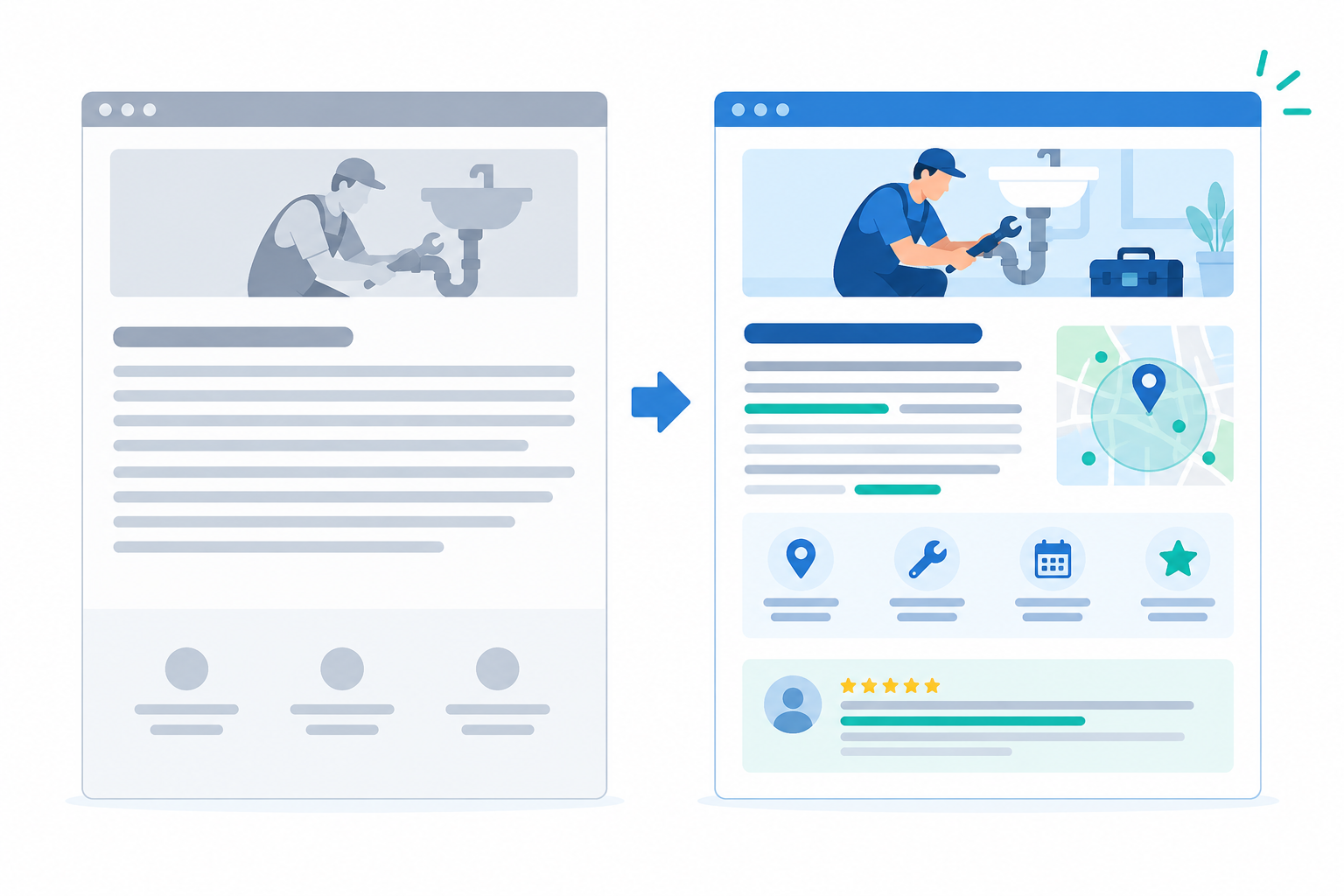
Before: "We are a friendly local plumbing company offering quality services at competitive prices. Contact us today."
After: "Harrow Plumbing has been trading in Leeds since 2011. We are Gas Safe registered and cover Leeds, Bradford and Harrogate. A standard boiler service takes about 45 minutes and costs from £85. In 2024 we replaced 140 boilers, most completed in a single day."
The second version gives you things you can check: years trading, accreditation, named locations, a typical cost and customer outcomes. (The business is fictional, but the pattern is real.)
Earn Mentions Beyond Your Own Website
Search-based AI tools can link to web sources, and in my experience those sources are frequently third-party pages. So being mentioned elsewhere matters as much as what you publish yourself. Realistic routes include:
- Local press and community newsletters
- Supplier or partner pages that list you
- Community sponsorships
- Industry roundups and association directories
Be wary of any promise of instant results. Google is explicit that there are no special content tricks for AI Overviews, and improving the underlying page is the better use of your time.
5. Track AI Visibility with Regular Brand Monitoring
One-off manual checks mislead. AI answers vary by wording, platform and day, so a single test tells you very little. Google's own guidance on AI features reflects that variability, and I would treat any isolated change as noise until it repeats.
How to Check Your AI Visibility Manually
- Write ten questions a customer would genuinely ask, such as "Which accountant in Bristol works with sole traders?"
- Run them across ChatGPT, Gemini, Perplexity, Claude and Copilot.
- Log the result for each: named, cited or ignored.
- Note which sources are cited and any factual errors, such as wrong hours or services.
- Repeat on a fixed schedule using the same questions, so you compare like with like.
This works, but it is slow, and a manual log cannot easily capture daily variation.
Using Brand Monitoring Tools for AI Search
This is where brand monitoring built for AI search earns its place. MentionOwl crawls your website, auto-generates relevant customer questions and runs them daily across ChatGPT, Claude, Gemini, Copilot and Perplexity. It records answers, citations, sentiment and competitor mentions.
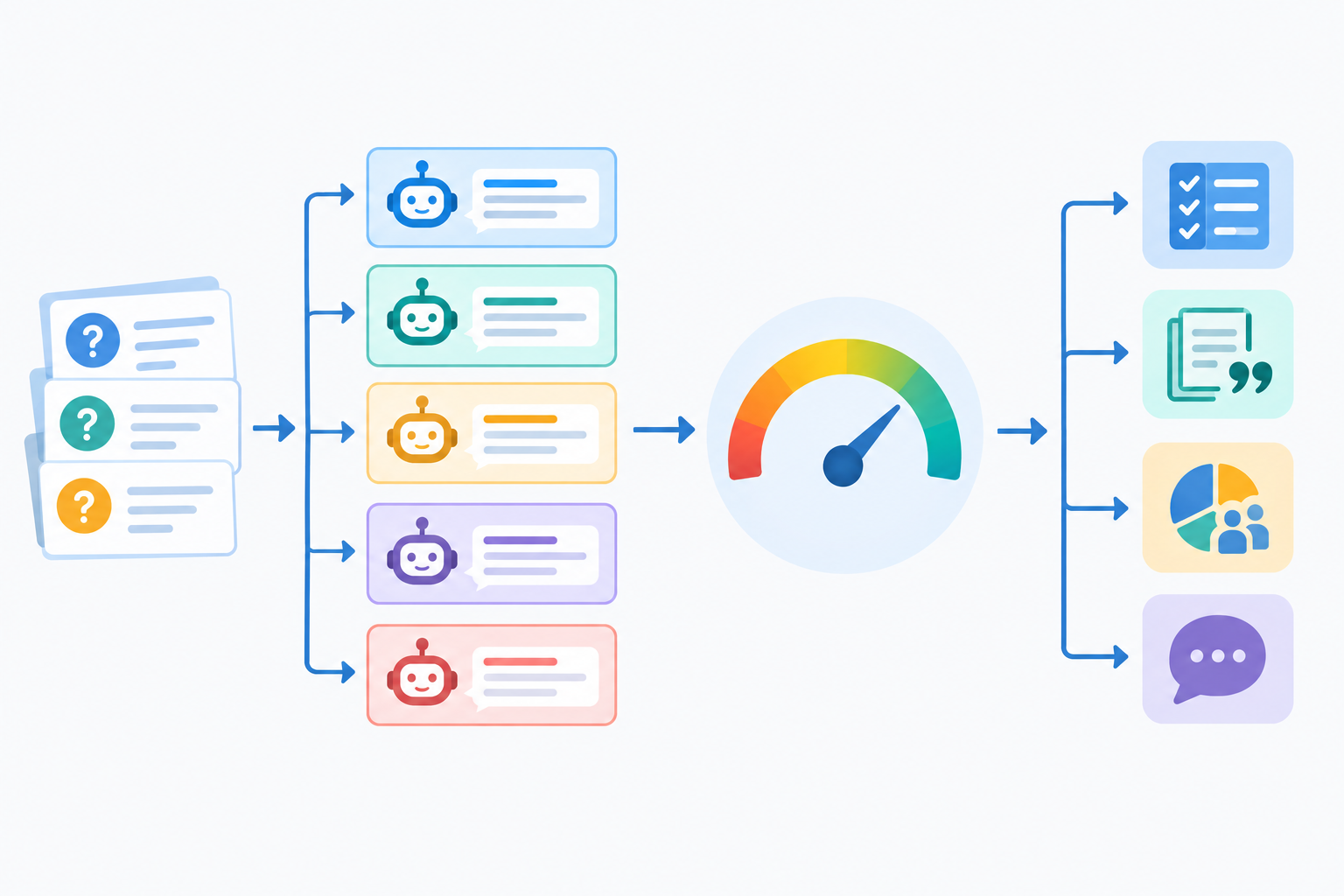
The metrics worth tracking are:
- Query coverage: the share of relevant questions where you appear at all
- Position-weighted citations: being cited first counts for more than being cited last
- Share of voice: your mentions relative to competitors across the same questions
- Soft mentions: being named without a link
- Sentiment: whether the description is positive, neutral or negative
MentionOwl combines these into a proprietary 0-100 visibility score, which makes movement easy to see.
Competitor tracking matters because the real question is whether you appear instead of the business down the road. Weekly digests summarise the changes, and cookieless AI traffic analytics help connect visibility to actual visits without heavy setup. There is also a $1 seven-day trial, a low-risk way to establish a baseline before you change anything.
If you use Microsoft's ecosystem, Bing Webmaster Tools' AI Performance report, announced in 2025, is another monitoring option. It offers site-level citation data for Copilot and selected AI experiences.
How Long Does It Take to Improve AI Visibility?
I would rather be honest than reassuring here. There is no established, universal timeframe for improving visibility in AI-generated recommendations, and no reliable cross-platform statistic gives a standard number of weeks. Results depend on how often relevant sources are crawled, how consistent your information is and how often each AI product refreshes its answers or retrieves live web content.
There are some reference points. Google says recrawling can take from a few days to a few weeks, and that requesting a recrawl does not guarantee indexing. Its general SEO guidance has also suggested improvements may take roughly four months to a year to show benefits. That is general SEO advice, not an AI-specific promise.
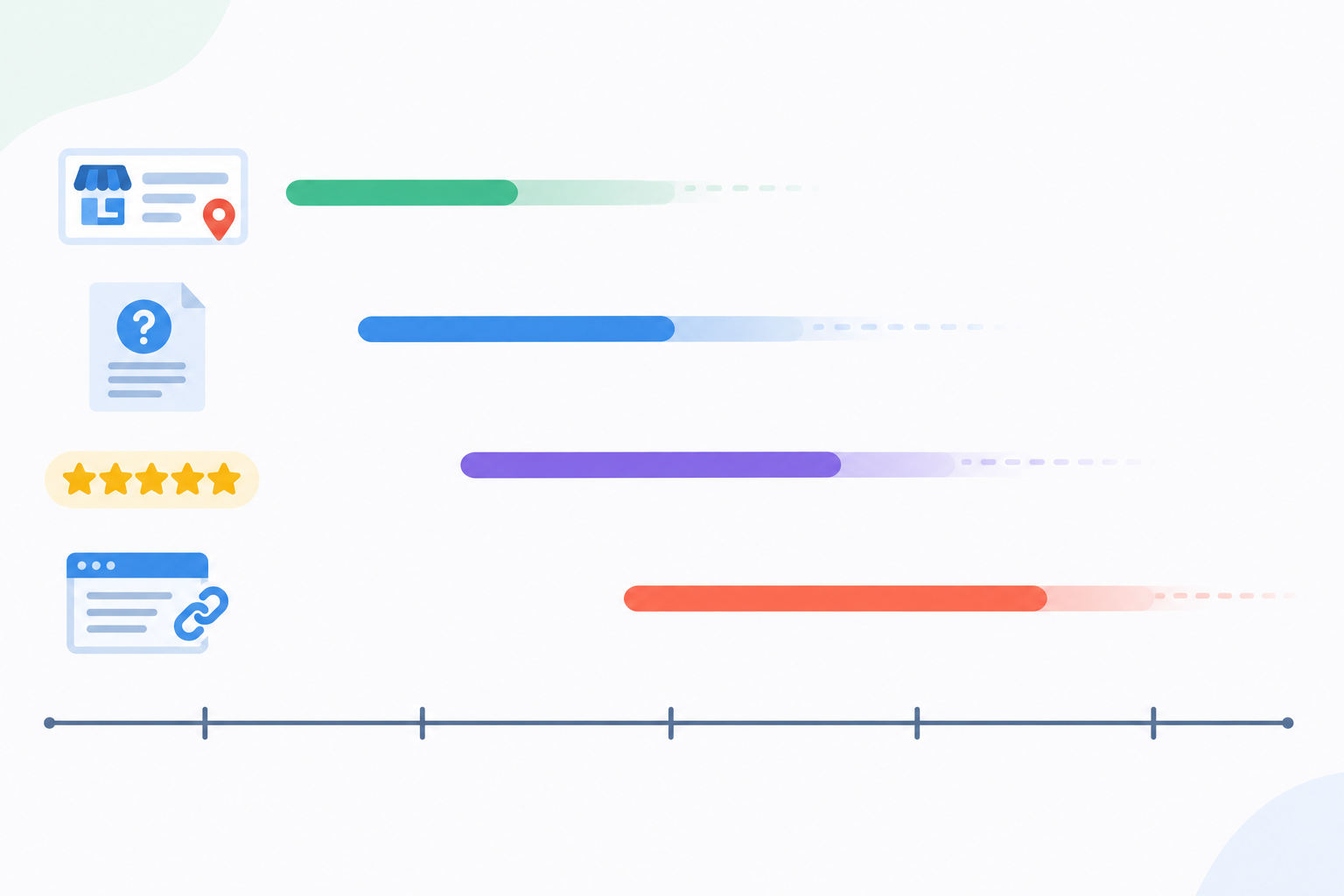
| Action | Typical time to impact | Why |
|---|---|---|
| Fixing inconsistent listings | Days to weeks | Depends on platform updates and recrawling |
| New question-led FAQ content | Weeks | Needs crawling and indexing first |
| Review growth | Weeks to months | Volume and recency build gradually |
| Third-party mentions | Months | Relies on others publishing and being indexed |
These ranges are my practical estimates, not guarantees. The early milestone to watch is whether your updated pages are crawled and indexed. Whether an AI answer changes overnight is the wrong thing to look at.
I recommend a 90-day review cycle with a clear before-and-after comparison. Check weekly during the first few months and assess trends monthly. A baseline lets you spot small movements early, and repeated improvement across the same question set is the signal worth trusting.
Your 7-Day AI Visibility Action Plan
- Day 1: Record your canonical business details and check your Google Business Profile for completeness.
- Days 2 to 3: Correct inconsistent listings across Facebook, Bing Places, Yell, Trustpilot and directories.
- Days 4 to 5: Write or improve five question-led answers on your website, using real customer questions.
- Day 6: Send a review request to your last ten customers, with a direct link and no incentive.
- Day 7: Run your baseline set of customer questions and record where you stand, either manually or with a MentionOwl trial.
Small, steady improvements compound. The businesses that benefit are rarely the ones with the cleverest tactics. They have accurate details, clear answers, genuine reviews and the discipline to measure. Run your baseline check this week and you will know where you stand before your competitors do. 📈
Frequently Asked Questions About AI Visibility and AI SEO
Do I Need a Developer to Improve AI Visibility?
Not for most of it. Correcting listings, writing question-led pages, requesting reviews and updating content can all be done through standard website editors and platform dashboards. A developer only becomes useful for technical items such as crawler access settings or structured data, and an AI legibility audit can tell you whether any of those apply to you.
Does a Google Business Profile Help with AI Recommendations?
It is very likely to help. A complete, accurate and active Google Business Profile is a major source of verified business information and reviews, and Gemini in particular is closely tied to Google's ecosystem. Other assistants also draw on the same information through the wider web, so it is one of the best places to start.
How Do Reviews Factor into AI Recommendations?
Reviews give AI engines evidence about reputation, sentiment and the specific services you provide. Recent, detailed reviews that mention what you did and where are generally more useful than short star ratings. The exact weighting differs between assistants and is not publicly documented, so treat reviews as an important signal rather than a guaranteed lever.
How Long Until I See a Difference in AI Search?
It varies. Fixing inconsistent listings and publishing clear answers can show effects within a few weeks on engines that retrieve live web content, while review growth and third-party mentions typically take a few months. The only dependable way to see whether your changes are working is to establish a baseline before you start and track it consistently.