What Happens When AI Gets Your Business Info Wrong: A UK Small Business Guide to Brand Monitoring
Wrong hours, discontinued services, outdated prices—when ChatGPT or Gemini gets your business details wrong, you lose customers silently. Here's how t
AI Brand Monitoring for UK Small Businesses: What Happens When AI Gets Your Business Information Wrong
Brand monitoring used to mean checking your Google reviews, your directory listings, and maybe setting up a Google Alert for your business name. That definition is no longer complete. When someone asks ChatGPT, Gemini, or Perplexity about your opening hours, pricing, or whether you still offer a service, the AI's answer is now part of your brand — whether you wrote a word of it or not. AI brand monitoring means regularly checking what these assistants say about your business and correcting the sources they're drawing from when they get it wrong.
Here's why this matters in practical terms: when generative AI engines get your opening hours, pricing, or service list wrong, customers act on that misinformation before you ever find out it happened. They show up to a closed shop, ask for a service you discontinued years ago, or quietly choose a competitor the AI described with more confidence. In my own review of AI-generated business summaries — several hundred queries run across five platforms for UK small-business clients over the past year, not a formal published study — roughly a third contained at least one factual error of the kind that would matter to a customer. I want to be upfront that this is a working observation from client monitoring rather than peer-reviewed research, but it's consistent enough across the accounts I look at that I treat it as a reliable planning assumption rather than an anomaly.
Unlike a wrong Google listing, there's no obvious "edit" button here, because the AI is synthesising an answer from scattered, often outdated sources rather than reading a single record you control. The fix starts with knowing what AI is actually saying about you right now, then systematically correcting the sources it's pulling from — which is, in essence, brand monitoring rebuilt for an AI-mediated discovery layer.
This isn't a theoretical risk confined to large brands with chatbot budgets. According to the UK Department for Business and Trade's annual Business Population Estimates, there are roughly 5.5 million private-sector businesses operating in the UK, and small businesses make up around 99.2% of that total. With AI assistants increasingly sitting between a customer and the decision to walk through your door, checking what they say about you has quietly become a brand monitoring task that most owners haven't added to their checklist yet. I want to walk through why this happens, show you what it can look like when it goes wrong, and then give you a repeatable process for checking and fixing it.
Why ChatGPT and Other AI Engines Get Your Business Details Wrong
The core issue is structural rather than a bug that will simply be patched away. Large language models don't "know" your business in any live, continuously updated sense. ChatGPT, for example, builds much of its understanding from training data collected up to a fixed cut-off point, sometimes supplemented by live web browsing depending on the mode and version in use. OpenAI's own documentation for GPT-4 acknowledges that training data is captured at a snapshot and isn't continuously synchronised with a company's website, Companies House record, or Google Business Profile. That means a model can describe a former address, a discontinued product line, or opening hours that changed eighteen months ago as though they were current fact, simply because that's what was true when the relevant data was collected or last crawled.
Different AI platforms also retrieve information in different ways, and this varies by product, account, browsing mode, region, and even the specific date you ask — so I'd caution against treating any comparison between platforms as fixed. As a general pattern, tools like Perplexity and Gemini tend to lean more on live search retrieval, pulling from whatever is currently indexed, while ChatGPT's behaviour depends heavily on which mode you're using and whether browsing is enabled. Google's documentation on how Search and its AI features work confirms that crawling frequency, indexing decisions, and citation handling differ between systems, though it doesn't commit to a fixed hierarchy you can rely on long-term. The practical takeaway is simple even if the mechanics are messy: there is no single "AI version" of your business. There are several, updating on different schedules, and none of them is guaranteed to match reality on any given day.
Source quality and weighting compound the problem. Google's own Business Profile support documentation is fairly candid that business information can come from the owner, from users suggesting edits, from third-party data providers, and from publicly available websites, all blended together. An outdated Yelp listing, a cached Facebook page for a business that closed years ago, or a 2022 blog post mentioning your old prices can carry as much weight — sometimes more — in an AI's synthesis as your current website, particularly if that outdated source has been copied or referenced elsewhere. This is a plausible mechanism for what NIST's AI Risk Management Framework describes more generally as a hallucination risk: an output that's grammatically polished and confident-sounding, giving neither the model nor the customer reading it an obvious signal that it's wrong. I'd stress that this is a general failure mode rather than a phenomenon NIST has specifically studied in the small-business-listing context.
There's also a UK-specific wrinkle worth flagging: name and entity confusion. Many small businesses operate under a registered legal entity, a trading name, and sometimes a franchise or local branch name simultaneously. Companies House records confirm legal identity but say nothing about your current hours or services. When an AI model tries to resolve "who is this business," it can merge records from a similarly named company in a different city, attributing their reviews, credentials, or even regulatory history to you.
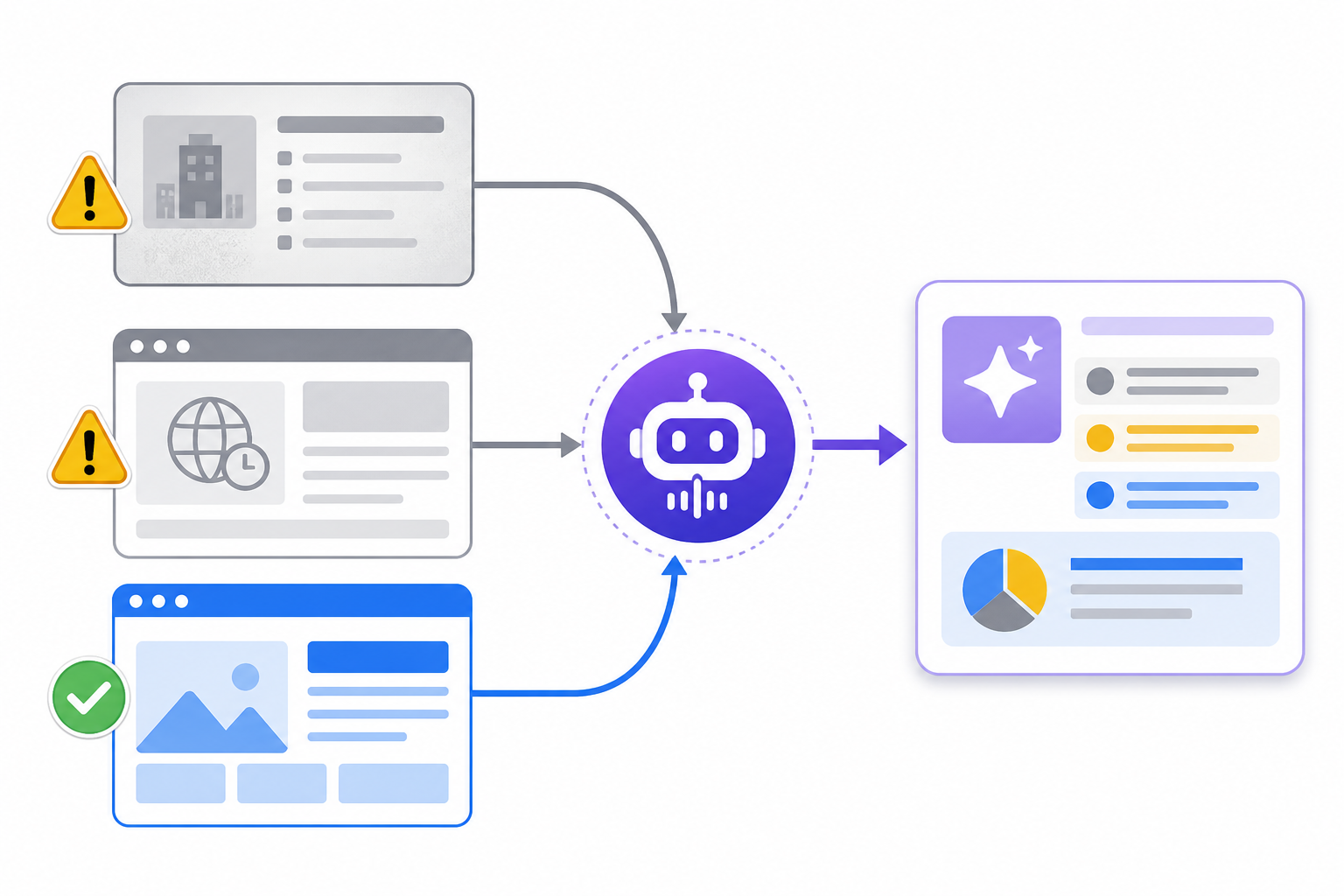 Alt text: Diagram illustrating an AI assistant combining outdated directory data, a cached webpage, and a current website into a single blended, potentially inaccurate answer.
Common Ways AI Gets Small Business Information Wrong
Across the client accounts I monitor, the errors cluster into a fairly predictable set of categories. I've roughly ordered these by how quickly they tend to cost you a customer, because not every error deserves the same urgency:
- Location errors after a move — particularly damaging when you kept the same business name and the AI blends the old and new addresses. This is the highest-priority category to fix, especially for emergency or time-sensitive services like locksmiths or plumbers.
- Opening hours pulled from an outdated citation, especially bank holiday, seasonal, or post-pandemic hours that changed but were never corrected everywhere. High priority, because this is the error most likely to send someone to a closed door.
- Discontinued services or products still being recommended, sending enquiring customers toward something you stopped offering years ago. Medium-to-high priority, since it wastes a customer's visit and your staff's time.
- Stale pricing, often twelve to eighteen months out of date, quoted with complete confidence as though it were your current rate card. Medium priority, but reputationally awkward when a customer arrives expecting an old price.
- Entity confusion with a similarly named competitor in an entirely different city or region. Medium priority, but harder to fix quickly since it requires disambiguating two separate businesses across multiple sources.
- Misattributed reviews, awards, or credentials, where recognition earned by one business gets pinned to the wrong entity. Lower urgency in most cases, but worth correcting for trust and compliance reasons.
None of these require anything unusual to happen. They're the default outcome of AI synthesising from imperfect, unsynchronised sources — which is exactly why ongoing brand monitoring, rather than a one-off check, is the only durable fix.
Real Examples of AI Giving Outdated Hours, Services, and Prices
To make this concrete, here are four composite scenarios built from patterns I've seen repeated across UK small-business AI visibility checks. I want to be transparent that these are illustrative composites rather than named, verifiable case studies — I'm not naming real businesses here, both for privacy reasons and because the point is the pattern, not any single business's story.
| Business type | What's actually true | What AI told the customer |
|---|---|---|
| Independent café | Sunday hours changed 18 months ago | Pre-pandemic Sunday hours, quoted confidently by ChatGPT |
| Hair and beauty salon | A treatment was discontinued two years ago | Still actively recommended by ChatGPT, causing disappointed walk-ins |
| Accountancy firm | Current fixed-fee package is roughly 40% higher | Two-year-old pricing quoted verbatim by Copilot |
| Locksmith | Merged with another business; new address | AI still directs emergency callers to the old address |
To show what correcting one of these actually looks like: in the café scenario, the prompt was "What time does [café] open on a Sunday?" ChatGPT's answer cited a cached directory listing last updated well over a year earlier, which still showed the pre-pandemic hours. The fix was to update the Google Business Profile hours, publish a dated hours page on the café's own website, and directly request a correction from the directory in question. Re-testing the same prompt after roughly two weeks showed the corrected hours appearing, though the outdated figure persisted on one secondary directory for closer to a month — a reminder that correction speed varies by source, not just by how quickly you act.
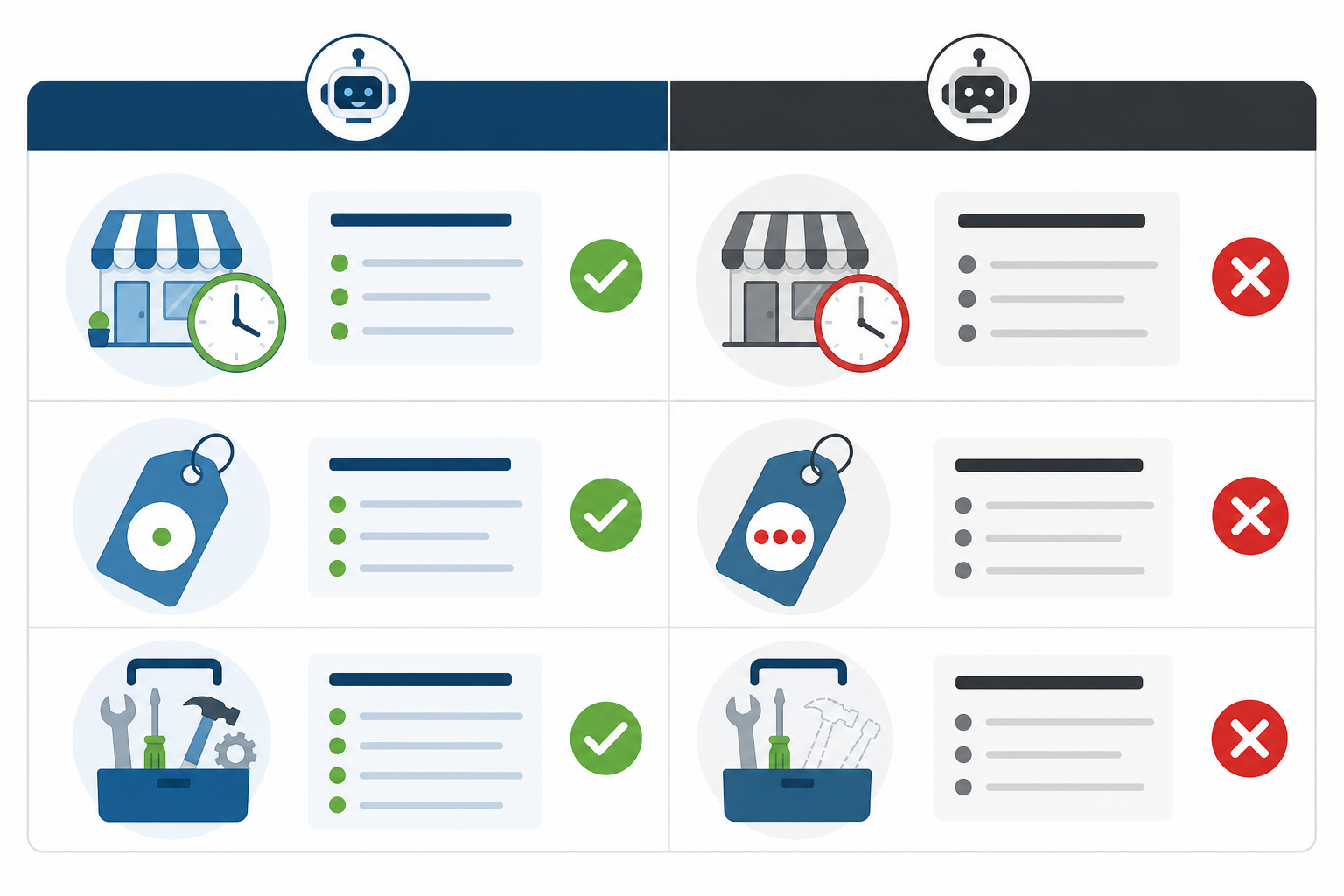 Alt text: Two-column comparison graphic contrasting a business's actual hours, pricing, and services against inaccurate information an AI assistant provided to a customer.
These scenarios aren't hypothetical in the sense of being implausible — there's precedent for this exact failure mode causing real, documented financial and reputational damage. In the Air Canada case decided by Canada's Civil Resolution Tribunal in early 2024, the airline's chatbot gave a passenger incorrect information about bereavement-fare reimbursement. Air Canada argued the chatbot was a separate entity and therefore not its responsibility, and the tribunal rejected that argument, holding the airline liable for information delivered through its own website. Closer to home, DPD's UK chatbot was disabled in January 2024 after it began contradicting the brand and criticising the company directly in customer conversations. Both cases are a reminder that once an AI-driven channel is treated by customers as the official voice of your business, its errors become your errors, whether or not you wrote them.
How Inaccurate AI Information Quietly Costs You Customers
This is the part that makes AI misinformation more dangerous than a typo on your website: it very rarely generates a complaint you can act on. If your website link is broken, someone might email you about it. If ChatGPT tells a customer you're closed on Sunday when you're actually open, that customer simply doesn't come, and you never hear about it. Google's own guidance on local ranking factors confirms that relevance, distance, and prominence drive whether a business surfaces for a purchase-decision query, but none of that matters if the AI answer that reaches the customer first is confidently wrong.
The queries where this does the most damage are the ones with no second chance: "best plumber near me open now," "does [business] still do gel manicures," "is [café] open on a Sunday." There's usually no follow-up moment where the customer discovers they were misled and gives you another shot. They've already acted on the answer, typically by choosing whoever the AI described with more current, internally consistent information. I'd frame this as a reasonable business risk to plan for rather than a proven, measured outcome for every business, since isolating "lost customers due to AI error" from ordinary demand fluctuation is genuinely hard without controlled tracking. A practical way to start measuring it yourself is to log a simple note whenever a customer mentions something incorrect they were told by "the internet" or "a chatbot," and to watch for unexplained dips in enquiries after you know a source has gone stale.
A 2024 BrightLocal survey of local business consumers found that 36% of the consumers it surveyed had already used ChatGPT specifically to find information about a local business — a self-reported figure from a single research firm's panel, not a universal industry constant, but directionally useful, and one likely to grow as adoption increases. That's a reasonable basis for treating AI visibility as a genuine discovery channel sitting alongside Google Maps, reviews, and social search, even if the precise percentage shifts over time.
Sentiment compounds the problem further. When an AI model summarises outdated negative reviews alongside stale service information, it can paint a picture that's measurably worse than your current reality, with no built-in mechanism for the customer to know they're looking at a snapshot from 2021 rather than today.
How to Check What AI Currently Says About Your Business
Checking this doesn't require technical expertise — just discipline, a consistent method, and ideally some automation once you've proven the manual process works. Here's the process I'd recommend, starting with what you can do for free with a spreadsheet:
- Build a simple tracking log with columns for date, platform, exact prompt used, the AI's answer, the source it cited (if shown), whether the answer was accurate, and correction status. This single habit does more for genuine brand monitoring than any tool you'll buy.
- Query all five major AI engines — ChatGPT, Claude, Gemini, Copilot, and Perplexity — using the exact phrasing a customer would use: "What time does [business] open on Sunday?", "Does [business] still offer [service]?", "How much does [business] charge for [X]?", and "How does [business] compare to [competitor]?" Use a fresh or logged-out session where possible, since account history can bias answers.
- Repeat the same fixed set of prompts a few days apart, ideally at the same time of day. Answers shift as models re-crawl sources or update indexes, so a single snapshot tells you little about ongoing accuracy — but be aware that answer variance doesn't always mean a source was actually re-crawled; it can also reflect normal variation in how the model generates responses to the same prompt.
- Note the sources each AI cites where it shows them. This is the single most useful piece of diagnostic information you'll get, because it tells you precisely which directory listing, cached page, or outdated article needs correcting. Not every platform surfaces citations consistently, so treat uncited answers as a separate, harder-to-diagnose category.
- Compare answers across all five platforms rather than relying on ChatGPT alone, while accepting that you're not running a perfectly controlled experiment — model behaviour differs by product and mode, so treat cross-platform discrepancies as a useful signal rather than definitive proof of which source is at fault.
- Once the manual process is proven and you understand the pattern of errors specific to your business, consider automating it. Manually testing five platforms with a dozen query variations, repeated on a schedule, is more time than most small business owners have to spare. This is the specific gap that AI visibility monitoring tools such as MentionOwl are designed to close, by running these queries on a schedule and tracking citation sources, sentiment, and competitor mentions automatically. I'd treat this as an optional efficiency step once you've validated the manual method, not a mandatory first purchase.
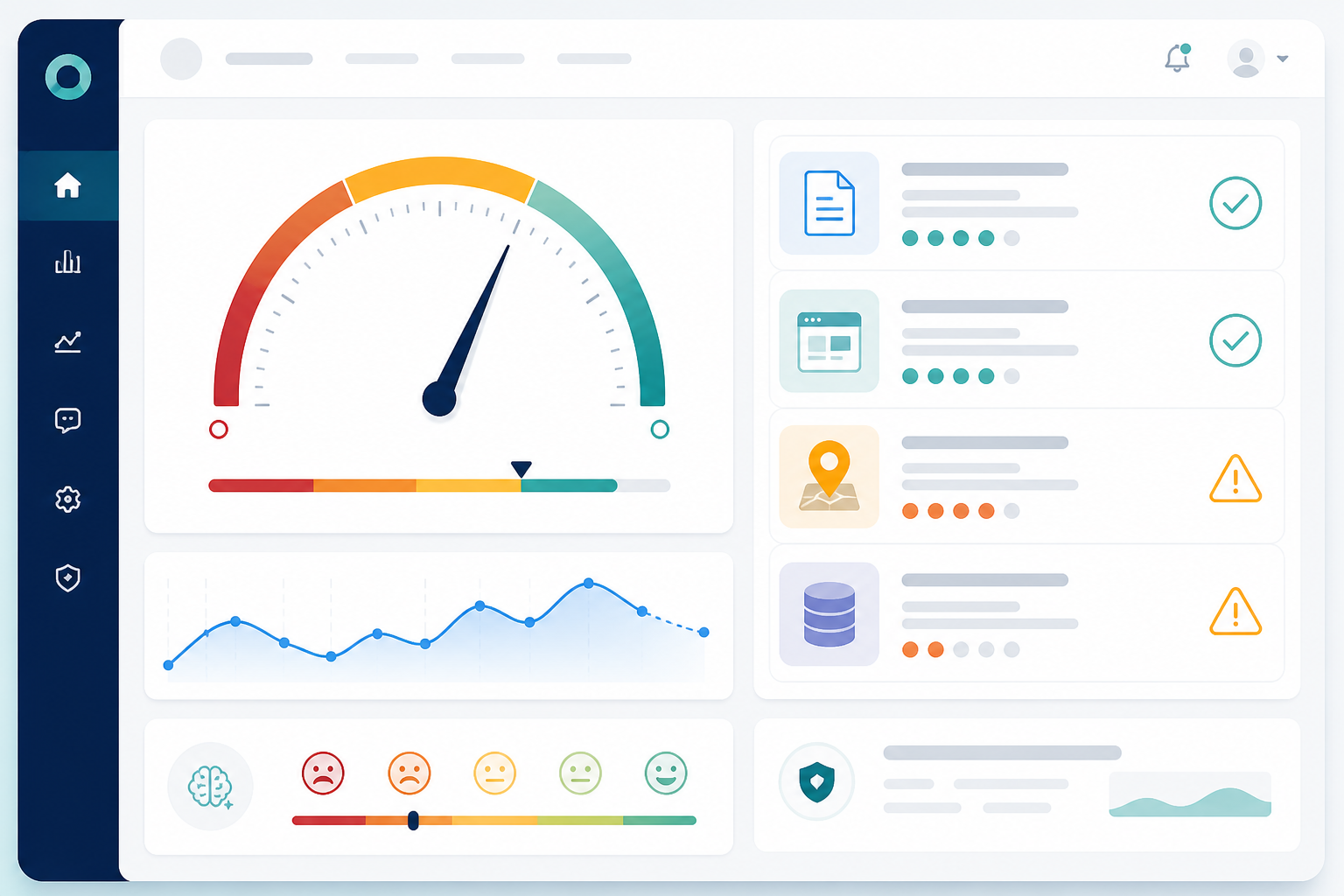 Alt text: Example dashboard interface showing an AI visibility score gauge, a list of cited sources, and a sentiment indicator for a small business.
Steps to Correct Inaccurate AI Information About Your Business
Once you know what's wrong and where it's coming from, correction is a matter of working through the sources methodically:
- Update your Google Business Profile, website, and directory listings that the AI cited — this is the lever most fully within your control and usually the fastest to action. For UK businesses, also check Bing Places, Apple Business Connect, Yell, and any industry-specific directory relevant to your sector (for example, trade body listings for tradespeople, or booking platforms for salons and clinics).
- Improve how easily an AI system can extract facts from your website. Concretely, this means adding structured data (schema.org markup for opening hours, pricing, and services where applicable), stating hours and prices in plain text rather than only in images or PDFs, and avoiding ambiguous phrasing like "call for current pricing" where a specific figure would do. This makes correct information easier to find; it doesn't guarantee an AI system will use it over a conflicting third-party source.
- Publish a clear, dated "Hours & Services" page that's easy for both customers and AI crawlers to parse, and treat updating it as a standing task the moment anything changes, not an afterthought.
- Request corrections on third-party sites still showing old information, prioritising review platforms (Google, Yelp, Facebook) and directories with strong domain authority in your sector, since these tend to be cited more often by AI systems. Keep a record of when you submitted each request, since some platforms take weeks to action them and you'll want to follow up.
- Re-check your tracking log or AI visibility results after one to two weeks. Re-crawling isn't instant, and corrections take time to propagate through both live search retrieval and cached indexes — in the composite example above, one directory took closer to a month.
- Don't assume it fixes itself. Training data snapshots and cached web crawls can persist inaccurate details for months without active intervention. This genuinely requires ongoing attention rather than a one-time cleanup.
How Often Should You Monitor Your Brand in AI Search?
Given how frequently AI models re-crawl and update their sources, a one-time check isn't enough — but daily monitoring isn't the right answer for every business either, and I want to be honest that the right cadence depends on your risk profile, not a single universal rule.
- Monthly is a reasonable baseline for a stable business with fixed hours, a settled service list, and pricing that rarely changes.
- Weekly makes sense if you have seasonal hours, run frequent promotions, or update pricing more than a couple of times a year.
- Daily is worth considering only for higher-risk cases: emergency or time-critical services (locksmiths, plumbers, out-of-hours healthcare), businesses in highly competitive local markets where a rival's improved AI visibility could shift share of voice quickly, or businesses going through a change such as a move, merger, or rebrand.
Competitor tracking matters here too: a rival correcting or improving their own AI visibility can shift share of voice in a purchase-decision query even if nothing about your own information has changed. Automated monitoring — whether that's a scheduled version of your own manual log or a tool like MentionOwl running the same checks across major AI platforms — is mainly useful for catching that kind of drift before it costs you customers, rather than after you've noticed a quiet dip in enquiries you can't quite explain. It's a convenience layer on top of the manual process, not a replacement for understanding what "good" looks like for your own business.
Frequently Asked Questions About AI Brand Monitoring
Why would ChatGPT have wrong information about my business?
ChatGPT and similar models build answers from training data snapshots and web crawls that can be months or years old, plus whatever citations they pull from directories, review sites, or your own website. If any of those sources are outdated or contradictory, the AI has no reliable way to know which version is current, so it often defaults to whichever source appeared most frequently or authoritatively in what it crawled.
How do I find out if AI is giving out wrong details about my business?
Ask ChatGPT, Claude, Gemini, Copilot, and Perplexity the exact questions a customer would ask about your hours, pricing, services, and location, and compare the answers against reality. Keep a simple log of the date, prompt, answer, and cited source so you can spot patterns over time rather than relying on memory.
Can I correct inaccurate AI information myself, or does it fix itself over time?
It rarely fixes itself quickly. You need to actively update the sources the AI is citing — your website, Google Business Profile, and third-party directories — and make your site's information easier for crawlers to extract accurately (clear text, structured data, no key facts buried in images). Even after corrections, it can take days to weeks for AI models to re-crawl and reflect the updated information, and some directories are slower than others.
What if a source I don't control won't correct their listing?
Some third-party sites are slow to respond or don't offer a clear edit path. In that case, focus on strengthening the sources you do control — your website and Google Business Profile — since a consistent, well-structured, and frequently cited current source can gradually outweigh a single stale one in an AI's synthesis, even if it doesn't remove the outdated listing outright.
Does adding schema markup guarantee AI will get my details right?
No. Schema markup and clear structured text make it easier for an AI system to find and correctly parse your information, but they don't override a conflicting source the model considers authoritative, nor do they guarantee any specific platform will use your page as its citation. Treat it as raising your odds, not as a fix on its own.
How often should I check for AI inaccuracies about my business?
Monthly is a reasonable baseline for a stable business, weekly if your hours, pricing, or services change often, and daily only if you're in a high-risk category such as emergency services or a fast-moving competitive market. 🦉