Do AI Recommendations Matter More Than Star Ratings Now? A Guide for UK Small Businesses
Learn how AI visibility and star ratings shape local recommendations, and how small businesses can balance reviews, AI search checks and limited time.
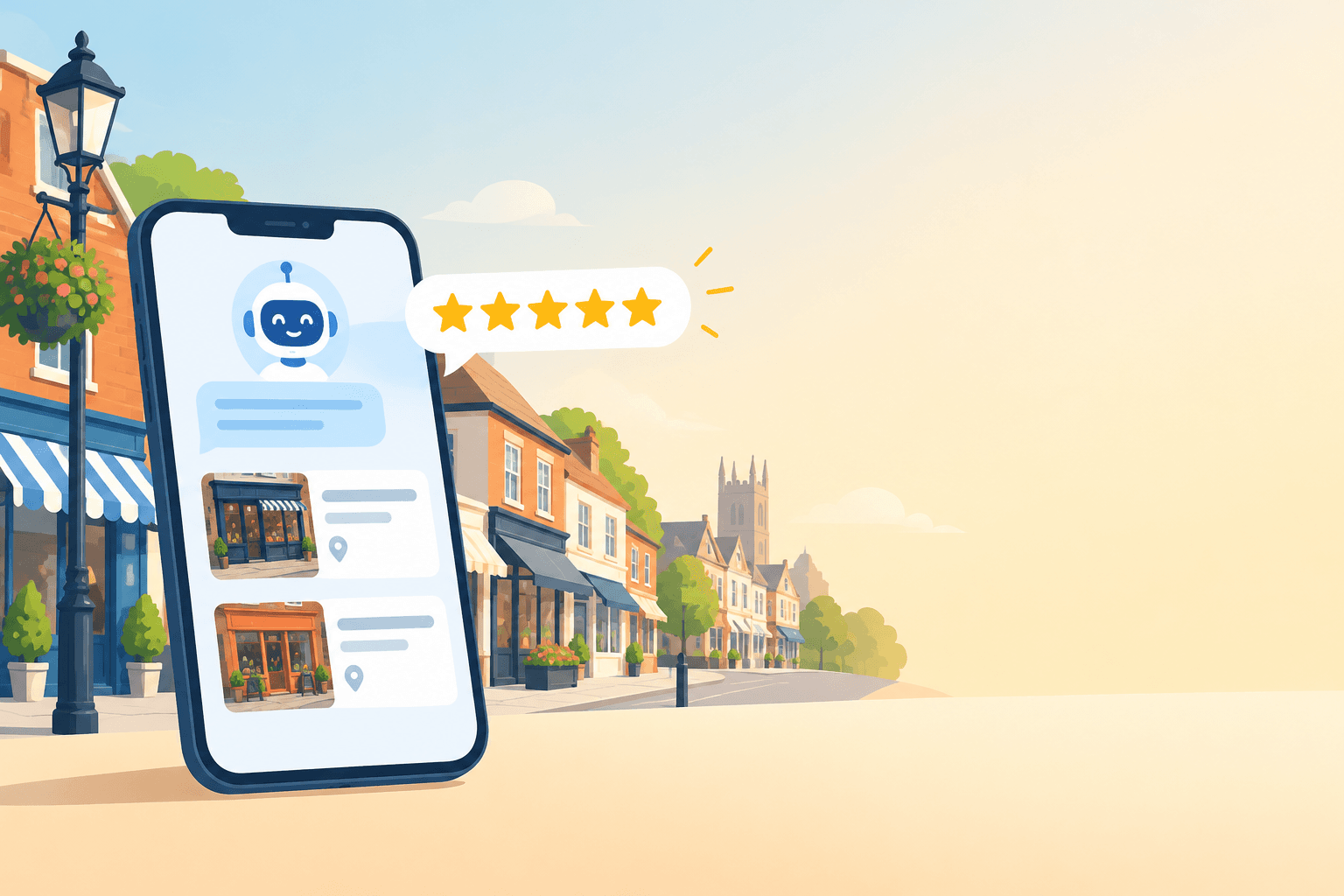
No, AI recommendations have not replaced star ratings. They have started to sit on top of them. AI assistants can draw on review platforms, your website and third-party mentions when deciding which local businesses to recommend, although the mix varies by product and is not published. Your star rating probably still feeds the answer, but it no longer decides on its own whether a customer ever sees your name. For most small businesses, the sensible approach is to keep reviews healthy and add regular checks of AI search answers, so you can see, rather than guess, whether assistants are recommending you or a competitor.
I am Marcus, a data analyst at MentionOwl, and this guide sets out the evidence as carefully as I can. Some of it is solid. Some is early-stage, self-reported or American rather than British, and I will flag which is which as we go. Because MentionOwl sells AI visibility monitoring, I have kept the practical advice tool-neutral and labelled the one place where I describe our own product.
The short answer: star ratings are the input; AI recommendations are the new output
This is not an either/or contest. AI assistants can take in review data, website content and directory listings, and compress them into a short list of recommended businesses. The star rating is raw material. The AI answer is what the customer may actually receive.
That matters because of how a customer's journey can now begin. Someone typing 'the best plumber in Leeds' into ChatGPT, Gemini or Perplexity may get two or three named firms with a sentence of explanation each. They may never see a review page, a Google Maps panel or your five-star average. If you are on that shortlist, your reviews get a chance to close the sale. If you are not, nobody reads them.
It is useful to separate two reputation channels:
- The review profile customers browse: your Google Business Profile, Tripadvisor page, Trustpilot listing and similar. You can see this one, and most owners check it regularly.
- The AI answer customers receive: the conversational recommendation an assistant produces. This one is largely invisible to you unless you deliberately look.
A caveat before we continue: AI behaviour varies by platform and changes quickly. Nobody outside the providers can give you a fixed formula, and I will not pretend otherwise.
How customers are starting to ask AI instead of reading reviews
The adoption data points in one direction, but it needs careful reading, because each figure measures something different and comes from a different population.
- Adobe (2024), US consumers, use: 39 per cent of surveyed US consumers said they had used generative AI for online shopping, and 85 per cent of those users said it improved their experience. This is a US survey of self-reported behaviour.
- Capgemini Research Institute (2024), multi-market, self-reported behaviour: 58 per cent of consumers surveyed across 12 countries said they had replaced traditional search engines with generative AI tools for product or service recommendations. I have not been able to confirm the exact question wording, so treat the headline as the publisher's own framing and check the original report before quoting it.
- Gartner (February 2024), global, forecast: traditional search engine volume would fall 25 per cent by 2026 as users move to AI chatbots and virtual agents. This is a prediction, not an observed decline, and it is not specific to the UK.
- Google (August 2024), UK, product availability: AI Overviews expanded to the UK, so synthesised answers now appear inside the search results British customers already use. That shows availability, not how often people rely on the answers, and inclusion of any given business is not guaranteed.
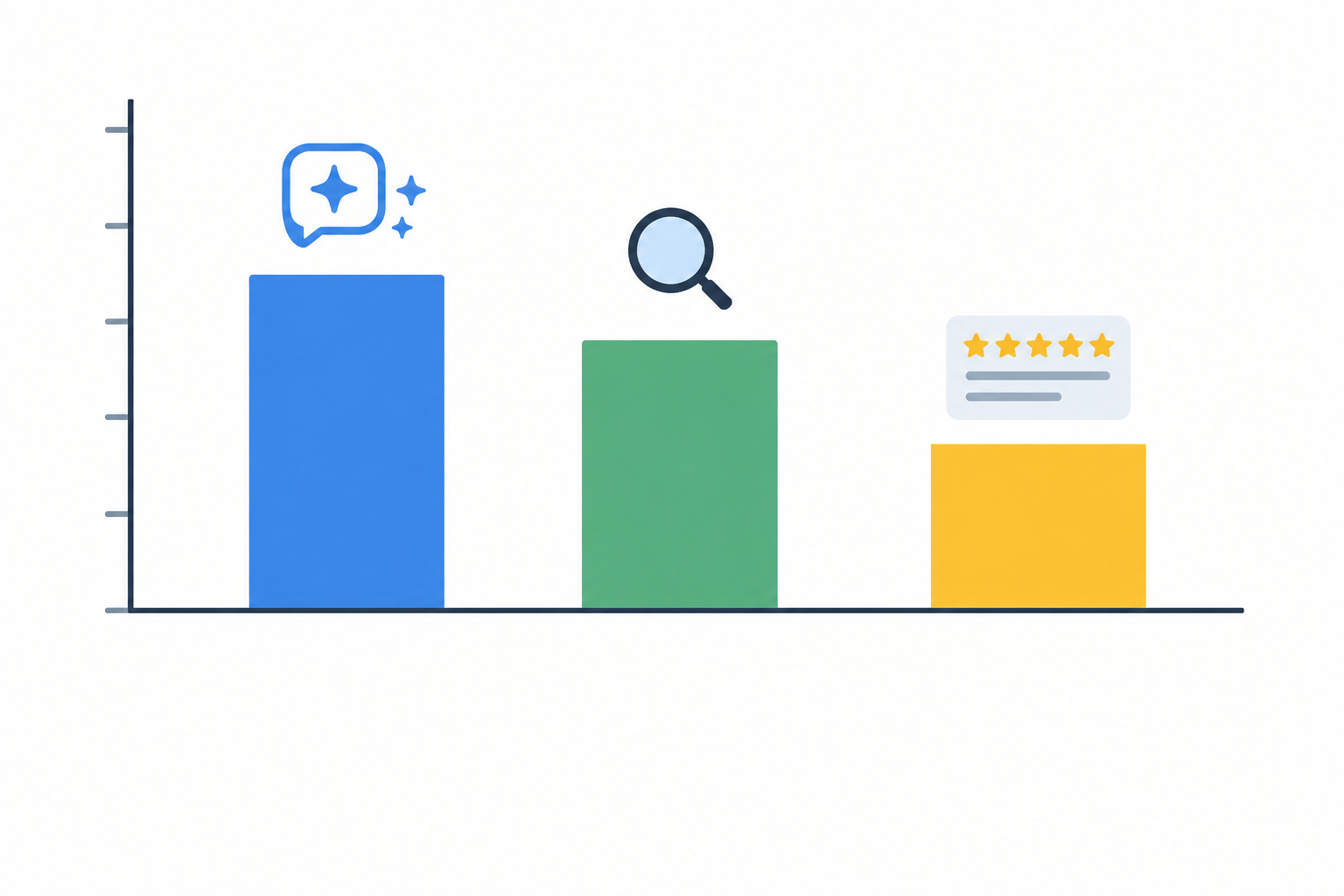
A note on the graphic above: the statistics in this section come from different surveys, countries and definitions, and some measure use while others measure trust or forecast adoption. Any chart should therefore label each figure's source, date, geography and what it measures, and should not imply a like-for-like comparison between AI assistants, search engines and review sites.
The gap in UK evidence on AI search
I have not found a UK-specific study of AI assistant use for local-service discovery that I would be comfortable citing, and I would rather say so than substitute a US figure and imply it applies here. The UK evidence I can point to concerns product availability (AI Overviews) and the regulation of reviews (covered below). Until better British data exists, read the US and multi-market figures as indicators of direction, not estimates of what customers in your town do.
AI use is not the same as trust
So are customers really trusting AI over reviews? Some are asking AI, but the evidence does not show they have stopped verifying. BrightLocal's 2023 Local Consumer Review Survey (a US survey of roughly 1,000 consumers) found that 98 per cent had read online reviews for local businesses at least occasionally, and 87 per cent had used Google to evaluate local businesses. Its 2024 edition found 75 per cent regularly read reviews when researching local firms. Put next to the Adobe figures, this suggests generative AI is becoming an additional discovery route, with reviews plausibly used afterwards to check the recommendation. None of these surveys tested that sequence directly, though.
Product design points the same way. Amazon's Rufus shopping assistant and Yelp's AI-generated review summaries both package recommendations and review information together instead of discarding the underlying feedback. They show where things are heading. They are not evidence that every customer now prefers AI.
Why being left out of an AI shortlist costs more
Customers used to browse ten blue links and several review pages. Now they may get one conversational answer with a few named options. A search results page can display dozens of businesses, whereas an AI answer typically names very few. If you compete with three or four local rivals, being left off a shortlist of two or three is likely a far costlier outcome than sitting on page one at position seven.
The limits of the evidence
I don't want to overstate this. Most of these figures are self-reported, several are US-based or multi-market rather than UK-specific, and the sector is moving faster than survey cycles can track. Treat them as directional evidence of a real shift, not precise measurements.
Where star ratings still matter for small businesses
Nothing in the data suggests you can neglect reviews. Here is where they still carry weight:
- Google Business Profile and Maps remain a primary conversion point. Google states that local results are based mainly on relevance, distance and prominence, and that more reviews and positive ratings can improve local ranking. Customers who find you still check the rating before they call or book.
- Ratings work as a trust filter after an AI recommendation. If an assistant names you, a cautious customer may well look you up, and a weak profile at that moment can undo the recommendation.
- Reviews may feed AI answers, depending on the assistant. Some products retrieve review-platform content and some do not, and the weighting is not published, so I would treat reviews as a plausible input rather than a guaranteed one.
- Rating thresholds are a rule of thumb, not a law. Many practitioners treat anything below roughly 4.0 as a drag on enquiries. I have not found a UK study I would cite for a precise figure, so view that threshold as a sensible internal alarm rather than a proven cliff.
- Recency and volume matter. A profile with a handful of reviews, the latest from eighteen months ago, can look risky to a human and gives any system little current evidence to work with.
- Genuine reviews are a legal matter. UK rules in force from 6 April 2025, under the Digital Markets, Competition and Consumers Act 2024 and enforced by the Competition and Markets Authority (CMA), prohibit commissioning or hosting fake reviews and concealing that reviews are incentivised. The CMA publishes guidance for businesses on gov.uk, and Google's policies also prohibit incentives for reviews and discourage selectively soliciting only positive ones.
A practical, compliant approach for a tradesperson is to send the same Google review link to every customer, reply professionally to praise and criticism alike, and never offer discounts in exchange for ratings.
How AI assistants synthesize reviews into recommendations
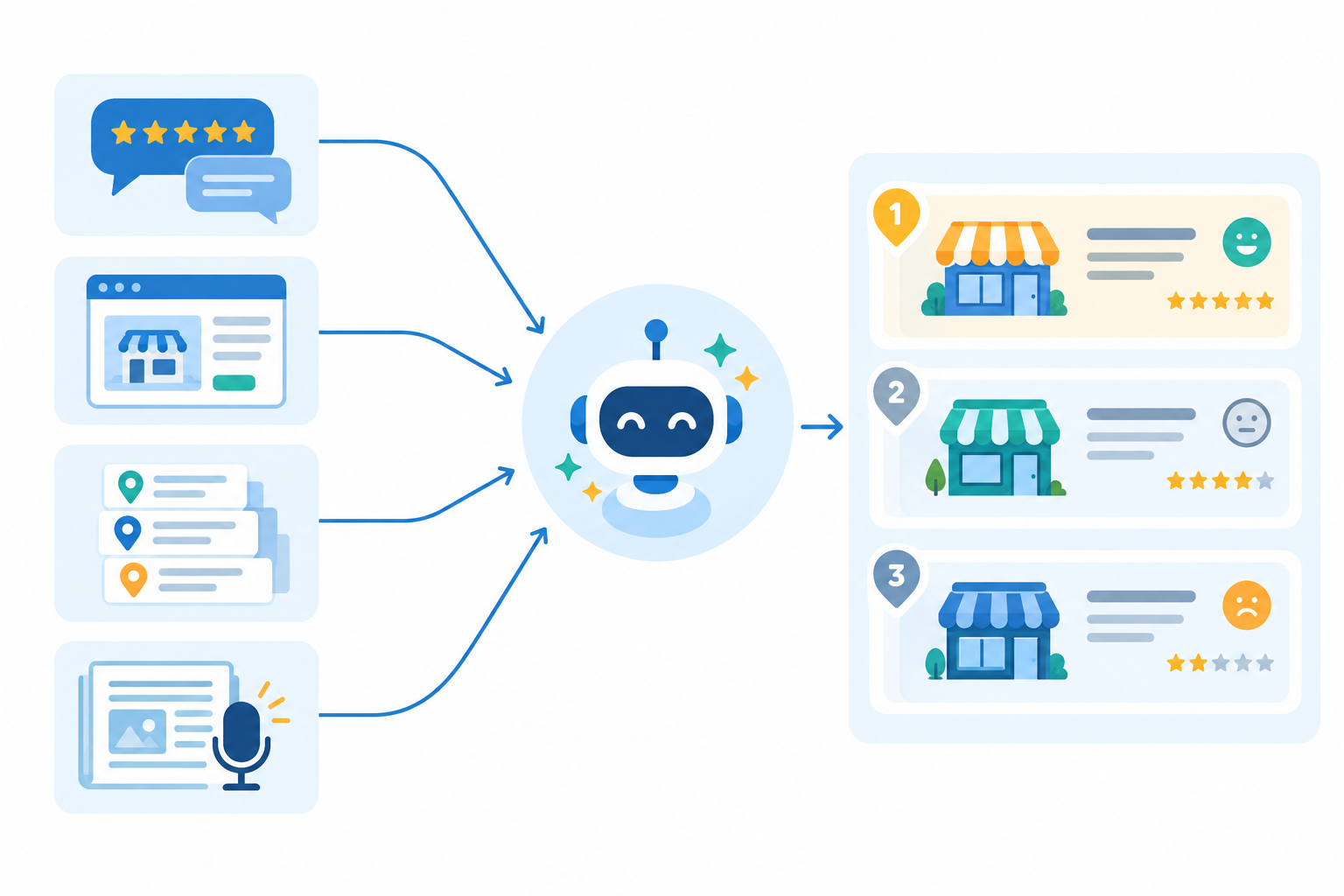
A generative engine can assemble an answer from several layers. There is what the model learned in training, there is live retrieval of web pages and other sources at the moment of the question, and there are the citations or links that some products show alongside the answer. Google says its AI features use the same core Search systems and may link to supporting pages. OpenAI describes ChatGPT search as grounded in retrieved web sources. The exact sources and weighting vary by product, and providers do not publish a universal formula.
Does a low star rating hurt my chances of being recommended by AI?
It can, but probably indirectly, and the mechanism differs between assistants. Where a system reads review text, it may summarise themes instead of averaging stars, in which case what reviewers say could matter as much as the headline number. A 4.3 average with repeated comments about 'hard to reach' or 'expensive' might be described more cautiously than a 4.1 average whose reviews praise 'fast response'. I cannot point you to a published study showing that themes outweigh averages across assistants, so treat this as a plausible pattern to test, not an established rule. Google's own documentation notes that the review score comes from ratings and reviews, while the text supplies the detail about service, value or quality.
A café shows how this plays out. If comments repeatedly praise accessible seating but mention long weekend queues, the owner can fix the queues and publish accurate accessibility and opening-time details on the website. Customers benefit, and so potentially do the systems reading those pages.
Other signals that may shape AI recommendations
Reviews are probably one signal among several:
- Website clarity: pages that directly explain your services, location, experience and customer questions. Google notes that structured data can help systems interpret a page, but it guarantees neither a rich result nor an AI recommendation.
- Local directories and profiles: a consistent name, address or service area, hours, services and contact details.
- Press and third-party mentions: independent sources that corroborate what you say about yourself.
- Consistency: conflicting details across the web make it harder for any system to represent you accurately.
AI legibility: a factor independent of star ratings
AI legibility is how technically easy your website is for AI crawlers to read, parse and quote. A business can have a flawless 4.9 rating and still be hard to read: content hidden behind scripts, crawlers blocked, vague service descriptions, missing contact details. You can check much of this yourself by viewing your pages with scripts disabled, looking in your robots.txt file for blocked crawlers, and confirming that your services, area and contact details appear as plain text. A star rating cannot show these problems, and they could quietly limit how well assistants can represent you.
Cited, mentioned or recommended by AI?
These are three different outcomes, and position within the answer matters:
- Cited: your website or profile appears as a source link.
- Soft mention: you are named in passing, perhaps in a list, without endorsement.
- Actively recommended: the assistant presents you as a good choice, ideally first.
A name in the first sentence of an answer plausibly carries more weight with a reader than one in a closing list of alternatives, so record position as well as presence.
Why one AI visibility spot-check is unreliable
ChatGPT, Claude, Gemini, Copilot and Perplexity draw on different sources and can answer the same question differently. Answers can also vary from day to day and with small changes in phrasing. A single check on one platform is an anecdote, not a measurement.
Star ratings vs AI recommendations: a side-by-side comparison
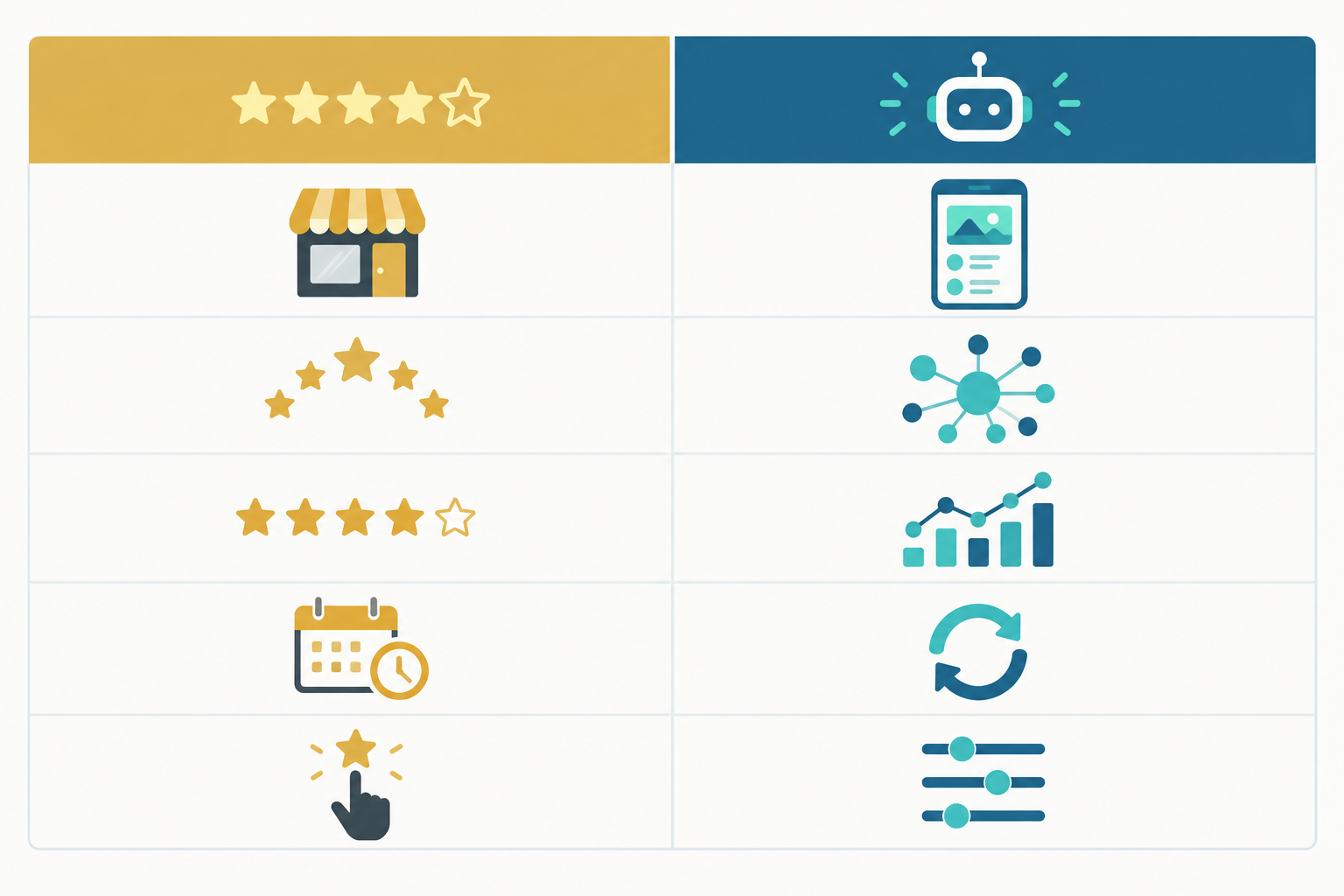
| Dimension | Star ratings | AI recommendations |
|---|---|---|
| Where customers meet it | Google Search and Maps, Tripadvisor, Trustpilot, your own site | ChatGPT, Gemini, Claude, Copilot, Perplexity, AI Overviews |
| What influences it | Customer experience, review volume, recency, your replies | Likely a mix of reviews, website clarity, directories, press mentions, consistent details and AI legibility, varying by assistant |
| How quickly it changes | Gradually, as reviews accumulate | Can shift between days, platforms and phrasings |
| How easy to measure | Very easy: one number and a count, visible to anyone | Hard by hand: conversational, varies by prompt, rarely visible to the business |
| What you control | Fairly direct: service quality and a genuine review routine | Indirect: you shape the sources the assistants may read |
Measurement is the row that worries me most. Most owners know their rating to one decimal place, yet have no idea whether an assistant names them when a customer asks. That is the measurement gap, and it is why guesswork dominates this topic.
Share of voice is one way to close it. Instead of asking 'do I rank first?', which makes little sense in a conversational answer, you ask: across a fixed set of realistic questions a customer might put to an assistant, in what proportion of answers am I named compared with local competitors? It captures consistency across questions and platforms, and it shows who is taking the recommendations you are not. One caution: the result depends entirely on the prompts and platforms you choose, so it is a way to compare your own trend over time, not an absolute market measure.
Managing reviews and AI visibility at the same time
The two channels share a lot of groundwork, so managing both is less work than it sounds. Here is a routine that fits a small team, with approximate times so you can judge the cost. 🦉
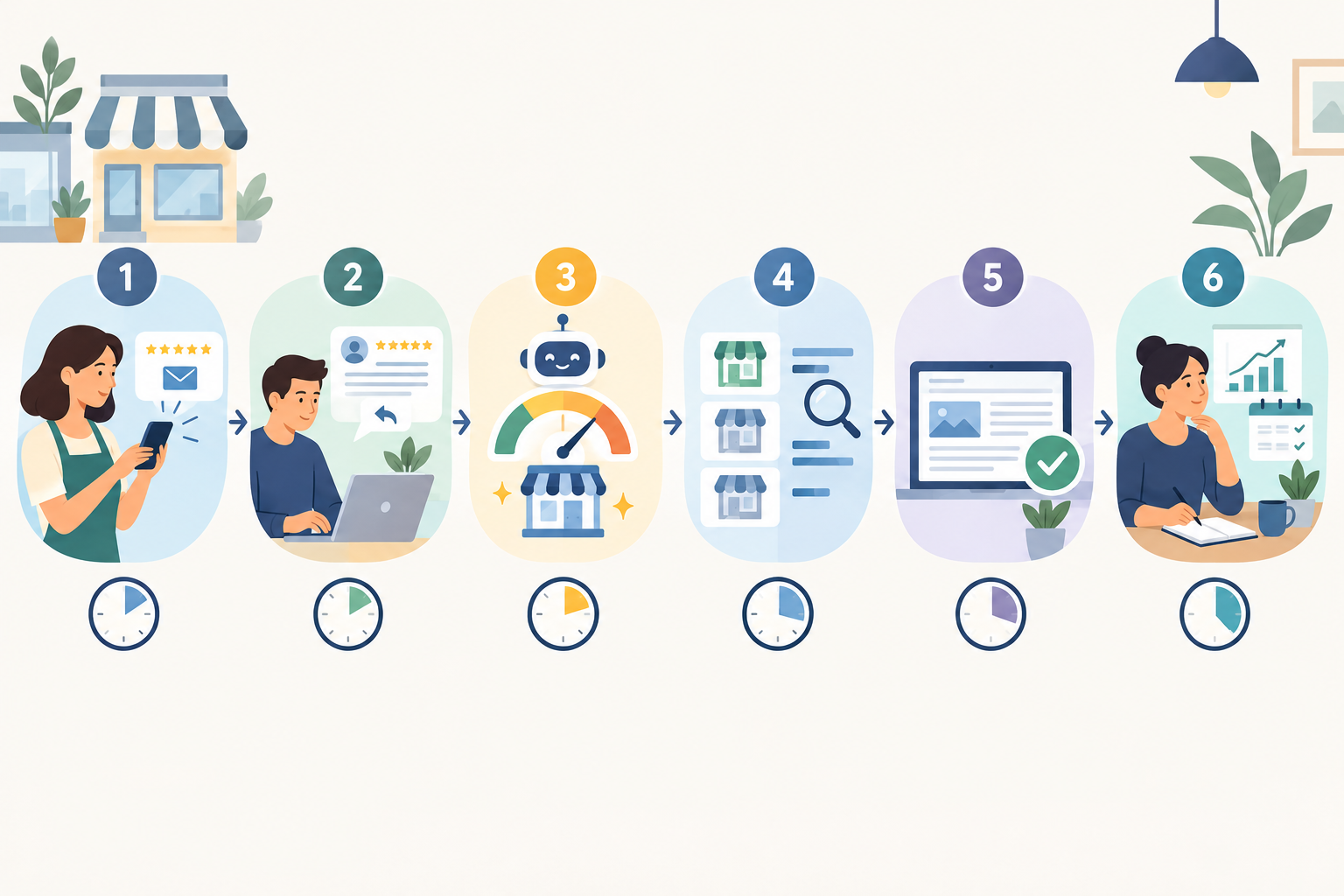
- Establish a baseline (about 45 minutes, once). Use the sample prompts and log below. Treat the result as a snapshot, not a ranking guarantee.
- Keep the review engine running (about 10 minutes a week). Ask every customer for a review using the same neutral message, with no incentives and no filtering. Track rating, volume, recency and recurring complaint themes across the platforms your customers actually use.
- Reply to feedback (about 10 minutes a week). Respond within a few days, to praise and criticism alike, and add specific, factual detail where it helps future readers.
- Fix the shared foundations (about 30 minutes a month). Keep your name, address and phone details identical everywhere. Write clear service pages and FAQs in your customers' own language, and run through the legibility checks described earlier.
- Track competitors (about 10 minutes a week). Note which rivals assistants name instead of you and which sources are cited for them. Those sources, whether a directory, a local press piece or a comparison article, are your gap list.
- Re-run the baseline (about 20 minutes a month if done by hand). Compare against last month and look at the direction of travel rather than any single answer.
A manual AI visibility baseline you can run today
Pick five prompts that match how your customers genuinely phrase a search, and run each on at least three assistants. For a Leeds-based business, examples might be:
- 'Who is the best emergency plumber in Leeds?'
- 'Which accountants near Headingley work with sole traders?'
- 'Recommend a dog-friendly café in Leeds city centre with step-free access.'
- 'Which local electricians are well reviewed and reasonably priced?'
- 'What should I check before hiring a boiler engineer, and who would you suggest in Leeds?'
Then record each answer in a simple spreadsheet:
| Date | Assistant | Prompt | Businesses named (in order) | Sources cited | Sentiment toward you | Notes |
|---|---|---|---|---|---|---|
| 3 June | Gemini | Best emergency plumber in Leeds | Rival A, You, Rival B | Google Maps listing, local directory | Positive, 'fast response' | Named second |
That row is illustrative. To turn the log into share of voice, divide the number of answers that name you by the total number of answers. Five prompts across three assistants gives 15 answers, so if you appear in four of them, your share of voice for that prompt set is roughly 27 per cent. Repeat the same prompts monthly and keep the wording fixed. Answers vary, so a movement of one or two is noise, not a trend.
Moving from manual checks to brand monitoring
Doing this by hand stops being practical once you want many questions, five platforms and frequent repeats. Several brand monitoring tools now automate it. In the interest of disclosure, I work for MentionOwl, which is one of them. It crawls your site, generates customer-style questions, runs them daily against the major assistants and records answers, citations, sentiment and competitor mentions. It also produces a 0-100 visibility score combining query coverage, position-weighted citations, share of voice and soft mentions. That score is MentionOwl's own methodology, not an industry standard, so it is useful for tracking your trend within one tool and should not be compared with scores from other products. Our audit also runs 16 technical legibility checks. Whichever tool you consider, ask how it chooses questions, how often it runs them and how it handles variation between runs.
Can I manage reviews and AI visibility without extra work?
Largely, yes, because much of the work overlaps. A clearer service page helps a human decide and gives an AI crawler a quotable answer. A thoughtful reply to a critical review reassures future customers and adds balanced, specific context to the public record. Consistent business details help Google Maps and AI search alike. The only genuinely new task is monitoring, which you can do by hand in under half an hour a month or automate.
What to prioritize when time is limited
Here is how I would sequence effort depending on your situation:
- Rating below about 4.0, or few recent reviews: fix reviews first. They feed the channel customers browse directly, and a weak profile undermines any recommendation you do win.
- Solid rating, but your baseline shows you rarely come up in AI answers: shift effort towards website clarity, legibility and third-party mentions.
- Competitive local category such as trades, hospitality or professional services: check AI answers early. Shortlists are short, and an early absence is expensive.
- Solo founder with one hour a week: start with roughly 60 per cent on reviews and 40 per cent on AI visibility, then adjust once your baseline shows where the gap is.
That split is a judgement call based on current evidence, not a formula. Revisit it each quarter as your baseline and the platforms change.
What the next 12 months could look like for AI search
My view is that AI search will keep growing as a discovery route, but the pace is uncertain. Gartner's 25 per cent figure is a forecast, the survey figures are early and self-reported, and platforms are changing how they cite sources. I would not bet a business on any single prediction.
It is also plausible, though not proven, that visibility in AI answers improves as more reputable places describe you accurately, since assistants then have more consistent material to draw on. Starting early costs little, and a few months of trend data would show whether that pattern holds for your own category.
The fundamentals have not changed. Being genuinely good, well reviewed and clearly described is still the best strategy for both channels.
Your immediate next step: run the five-prompt baseline above this week and save the spreadsheet. If you would rather automate it, MentionOwl offers a $1 seven-day trial that runs this kind of check for you, but the manual version will already tell you which questions you appear in and who is named instead.
Frequently asked questions about AI visibility and reviews
Are customers really trusting AI over reviews now?
Not on the evidence available. Surveys show growing use of AI assistants, mostly US or multi-market and self-reported, but they do not show customers abandoning reviews. The practical risk is that if you are not on an assistant's shortlist, the customer may never reach your reviews.
Does a low star rating hurt my AI recommendation chances?
It can, though usually indirectly and differently by assistant. Where review text is used, recurring complaints may weigh more than the average itself, and other signals such as a clear website and third-party mentions also play a part.
Should I focus more on reviews or AI visibility?
Start with reviews if your rating or review recency is weak. If your reviews are healthy but assistants do not mention you, put more effort into website clarity and third-party mentions. The baseline check will tell you which situation you are in.
Can I manage both without extra work?
Largely, yes. Collecting genuine reviews, replying to them, keeping business details consistent and writing clear website content help both channels. The new task is checking AI answers, which takes about 20 minutes a month by hand or can be automated.
Do different AI assistants recommend different businesses?
Yes. ChatGPT, Claude, Gemini, Copilot and Perplexity draw on different sources and can answer the same question differently, and answers can vary from day to day. Repeating the same prompts over time gives a more reliable picture than any single check.
How do I know if an AI assistant is recommending my competitors instead of me?
Ask realistic customer questions on each platform and log who is named, using the template above. Monitoring tools, including MentionOwl, can automate the process if the manual approach becomes too slow.
Sources and notes
- Adobe, 2024 survey of US consumers on generative AI and online shopping (self-reported; US only).
- Capgemini Research Institute, 2024 consumer survey on generative AI (multi-market, around 12 countries; self-reported). Please verify question wording in the original report.
- Gartner, February 2024 press release forecasting a 25 per cent drop in traditional search engine volume by 2026 (forecast, global).
- BrightLocal, Local Consumer Review Survey 2023 and 2024 (US consumers).
- Google, announcement of AI Overviews expansion to the UK, August 2024; Google Business Profile help documentation on local ranking factors.
- UK Government and Competition and Markets Authority guidance on the Digital Markets, Competition and Consumers Act 2024 and fake reviews, effective 6 April 2025.
- OpenAI product documentation on ChatGPT search.
Figures are quoted as the publishers report them. Before relying on any statistic, check the original report for sample size, date and question wording.