Does ChatGPT Recommend You or Your Local Competitor? A DIY AI Visibility Test for UK Small Businesses
Find out whether ChatGPT, Gemini and Perplexity recommend your business or your local rival. A step-by-step AI visibility test plus how to automate it
AI Visibility for Local Businesses: How to Test ChatGPT Recommendations and Monitor Competitors
In our own testing across hundreds of local business queries, ChatGPT and other generative engines don't recommend businesses at random. They lean heavily on structured web content, review signals, and how clearly a site answers the exact question a customer would type. You can find out where you stand in about ten minutes by running a handful of realistic prompts yourself, but if you want a reliable, repeatable answer, you'll eventually need to automate the process, because AI answers shift week to week, sometimes day to day.
I want to walk you through exactly how to run that ten-minute test today, what the results typically mean, and why a growing number of UK small businesses are treating AI visibility as seriously as they've historically treated their Google Business Profile or their backlink profile. This isn't a fringe concern anymore. It's a measurable, testable channel with its own rules, and most local businesses simply haven't looked yet.
Why AI Recommendations Matter for Local Businesses
Let's start with the scale of the shift, because the numbers here are worth sitting with. BrightLocal's 2025 Local Consumer Review Survey found that 45% of consumers reported using AI tools such as ChatGPT to find local businesses. That's survey data rather than a UK-only census figure, but it's a meaningful signal that AI search has moved from novelty to habit for a large share of consumers, and Google's own commentary on AI features points to that behaviour rising fastest among younger consumers in markets like the UK.
What makes this particularly consequential for local businesses is a structural difference between traditional search and AI search. A Google Maps pack shows you ten options and lets you scroll. ChatGPT and Perplexity, in our experience running these tests repeatedly, typically name just one to three businesses per answer. That's not a ranking demotion if you're left out - it's a full disappearance from the shortlist. There's no page two to fall back on when the entire answer is three sentences long.
We've also noticed something that I think deserves more attention than it currently gets: AI visibility appears to function as a leading indicator of organic search performance. In the accounts we monitor, businesses that are invisible in AI answers today are frequently the same businesses that lose organic search share over the following two to three quarters, as AI-mediated search behaviour keeps normalising among their customer base. This tracks with broader industry forecasting. Gartner projected that traditional search-engine volume could fall by 25% by 2026 as consumers adopt AI chatbots and virtual agents, and SparkToro and Datos found that 58.5% of Google searches in the US, and 59.7% in the EU, already ended without a click to an external result in 2024. Whether or not those exact figures hold precisely, the direction is unambiguous: more of the answer is being delivered inside the interface, not linked away from it.
I want to be clear about one thing, though, because it's easy to overstate this. AI visibility is not a replacement for traditional SEO or Google Business Profile optimisation. It's a parallel channel that behaves by different rules - which is precisely why most local businesses haven't audited it yet, and precisely why there's an advantage available to the ones who do.
How to Test What ChatGPT Says About You vs Competitors
Here's the practical part. This AI search visibility test takes about ten minutes and requires nothing more than a browser and a private session.
Open an incognito or private browsing session in ChatGPT, Claude, Gemini, Copilot, or Perplexity. This matters more than people assume - personalisation and prior chat history can quietly skew what the model surfaces, and you want to see what a brand new customer would see.
Ask the question a real customer would ask, not your brand name. Try "who's the best emergency plumber in Leeds" rather than "tell me about [Your Business]." The second question tests brand recognition. The first tests whether you exist at all in the model's shortlist when nobody's already thinking of you.
Run at least five variations of the query. Vary by service ("boiler repair" vs "bathroom fitting"), by neighbourhood, by price tier ("affordable plumber near me"), by urgency ("emergency plumber available tonight"), and by direct comparison ("X vs Y vs Z plumbers near me"). Each phrasing can pull from a different retrieval pattern, and a business that appears strongly for one query type can be entirely absent from another.
Record three data points for every answer: whether you're mentioned at all, where in the list you appear, and what specifically is said about you compared with your competitor. A neutral mention buried third is a very different result from a confident, detailed first recommendation.
Repeat the identical five prompts across at least two more platforms. This step catches people out constantly. Answers actually differ between ChatGPT, Gemini, and Perplexity, because they draw on different underlying sources and use different retrieval methods. A strong result on one platform tells you almost nothing about your standing on the others.
Repeat the entire test again in seven to ten days. This is the step most business owners skip, and it's the one that actually reveals whether your good result was a stable pattern or a one-off fluke caused by a temporary source, a cached answer, or simple model variability.
Common Reasons Local Businesses Get Skipped by AI
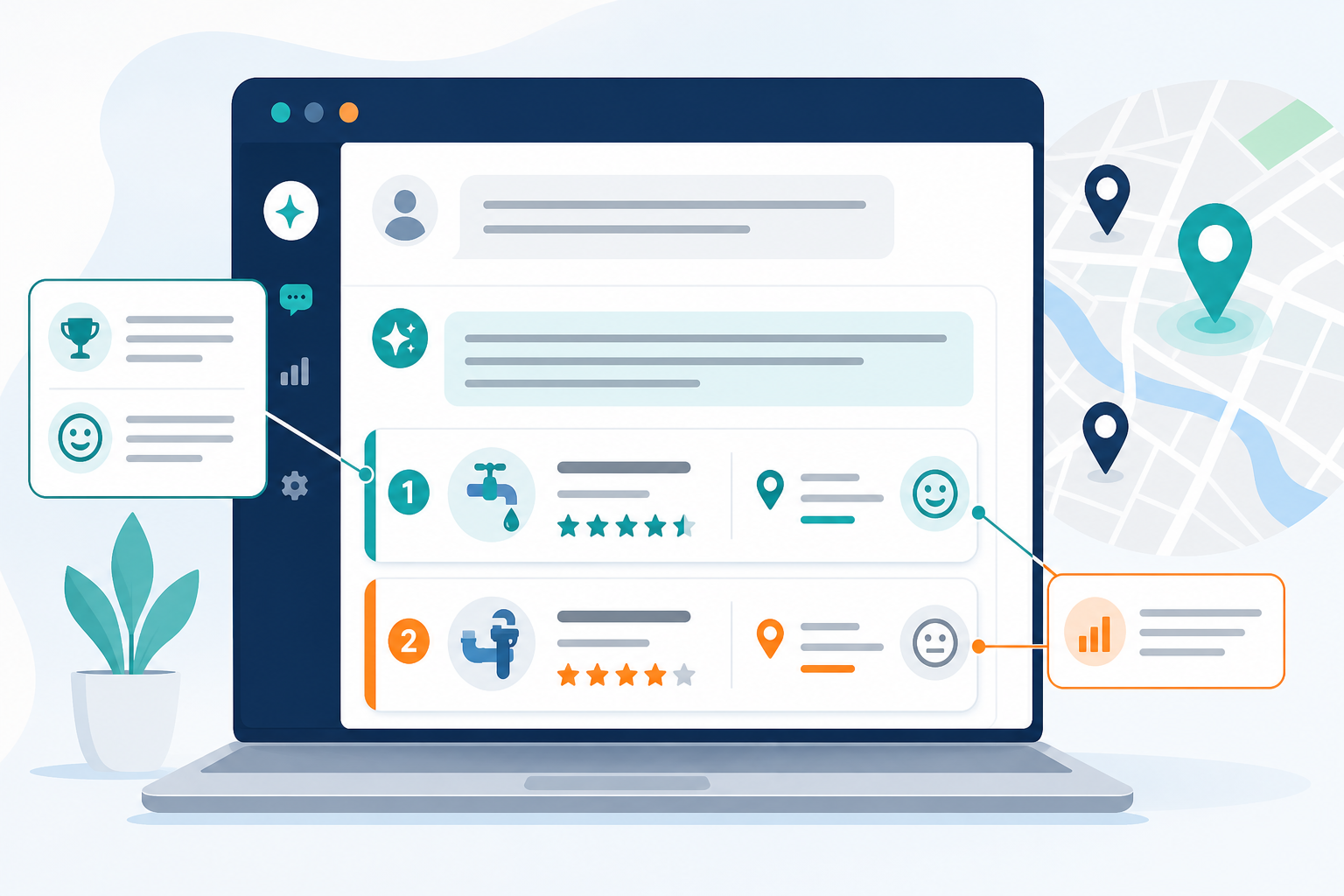
When we dig into why a business appears in one AI answer and not another, the pattern is remarkably consistent across sectors. Here's what we see most often:
Pages without structured, crawlable content that directly answers buyer questions get passed over. AI models favour pages that state facts plainly - services offered, areas covered, indicative pricing ranges - over pages built almost entirely from marketing copy or content rendered through heavy JavaScript that's harder for a crawler to parse.
A thin or inconsistent citation footprint causes real problems. If your directories, review sites, and your own website disagree on your name, address, or the services you actually offer, AI systems tend to default to whichever competitor's information is unambiguous. Google's own guidance on local business information makes this point directly: conflicting names, addresses, or hours reduce confidence in the entity being described, and that lack of confidence often results in the model simply choosing someone else.
Low or absent presence in the sources these models actually cite matters a great deal. In our data, that skews heavily toward review platforms, local directories, and well-structured "best of" articles, not a business's own homepage. If nobody trustworthy is talking about you in a structured way, the model has nothing reliable to cite.
Missing basic AI legibility signals is another common culprit. Clear headings, FAQ-style content, structured data markup, and crawlable text rather than image-based content all matter here. This is exactly what our 16-point AI legibility audits at MentionOwl are designed to catch, because a business can have excellent service and still be functionally invisible to a model that can't parse its site.
Sentiment gaps play a role too. A competitor with more recent, more detailed positive reviews will often edge out a business with older or sparser feedback, even when the underlying service quality is actually comparable. BrightLocal's 2024 survey found that 74% of consumers consider reviews from the last three months important to their decision, and 47% said they wouldn't use a business with fewer than 20 reviews. AI sentiment analysis appears to weight recency and specificity in a similar way.
One caution worth stating plainly: don't try to fix a thin review profile by manufacturing reviews. The UK's Digital Markets, Competition and Consumers Act 2024 makes fake and incentivised reviews unlawful, and it's simply not worth the risk when genuine, specific reviews requested after real work tend to outperform manufactured volume anyway.
Turning Manual Testing Into Automated AI Monitoring
Manual testing tells you the truth for one day. That's genuinely useful - it's exactly why I've laid out the ten-minute test above - but AI answers are not static. They shift as models update, as competitors publish new content, and as review profiles change. A single test session, however carefully run, has a short shelf life.
This is the exact gap we built MentionOwl to close. Rather than asking you to remember to open five browser tabs every fortnight, we crawl your website, auto-generate the realistic customer questions your buyers actually ask, and run them daily against ChatGPT, Claude, Gemini, Copilot, and Perplexity. You get the same discipline as the manual test, just without relying on memory or a spreadsheet that inevitably goes stale.
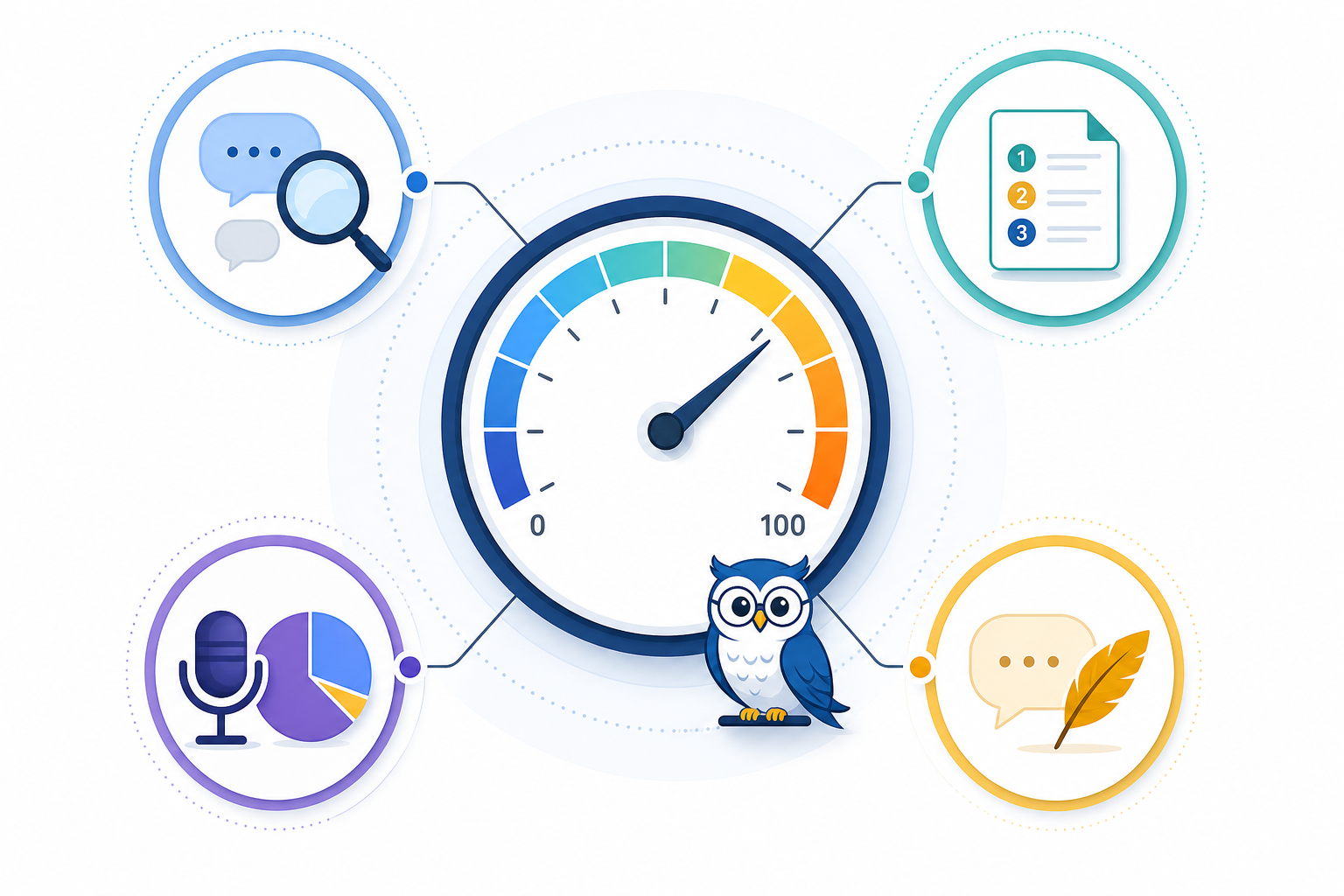
Every run gets consolidated into a single AI visibility score, from 0 to 100, built from four weighted inputs:
- Query coverage - how many of the relevant customer questions you actually appear in
- Position-weighted citations - how prominently you're positioned within each answer, not just whether you're mentioned
- Share of voice - how you're doing directly against named competitors across the same query set
- Soft mentions - indirect references that don't name you outright but still contribute to how the model characterises your market position
Alongside that score, we track competitor mentions directly against yours, run sentiment analysis on what's actually being said about your brand, and flag the specific AI legibility issues most likely to be holding you back - the same categories of problems covered in the previous section, but monitored continuously rather than checked once. Weekly digests, a REST API, and an MCP server for AI agents mean you don't have to log in daily to stay informed. The monitoring runs in the background and surfaces the changes that actually matter, like a competitor overtaking you on a query where you'd previously held the top position.
What to Do If AI Favors Your Competitor
If your DIY test shows a competitor winning consistently, here's the sequence I'd recommend working through:
Identify exactly which queries you're losing on. "Best plumber" and "emergency plumber near me" are different questions with different winning content, so treat them separately rather than assuming one fix will cover both.
Publish direct, structured answers to those specific questions on your own site. Service pages that plainly state coverage areas, pricing ranges, and specialisms tend to outperform generic "about us" copy in AI retrieval, largely because they give the model something concrete and unambiguous to work with.
Audit and align your citations. Make sure your name, address, services, and pricing signals match consistently across your website, your Google Business Profile, and the major review platforms serving your area. Inconsistency here is one of the most common - and most fixable - reasons businesses get skipped.
Actively pursue recent, detailed reviews rather than simply more reviews. Since AI sentiment analysis tends to weight specificity and recency, a handful of detailed recent reviews can outweigh a large pile of old, generic ones.
Fix the technical legibility issues first. If your key pages sit behind heavy JavaScript rendering, lack clear headings, or have no FAQ-style content, no amount of excellent service will get through to the model. This is foundational work, and it should come before any content expansion.
Re-test on a fixed schedule, not just once. Track whether your changes actually move your visibility score and share of voice over the following weeks, since AI platforms take time to re-crawl and re-weight their sources. Patience matters here as much as the fixes themselves.
Frequently Asked Questions About AI Visibility and Brand Monitoring
Can I ask ChatGPT which plumber it recommends in my city?
Yes, and you should phrase it exactly the way a customer would - "who's the best plumber in [your city]" or "recommend a reliable plumber near [your area]" - rather than asking about your business by name, since that tests what happens when you're not already top of mind.
Why would AI recommend my competitor instead of me?
In most cases it comes down to three things we see repeatedly: your competitor has clearer, more crawlable content that directly answers the question asked, more consistent citations across directories and review sites, or a stronger recent sentiment signal from reviews. It's rarely about being a worse business - it's about being a less legible one to the model.
How often should I check what AI says about my business?
Weekly is a reasonable minimum given how often models update their retrieval sources and how quickly a competitor's new content or reviews can shift an answer. This is precisely why we built MentionOwl to run these checks daily rather than leaving it to manual, occasional spot-checks that miss the trend.
What can I change to get recommended more often?
Start with content that plainly answers buyer questions (services, areas, pricing), fix any inconsistencies in your business citations across the web, and generate recent, specific customer reviews - then monitor whether your AI visibility score and share of voice actually move in response before making further changes.