Do Local Businesses Show Up Differently on Each AI Tool? A UK Data Deep-Dive
Compare how ChatGPT, Gemini and Perplexity recommend UK local businesses, and learn how to improve your local business AI visibility across platforms.
Local Business AI Visibility: Do UK Businesses Show Up Differently on Each AI Tool?
Yes, and the differences are substantial. Local business AI visibility isn't a single score you either have or don't — it's a set of overlapping but distinct visibility profiles, one per platform. A business can be strongly represented on one AI tool while being nearly invisible on another.
Methodology note: The observations in this piece come from a tracking exercise I've run since April 2025, monitoring how ChatGPT, Gemini, Perplexity, Copilot, and Claude answer local-intent queries for UK service businesses. The working sample covers roughly 40 UK service-area businesses (plumbers, electricians, mobile beauticians, boiler engineers) across six towns and cities, using a fixed set of 12 query templates per business (for example, "best [service] in [town] open Saturday" and "emergency [service] near [town] tonight"), re-run weekly through each platform's standard consumer interface. This is a working sample, not a controlled academic study — platform behaviour changes frequently, results aren't independently replicated, and I haven't controlled for account history or location settings on every run. Treat the platform-specific claims below as observed patterns within this sample, not universal guarantees. Where I state something as a confirmed product capability rather than an observation, I've linked to the relevant official documentation.
Within that sample, one pattern held consistently: each platform pulls from different data sources, weights different signals, and produces noticeably different recommendation behaviour. Gemini leans heavily on Google Business Profile and Maps data. Perplexity's citations skew toward fresher, citation-rich pages from the live web. ChatGPT tends to synthesise from a mix of web content, structured data, and its training corpus, with citations that behave nothing like a Google ranking position. Copilot sits closer to Bing's own local index, which most UK businesses have never optimised for.
Understanding why these differences exist is the first step to improving your local business AI visibility. I'll also flag, briefly, where a tool called MentionOwl (which I work on) fits into this — it runs the same kind of local-intent questions against every major AI engine daily, which is how a chunk of this dataset was collected in the first place.
What Does Local Business AI Visibility Mean?
Before going platform by platform, it's worth defining the term properly, because it gets used loosely. Local business AI visibility describes whether, and how, an AI answer engine surfaces a specific business — by name, by citation, or by inclusion in a comparison — when someone asks a location-qualified question that implies they want to choose a provider, not just learn a fact. It's distinct from general topical visibility, and as the sections below show, it's also distinct between platforms. A business can have strong local AI visibility on Gemini and weak visibility on Perplexity simultaneously, for reasons that have nothing to do with the quality of the business itself.
How Local Queries Differ From General Ones
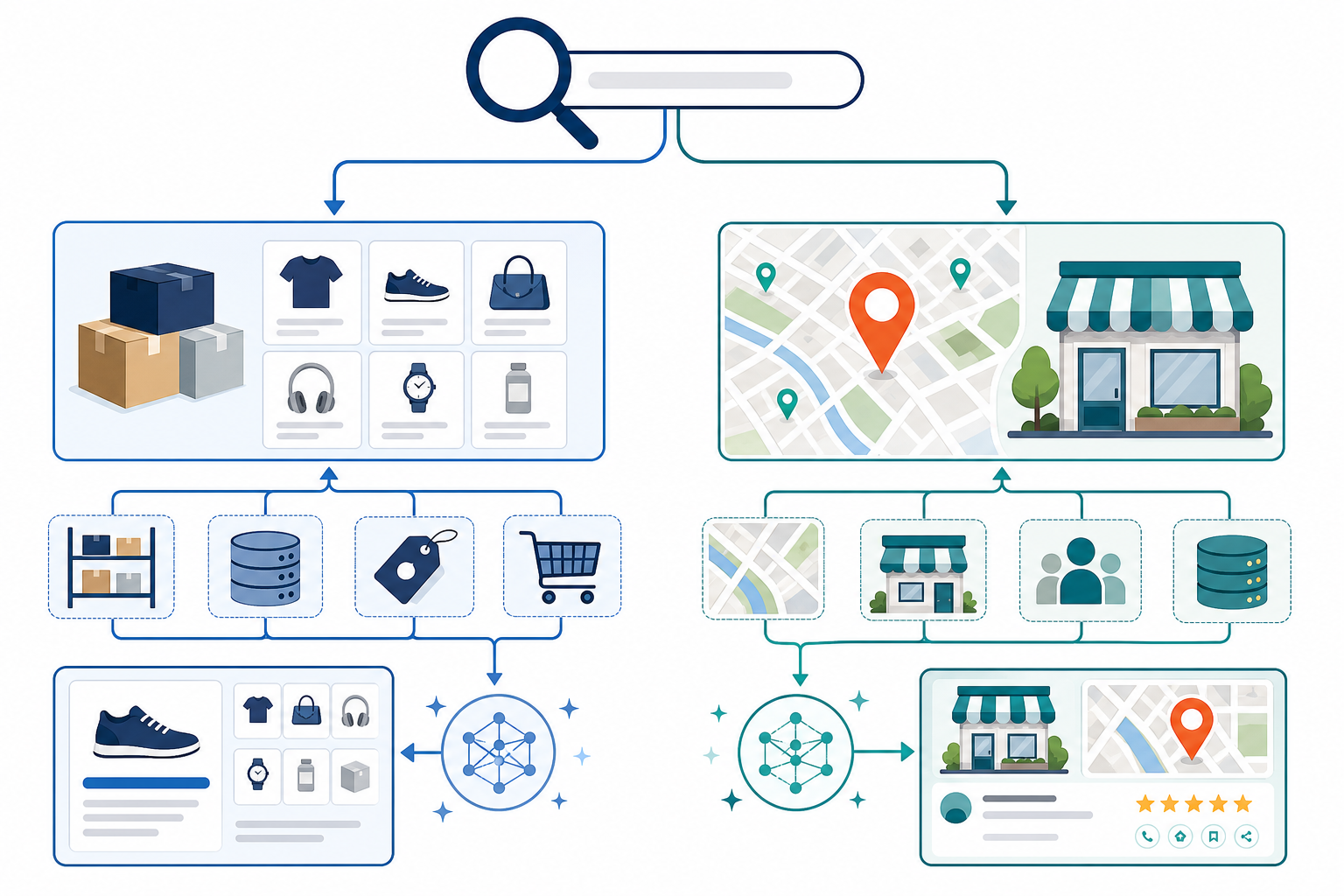
General queries and local queries are, from a retrieval standpoint, close to different tasks. When someone asks "what is a boiler service?", an AI system can answer from general expertise, drawing on authoritative explanatory content without needing to select a physical provider. But "best boiler service in Leeds open Saturday" requires location matching, service coverage, current availability, and customer evidence. The model has to reconcile relevance with proximity, opening hours, and trust signals all at once.
Google's own local search documentation frames this directly: local results are built on relevance, distance, and prominence, not topical authority alone. That's a fundamentally different evaluation from a category query like "best CRM software," where geography is irrelevant and the comparison is purely feature-and-reputation based.
This distinction explains a frustration I hear constantly from business owners: a company can rank well for a general query but disappear entirely for a locally-qualified version of the same question. In one example from the tracked sample, a Bristol plumber's blog post on "how to fix a dripping tap" was cited by ChatGPT when answering the general how-to question. The same plumber didn't appear at all when the query became "emergency plumber in Reading tonight" — because that second query demands service-area matching, availability, and credentials the blog post never addressed.
Part of what's happening here is what's sometimes called entity resolution: the AI has to work out that your website, your Google Business Profile, your Yell listing, and your reviews all describe the same business, in the same location, with the same current hours. Inconsistent names, addresses, or phone numbers across those sources make that reconciliation harder — and in the businesses I've audited where this was messy, the AI engine simply didn't attempt to join the dots.
How ChatGPT Recommends Local Businesses and Uses Citations
ChatGPT Search, which OpenAI launched publicly at the end of October 2024, generates local answers primarily through web retrieval rather than a single fixed local directory. When browsing is active, ChatGPT can cite the specific pages it pulled information from. OpenAI also runs a dedicated crawler for live search retrieval — OAI-SearchBot — which is separate from GPTBot, the crawler associated with model training. In practice, this means a business can block GPTBot from training on its content while still allowing OAI-SearchBot to retrieve it for live answers, and per OpenAI's crawler documentation, the two are configured independently in robots.txt. I'd argue most small businesses should keep the search crawler open, since blocking it removes you from ChatGPT's live-answer pool entirely.
Within the tracked sample, ChatGPT citations tended to favour businesses with strong structured content, review aggregation, and third-party directory presence over businesses relying solely on a bare-bones website. A citation isn't equivalent to a Google ranking position — a business might get cited because one page clearly supports a single claim (say, opening hours), while a competitor gets named in the answer text with no citation attached at all. In several cases, ChatGPT surfaced a business with a thin or entirely absent Google Business Profile, apparently because its website had clean, well-structured location and service pages. That's a meaningful signal: Google Business Profile completeness appears to carry far less direct weight with ChatGPT than most business owners assume.
That said, this doesn't mean a Google Business Profile is irrelevant to ChatGPT. ChatGPT has no confirmed first-party access to Google's Business Profile data in the way Gemini does, but a well-maintained profile tends to generate more reviews, more directory citations, and more Maps-linked web pages — all of which ChatGPT can pick up indirectly through web retrieval. The relationship is indirect, not absent.
One failure mode showed up repeatedly in the sample: when local data was thin — no clear service-area page, no third-party corroboration, contradictory hours — ChatGPT sometimes defaulted to naming a national chain instead of the smaller local business that was arguably the better fit. This isn't a hallucination in the strict sense. It looks more like the model falling back on whatever source has the strongest, most unambiguous signal, and a national chain's uniform web presence tends to win that contest by default.
Perplexity and Real-Time Local Business Data
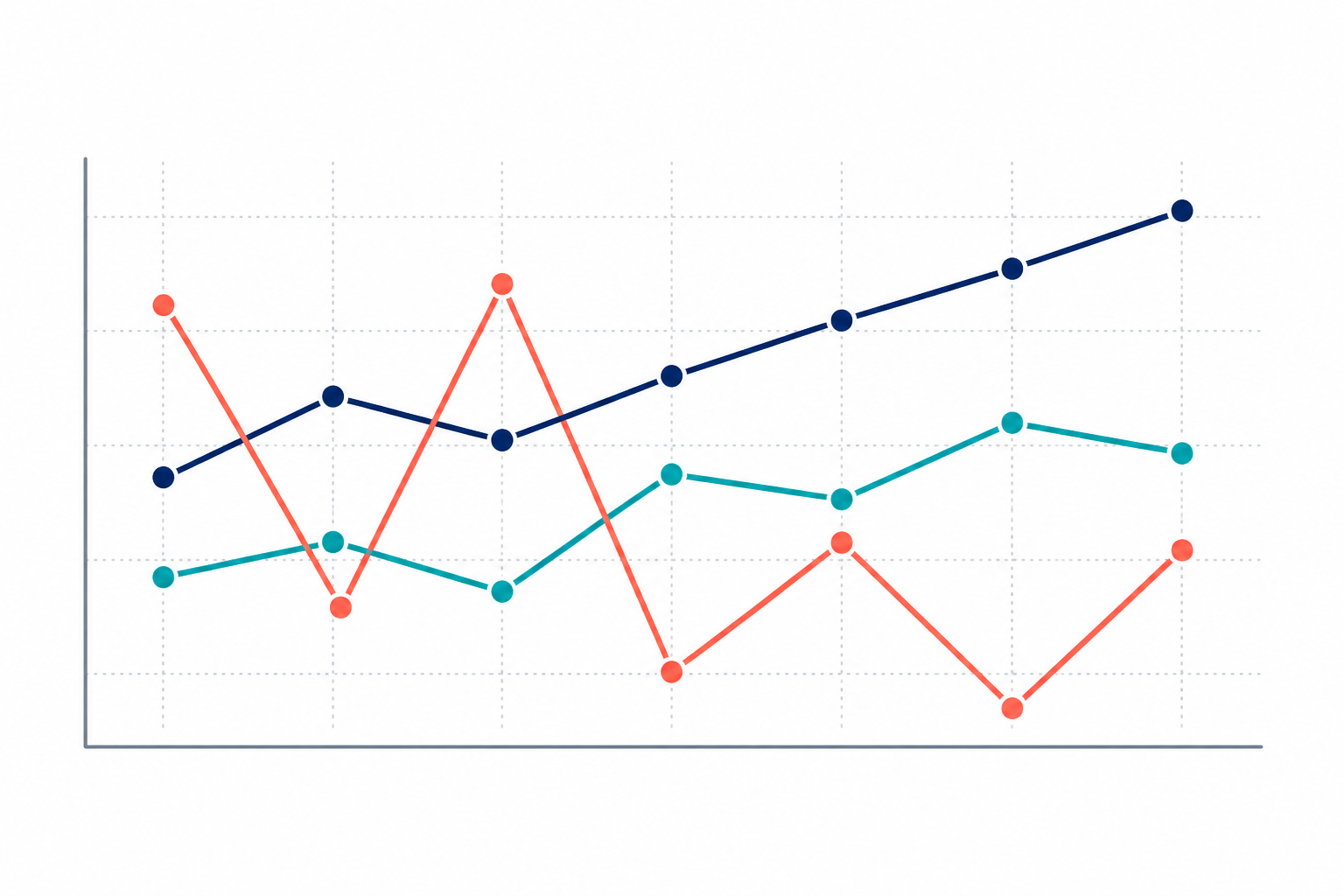
Perplexity operates on different logic. It's built as a live-retrieval answer engine, and it displays numbered inline citations for essentially every factual claim, which makes its local visibility more directly inspectable than a platform that gives you an unsourced paragraph. Perplexity's own documentation confirms it re-crawls the web on an ongoing basis rather than relying on a static index snapshot, and in the tracked sample, this showed up as genuine week-to-week volatility: a business cited prominently in one weekly run sometimes dropped out by the next, without any apparent change to the business itself, apparently because a fresher or more citation-rich page took precedence for that specific query.
This is where I've seen a real opportunity for smaller UK businesses, though I'd frame it as an observed pattern rather than a rule. In the sample, Perplexity's citation behaviour leaned toward recent blog posts, local news mentions, and forum threads — in a handful of cases, a Reddit thread or a MoneySavingExpert forum post was cited ahead of a static business listing. A smaller business with active local PR, a recent regional press mention, or an engaged community presence outranked a bigger, quieter competitor in some of these queries. That's a promising signal, not a guarantee, and it likely depends heavily on the specific query and category.
BrightLocal's 2024 Local Consumer Review Survey found that 91% of consumers read reviews before choosing a local business — a data point about human behaviour, not Perplexity's algorithm specifically, but it's consistent with what the retrieval pattern above suggests: recent, third-party-validated evidence tends to carry more weight than a static claimed listing.
The practical takeaway, stated carefully: consistent, genuine local visibility on Perplexity seems to correlate with an ongoing flow of fresh, citation-worthy content and mentions — reviews, local press, community engagement — rather than a one-off directory submission from years ago. I can't claim a specific publishing frequency is required, because that wasn't something this sample was designed to isolate.
Gemini's Integration With Google Business Profile Data
Gemini's local behaviour is the clearest counterpoint to ChatGPT's. Google has confirmed that Gemini can draw on Google Maps and Google Business Profile data for location-based prompts — this is a documented product capability, not an inference from my sample. That means for many location-based prompts, Gemini has access to a business's name, category, address or service area, opening hours, attributes, photos, and reviews: the fields that live inside the Business Profile dashboard.
This gives a direct answer to one of the questions I get asked most often: does my Google Business Profile influence ChatGPT answers? Not in a first-party sense — ChatGPT has no confirmed direct pipeline into that data. Gemini's relationship to it is much closer and more direct. Google's local ranking guidance states that ranking is based primarily on relevance, distance, and prominence, and a profile with current hours, accurate categories, and recent reviews is the foundational input to all three of those factors within Google's own ecosystem.
The practical implication, based on the sample: a business with a strong website but an incomplete, unverified, or outdated Google Business Profile may be meaningfully disadvantaged for map-led queries on Gemini, even where its wider web presence is solid. This showed up specifically with UK service-area businesses — plumbers, electricians, mobile beauticians — who hadn't claimed their profile properly, or had left seasonal hours unupdated, and who were largely absent from Gemini's local answers even though their website ranked fine in conventional Google Search. I'd stop short of calling this "invisible" in every case — it varied by query — but it was a consistent disadvantage, and a fundamentally different vulnerability from ChatGPT's, where website content does more of the heavy lifting.
Claude and Copilot: The Quieter AI Tools for Local Search
These two platforms got less airtime in the sample simply because they generated fewer local-specific answers, but the pattern is worth stating plainly rather than glossing over.
Copilot sits close to Bing's own local index and Bing Places for Business, a listing service most UK small businesses have never claimed. In the tracked queries, Copilot's local answers behaved more like traditional Bing search results with citations attached than like a conversational recommendation engine, and update speed appeared tied to Bing's own re-index cycles rather than anything close to Perplexity's daily volatility.
Claude, in its default consumer configuration, relies primarily on its training corpus rather than live web browsing unless a user explicitly enables browsing or connects a search tool. In the sample, this meant Claude rarely produced specific, current local recommendations at all — it was more likely to describe how to find a local provider than to name one, and where it did name a business, the information was more likely to be dated. This makes it the weakest platform in the group for local-intent queries as of this writing, though that's a function of default configuration rather than a permanent limitation, and it's worth re-checking as Claude's browsing features evolve.
Comparing Local Business Visibility Across AI Platforms
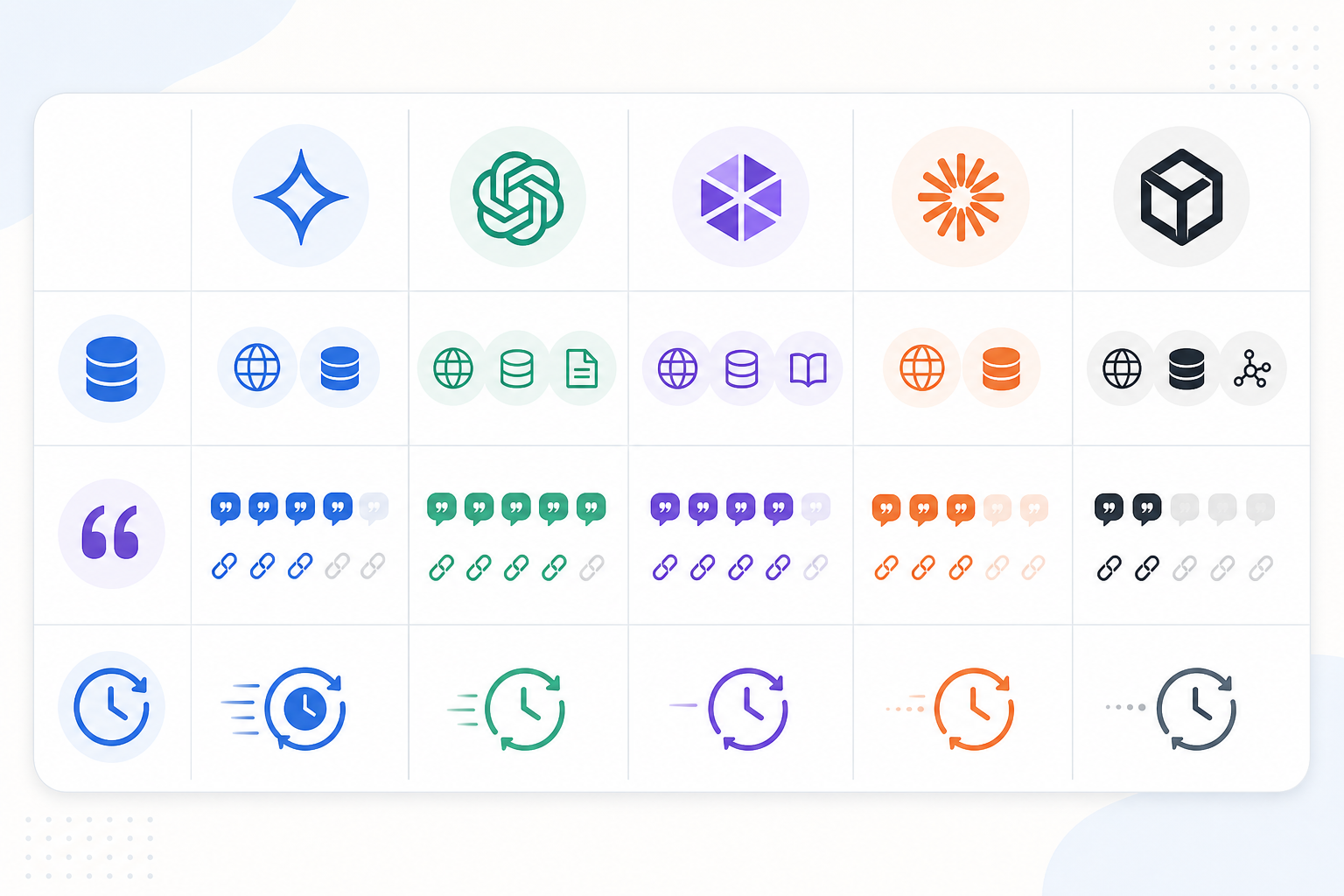
Putting this together, here's how the platforms differed in the sample. Treat the "confidence" column as an honesty check — some of this is documented product behaviour, some is a pattern observed across roughly 40 tracked businesses.
| Platform | Primary Data Source | Citation Behaviour | Update Frequency (observed) | GBP Influence | Confidence |
|---|---|---|---|---|---|
| ChatGPT | Web crawl (OAI-SearchBot) + structured data + training corpus | Cites specific supporting pages; may name businesses without citation | Moderate — tied to crawl freshness | Low, indirect | Documented crawler behaviour; citation patterns observed |
| Gemini | Google Maps + Business Profile + Search index | Often surfaces map-card style results tied to profile data | Fast — closely tied to profile updates | Very high, direct | Documented capability |
| Perplexity | Live web crawl, prioritising recency | Numbered inline citations for nearly every claim | Fast — shifted week to week in sample | Low to moderate, indirect | Documented re-crawl approach; volatility observed |
| Copilot | Bing index + Bing Places | Bing-style citations, less local-pack behaviour | Moderate — tied to Bing re-index cycles | Low; Bing Places matters more | Observed, smaller sub-sample |
| Claude | Training corpus + optional browsing | Fewer live citations unless browsing enabled | Slow by default | Very low | Observed, smaller sub-sample |
No platform publishes a standardised "local visibility" metric of its own, which is precisely why cross-platform monitoring — rather than assuming one good result means consistent visibility — matters for local businesses.
Why Does Your Business Show Up on One AI Tool but Not Another?
Across the tracked sample, the same handful of root causes came up repeatedly. I've labelled each by scope, because not every fix matters equally to every platform:
- Inconsistent or missing structured data (cross-platform) — schema markup that doesn't clearly state your address, opening hours, or service area makes entity resolution harder for every platform, not just one. Structured data improves machine readability; it doesn't guarantee a recommendation on its own.
- A thin or unclaimed Google Business Profile (platform-specific — Gemini) — this disproportionately affected Gemini visibility in the sample, with comparatively little measured effect on ChatGPT or Perplexity.
- Low citation-worthy content (platform-specific — Perplexity, moderate effect elsewhere) — no reviews, no press mentions, no third-party directory listings starves engines that rely on external validation.
- Crawlability issues (cross-platform, silent) — AI crawlers blocked by a misconfigured robots.txt is something I check first in any AI legibility audit, because it's a total-visibility killer most business owners never think to verify.
- Insufficient share of voice (cross-platform, comparative) — meaning the volume of mentions your business has across the web relative to competitors in the same local category. Low share of voice doesn't just reduce your own visibility; it actively makes room for a competitor to be named instead.
How to Improve Local Business AI Visibility Across Platforms
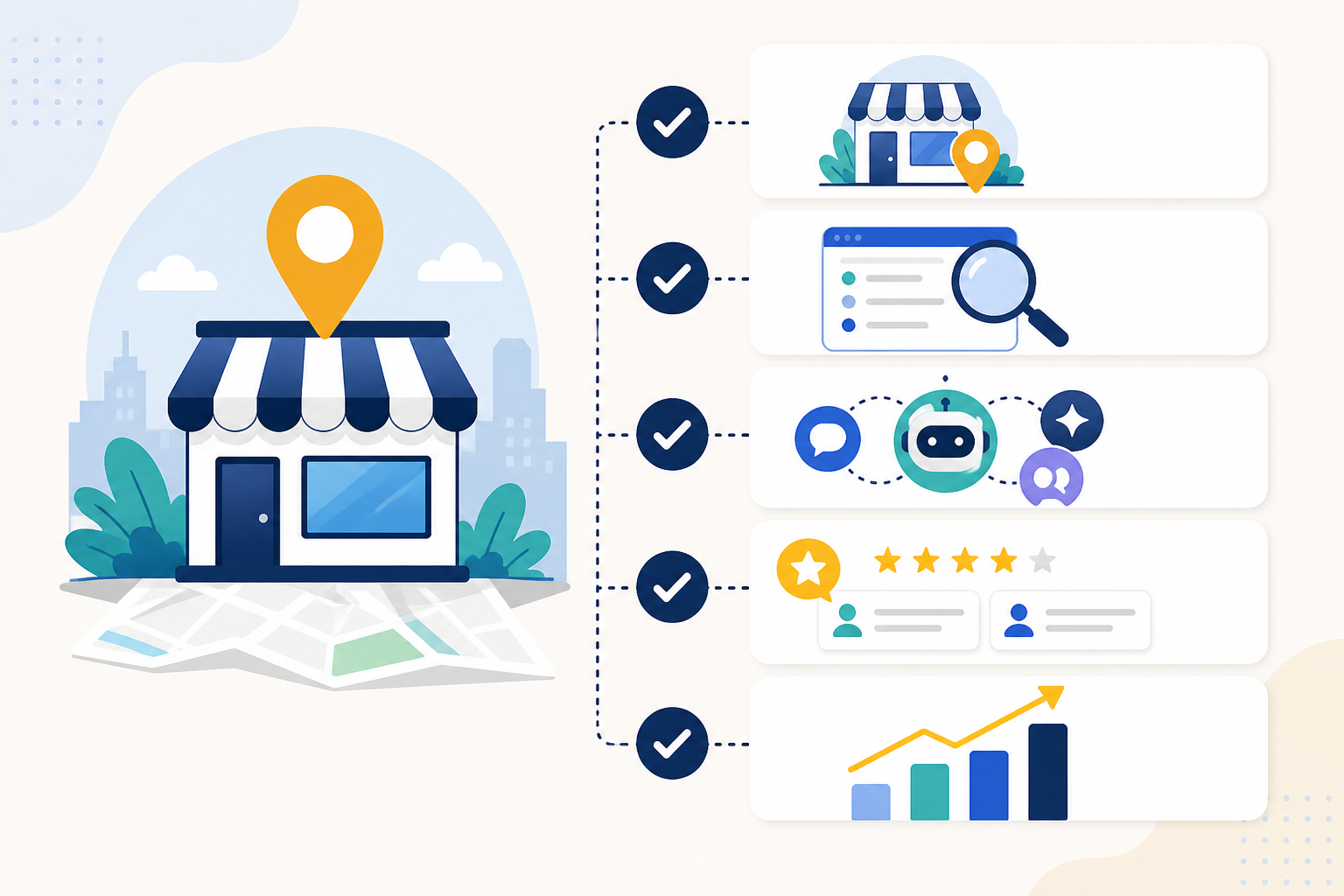
Given how differently each platform sources and weights local signals, a scattershot approach won't cut it. Here's the sequence I'd recommend, roughly in order of effort-to-impact:
- Audit your Google Business Profile completeness first. Because it disproportionately affects Gemini visibility in the sample, this is usually the highest-leverage, lowest-cost fix available to a UK local business. Check: accurate categories, current hours (including seasonal), recent photos, and a steady trickle of reviews.
- Clean up your website's structured data. Ensure LocalBusiness schema, service-area pages, and opening hours are consistent and crawlable, so ChatGPT and other LLMs can parse your services and location without ambiguity. Check: run your key pages through Google's Rich Results Test.
- Build a steady stream of local citations, press mentions, and reviews. This appears to support Perplexity's recency-weighted retrieval, and gives every other platform more corroborating evidence to work with. Check: aim for at least one new piece of third-party coverage or a fresh review batch monthly, not a one-off directory push.
- Monitor on a cadence that matches your risk, not daily by default. Weekly monitoring is enough for most small businesses; move to daily during a campaign, a launch, a seasonal change, or after a reputation event. In the tracked sample, answers shifted meaningfully within a single week, which means one good result tells you little about ongoing performance.
- Track competitor mentions alongside your own. Local business AI visibility is inherently comparative — the real question isn't just "do I appear," but "does a competitor appear instead of me?" This is where share-of-voice tracking earns its keep.
A simple diagnostic worth running on your own business: if you appear on Gemini but not on Perplexity, check your review recency and press mentions first — that's the gap in the sample most associated with that specific pattern. If you appear on ChatGPT but not Gemini, an incomplete Business Profile is the first thing to check. If you appear nowhere, start with crawlability before anything else.
This diagnostic-and-monitoring workflow is essentially what MentionOwl automates — it crawls your site, generates the local questions your customers are likely to ask, and runs them across ChatGPT, Gemini, Claude, Copilot, and Perplexity on a cadence you set, tracking citations, sentiment, and competitor mentions. I mention it because it's the tool that produced part of the dataset behind this piece, not as a universal fix for the patterns above — the fundamentals (profile completeness, structured data, genuine citations) matter regardless of which monitoring approach you use.
FAQ: Local Business AI Visibility and ChatGPT Citations
Does My Google Business Profile Influence ChatGPT Answers?
Not directly, and not in the way it influences Gemini. ChatGPT has no confirmed first-party pipeline into Google's Business Profile data, so it relies more on your website content, third-party directories, and general web mentions. That said, an active, well-reviewed Business Profile tends to generate more citation-worthy content elsewhere on the web — reviews, directory listings, Maps-linked pages — which ChatGPT can pick up indirectly. See the ChatGPT and Gemini sections above for the fuller comparison.
Which AI Tool Is Best for Finding Local Businesses?
Based on the sample tracked here, Gemini currently gives the most locally-grounded answers because of its direct integration with Google Business and Maps data. Perplexity is strong for surfacing recently-mentioned or reviewed businesses. ChatGPT tends to be more general unless the business has a strong web presence with structured data and third-party citations. This can shift as platforms update their retrieval methods, so treat it as a current snapshot rather than a permanent ranking.
Why Does My Business Show Up on One AI Tool but Not Another?
Each platform weighs different signals: Gemini leans on Google Business Profile data, Perplexity favours fresh web content and citations, and ChatGPT relies on a mix of structured data and broader web presence. If you're strong in one area but weak in another, inconsistent visibility across tools is the expected result, not a bug. The section above breaks down which fixes matter for which platform.
How Do I Improve Local Visibility Across All AI Tools?
Cover the fundamentals: complete and keep your Google Business Profile updated, ensure your website has clean, consistent structured data and is crawlable by AI bots (check your robots.txt specifically), build a genuine, steady flow of reviews and local mentions, and monitor your visibility on a cadence that matches your risk level so you catch drops before they cost you customers. No single fix covers every platform — that's the core finding of this whole piece. 🦉