What to Do When AI Recommends Your Competitor First: A Diagnosis-to-Fix Guide for UK Small Businesses
When AI recommends a competitor, learn how to verify the pattern, find the cause, improve visibility, and track progress across major platforms.
What to Do When AI Recommends a Competitor First: A UK Small Business Guide
If you've typed your own business name alongside a competitor's into ChatGPT and felt that sinking feeling when AI recommends a competitor over you, here's the thing I want to say before anything else: don't panic, and don't react yet. The fix starts with verification, not with a hurried rewrite of your homepage.
Run the same questions your customers would actually ask across ChatGPT, Claude, Gemini, and Perplexity. Document who gets mentioned, in what position, and with what sentiment. Then work through a structured remediation plan that covers technical AI legibility, content depth, and third-party citations, roughly in that order. In the small business audits I've worked through, businesses that stop guessing and start measuring consistently move faster than those relying on scattered screenshots, though I want to be upfront that timelines vary considerably depending on your market, your existing web presence, and how entrenched your competitor's advantage already is. I'll set out realistic expectations later in this piece rather than promising a fixed number of weeks up front.
That's the headline. Now let's unpack why AI recommends a competitor, how to confirm it's a genuine pattern, and precisely what to do about it.
First, Confirm What AI Is Actually Saying
I've lost count of the business owners who've shown me a single ChatGPT screenshot as proof that “AI hates us.” The issue is that large language models are probabilistic rather than deterministic, and several distinct mechanisms can cause the same question to produce different answers: model updates, live web retrieval pulling from a slightly different set of sources, personalisation, and plain session variation. I've run identical prompts at 9am and 3pm on the same day and watched the recommended business change entirely. A single answer is a data point. It is not a pattern, and it's worth being honest that we can't always know which of those mechanisms caused a particular shift without deeper platform access than most of us have.
Here's a methodology that gives you something more reliable to work from:
- Generate 15-30 realistic customer questions. Cover three categories: direct comparison queries (”X vs Y for [service]”), location-based queries (”best [service] in [town]”), and problem-solution queries (”who can fix [specific problem] near me”). A Bristol electrician, for instance, should be testing “best emergency electrician in Bristol” alongside “[Competitor] vs [own business] rewiring cost,” not just generic brand queries, because real customers rarely ask brand-neutral questions.
- Test across at least four platforms. ChatGPT, Claude, Gemini, and Perplexity differ in underlying models, retrieval methods, and how much live browsing they do. I've seen gaps of 30 points or more on the same underlying visibility framework between platforms for the same business, which is a reasonable signal that optimising for one engine and assuming the rest will follow is a flawed strategy, even though I can't say precisely which platform-level mechanism produces any single gap.
- Record three data points per answer. Was your business mentioned at all? Where did it appear, since earlier mentions appear to correlate with stronger recall and, plausibly, stronger click-through, although I'd treat that as a reasonable working assumption rather than a proven causal claim? And what was the surrounding sentiment: favourable, neutral, or subtly undermining?
- Repeat this over several days, not once. Consistency across repeated tests is what separates a genuine pattern from noise.
A simple way to record this is a spreadsheet with one row per question and columns for platform, date, mentioned (yes/no), position, sentiment, and competitor mentioned. Here's a shortened example:
| Query | Platform | Mentioned? | Position | Sentiment |
|---|---|---|---|---|
| “Best boiler repair in Leeds” | ChatGPT | No | – | – |
| “Best boiler repair in Leeds” | Perplexity | Yes | 2nd | Neutral |
| “[Competitor] vs [You] for boiler servicing” | Claude | Yes | 1st (competitor) | Favourable to competitor |
Doing this by hand across 20-plus questions and four platforms, several times a week, is genuinely tedious. That's a fair amount of manual effort for any small business owner to sustain alongside actually running the business. In the interests of full disclosure, I work on MentionOwl, a tool built specifically to automate this tracking, generating relevant customer questions from your website content and running them daily against major AI engines. I'm mentioning it here as one option, not the only one; a well-maintained spreadsheet and a recurring calendar reminder will get you the same underlying data, just with more of your own time invested.
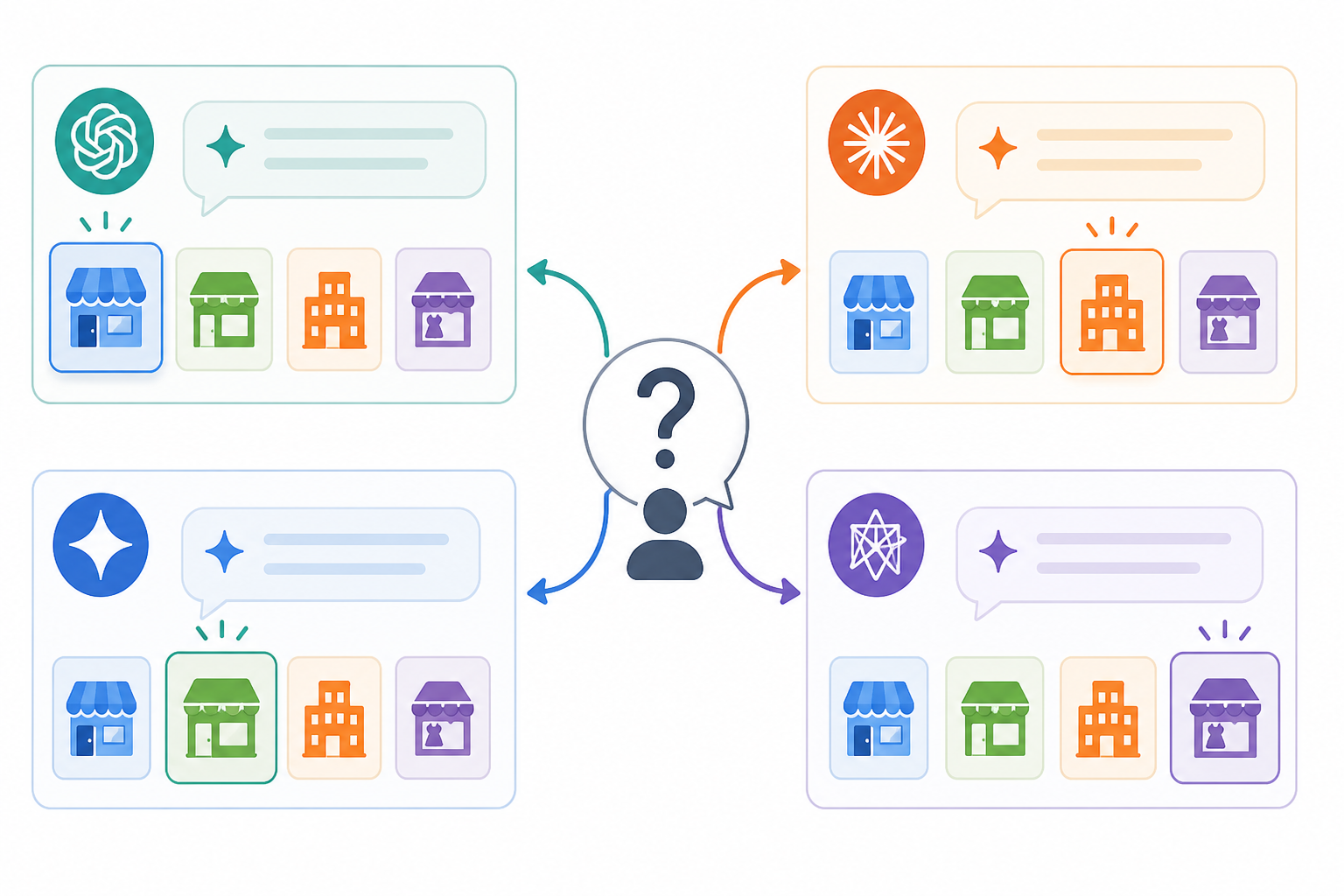
Why AI Recommends a Competitor
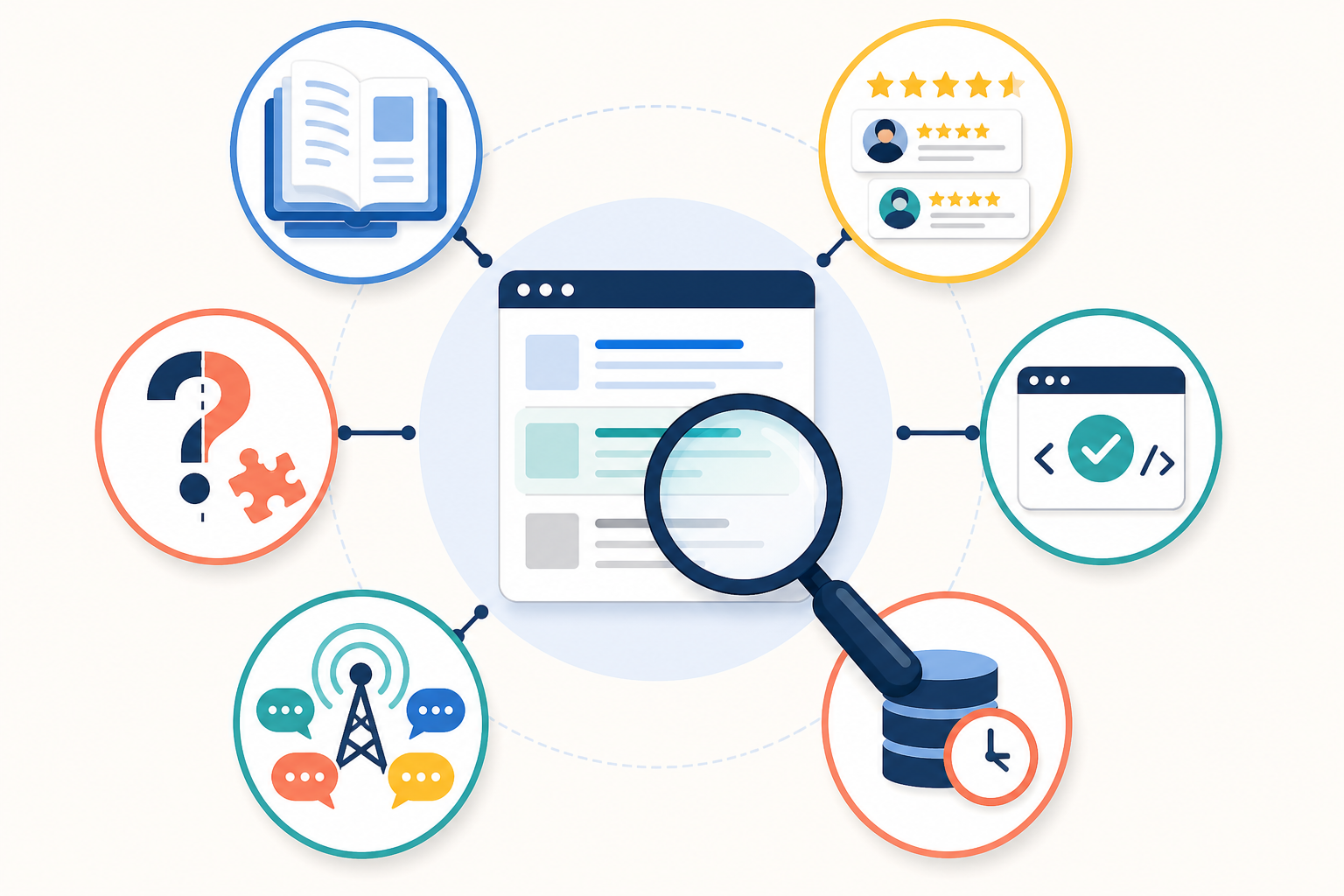
Once you've confirmed the pattern is real, the natural next question is why. I want to be careful here: what follows are the most common hypotheses I've seen borne out across a range of small business categories, not a settled, proven ranking algorithm, because no AI provider publishes the exact weighting logic behind their outputs. Treat these as a checklist to investigate in your own case, roughly ordered by how easy each one is to verify yourself.
- Query framing mismatches (check this first, it's the easiest to verify). Read your own website as if you were the AI model. Does it ever directly address comparative or problem-based phrasing, such as “we're better than [competitor] for X because Y”? If that sentence doesn't exist anywhere on your site, it's a reasonable bet the model has nothing to draw on when constructing that comparison.
- AI legibility gaps (check this second, it's mechanical and fixable). Missing structured data, poor crawlability, thin page content, or unclear business descriptions in the HTML can prevent AI models from extracting clean information from your site, even when you're the better business. This is a technical problem worth auditing directly rather than guessing at.
- Citation-worthy content depth. Models appear to favour sources that give them something concrete to extract—structured FAQ pages, transparent pricing, and specific service breakdowns—over vague marketing copy. A competitor with a detailed “how much does X cost” page will often get cited ahead of a business with only a generic “contact us for a quote” line.
- Third-party validation signals. Review volume and recency across Google Business Profile, Trustpilot, and sector directories plausibly feed into the data these models are trained on and retrieve from live. A competitor with 200 reviews from the last six months tends to outrank a business with 20 reviews from three years ago, though I'd treat recency as a likely contributing factor rather than a precisely quantified one.
- Historical training data lag. Because LLMs carry a knowledge cutoff, a competitor that dominated search visibility and press coverage 12-18 months ago may still be over-represented in outputs even if you've since overtaken them in the real world. This is frustrating precisely because it rewards past performance that may no longer reflect present reality.
- Share of voice imbalance. If a competitor appears more often across forums, comparison articles, and niche publications, they accumulate informal, unlinked references that may compound into a stronger overall presence over time.
Quick Wins to Improve Your AI Visibility in the First 1-2 Weeks
Once you have a working theory about which of those factors is driving your specific gap, the first fortnight should focus on changes that are within your direct control:
- Rewrite your homepage summary with specificity. State clearly who you serve, where, and what genuinely differentiates you. Vague copy gives a model little to work with when constructing a comparison, so specificity here is a reasonable, low-risk investment even without a guaranteed timeline for results.
- Build a dedicated FAQ page around the comparison and problem-solution questions you tested earlier. This is one of the higher-leverage, lower-effort fixes available, precisely because it mirrors the phrasing customers and AI models actually use.
- Address basic AI legibility issues. Clean HTML structure, appropriate schema markup, reasonable load times, and removing accidental crawl blocks such as an overly aggressive robots.txt rule or a JavaScript-rendered page with no server-side content. None of these guarantee a citation, but they remove barriers that can prevent one entirely.
- Claim and complete your relevant UK directory and review listings. Google Business Profile, Yell, Checkatrade if you're in a trade sector, Trustpilot, and any trade association or local chamber listing relevant to your industry. Focus on the listings that are genuinely relevant to your sector rather than claiming every directory that exists; an incomplete or abandoned listing on a directory that matters to your industry is a more direct visibility leak than an unclaimed generic one.
- Publish one genuinely useful piece of content this week. Rather than a page that simply claims to be “the best [service] in [location],” write something that actually helps: a buying guide, a transparent pricing breakdown, or a comparison framework for a query like “emergency boiler repair in Leeds.” A rough page with concrete, useful detail will often outperform a polished page that says very little.
Long-Term Fixes for Sustained AI Visibility
Quick wins buy you initial movement, but sustained AI visibility requires the same discipline traditional SEO has always demanded, applied to a different set of signals.
- Build a content calendar around question-led, structured content. This is sometimes called generative engine optimisation, essentially writing content that directly answers the specific questions your customers ask, in a format models can extract cleanly, rather than writing purely for keyword density. It's an emerging practice rather than a settled discipline with agreed best practice, so treat any specific tactic as worth testing rather than guaranteed.
- Invest in genuine third-party mentions. Guest posts, industry roundups, and press coverage build the external citation network these models plausibly draw on when forming recommendations. This is slower than on-site fixes but likely more durable once established.
- Systematically grow and manage reviews across every relevant platform. Recency and volume come up repeatedly as likely factors in how models frame trust and recommendation language, so a stagnant review profile is worth actively managing even if you can't measure its exact effect.
- Track competitor content and citation patterns continuously, not once. Competitors update their sites too, so I'd caution against treating a six-month-old audit as still valid.
- Treat AI visibility as an ongoing discipline with monthly reviews, watching the individual components of your tracking, not a single number, since each component tells you something different about where further work is needed.
Monitoring Progress: How Do You Know if Your Fixes Are Working?
A quick note on terminology before we go further: when I refer to an “AI visibility score,” I don't mean an official, standardised industry metric—no such universal standard currently exists. I mean a simple, reproducible measurement you can build yourself: the percentage of your test queries where your business is mentioned at all, weighted by how early it appears in the response and by sentiment, with your named competitor's share tracked separately alongside it. You can build this in a spreadsheet with the columns shown earlier, tallied weekly.
A sample weekly AI visibility scorecard might look like this:
| Metric | Week 1 | Week 4 | Week 8 |
|---|---|---|---|
| Query coverage (mentioned in % of test queries) | 20% | 35% | 55% |
| Average position when mentioned | 3rd | 2nd | 1st-2nd |
| Favourable sentiment (%) | 40% | 60% | 75% |
| Competitor's query coverage | 70% | 65% | 55% |
Manual re-testing weekly is realistic if you're only tracking a handful of core queries. It becomes genuinely unsustainable once you're covering 20-30 question variants across four platforms, which is roughly the scale needed for a reliable read. This is the gap that automated tracking tools, including the one I work on, are built to close, though a diligent spreadsheet habit will get you most of the way there with more of your own time.
I'd also flag that I've seen meaningful fluctuation in AI responses even when nothing on a business's own site or citation profile has changed at all. Without a consistent tracking method across several weeks, it's easy to mistake normal variance for either a crisis or a false victory. Track competitor coverage alongside your own for the same reason: improving in isolation means comparatively little if your named competitor is improving faster over the same period.
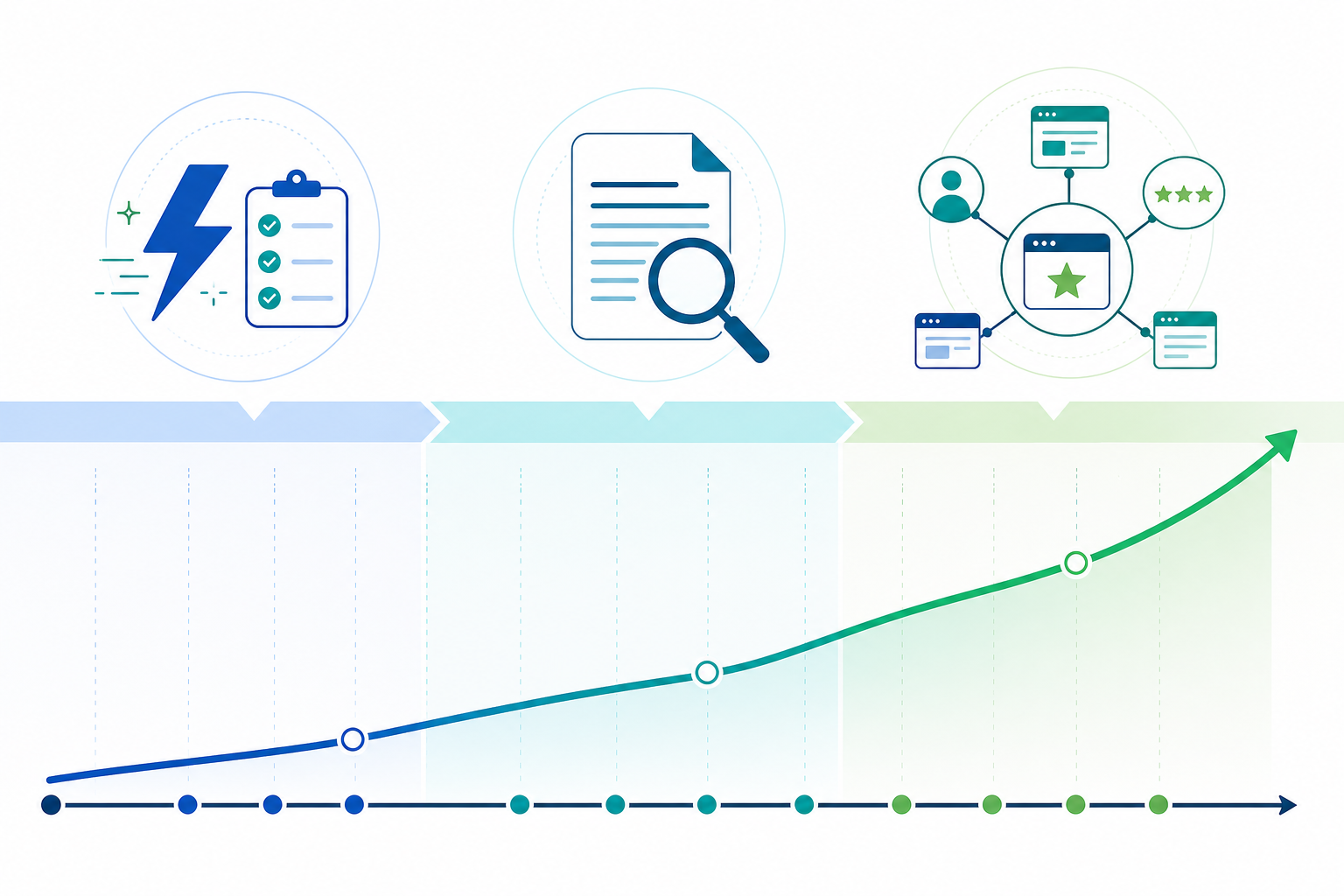
On timelines: in the audits I've reviewed, technical legibility fixes have tended to show measurable movement within roughly two to four weeks, since they remove barriers that were actively preventing models from reading a site correctly. Content depth and third-party citation improvements have typically taken longer, often six to twelve weeks, to show up in AI answers, because they depend on external crawling, indexing, and sometimes retraining cycles that sit entirely outside your control. I'd treat both ranges as reasonable expectations based on observed patterns rather than guarantees, since AI platforms don't publish reliable timelines for how quickly changes propagate through their systems.
![Illustration: A clean dashboard-style screenshot mockup showing a rising AI visibility score for What to Do When AI Recommends Your Competitor First(https://www.mentionowl.com/visibility-score) line graph from 0-100 alongside competitor comparison bars, styled like a SaaS analytics interface]
Frequently Asked Questions About AI Competitor Recommendations
How do I verify that AI is really favouring my competitor and it's not just a one-off answer?
Run the same set of 15-30 realistic customer questions across ChatGPT, Claude, Gemini, and Perplexity at least three times over a week, noting whether your competitor consistently appears first or more favourably each time. A single response can be affected by phrasing, personalisation, or session variation, so consistency across repeated tests and multiple platforms is what confirms a genuine pattern rather than noise.
What usually causes the visibility gap between me and my competitor?
In most cases it's a combination of website content that doesn't directly answer comparison questions, technical AI legibility issues that prevent models from extracting clean information, and fewer third-party citations, such as reviews or press mentions, feeding into what the models can draw on. Start with query framing and technical legibility, since both are within your direct control and easiest to verify, before assuming the cause lies with review volume or training data lag, which are harder to influence quickly.
What if different AI platforms give me contradictory answers?
This is common and doesn't necessarily mean one platform is “wrong.” Each draws on different training data, retrieval methods, and live browsing behaviour, so disagreement between platforms is expected rather than a sign of a bug. Track each platform separately in your scorecard rather than averaging them into one figure, and focus your fixes on the platforms where your actual customers are most likely searching.
How fast can I realistically improve my AI visibility?
Technical and on-site fixes, like improving AI legibility and adding clear FAQ content, have shown measurable movement in some of the audits I've reviewed within two to four weeks. Improvements tied to third-party citations, reviews, and broader content authority typically take longer, often six to twelve weeks, to meaningfully shift how models represent your business. These are observed ranges rather than guarantees, so it's worth setting expectations accordingly.
How do I know if my fixes are actually working over time?
Track a consistent set of metrics—query coverage, citation position, sentiment, and competitor share—rather than isolated screenshots, and watch for movement over successive weeks. A simple spreadsheet logging weekly results works fine for a handful of queries; automated monitoring becomes more useful once you're tracking the 20-30 queries needed for a genuinely reliable read.
Discovering that AI recommends your competitor over you is unsettling, but it's a solvable, measurable problem rather than an existential one. The businesses I've seen make the fastest progress treated it like any other data problem: verify first, form a specific hypothesis about the cause, apply fixes in a sensible order starting with what's within your control, and keep measuring so you know the work is actually paying off rather than assuming it is.