Scaling AI Visibility Monitoring Across Client Accounts: An Operations Guide for Agencies
Managing AI visibility monitoring for dozens of clients? I break down the API workflows, standardized metrics, and dashboard tactics UK agencies need
AI visibility monitoring at scale: how agencies can manage more client accounts
Scaling AI visibility monitoring across client accounts comes down to three operational pillars: automating data collection and reporting through an API rather than manual checks, standardising your AI visibility score and share-of-voice metrics so every account report is comparable at a glance, and building templated client-facing dashboards that separate raw data pulling from client communication. I've seen agencies go from spending 6+ hours per client per week on manual ChatGPT and Perplexity checks to under 20 minutes once these three systems are in place.
I want to unpack exactly how that transition happens, because I've watched enough UK agencies attempt to bolt AI visibility monitoring onto their existing service stack to know that the failure mode is almost always the same: they treat it like an extension of manual SEO rank tracking, and the headcount maths falls apart within a quarter. Below, I'll walk through the operational architecture that actually holds up once you're managing 20, 50, or 100+ accounts.
The challenge of managing AI visibility across multiple client accounts
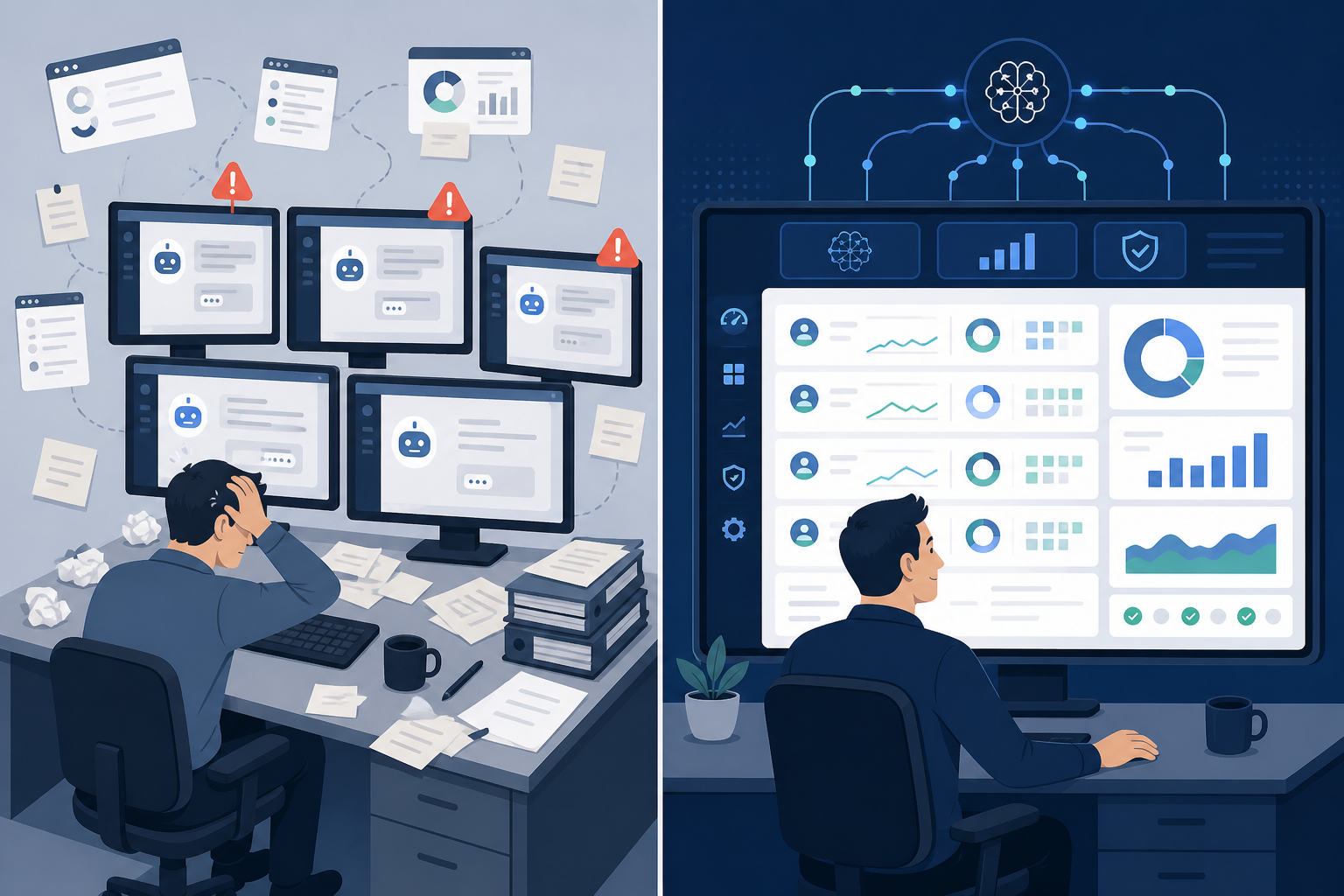
Here's the arithmetic that catches most agencies off guard. If you're manually typing customer questions into ChatGPT, then repeating the process in Claude, Gemini, Copilot, and Perplexity, and doing this for even a modest set of ten queries per client, you're looking at 50 individual checks per client, per monitoring cycle. Across our own client base, we see an average of 35-60 auto-generated customer questions per account once query coverage is built out properly to reflect real purchase-decision language. Multiply that by five AI platforms and you're at 175-300 individual lookups per client, per week, if you want anything resembling a reliable monitoring cadence.
At three or four clients, an analyst can absorb that workload, if inefficiently. Past that threshold, something has to give, and in my experience it's almost always monitoring consistency. Analysts start skipping platforms, batching checks fortnightly instead of weekly, or quietly dropping the smaller accounts to focus on retainer clients paying premium fees. This is the hidden cost that rarely shows up in a time-tracking spreadsheet but shows up very clearly in client churn data: the agencies who lose AI visibility monitoring clients within the first two quarters are disproportionately the ones relying on manual spot-checks rather than automated daily crawls.
The root cause I keep encountering is inconsistent monitoring cadence, not poor strategic insight. Clients don't churn because their account manager gave bad advice. They churn because a competitor started appearing in ChatGPT's recommendation for "best [category] provider near me" three weeks before the agency noticed, and by the time it surfaced in a monthly report, the client had already seen it themselves and lost confidence in the service. Daily automated monitoring closes that gap. Manual checking, however diligent, structurally cannot.
Using an API to automate AI visibility reporting
Once the volume problem is clear, the fix is straightforward in principle, even if it requires some upfront engineering time: pull the data programmatically instead of manually. Here's the sequence I recommend to agencies building this out for the first time.
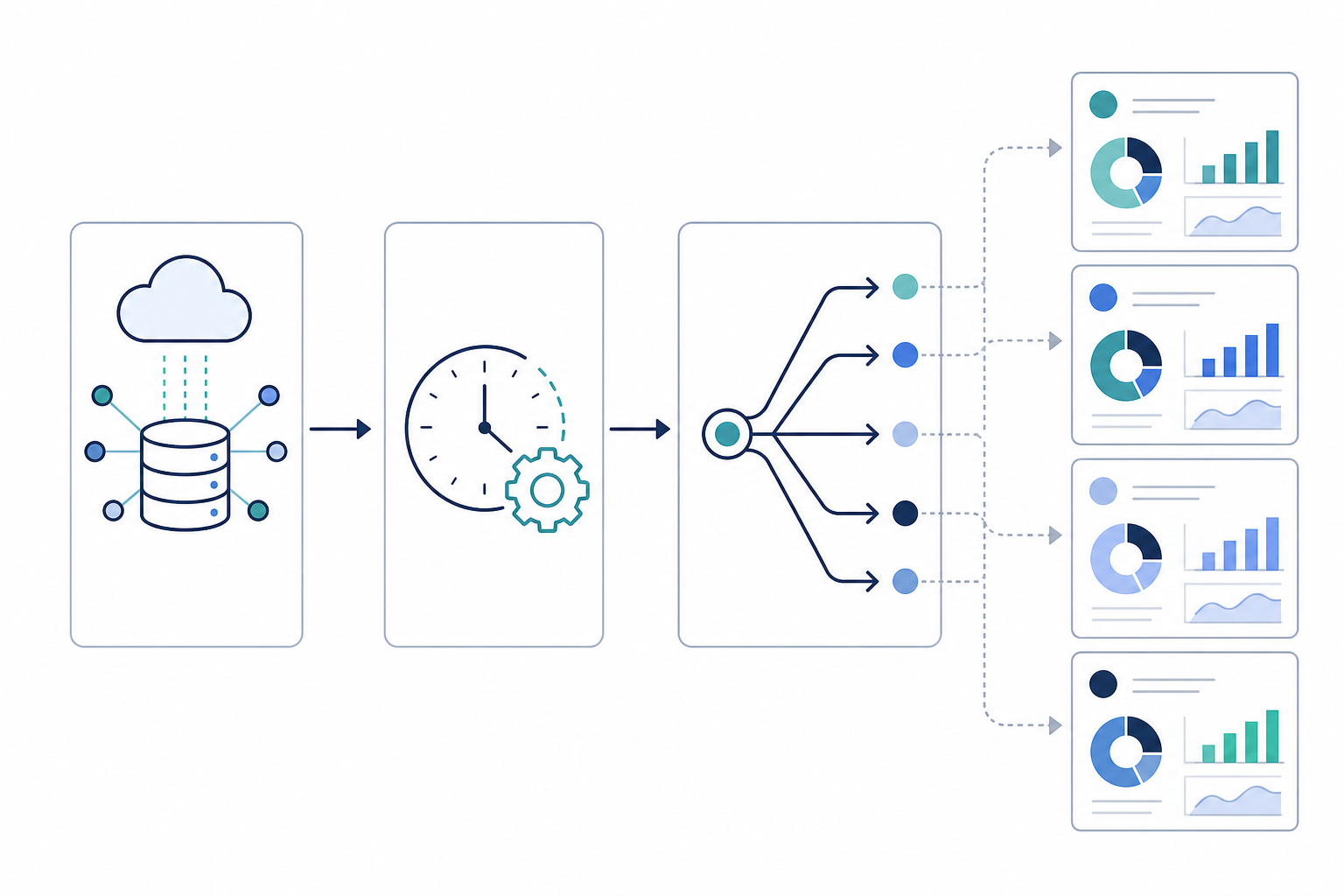
Authenticate against the REST API. MentionOwl's API returns visibility score, citation data, sentiment classification, and competitor mentions per account in a single authenticated call. This eliminates the need for anyone on your team to log into separate client dashboards one at a time.
Structure a data pipeline. The pattern that works reliably is: API pull into an internal database or spreadsheet warehouse (Airtable, BigQuery, or even a well-organised Google Sheet for smaller agencies), then into templated report generation. This decouples data collection from report writing, meaning the same underlying pull can feed both your internal analyst view and your simplified client-facing dashboard.
Schedule automated pulls. Daily pulls for internal monitoring and weekly aggregated pulls for client reporting provide a cadence that balances responsiveness against noise. A scheduled job (cron, a serverless function, or a workflow tool like Make or n8n) removes the human bottleneck entirely.
Feed the MCP server into internal AI agent workflows. For agencies already using AI agents internally for reporting or QA, the MCP server lets you connect AI visibility data directly into those agent pipelines. This cuts turnaround time even further, since the agent can flag anomalies, a sudden visibility score drop or a new competitor citation, without a human first noticing it in a spreadsheet.
Measure the before-and-after. One 15-client agency I worked through this transition with was spending roughly 12 hours a week on manual reporting across their client base. After building the scheduled API job and templated output, that dropped to under 2 hours a week, almost entirely spent on the interpretation layer rather than data assembly. That's not an outlier figure either. It's the typical result once the manual step is removed from the workflow entirely.
Standardising AI visibility score and share-of-voice metrics
The second pillar matters just as much as automation, and it's the one agencies underinvest in most consistently. If your reporting template invents new metrics per client, you lose the ability to benchmark across your book of business, and you force every analyst to relearn a bespoke framework every time they touch a different account.
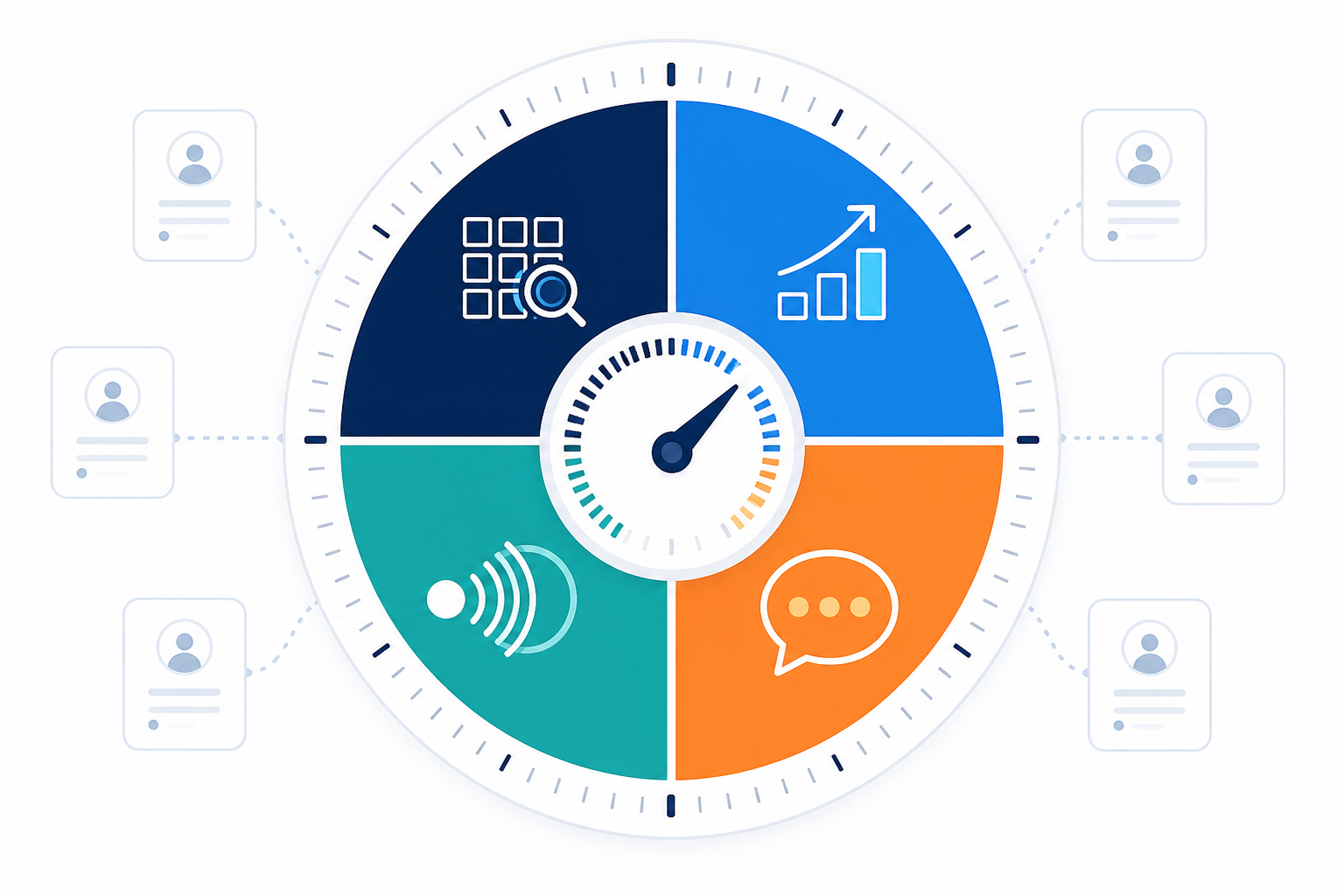
The fix is to lead every single client report, regardless of industry, with the AI visibility score on its 0-100 scale. It's the one number that translates across a SaaS client, a local plumber, and an e-commerce store, because it's built from the same four inputs every time:
- Query coverage: the proportion of relevant customer questions where the brand appears at all in AI-generated answers
- Position-weighted citations: how prominently the brand is cited when it does appear, since being mentioned third in a Perplexity answer carries different weight than being the lead recommendation
- Share of voice: how the brand's mention frequency compares against tracked competitors across the same query set
- Soft mentions: instances where the brand is referenced without a direct citation or link, which still shape how an AI assistant frames a category or recommendation
Explaining these four components to clients directly, rather than presenting the score as a black box, does two things: it builds trust in the number, and it gives your account managers a shared vocabulary that doesn't need to be reinvented for every industry vertical.
On the competitor tracking side, build one standard template structure (top five tracked competitors, their share-of-voice trend, and any newly appearing competitors in the last 30 days) and apply it uniformly. The specific competitors will obviously differ between a plumber in Leeds and a mid-market SaaS company, but the report skeleton should not.
Internally, this standardisation pays off in a second way: it lets junior team members triage without pulling in a senior analyst for every account. A benchmark like "anything under 30 visibility score flags for an urgent AI legibility audit review" is the kind of rule that, once established, means your most experienced staff are only reviewing genuine edge cases rather than every single account update.
Building client-facing AI visibility dashboards
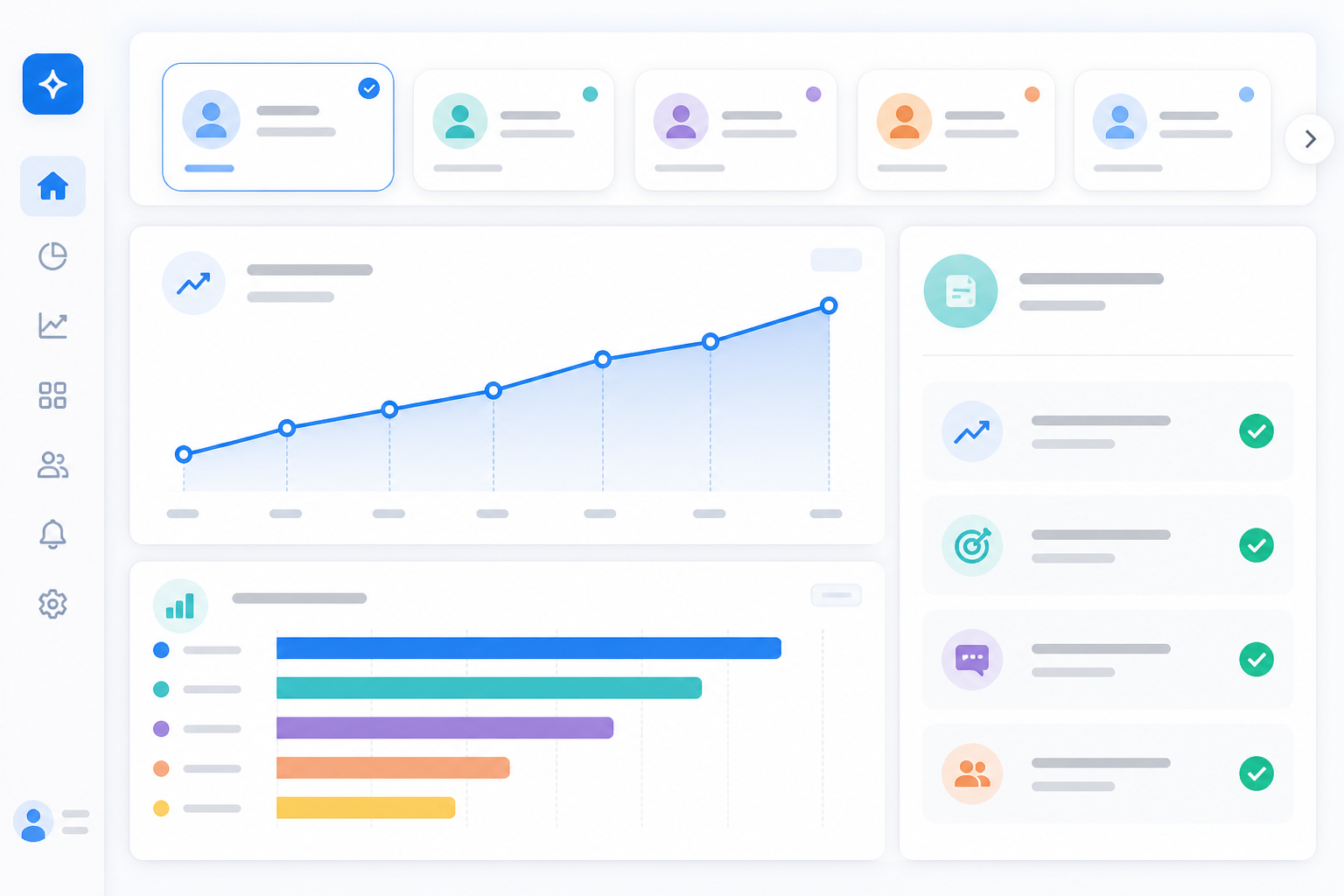
The third pillar is where a lot of the client relationship value actually gets delivered, and it's also where I see agencies make an avoidable mistake: showing clients the same dashboard the analyst uses internally. Internal dashboards should be dense, with raw data, every tracked competitor, and every query in the set visible. Client-facing views should be radically simplified: a score trend line, the top three wins from the period, and the top three gaps that need attention. That's it. Clients don't need to see all 50 queries; they need to see whether their position is improving and where the next opportunity sits.
Between full reporting cycles, weekly digest emails are a low-effort touchpoint that keeps the relationship active without requiring a full analyst review each time. A short automated summary, generated from the same API pull feeding your internal systems, is often enough to remind a client the monitoring is active and working, which matters more for retention than most agencies give it credit for.
White-labelling these AI visibility score reports under your own agency branding, rather than sending clients raw screenshots of ChatGPT conversations, does meaningful work for your positioning. It signals that AI visibility monitoring is a structured, measurable discipline your agency has built real capability around, not an ad-hoc novelty service you're improvising.
One addition I'd strongly recommend: pairing visibility score data with cookieless AI traffic analytics in the same dashboard view. Visibility tells a client whether AI assistants are recommending them. Traffic analytics tells them whether that recommendation is actually converting into visits. Showing both together closes the loop between AI SEO effort and business outcome, which is exactly the kind of full-funnel narrative that justifies retainer pricing.
The cadence I recommend as a default: daily monitoring feeding into a weekly digest, which rolls up into a monthly strategic review where the account team actually discusses interpretation and next steps with the client. This mirrors how most agencies already structure traditional SEO reporting, which makes the transition easier to sell internally and externally.
Avoiding common AI visibility monitoring scaling pitfalls
Even with automation and standardisation in place, I've seen agencies stumble on a handful of avoidable mistakes:
- Onboarding too fast, before the workflow is templated. Signing 20 new clients before your reporting pipeline and dashboard template are locked in leads to inconsistent quality across accounts and burns out analysts trying to retrofit structure after the fact.
- Treating AI legibility audits as one-and-done. The 16 technical checks that determine how easily AI crawlers can parse a client's site should be re-run after any meaningful site change, not filed away after the initial onboarding audit.
- Reacting to competitor visibility only after a client notices it first. Competitor tracking data should be reviewed proactively, ideally weekly, because by the time a client asks why a rival is showing up in ChatGPT answers and they aren't, the gap has usually existed for weeks.
- Underestimating query drift. The customer questions AI models get asked shift as the models themselves update. A static question set built at onboarding goes stale within weeks, so your auto-generated query coverage needs periodic refreshing, not a one-time setup.
- Failing to set expectations on the pace of change. AI visibility score movement is typically slower than traditional SEO ranking shifts, and clients coming from a search-ranking mindset can panic prematurely if a score doesn't jump within the first reporting cycle. Setting that expectation early prevents churn driven by impatience rather than genuine underperformance.
Frequently asked questions about AI visibility monitoring
Can one analyst realistically manage AI visibility monitoring for dozens of clients?
Yes, but only once the manual checking step is removed. With daily automated crawls and an API feeding a standardised dashboard template, I've seen a single analyst comfortably oversee 30-40 accounts, spending most of their time on interpretation and client strategy rather than data collection.
Is there an API for automating AI visibility reporting?
Yes. MentionOwl offers a REST API that returns visibility scores, citation data, sentiment, and competitor mentions per account, which agencies can pull into their own reporting pipeline or connect via the MCP server for AI agent workflows.
How do I standardise AI visibility reporting across different industries?
The visibility score itself is industry-agnostic because it's built from four consistent inputs: query coverage, position-weighted citations, share of voice, and soft mentions. Standardise your report template around this score and layer in industry-specific competitor context underneath, rather than inventing new metrics per client.
What tools help agencies scale AI visibility monitoring without hiring more analysts?
A platform with a REST API for bulk data pulls, auto-generated customer questions per client site, and pre-built weekly digests removes most of the manual workload. Pairing that with a templated dashboard, an internal detailed view plus a simplified client view, is usually enough to scale to dozens of accounts with the same headcount.