Why Solo Founders Need a Weekly AI Visibility Digest (Not Daily Manual Checks)
Solo founders don't have time to query ChatGPT, Claude, and Gemini every day. Here's why a weekly AI visibility digest gives you the same insight in 1
AI Visibility Digest: A Better Alternative to Daily Manual Checking
A weekly AI visibility digest is a single report that consolidates what ChatGPT, Claude, Gemini, Copilot, and Perplexity are saying about your business into one document you can read in about 15 minutes. Instead of manually querying five AI platforms every day, checking whether they mention you, and trying to remember what they said last week, you get one number, a short list of what changed, and enough context to know whether any of it actually matters.
This piece is written for solo founders and very small teams who don't have a marketing department to hand this to, and who need a workflow that fits into a Monday morning rather than consuming an afternoon. I've spent enough time in this data to say it plainly: for solo operators, a weekly cadence beats daily obsession, because it filters out the noise inherent in how these models behave while still catching anything that genuinely matters to your business. That's not a minor operational preference — it's a structural response to how generative AI actually works, and once you understand the mechanics, the case for a digest over ad hoc daily checking becomes fairly hard to argue against.
Why AI Visibility Monitoring Matters for Your Business
Here's the uncomfortable starting point: AI-generated answers are now a distinct layer of brand visibility, one where a company can be mentioned, omitted, miscategorised, or described inaccurately before a prospect ever lands on its website. Google began rolling its AI Overviews feature out more widely through 2024, including to UK searchers, and reported more than 1.5 billion monthly users of AI Overviews across supported countries as of July 2025. On the adoption side, Ofcom's 2024 Online Nation research found generative AI chatbot use climbing sharply among UK adults over the previous two years, and Pew Research Center separately found that 26% of US adults had used ChatGPT by February 2025, up from 18% in March 2023, rising to 34% among under-30s. The exact percentages differ by market and by study methodology, and I'd treat any single figure as directional rather than precise — but the direction itself is not in doubt. The audience consuming AI-generated descriptions of your business, in the UK as much as anywhere else, is mainstream and growing quickly.
How AI Answers Can Affect Brand Visibility
What makes this genuinely different from traditional search-rank monitoring is the source material. A single AI answer can synthesise information pulled from your website, customer reviews, directory listings, social profiles, forums, and third-party publications. That means you can lose control of your own narrative even when everything on your own site is accurate and current. This is the point that surprises solo founders most: the problem often isn't your content, it's what the model is pulling in from elsewhere, and how it's stitching that together into a confident-sounding answer that a prospective customer never thinks to question.
And confidence is exactly the issue. AI systems don't produce stable, repeatable answers. Responses shift based on the underlying model version, prompt phrasing, location, date, and whatever sources happen to be available at query time. OpenAI's own research on why language models hallucinate makes clear that a single manual check gives you a snapshot, not a dependable read on your brand's standing. If you query ChatGPT once on a Tuesday and get a favourable mention, that tells you almost nothing about what it said last Thursday or what it will say next Monday — and it tells you even less about what a customer in a different city, using a different phrasing, sees at the same moment.
The Commercial Risk of Inaccurate AI Answers
The financial exposure is real rather than theoretical, even if the clearest evidence for it comes from outside the UK. Ahrefs' 2024 analysis of roughly 300,000 keywords found that pages with an AI Overview present saw a 34.5% lower average click-through rate for the top organic result — meaning even businesses ranking well can lose visibility to the AI layer sitting above them. That study was conducted on US search data, but the mechanism it describes (an AI summary absorbing the click before the user reaches an organic result) applies to how Google's AI Overviews behave in UK search results too, since it's the same underlying feature. And the errors compound: the Columbia Journalism Review's Tow Center analysis of roughly 1,000 AI-generated search responses in 2024 found AI tools frequently struggled to accurately reproduce source content, with error rates climbing for anything recent or ambiguous. If an AI system can misrepresent a published news article, it can just as easily misrepresent your pricing, your service area, or your ideal customer profile.
The Air Canada case is a useful cautionary example, even though it sits in a different jurisdiction. A British Columbia tribunal held the airline liable in February 2024 after its chatbot gave a customer incorrect information about bereavement fare policy, rejecting the argument that Air Canada shouldn't be responsible for its own AI system's answer. There's no UK tribunal ruling on record that mirrors this exactly, but the underlying principle isn't foreign to UK law: under the Consumer Rights Act 2015, information a consumer relies on when making a purchasing decision can be treated as forming part of the contract, which suggests a UK court could reach a broadly similar conclusion if a business's chatbot misstated a policy in a way that caused loss. Chevrolet faced a related reputational problem in 2023 when a dealership chatbot was manipulated into agreeing to sell a vehicle for $1. Neither company was monitoring for this kind of exposure closely enough, and both paid a price for it — which is precisely the scenario a digest is designed to catch before it escalates.
For a solo founder, doing this monitoring manually means running the same set of customer questions across five platforms, recording or screenshotting the answers, then repeating the exercise days later to spot a pattern. Done properly, that's 5 to 10 hours a month — time most one-person businesses simply don't have. This underlying discipline is sometimes labelled AI SEO or generative engine optimisation (GEO); the terms just describe the practice of managing how your brand appears in AI-generated answers the way you'd manage how it appears in traditional search results. Most founders, lacking the hours for it, either check sporadically and miss the trend entirely, or don't check at all and fly blind. Both carry real opportunity cost, and neither is sustainable as a long-term strategy.
What Should an AI Visibility Digest Include?
A digest earns its 15 minutes by consolidating the full picture rather than handing you a single data point. Before listing the components, it's worth being precise about what the headline number actually is: an AI visibility score is a composite, platform-specific metric, not an industry-standard measurement with a fixed definition. Different tools calculate it differently, sample different numbers of queries, and weight components in their own way, so a score of 68 from one tool isn't directly comparable to a score of 68 from another. Treat it as a comparative tracking figure for your own business over time, not an absolute grade.
With that caveat in place, here are the six elements I look for in any AI visibility digest worth reading, along with what each one actually means:
- Your current AI visibility score (0-100) and its week-over-week movement. In MentionOwl's implementation, this is built from query coverage (how many of your tracked customer questions return any mention of you at all), position-weighted citations (whether you're named early and directly versus buried or implied), share of voice relative to competitors, and soft mentions. Other tools will weight these differently, so the number itself matters less than its trend.
- New or lost citations, showing which specific AI answers now mention you and which ones dropped you between the last two reporting periods.
- Competitor mentions across the same query set, so you can see who's gaining ground on the exact questions your customers ask before they buy.
- Sentiment shifts, tracking whether AI platforms are describing you more positively, neutrally, or negatively than the prior period.
- Notable soft mentions — meaning you're referenced in an answer but not directly recommended or named as a solution. These often signal early visibility ahead of full citation status, and they're worth watching even when they don't yet move your score.
- AI legibility flags from that week's crawl, covering structural or technical issues (missing schema, unclear headings, thin or outdated pages) that make it harder for AI systems to parse your site accurately.
A quick methodological caveat that applies across all of the above: any AI visibility tool, including ours, is sampling a finite set of queries against models that personalise results by location, account history, and conversation context. A digest tells you how your tracked query set performed on the platforms and prompts it tested — it's a strong proxy for how AI systems generally treat your brand, not a census of every possible customer conversation. And a citation is not the same thing as a qualified lead; being mentioned favourably in an AI answer is a visibility signal, not proof that it converted anyone. I want to be upfront about that distinction, because in the interest of transparency, MentionOwl is the tool I work on, and the specific scoring mechanics described here reflect how we've built it. Other monitoring tools, or a manual spreadsheet tracking the same six categories, would give you the same underlying workflow with different implementation details.
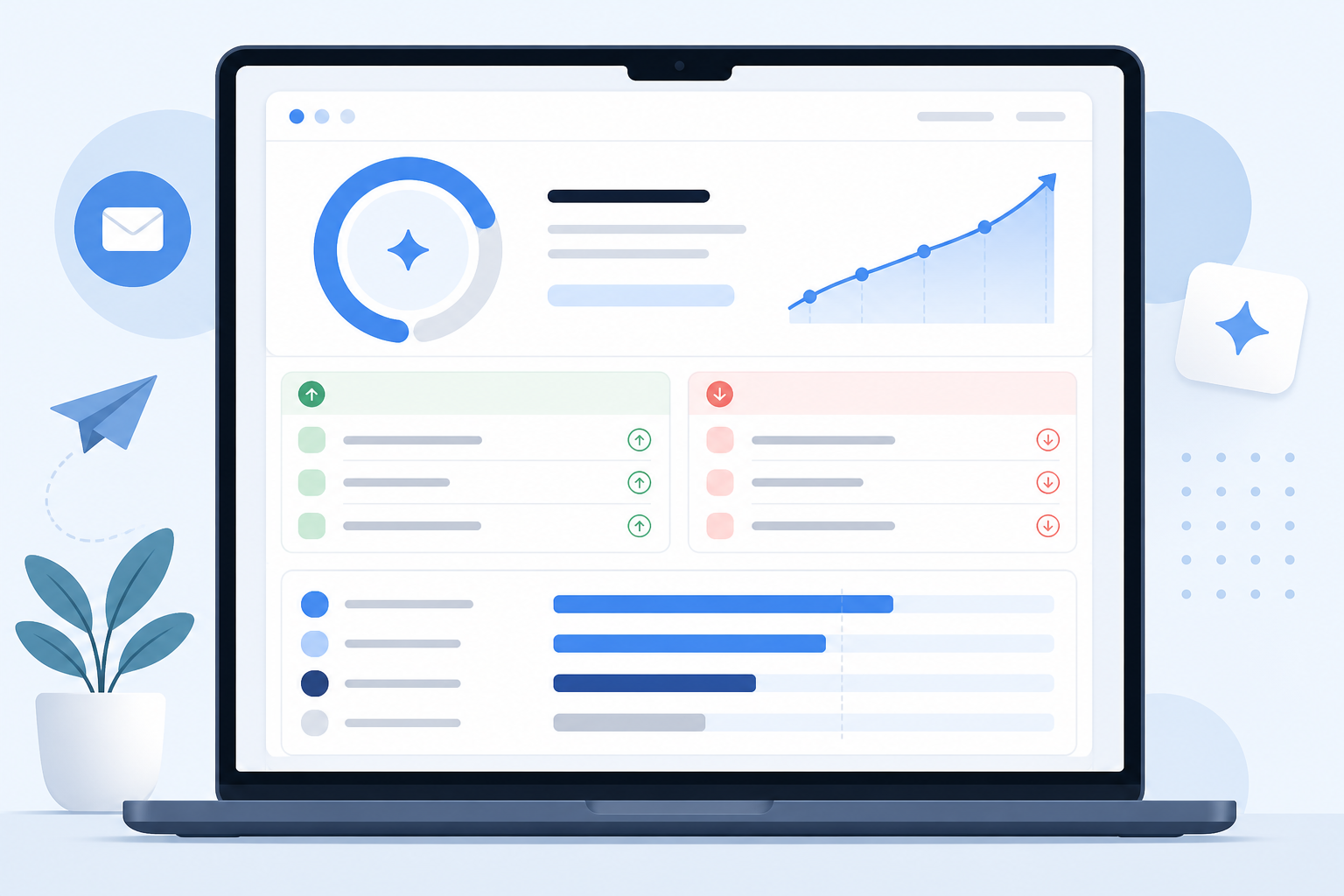 Caption: An illustrative digest layout — the score itself is a comparative tracking figure specific to the queries and platforms sampled, not a universal benchmark.
How to Read AI Visibility Score Trends Without Overanalysing
Here's where I'd caution against a common mistake: treating every single-week fluctuation as meaningful. It usually isn't, and reacting as though it is will burn hours you don't have chasing noise.
AI platforms update their underlying models and retrieval behaviour frequently and without warning. A drop of a few points in your visibility score this week is often normal volatility rather than a crisis. As a starting point, I'd suggest evaluating a rolling 3-4 week trendline rather than reacting to any single digest in isolation, since this smooths out noise from model updates and natural query variability. But treat that window as a provisional baseline, not a fixed rule — a business tracked across 40 queries will show more single-week jitter than one tracked across 300, so the right window for you depends on your own query volume and historical variance, which becomes clearer after your first six to eight weeks of data.
When a Change in Visibility Requires Action
The exception worth flagging immediately: a sudden, sharp drop in citations for a query tied to a core service or product that had previously performed well. That's a signal worth investigating the same week rather than waiting for a month of data to confirm the pattern. Google's own guidance on debugging search traffic drops draws a similar distinction — isolate sudden, query-specific changes from gradual, platform-wide drift, because they usually have different causes and require different fixes.
One more nuance worth understanding, again as a general tendency rather than a guarantee: your share of voice relative to your top two or three competitors tends to be a somewhat more stable signal than your absolute visibility score, because it's less sensitive to platform-wide shifts that affect everyone in your category at once. If your score drops five points but your competitors' scores drop by a similar margin, your competitive position likely hasn't changed — the whole category probably experienced a model update. I'd still watch both figures rather than relying on share of voice alone, since a category-wide drop can occasionally mask a genuine, business-specific problem underneath it.
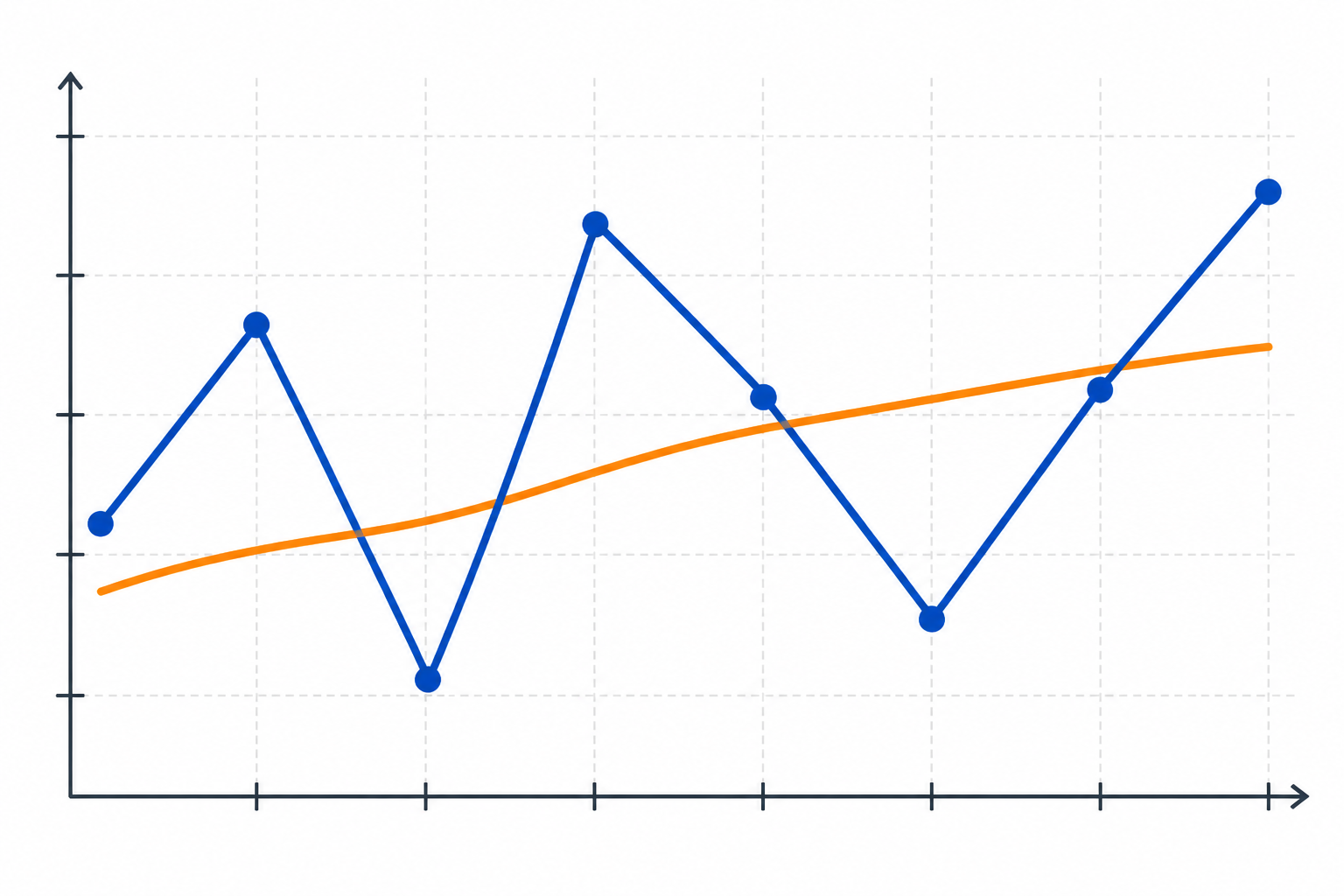 Caption: Illustrative eight-week trend — the rolling average, not any single week's reading, is what should drive action.
How to Act on AI Visibility Insights in 15 Minutes a Week
A digest only creates value if it changes what you do next. Here's a concrete example of how this plays out: imagine your score drifts from 68 to 61 over a fortnight. Scanning the digest, you notice the drop tracks almost entirely to one query — "best [your service category] for small businesses" — where you'd previously held a citation and a competitor has now taken it. Everything else is roughly flat. Rather than treating the whole five-point movement as a mystery, you know exactly where to look: what does the competitor's page say on that specific topic that yours doesn't? You make one targeted update — perhaps a clearer comparison paragraph or an FAQ answering that exact question — and you check the next two digests to see whether the citation returns. That's the entire loop, and it's the same loop whether the score moves five points or fifteen.
Here's the sequence I'd follow each week to keep the review genuinely fast:
- Scan the visibility score movement and flag anything outside your normal range. A swing of more than roughly 5-8 points in either direction is a reasonable starting alert threshold, but calibrate it against your own history — if your score naturally bounces around by 10 points most weeks, that's your normal range, not a red flag.
- Check which queries lost citations. A lost citation tied to a core service or product takes priority over one tied to a secondary offering — not all lost visibility carries equal weight.
- Look at what competitors gained citations for on the same query. This often reveals a specific content gap, sometimes closeable with a single page update or a well-targeted FAQ addition.
- Review AI legibility flags and fix the highest-impact issue for your specific case. That's often missing structured data or unclear headings, but not always — if the flag points to thin or outdated content, schema markup won't fix that. Diagnose before you default to a technical fix.
- Note one action item for the coming week, implement it, and let the next digest tell you whether it worked. This turns a report into a feedback loop instead of a one-off fix you never verify.
That last step matters more than it sounds. Without a follow-up check, you're guessing whether your fix actually moved the needle. With one, you're running a small, continuous experiment on your own AI visibility, and you're building a body of evidence about what actually influences your standing in AI-generated answers over time.
How to Set Up Your First Weekly AI Visibility Digest
If you're starting from zero, the setup sequence matters more than people expect, because a rushed baseline gives you a distorted starting point. A few of the steps below describe how MentionOwl specifically handles this; if you're using a different tool or a manual process, the underlying logic still applies even where the mechanics differ.
- Connect your website so the platform can crawl it and generate realistic customer questions — not just generic brand queries, but the comparative and evaluative questions your buyers actually type into AI assistants. This is a MentionOwl-specific automation step; if you're doing this manually, you'd draft 20-40 of these questions yourself, based on what your sales conversations and support tickets tell you people actually ask.
- Let the system run those questions daily against ChatGPT, Claude, Gemini, Copilot, and Perplexity for at least a full week before drawing conclusions. Bear in mind that not every platform is equally accessible to automated querying, and results can vary by account region and personalisation settings — a single day's snapshot isn't a baseline, it's one data point in a series that needs time to stabilise.
- Review your first digest as a baseline, not a verdict. Wherever your starting AI visibility score lands, it simply reflects where you are today, sampled against that particular query set. It says nothing definitive about the quality of your marketing.
- Set a recurring 15-minute calendar block on the day your digest arrives each week. Digests create zero value sitting unread in an inbox — the discipline of reviewing them is what makes the whole system work.
- If you want to trial the workflow before committing, MentionOwl offers a 7-day trial for £1 (see current terms on our pricing page), which is enough time to see one or two digests and judge whether the weekly format fits how you actually work.
Frequently Asked Questions About AI Visibility Digests
How much time does a weekly AI visibility digest actually save?
Manually querying five AI platforms with a realistic set of 20-40 customer questions, then comparing results to a prior check, typically takes 5-10 hours a month if done thoroughly — more if you serve multiple locations or need detailed reporting. A digest that's already run daily in the background and summarised weekly collapses that into roughly 15 minutes of review time, since the collection and comparison work is automated rather than manual. The exact time saved will scale with how complex your query set and business are.
What should be included in an AI visibility digest?
At minimum, it should show your current AI visibility score and its trend, new or lost citations, competitor mentions for the same queries, sentiment shifts, and any technical AI legibility issues detected that week. Anything less and you're missing either the "what changed" or the "why it changed" half of the picture. Remember that the score itself is a comparative, tool-specific metric rather than a standardised measurement.
How do I act on AI visibility insights quickly?
Prioritise by business impact, not by volume of flags. A lost citation on a core service query matters more than ten minor sentiment fluctuations on secondary topics. Pick one action item per week — often a content update or a technical fix — diagnose the actual cause before defaulting to a schema fix, and use the following digest to confirm whether the change worked.
Is a weekly digest enough, or do I need daily tracking?
For most solo founders, daily manual checking isn't sustainable, and daily digest review isn't necessary either. The underlying data collection is best done daily, since AI answers can shift day to day, but a human only needs to review the summarised trend weekly. The daily crawling happens automatically in the background; what changes is how often you personally look at it — and if your business is high-stakes enough that a same-day pricing or policy error would be costly, you may still want to spot-check manually between digests.