Weekly AI Visibility Digests: A New Deliverable for Agencies
Learn how AI visibility reporting can become a weekly client digest, with practical guidance on content, automation, competitor insights, and pricing.
Weekly AI Visibility Reporting: How Agencies Can Build and Sell a Client Digest
AI visibility reporting tracks how often, how accurately, and how favourably a brand gets cited in AI-generated answers from tools like ChatGPT, Gemini, Claude, Copilot, and Perplexity. Then it turns those findings into something a client can actually act on.
For a decent chunk of clients, I think that reporting cadence should be weekly rather than monthly. But weekly reporting isn't right for every account — it depends on query volume, competitive pressure, business risk, and whether there's active optimisation work happening.
A weekly AI visibility digest is starting to look, for actively optimised accounts, like what the monthly SEO report used to be: the deliverable that proves an agency is earning its retainer. AI search results shift more often, and for more varied reasons, than traditional Google rankings do. A 30-day reporting cycle can leave both agency and client working from stale information for most of the month.
This guide covers why reporting cadence matters, what belongs in a weekly digest, how to tell genuine signal from measurement noise, and how agencies can package weekly reporting as a premium retainer add-on rather than a manual chore nobody wants to own.
One thing worth clarifying up front: monitoring frequency and reporting frequency aren't the same decision. An agency might reasonably monitor AI visibility daily for every client while only producing a client-facing digest weekly for high-priority or actively optimised accounts, and monthly (or on demand) for smaller, lower-risk accounts where not much is changing. That distinction matters if you want a defensible service model instead of one that over-promises.
Why clients want more frequent AI visibility reporting
Traditional SEO runs on a rhythm most agencies and clients have internalised over the last two decades. Keyword rankings move gradually, backlink profiles build incrementally, and monthly reporting has historically been enough because the underlying signals don't usually shift dramatically week to week. Rankings aren't perfectly stable — algorithm updates, seasonal demand, and SERP feature changes all introduce some volatility — but a page ranking third for a competitive term today is still probably ranking near third in seven days, barring a major update or technical event.
AI search behaves differently, and it's worth being precise about why. A brand's presence in an AI answer to a purchase-decision question can shift for several distinct reasons:
- A model version update
- Changes to retrieval or browsing availability
- The specific phrasing of the question
- The user's location or account context
- Sampling randomness in how the model generates a response
- A competitor publishing new content
- A crawler discovering a recently updated page
Some of these are genuine, durable changes in visibility. Others are closer to noise — the same question asked twice on the same day can sometimes return a different answer just because of how the model samples its output. Any credible reporting process needs to account for that rather than treating every week-over-week move as meaningful.
Across a small set of client accounts I've tracked directly — a handful of UK-based service businesses, sampling roughly 15–30 customer questions per brand across five platforms daily over several months — composite visibility scores have shown week-over-week swings in the range of 10 to 20 points. I want to be clear this is an observation from my own monitoring, not a published industry benchmark. Any agency building this service should run its own baseline period before quoting volatility figures to clients.
Even accounting for measurement noise, movement of that scale isn't always random. In a traditional organic ranking report, a 10–20 point swing would signal something significant — a manual action, algorithm update, large-scale technical migration. In AI search, movement of that scale can happen often enough to justify more frequent sampling, though not every point reflects a durable change.
This matters for how agencies set expectations. When a client discovers that a citation has vanished from ChatGPT — often by asking the tool a question out of curiosity, on their own time — they're understandably less patient with a report that arrives 30 days later explaining what happened three weeks earlier.
The honest framing is that AI search requires more frequent sampling to measure accurately, not just more frequent reporting for its own sake. That reframes a weekly digest as proportionate to how the channel actually behaves, while leaving room to admit not every account needs one.
How weekly AI visibility reporting differs from a monthly SEO report
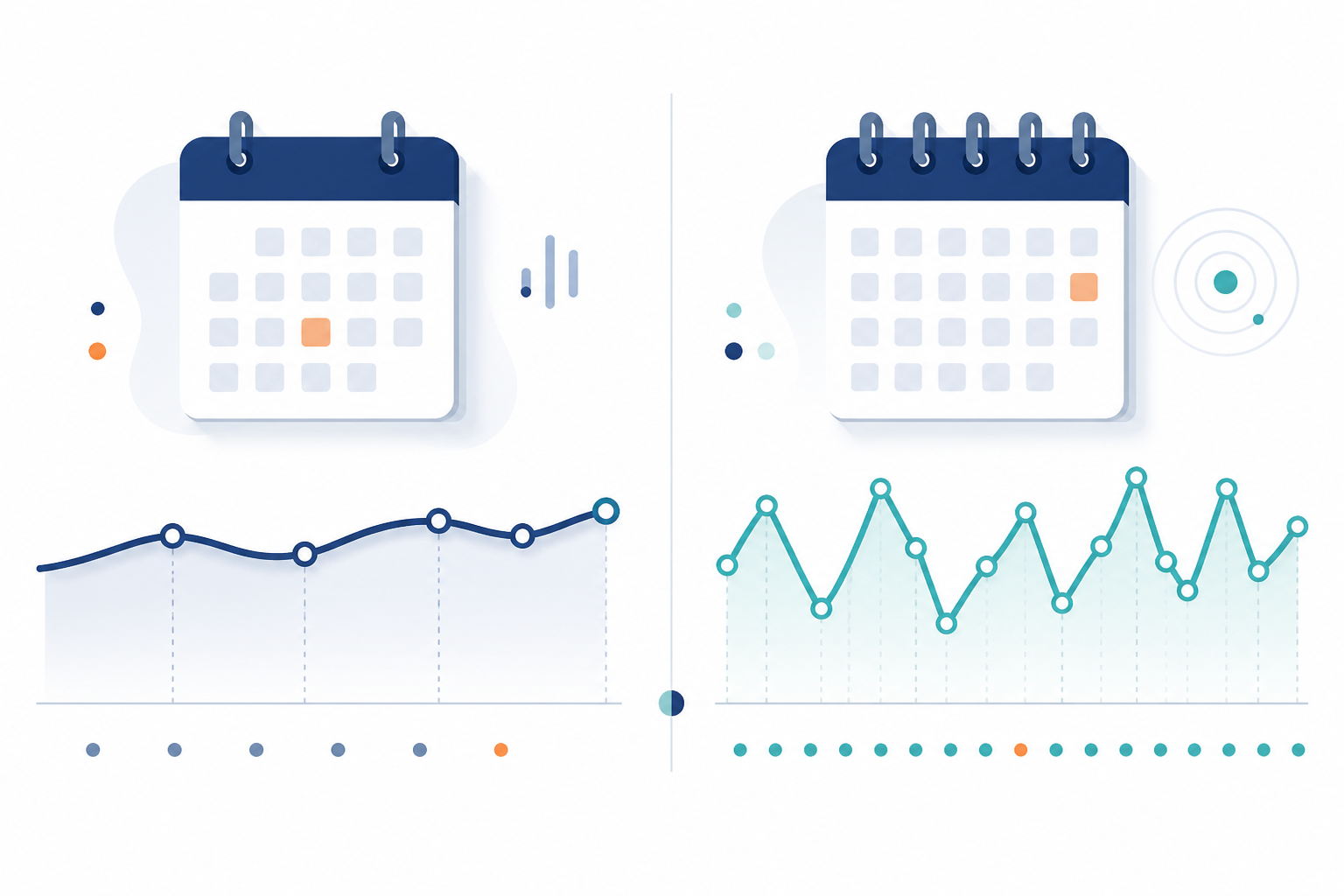
It's worth being precise about what actually changes when an agency moves from monthly SEO reporting to weekly AI visibility reporting. It's not just the delivery schedule. The two deliverables are built from fundamentally different data.
A monthly SEO report typically covers:
| Metric | Data source | Typical volatility |
|---|---|---|
| Keyword rankings | Search engine index positions | Low to moderate |
| Backlink growth | Link crawl databases | Low, gradual |
| Organic traffic | Analytics platforms | Seasonal, gradual |
| Conversions | Site analytics | Gradual, campaign-driven |
Weekly AI visibility reporting, by contrast, covers:
| Metric | Data source | Typical volatility |
|---|---|---|
| Visibility score movement | Repeated daily sampling of AI answers | High |
| Citation frequency by platform | AI query responses | High |
| Sentiment trend | Sentiment analysis of AI answers | Moderate to high |
| Share of voice versus named competitors | Query-level competitor mentions | High |
| Query-level wins and losses | Auto-generated customer questions | High |
The real distinction is the data source. SEO reporting draws from search engine index positions — a stable structure that search engines have spent years standardising. AI visibility reporting draws from sampled AI answers: actual responses generated by five different systems to real customer questions, recorded and analysed repeatedly over time.
There's no single index to check. Instead, agencies have to monitor the live, sometimes inconsistent output of models that may answer the same question differently depending on the day, phrasing, model version, location, or browsing context.
This is really the core argument for matching reporting cadence to how volatile the channel is, rather than just defaulting to whatever cadence worked for SEO. Monthly reporting made sense for search rankings because it roughly matched the pace of change there. Apply that same cadence to AI visibility and you can end up with both agency and client working from outdated information for most of the reporting period.
That said, this should stay an account-by-account decision. A client with low query volume, a stable niche, and no active AI optimisation work may genuinely be fine with monthly reporting. A client actively fighting for visibility in a fast-moving category is going to get more out of weekly reporting.
What should go into a weekly AI visibility digest?
Once an agency commits to a weekly cadence, the harder question is what actually belongs in the digest. A report crammed with every available metric can be worse than no report at all — it can overwhelm a client who doesn't have time to parse it, or get skimmed so fast the important signal gets lost.
Before I list the components, a few terms are worth defining. These concepts aren't fully standardised across the industry, so agencies should be upfront with clients about how each metric is calculated.
- Visibility score — A composite 0–100 metric. There's no single industry-standard formula for this. Whatever method an agency uses, it should explain the components — typically some blend of query coverage, position-weighted citations, share of voice, and mention frequency — how each is weighted, and what baseline the score is measured against. A 10-point move on one agency's model isn't necessarily comparable to a 10-point move on another's.
- Citation — An instance where an AI tool references or names the brand in its answer, with or without a link.
- Soft mention — An informal reference to the brand in a forum post, review site, or third-party article that an AI model may draw on without directly citing the brand.
- AI legibility — How easily an AI crawler can parse and accurately represent a website's content. Affected by structured data, page hierarchy, schema markup, and content clarity.
- Share of voice — The brand's citation frequency relative to named competitors across the same query set.
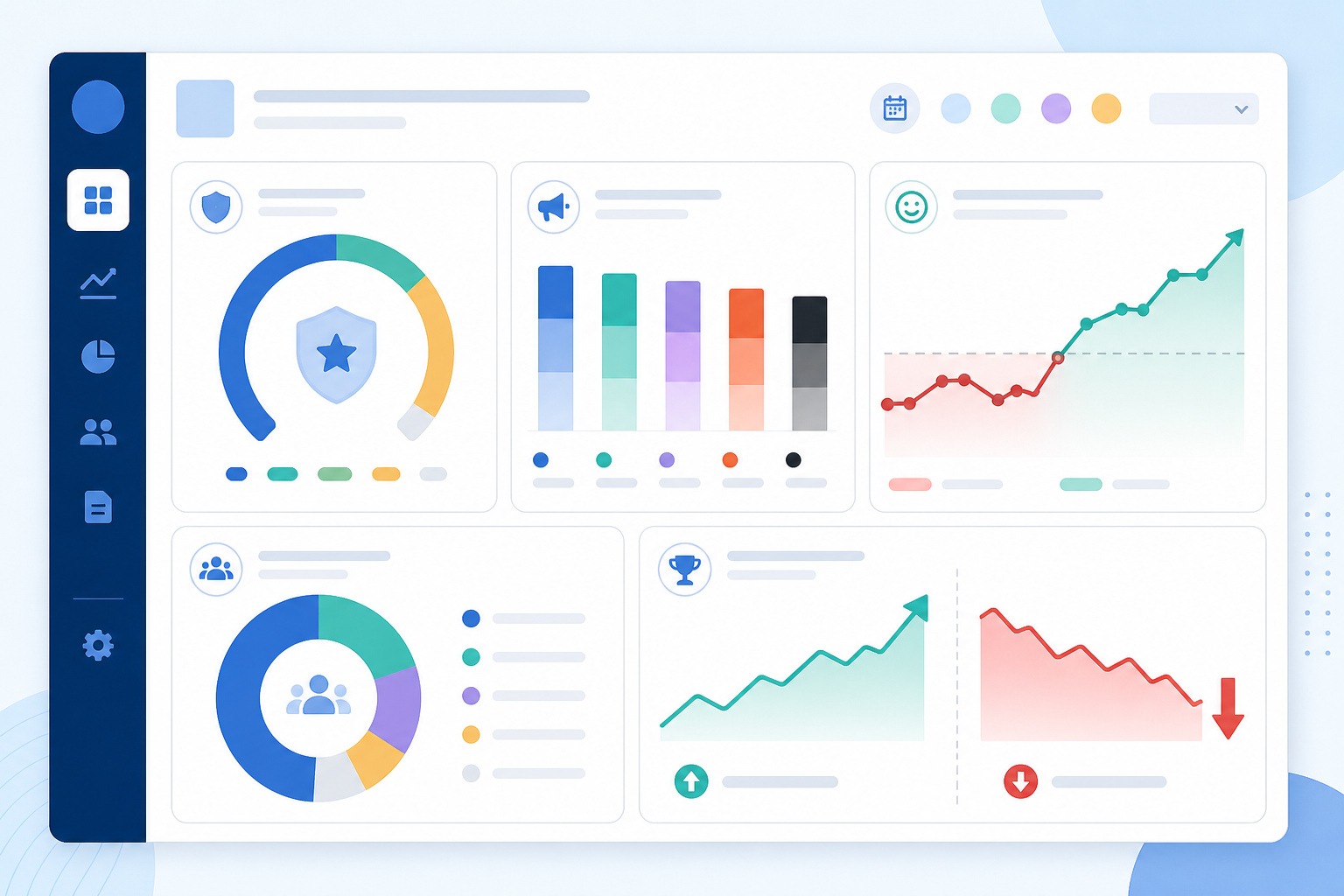
A useful weekly digest should include:
- Overall visibility score and its change from the previous week, alongside raw citation rate and query coverage numbers. A composite score is easier to trust when clients can see the raw components behind it.
- Citation breakdown across ChatGPT, Claude, Gemini, Copilot, and Perplexity, since a brand can gain ground on one platform while losing it on another in the same week.
- Sentiment analysis showing how the brand is described when it appears. A neutral or lukewarm citation next to a competitor's more favourable description is a different outcome than a strong, recommendation-style citation.
- Query-level detail showing which customer questions the brand answers well and which it's losing. This is where the digest turns from abstract scoring into something actionable.
- Competitor share-of-voice comparison across the same query set.
- AI legibility issues identified that week, such as structured data gaps or missing schema that may limit citation eligibility.
- A short written summary highlighting the biggest movements with a confidence-labelled explanation.
- A note on sample size and query consistency, so the client knows whether a movement is based on 10 queries or 100, and whether the same question set was used week over week.
Raw numbers, no matter how well organised, rarely justify a retainer fee on their own. Clients pay for interpretation as much as data. The written summary — delivered honestly, with proper qualification when the cause is uncertain — is where an analyst actually earns their keep, and what separates a genuine AI visibility service from an automated export.
How to highlight AI visibility wins, losses, and competitor movement
Once all the metrics are assembled, there's a real risk of producing a digest so dense the client's takeaway is confusion rather than clarity. Lead with the single biggest change of the week, positive or negative, instead of burying it mid-report.
If the visibility score dropped 15 points and a competitor's new comparison page is now being cited across three platforms for the same query, that's the opening line — not a footnote.
A simple traffic-light or arrow system helps:
- Green for query wins
- Red for query losses
- Amber for stable but watch-worthy movement
This lets a non-technical stakeholder scan the digest in under two minutes and still walk away understanding where things stand.
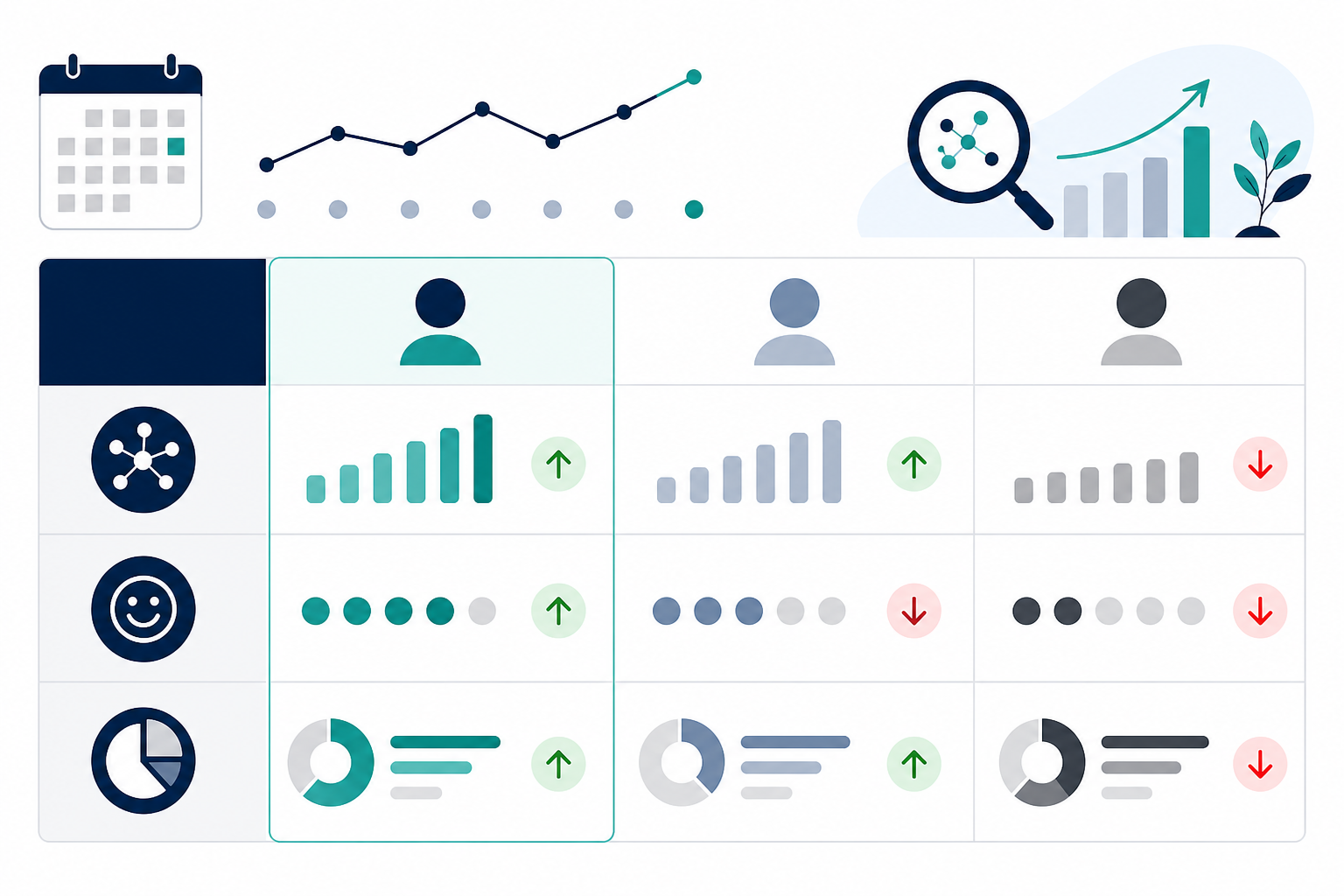
When a competitor gains ground, tie that gain to a plausible cause instead of leaving it hanging. But label how confident that explanation actually is — correlation and causation blur easily in this kind of reporting.
In my experience, competitor share-of-voice gains tend to line up with one of these triggers:
- New content published that directly addresses a customer question the brand hadn't covered — confirmed when the specific page can be identified and the timing lines up with the citation shift.
- A pricing page update that made cost information clearer or easier for AI crawlers to parse — likely if it coincides with the shift but hasn't been independently verified.
- An increase in soft mentions across forums, review sites, or third-party content — likely, since these are harder to trace precisely to a single source.
- Improved AI legibility on the competitor's website — unconfirmed unless you've actually audited their markup and site structure.
Treating every hypothesis as a confirmed cause risks handing clients a confident-sounding explanation that falls apart under scrutiny. It's more honest, and frankly more credible in the long run, to say "this is our best explanation based on timing" than to claim certainty you don't have.
Framed this way, losses become the starting point for a recommendation. "You lost visibility on this query" is informational. "You lost visibility on this query, a competitor published a detailed guide addressing it last Tuesday, the timing lines up with the change, and here's the content brief we recommend in response" is strategic.
That kind of proactive insight is what clients remember at renewal time — even when the causal link is presented as a strong hypothesis rather than a proven fact.
How to automate weekly AI visibility reporting
Manually running a modest set of customer questions against five AI platforms every day, then compiling sentiment and citation data into a weekly report, isn't a realistic workflow once you're serving more than one or two clients. If an analyst asks 20 customer questions across five platforms daily, that's 100 individual query-and-response checks per client, per day, before the analysis even starts.
Agencies typically close this gap one of three ways:
- Build an internal API-based workflow. An agency can use the APIs AI platforms make available, schedule queries, and log responses into a spreadsheet or database. This works at small scale, though it needs ongoing engineering maintenance and may not include sentiment analysis or scoring out of the box.
- Use an AI visibility monitoring platform. Specialist tools have popped up to automate query tracking, citation monitoring, competitor analysis, and reporting. Coverage, scoring methodology, and pricing vary a lot between them, so it's worth comparing carefully.
- Run a manual pilot. A short pilot for one client can help an agency understand the data before investing in tooling or rolling out a new service across the whole portfolio.
MentionOwl is one platform in this category — it's the one I've used directly, so I can speak to how it works. Agencies should still weigh it against alternatives rather than treat it as the only option.
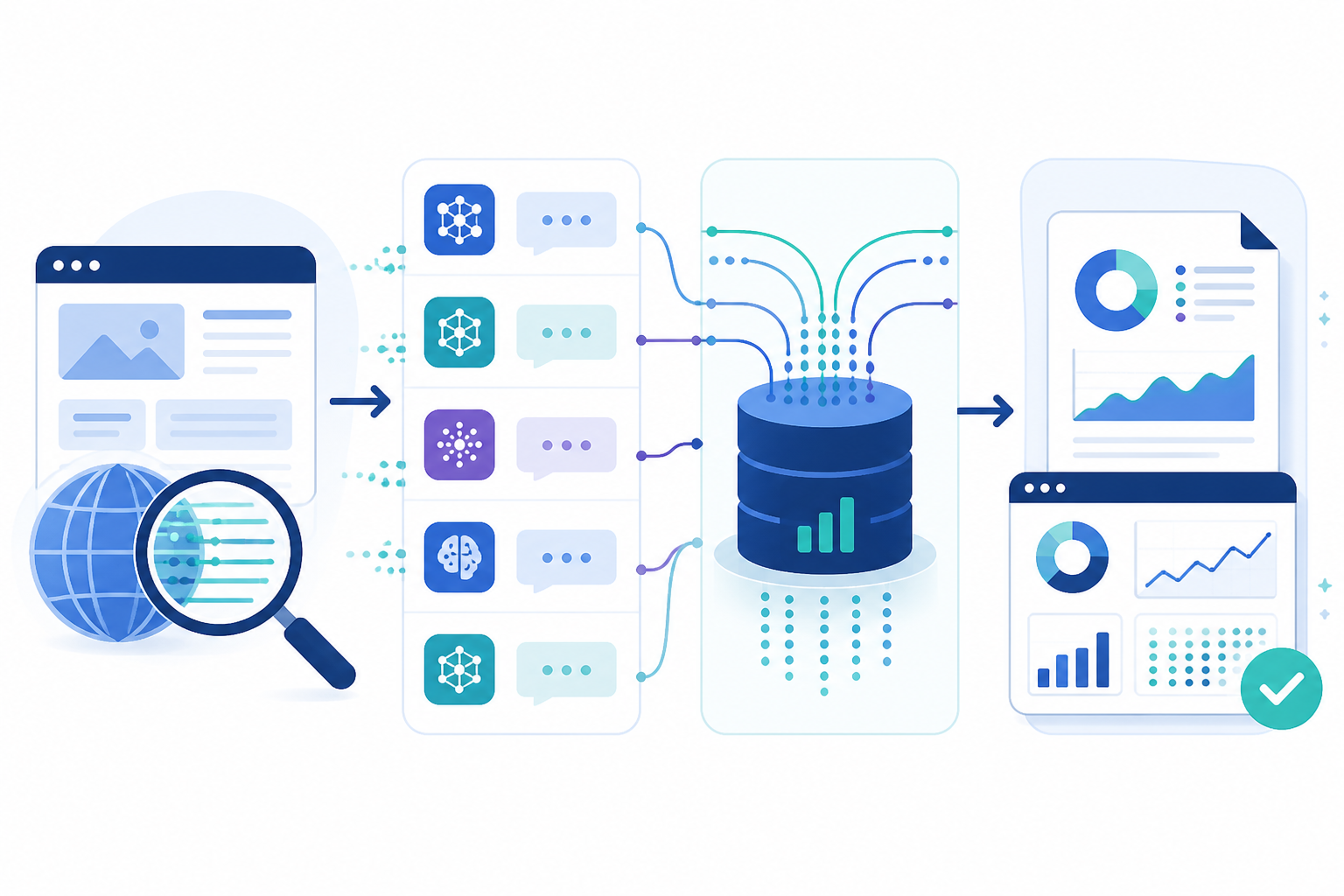
The platform crawls a client's website, generates likely customer questions based on that content, and runs them daily across five major AI platforms. Roughly, the workflow looks like:
- Website crawl — Indexes the site to identify products, services, and likely customer questions.
- Auto-generated query set — Builds a realistic set of purchase-decision questions.
- Daily query runs — Runs the questions against ChatGPT, Claude, Gemini, Copilot, and Perplexity.
- Data aggregation — Compiles citations, sentiment, competitor mentions, and visibility scores over time.
- Structured digest output — Compiles results into a weekly digest that can be white-labelled or accessed through a REST API.
Like any tool sampling live AI outputs, this workflow can't fully eliminate the variability I described earlier. A query asked twice may still return different answers, and an auto-generated question set won't perfectly match every customer's phrasing.
Agencies should judge platforms on how transparently they handle that variance, not just on how polished the dashboard looks. For agencies further along with AI-agent-driven workflows, MentionOwl also offers an MCP server for piping data directly into internal tools rather than relying on manual dashboard exports.
Whichever approach you pick, the value of automating data collection isn't just the time saved — though that's substantial on its own. It frees analysts up to focus on interpretation and strategy: the written summary, the confidence-labelled competitor analysis, the content recommendations.
Clients don't renew a retainer because an agency is good at running queries. They renew because the agency tells them what those queries mean and what to do next.
How to sell weekly AI visibility reporting as a premium retainer add-on
Agencies should resist quietly folding weekly AI visibility reporting into existing SEO retainers without a clear line item. It's distinct enough — in data source, cadence, and analyst time — to stand on its own as a deliverable rather than get absorbed into work the client's already paying for.
For the UK market, a starting range of roughly £150–£400 per client per month, excluding VAT, is a reasonable anchor. Where you land depends heavily on scope. A lower-tier offering might track one competitor and a fixed set of 10–15 queries with a templated summary. A higher-tier service might track multiple competitors, 30-plus queries, and include bespoke written analysis from a senior analyst every week.
Agencies should decide explicitly whether software and monitoring costs are included in the fee or billed separately, since tooling costs vary a lot. The pricing here is roughly in line with what agencies already charge for weekly PPC or social media reporting add-ons, so clients used to paying for weekly reporting elsewhere shouldn't find it unfamiliar.
There's also a case for bundling the digest into a higher-tier AI visibility retainer alongside AI legibility audits and ongoing competitor tracking. This can justify a bigger overall retainer increase than itemising every piece separately, since it frames the service as a full programme rather than a menu of small add-ons.
For agencies wanting to test the offer before a full rollout, a short trial with one client account is a sensible starting point. It lets the agency see how the data behaves week to week and how the client responds, before deciding whether to roll it out across the portfolio. MentionOwl, for instance, currently offers a $1 seven-day trial — one low-cost way to test that particular tool.
Frequently asked questions about AI visibility reporting
How is weekly AI visibility reporting different from a monthly SEO report?
The core difference is the data source and how it needs to be sampled, not just the delivery schedule. SEO reporting draws from a relatively stable search index. AI visibility reporting draws from live model outputs that can vary with phrasing, timing, model version, and sampling randomness.
A single query on a single day tells you very little. You need repeated sampling across a consistent query set to spot a reliable trend. Based on my own monitoring of a small set of UK client accounts over several months, composite visibility scores have moved by 10–20 points week over week. Treat this as an illustrative observation rather than a universal benchmark — volatility varies by industry, query volume, and scoring methodology.
Does every client need weekly AI visibility reporting?
No. Weekly digests make the most sense for accounts with meaningful query volume, active AI optimisation work, or a competitive category where visibility is contested week to week.
A smaller account with limited query volume and no active optimisation work may be perfectly well served by monthly reporting. An agency could also monitor the account quietly in the background and only produce a digest when something notable happens. The decision should come down to business risk and query volume, not a blanket policy.
What should go into a weekly AI visibility digest?
At minimum: the visibility score and its week-over-week change, raw citation rate, query coverage, citation breakdown by AI platform, sentiment shifts, query-level wins and losses, competitor share of voice, and a short written summary.
The summary should include confidence-labelled explanations for the biggest movements. Since there's no standardised industry formula for a visibility score, agencies should also explain how the score is calculated and what sample size it's based on each week.
Can weekly AI visibility reporting be automated?
Yes. Manually building a report across five AI platforms isn't sustainable past a client or two. Options range from a custom API-based workflow, to specialist AI visibility monitoring platforms like MentionOwl, to a manual pilot period before committing to a tool.
Automation cuts down the effort of collecting and organising data, but it doesn't eliminate variability in AI-generated answers. Its main benefit is making consistent sampling and trend-tracking easier over time.
How should agencies price AI visibility reporting as an add-on?
For the UK market, £150–£400 per client per month, excluding VAT, is a reasonable starting range. Price should scale with query volume, number of competitors tracked, reporting frequency, and whether the summary is templated or bespoke.
Be upfront with clients about whether the fee includes software costs or covers analyst time only. Some agencies bundle weekly AI visibility reporting into a higher-tier retainer instead of itemising it, which can reduce line-item pushback while still justifying a bigger overall increase.