Sentiment Matters: Why Being Mentioned by AI Isn't Enough for Agency Clients
AI brand mentions aren’t enough: learn how sentiment shapes recommendations, monitor negative or outdated claims, and improve how AI frames your brand.

The central lesson of Sentiment Matters: Why Being Mentioned by AI Isn't Enough is simple: a mention in an AI answer only counts as a win if the framing is favourable. A lukewarm "it's an option, but reviewers cite poor support" can do more damage than silence, because it reaches a buyer at the moment of decision and may plant a doubt. For agencies, the practical response has four parts: track sentiment alongside AI visibility and share of voice, trace negative or outdated claims back to the sources models draw on, fix those sources, and re-measure daily to confirm the framing has actually shifted.
I spend much of my working week inside monitoring data, and the pattern I see most often is this: a client's report shows healthy mention counts, everyone relaxes, and nobody reads the answers closely enough to notice that the brand is being described as the cautious second choice. This article sets out how to close that gap. 🦉
Sentiment Matters: Why Being Mentioned by AI Isn't Enough
Take the same client appearing in two AI answers to two different buyer questions. These are illustrative examples, not recorded outputs.
- Answer A: "For small teams, Brand X is the top choice thanks to its straightforward onboarding and responsive support."
- Answer B: "Brand X is a budget option, though reviewers note limited support and mixed experiences with reliability."
Both answers register as one mention and, if a source is linked, one citation. A report that counts them equally tells the client they were "mentioned twice", which is accurate and almost useless. The first answer is far more likely to generate an enquiry. The second may send the reader to a competitor and leave a lasting doubt about the client.
Why AI mention counts can flatter a caveated brand
Mention and citation counts measure presence, not persuasion. Pew Research Center's 2025 analysis of US browsing data (900 adults, March 2025) found that users clicked a traditional search result in 8% of visits when a Google AI summary appeared, against 15% when none did. Only about 1% of visits with a summary included a click on a source link within it. That study concerns search behaviour rather than sentiment or purchasing, so I would not stretch it further than it goes. What it does show is that when the answer itself absorbs much of the reader's attention, the wording of the answer deserves at least as much scrutiny as whether a link sits beneath it.
The measurement guidance I give agencies follows from this. Classify the sentiment, the strength of recommendation, the stated rationale and the cited sources separately, rather than relying on a single mention tally. Treating "recommended because it fits the stated criteria", "mentioned as one option" and "mentioned with a limitation" as equivalent overstates recommendation strength.
Measure AI visibility and sentiment separately
Absence is a visibility result, not a sentiment result, so I record the two things separately. First, log whether the brand appears in the answer at all. Then, for every answer where it does, score the framing on a four-point scale running from least to most favourable:
- Negative mention: named as something to avoid or as clearly inferior.
- Caveated mention: named, but with a qualification such as limited support, narrow fit or mixed reviews.
- Neutral listing: named among several options with no preference expressed.
- Strong recommendation: named as the best or leading fit for the stated need.
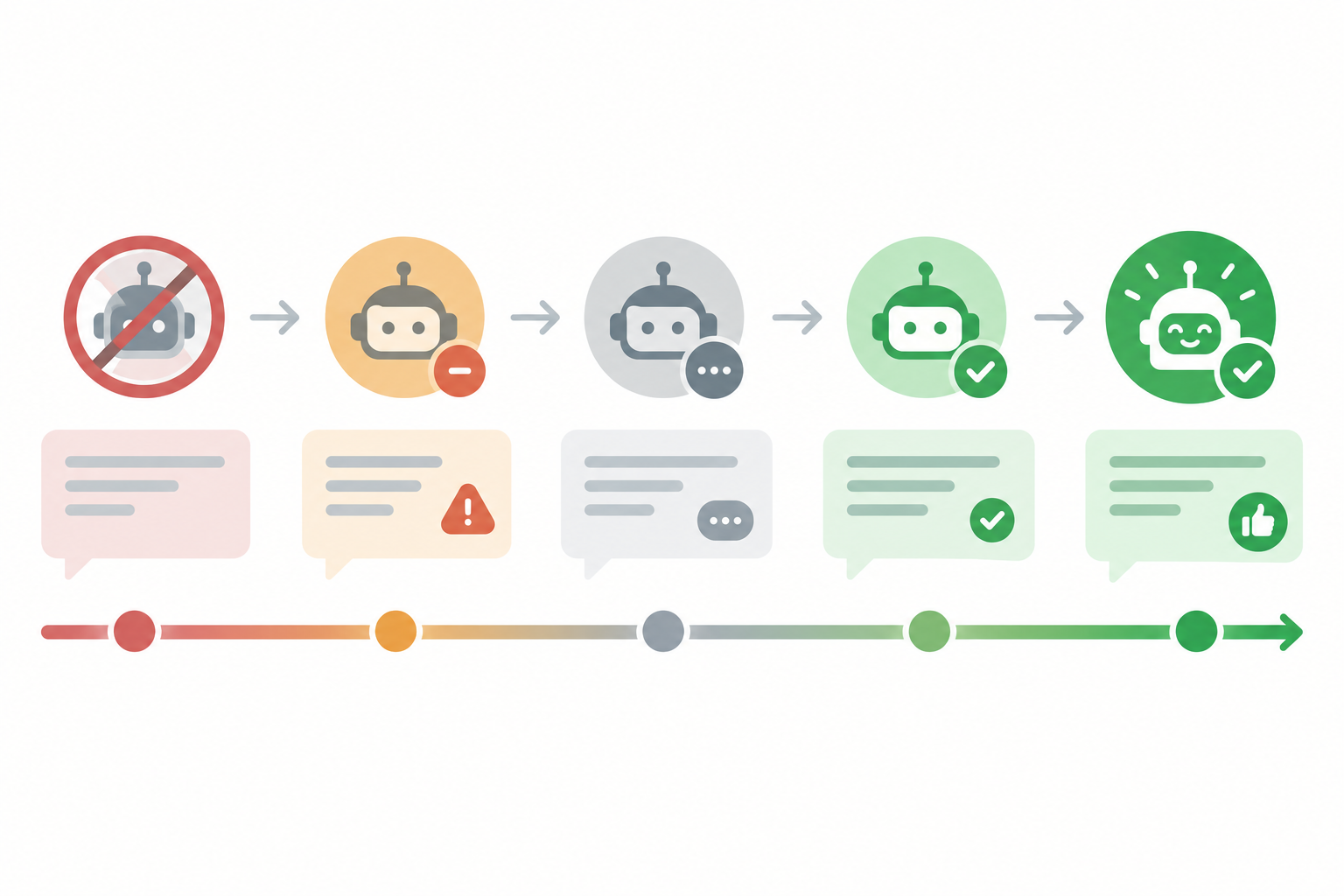
The visual above places "absent" at the far left as the visibility baseline. The four framing labels then follow in the same negative-to-positive order as the written scale.
Sentiment does not replace the other components of an AI visibility measure. Query coverage, position-weighted citations, share of voice and soft mentions each describe something different, and sentiment is the qualifier that tells you whether those other numbers are good news. A high visibility score should always be checked against the tone behind it.
The business case for AI sentiment tracking for UK agencies
Purchase-decision queries such as "best accounting software for a small UK business" or "is [brand] worth it" are where framing is most likely to influence an enquiry. I want to be precise about the evidence here. I am not aware of robust, UK-specific research that isolates how AI answer framing changes conversion, and I would be wary of any agency that claims otherwise. What I can offer is a working hypothesis: a hedge in a recommendation may cost the client consideration at the shortlisting stage. That hypothesis should be tested against the client's own enquiry data, not assumed.
Testing it is a practical recommendation in its own right. Ask new enquirers how they found the brand, track referrals from AI platforms where analytics allow, and compare enquiry quality before and after framing improves. Over a few quarters, a client's own numbers will say more than any general benchmark.
How AI frames pros and cons: reading recommendation sentiment
The difference between a win and a loss is often a handful of words. Reliable AI sentiment analysis depends on training yourself and your analysts to read that language consistently.
| Signal | Typical phrases | Likely effect on a buyer |
|---|---|---|
| Strong endorsement | "best for", "consistently praised", "the go-to choice", "stands out for" | May build confidence and support shortlisting |
| Neutral description | "offers", "provides", "is available in" | Informs without persuading |
| Hedged language | "can be", "some users report", "may not suit", "however" | May introduce doubt and invite comparison |
| Explicit warning | "frequent complaints about", "reviewers cite poor support" | Likely to deter and prompt a search for alternatives |
The "likely effect" column reflects a reasonable reading of the wording, not measured buyer behaviour, so treat it as a coding aid.
Three AI answer framing patterns worth tracking
- The "lead with a competitor" pattern: the answer opens with a rival and mentions the client afterwards, often as an alternative. First position plausibly carries extra weight.
- The "pros then deal-breaker" pattern: several genuine strengths are followed by a single serious caveat, and readers may weigh that caveat heavily.
- The "category-fit" pattern: the brand is recommended only for a narrow use case, such as "suited to very small teams". This can quietly exclude the client from the larger segment they want to win.
Position, order and length in AI answers
Where a mention sits matters. A brand named first, with two or three sentences of description, is likely to carry more weight than one tucked into the last line of a long list. That is why I favour position-weighted citations over a flat count, and why I would never report "appeared in 40 answers" without saying where.
Why AI soft mentions need sentiment scoring too
A soft mention, where a brand is referenced by name without a link, is easy to dismiss because it generates no referral. Yet it still shapes how the brand is described, and a negative soft mention is invisible to any tool that only tracks URLs. Score soft mentions on the same scale.
Why AI sentiment monitoring should cover multiple platforms
The same brand can be framed warmly by one assistant and cautiously by another, because each draws on different retrieval methods, sources and training data. OpenAI notes, for example, that ChatGPT search responses may include inline citations and that the cited material can depend on the query and the search process. Spot-checking a single tool tells you very little. Real AI monitoring means covering ChatGPT, Claude, Gemini, Copilot and Perplexity consistently.
Compare AI sentiment with competitors
A caveat only means something relative to what is said about the alternatives. If every brand in the answer carries a hedge, the client is not losing the framing contest. If rivals receive clean endorsements while the client is qualified, they are. Tracking competitors within the same recorded answer turns an isolated observation into a comparative judgement.
How to spot negative, outdated or inaccurate AI claims
Clients should not learn about a damaging AI claim from a prospect or a colleague. A repeatable monitoring process lets you find it first.
- Build a question set that mirrors real decisions. Cover comparison ("X vs Y"), pricing, reliability, support and "alternatives to" questions, not just brand-name searches. The caveats tend to live in the questions buyers ask when they are weighing options.
- Run the questions daily across multiple platforms. Answers are probabilistic, so a single snapshot is unreliable, and daily runs give you a distribution rather than an anecdote.
- Record everything. Keep the full answer text, citations, sentiment label and competitor mentions, along with the exact prompt, the AI product and the date, so any claim can be audited later.
- Flag recurring claims. Separate one-off phrasing variance from patterns that appear across runs and platforms. A claim that appears in one answer in thirty is probably noise; one that appears in a third of runs is a finding.
- Classify each issue as inaccurate, outdated, accurate-but-unflattering, or missing context. Each demands a different response, which I cover below.
- Prioritise by importance and frequency. Agree a simple severity matrix with the client: a recurring caveat on a high-intent comparison query outranks an odd phrase on a rare question.
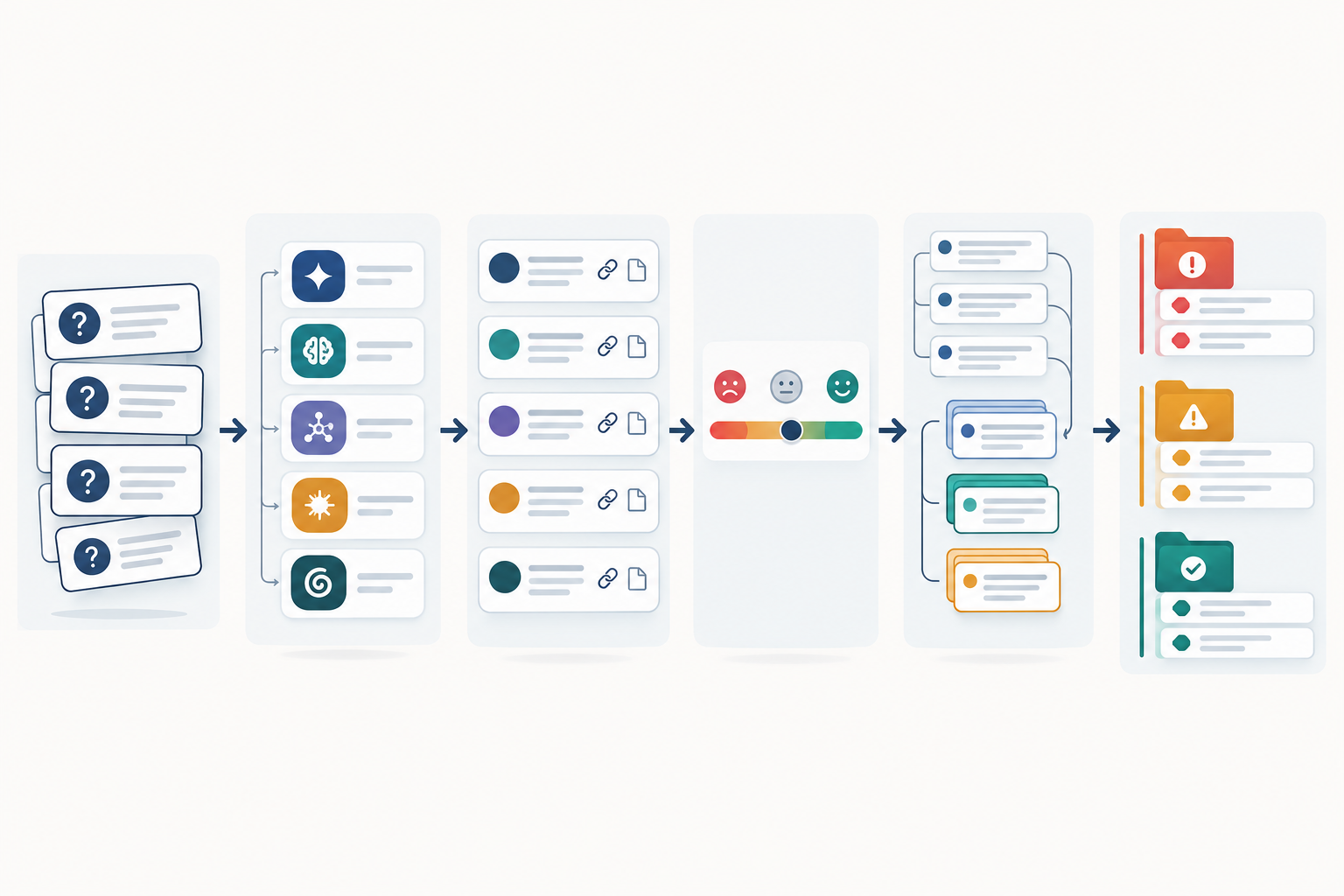
Where AI sentiment monitoring automation helps agencies
Step one is where agencies running many accounts lose the most time, and it is where tooling earns its place. As one example, MentionOwl crawls a client's website and auto-generates relevant customer questions, then runs them daily against the major AI platforms, recording answers, citations, sentiment and competitor mentions. That removes the manual drafting and daily copy-and-paste, so analyst time goes to steps four to six, where judgement matters. Its trial costs $1 for seven days, which makes it easy to test on a single account. Whatever you use, the same principles apply: consistent prompts, daily runs and a full audit trail.
Where AI sentiment comes from: the sources behind the framing
I want to be candid before listing sources: nobody can see inside a model. Tying a sentiment to a source is an inference drawn from citations and pattern analysis, not proof. With that caveat, these are the places I look first.
- Training data and its lag. Models may repeat pricing, features or controversies from years ago, which explains many "outdated" claims that no current page supports.
- Live retrieval and citations. Perplexity, Copilot and search-enabled ChatGPT draw on current web pages. Google describes its AI search features as using query fan-out, issuing related searches to find supporting material, and showing links to sources. The cited URLs are the fastest lead for diagnosis, because they show what the answer was built from.
- Third-party content. Review sites, forums, Reddit threads, news coverage and comparison articles often carry as much weight as a brand's own copy. A favourable brand page sitting beside critical independent coverage can produce exactly the mixed, qualified account that worries clients.
- The brand's own site. Where content is unclear, inconsistent or hard to parse, models may fill the gaps with other people's opinions.
- Machine legibility. Structured data, clear product and pricing pages and crawlability all affect whether a model reads a site correctly. A technical audit will often reveal why a site is being misread, such as pricing buried in an image or a key page blocked from crawlers.
During a source audit, it helps to separate owned content from independent coverage and customer feedback. A glowing case study on a client's site is different evidence from a detailed independent review, and each shapes the generated description in its own way.
Reviews deserve particular attention. BrightLocal's 2024 consumer survey found that 91% of US consumers said local business reviews influence their general perceptions of businesses. That is a self-reported view about local businesses, not a measurement of AI sentiment, and it does not show that replying to reviews changes how a model describes a brand. It does suggest that review content is part of the evidence pool you need to audit.
How AI sentiment is measured, and what the numbers cannot tell you
Sentiment analysis classifies each recorded answer, typically as positive, neutral, mixed or negative, and it should be scoped to the brand in question rather than to the answer as a whole. An answer can be broadly upbeat about a category while being cool about your client, and a whole-answer score would hide that.
For the same reason, scoring at the claim level beats scoring at the answer level. Where an answer praises one feature and criticises another, a single label forces a false compromise. Recording "praised for onboarding, criticised for support" as two claims gives you something you can act on.
Variance is the other discipline. The same prompt can return different answers, so I treat any single run as one draw from a distribution. Reporting should describe the share of sampled answers that recommend the client, the share that include caveats and the common reasons given, rather than implying certainty from a handful of outputs.
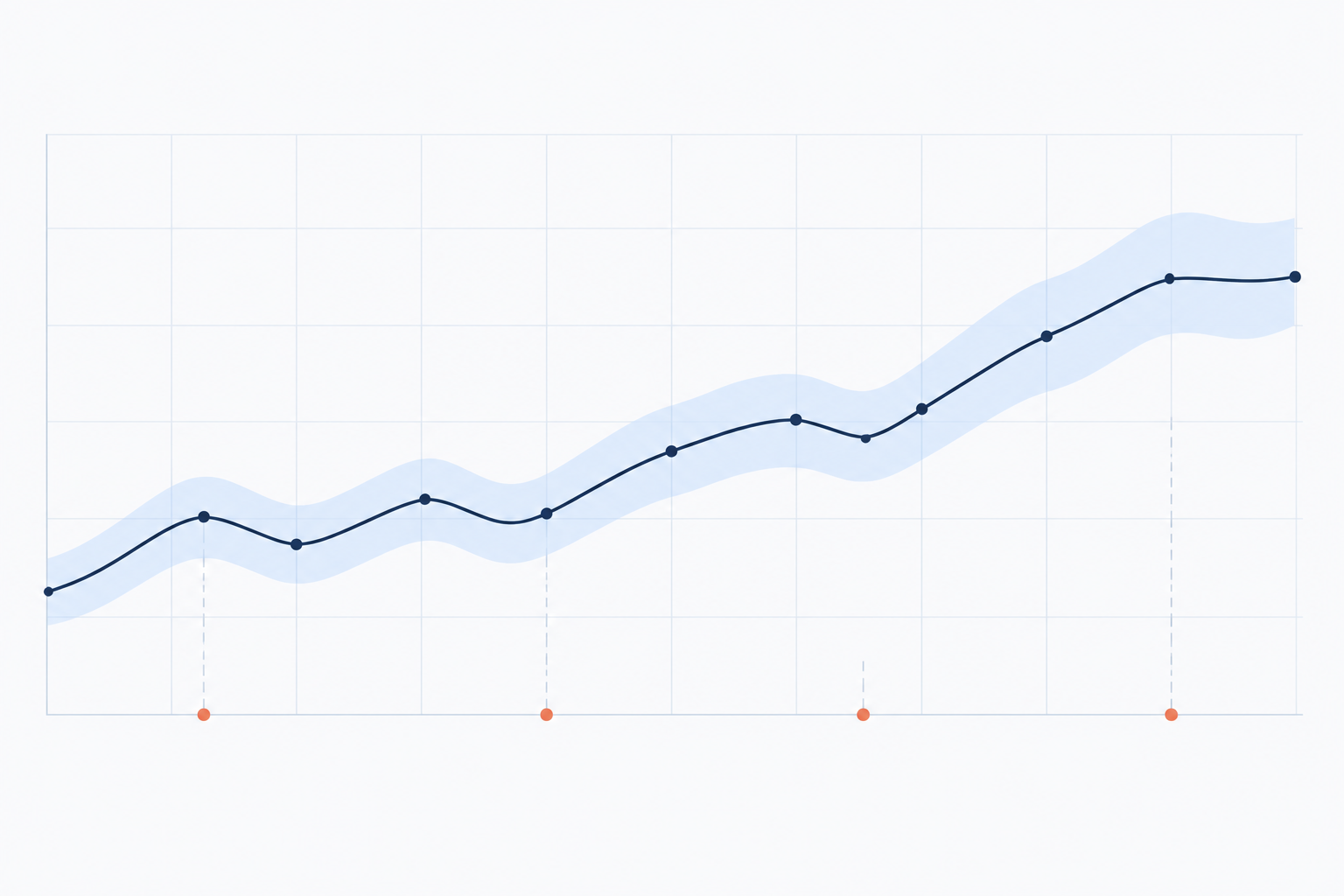
Three practices keep the numbers honest:
- Read sentiment alongside share of voice and position-weighted citations. A positive tone on a rarely seen mention is a weaker result than a mixed tone on a dominant one.
- Validate automated labels with periodic human spot-checks. Review a sample each month, record agreement rates and document the method so clients can see how the figures are produced.
- Resist over-precision. A shift of a few points is not necessarily a meaningful change, and I would not tell a client that sentiment "improved" until the movement exceeds the normal run-to-run band.
How to improve AI sentiment over time: a practical agency playbook
- Fix what you control first. Update product, pricing, FAQ and comparison pages so the facts are current, specific and easy for models to extract. Many outdated claims persist simply because nothing current and clear contradicts them.
- Answer the objection with evidence. If the caveat is support, publish response times. If it is security, publish documentation or independent certifications. If it is results, publish case studies with real figures.
- Work the third-party layer, and keep it honest. Refresh listings, respond to reviews, pursue accurate coverage and request corrections on frequently cited sites. In the UK, the Digital Markets, Competition and Consumers Act 2024 prohibits fake reviews and requires businesses that publish reviews to take reasonable steps to prevent them, with the Competition and Markets Authority empowered to enforce; the relevant provisions took effect in April 2025. In the US, the FTC's Consumer Reviews and Testimonials Rule (effective October 2024) takes a similar line, and its earlier case against Fashion Nova, which ended in a $4.2 million payment over suppressed negative reviews, shows that visible reviews are not always a reliable proxy for real sentiment. Authentic feedback and transparent responses are the only durable route, and clients should take their own legal advice where in doubt.
- Answer the exact questions where the brand is caveated. Content that directly addresses "is it worth it" and comparison queries is the core of generative engine optimization and AI SEO. Write it plainly, with the evidence on the page.
- Use competitor tracking to find credible ground. See which attributes rivals are praised for and where the client can honestly claim an advantage.
- Re-measure daily, review weekly, and log every intervention. Recording each change alongside subsequent sentiment movement lets you evaluate whether the two are associated and whether the intervention plausibly contributed. Monitoring cannot prove causation, so report it as evidence, including the cases where nothing moved.
- Set realistic expectations. Changes in AI answers can take weeks, retrieval-based platforms tend to respond faster than those leaning on training data, and some influences sit outside any agency's control.
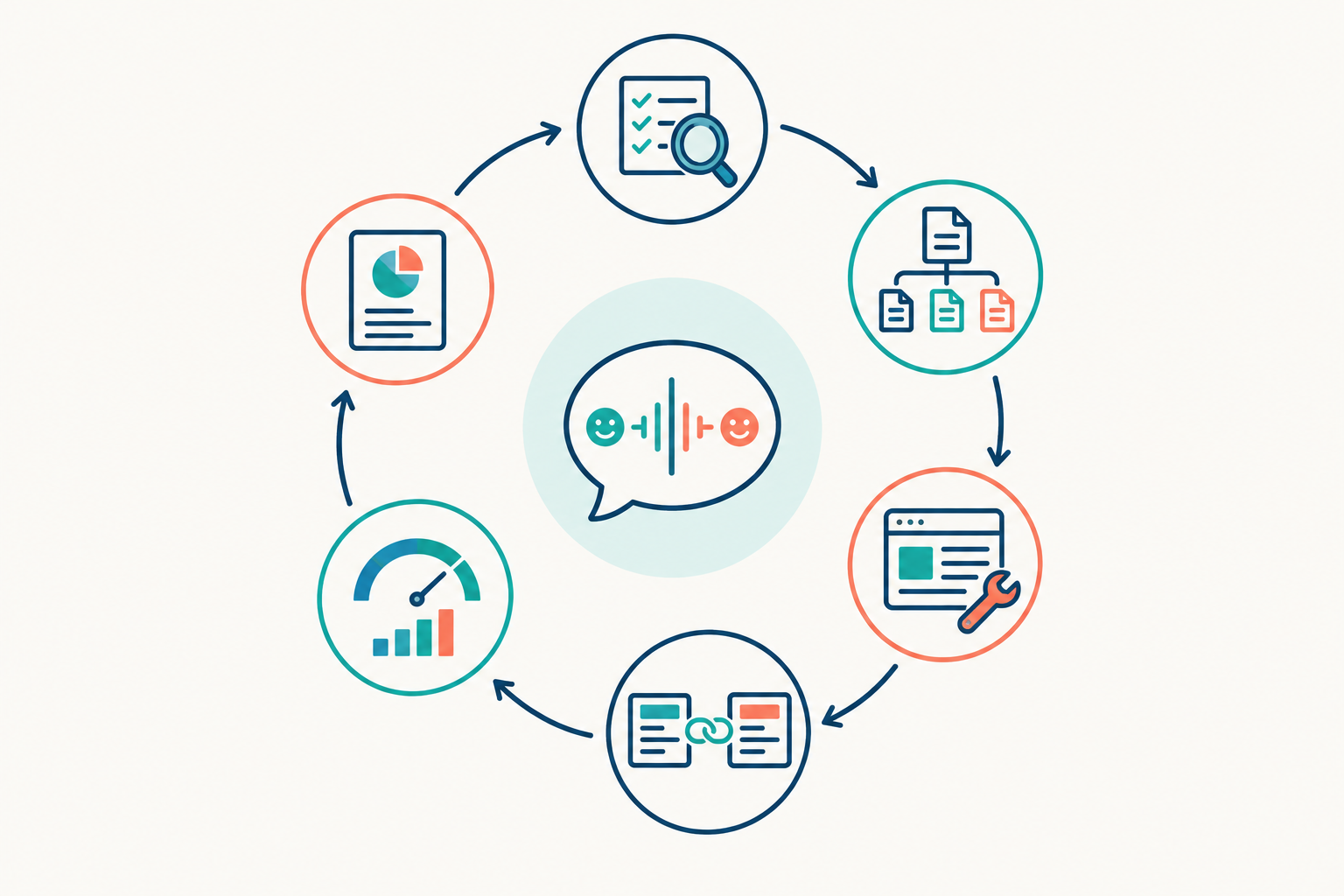
Reporting AI sentiment to clients: turning a nuanced metric into a clear story
Sentiment is harder to summarise than a count, which makes presentation matter.
- Lead with the framing examples. A quoted AI answer is more persuasive than any score, and it makes the stakes immediately clear.
- Pair the overall visibility score with a sentiment breakdown and a short list of top issues and wins.
- Use weekly digests for ongoing visibility and a quarterly review for strategic decisions, such as where to invest in content or third-party outreach.
- Connect sentiment to outcomes cautiously. AI referral traffic can be measured where analytics allow, but attribution has limits and you should say so.
- Feed existing workflows. If your monitoring tool offers an API, pulling the data into your own dashboards makes reporting across many clients far less laborious.
Frequently asked questions about AI brand sentiment
What if AI says something negative about my brand?
First establish whether the claim is inaccurate, outdated or simply an unflattering but fair opinion, and check whether it recurs across runs and platforms. Inaccurate or outdated claims can usually be traced to cited sources and corrected at source. Fair criticism is better addressed through genuine improvements and clear, evidence-backed content.
Can I correct wrong information in AI answers?
You cannot edit a model's answer directly, but you can influence it. Update your own pages, correct third-party listings and articles that get cited, and publish clear, structured content that addresses the question. Platforms with live retrieval tend to respond faster than those relying mainly on training data, and results are never guaranteed.
How is AI sentiment measured?
Each recorded AI answer is analysed for how the brand is described, then labelled as positive, neutral, mixed or negative, ideally at the claim level. Because answers vary between runs, the useful signal is the trend across many queries and platforms over time, ideally validated with periodic human review.
Is a neutral AI mention good enough?
Neutral is better than absence, but on purchase-decision queries it may not win the click when a competitor receives an explicit recommendation. Treat neutral as an opportunity to improve the framing, not a finished result.
The takeaway: AI visibility needs sentiment context
Visibility tells you whether a brand is in the conversation; sentiment tells you whether it is winning it. Record presence and framing separately, read the language of each answer, trace recurring claims to their sources, fix what you can verify, and judge progress against the normal run-to-run variation rather than a single result. Agencies that do this can show clients where the framing is working and where it needs attention, instead of offering false comfort from a mention count. 📊