How Agencies Can Monitor Client Brand Mentions Across AI Search Platforms: A Practical Guide
Learn how agencies can build AI brand monitoring into client services, track mentions across AI search platforms, and turn changing answers into usefu
AI Brand Monitoring for Agencies: How to Track Client Mentions Across AI Search Platforms
Here's the workflow I recommend to every agency that asks me about AI brand monitoring: build a representative prompt set from real customer language, run it consistently across the AI search platforms that matter for that client's category, and convert the results into caveated, client-ready actions rather than raw scores. That's the whole operational answer, and the rest of this piece unpacks each of those three steps in enough detail that you could implement them next week rather than next quarter.
I've spent a fair amount of time recently pulling apart how agencies actually operationalise AI brand monitoring, and the honest answer is that most teams are still doing it manually — typing questions into ChatGPT one at a time, screenshotting the answer, and hoping nobody asks about Perplexity. That gap is closing. The agencies that build a repeatable process now will be answering client questions with data rather than guesswork the next time someone asks, "Why does it keep recommending [competitor]?"
Why UK clients are starting to ask about AI brand mentions
The shift in how people research purchases isn't theoretical, though I want to be careful about which numbers are UK-specific and which aren't, because most of the robust data currently available is US-led.
Pew Research Center published a study in March 2025 examining Google search behaviour among a panel of US adults, finding that AI Overviews appeared in 18% of the sampled queries, and that users clicked through to a traditional web result in just 8% of those AI-Overview visits, compared with 15% on searches without an AI summary present (Pew Research Center, "Google users are less likely to click on links when an AI summary appears in the results,” March 2025 — search this exact title on pewresearch.org, as Pew's URLs restructure over time). That's roughly a halving of click-through behaviour whenever an AI-generated answer sits above the fold. It's a single study, on a US sample, at one point in time, so treat it as a strong directional signal rather than a UK constant — but the direction matters, because it describes exactly the mechanism by which a brand can lose visibility invisibly.
Gartner's public commentary, cited widely since 2024 (Gartner press release, "Gartner Predicts Search Engine Volume Will Drop 25% by 2026 Due to AI Chatbots and Other Virtual Agents"), forecasts that traditional search engine volume could fall 25% by 2026 as generative AI tools absorb query volume. This is a forecast, not a measured outcome, and Gartner itself frames it as a prediction rather than an observed trend — I'd cite it as context for why agencies are moving now, not as evidence of where things already stand.
On actual measured behaviour, Adobe Analytics' 2024 US holiday shopping data (Adobe, "Adobe Analytics: US Online Holiday Shopping Set to Reach New Heights,” November 2024) found generative-AI referral traffic to US retail sites rose more than 1,000% year-over-year during that period, with those visitors browsing more pages per session than visitors from most other referral sources. That's concrete, but it's US retail traffic, not UK, and not necessarily representative of other sectors like B2B services, finance or healthcare.
The UK-specific evidence is thinner than I'd like, and I think it's more honest to say that plainly than to paper over it with a vague Ofcom mention. Ofcom's Online Nation report tracks UK adult internet behaviour annually, and its most recent published editions have shown a rising share of UK adults reporting at least occasional generative AI chatbot use — but because Ofcom updates this report on its own cycle and revises methodology between waves, I'd point you to Ofcom's current Online Nation release directly (ofcom.org.uk, search "Online Nation") rather than repeat a number here that may already be out of date by the time you're reading this. What I can say with more confidence, from working with UK agencies directly, is that client-side questions about AI visibility have gone from essentially zero eighteen months ago to a recurring theme in new-business pitches and quarterly reviews across the accounts I've been close to — that's a qualitative observation from direct client work, not a survey finding, and I'm flagging it as such.
What this means practically is that clients are starting to notice something unsettling before you've had the chance to raise it yourself. They ask ChatGPT or Perplexity a question about their own category, and a competitor's name comes back instead of theirs. Account teams I've worked alongside have had this exact scenario raised in client meetings with no answer prepared, and that's an uncomfortable position to be in with a paying client.
The reassuring part is that this isn't a separate discipline you need to sell clients on from scratch. It's a natural extension of the SEO and PR reporting conversations you're already having. Clients understand visibility, sentiment and share of voice conceptually — AI brand monitoring applies those same concepts to a new set of AI search platforms. Google's own Search Liaison team has stated publicly that foundational SEO practices — crawlability, structured data, authoritative third-party references — remain relevant inputs to how AI systems select and cite sources (Google Search Central Blog, "AI features in Search," blog.google/products/search), which means you're extending an existing service line rather than inventing a new one.
The risk cuts the other way too. If you don't raise AI search visibility with a client, another agency pitching against you probably will, and it can meaningfully differentiate a pitch — particularly when the competing agency hasn't thought to bring it up at all.
Which AI search platforms should agencies track for clients?
Single-platform monitoring gives an incomplete, sometimes misleading, picture of AI visibility, because each platform sources, weights and cites information differently. A brand can rank well in ChatGPT's answers while being nearly absent from Perplexity's citation list, or vice versa. Before I get to specific platforms, a caveat on the user figures below: these come from different companies, measured over different time windows (weekly versus monthly active users), self-reported in press releases rather than audited third-party data, and they are not directly comparable to each other. I'm including them for scale context only, not as a ranking.
| Platform | Reported users | Metric type | Date | Source |
|---|---|---|---|---|
| ChatGPT | 400M+ | Weekly active users | Feb 2025 | OpenAI, company statement |
| Gemini Apps | 400M+ | Monthly active users | May 2025 | Google, I/O 2025 keynote |
| Microsoft Copilot | 100M+ | Monthly active users | 2024 | Microsoft, company statement |
| Perplexity | Not directly comparable — no consistent MAU/WAU disclosure | — | — | — |
| Claude | Not directly comparable — no consistent MAU/WAU disclosure | — | — | — |
- ChatGPT (including Search mode) — Highest priority for most consumer-facing UK clients given its user base. Distinguish standard ChatGPT responses from Search-enabled responses in your testing, since only the latter reliably reflects web discoverability and citation behaviour. Set location to UK/en-GB in account settings where available.
- Perplexity — Built around citation-heavy answer synthesis with visible source links, which makes it the easiest platform to audit for citation accuracy: you can see exactly which pages get cited and check whether those citations actually support the claims made. If a client wants to know "who is the internet pointing to on this topic," Perplexity usually gives the clearest signal.
- Google Gemini — Distinct from Google's AI Overviews and AI Mode within Search itself; test these as separate surfaces, not one product, given Google's dominance in UK search behaviour.
- Microsoft Copilot — Matters disproportionately for B2B and enterprise clients whose buyers work inside Microsoft 365 and Windows environments. Its source selection can diverge meaningfully from Google and ChatGPT.
- Claude — Smaller consumer share, but growing use in professional research and analysis contexts. I'd include it selectively, where a client's audience skews toward research-heavy or technical decision-making, rather than as a universal default.
Agencies that only check ChatGPT are reporting a fraction of the picture. Genuine AI share-of-voice measurement means testing the same prompt set across all five surfaces, because a competitor might dominate Perplexity's citations while being nearly invisible on Copilot.
A practical note on UK-specific testing: setting a platform to "UK/en-GB" is not one switch. Depending on the platform, it can mean the account's registered region, the browser or device's language and locale settings, a UK-based IP address (relevant if you're running automation from a US-hosted server), whether the session is logged in or anonymous, and even which app store the mobile app was downloaded from. If you're not controlling for these consistently, you may be comparing runs that aren't actually comparable to each other.
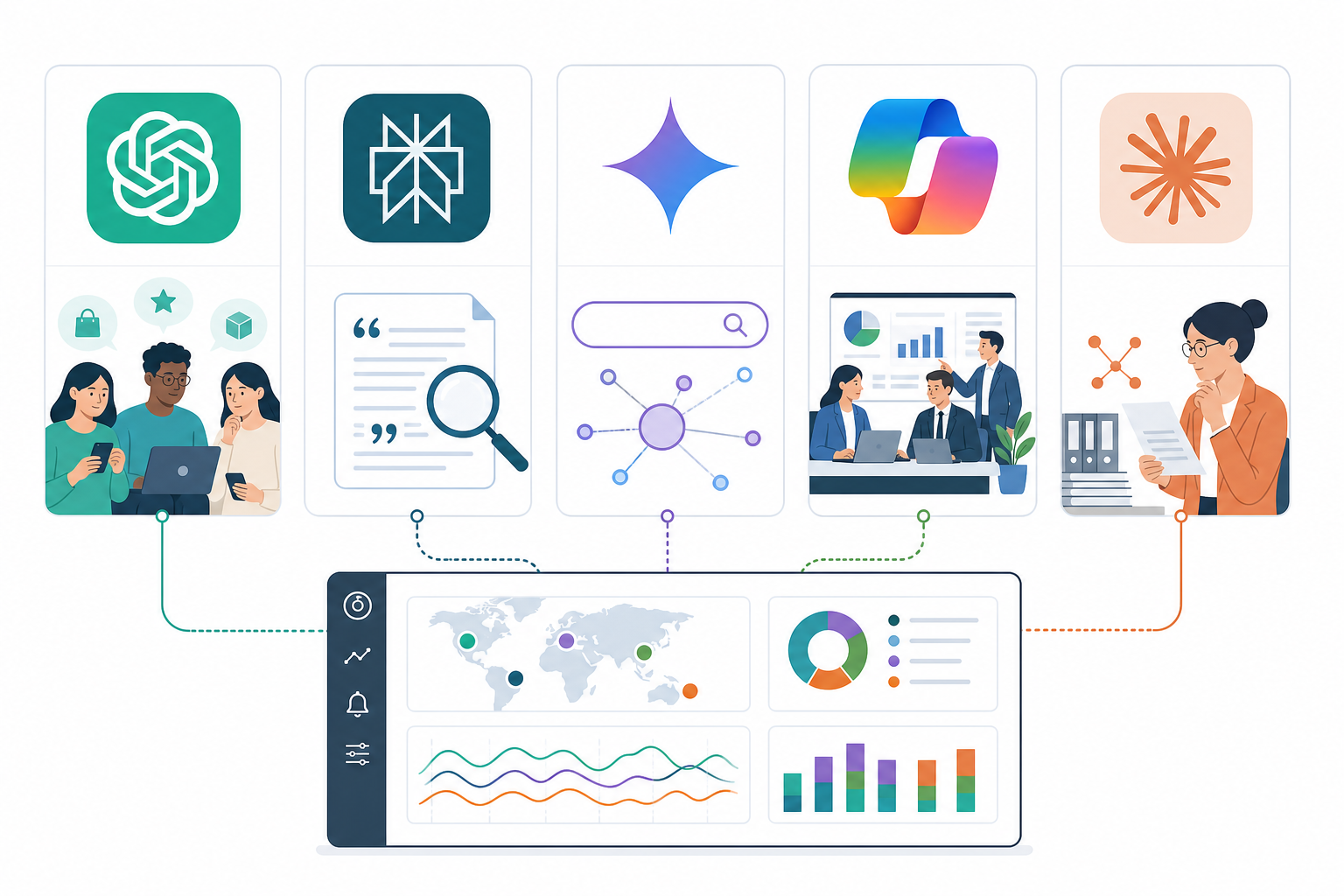 Suggested alt text: "Grid comparing ChatGPT, Perplexity, Gemini, Copilot and Claude by primary use case for agency monitoring."
What AI brand monitoring actually measures — and where it can mislead you
Before trusting any dashboard number, it's worth being explicit about what these tools are doing, because the methodology determines how much weight a client should put on the output — and this is the section most agencies skip, to their own detriment later.
How to build an AI monitoring prompt set
Prompt generation isn't the same as customer research. Crawling a client's website and generating plausible questions from its content gives you a starting list, but it is not a substitute for knowing what real customers actually ask. Treat automated prompt generation as one input among several: pair it with Google Search Console query data, on-site search logs, PPC search term reports, CRM and sales-call language, and review content. Then have a human review, deduplicate and categorise the resulting list before it goes into daily monitoring. Skipping that review step is the most common way agencies end up tracking prompts nobody actually types.
Aim for a tight, deduplicated set of 15–30 prompts per client rather than 100 loosely related ones — duplicate or near-duplicate prompts inflate apparent coverage without adding real signal, and a smaller, well-curated set is easier to defend to a client who asks, "Where did these questions come from?"
A recommended AI visibility scoring model
The glossary terms below are useful, but they only become defensible reporting once you attach an explicit method to each one. Here's the model I'd suggest as a baseline, adjustable to your own tooling:
- Visibility score — the percentage of monitored prompts, across all tracked platforms and runs in the reporting window, where the brand appears anywhere in the response. Formula: (number of prompt-platform-day combinations where the brand appears ÷ total prompt-platform-day combinations run) × 100. State the denominator every time you report this number, because "34/100" means nothing without knowing it was measured across, say, 24 prompts × 5 platforms × 28 days.
- Share of voice — the brand's visibility relative to named competitors across the same prompt set, ideally weighted by position: a brand mentioned first in a list should count for more than one mentioned fifth. A simple weighting is to score position 1 as 1.0, position 2 as 0.75, position 3 as 0.5, and anything beyond as 0.25, then average across appearances.
- Citation — a linked, attributable source in an AI response. Distinct from a claim, which is something the model states without linking to any source. These need different treatment: a citation can be checked against the linked page for accuracy; an unlinked claim can't be traced back at all, so log it separately and flag it to the client as unverifiable rather than folding it into the same sentiment score.
- AI legibility — how easily a model's crawler and retrieval systems can parse a site's structure, schema markup and content hierarchy, distinct from traditional keyword SEO.
A sample prompt-level record, which is roughly what your underlying data should look like before it gets rolled up into a dashboard score:
| Field | Example |
|---|---|
| Prompt | "best vitamin C serum for sensitive skin" |
| Platform | Perplexity |
| Run date | 2025-03-14 |
| Model/version (if exposed) | Perplexity, default model |
| Brand appears? | Yes, position 3 |
| Competitor(s) appearing | Competitor A (position 1), Competitor B (position 2) |
| Citation or claim | Citation — linked to client's ingredient page |
| Sentiment | Neutral-positive |
| Reviewer | Analyst initials, for QA traceability |
Without a record structure like this, a "visibility score" is just a number with no audit trail, and I'd treat any tool or process that can't produce this level of detail on request with some scepticism.
Operational risks to flag in AI monitoring reports
- Model versions change without notice, and a response that held steady for weeks can shift overnight after a provider update — log the model version alongside each run where the platform exposes it.
- Responses vary by wording, location, language and time of day.
- Regional personalisation means a prompt run from a US IP address may not reflect what a UK searcher sees.
- None of the major consumer chatbot apps currently offer a fully open API for scraping consumer-facing answers at scale, so most tooling relies on approved business APIs or browser-based automation, and coverage can be affected by platform terms of service — check this before committing to a tool.
None of this means the data is useless. It means a single day's snapshot is a sample, not a census, and the value comes from the trend line built over several weeks, not any one answer. A visibility score of 34/100 is an index for a specific prompt set on specific platforms over a specific window — it is not the brand's objective standing in some universal AI market, and I'd say that explicitly in every client report rather than let the number imply more precision than it has.
Manual querying vs automated AI brand monitoring at scale
Here's the arithmetic that makes the case for automation. Assume ten core prompts, tested across five platforms, with one response logged per prompt per platform — that's 50 individual query-and-log actions per client per week (10 × 5 = 50, run once weekly as a baseline; daily monitoring multiplies this by seven). Each query-and-log action — reading the response, screenshotting it, recording sentiment, and noting which citations or claims appear — takes roughly three to four minutes for an experienced analyst. That's 2.5 to 3.5 hours of pure collection per client, per week, before any competitor analysis or interpretation happens. Across a portfolio of fifteen to twenty clients, that's close to a full-time role dedicated purely to collection, with zero strategic output — and that's before you've added competitor prompts, which roughly double the workload if you're tracking two named competitors per client.
| Manual Monitoring | Automated Monitoring | |
|---|---|---|
| Time per client/week | 2.5–4+ hours | Minutes (review only) |
| Platforms covered | Usually 1–2 (time-limited) | All 5 major platforms |
| Consistency | Single snapshot, session-dependent | Repeated daily runs |
| Sentiment tracking | Manual, subjective | Logged against a rubric |
| Competitor visibility | Ad hoc | Continuous, comparative |
| Scalability across clients | Poor | Built for it |
Daily automated runs matter for a reason beyond time saved: they turn a single anecdotal snapshot into a trend line, which is what lets you distinguish a genuine sentiment shift from ordinary model variability. Running daily doesn't eliminate sampling bias — it reduces the chance that one unrepresentative answer gets reported as fact, but the underlying limitations covered above still apply. It also means you're more likely to catch a negative shift or a new competitor mention before the client stumbles across it themselves, which is a better position to report from than reacting after the fact.
How do I scale AI brand monitoring across many client accounts?
Scaling past a handful of accounts requires treating AI brand monitoring as a repeatable operational pipeline, not a bespoke task per client. In practice, that means:
- Standardise the prompt-building template so every account manager follows the same intake process (site crawl + GSC data + PPC terms + CRM language), rather than reinventing the method per client.
- Centralise scheduling in one tool or dashboard rather than letting individual analysts run queries ad hoc — this is what actually removes the analyst-hours bottleneck.
- Set QA checkpoints, not just automation: a named reviewer should spot-check a sample of logged responses each week for sentiment-tagging accuracy and citation classification, because automated sentiment scoring on LLM outputs is not yet reliable enough to run unchecked.
- Define alert thresholds — for example, a visibility score drop of more than 15 points week-on-week, or a new competitor appearing in more than 20% of prompts — that trigger a human review rather than waiting for the monthly report cycle to surface a problem.
- Assign clear review ownership: one named person per account should sign off the weekly digest before it reaches the client, even once collection is fully automated.
- Batch onboarding in cohorts of three to five clients at a time when rolling this out across a portfolio, so your team can refine the prompt-review process before scaling further.
Can I automate AI brand monitoring instead of manually asking chatbots?
Yes, largely, though "fully automated" oversells it slightly. Automation tools handle the repetitive part — running the same prompt set against multiple platforms on a schedule and logging the raw responses — typically via approved business APIs where available (OpenAI and Microsoft both offer commercial API access with different terms to their consumer apps) or browser-based automation where no API exists, which is more fragile and more exposed to platform terms-of-service changes. What doesn't automate cleanly yet is sentiment nuance, citation-accuracy checking, and strategic interpretation — those still need a human reviewer, which is why I'd frame this as "automated collection, human-reviewed output" rather than a fully hands-off system.
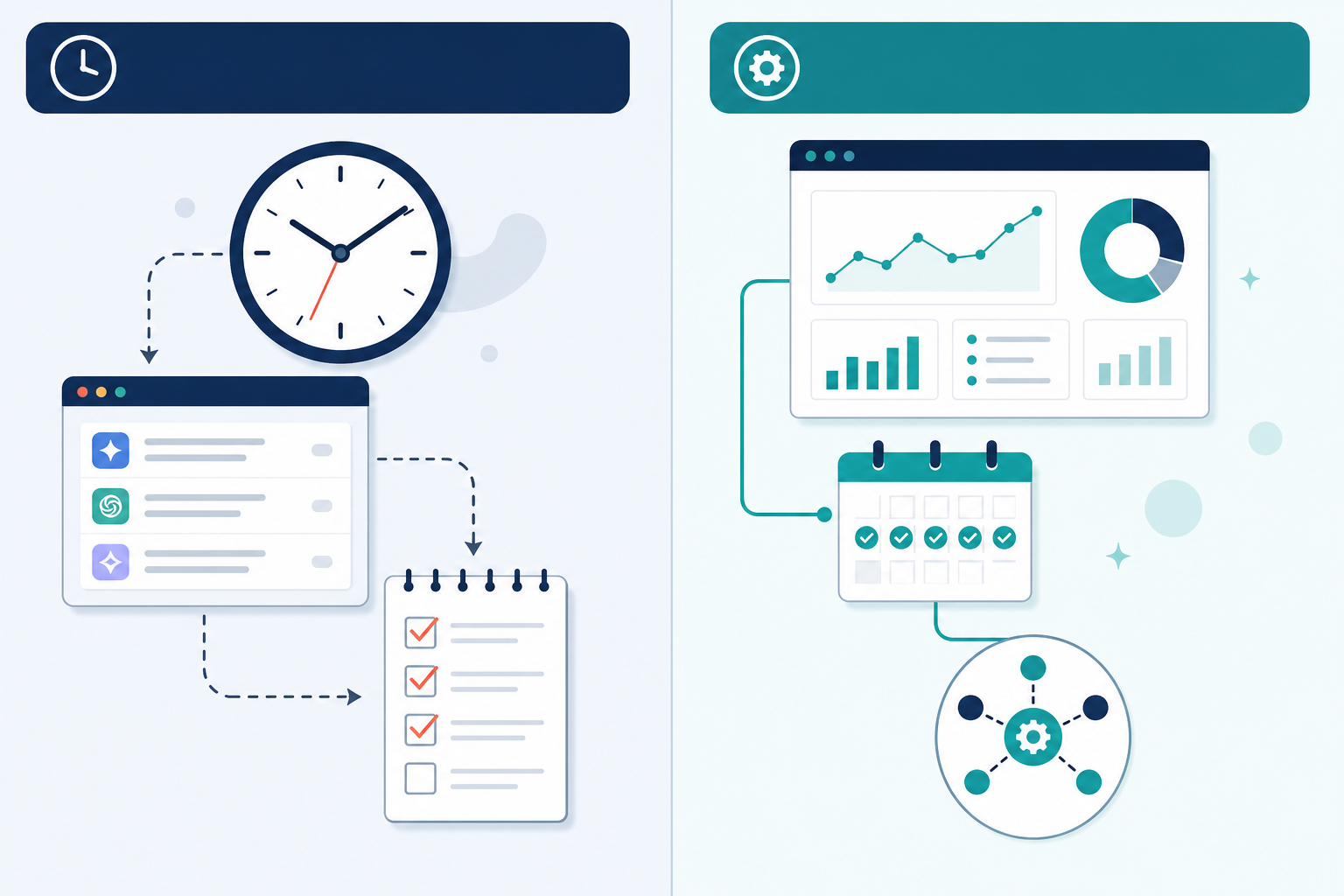 Suggested alt text: "Infographic contrasting manual chatbot checking with automated daily AI brand monitoring workflows."
Turning AI mention data into client-ready deliverables
Collecting the data is only half the job — the value an agency adds is packaging it into something a client can act on. Here's a worked, illustrative example (hypothetical, built from patterns I've seen across real accounts, not a single verified case study): imagine a mid-sized UK skincare brand where we tracked 24 deduplicated prompts across all five platforms daily for four weeks. Using the formula above (appearances ÷ total prompt-platform-day combinations × 100), the baseline visibility score came in at 34/100, against a named competitor at 61/100 — largely because that competitor's ingredient glossary pages were being cited repeatedly by Perplexity and ChatGPT's Search mode. After the client fixed structured data and added clearer product comparison pages — an AI legibility fix, not a guaranteed visibility fix — visibility rose to 48/100 over six weeks, and citations pointing to the client's own blog increased from two to eleven.
I'd flag that as a plausible, illustrative pattern rather than a guaranteed result. Technical fixes are correlated with improved citation rates in the accounts I've reviewed, but AI systems don't publish their ranking logic, so any causal claim here should be treated with real caution — "correlated with" is doing a lot of work in that sentence, deliberately.
A practical AI visibility reporting process for agencies
- Establish a baseline visibility score for the client and their top two or three named competitors during the first week, using a fixed prompt set and formula (see above), giving you a stable starting point rather than isolated figures with no context.
- Pull a weekly digest showing changes in citations, sentiment and share of voice, and slot it into your existing reporting cadence rather than building a separate report cycle clients have to learn to read.
- Use AI legibility audit findings — structured data gaps, unclear content hierarchy, crawlability issues — to give clients concrete technical fixes, while being explicit that these are correlated improvements, not guaranteed visibility gains.
- Build a traffic-attribution layer carefully. AI platforms are inconsistent about referrer data: some pass a clean referrer string, some strip it, and some traffic arrives looking like direct traffic with no referrer at all ("dark traffic"), which means your AI-referral numbers are very likely an undercount. Use whatever referrer segmentation your analytics platform supports, but present this to clients as a directional indicator of AI-driven traffic, not a complete or precise figure — and never claim that a visibility score increase caused a traffic increase without checking for other contributing factors first.
- Package findings into a monthly AI Visibility Report, either standalone or as an add-on section within existing SEO or PR reports.
- Pull data via API into your own dashboards rather than manually exporting screenshots and rebuilding slides every cycle.
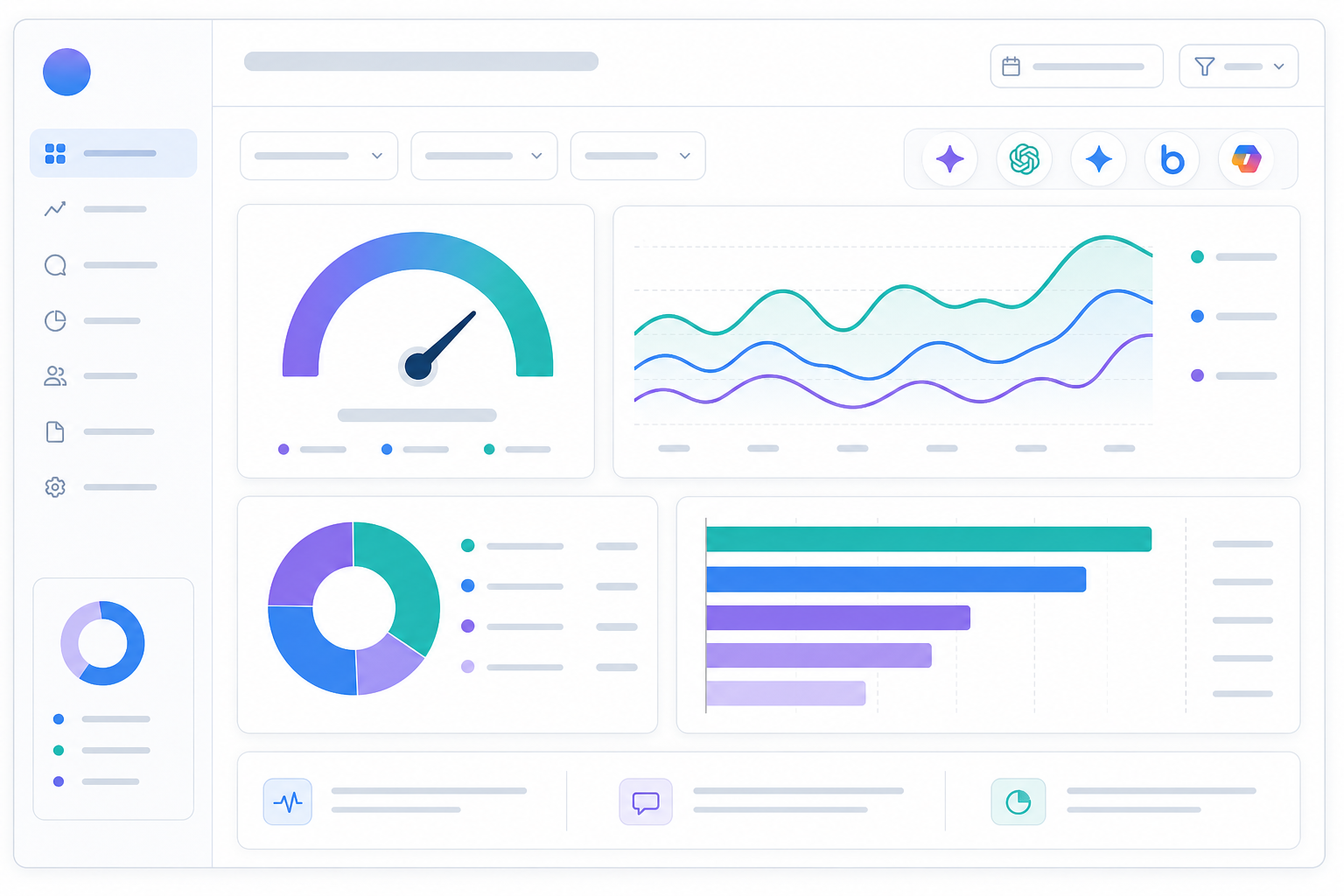 Suggested alt text: "Mockup of an AI brand monitoring dashboard showing visibility score, sentiment trend and share of voice."
Pricing AI brand monitoring as an agency service add-on
Most UK agencies I've spoken with land on one of two structures: a flat monthly add-on fee per client, or tiered pricing based on the number of tracked prompts and competitors — similar in logic to how keyword-tracking tiers are already priced in SEO retainers. The ranges below are illustrative starting points based on conversations with several UK agencies, not a benchmark survey, and your actual pricing should reflect your own tool costs, review time and client complexity.
| Tier | Prompts | Platforms | Reporting | Illustrative price/month | Setup fee |
|---|---|---|---|---|---|
| Starter | Up to 15 | All 5 | Monthly | £250–£400 | £150–£300 one-off |
| Growth | Up to 30 | All 5 | Weekly digest + competitor benchmarking | £600–£900 | £300–£500 one-off |
| Enterprise | Custom | All 5 + custom cohorts | Dashboard/API integration | £1,200+ | Scoped individually |
A worked margin example: say your monitoring tool costs £80/client/month once scaled across a portfolio, and analyst review time — reviewing flagged sentiment, checking citations, writing the digest commentary — runs 1.5 hours/week at a £40/hour blended rate, or roughly £240/month. Your all-in cost for a Growth-tier client is around £320/month. Priced at £750/month, that's a gross margin of roughly 57%, which is broadly in line with what agencies typically target on retained analytics services. If your own maths gives you a lower margin than your SEO or PR retainers for comparable effort, you're probably underpricing it — recalculate rather than guess.
Minimum contract periods matter here too: because the value case builds over four to six weeks of trend data, I'd avoid selling this on a month-to-month basis and instead set a minimum three-month term, which also protects your margin against the setup time.
Given that entry-level monitoring tools often offer low-cost trials, there's little reason not to pilot this with one or two willing clients before a portfolio-wide rollout. That lets you test your reporting format, refine your prompt sets, and build a case study before pricing it confidently across the board. I'd resist bundling it in for free as a value-add — clients place real perceived value on "AI reputation" right now precisely because it feels new to them, which supports a premium price point rather than a freebie.
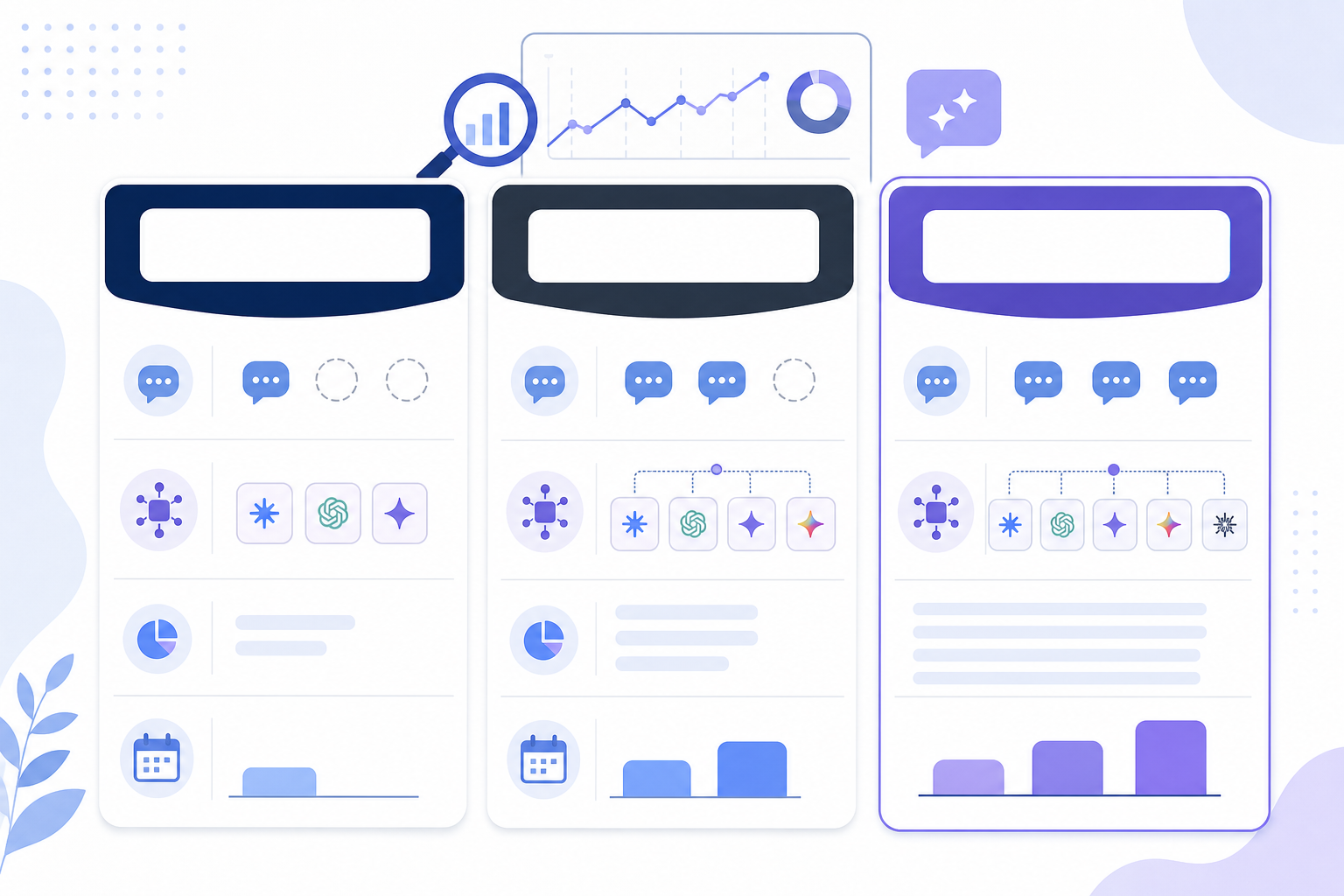 Suggested alt text: "Comparison of Starter, Growth and Enterprise pricing tiers for AI brand monitoring as an agency service."
AI brand monitoring FAQ
Which AI platforms should I be monitoring for clients?
At minimum, track ChatGPT, Perplexity, Google Gemini and Microsoft Copilot, adding Claude where budget allows or where the client's audience skews toward research-heavy decision-making. Gemini's integration with Google Search makes it increasingly relevant to UK organic visibility conversations given Google's search share here, while Copilot matters most for B2B clients whose buyers work inside Microsoft-heavy organisations. I'd avoid assuming any single platform dominates UK consumer research without checking usage patterns specific to your client's sector, since this varies significantly by category.
How do I scale AI brand monitoring across many client accounts?
Standardise the prompt-building template across accounts, centralise scheduling in one tool rather than running queries per analyst, set clear alert thresholds that trigger human review, and assign one named reviewer per account for sign-off. Automation removes the collection bottleneck; it doesn't remove the need for a consistent process across your whole portfolio, so build that process once and apply it everywhere rather than customising it per client.
Can I automate AI brand monitoring instead of manually asking chatbots?
Mostly, yes. Scheduled automation — via approved business APIs where available, or browser automation where they aren't — can handle running your prompt set across platforms and logging raw responses. What still needs a human is sentiment nuance, citation-accuracy checking against the source, and strategic interpretation of what the trend actually means for the client. Treat it as automated collection with human-reviewed output, not a fully hands-off system.
How reliable is AI mention data, given that AI answers change constantly?
Treat any single query as a sample, not a definitive answer. Model versions update without notice, responses vary by wording and location, and platforms personalise by region — all of which means a trend built from daily runs over several weeks is far more trustworthy than any one screenshot. Report visibility scores with their denominator (number of prompts × platforms × days) attached, so clients understand they're looking at a directional signal for a defined prompt set, not a fixed market ranking.
Do I need client consent to monitor and store AI-generated content about their brand?
Monitoring publicly available AI outputs about a client's own brand is generally a lower-risk activity than collecting personal data about individuals, but it's not risk-free, and "get consent" isn't automatically the right UK GDPR answer — consent is one lawful basis among several, and it may not even be the appropriate one here. What matters more in practice: document what you're logging (queries, responses, sentiment tags), where it's stored, how long you retain it, who has access, and whether any captured response contains personal data about named individuals (a competitor's staff member, a reviewer's name) that would trigger separate obligations. Build this into your service agreement as a data-processing clause rather than relying on an assumed consent, and take specific legal advice if a client's category is likely to surface personal data regularly — this article isn't a substitute for that advice.
How do I present AI mention data to clients who don't understand LLMs?
Translate it into reporting language clients already know from SEO: a visibility score (0–100, always reported with its prompt/platform/date scope attached), share of voice against named competitors, and a sentiment trend over time. Pair this with concrete technical fixes — like AI legibility improvements — framed as correlated actions rather than guaranteed outcomes, so clients see AI visibility as an extension of existing marketing work rather than a confusing new discipline.
How often should monitoring run, and does it need adjusting for UK clients specifically?
Daily runs give the most reliable trend line, aggregated into weekly reporting for clients. For UK accounts, set location, language and account region to UK/en-GB wherever the platform supports it, and check IP location if you're running automation from cloud infrastructure — several tools personalise citations by region, and a US-default query can return a meaningfully different picture than what a UK customer would actually see.
A five-step AI brand monitoring pilot for agencies
Rather than rolling this out across your whole portfolio at once, I'd run a contained pilot first:
- Pick one willing client — ideally one already asking about AI visibility, so there's an existing appetite.
- Build a 15–24 prompt set using the site-crawl-plus-real-query-data method above, then have a second person review and deduplicate it.
- Establish a baseline across all five platforms for the client and two named competitors, and log it using a structured record, not just a dashboard screenshot.
- Run for four weeks minimum before drawing any conclusions about trend direction, since anything shorter risks mistaking normal model variability for a real shift.
- Review, then price — use the pilot to refine your reporting format and prompt set, build a short case study from the results, and only then set your tiered pricing with confidence across the rest of your portfolio.
Whichever monitoring tool you choose to support this, check that it covers all five major AI search platforms, refreshes at least daily, explains its scoring methodology in plain terms rather than a black-box number, supports UK/regional query settings, and offers API or export access so the data isn't trapped in someone else's dashboard.😊