Manual Chatbot Checks vs Automated LLM Monitoring: What a Solo Founder Actually Saves
Wondering if you can just ask ChatGPT yourself each week? We break down the real time cost of manual AI visibility checks versus automated LLM monitor
LLM Monitoring for Solo Founders: Manual Checks vs Automated AI Visibility Tracking
Manually checking ChatGPT, Claude, Gemini, Copilot and Perplexity is perfectly feasible for a handful of questions, once. After that it breaks down fast, because AI answers vary from run to run and from platform to platform. A realistic question set takes several hours to work through in a single round, and doing that daily by hand isn't a serious option for anyone running a business alone. Automated LLM monitoring, such as MentionOwl, records the answers, citations, sentiment and competitor mentions for you and condenses them into a single 0-100 AI visibility score. 🦉
Below I quantify the effort, show where the hours go, and set out what automation replaces and what it adds. The time estimates are illustrative arithmetic based on stated assumptions, not measured industry benchmarks, so please substitute your own numbers.
The short answer: Can't I just ask ChatGPT myself every week?
You can, and you should do it once. A manual spot-check gives you a baseline and builds intuition for how AI assistants describe your market, your competitors and, if you're lucky, you. I would never talk a founder out of that exercise.
The limitation is statistical rather than practical. A single answer is a sample, not a measurement. OpenAI's own evaluation guidance notes that model outputs can be nondeterministic and recommends testing across representative cases rather than relying on one example. The same prompt can recommend three suppliers today and four tomorrow, and rephrasing the question can change the shortlist entirely. Platforms also draw on different sources, so a good result on one tells you little about the others.
So the real question is whether manual checking produces trustworthy trend data over weeks and months. That is what AI visibility tracking is for, and it is where the manual approach struggles.
What manual AI checking actually looks like
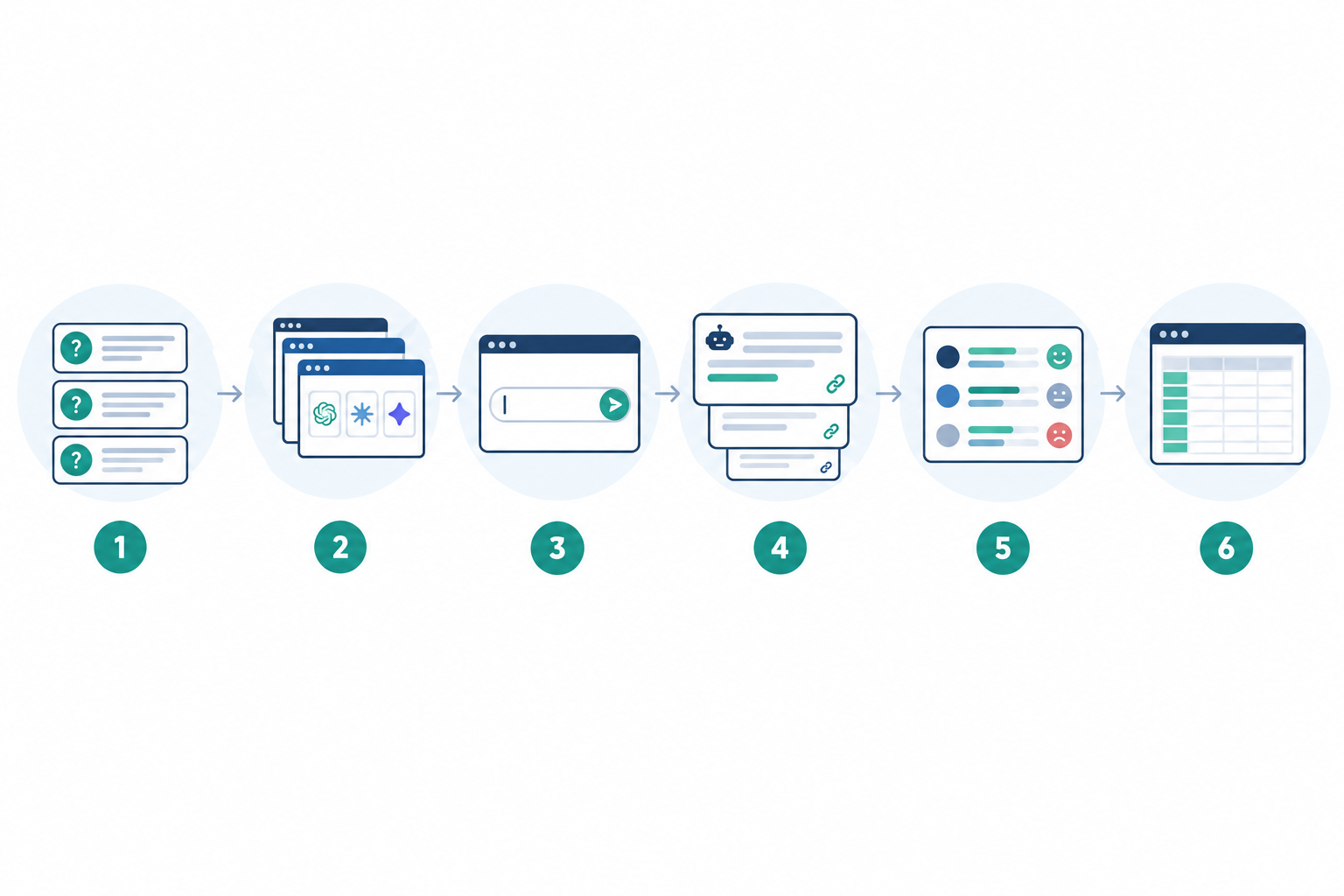
The effort is easy to underestimate until you have done a full round, so here is the workflow. A thorough manual check goes like this:
- Decide which customer questions matter. These should be the purchase-decision queries buyers actually type ("best bookkeeping software for freelancers", "who should I hire for…"), not just your brand name.
- Open each platform separately: ChatGPT, Claude, Gemini, Copilot and Perplexity.
- Enter each question, ideally in a fresh session, so earlier context doesn't skew the result.
- Record the full answer, whether you were mentioned, your position in any list, and any cited sources.
- Note which competitors appeared and how each brand was described: positive, neutral or negative.
- Log everything in a spreadsheet so you can compare against last week.
The hidden friction in manual AI monitoring
The steps themselves are simple. The friction is in the details.
- Your note-taking drifts. By the fortieth query of the afternoon, you will record things differently than you did at the start.
- Sentiment judgements are subjective. Is "a reasonable option for smaller budgets" positive, neutral or faintly negative? Your answer will vary with your mood.
- Soft mentions slip past. Sometimes an AI describes your business ("a Manchester-based consultancy specialising in…") without naming it. These are easy to miss by eye, and they are worth capturing.
How many questions would I need to check manually?
Here is a worked example. Take 20 customer questions across five platforms, which makes 100 queries per round. If each query takes two to three minutes, including opening a session, reading the answer and logging it, a single round costs roughly 3.3 to 5 hours. That time estimate is an assumption, not a published benchmark, and I'd suggest timing yourself over a handful of queries before trusting any figure, mine included.
The general formula is distinct prompts × platforms × runs per prompt × checks per month × minutes per check. As a simple reference point, 25 prompts on a single platform, checked weekly at two minutes each, comes to about 3 hours 20 minutes in a four-week month. Fifty prompts takes 6 hours 40 minutes, and 100 prompts takes 13 hours 20 minutes, and that is on one platform only.
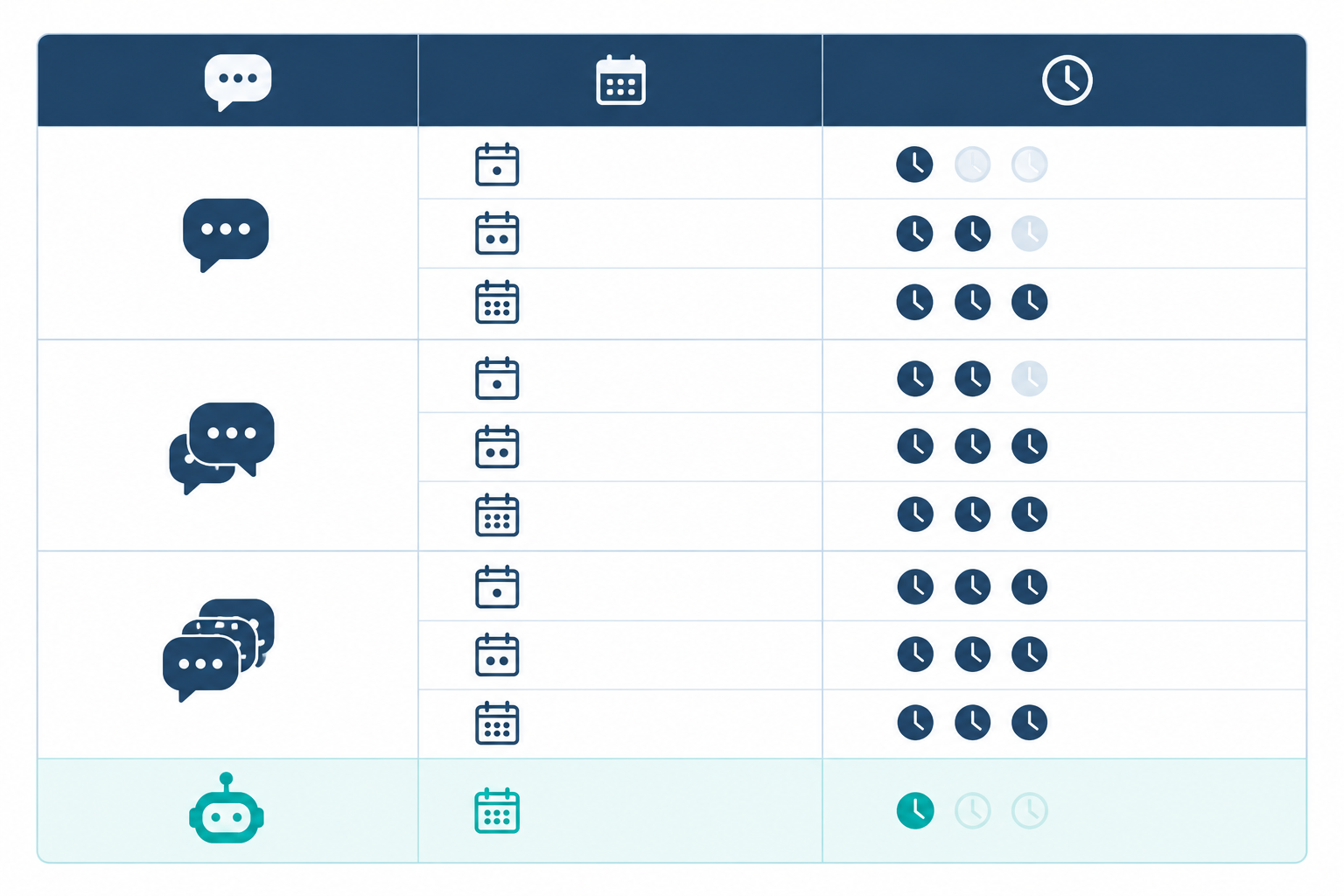
The table below applies a midpoint of 2.5 minutes per query across all five platforms, assuming a four-week month (28 rounds for daily checking).
| Questions | Queries per round | Hours per round | Weekly (4 rounds) | Twice weekly (8 rounds) | Daily (28 rounds) |
|---|---|---|---|---|---|
| 10 | 50 | ~2.1 | ~8 hrs/month | ~17 hrs/month | ~58 hrs/month |
| 20 | 100 | ~4.2 | ~17 hrs/month | ~33 hrs/month | ~117 hrs/month |
| 50 | 250 | ~10.4 | ~42 hrs/month | ~83 hrs/month | ~292 hrs/month |
| Automated tracking | Same coverage, run daily | Review only | Minutes | Minutes | Minutes |
All manual figures are illustrative estimates based on 2.5 minutes per query, not measured benchmarks.
The repeat-sampling factor in AI visibility tracking
Because answers vary, a careful analyst wouldn't trust one run per query. If you run each query three times to smooth out the variability, every figure in the table triples. Twenty questions checked weekly then costs around 50 hours a month by hand. This is the point at which most manual programmes quietly stop.
An automated tool, by contrast, runs the same coverage daily, and the only founder time required is reviewing the output. I want to be explicit about one caveat: automation doesn't remove the need for judgement. You still decide which questions matter and review notable changes. What it removes is the repetitive collection and logging.
Why it's nearly impossible to keep up with AI monitoring alone
Even if you could find the hours once, sustaining them is another matter. These are the failure points I see most often:
- Variability. Identical prompts can produce different brand recommendations, so one-off checks can mislead you in either direction. You may celebrate a mention that doesn't recur, or panic over an omission that was noise.
- Platform fragmentation. Each AI engine draws on different sources and behaves differently. A strong result in Perplexity, which cites sources prominently, says little about what Gemini or Copilot will say.
- Consistency decay. Manual processes slip the moment a product launch, client deadline or school-holiday week gets in the way. Monitoring is the first task to be dropped because it is never urgent.
- No reliable trend line. Gaps in your log make it hard to tell whether a change in visibility was real or just noise. Two missed weeks can ruin a month of data.
- Subjectivity. Judging sentiment and list position by eye produces records that aren't comparable over time.
- Opportunity cost. Every hour spent copying answers into a spreadsheet is an hour not spent on sales, product or content.
The wider context matters too. Stanford's AI Index reported that 78% of surveyed organisations used AI in at least one business function in 2024, up from 55% the year before. Adobe separately measured a 1,200% increase in generative AI referral traffic to US retail sites between July 2024 and February 2025. Neither figure describes your particular customers, and Adobe's data is US-specific. Still, together they suggest that AI-mediated discovery is growing quickly, which increases the number of places where your brand might be described, accurately or otherwise.
Both NIST's AI Risk Management Framework and OpenAI's evaluation guidance treat monitoring as a recurring activity rather than a one-time test. The same logic applies to brand monitoring: repeatable checks on a fixed question set beat occasional impressions.
What does automated LLM monitoring add that manual checking can't?
Time saved is only half the case. The other half is what manual checking can't realistically capture, however diligent you are.
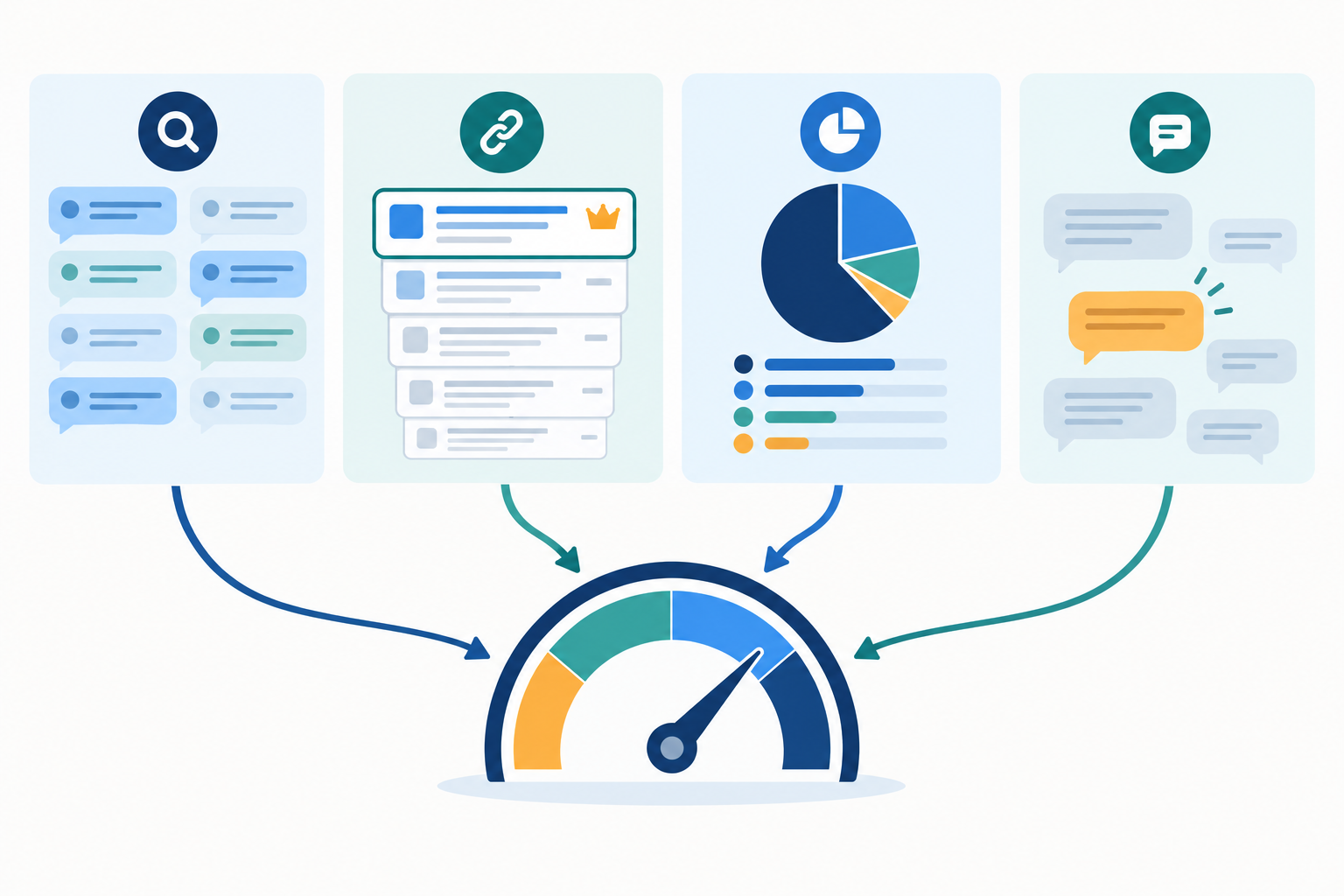
- Daily coverage instead of occasional snapshots, so you can see the effect of a content change or a competitor move quickly.
- Auto-generated questions based on your website. MentionOwl crawls your site and writes relevant customer questions, which removes the blind spot of only testing what you already believe customers ask.
- Citation tracking. You see which pages and third-party sources the AI engines reference when they recommend you, or ignore you. This is the raw material for ChatGPT citations analysis and wider generative engine optimization.
- Share of voice against named competitors, which a single manual check rarely captures reliably. Competitor tracking only becomes meaningful when it is measured the same way every day.
- One consistent AI visibility score. MentionOwl builds a 0-100 score from query coverage, position-weighted citations, share of voice and soft mentions, giving you a single number to track.
- Sentiment analysis applied the same way every time, so a change in tone reflects the AI's answers rather than your mood.
- AI legibility audits. Sixteen technical checks show whether your site is easy for AI systems to parse, which no amount of chatbot querying can tell you.
- Cookieless AI traffic analytics, which connect visibility with actual visits.
- Weekly digests, so insight lands in your inbox instead of needing a dedicated session.
A fair caveat: no monitoring tool, ours included, guarantees comprehensive coverage of every model or every user query, and none can directly correct what a third-party chatbot says. Treat the results as well-structured sampled observations. That is exactly what makes them useful for spotting trends.
Manual vs automated LLM monitoring: a side-by-side comparison
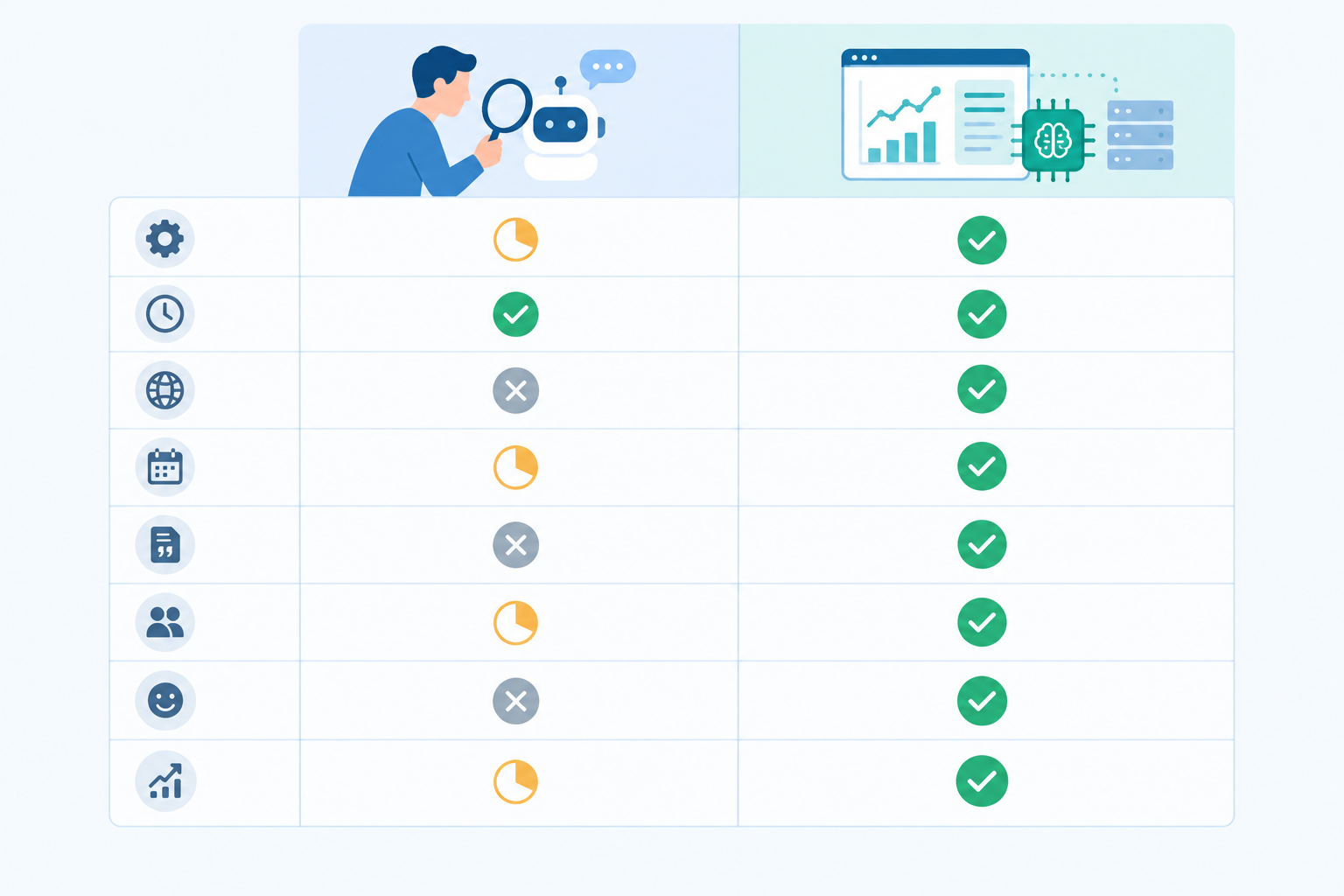
| Manual checking | Automated LLM monitoring | |
|---|---|---|
| Setup effort | Low: a spreadsheet and a question list | Low to moderate: crawl, question generation and review |
| Weekly time commitment | Roughly 4+ hours for 20 questions on five platforms (illustrative) | Minutes to read a digest |
| Platform coverage | Whatever you have time to open | ChatGPT, Claude, Gemini, Copilot, Perplexity |
| Frequency | Weekly at best | Daily |
| Question generation | Your own assumptions | Auto-generated from your website |
| Citation capture | Copied by hand, patchy | Recorded systematically |
| Competitor tracking | Ad hoc | Continuous share of voice |
| Sentiment consistency | Subjective | Applied uniformly |
| Trend reporting | Whatever your log supports | Built in, with a 0-100 score |
| Cost | Free in cash, heavy in hours | Subscription, near-zero ongoing time |
Where manual brand monitoring still wins
I want to be fair here. Manual checking costs nothing in cash, and it remains an excellent way to build intuition for how AI describes your market. For a one-off sanity check, it is hard to beat.
The two approaches complement each other. Use a manual check to understand the problem, then automate to measure it. NIST's guidance also stresses human oversight alongside automated monitoring, so I would keep an occasional manual spot-check even once automation is running, to catch blind spots in your question set.
How much time does LLM monitoring actually save a solo founder?
Let's translate the arithmetic into hours. Take a modest scenario: 20 questions across five platforms, checked weekly, at 2.5 minutes per query. That is about 4.2 hours per round and roughly 17 hours a month. Now suppose the automated alternative costs you ten minutes each week reading a digest, about 40 minutes a month. The reclaimed time is around 16 hours a month, or roughly 200 hours a year. (A separate illustrative calculation from our research, 20 prompts across three services at three minutes each, gives a 3-hour round, reduced to a 30-minute review, saving about 2.5 hours per round. The principle holds even when the inputs differ.)
Put a value on it using your own rate. At £40 an hour, 16 hours is £640 a month. Substitute your own number, and subtract the cost of whichever tool you choose. These are scenario figures based on assumptions, and your real saving depends on your question count, frequency and how much of the output you want to verify personally.
Picture a UK freelance consultant, or a small e-commerce owner, weighing three hours a week of spreadsheet logging against a ten-minute digest. The manual route gives you a lumpy, incomplete record. The automated route gives you a daily record and leaves nearly three hours for client work, product pages or content.
The real shift is from data collection to decision-making. Reading a weekly digest takes minutes, which leaves time to act on it. You can fix a legibility issue, publish a page that answers a question where a competitor is cited, or tighten how you describe your service. That is where the value of LLM monitoring and brand monitoring really sits.
Is automated AI visibility tracking worth it for a solo founder?
Not for everyone. A simple break-even test: (manual minutes per run minus review minutes) × runs per month ÷ 60, multiplied by your hourly value, minus the tool cost. If the result is clearly positive, automate.
It is probably worth it if:
- Your customers use AI assistants to shortlist suppliers in your category.
- You have named competitors you want to be compared against.
- You are investing in content and AI SEO and need to know whether it is working.
It is probably not worth it yet if:
- You have no website content for AI engines to draw on.
- You have no real competitors in your space.
- You simply want a one-time curiosity check.
Here is a decision test I find useful: if you wouldn't keep up a weekly manual log for three months, automation is the more honest option.
There is also a UK angle. Buyers here often phrase questions differently ("accountant near me", "best value", "VAT-registered") and local suppliers feature in answers, so monitoring should reflect how UK customers actually ask. Check that your question set includes that phrasing and local context.
Getting started with LLM monitoring without a big budget
You don't need to commit heavily to find out whether this is useful.
- Run a quick manual baseline on 5 to 10 questions across two or three platforms, to see how you are described today.
- Start a MentionOwl trial ($1 for 7 days) so the platform can crawl your site and generate relevant customer questions.
- Review your initial visibility score, competitor mentions and sentiment, and compare them with your manual baseline.
- Run the AI legibility audit and fix the highest-impact technical issues first.
- Use the weekly digest to pick one improvement at a time, then watch the score over the following weeks.
- If you want to go further, the REST API and MCP server let you pull data into your own dashboards or AI agents.
Change one thing at a time. If you alter five things at once, you won't know which one moved the score.
Frequently asked questions about LLM monitoring
Can't I just ask ChatGPT myself every week?
You can, and it is a good way to get a first impression. However, AI answers vary between sessions, phrasing and platforms, so a single weekly check gives you an anecdote rather than a reliable trend. Automated LLM monitoring runs a consistent question set daily and records the results in a comparable format.
How many questions would I need to check manually?
A meaningful set is often 20 or more customer questions across five AI platforms, which is 100 queries per round. At a few minutes each including logging, that is several hours per round, before you repeat checks to account for variability.
What am I missing by not automating this?
Mainly consistency and context: daily coverage, citation tracking, share of voice against competitors, uniform sentiment scoring, and technical checks on whether your site is legible to AI systems. These are hard to capture reliably by hand.
Is automated tracking worth it for a solo founder?
It is worth it if your customers use AI assistants to compare suppliers and you want evidence of whether your efforts are working without giving up hours each week. If you only want a one-off look, a manual check may be enough.
Which AI platforms does automated tracking cover?
MentionOwl monitors ChatGPT, Claude, Gemini, Copilot and Perplexity, recording answers, citations, sentiment and competitor mentions.