Case Study: How a Local Brand Quietly Lost Ground in AI Answers (And What the Data Finally Showed)
A real-world case study on AI visibility decline: how a UK small business lost customers to a competitor in ChatGPT and Gemini answers—and the data th
AI Visibility Case Study: How a Bristol Business Lost Customers Without Losing Google Traffic
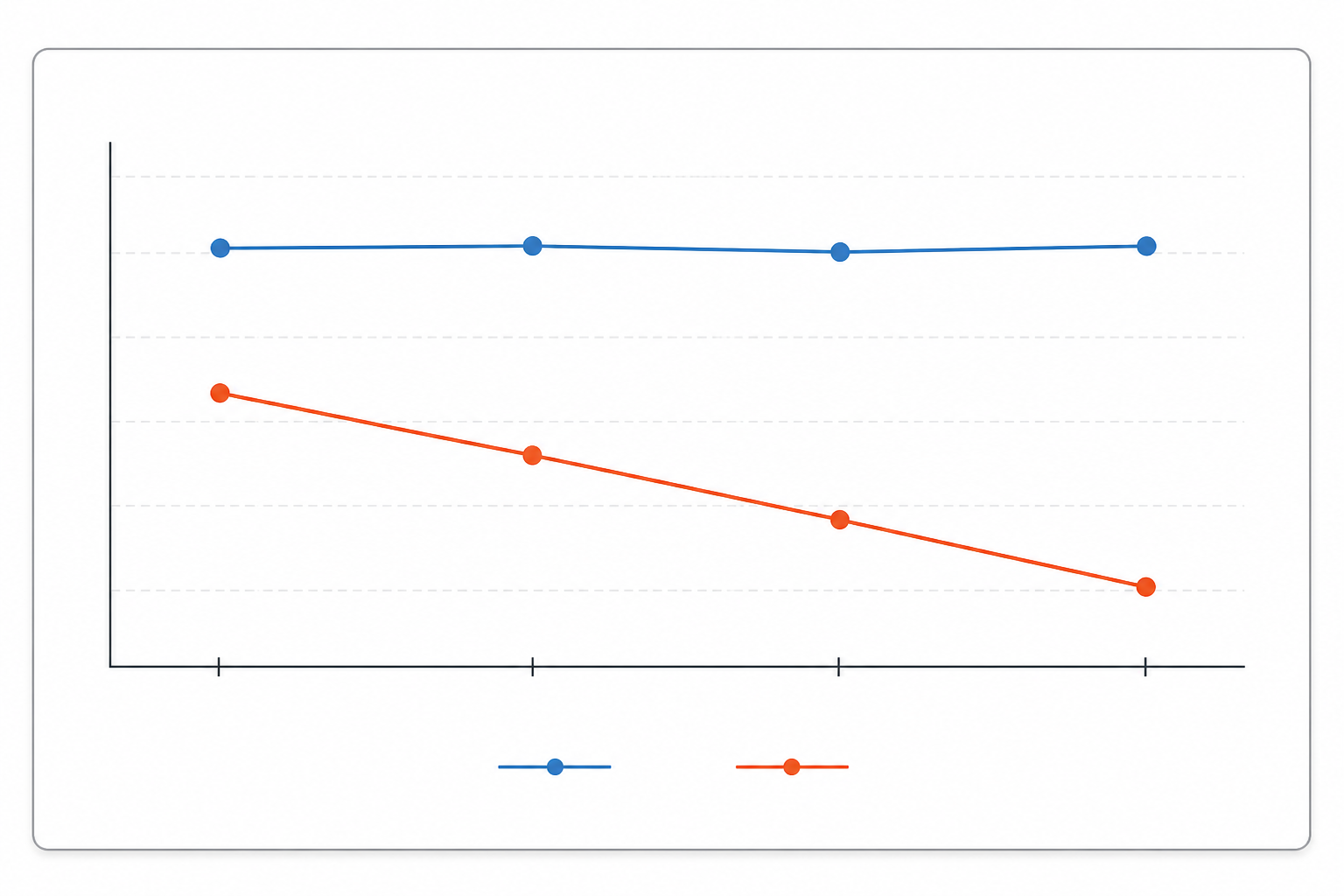
A Bristol-based coffee roastery lost roughly 40% of its share of voice in AI-generated answers over four months, and not a single metric on its Google Analytics dashboard flagged the problem. Organic traffic held steady. Google Business Profile views ticked up slightly. Review counts kept growing at their usual pace. By every traditional measure, the business looked healthy.
Yet when we eventually ran an AI visibility audit, we found that a direct competitor had gone from appearing in 3 of 20 tracked customer questions to 11, while the roastery itself had dropped from 14 to 7. The shift was only caught because the competitor's rebrand triggered a wave of fresh citations that the roastery's own site never generated. By the time that became visible, four months of lost consideration had already passed.
This is a composite case built from patterns we see repeatedly across small UK businesses. I'm walking through it in detail because the mechanism matters more than the specific business. What happened to this roastery is structurally invisible to conventional SEO monitoring, and I want to show you exactly why, using the real data categories that an AI visibility monitoring platform like MentionOwl tracks: query coverage, position-weighted citations, share of voice, and soft mentions.
If you run a local business in the UK and you've never checked what ChatGPT, Gemini, Claude, Copilot, or Perplexity say about you compared with your competitors, this case study is the clearest argument I can give you for why that check can no longer wait.
The Business That Didn't Know It Was Losing AI Visibility
The roastery in question is family-run, has operated in Bristol for over a decade, and holds a loyal customer base built on genuine quality and consistent local reputation. Its Google rankings for core terms such as “coffee roastery Bristol” sat comfortably on page one. Its Google Business Profile carried hundreds of positive reviews. Nothing in its quarterly reporting suggested decline — because nothing in its quarterly reporting was built to detect the kind of decline that was actually happening.
Here's the structural problem, and it's one that Google's own documentation on AI features quietly acknowledges: AI-generated answers synthesise information from multiple sources and often answer a user's question directly, without requiring a click at all.
Pew Research Center's 2025 analysis of roughly 68,000 Google searches found that when an AI summary appeared, users clicked through to a traditional result in just 8% of visits, compared with 15% when no AI summary appeared. A full 26% of AI-summary searches ended the session entirely, with no click anywhere.
When someone asks an AI assistant, “what's the best specialty coffee roaster near Bristol?”, and the assistant confidently names a competitor, the roastery doesn't lose a visitor. It loses a customer who never became a visitor in the first place. There's no referral entry to inspect, no bounce rate to flag, and no funnel step to audit. The customer simply never arrived.
This is precisely the blind spot that AI visibility monitoring exists to close. It is a meaningfully different discipline from conventional brand monitoring built around mentions, backlinks, and press coverage.
Traditional brand monitoring asks: who is talking about us, and where? AI visibility monitoring asks a sharper question: when someone asks an AI engine to make a decision on their behalf, are we the answer, or are we invisible to the decision entirely?
Those are not the same question. A business can score well on the first while failing badly on the second.
How the Shift Happened Without Any Warning
The timeline is worth walking through slowly because the speed of it is the part most small business owners underestimate.
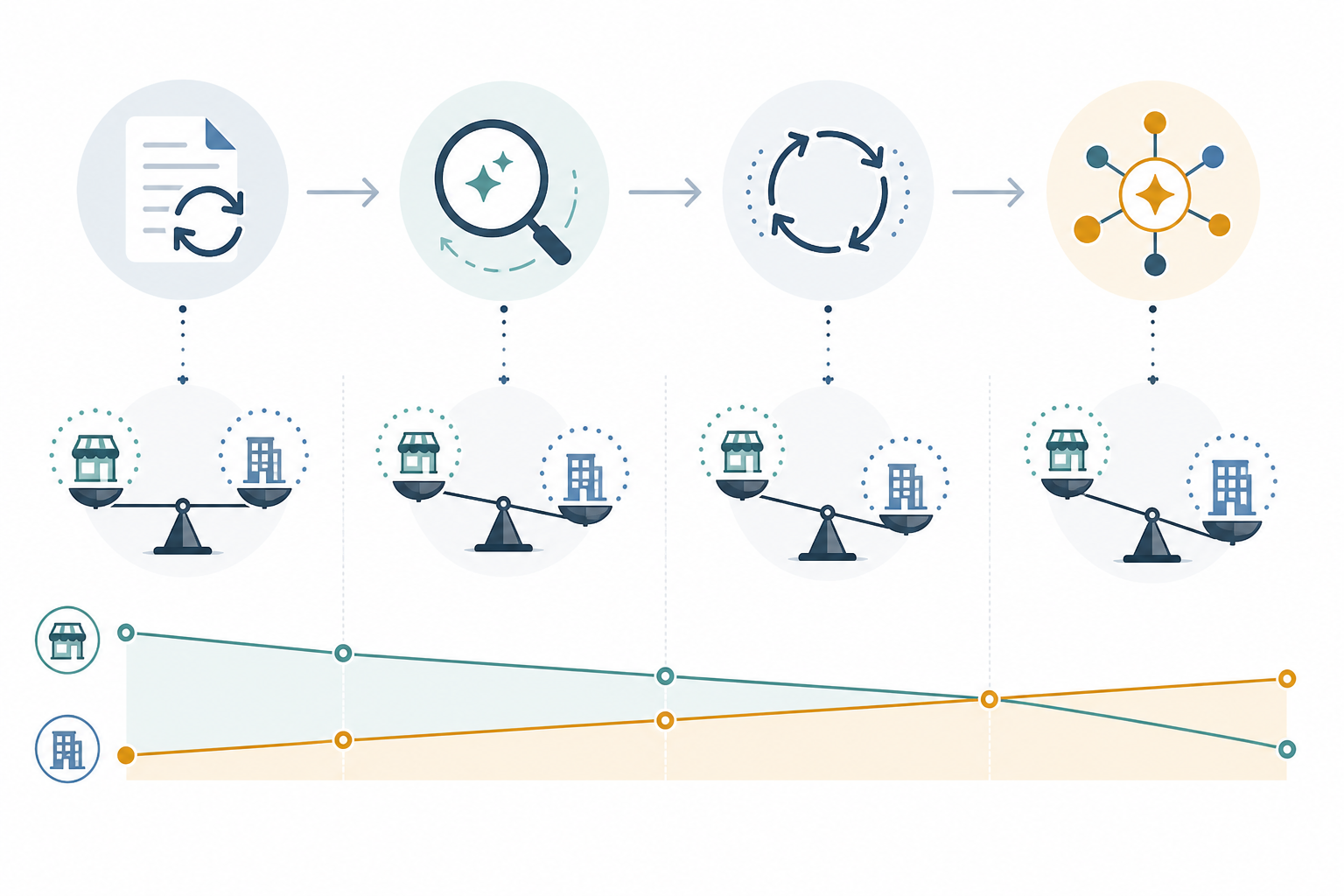
In month one, a competitor roastery across town refreshed its website. The changes included new copy, structured FAQ blocks answering specific questions such as “is this coffee ethically sourced?” and “do you deliver across Bristol?”, and clearer, more extractable facts about sourcing, certifications, and delivery radius.
Nothing about this was particularly sophisticated. It was content written to directly answer the kinds of questions real customers type into AI assistants, rather than general brand storytelling.
What happened next is the part that conventional SEO experience doesn't prepare business owners for. Generative engines such as ChatGPT and Perplexity re-crawl and re-weight sources continuously, which means a competitor's content refresh can shift citation patterns within weeks rather than months.
Traditional organic rankings, by contrast, tend to move more slowly, shaped by accumulated backlink profiles and long-established domain signals that don't reshuffle overnight. Google's own guidance on AI features makes a related point: AI answers often draw on a wider and more dynamic source set than a single ranked page, pulling from business profiles, review platforms, directories, and freshly published content in combination.
A competitor publishing clearer, more answerable content doesn't need to outrank you in the conventional sense. It just needs to become the more citable, more extractable source the next time the model is re-crawled.
Meanwhile, the roastery kept doing exactly what had always worked: publishing the same evergreen blog content, updating the same seasonal offers page, and maintaining the same general brand copy it had used for years.
There was nothing wrong with this content from a traditional SEO standpoint. It simply wasn't built to be the kind of specific, factual, directly answerable source that AI engines favour when constructing a recommendation.
Query by query, the roastery's share of voice eroded, and nobody noticed because almost no small business runs daily LLM monitoring across ChatGPT, Claude, Gemini, Copilot, and Perplexity simultaneously.
There was no alert. No ranking-drop email. No red flag in any dashboard the business was already looking at. That absence of warning is, I'd argue, the single most important fact in this entire case study.
What the Data Revealed When They Finally Checked
When the roastery finally ran a full AI visibility audit, the numbers told a story that four months of “everything looks fine” reporting had completely obscured.
The headline figure was a visibility score that had fallen from the low 60s to the high 30s. Once broken into its component parts, the data pointed to a specific failure rather than a general one.
The proprietary visibility score behind this kind of audit is built from four components. The breakdown matters because it shows where recovery effort should be focused:
| Visibility component | Month 1 — Before | Month 4 — After | What it measures |
|---|---|---|---|
| Query coverage | Strong — present in most relevant question types | Mostly unchanged | Whether the brand appears at all across a representative set of customer questions |
| Position-weighted citations | Strong — frequently cited early in answers | Sharply declined | Not just whether you're mentioned, but how prominently and how early in the answer |
| Share of voice | 14 of 20 tracked questions | 7 of 20 tracked questions | Your presence relative to competitors across the same question set |
| Soft mentions | Stable | Stable | Passing references without a clear recommendation or citation |
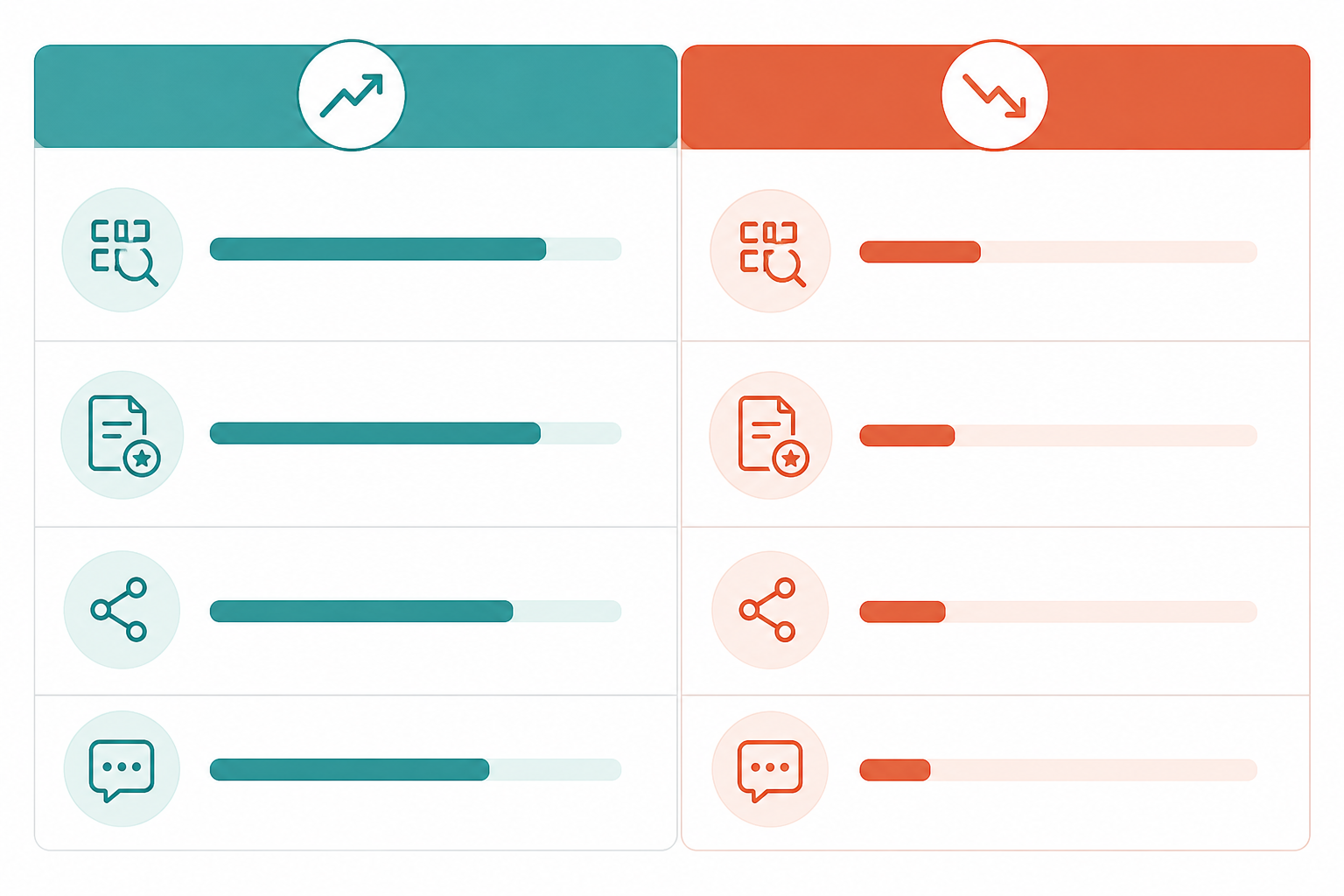
The decline concentrated almost entirely in position-weighted citations and share of voice — not in raw mention count and not in sentiment.
The roastery was still occasionally named. It just wasn't being named first, confidently, or as often relative to the competitor who had overtaken it.
That distinction matters enormously because it explains exactly why conventional monitoring missed the problem. A business checking “are we still mentioned anywhere?” would have received a reassuring yes. A business checking “how often are we the top recommendation compared with our nearest rival?” would have seen the collapse immediately.
The competitor tracking data made the shift unambiguous. The rival roastery appeared in 11 of the same 20 tracked customer questions by month four, up from just 3 at the start of the period — a near-fourfold increase achieved almost entirely through clearer, more specific content rather than any change in product quality or local reputation.
Sentiment analysis, meanwhile, showed the roastery's own sentiment had stayed positive throughout the entire period. This is worth sitting with because it's the detail that explains the false sense of security: sentiment tells you how people feel about a brand when it is mentioned, not how often or how prominently it gets mentioned in the first place.
A brand can be universally well-liked and still be losing the recommendation race simply because it is being cited less frequently and positioned lower when it does appear.
How the Business Recovered Its AI Visibility
Once the problem was visible, the recovery plan followed a sequence I'd recommend to any small business in a similar position. It combined technical fixes with content improvements because fixing only one tends to produce partial, fragile results.
- Ran an AI legibility audit covering 16 technical checks. This examined whether AI crawlers could actually parse and extract clear facts from the site, including structured data implementation, clear heading hierarchies, answerable FAQ blocks, and general crawlability. Several gaps surfaced that had never mattered for traditional SEO but mattered considerably here.
- Rewrote key pages to directly answer specific customer questions. Rather than using general brand copy, the roastery restructured pages around the actual auto-generated customer questions surfaced by the monitoring tool — including questions about delivery radius, sourcing practices, and certifications — while mirroring the real phrasing customers use.
- Added citation-worthy specifics. Sourcing details, certifications, delivery radius, and pricing ranges were made explicit and concrete because AI engines consistently favour extractable facts over vague marketing language when constructing an answer.
- Set up daily tracking against the same 20 customer questions, plus new questions as they emerged, so that future shifts would surface within days rather than being discovered by accident four months later.
- Monitored competitor share of voice weekly through digest reports, tracking whether the gap was closing and by roughly how much each week. This turned recovery from a guess into a measured process.
- Tracked the realistic timeline honestly. Partial share-of-voice recovery appeared within 6 to 8 weeks of consistent effort, with fuller parity against the competitor achieved by roughly month four. This can be slower than traditional SEO recovery, but it can also be faster because LLM re-crawling cycles happen more frequently than conventional ranking updates.
Lessons for Any Small Business Owner
I want to be direct about what this case study demonstrates because the implications extend well beyond one roastery in Bristol:
- You can lose customers to AI recommendations while every traditional metric you check looks perfectly healthy. This is the core risk the case illustrates and the reason AI visibility needs to be measured as its own distinct category, separate from search rankings and web analytics.
- Positive sentiment is not the same as stable visibility. A brand can be well-liked and still be recommended less often because it is cited less frequently and positioned lower when it does appear.
- Competitors don't need to outspend you to overtake you in AI answers. They often just need clearer, more specific, more answerable content that directly matches real customer questions — a content advantage, not necessarily a budget advantage.
- Daily or near-daily LLM monitoring across multiple AI platforms is the most reliable way to catch this shift early. Manual spot-checks against ChatGPT alone will miss what's happening on Gemini, Claude, Copilot, or Perplexity, and these platforms don't move in lockstep.
- Recovery is achievable, but it requires technical and content improvements together. You need AI legibility work to make your site extractable, as well as direct, factual content that answers the questions your customers are asking AI assistants right now.
I'd add one further point from the data we reviewed across similar cases: nearly half of UK consumers now report having used generative AI to find information about local businesses, according to BrightLocal's 2025 Local Consumer Review Survey.
That number will only grow. Businesses that treat AI visibility monitoring as a standing practice — not a one-off check — are the ones that will catch the next version of this shift in days rather than months.
Frequently Asked Questions About AI Visibility and Brand Monitoring
Can a small business really lose customers to AI recommendations without noticing?
Yes, and it's arguably more common than losing search rankings unnoticed. When a customer asks an AI assistant for a recommendation and never clicks through to your site, there's no referral traffic, bounce-rate change, or standard web analytics signal to flag the loss.
The only way to see it is to track what AI platforms are actually saying about your business, which is exactly the gap AI visibility monitoring is designed to fill.
How would I detect an AI visibility shift in my own business?
Start by identifying the 15 to 20 questions real customers would plausibly ask an AI assistant before choosing a business like yours. Then run those questions against ChatGPT, Gemini, Claude, Copilot, and Perplexity regularly.
Record whether your business is mentioned, where it appears in the answer, how prominently it is cited, and which competitors are also recommended. Doing this manually once is useful; doing it daily or near-daily is where the real signal appears because answers can change as AI models re-crawl the web.
What usually causes a competitor to overtake a business in AI answers?
In most cases we've seen, it comes down to content clarity rather than budget. Competitors that add specific, structured, easily extractable facts — such as clear service areas, pricing, certifications, and FAQs that mirror real customer phrasing — tend to be cited more often because generative engines favour content that is easy to parse and confidently quote.
What's a realistic timeline for recovering lost AI visibility?
Based on the pattern in this case and similar ones, partial recovery in share of voice often appears within six to eight weeks of consistent technical and content improvements. Fuller parity with a competitor can take three to four months.
The timeline varies by query volume and how aggressively the competitor continues publishing, so ongoing competitor tracking remains important even after recovery begins.