Do You Need an AI Visibility Tool? A Founder's Decision Guide
Not sure if you need an AI visibility tool yet? Use this founder's self-assessment to see whether manual checking still works or you're already losing
Do You Need an AI Visibility Tool? A UK Founder's Decision Guide
You need an AI visibility tool the moment manual checking stops giving you a full picture. For most solo founders, that moment arrives faster than expected. Let me walk through the actual arithmetic, because I think founders deserve real numbers rather than a vague warning.
Say you're tracking one core product query across five AI platforms: ChatGPT, Claude, Gemini, Copilot, and Perplexity. Checking each platform once per weekday gives you 25 platform checks a week. Checking daily, including weekends, gives you 35. Now factor in the reality that a real buyer doesn't ask one question, they ask variations of it. If you're testing even 10 realistic question variants (not unreasonable, since buyers phrase intent differently depending on where they are in the decision), you're looking at 250-350 individual platform-query checks weekly, before you've read a single answer in full or logged what changed since last time. That's not a quick sanity check. That's an unpaid research operation running in your spare time, and I want to be upfront that this is the actual calculation, not a rounded-off guess.
What is an AI visibility tool? In plain terms, it's software that automates the process above. It generates realistic buyer questions, runs them against multiple AI platforms on a schedule, and logs whether your brand appears, how it's described, and where it ranks relative to competitors. This sits alongside AI SEO more broadly: the practice of optimising your site and third-party presence so AI engines can find, understand, and cite you accurately.
I'll say this plainly: if you're spending more than an hour a week on manual AI checking, missing citation changes, or forgetting to check at all, a monitoring tool likely saves you time and catches drops you'd otherwise miss. But that's not true for everyone at every stage. This guide is built as a self-assessment rather than a hard sell, so you can work out which camp you're actually in before spending anything.
Why AI visibility matters for UK founders right now
I want to set the context clearly before the checklists, because the landscape has shifted meaningfully over the past 18 months. It's worth being precise about what's evidence and what's forecast here.
AI search is no longer an experimental side-channel. It's becoming a normal discovery layer that sits alongside, and in some contexts ahead of, traditional search. Google has expanded AI Overviews and rolled out AI Mode, and these features are live in the UK as part of Google's broader international rollout, though availability and exact behaviour can vary by query and region. Microsoft's Copilot is similarly embedded in UK Bing search. This means there are more places your company could be mentioned, or quietly left out, before a UK buyer ever reaches your website.
Here's what makes this genuinely tricky: visibility in AI-generated answers isn't the same as ranking well in traditional search. Google's own documentation on AI features states that a page can rank well for a keyword and still not surface in an AI answer, because these systems select sources differently, blend information across multiple pages, and often favour third-party reviews and discussion threads over a brand's own site copy. I've seen this play out with SaaS founders who rank first on Google for their category term in the UK but are entirely absent when a buyer asks ChatGPT for a shortlist of vendors, because the AI is pulling its answer from a G2 comparison page or a Reddit thread the founder never thought to monitor.
A data point worth sitting with: Pew Research Center (2025) found that when an AI summary appears on a Google search results page, US users clicked a traditional search result in just 8% of visits, compared with 15% when no summary appeared, and clicked a link within the AI summary itself in only 1% of cases. This is US-based data. I haven't found an equivalent UK-specific study, so treat the exact percentages as directional rather than a precise match for UK behaviour. But the underlying mechanism, AI summaries reducing click-through, is unlikely to be a purely American phenomenon given similar AI feature rollouts here. The practical implication: if you've been assuming that appearing in an AI answer drives the same traffic a search ranking used to, that assumption probably doesn't hold. Influence increasingly happens within the answer itself, which raises the stakes on accuracy, sentiment, and citation position.
On the forecasting side, Gartner predicted in a 2024 report that traditional search engine volume could decline by 25% by 2026 as users shift toward AI chatbots and virtual agents. I'd treat this as a forecast, not a confirmed outcome. Gartner itself frames it as a prediction, not an observed trend. Directionally, though, it's consistent with OpenAI's reported figure of over 400 million weekly active ChatGPT users as of February 2025, and Google's confirmation that AI Overviews now reach more than 200 countries and 40 languages. None of these figures tell us precisely how UK B2B or SaaS buyers behave, but the scale of adoption suggests the shift is real even if the exact percentages remain uncertain.
One more caveat worth stating outright: AI visibility itself is not a stable, fully objective measurement. Model outputs vary between runs even for identical prompts, citations change as models update, results can differ by region or account personalisation, and no third-party visibility score is a perfect proxy for real buyer exposure. Any tool, including the one discussed later in this guide, is measuring a moving target, not a fixed truth.
The practical takeaway: every week without any structured AI visibility tracking is a week a competitor could be winning citations you don't know exist. I'm not raising this to alarm you. I'm raising it because "do I need a tool for this yet?" deserves a properly evidenced answer.
Signs you're still fine checking AI visibility manually
Let's be fair to manual checking, because for some founders it genuinely still works. Here's when I'd say sticking with copy-pasting into ChatGPT is still the rational choice:
- You only care about one or two core queries, not dozens of purchase-decision variants. If your buyer journey compresses down to "best [category] tool" and little else, manual spot-checks may adequately cover your real exposure.
- You check fewer than five times a month, and that cadence hasn't caused problems. If nothing has visibly gone wrong, no lost deals traced to AI misinformation, no surprise competitor mentions, there's no urgent fire to put out.
- You're pre-revenue or pre-launch, and AI visibility isn't yet tied to pipeline. Tracking mentions before you have paying customers is closer to an academic exercise than a growth lever.
- You have no real competitors being cited yet, so there's nothing to benchmark share of voice against. Competitive tracking matters once there's actual competition showing up in answers.
- You genuinely enjoy the process and treat it as market research, not a chore. Some founders like manually prompting ChatGPT and Perplexity because it doubles as customer language research.
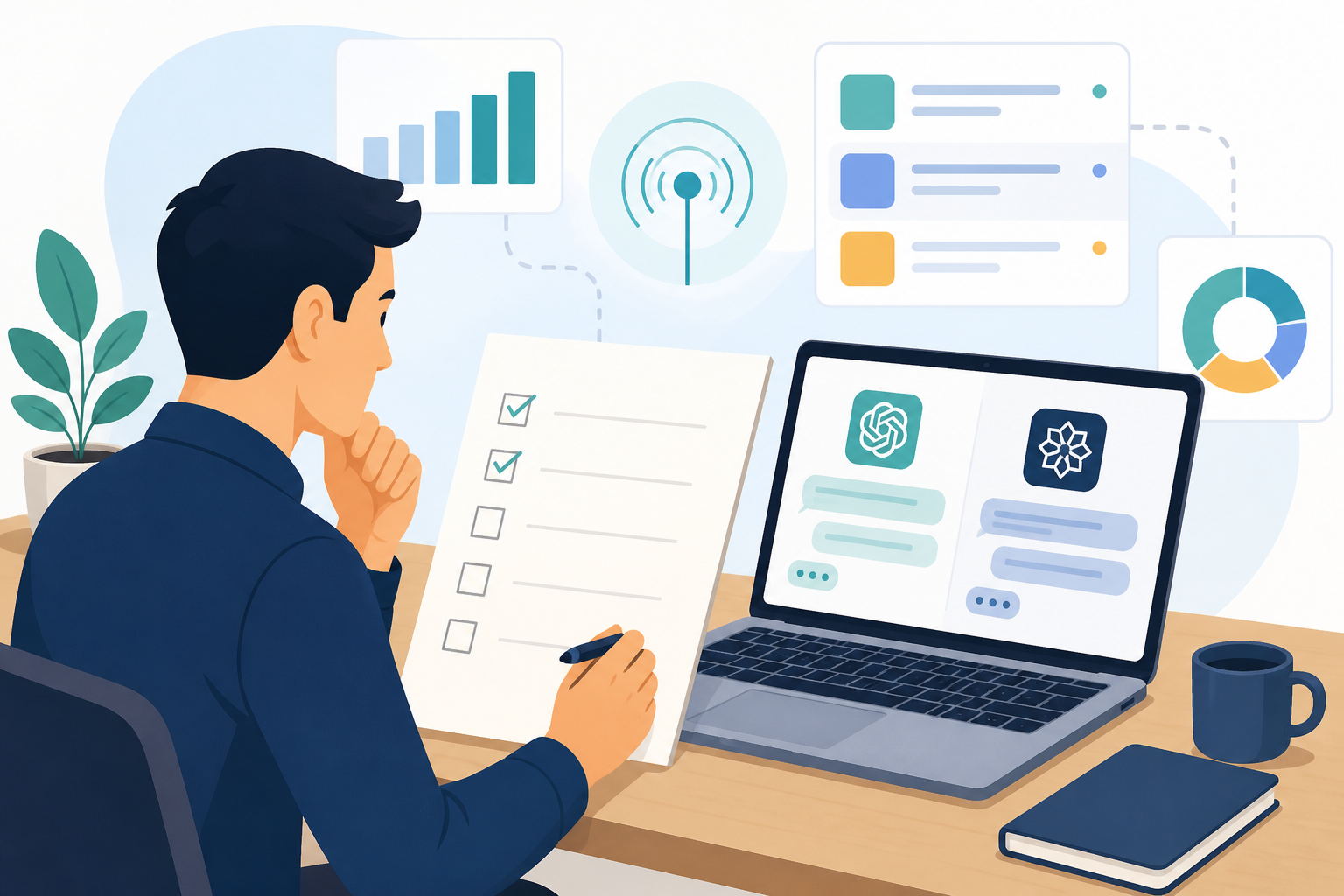
If most of these describe your situation, keep doing what you're doing. Revisit the decision in three to six months, or the moment any of these conditions change.
Signs you're already losing time and AI visibility
Now for the flip side. Score yourself against the list below. If two or more apply, the maths has likely already tipped toward automated tracking, whether or not you've admitted it yet.
- You've forgotten to check for two or more weeks at a stretch. AI visibility checking is exactly the kind of task that quietly slides down the priority list until it disappears.
- You've discovered a competitor being recommended instead of you, after the fact. Finding out weeks later that ChatGPT has been steering prospects toward a rival is a lagging indicator you can't afford in a fast-moving category.
- You can't answer "what did ChatGPT say about us last month" without redoing the search. No historical record means no way to spot trends, only a single noisy snapshot.
- You're manually copy-pasting the same 10-15 questions into multiple chat windows. This is exactly the repetitive, low-judgement task automation exists to remove.
- You have no visibility into sentiment or citation position, only whether you appeared at all. A favourable, well-positioned mention is meaningfully different from being buried below three competitors or described unfavourably, but manual checking rarely captures that nuance consistently.
- Your site has grown past a handful of pages, and the AI-generated questions about you have multiplied beyond what you're testing. More content means more surface area for AI engines to draw from, and more question permutations you're not covering.
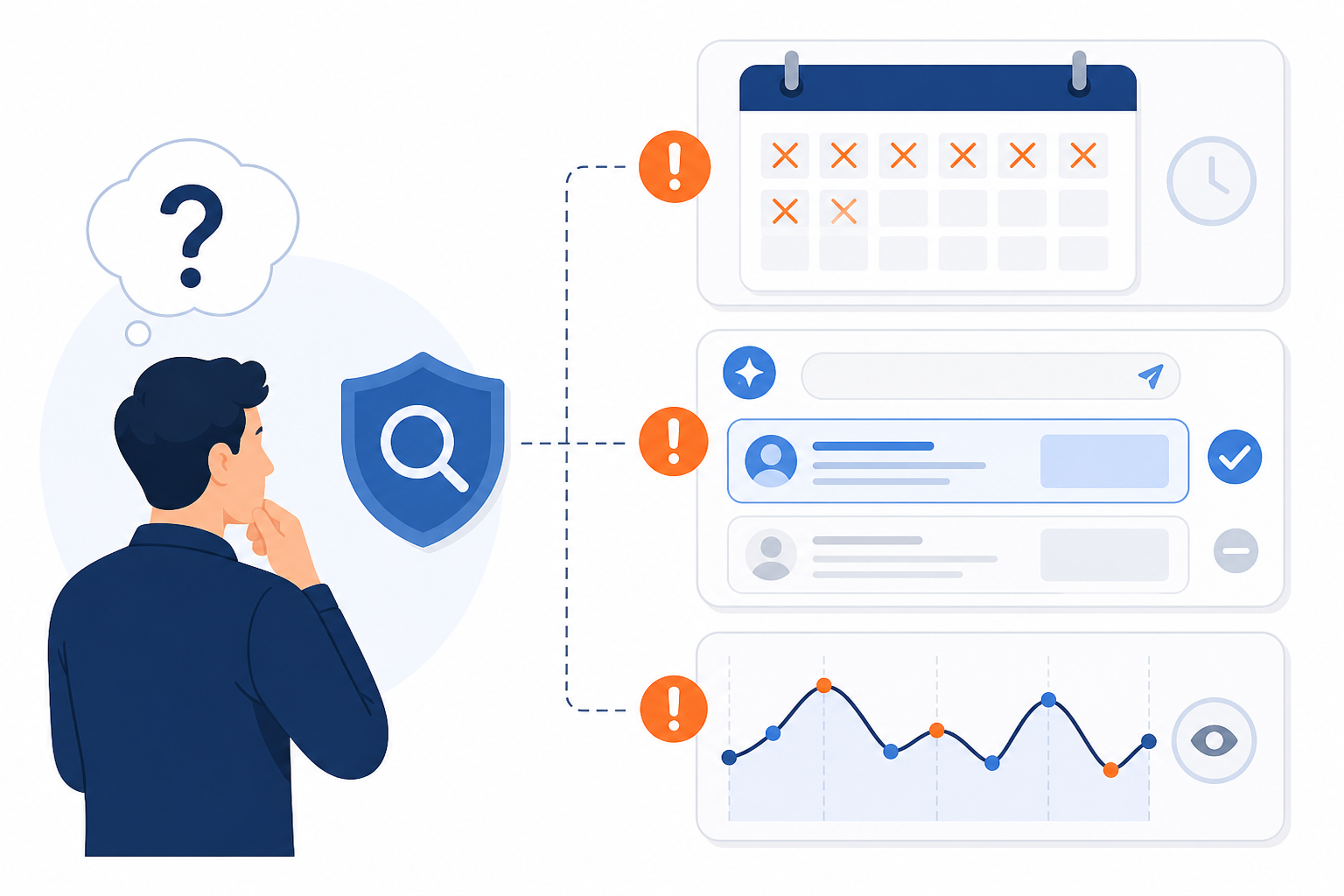
Scoring guide: 0-1 signals means manual checking is probably still adequate; revisit monthly. 2-3 signals means a lightweight tool trial is worth running now. 4+ signals means you're very likely already losing visibility you can't see, and a structured tool should be a near-term priority.
What does an AI visibility tool actually automate?
"AI visibility tool" can sound abstract until you see the specific mechanics being automated. Capabilities vary by provider, so I'll describe what's common across the category, then flag where specific tools, like MentionOwl, which I'll use as a working example, differ.
Common across most credible tools in this category:
- Generating realistic customer questions people actually ask AI about your category, rather than only the ones you'd think of yourself. Founders consistently underestimate the phrasing variety real buyers use.
- Running those questions against multiple AI platforms on a schedule, typically daily. This is the part that's genuinely impractical to replicate by hand at scale.
- Recording citation position and sentiment, not just presence. "Citation position" means where in the AI's answer your brand is mentioned relative to competitors, earlier and more prominent citations tend to carry more influence. "Soft mentions" refers to indirect references where your brand is implied or described without being explicitly named or linked.
- Tracking competitor mentions in the same queries, giving you share of voice rather than an isolated result.
- Producing a composite visibility score (MentionOwl uses a 0-100 scale built from query coverage, position-weighted citations, and share of voice). Treat any such score as a useful trend indicator, not an absolute measure. Methodology differs between providers and none of them claim perfect accuracy.
- Technical "AI legibility" audits, checks on your site's structure (things like structured data markup, clear page hierarchy, and FAQ markup) that affect how easily AI crawlers can parse and cite your content. MentionOwl runs 16 such checks; the exact number and focus varies by provider.
- Scheduled digests so insight arrives whether or not you remembered to check that week.
- API or integration access (MentionOwl offers a REST API and MCP server) for founders who want the data flowing into their own dashboards rather than living in a separate tool.
I'd encourage verifying these specifics against current product documentation before treating any of them as guaranteed. Feature sets change, and I'm describing MentionOwl's offering as of this writing rather than a universal standard.
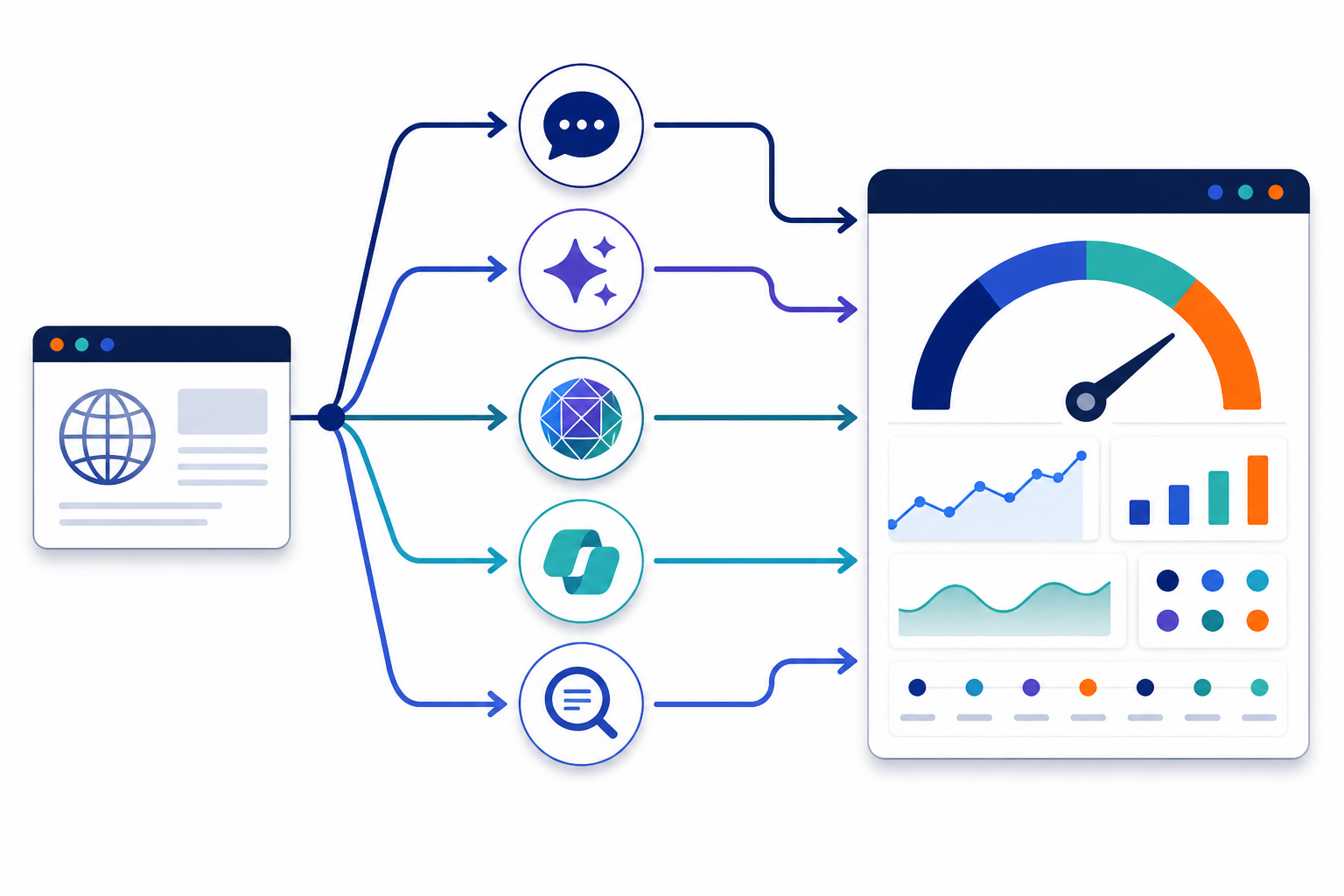
The real value isn't just speed, it's consistency. Manual checking is inherently sporadic and partial. Automated tracking, run daily across every major platform, gives you a dataset you can actually act on, though it's still an approximation of a system (AI model outputs) that shifts over time.
AI visibility tool cost vs the cost of your time: a worked example
Let's run an honest calculation rather than a vague "it's worth it" claim.
The manual scenario: tracking one core query with 10 realistic variants across five platforms, checked once daily on weekdays, works out to 250 platform-query checks a week. Even at a conservative 15 seconds per check purely for the query-and-glance (excluding reading full answers or logging results), that's over an hour just executing the checks, before you factor in comparing answers to last week's, noting sentiment, or catching competitor mentions. Realistically, thorough manual coverage runs 1-2 hours weekly for most founders.
The cost comparison: if you value your time conservatively at £25-40/hour (roughly what you'd pay a competent freelance contractor in the UK), 1-2 hours weekly costs you £25-80 per week, or roughly £100-320 a month, in time alone. Set that against MentionOwl's published pricing (check their current site for exact tiers, as pricing changes) and a £1 seven-day trial. If a monthly plan sits meaningfully below your monthly time cost, the arithmetic favours the tool. If your effective hourly rate is much lower, or if you only check sporadically rather than thoroughly, the case is weaker and worth testing before committing.
The time cost is only half the equation. The other half is what manual checking is likely to miss: sentiment shifts that happen gradually between spot-checks, competitor gains in share of voice only visible when tracking trend lines rather than snapshots, and technical AI legibility issues on your own site that no amount of prompting ChatGPT will reveal, because those problems live in your site's structure, not the AI's output.
To be fair to the other side of the argument: if your time genuinely has low opportunity cost right now, between projects, deliberately slowing down, or not yet at a stage where AI visibility affects revenue, manual checking might remain the rational choice for a while longer. No tool "pays for itself" if you're not checking often enough to feel the time cost in the first place.
How to trial an AI visibility tool without overcommitting
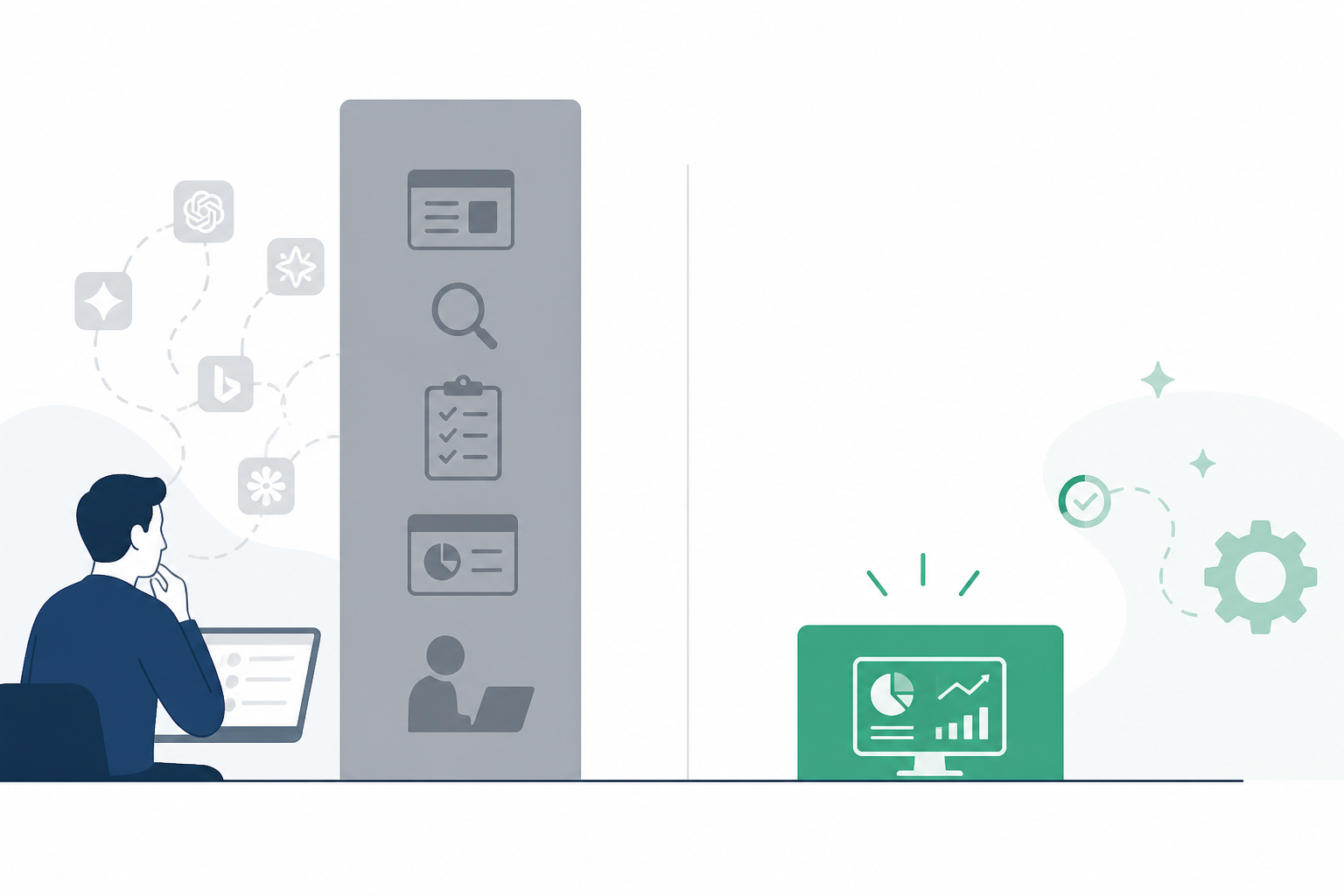
If the assessment above points you toward "I probably need this," I'd still avoid an annual contract on the first look. Here's a due-diligence approach, followed by what to actually verify before you subscribe.
- Start with a short, low-cost trial rather than an annual commitment. MentionOwl offers seven days for £1 specifically so founders can test real value before spending real money.
- Compare the tool's first-week findings against your own most recent manual check. This is the most revealing exercise. You'll see quickly what it catches that you missed.
- Watch for competitor names you didn't expect to see cited. This is often where founders get the biggest wake-up call, discovering share-of-voice gaps they didn't know existed.
- Review the AI legibility audit results carefully. This often surfaces technical fixes, structured data issues, unclear page hierarchy, missing FAQ markup, that manual checking would never reveal.
- Decide based on trial data, not marketing copy. Ask two concrete questions: did it save time, and did it find something you genuinely didn't already know?
Before you subscribe beyond the trial, verify:
- Cancellation terms — can you cancel monthly, or are you locked into a longer minimum term after the trial?
- Query and platform limits — does the plan you'd actually pay for cover all five platforms and enough query variants for your real buyer journey, or is that reserved for higher tiers?
- Data retention — how long does historical tracking data remain accessible if you pause or cancel?
- Attribution methodology — how does the tool determine sentiment and citation position, and does it disclose margin of error given that AI outputs vary between runs?
- Terms of use compliance — automated querying of AI platforms should comply with each platform's terms of service; it's worth confirming the provider addresses this rather than assuming it.
A trial should be judged a failure, not a success, if it simply confirms what you already suspected without revealing new gaps or saving meaningful time. In that case, manual checking may still be sufficient for your stage.
Frequently asked questions about AI visibility tools
How do I know if I actually need an AI visibility tool?
Use the scoring guide in this article: score yourself against the "already losing time and visibility" signals. Zero or one applies, and manual checking is probably still fine. Two or three, and a trial is worth running. Four or more, and you're likely already losing visibility you can't currently see.
What does an AI visibility tool do that I genuinely can't replicate manually?
The core difference is consistency at scale: running the same queries across five platforms daily, logging citation position and sentiment over time, and tracking competitor share of voice as a trend rather than a snapshot. Technically-minded founders could approximate parts of this with a spreadsheet and scheduled reminders, but few sustain it beyond a few weeks, which is itself the argument for automation.
Are AI visibility tools affordable for a solo founder, or built for enterprise budgets?
Pricing varies by provider. MentionOwl starts with a £1, 7-day trial before moving to paid monthly plans, check current pricing directly, as it changes. Whether it's "affordable" depends on your checking frequency: if you'd only check sporadically anyway, the monthly cost may exceed the time it actually saves you.
Is there a low-risk way to try an AI visibility tool before committing budget?
Yes. Favour providers offering short, low-cost trials over annual contracts. Use the trial to compare findings against your own manual check, and check cancellation terms and query limits before the trial converts to a paid plan.
How accurate are AI visibility tools, and should I trust the visibility score completely?
Treat any visibility score as a directional trend indicator, not an exact measurement. AI model outputs vary between identical runs, citations change as models update, and results can differ by region or personalisation. A tool's value lies in consistent, repeated measurement over time, not in any single number being precisely "correct."