AI SEO vs Traditional SEO: What Actually Changes for Brands
A side-by-side comparison of AI SEO and traditional SEO: goals, metrics, tactics and reporting. See what carries over, what to measure anew, and how t

AI SEO does not replace traditional SEO; it extends it. Search engines still reward crawlable, authoritative, well-structured content, but generative tools such as ChatGPT, Gemini and Perplexity increasingly decide whether to recommend, cite or merely mention your brand. Success therefore shifts partly from rankings and clicks towards citations, share of voice and sentiment. For most UK marketing teams, the sensible response is to keep existing SEO foundations intact and add a separate measurement layer for AI visibility. Below I cover what carries over, what changes, and how to report it with numbers that survive scrutiny.
Is SEO dead because of AI? The short answer for leadership
No, and the 'SEO is dead' narrative misreads what is changing. People are finding things through more interfaces than before, but they still need content they can find and trust. Google's documentation on AI features states that the same foundational practices apply to AI Overviews and AI Mode: pages must be indexed and eligible to appear in Search, and there are no additional technical requirements or special markup. Other platforms differ. Some AI search experiences retrieve and cite live web content, while others lean more on training data, and each has its own rules for access and source selection. The fundamentals you already maintain help, but they do not guarantee inclusion anywhere.
The evidence does show that clicking behaviour is shifting. Every study below is international or US-based, and none is a UK measurement, so I would treat them as context rather than prediction:
- Pew Research Center (US, March 2025, 68,879 searches from 900 adults; observational browsing data) found Google showed an AI summary on 18% of searches. Users clicked a traditional result in 8% of visits when a summary appeared, against 15% when it did not, and about 1% clicked a link inside the summary.
- Ahrefs (April 2025, 300,000 keywords; observational) associated an AI Overview with a 34.5% lower average click-through rate for the top-ranking page. This is a correlation across keywords, not a controlled experiment.
- SparkToro and Datos (2024) estimated that 58.5% of US and 59.7% of EU Google searches ended without a click to the open web. That baseline predates generative search, and the EU figure is not a UK measurement.
- Gartner forecast in 2024 that traditional search volume would fall 25% by 2026. That is a forecast, not a measured outcome.
What should leadership conclude? Informational queries may deliver fewer clicks even when your content is working, and a falling click-through rate on those queries is not, on its own, proof of falling relevance. They should not conclude that SEO investment can be redirected wholesale, or that these studies describe what will happen to your brand. I would frame AI search as an additional channel with its own measurement needs, and then test your own category: filter Search Console by United Kingdom and compare click-through trends on informational queries before and after AI features appeared for your topics.
Rankings vs recommendations: how AI SEO changes the goal
Traditional SEO is built around ten blue links. You track a position for each keyword, and because results are reasonably stable, a weekly rank check is a credible measure of progress. AI search produces something different: a single synthesised answer in which brands are named, ranked, compared or left out entirely. Competition moves from the page to the brand, and from the keyword to the question.
That answer is also less stable. The same question can yield different responses across ChatGPT, Claude, Gemini, Copilot and Perplexity, because each platform uses different models, retrieval methods and sources, and answers can vary between runs on the same platform. A single manual check is an anecdote, not a measurement.
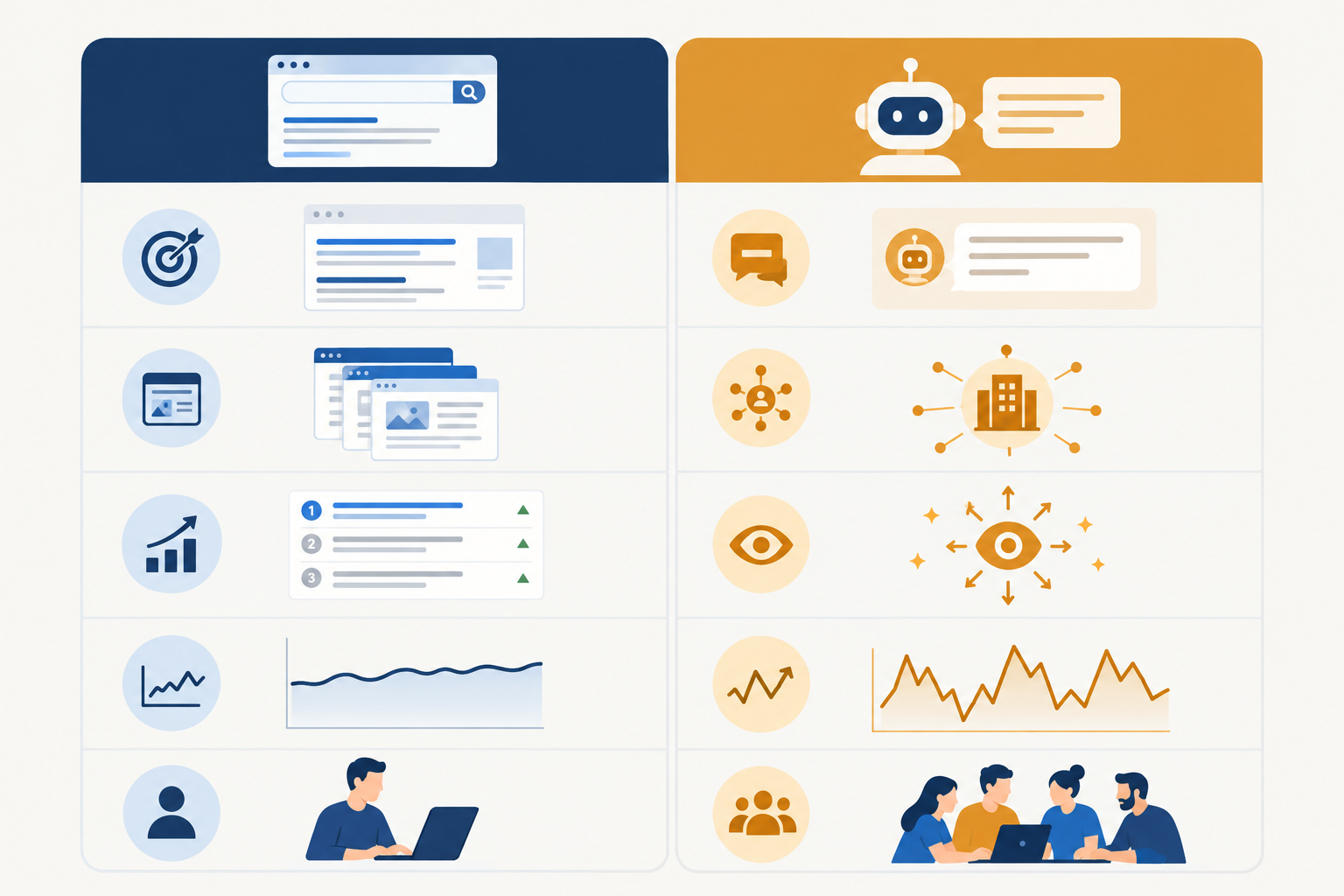
| Dimension | Traditional SEO | AI SEO |
|---|---|---|
| Goal | Rank highly and earn the click | Be recommended, cited or accurately described in an answer |
| Unit of competition | Page, per keyword | Brand and entity, per question |
| User journey | Query, results page, click, site visit | Question, synthesised answer, possible follow-up, optional visit |
| Primary metrics | Rankings, impressions, clicks, conversions | Query coverage, citations, share of voice, sentiment |
| Volatility | Moderate; weekly tracking is adequate | High; varies by platform, run and day |
| Typical owner | SEO or organic lead | Often unowned; sits between SEO, content and PR |
Which term should you use for AI SEO internally?
The terminology is messy. AI SEO, generative engine optimization (GEO), AI search optimization and answer engine optimization (AEO) are used inconsistently, and none is an established replacement for SEO. The GEO label comes from academic research (Aggarwal et al., ACM SIGKDD 2024), which reported visibility gains of up to 40% in its benchmark from methods such as adding statistics, quotations and citations. That is a best-case result from a controlled study, not a forecast for any individual brand. The terms overlap heavily in practice, so I advise picking one umbrella term and defining it once. 'AI SEO' is the one non-specialists understand most readily.
Clicks vs citations and soft mentions: what counts as an AI SEO win?
Two outcomes need defining before anything can be measured. A citation is a linked source within an AI answer. A soft mention is your brand named in the answer without a link. Both can influence purchase decisions, because a buyer who reads 'consider these three providers' has been influenced whether or not they click. A citation is a visibility outcome, a click is a referral outcome, and neither proves a conversion on its own. Record citation share, referral visits and conversions as three separate measures, so a rise in citations is never presented as incremental demand without click or conversion data.
This is why sessions give an incomplete picture of influence. Pew's finding that only about 1% of visits included a click within the AI summary shows how far answer exposure can diverge from traffic. Google reports AI feature traffic within the overall Web search data in Search Console, with no standalone report, so you cannot isolate it there. Microsoft has taken a different route with an AI Performance report in Bing Webmaster Tools, which shows how often a site is cited in Copilot and selected AI-generated answers. It suggests citation visibility is becoming its own reporting line, though it covers one ecosystem only.
Two further points sharpen the picture. Position matters: being the first recommendation is not equivalent to appearing fourth in a list. And sentiment changes the value of visibility, because a mention framed as 'the cheaper alternative' or 'with known reliability issues' may cost you sales.
What still carries over from traditional SEO to AI SEO?
If your team already runs a mature SEO programme, much of the work transfers.
- Crawlability and clean technical foundations. Retrieval-enabled AI tools may use pages they can access as sources, so keeping important content in crawlable text rather than images or script-dependent rendering improves eligibility. It does not guarantee citation, and some answers draw on training data or other sources entirely.
- Topical authority and genuinely useful content. Pages that answer real buyer questions and demonstrate first-hand expertise remain the raw material for citations.
- Earned mentions, reviews and third-party coverage. These can influence which sources retrieval systems surface and, over longer horizons, what appears in training data. Platforms differ and the mechanisms are not fully transparent, but digital PR and review management plausibly serve both channels.
- Structured data, clear headings and answer-first writing. Structured data must match visible content, and Google is clear that it guarantees neither a rich result nor an AI citation.
- Consistent brand facts. Conflicting details about pricing, locations or services across your site, directories and profiles can produce inaccurate answers.
- Internal and external links. Links still help discovery and context.
'AI legibility' is just an extension of the technical audit you already run: checking robots rules, rendering, schema and page clarity to see whether AI crawlers can access your content, and whether key facts are stated plainly enough to be quoted accurately.
What changes in AI search optimization? Tactics side by side
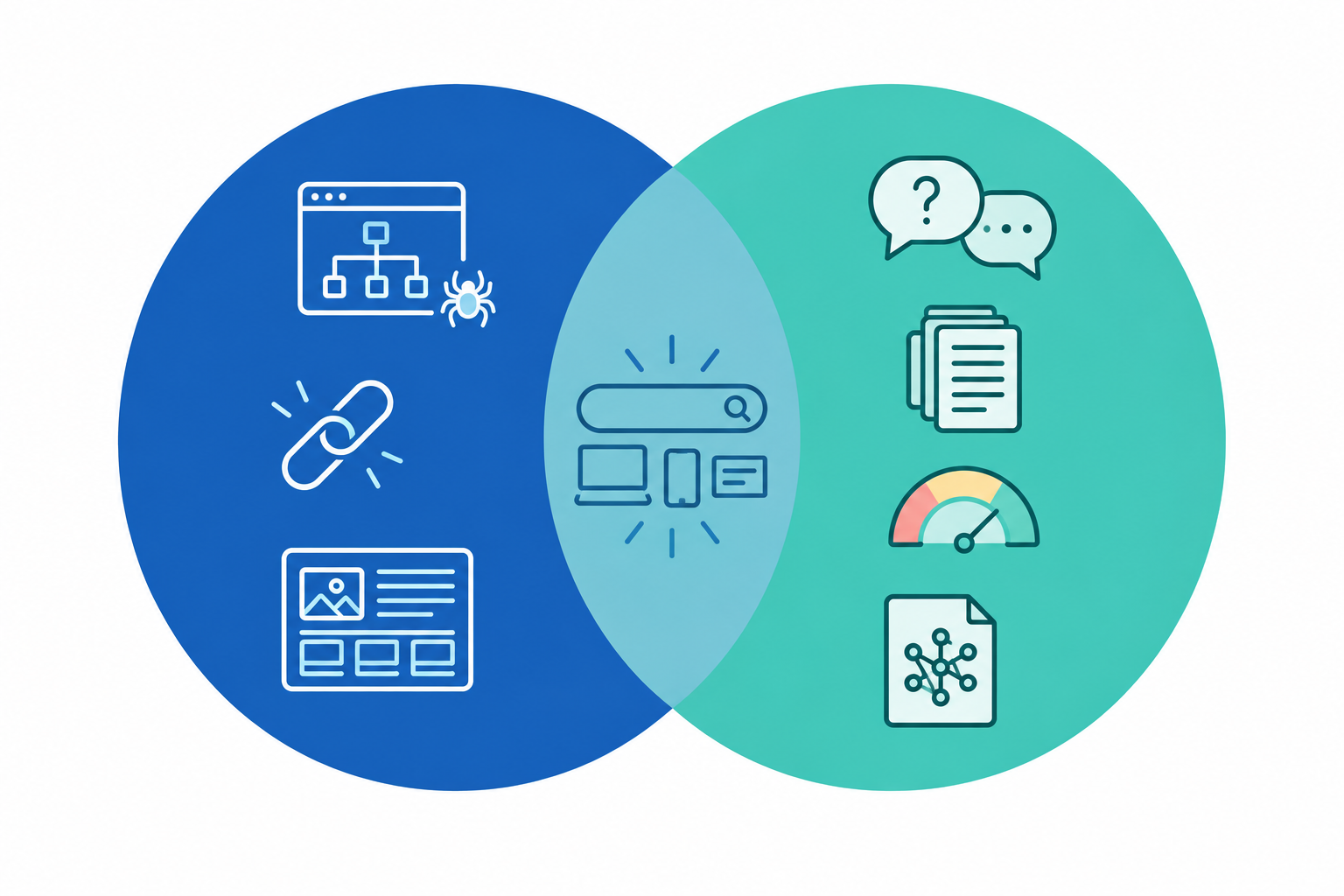
| Area | Traditional SEO | AI SEO |
|---|---|---|
| Targeting | Keywords and head terms | The full set of customer questions, mapped to the buying journey |
| Authority signals | Backlinks | Citation-worthy sources: original data, clear definitions, honest comparisons |
| Optimisation level | Page by page | Entity-level consistency across your site and the wider web |
| Competitor analysis | SERP overlap | Who is named alongside you in AI answers, and in what order |
| Cadence | Weekly or monthly rank checks | Repeated sampling, because answers fluctuate |
Designing content around questions means covering comparisons, alternatives, pricing, suitability and objections, because those are the queries where recommendations are actually made. Original reporting and first-party research are more useful to cite than generic summaries, though nothing guarantees a citation. Be wary of any vendor that promises control over model outputs. Models are probabilistic, retrieval sources change, and no markup or file format forces inclusion. The defensible position is that you can improve the likelihood of being understood and cited, and measure the outcome honestly.
New AI SEO metrics to add to leadership reporting
I recommend adding the following to your existing organic reporting rather than replacing it. None is an industry standard. Each is a custom index whose value depends on the sampling and scoring rules below, so figures are comparable only with your own past figures under the same rules, never with another vendor's.
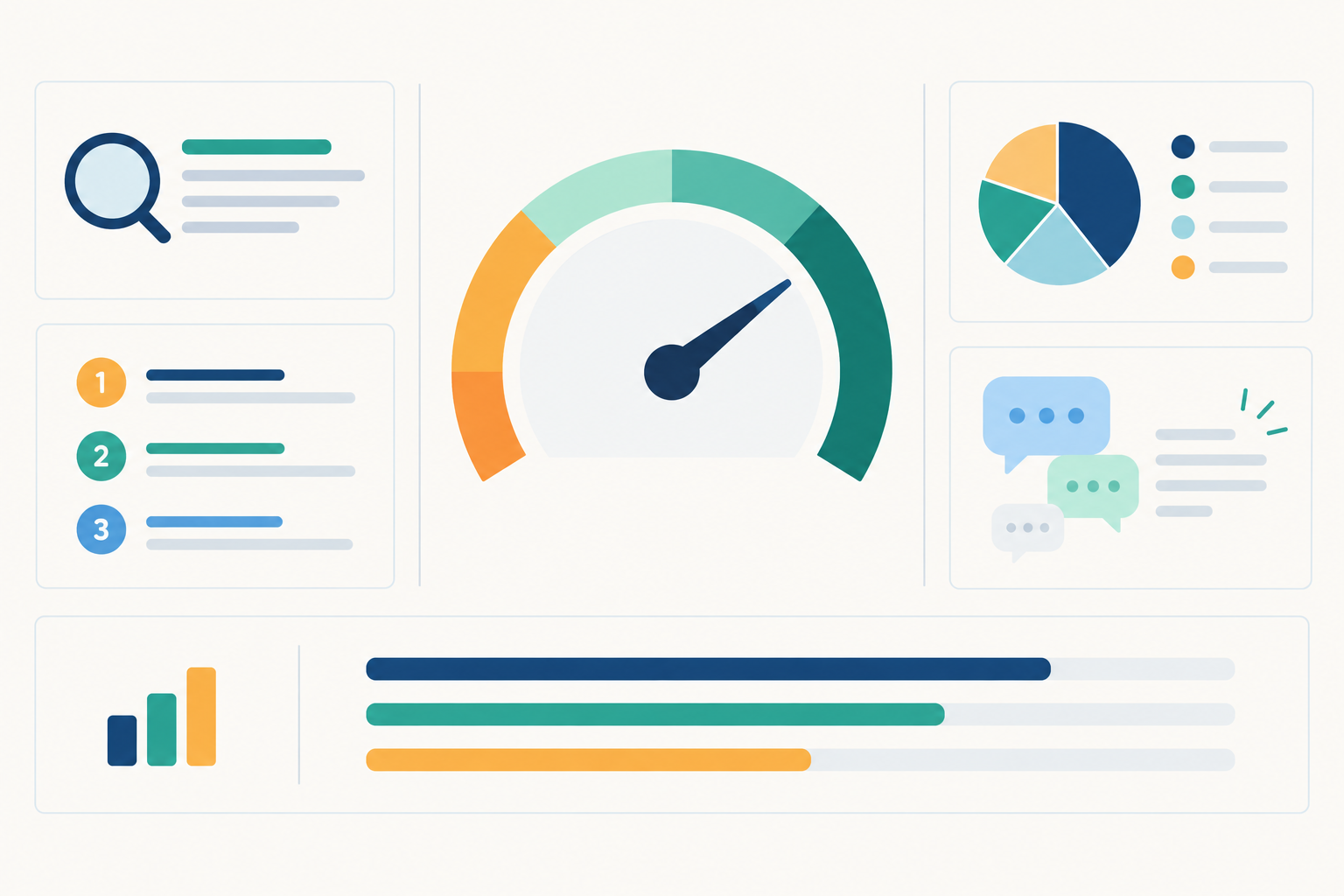
- Query coverage: answers naming your brand at least once ÷ total answers. A brand is counted once per answer, however often it is repeated within it.
- Position-weighted citations: for each answer, take the weight of your brand's first position (see below), then divide the sum of weights by total answers.
- Share of voice (SOV): answers naming your brand ÷ the sum of answers naming each brand on your fixed list (you plus named competitors). Each brand is counted once per answer, so SOV counts answers, not individual mentions. This is the metric most likely to resonate with a board, because it frames performance against the market.
- Soft mention rate: answers naming your brand without a link ÷ answers naming your brand. Traditional analytics will never capture these.
- Sentiment and framing: the share of mentions coded positive, neutral or negative using a written rubric.
- Composite visibility score: a 0-100 index gives leadership a single trendline, but any score is vendor-specific or in-house. Show the components beneath it and document the weighting.
- AI referral traffic: visits from AI platforms, identified through referrers. Treat this as a lagging indicator, since citations without clicks are common.
Methodology: how to make AI visibility numbers reproducible
Define these once, apply them identically to every platform and period, and record them in your reporting notes:
- Unit: one 'answer' is one question run on one platform once. Total answers = questions × platforms × runs.
- Position weights: a fixed scheme, unchanged mid-quarter. An illustrative convention is 1.0 for the first brand named, 0.7 for second, 0.5 for third and 0.3 for fourth or lower.
- Sentiment coding: a written rubric with examples, with two people coding a sample to check agreement.
- Competitor list: fixed and stated in the report.
Here is a worked example. A UK accountancy firm samples 40 questions across 3 platforms with 3 runs each, giving 360 answers. Its brand is named in 90 answers, so query coverage is 90 ÷ 360 = 25%. Competitor A is named in 120 answers, Competitor B in 70 and Competitor C in 20. Counting each brand once per answer, SOV is 90 ÷ (90 + 120 + 70 + 20) = 90 ÷ 300 = 30%. If the firm is named first in 30 answers, second in 40 and third in 20, its position-weighted score is (30 × 1.0 + 40 × 0.7 + 20 × 0.5) ÷ 360 = 68 ÷ 360 ≈ 0.19. Finally, if 20 of its 90 answers frame it as 'more expensive', sentiment tells leadership something the raw 25% does not.
Is an AI SEO change real? A simple check on uncertainty
Three runs per question is a starting minimum for seeing how much answers vary. It is not proof of statistical reliability. For a rough guide, the margin of error on a proportion is about 1.96 × √(p(1 − p) ÷ n). For the 25% coverage above with 360 answers, that is roughly ±4.5 percentage points. Because the same 40 questions are repeated, the true uncertainty is larger, so treat that figure as optimistic. My working rule is to compare each period's range across runs, treat movement within that range as noise, and declare a real change only when it persists across several reporting periods.
How to measure AI SEO success step by step
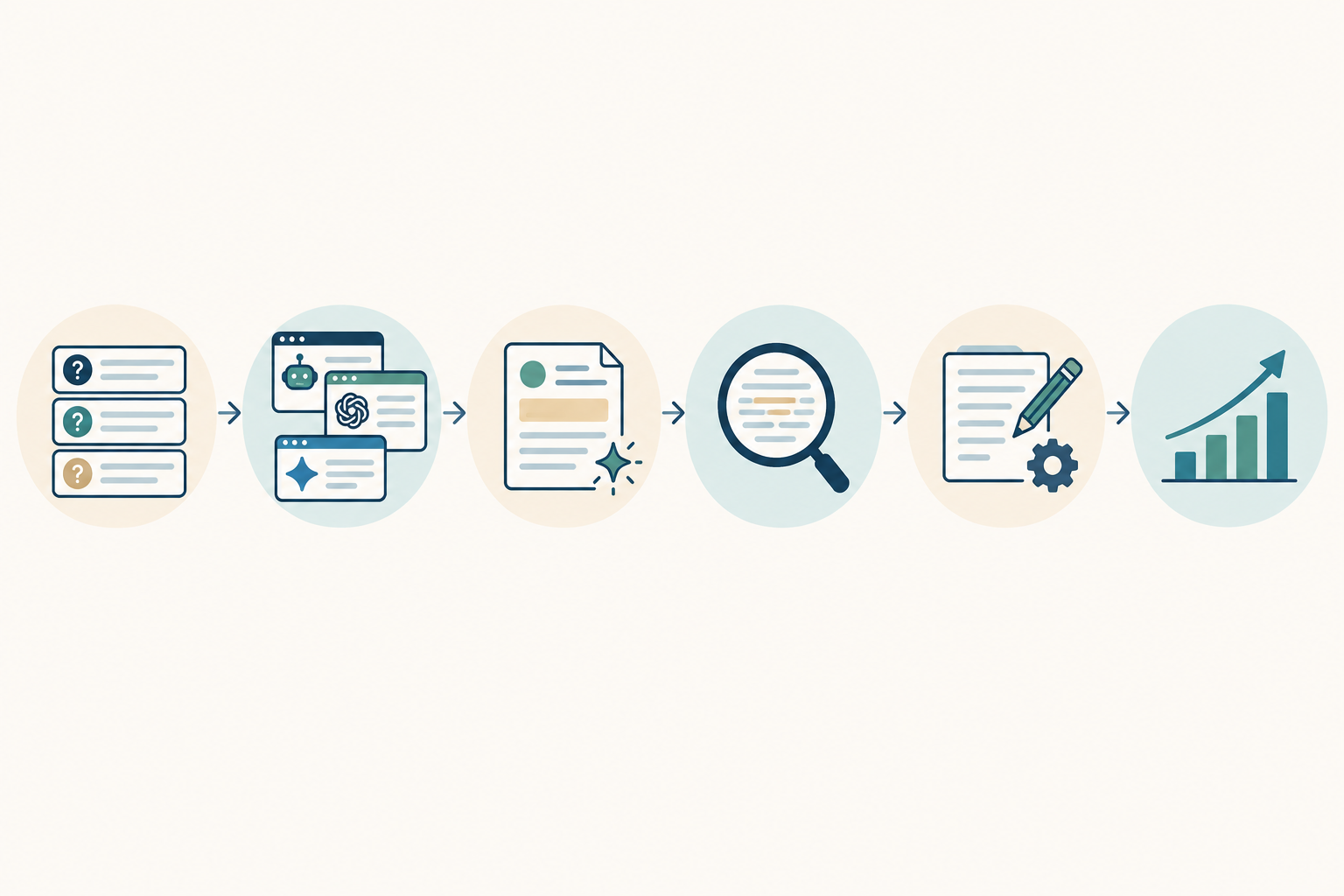
A note on the diagram: daily checks suit larger question sets, while a smaller team can run the same six steps on a fixed weekly schedule with repeat runs.
- Build a question set from real customer queries. Use sales calls, support tickets, search data and on-site search, mapped to the buying journey and written with UK phrasing.
- Run the questions on a fixed schedule across the major platforms. Cover ChatGPT, Claude, Gemini, Copilot and Perplexity, recording answers, citations, sentiment and competitors named. A team with 15 to 20 priority questions can run them manually each week with repeat runs. Automation becomes practical once the question and platform count outgrow what a person can record consistently.
- Establish a baseline. Capture your metrics before changing anything, so later movement can be attributed with some confidence.
- Audit AI legibility. Identify pages that models may struggle to read, render or trust.
- Make targeted changes and track across several periods. One week of data rarely settles anything.
- Report with trends, competitor comparisons and caveats. State where results vary and what the data cannot tell you. Weekly digests suit the working team, and monthly trend summaries suit the board.
A UK AI SEO testing protocol
Most published evidence is US-centric, so validate visibility in your own market:
- Phrase queries as UK buyers would ('solicitor', 'trainers', 'VAT', '£' pricing) and include UK place names where location matters.
- Record the platform, model or mode, date, location and language settings for every run, and note whether the session was logged in.
- Compare a clean session with a logged-in one, since personalisation can alter results.
- Cross-check against Search Console data filtered to the United Kingdom, and against UK-only referral traffic in your analytics.
How to split effort between traditional SEO and AI SEO
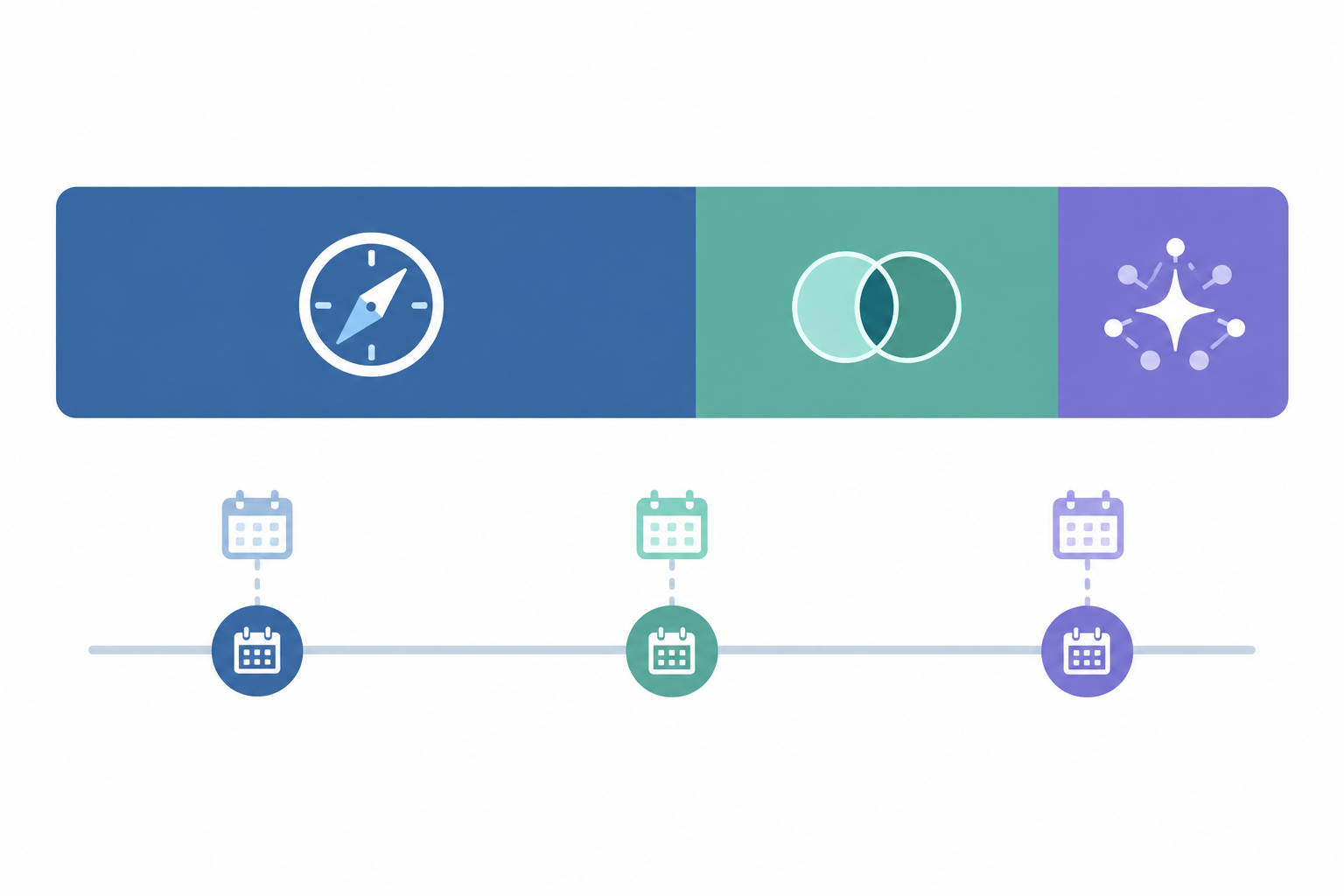
There is no industry benchmark for allocation. As a planning example only, a small team might begin with roughly 70% of effort on existing SEO foundations and 30% on AI-specific work. Treat that as a starting hypothesis and adjust it according to how much AI search affects your category (software, professional services and travel may justify a larger share sooner) and what your measured outcomes show. If AI features rarely appear for your queries, shift effort back towards core SEO.
| Work type | Examples | Serves |
|---|---|---|
| Shared tasks (prioritise first) | Crawlability fixes, answer-first content, original data, reviews and third-party coverage, consistent brand facts | Both channels |
| SEO-specific | Rank tracking, link acquisition, on-page keyword refinement, conversion optimisation | Traditional search |
| AI-specific | Question coverage, citation source analysis, sentiment fixes, AI legibility fixes, competitor mention tracking | AI search |
Shared tasks come first because they pay off in both places.
A simple 90-day AI SEO plan
- Days 1-30, baseline: build the question set, run repeat checks, record coverage, share of voice and sentiment, and complete an AI legibility audit.
- Days 31-60, fix: resolve legibility issues, correct inconsistent brand facts, and create or update content for questions where competitors are named and you are not.
- Days 61-80, expand: widen question coverage to later stages of the journey, and pursue third-party sources that already feature in competitors' citations.
- Days 81-90, report: present the trend, competitor comparison and caveats, and agree the next quarter's allocation.
Common AI SEO reporting mistakes to avoid
- Treating a single prompt check as evidence of visibility. Variation between runs and platforms makes one-off checks unreliable.
- Reporting mentions without sentiment or competitor context. A raw count says little if the framing is negative or competitors appear three times as often.
- Expecting AI visibility to move on the same timescale as rankings. Changes can take weeks to appear, and some will not move at all.
- Assuming US findings apply to the UK. Test UK-relevant queries using the protocol above.
- Attributing all traffic declines to AI. Seasonality, algorithm updates, tracking changes and long-standing zero-click behaviour all play a part. Compare branded and non-branded referrals, and annotate analytics when exposure changes.
Frequently asked questions about AI SEO
Is SEO dead because of AI?
No. AI answers draw on a mix of retrieved web content and model training, and crawlable, authoritative, well-structured content remains the foundation of both. What changes is where influence happens, so you need to measure citations and mentions alongside rankings and clicks.
Do I need separate AI SEO work?
Mostly it is an extension rather than a separate programme. Existing technical and content work carries over, but tracking question coverage, competitor mentions, sentiment and AI legibility needs distinct tasks that traditional SEO tools do not cover.
How do I measure AI SEO success?
Track a fixed set of customer questions across the main AI platforms, calculate query coverage, share of voice, position-weighted citations and sentiment using the definitions above, and report the trend against named competitors rather than single results.
What is the difference between generative engine optimization and answer engine optimization?
The terms overlap heavily. AEO usually refers to being the chosen answer in featured-answer experiences, while GEO focuses on inclusion in synthesised responses from large language models. The tactics and measurement are largely the same.
How often should we check AI visibility?
Use a fixed schedule that fits your scale: daily for large question sets, weekly with repeat runs for smaller teams. Report to leadership on monthly trends.
The bottom line: AI SEO extends traditional SEO
Keep the SEO foundations that already earn you traffic, and add a measurement layer for the part of discovery that happens inside AI answers. Define your metrics once, test with UK phrasing, sample on a fixed schedule, and report trends with their caveats. That gives leadership a defensible picture without overstating what the data can show.
Disclosure: MentionOwl is the product our team builds. If you would rather not run the tracking yourself, it offers a $1 seven-day trial that runs customer questions across the major AI platforms and reports visibility, share of voice and competitor mentions. Its scoring rules are its own, so check its methodology against the definitions above before comparing figures. 🦉