Adding AI Visibility Monitoring to Your Agency's Service Menu: A Go-To-Market Blueprint
A data-driven guide for UK agencies on pitching, packaging, and pricing AI visibility monitoring as a new service line—without adding manual workload.
AI Visibility Monitoring for UK Agencies: A Go-to-Market Blueprint
UK agencies can turn AI visibility monitoring into a profitable new service line by running a low-cost diagnostic audit first, using that audit to demonstrate a genuine gap in a client's ChatGPT, Gemini, or Perplexity presence, and then converting that evidence into a recurring retainer priced somewhere between £250 and £750 a month depending on scope. That's the short answer. The longer answer, which is what this post is actually about, is that the pricing structure matters far less than the delivery model behind it. Agencies that scale this service profitably are the ones that automate query generation, citation tracking, and reporting from day one, rather than relying on a team member manually prompting five different AI tools client by client. That single operational decision is usually what separates a high-margin line item from a task that quietly eats into account profitability by month three.
What follows is the blueprint I'd walk through with any UK agency owner asking how to build this properly: the market signals that justify the pitch, a pitching sequence with a script you can adapt, packaging and pricing decisions with worked examples, the delivery infrastructure that makes AI SEO scalable, and a 30-day plan for actually launching it. I'll flag where a claim is well-evidenced, where it's a reasonable inference, and where it's simply the pattern I've observed across the agencies I've spoken with — because a service built on overclaimed data is not one I'd want to sell to a client.
Why UK Clients Are Starting to Ask About AI Visibility Monitoring
The underlying shift in how people research purchase decisions is real, even if some of the numbers agencies quote to justify it are stretched further than the source material supports. Google's own documentation confirms that AI Overviews expanded to more than 100 countries and territories by the end of 2024, having launched first in the United States in May of that year. That's a documented rollout, not a projection.
Ofcom's Online Nation 2024 report found UK adults spending an average of more than four hours online per day across devices. I'd be careful here, though: that report measures overall internet use, not a specific migration toward AI-mediated research, so I won't claim it proves what agencies want it to prove. What I can say with more confidence is that Gartner's widely cited forecast — that traditional search engine volume could fall by 25% by 2026 as users shift toward AI chatbots and virtual agents — is a global projection, not a UK-specific figure. It's the number agency owners use most often in budget conversations, but it should be presented to clients as an industry-wide directional signal, not as measured UK behaviour.
On the UK-specific side, two data points are worth citing directly. The Competition and Markets Authority has formally flagged AI foundation models as an emerging competition issue requiring regulatory attention, which tells us the UK policy environment is already treating this shift as structurally significant. And UK government research (DSIT's AI adoption research) found that roughly one in six UK businesses had adopted at least one AI technology by 2024 — a baseline that's likely understating current adoption given how fast the underlying tools have moved since that survey was fielded.
What this means practically: a UK customer can now ask ChatGPT, Microsoft Copilot, or Google's AI Overviews for a recommendation, a comparison, or a summary without ever landing on a conventional search results page. That's a visibility problem categorically different from a ranking problem. A brand can be mentioned, omitted, misrepresented, or quietly associated with a competitor inside a generated answer, and none of it shows up in Google Analytics or Search Console. This is also where the discipline sometimes called AI SEO, and the broader practice of brand monitoring across owned, earned, and now AI-generated channels, starts to converge into something agencies need a name and a service line for.
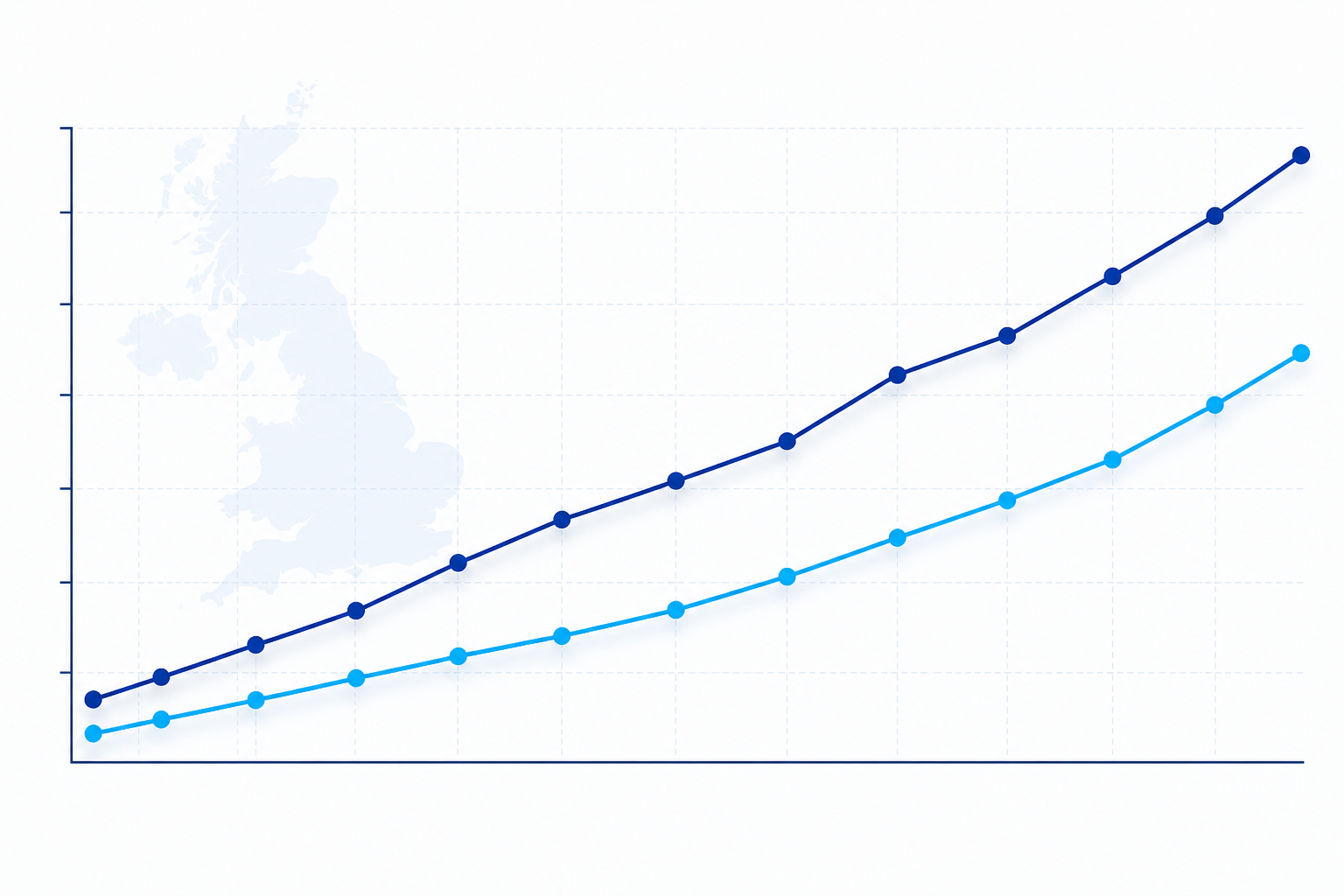
A note on that chart brief above: I haven't found a single authoritative, publicly available UK dataset that isolates purchase-research behaviour on AI platforms over a two-year period. If you're commissioning this visual for a client-facing deck, either source it from a specific study you can cite (several UK research agencies have started publishing smaller-sample surveys on this) or relabel it as an illustrative trend rather than measured data. Don't let a clean chart imply precision the underlying data doesn't have.
I'd flag three client-side signals that agencies are already encountering, often without a name for what's happening:
- Direct questions: "Why aren't we mentioned when someone asks ChatGPT for [category] recommendations?" This question is increasingly common from marketing directors who've tested prompts themselves out of curiosity.
- Referral anomalies: traffic patterns showing declines in certain informational queries that previously drove assisted conversions, with no corresponding drop in rankings.
- Competitive anxiety: clients discovering, usually by accident, that a named competitor is being actively recommended in AI-generated answers while they are not.
The gap between what traditional SEO reporting shows and what clients now want to know is widening. A rank-tracking report demonstrates position 3 for a target keyword; it says nothing about whether that same brand is cited, paraphrased, or ignored when a user asks Perplexity "which UK mortgage provider is best for first-time buyers." This is why generative engine optimisation is emerging as a distinct discipline rather than a subset of SEO — the mechanics of appearing in an AI-generated answer (structured data, clear factual statements, third-party citations, consistent NAP data across directories) overlap with SEO best practice, but the measurement layer is genuinely new, and it's a layer most agencies aren't yet reporting on.
The competitive window here is narrow but not because of any single statistic — it's because AI visibility monitoring, like rank tracking before it, will commoditise. The agencies that build early expertise, real case studies, and client trust now will hold a durable advantage. Agencies that wait will be selling a catch-up service into a market where clients already have a preferred provider.
How to Pitch AI Visibility Monitoring to Clients Who Haven't Asked Yet
The mistake I see most often is agencies trying to explain the concept before they have evidence. That's backwards. Here's the sequence that converts, along with a validation step most agencies skip.
- Run the baseline audit before the conversation, not during it. Use a low-commitment tool — MentionOwl's $1 trial is one option built for exactly this, though it's worth trialling two or three platforms before committing, since AI-generated answers can shift between runs and you want a tool that shows you consistent, reproducible output rather than a single lucky screenshot. Generate a visibility score and a handful of concrete citation examples across ChatGPT, Gemini, and Perplexity. Walk into the meeting with findings, not a pitch deck.
- Validate the output before you present it. Run the same five to ten prompts twice, ideally a day apart, before you show anything to a client. AI-generated answers are not static; a citation that appears once may not appear consistently. Presenting a single unverified snapshot as fact is the fastest way to lose credibility if the client tests it themselves and gets a different answer.
- Lead with competitor comparison, not theory. "Your competitor is being recommended in three out of five relevant AI queries and you're not" lands far harder and faster than any explanation of how large language models retrieve and rank sources.
- Anchor the conversation to the visibility score, but explain what it actually measures. A single 0-100 number is board-friendly in a way that citation-frequency tables aren't, but be upfront that it's a directional index built from a defined prompt set at a point in time — not an industry-standard metric like domain authority, and not immune to sampling variability. Clients who understand the limitation trust the number more, not less.
- Frame this as risk mitigation on the existing retainer, not a new pitch. If you already manage SEO or content for this client, position AI visibility as protecting the value of that existing investment, rather than competing for a fresh budget line.
- Bring verified screenshots, and use inaccuracies responsibly. If an AI-generated answer misquotes a price, cites an outdated service description, or gets a regulatory detail wrong, that's genuinely useful evidence — but the value is in showing the client a factual risk they need to correct, not in exploiting a scary-looking screenshot for shock value. Confirm the inaccuracy is reproducible before you present it, and frame the fix as protecting the client's customers from bad information, not just as a sales lever.
A sample opening line for the meeting: "We ran your brand and two named competitors through 40 questions your customers are likely asking ChatGPT and Perplexity this month. Here's what came back, and here's what it would take to close the gap."
Standalone AI Visibility Service or SEO Add-On?
This is the packaging question I get asked most, and the honest answer is that both models work — they suit different client profiles and different agency capacity constraints.
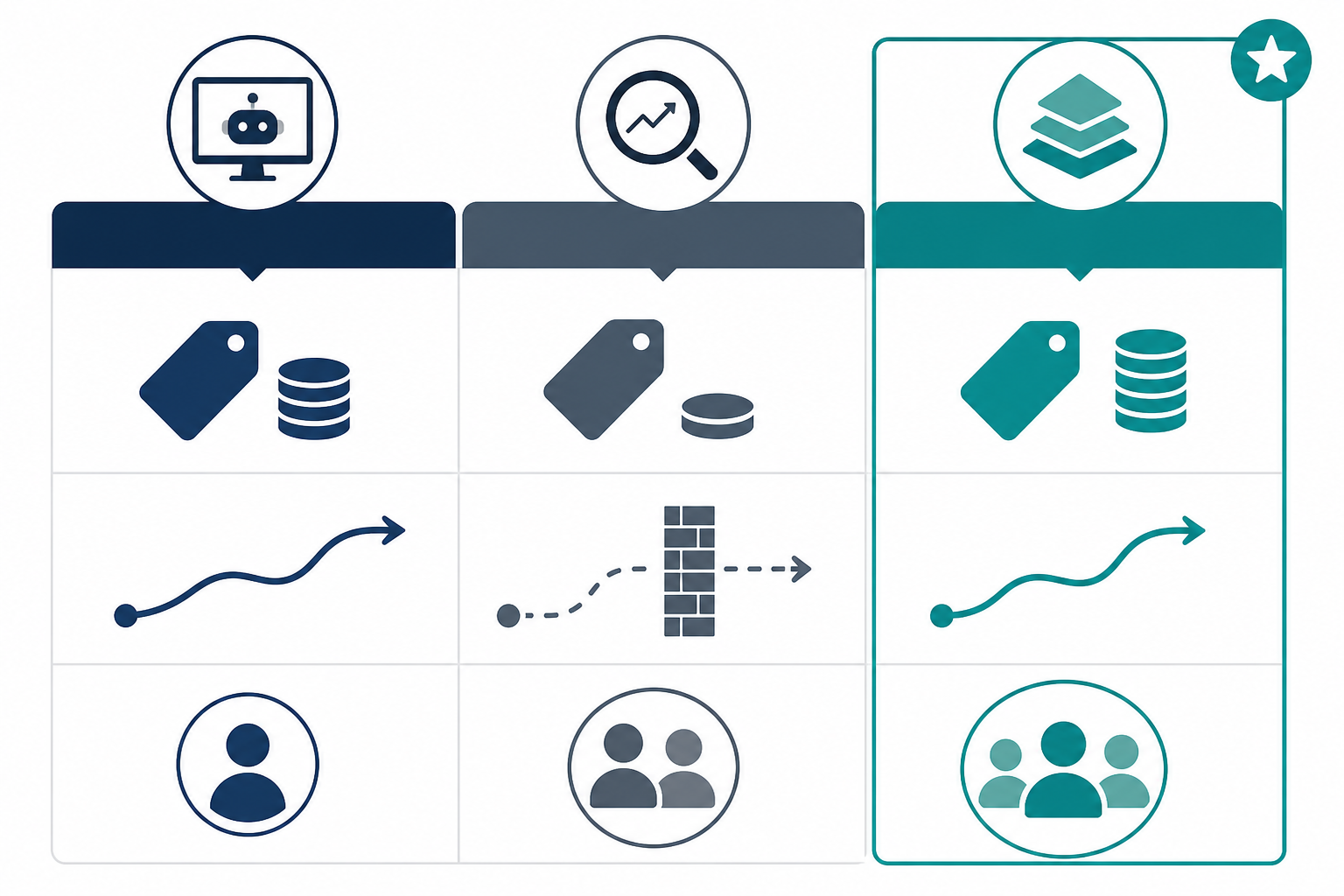
| Consideration | Bundled with SEO | Standalone Service | Hybrid Tiered Model |
|---|---|---|---|
| Sales friction | Low — existing trust and billing relationship | Higher — requires a fresh sales conversation | Moderate — upsell path with an unbundled option |
| Value attribution | Can blur with existing SEO wins | Clear and isolated | Clear within the tier structure |
| Client fit | Best for existing SEO/content retainer clients | Best for prospects without an SEO contract | Best for agencies with a mixed client base |
| Setup requirement | Minimal — extends existing onboarding | New onboarding, contract, and reporting cycle | Moderate — one onboarding flow, two output tracks |
| Gross margin control | Harder to isolate; risk of scope creep | Easiest to price and protect directly | Manageable if tiers have hard query/platform caps |
| Internal hours/month (est., per client) | 2–4 hours folded into existing SEO work | 4–8 hours as a dedicated deliverable | 3–6 hours, split across teams |
| Renewal risk | Lower — tied to a broader relationship | Higher — stands or falls on its own results | Moderate — protected by the SEO relationship underneath |
Most agencies I've spoken with in the process of researching this piece are landing on the hybrid model: AI visibility monitoring sits as a tiered add-on within existing SEO packages, but can be unbundled and sold standalone to prospects who don't have — or don't want — a full SEO contract. This is an observed pattern across a limited set of conversations, not a market-wide survey, so treat it as a reasonable starting hypothesis rather than settled fact.
The hybrid structure also resolves the internal ownership question, which is more consequential than it first appears. If the deliverable sits entirely with the SEO team, it risks becoming a bolt-on report nobody has time to interpret properly. Agencies that treat this as a genuine specialism — even if it's one person's part-time focus initially — tend to produce sharper insight and retain clients longer, simply because someone is actually accountable for it.
AI Visibility Monitoring Pricing: Three Worked Packages
Rather than list pricing philosophy in the abstract, here are three example packages with the deliverables, labour assumptions, and margin logic behind each price point. Treat these as a recommended starting structure to adapt, not a benchmark drawn from a formal market survey.
Starter — £250/month
- 25 tracked queries across 2 platforms (typically ChatGPT and Gemini)
- 1 competitor tracked
- Monthly reporting, visibility score plus 3 example citations
- Estimated software/API cost: £25–£40/month (white-labelled platform)
- Estimated labour: 1.5–2 hours/month (review, client summary)
- Target gross margin: roughly 65–70% once labour is costed at a blended £35/hour
Growth — £500/month
- 50 tracked queries across 3–4 platforms (adds Perplexity and/or Copilot)
- 2–3 competitors tracked
- Monthly reporting with a mid-month flag for any significant citation or sentiment change
- Estimated software/API cost: £50–£80/month
- Estimated labour: 3–4 hours/month
- Target gross margin: roughly 60–65%
Strategic — £750/month
- 100 tracked queries across 5 platforms (ChatGPT, Gemini, Claude, Copilot, Perplexity, where each platform is genuinely monitorable — see the caveat below)
- Full competitor set (up to 5)
- Weekly digest plus a monthly strategy call, with specific content/technical recommendations attached to each reporting cycle
- Estimated software/API cost: £90–£150/month
- Estimated labour: 5–7 hours/month
- Target gross margin: roughly 55–60%, reflecting the higher advisory time built in
The general formula: price should cover software or API cost, plus fully-loaded labour hours at your standard rate, plus your target margin — I'd suggest treating anything below 50% gross margin on this service as a signal you're either underpricing or under-scoping the query volume for the platforms involved. For prospects hesitant about a recurring cost, a one-off AI legibility audit (structured data, crawlability, clarity of factual content) priced as a fixed fee of roughly £400–£800 works well as a foot-in-the-door offer ahead of a monthly retainer.
On white-labelling versus building in-house: reselling a platform like MentionOwl under your own branding carries a predictable, disclosed software cost and near-zero build time. Manually prompting five AI platforms daily per client requires either significant staff hours or custom scripting most agencies aren't resourced to maintain. The margin case for white-labelling strengthens once you're serving more than two or three accounts — but validate this against your own actual labour costs rather than taking it on faith, since a platform with a poor API or unreliable citation tracking can just as easily create hidden labour of its own.
Delivering AI Visibility Monitoring at Scale
I want to separate two things that often get blurred in this conversation: the general operating principle, which is that manual prompting doesn't scale, and the specific claims any given vendor makes about what their platform can do.
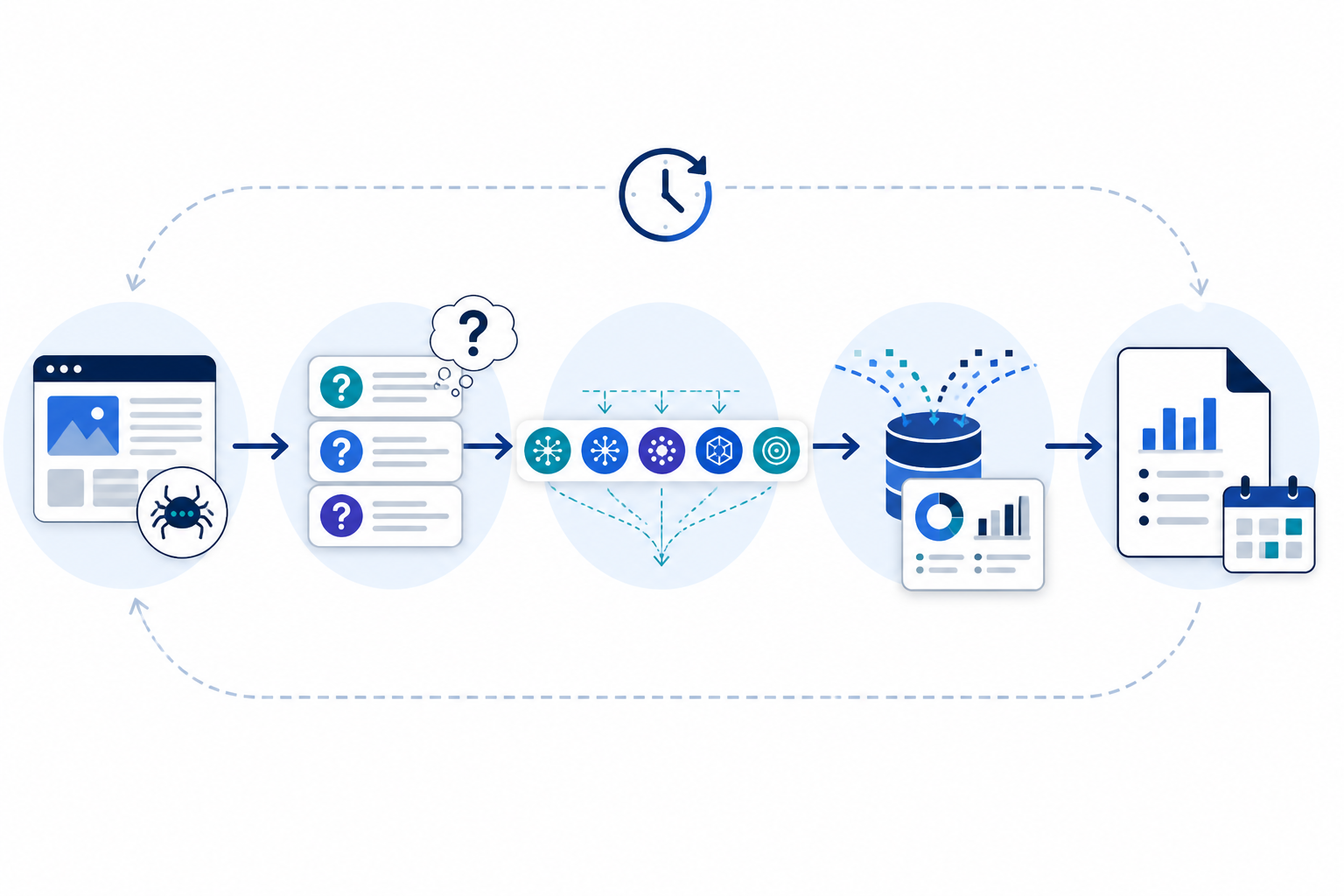
The principle first. Manually prompting ChatGPT, Claude, Gemini, Copilot, and Perplexity every day, logging the answers, checking citations, and tracking sentiment is not viable past two or three client accounts. Generating a statistically meaningful picture typically requires 50 to 100 commercially relevant queries per client, run consistently over time — which makes manual tracking a full-time job for a single account, let alone a roster of twenty. That part is arithmetic, not a vendor claim.
The vendor-specific part requires more scrutiny. Platforms like MentionOwl advertise automated website crawling, auto-generated customer questions, daily querying across major AI platforms, and a proprietary 0-100 visibility score built from query coverage, position-weighted citations, and share of voice. Those are genuinely useful capabilities if they hold up — but before you commit budget or a client relationship to any platform, I'd run it through a short evaluation checklist:
- Reproducibility: does the platform show you how consistent citations are across repeated runs of the same prompt, or just a single snapshot?
- Platform coverage and access method: some AI platforms restrict programmatic querying or return different results to logged-in versus logged-out, or UK versus US, sessions. Ask exactly how each platform is queried and whether results reflect what a real UK user would see.
- Prompt and model version control: does the tool tell you which model version generated an answer, and does it flag when a platform updates its model in a way that could shift results?
- Citation accuracy: can you audit a sample of citations manually against the platform's own report to check for false positives?
- Exports and API access: can data be pulled into your existing client dashboard, or does it lock you into a proprietary reporting UI?
- Data retention and white-label terms: what happens to historical data if you cancel, and can the reporting be fully rebranded under your agency's name?
- Cost at scale: does per-client pricing stay proportionate once you're running 15–20 accounts, or does it require a step up to an enterprise tier?
No monitoring platform, including the ones I've named, can guarantee identical results to what an individual user sees in their own ChatGPT or Gemini session, because these tools personalise and vary output. Any agency reporting AI visibility data to a client should say so plainly: this is a representative sample from a defined prompt set, not a complete or permanent picture.
Two capabilities I'd still highlight as genuinely scalable across a full client roster, provided the caveats above are addressed:
- AI legibility audits (structured data, crawlability, factual clarity — typically covering 15-20 technical checks) function as a repeatable diagnostic product for every new client onboarding, giving agencies a standardised starting deliverable regardless of industry.
- Competitor tracking and sentiment analysis let agencies deliver comparative insight a client can't easily replicate by manually typing a few prompts into ChatGPT themselves — which is exactly the differentiation that justifies a retainer fee, provided the underlying data is validated rather than taken at face value.
How to Build Client Reporting That Proves Ongoing Value
Retention in this service line depends on reporting that clients can interpret without a briefing call every time, and — more importantly — on reporting that connects directly to an action. I'd separate the reporting into leading indicators (what's moving) and commercial outcomes (what it means for the business), and make sure every leading indicator has a recommended next step attached to it.
Leading indicators:
- Visibility score movement month over month, reported alongside the prompt set and platforms it's drawn from, not as a standalone number. A flat or declining score should trigger a specific diagnostic: has a platform changed its model, has a competitor published new content, or has the client's own site lost a key structured-data element?
- New citations or improved position-weighted mentions, presented as concrete wins with the actual AI-generated text alongside the data point. Each new citation is also a signal of what's working — if a citation traces back to a specific FAQ page or press mention, that's a content format worth repeating.
- Competitor share of voice shifts, used explicitly to inform strategy, not just to justify renewal. If a competitor has overtaken the client on a specific query cluster, the reporting should name the likely reason (a recent digital PR placement, a more explicit comparison page, clearer pricing information) and recommend a corresponding action.
Commercial outcomes:
- Cookieless AI traffic analytics, framed as the bridge between visibility work and revenue — connecting AI-driven referral activity to actual site traffic and conversions rather than leaving the visibility score as an abstract number a client can't tie to their P&L.
The underlying discipline here is closer to ongoing brand monitoring than classic rank tracking: you're not just measuring position, you're managing how a brand is represented, cited, and compared across a set of channels the client doesn't control directly. Every report should end with two or three specific recommendations — a structured data fix, a new FAQ section addressing a commonly asked purchase question, a digital PR push to earn a citation-worthy mention, or a correction to an inaccurate factual claim about the client circulating in AI answers.
A 30-Day AI SEO Service Launch Plan
If you're building this service line from a standing start, here's the sequence I'd follow:
Days 1–7: Select three to five existing clients as pilot accounts, ideally a mix of industries. Define a 25-40 question prompt set per client based on real purchase-decision queries, not guesses. Run the baseline audit and validate results with a repeat run before treating anything as fact.
Days 8–14: Present findings to each pilot client using the pitch sequence above. Price the pilot at a discounted rate (or bundle it into an existing retainer at no extra charge) in exchange for a case study and testimonial if results are strong.
Days 15–21: For any client that signs on, deliver the first round of recommendations — structured data fixes, FAQ content, factual corrections — and set a re-measure date at day 30 to check for early movement.
Days 22–30: Review what worked, refine your prompt-set methodology and reporting template, and formalise pricing into the three-package structure above before opening the service to your wider client base.
AI Visibility Monitoring FAQ
Do I need technical AI expertise to sell this service to clients?
No — you need enough understanding to explain the concept clearly (how generative engines like ChatGPT and Gemini answer purchase-decision queries, and whether your client is cited) but the technical heavy lifting, like running daily queries and calculating a visibility score, is typically handled by a monitoring platform. Agencies usually position themselves as the strategic interpreter of the data, not the technical operator — though it's worth understanding a platform's methodology well enough to explain its limitations honestly.
How is AI visibility monitoring different from traditional SEO reporting?
Traditional SEO reporting tracks rankings, organic traffic, and backlinks within Google's index. AI visibility monitoring tracks something different: whether generative AI platforms mention, cite, or recommend a brand when users ask everyday purchase questions, plus how that compares to competitors and what sentiment surrounds those mentions. It's a complementary layer and a form of brand monitoring extended into a new channel, not a replacement for SEO.
Can I white-label a tool like MentionOwl instead of building this in-house?
Yes, and many agencies find this the faster path to profitability, though it's worth trialling more than one platform before committing, since coverage, reproducibility, and reporting quality vary. Building manual prompting workflows across five AI platforms for dozens of clients isn't sustainable past a handful of accounts, whereas a platform with API access and automated daily monitoring lets agencies resell the data under their own branding without the operational overhead — provided you've verified its accuracy and coverage claims first.
How long does it take to see measurable visibility score improvements after starting monitoring?
Anecdotally, agencies report initial movement within 4-8 weeks once they act on the diagnostic data — typically after addressing AI legibility issues such as structured content and clearer answers to common questions. Meaningful share-of-voice shifts against competitors tend to take a full quarter to show clearly, and because AI platforms update their models periodically, some month-to-month variation should be expected regardless of the work done.
Where to Start With AI Visibility Monitoring
If you're weighing whether to build this now or wait, the practical answer is to run the pilot before you decide. Pick three clients, define a genuine prompt set, validate the output twice before you present it, and price the pilot to get a case study rather than to make a margin in month one. The agencies that will hold the advantage in twenty-four months are the ones who can already show a client eighteen months of visibility score history and two documented competitive wins — not the ones who waited for the market to mature before building the muscle.