AI Legibility Audits: Why UK E-commerce Sites Need Them Now (2026 Guide)
Improve AI visibility for UK e-commerce with an AI legibility audit covering JavaScript product data, specs, pricing, reviews and structured markup.
AI Visibility for UK E-commerce: How to Run an AI Legibility Audit
Meta description: Improve AI visibility for UK e-commerce by auditing crawlability, JavaScript-rendered product data, specs, and structured markup across your catalogue.
An AI legibility audit examines whether your website's actual content—product specifications, pricing, availability, and reviews—is structured in a way that AI crawlers can parse and cite. That's a different problem from ranking well in Google.
I've tracked hundreds of e-commerce sites through MentionOwl's monitoring, and the pattern is stark: sites with JavaScript-rendered product data, inconsistent specification formatting across SKUs, or missing structured markup get excluded from AI-generated shopping shortlists, even when their traditional SEO scores look strong. Running an AI legibility audit now, before your competitors do, is one of the highest-leverage moves available for protecting your share of voice and improving AI visibility in search.
I want to be precise about why this matters right now, in early 2026, for UK e-commerce specifically. Google's own internet-sales data has shown online retail consistently holding around a quarter of total UK retail sales, with that share climbing sharply during Black Friday and Christmas peaks. That's a substantial volume of commercial demand that increasingly routes through conversational AI rather than a traditional search results page.
If ChatGPT, Gemini, Copilot, or Perplexity can't extract clean facts from your product pages, you're not losing a ranking position. You're being erased from the conversation entirely. And unlike a Google algorithm update, there's no public changelog telling you it happened.
What does an AI legibility audit check?
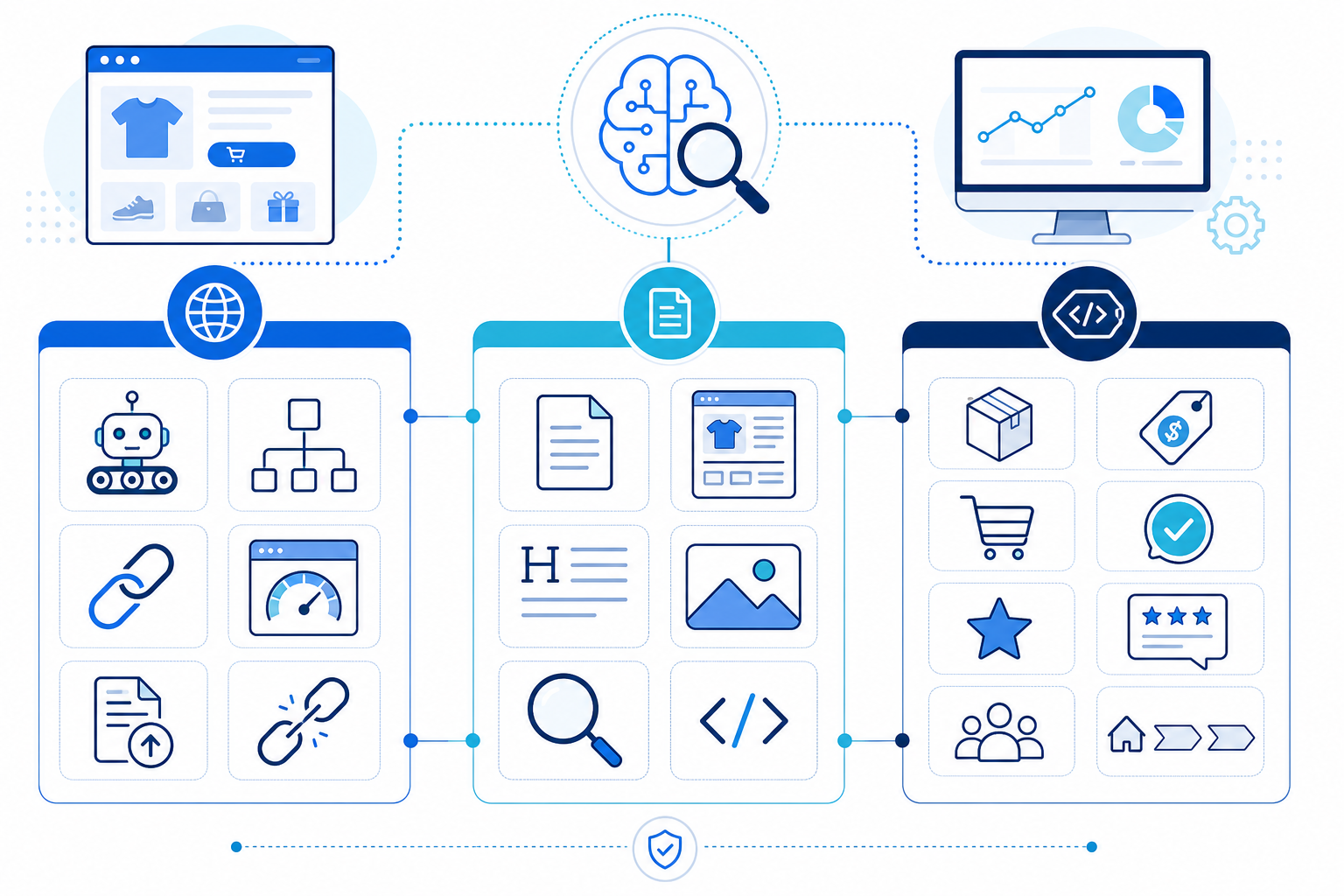
At MentionOwl, our AI legibility audits run 16 distinct technical checks, grouped into three broad categories. I've found this three-way split useful because each category fails for a different underlying reason, and the fixes rarely overlap.
1. Crawlability checks
Crawlability checks ask a simple question: can an AI crawler even reach the content? This means verifying robots.txt rules against the specific user-agent strings used by AI systems, things like GPTBot and OAI-SearchBot from OpenAI, ClaudeBot from Anthropic, and PerplexityBot from Perplexity, rather than assuming permissions granted to Googlebot extend automatically to these systems.
It also covers server response codes, including 403s, 429s, and bot-challenge pages logged against these specific user agents; canonical tag accuracy; and whether your XML sitemap actually reflects pages that are internally linked and reachable. Orphaned URLs can technically exist on a site without any crawl path leading to them.
2. Content clarity checks
Content clarity checks focus on whether the facts on the page are stated unambiguously in text an AI system can lift and quote with confidence. This is where consistent attribute labelling matters. If half your product pages say "Colour" and the other half say "Shade" or "Hue", you're forcing an AI system to reconcile inconsistent vocabulary across your own catalogue, and that measurably reduces citation confidence.
We also check whether pricing, stock status, and shipping information appear as plain text near the product description, rather than being generated dynamically inside a widget that only populates after a user interaction.
3. Structured data checks
Structured data checks verify the presence and accuracy of schema.org markup, specifically Product, Offer, and AggregateRating types. We don't just check that the markup exists; we check that it matches what's visibly on the page.
A stale price in your JSON-LD that no longer matches the sale price a shopper sees is arguably worse than having no markup at all, because it teaches the AI system to distrust your structured data going forward.
E-commerce issues that block AI crawlers
This is the section I spend the most time on with clients, because e-commerce catalogues create failure modes that a typical corporate brochure site simply doesn't encounter. Having run this analysis across hundreds of UK product catalogues now, six issues come up again and again.
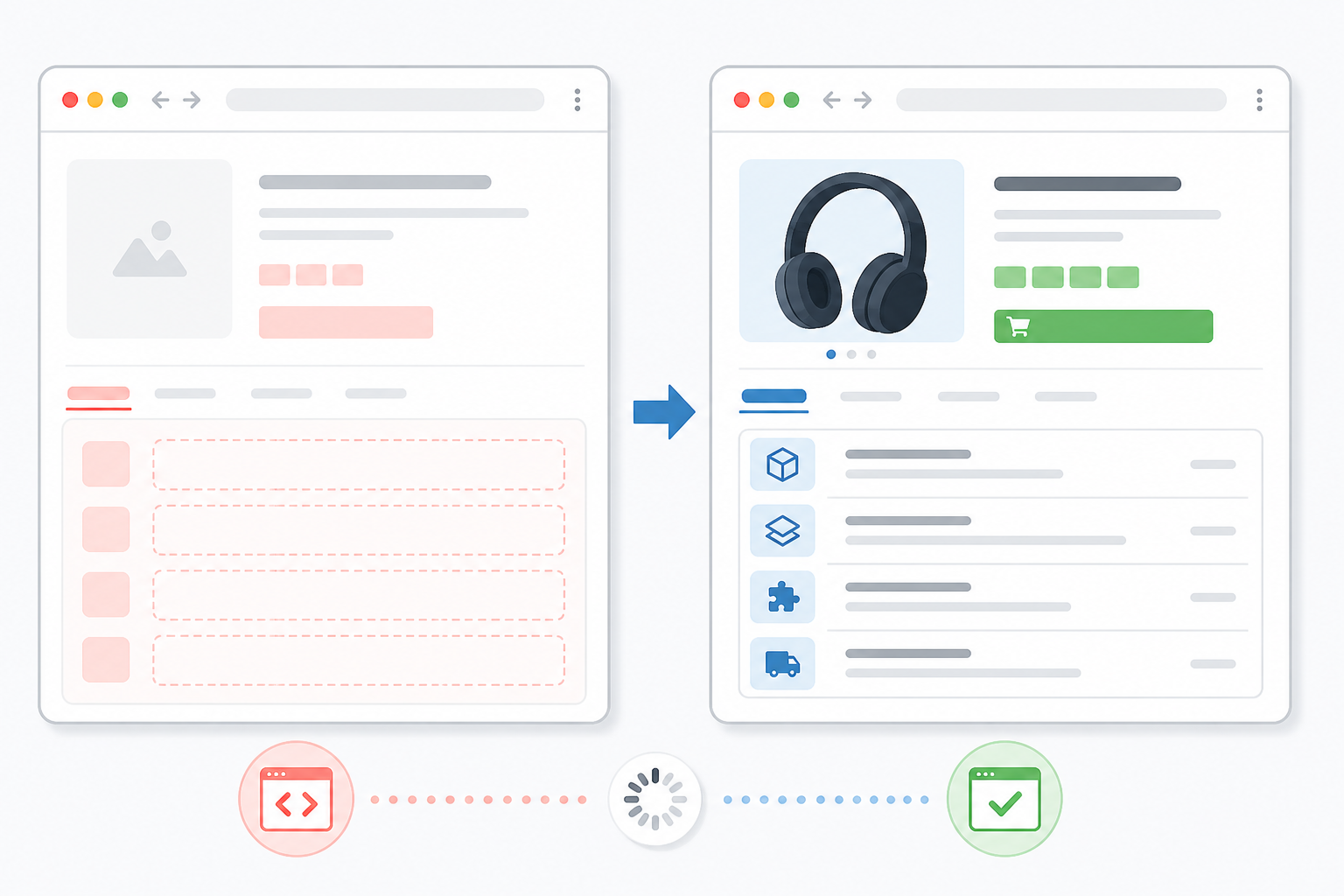
JavaScript-rendered product data. This is the most common failure I see, without question. Google's own JavaScript SEO guidance says plainly that generative-search crawlers may not execute JavaScript the way a full browser does. Product names, prices, stock statuses, and variant data need to be present in the initial HTML response, or served through a crawlable, server-rendered path.
I've audited fashion retailers where a React-based product-page component returns a nearly empty HTML shell to a single-fetch crawler while displaying a fully populated page to a human shopper. The site looks completely normal to every visitor. It's simultaneously invisible to the AI systems increasingly mediating purchase decisions.
Inconsistent specifications across similar products. When your men's trainers list "Upper material: Leather" and your women's trainers in the same range list "Material: Genuine leather upper", that's not just a style inconsistency. It's preventing an AI engine from confidently comparing your SKUs against each other, let alone against a competitor's range.
AI systems build confidence in citations partly through consistency. Ambiguous or contradictory phrasing across your own catalogue undermines that confidence and can reduce your AI visibility.
Variant selectors that hide critical data behind clicks. Google's structured data guidance is specific here: where a variant has its own URL, stock status, price, or image, it should be marked up separately using ProductGroup and individual Product entities.
A single generic product page that requires a dropdown click to reveal that size 10 is out of stock, while size 8 is available at a different price, is functionally invisible to a crawler performing one static fetch. The AI can't answer "Which UK size 10 black trainers are in stock?" if that fact sits behind an interaction it will never perform.
Infinite-scroll category pages. If your category listing only reveals products 21 through 40 after a scroll-triggered JavaScript fetch, a crawler working through static requests never sees that inventory. Google's own pagination guidance recommends crawlable pagination or stable category URLs for exactly this reason.
Your best-selling product might exist perfectly formatted on its own product detail page, but if it's never linked from a crawlable category page, it may as well not exist to the AI system trying to build a shortlist.
Duplicate or near-duplicate descriptions across variants. I frequently see catalogues where twelve colour variants of the same handbag share an identical description that never mentions colour, relying entirely on an image swap. This dilutes the specific detail an AI needs to answer a direct question like "Does this come in tan?"
Faceted navigation compounds this further. Google's guidance on managing faceted URLs notes that uncontrolled filter combinations create duplicate pages that consume crawl capacity without adding unique, citable content.
Asynchronously loaded review widgets. Genuine social proof—star ratings, review counts, verified-purchase badges—frequently loads via a separate JavaScript call after the main page renders. If that call never fires during a crawler's single-pass fetch, that review data never reaches the AI's retrieval context, no matter how many five-star reviews you've genuinely earned.
One UK-specific wrinkle worth flagging: consent-management platforms. The ICO's guidance on cookies and similar technologies is clear that core product content shouldn't be gated behind non-essential cookie consent, but I regularly see implementations where a bot-management challenge fires for any request lacking a marketing cookie, inadvertently blocking legitimate AI crawlers alongside malicious bots.
Given that automated traffic actually exceeded human traffic globally for the first time in the 2024 Imperva Bad Bot Report, the instinct to lock down bot access makes sense. But it needs to distinguish GPTBot from a credential-stuffing script.
How is an AI legibility audit different from a technical SEO audit?
I get asked this constantly, usually by teams who've already invested heavily in SEO and are understandably reluctant to commission what sounds like duplicate work. It isn't.
| Dimension | Technical SEO Audit | AI Legibility Audit |
|---|---|---|
| Primary focus | Crawl budget, indexation, Core Web Vitals, and ranking signals | Whether a single raw HTML fetch yields clear, extractable facts |
| Rendering assumption | Assumes eventual JavaScript execution; Googlebot renders in a second wave | Assumes many AI crawlers do not execute JavaScript reliably |
| Key signals measured | Page speed, backlinks, keyword relevance, and mobile-friendliness | Attribute consistency, schema accuracy, and plain-text fact placement |
| Failure mode | Lower ranking position or slower indexation | Complete exclusion from AI-generated answers, regardless of ranking |
| Overlap area | Schema markup and page speed | The same markup, judged on raw-fetch presentation rather than rendered output |
Here's the uncomfortable part, something I've watched play out repeatedly through MentionOwl's monitoring: a page can sit on page one of Google while being functionally invisible to ChatGPT's browsing tool or Perplexity's retrieval layer. Traditional SEO success and AI visibility are correlated but not equivalent.
Assuming an AI legibility audit is redundant because "we already did a technical SEO audit" is one of the more expensive mistakes a marketing team can make heading into 2026.
How to run your first AI legibility audit
I'd resist the temptation to tackle your entire catalogue at once. Here's the sequence I recommend to clients starting from zero:
Start with your top 10–20 revenue-generating product pages. Full catalogue coverage is a later-stage goal, not a starting point. A small subset of SKUs typically drives a disproportionate share of AI-referred conversions once visibility improves.
Fetch the raw HTML, not the rendered DOM. Use a simple
curlrequest or a tool that mimics a non-JavaScript-executing crawler, and check whether price, availability, and core specifications appear in that initial response. If they don't, you've found your highest-priority fix immediately.Manually query ChatGPT, Gemini, and Perplexity with the exact questions a shopper might ask about those products. Note whether your brand appears at all and, critically, what specific data point the AI cites when it does. This tells you which facts are actually reaching the model.
Run an automated 16-point check. This is precisely what MentionOwl's AI legibility audit does at scale: it generates a scored report against crawlability, content clarity, and structured data checks, with specific remediation steps rather than a vague pass/fail.
Cross-reference legibility gaps against your existing AI visibility score. MentionOwl's 0–100 score, built from query coverage, position-weighted citations, share of voice, and soft mentions, tells you where the highest-leverage fixes sit. There's little point fixing legibility on a product category where you already dominate share of voice.
Document a baseline before changing anything. Legibility improvements can take days to weeks to reflect in AI answer citations, so you need a clean before-state to measure against, ideally captured the same week you commission the audit.
How to prioritise AI visibility fixes across a large product catalogue
For catalogues running into the thousands of SKUs, prioritisation isn't optional. It's the entire strategy. I generally advise the following order:
- Segment by revenue contribution first. Fixing legibility across your top 100 SKUs by sales will move share of voice measurably faster than spreading identical effort evenly across 10,000 products, most of which generate negligible AI-referred traffic regardless.
- Fix template-level issues before page-level issues. A single change to your product detail page template, such as adding server-side rendering for the specifications block, can resolve the same underlying problem across every product using that template in one deployment, rather than requiring thousands of individual page edits.
- Prioritise categories where competitors already dominate AI citations. Closing that specific gap has an outsized impact on overall share of voice compared with reinforcing categories where you're already the default recommendation.
- Treat structured data fixes as quick wins. Schema markup corrections typically require developer time but no content rewrite, making them the fastest path to measurable improvement.
- Reserve full content rewrites for high-traffic pages with genuinely inconsistent specifications, particularly where that inconsistency is actively causing incorrect AI-generated comparisons against competitor products.

From AI legibility to measurable AI visibility
Legibility fixes are a leading indicator, not a guaranteed outcome. AI engines still weigh authority, recency, and third-party corroboration alongside raw legibility, so fixing your JSON-LD won't override a genuine deficit in review volume or brand recognition.
What legibility fixes reliably do is remove the mechanical barriers preventing an AI system from citing you at all. That's a necessary precondition for AI visibility, even if it isn't sufficient on its own.
This is where I'd push clients towards a structured measurement cadence rather than sporadic manual checks. MentionOwl's visibility score, built from query coverage, position-weighted citations, share of voice, and soft mentions, gives you a consistent 0–100 benchmark to track against your legibility fixes over time.
I recommend reviewing this weekly through the platform's digest, specifically checking whether the SKUs you fixed are generating new citations, rather than assuming a correlation without verifying it.
Competitor tracking matters enormously here too. If a rival fixes their legibility issues before you do, their share of voice can climb even while your absolute visibility score stays completely flat. AI visibility is inherently relative, distributed across however many brands an engine considers for a given query.
Running an AI legibility audit now isn't just about fixing your own house. It's about not ceding ground to a competitor who runs theirs first.
AI visibility and legibility audit FAQs
Is an AI legibility audit different from a regular technical SEO audit?
Yes, meaningfully so. A technical SEO audit is built around how search engine spiders crawl, render, and rank pages, including Core Web Vitals and indexation. An AI legibility audit checks whether a single, often non-JavaScript-executing fetch of your page yields clear, unambiguous facts that a generative AI engine can extract and cite.
A page can be perfectly optimised for Google while remaining effectively invisible to ChatGPT or Perplexity.
Do dynamic or JavaScript-heavy product pages cause problems for AI crawlers?
In my experience monitoring hundreds of e-commerce sites, this is the single most common legibility failure. If your product specifications, pricing, or stock status only appear after client-side JavaScript executes, many AI crawlers simply never see that data, because they're working from the initial HTML response rather than a fully rendered browser session.
How do I audit AI legibility across thousands of SKUs without it taking months?
Don't try to check every page manually. Start with a revenue-weighted sample of your top-performing products, identify template-level issues that repeat across categories, and use an automated tool that runs the same structural checks at scale.
Fixing a shared product detail page template resolves the issue for every product using that template in one pass.
Which AI legibility fixes should I prioritise first?
Structured data markup, particularly schema.org Product, Offer, and AggregateRating, tends to offer the fastest return because it's a developer-led fix that doesn't require content rewrites.
After that, prioritise server-side rendering for critical product attributes on your highest-revenue pages. This is the fix most likely to unblock AI citations where they matter most to revenue.