How to Track ChatGPT Brand Mentions Without Manual Prompting: A Founder's Guide
Learn how to track ChatGPT brand mentions with daily LLM monitoring, automate customer-style questions, and measure answers, citations, sentiment and competitors.

How to Track ChatGPT Brand Mentions Without Manual Prompting
The most dependable way to track ChatGPT brand mentions is to stop prompting by hand. Instead, run a stable set of customer-style questions on a schedule, ideally daily, through an automated LLM monitoring tool. Each run should record the answer, citations, sentiment and competitor mentions. ChatGPT responses vary from one run to the next, so repeated sampling gives you a far better directional estimate of your visibility than any single check. It is still an estimate, not a perfect record of what every customer sees. A single manual check is closer to an anecdote than a measurement.
I'm Marcus, the data analyst at MentionOwl. In this guide I'll explain why spot checks mislead, how to choose the right questions, what a useful record looks like, and how to get automated monitoring running. I've written it for solo founders and small business owners in the UK who have a product to ship and no spare hours for typing into chatbots. 🦉
A note on transparency: MentionOwl is my employer. The general advice here (question design, record-keeping, statistical caution) applies whatever tool you use, and I label the product-specific parts clearly so you can weigh them accordingly.
Why Manual ChatGPT Brand-Mention Spot Checks Mislead Founders
Most founders start the same way. You open ChatGPT, type 'best [your category] tool', see whether your brand appears, and draw a conclusion. If you appear, you feel reassured. If you don't, you feel a small jolt of panic. Either way, you have based a decision on one answer to one prompt, generated under one set of conditions at one moment. That is an observation, not a measure, and it can't tell you how often your brand is mentioned across different phrasings, sessions or dates.
Where the variance comes from
Several things can change what a chatbot says to the same person asking the same question:
- The model chooses its words from a probability distribution, so wording, brand lists and ordering can differ between runs.
- OpenAI documents product and model changes in its ChatGPT release notes, so behaviour that held last month may not hold today.
- When ChatGPT Search is used, answers can draw on current web sources, and the sources selected may differ between runs.
- OpenAI describes memory as a way for ChatGPT to use saved details in later conversations, so your own account may not reflect what a prospective customer sees.
- Logged-in and logged-out sessions can involve different tools, settings and context.
There is also published evidence that model behaviour drifts. In 'How is ChatGPT's behavior changing over time?' (Chen, Zaharia and Zou, Stanford and UC Berkeley, 2023), the authors compared GPT-4 in March and June 2023. Its accuracy on a prime-number identification task fell from 84% to 51%, and the share of its code responses that were directly executable dropped from 52% to 10%. I want to be careful here. Those are benchmark tasks, and the study did not measure brand mentions, so please don't read them as an estimate of how much your visibility might change. What they show is that a result captured on one date may not stay representative. That is why every observation should carry a date and, where available, a model or product label.
The survivorship problem
There is a human factor too. Founders remember the flattering answer and quietly forget the one where a competitor was recommended instead. If you check informally, you tend to stop when you see something pleasing and keep rerunning when you don't. That is a biased sample, and effort alone can't correct it.
Manual versus automated LLM monitoring
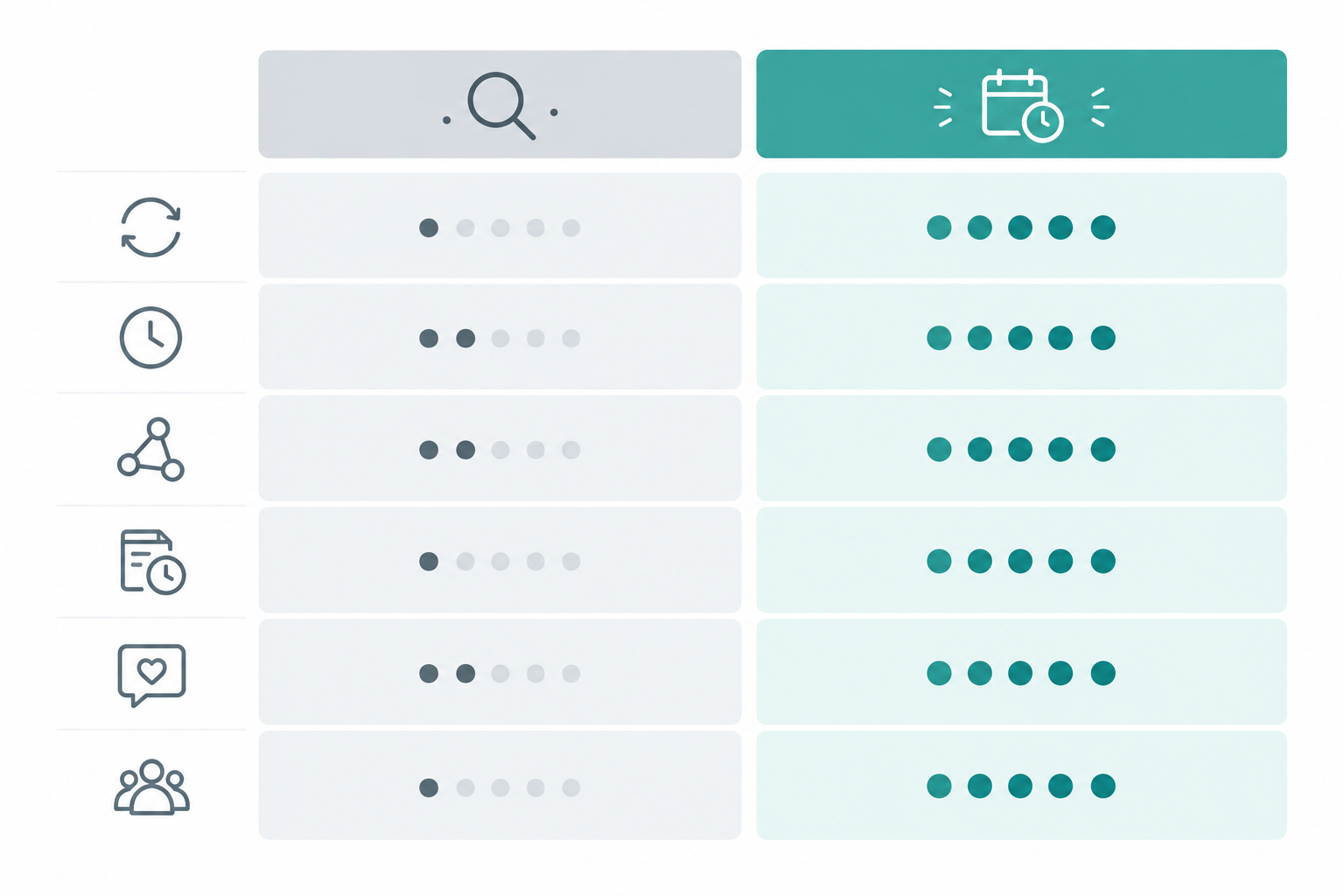
| Factor | Manual spot checks | Automated daily monitoring |
|---|---|---|
| Consistency | Wording, account and settings drift between checks | Same question set, run the same way every day |
| Collection time | Roughly 100 minutes per cycle for 20 questions across 5 platforms, before analysis | Minutes to configure, then collection needs no manual effort |
| Human analysis time | Extra, and usually skipped | Reading a weekly digest and a short monthly review |
| Platform coverage | Whichever chatbot you remember to open | ChatGPT, Claude, Gemini, Copilot and Perplexity together |
| Historical record | Scattered notes and screenshots | Dated archive of answers, citations and scores |
| Sentiment and citation capture | Eyeballed, if at all | Recorded and parsed for every answer |
| Competitor context | Anecdotal | Competitor mentions logged on every run |
The time arithmetic deserves spelling out, because the periods have to be comparable. Twenty questions across five platforms is 100 prompts. At roughly a minute each to run and log (my own estimate), that is about 100 minutes per cycle. Run it weekly and you spend around seven hours a month on collection alone, before analysis, and you still end up with only about four data points per question per month. Automation doesn't eliminate human effort. You still need setup time (I estimate 15 to 30 minutes, covered below), around 10 to 15 minutes a week to read a digest, and a monthly review. That adds up to roughly 1.5 to 2 hours a month, against more than seven, and you gain around 30 daily observations per question instead of four.
Why ChatGPT Answers Vary, and What That Means for Tracking
Put simply, a large language model generates an answer one word-fragment at a time, drawing on patterns learned in training. ChatGPT can combine that with web search results when search is used. Ask the same question twice and you can get different phrasing, a different shortlist of brands and a different running order. OpenAI's documentation on reproducible outputs describes a seed parameter intended to make API outputs more repeatable. It also states that determinism is not guaranteed, and that outputs can change when the backend configuration does.
It helps to separate two broad kinds of answer. Some lean mostly on what the model absorbed in training, which changes only when the model does. Others use live retrieval, which can surface and cite current pages. The second kind tends to shift citations more often, because a brand can appear in one run and vanish in the next simply because the retrieved pages differed. In practice the two often operate together, so you can't always tell from the outside which one produced a given mention.
One data point versus a series of ChatGPT mention checks
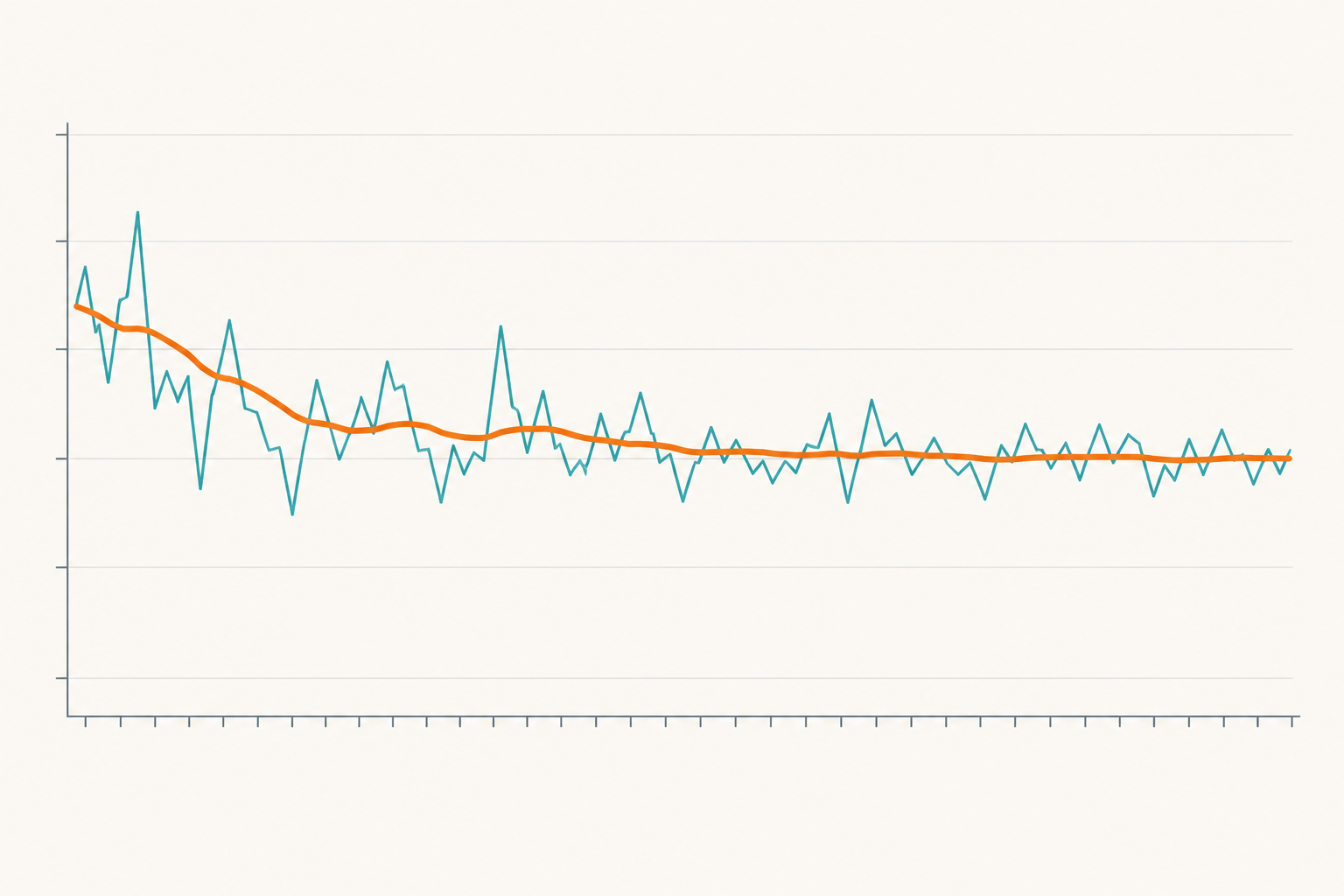
Suppose your brand genuinely appears in about 60% of answers to a given question under comparable conditions. If you check once, you will see either 'appeared' (100%) or 'didn't' (0%), and neither is close to the truth. Run it ten times and see six appearances, and a Wilson confidence interval (my own illustrative arithmetic, not a published benchmark) says 6 out of 10 is consistent with a true rate anywhere from roughly 31% to 83%. At 30 runs with the same 60% rate, the plausible range narrows to roughly 42% to 75%.
That calculation flatters reality in two ways, and you should know both. First, it assumes each run is an independent sample under identical conditions. Runs on the same day, from the same account or through the same retrieval index are correlated, so the true uncertainty is wider than the interval suggests. Second, it describes the tool's sample, not necessarily what customers see, since answers vary by product, location, account state and retrieval. So treat the result as a directional estimate of the frequency and position of your mentions across many runs, not a precise reading. Each day's run still adds information, and the picture sharpens.
Setting expectations for daily brand-mention tracking
Movement of a few points from one day to the next is probably noise. Trends that persist over weeks are more likely to be signal. I would rather you hear that now than abandon tracking after a wobbly Tuesday.
Choosing Customer Questions That Actually Matter
A monitoring set is only as good as its questions. The common mistake is to start from your brand name. Buyers who already know you are not the ones AI search is deciding about. The questions worth tracking come from people who haven't heard of you yet. The NIST AI Risk Management Framework is aimed at organisations managing AI risk rather than at brand tracking, but its principle of ongoing measurement and review is a sensible one to borrow. Test different buyer intents and natural phrasings, then record whether the brand appears, where, how it is described and which sources are cited.
A balanced set covers four types of query:
- Category discovery: 'best invoicing software for freelancers UK'
- Comparison: 'Tool X vs Tool Y for a small agency'
- Problem-led: 'how do I stop chasing late invoices'
- Alternatives: 'alternatives to [competitor] for small businesses'
How many prompts should I track?
I recommend roughly 15 to 30 well-chosen questions spanning the funnel. This is a rule of thumb from my own experience, not a published standard. With fewer than 15, a single question can swing your score disproportionately. With many more than 30, you add breadth faster than insight and bury the signal in material you have no time to read.
Practical guardrails for choosing prompts
- Keep the set stable. Trends are only comparable if the questions are, so change the set deliberately, say monthly or quarterly.
- Don't track only branded queries. They flatter your results and reveal almost nothing about discovery.
- Write like your UK buyers. Use British spelling, mention GBP pricing where it affects the decision, and include UK context such as VAT, local regulations or market names. 'Best accounting software for a UK sole trader' will return different answers from its US-flavoured equivalent.
Removing the blank-page problem (MentionOwl feature)
Staring at an empty list is where most founders stall. MentionOwl crawls your website to infer your offer, category and audience, then drafts customer questions for you to review. The generated questions are a starting point and won't be perfect, so remove any that don't sound like your real buyers. You are editing a draft rather than inventing one, which is a better use of limited time.
Recording ChatGPT Brand Mentions, Citations and Sentiment
A useful record contains considerably more than a yes or no. For each run, capture:
- The exact prompt and full answer text
- Whether your brand was named, and its position in any list
- The sources cited
- The sentiment of the description
- Which competitors appeared
- The date and, where available, the platform and model
What a brand-mention record looks like in practice
Here is an illustrative week for one question, 'best invoicing software for freelancers UK', run daily on one platform:
| Day | Brand named? | Position | Your page cited? | Sentiment | Competitors named |
|---|---|---|---|---|---|
| Mon | Yes | 3rd | No | Neutral | A, B, C |
| Tue | No | n/a | No | n/a | A, B |
| Wed | Yes | 2nd | Yes | Positive | A, C |
| Thu | Yes | 4th | No | Neutral ('limited free tier') | A, B, C |
| Fri | No | n/a | No | n/a | A, B, D |
| Sat | Yes | 3rd | No | Neutral | A, C |
| Sun | Yes | 3rd | Yes | Positive | A, B |
A founder checking only on Tuesday would conclude the brand is invisible. One checking on Wednesday would feel secure. The series tells a more honest story: mentioned on five of seven days, usually mid-list, cited twice, and always behind Competitor A. That is a mention rate of about 71% on a tiny sample. The sensible response is to keep collecting, and to ask why Competitor A appears every single day.
Direct mentions, citations and soft mentions
These are three different signals, and lumping them together hides useful information.
A direct mention means the brand is named in the answer. A cited source means one of your pages is linked or referenced, whether or not your name appears in the text. A soft mention means the brand is described but not named or linked, for example 'a UK-built tool aimed at freelancers'.
A model can discuss you without linking to you, and a page of yours can shape an answer without the brand being named. Tracking them separately tells you whether your problem is awareness, authority or both.
The visibility score (a MentionOwl-specific metric)
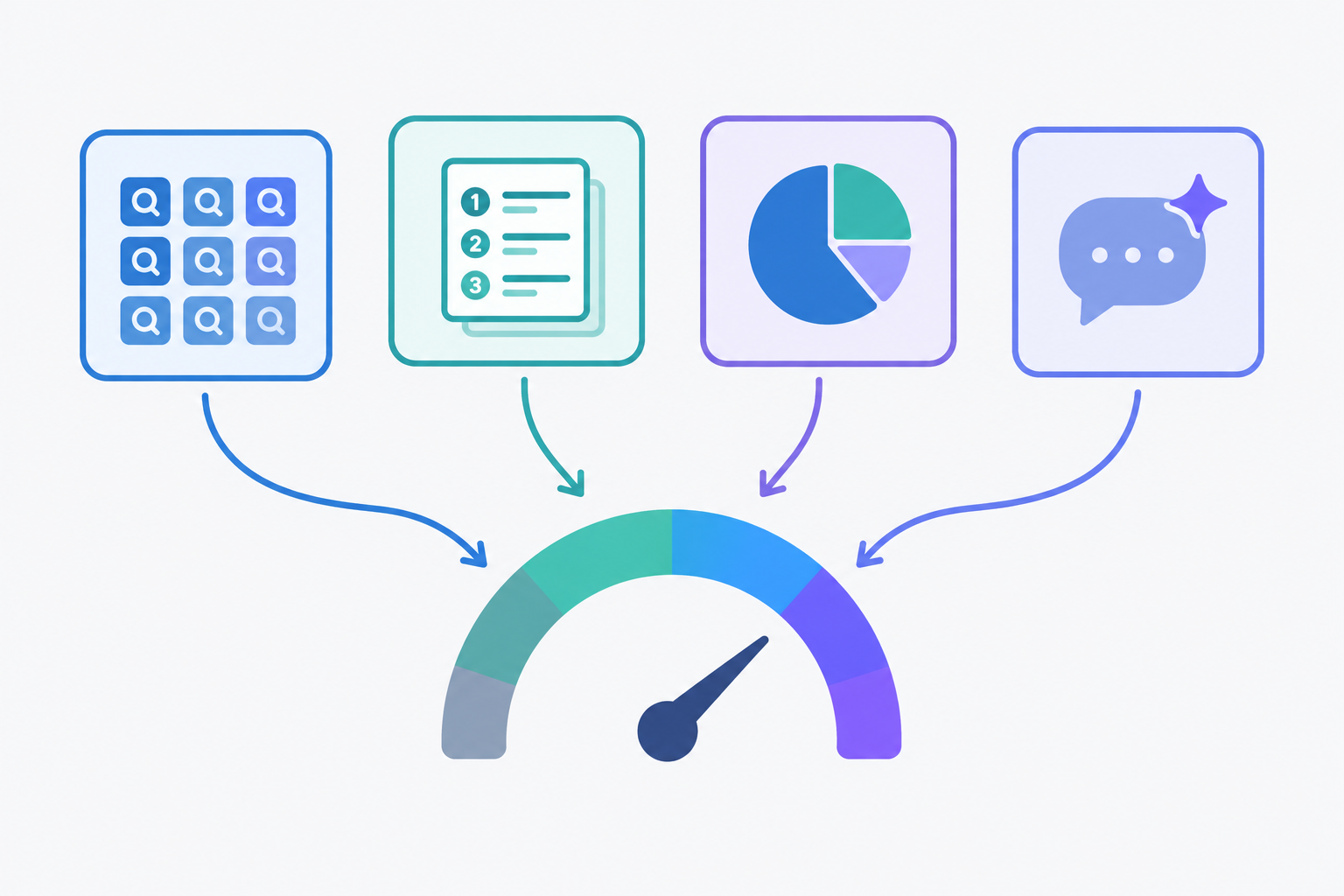
MentionOwl combines four signals into a proprietary 0 to 100 visibility score: query coverage (the share of tracked questions where you appear), position-weighted citations (citations count for more when they are placed prominently), share of voice, and soft mentions. The weighting is MentionOwl's own, so this is not an industry standard and scores from different tools are not comparable. I treat it as a directional indicator, and when it moves I look at the components to see why.
Share of voice, in plain terms, is your mentions as a proportion of all brand mentions across your tracked questions, benchmarked against named competitors. If your category produces 100 brand mentions in a week and 18 are yours, your share of voice is 18%.
Why sentiment matters when you track brand mentions
Being mentioned is not the same as being recommended. 'Cheaper but limited' and 'the best option for small teams' both count as mentions, yet they pull your pipeline in opposite directions. Sentiment analysis surfaces those recurring descriptions, and competitor tracking shows who wins the recommendations you want and which citations they earn that you don't.
Setting Up Automated LLM Monitoring in Minutes
Personal convenience isn't the only argument for automation. McKinsey's global survey found 65% of organisations regularly using generative AI in at least one business function in early 2024, and Gartner forecast that traditional search engine volume would fall 25% by 2026 as users shift towards chatbots and virtual agents. The Gartner figure is a forecast, not a measured outcome, and neither number tells you how many of your customers use ChatGPT. Even so, they help explain why many founders want AI search visibility alongside conventional search monitoring.
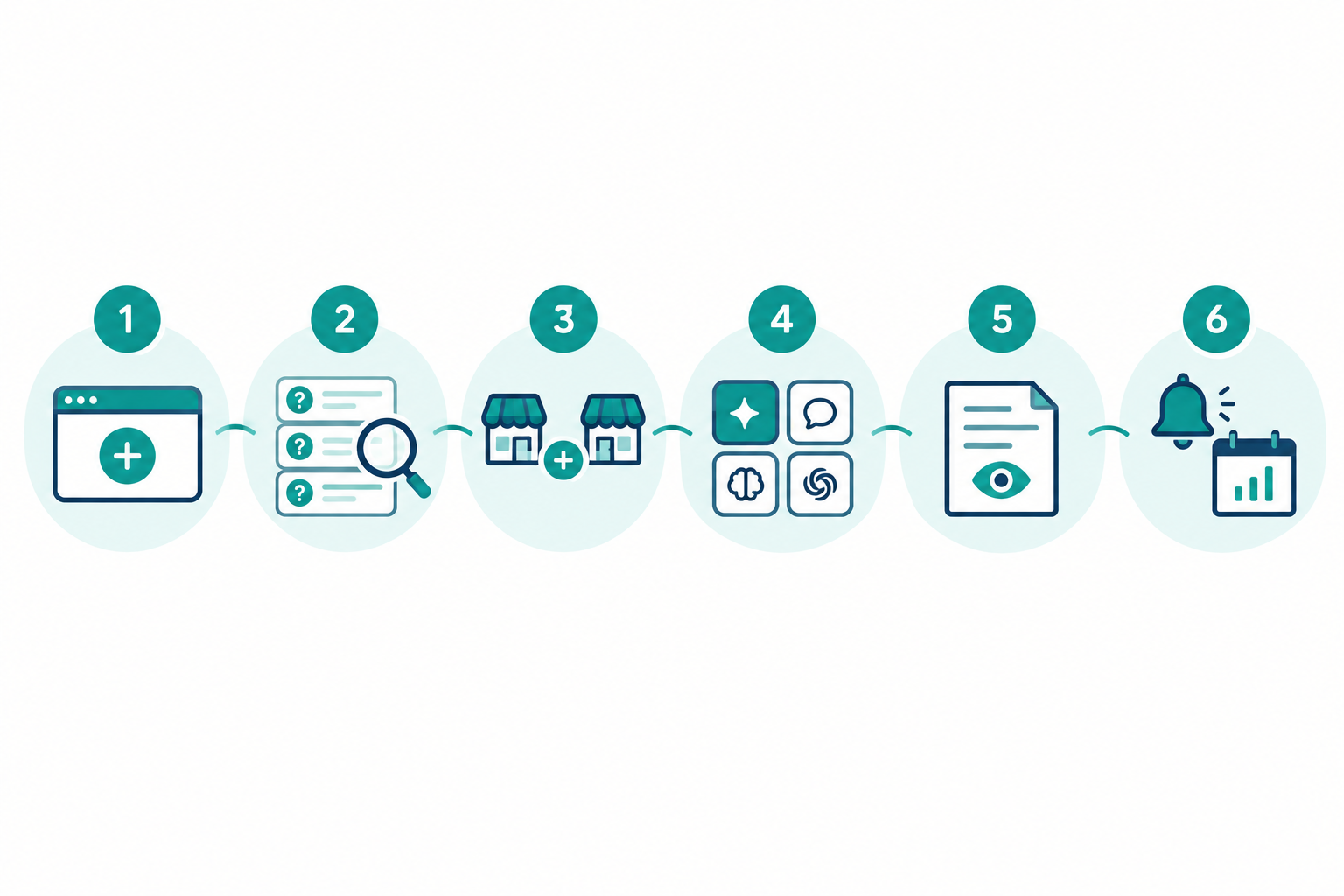
Here is how setup works with MentionOwl:
- Add your website URL. The platform crawls it to understand your offer, category and audience.
- Review the generated questions. Remove any that don't reflect real buyers, and add a few of your own.
- Add your competitors. Include the ones you most often lose deals to, so share of voice has a meaningful comparison.
- Confirm your AI engines. You can choose from ChatGPT, Claude, Gemini, Copilot and Perplexity, and the daily runs begin.
- Optionally, run an AI legibility audit. Sixteen technical checks flag crawlability or structure issues that may hinder citations.
- Connect the extras if they're useful to you: cookieless AI traffic analytics, the REST API and the MCP server for AI agents.
How long does that take? My estimate is 15 to 30 minutes for steps 1 to 4. Most of that goes on reviewing questions and choosing competitors, since the crawl and generation happen automatically. Expect longer if you write many custom questions, and treat steps 5 and 6 as optional extras that add time. 'In minutes' means minutes to start collecting data, not minutes to a finished strategy.
Can I automate LLM monitoring cheaply?
Yes, and I would rather give you the honest comparison than pretend there is only one route. A DIY setup with API calls and a spreadsheet is feasible for a technical founder. You will pay for API usage, write the scheduling, and then parse citations, positions and sentiment yourself. The bigger cost is upkeep. Models, interfaces and retrieval behaviour change, scripts break, and you should check provider terms and rate limits before automating requests.
A managed tool removes that maintenance and does the parsing for you. MentionOwl offers a seven-day trial for $1 (US dollars, roughly 80p at recent exchange rates), which is a low-risk way to see a real baseline. Pricing changes, so check the current pricing page before signing up.
One caveat applies to every method, mine included: automated tracking is a strong indicator, not a literal record of what each user sees. API-based queries may not match the consumer product, and answers differ by product, location and time. Repeated runs plus an occasional manual review of a sample keep you honest.
Reading Your First Weekly LLM Monitoring Digest
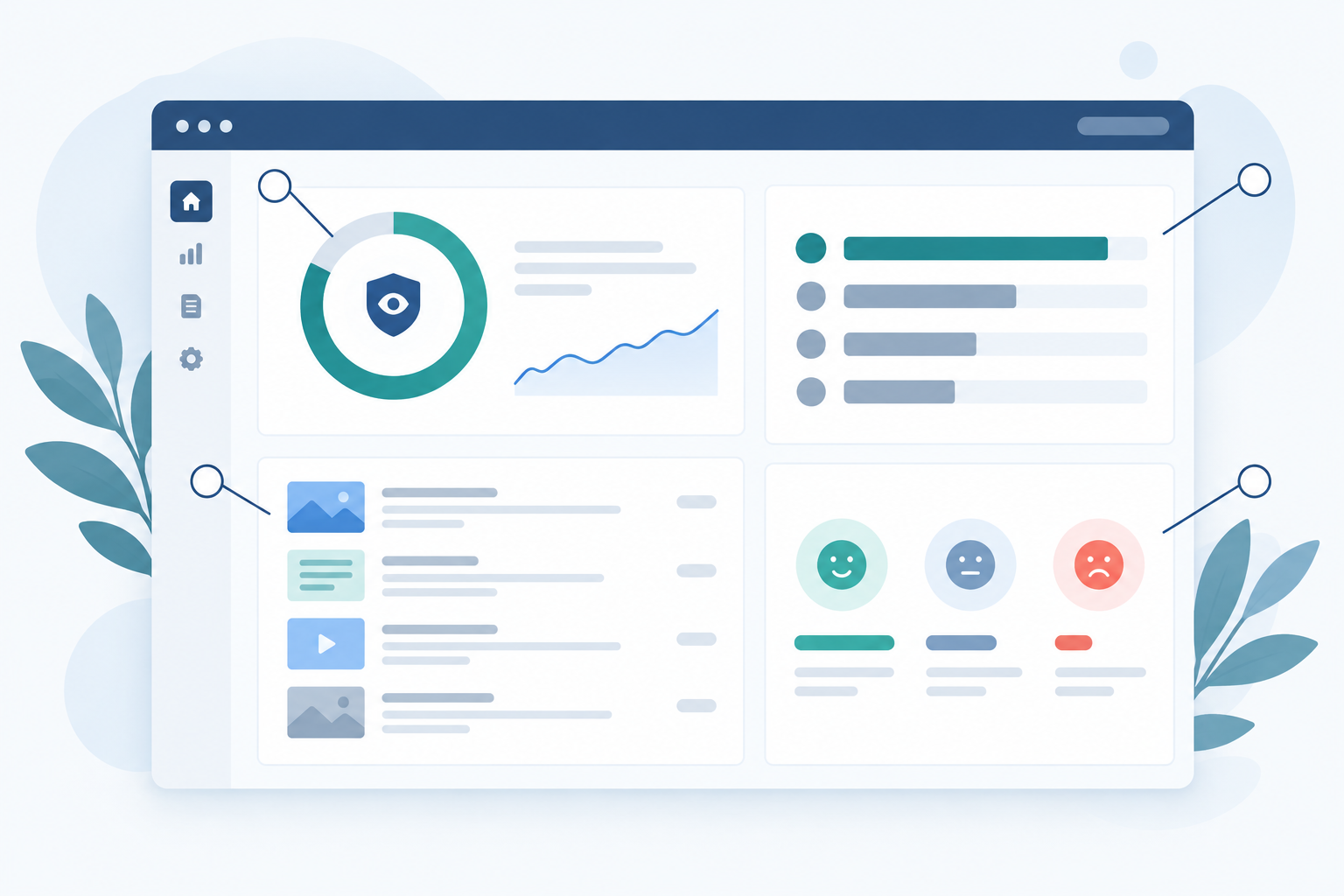
Your first digest will arrive with plenty of numbers. Read it in a consistent order, and treat week one purely as a baseline rather than a verdict.
- Check the headline visibility score and its direction. With only a few days of data, the number is a starting line, not a grade.
- Review query coverage. Which questions mention you at all, and which return nothing or only competitors? The empty ones are your clearest gaps.
- Examine citations. Which of your pages are cited, and which third-party sites do AI engines lean on in your category? Those sites are potential targets for earning a mention.
- Compare share of voice against competitors. A rival may own comparisons while you lead on problem-led queries.
- Scan sentiment for recurring descriptions. If the same limitation keeps surfacing, your messaging may need to address it directly.
- Choose one or two actions for the week, such as strengthening a thin page, fixing a legibility issue or pursuing a mention on a frequently cited source.
This is generative engine optimization in practice, and it overlaps heavily with what many call AI SEO: measure, change one thing, then watch the trend over several weeks. Change five things at once and you can't say what worked.
What to Do With Your ChatGPT Brand-Mention Data
Tracking tells you where you stand. It doesn't change anything by itself, but you can't improve what you can't measure consistently. Be realistic about timelines, too. Changes to content, structure or third-party citations may take weeks to appear in AI answers, and retrieval-based platforms may respond faster than those relying mainly on training data. Compare weekly averages rather than daily readings, and let the trend guide you.
For a solo founder, I suggest a light monthly rhythm:
- Review the score trend across the past four weeks.
- Identify your top three gaps, whether uncovered questions, missing citations or negative descriptions.
- Run one experiment, then measure it over the following month.
That review takes perhaps 30 minutes, on top of the 10 to 15 minutes a week spent reading digests. If you'd like to see where you stand, build a baseline before making any content changes. Otherwise you will never know whether your improvements did anything.
Frequently Asked Questions About Tracking ChatGPT Brand Mentions
How many prompts should I track to monitor ChatGPT brand mentions?
For most solo founders, I recommend 15 to 30 questions spanning discovery, comparison, problem-led and alternatives queries. Keep the set stable for at least a month so trends are comparable, then add or retire questions deliberately.
Why do ChatGPT answers vary between identical prompts?
Responses are generated probabilistically, and ChatGPT may also use live web retrieval, model updates, memory or conversation context. A single answer is therefore one sample, which is why frequency and position across repeated runs tell you more.
Can I automate ChatGPT brand-mention tracking cheaply?
Yes. A DIY setup with API calls and a spreadsheet costs little in cash but needs ongoing maintenance and your own parsing of citations and sentiment. A managed tool removes that overhead, and MentionOwl's $1 seven-day trial (roughly 80p) lets you test it first.
Do automated results match what customers see in ChatGPT itself?
Not necessarily. API-based monitoring may use different model versions, settings or retrieval behaviour from the consumer app, and real users differ by location, account state and memory. Use automated results for trends and relative comparison, and sample the consumer product by hand now and then to check the two broadly agree.