Do G2 and Trustpilot Reviews Influence AI Recommendations? How to Audit What AI Actually Cites
G2 reviews and AI: learn how to audit G2 and Trustpilot sources cited in AI answers, improve your profile and track the review sentiment shaping summaries.

G2 Reviews and AI: How to Audit Review Sources AI Answers Cite
Short answer to “G2 reviews AI?”: review pages can appear in some AI answers, but no public evidence I can verify shows that G2 or Trustpilot reviews cause an AI engine to recommend a product. What we can observe is narrower, and more useful. Search-enabled assistants sometimes link to review pages, and the language reviewers use may echo in how a product is described. Nobody has established how often this happens, how much weight those pages carry, or whether they change a recommendation. The answers vary by engine, by category and by the exact question asked.
So this guide is an audit method, not a set of claims about influence. I cover what public documentation does and does not establish, how to record which review sources appear in AI answers about your category, and how to prioritise profile fixes by what gets cited rather than by what feels important. It also includes a UK-specific workflow and a 30-day plan.
How review sites appear in AI answers about your category
Review platforms can play two distinct roles in an AI answer.
- Citation source. Retrieval-based experiences, such as Perplexity, Microsoft Copilot and ChatGPT with search enabled, fetch live web pages and link to them. A G2 category page or a Trustpilot company profile can be one of those linked sources.
- Language source. Even when a review page is not linked, recurring phrases in reviews ('easy onboarding', 'slow support response') may shape how a product is characterised, either through retrieval or through patterns absorbed from web text. This second mechanism is a plausible inference. It is not a documented fact.
I keep the two apart because only one is practical to manage week to week. Patterns absorbed during model training are opaque and change only when models are updated. Live retrieval is observable: you can run a question, record the cited URLs and repeat the exercise tomorrow. That is the layer worth measuring when you audit G2 reviews and AI citations.
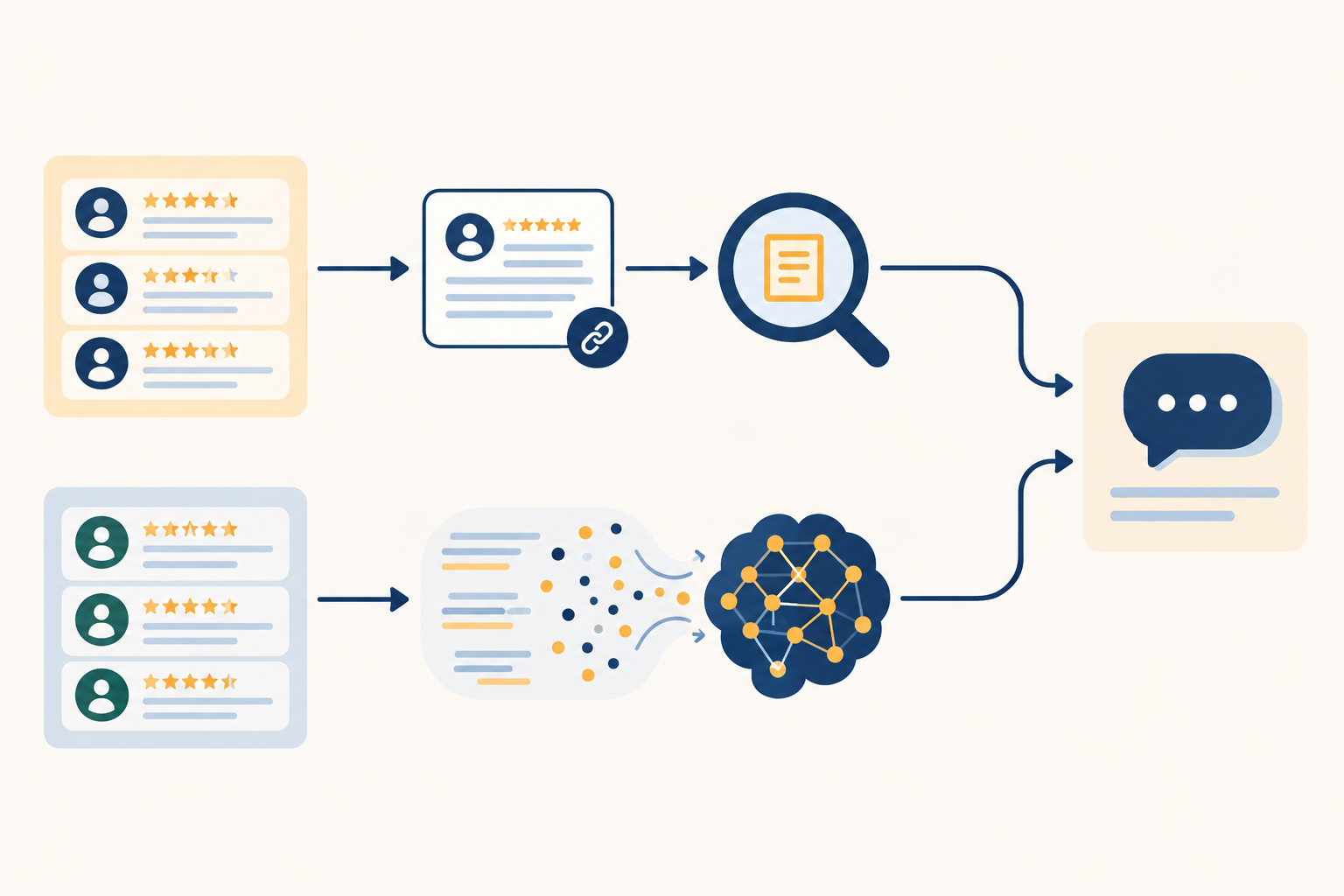
I would expect G2 to surface for B2B software comparison queries and Trustpilot to surface for consumer, service-trust and DTC queries such as 'is [brand] legit'. Verify that in your own category rather than assuming it. Both are plausible given what each site hosts, and neither is guaranteed. For Google's AI features, Google's documentation says they rely on the same foundational Search eligibility requirements as other Search features. It does not describe G2 or Trustpilot reviews as a special input.
Reviews are also only one input. Your own site, editorial roundups, Reddit threads and comparison pages all compete for the same answer, so fixing your G2 profile will not change your recommendations on its own.
What the evidence shows about G2 reviews and AI, and what it does not
Public documentation confirms that AI search products can show linked sources. It does not establish how often G2 or Trustpilot pages are cited, or whether their reviews independently change a recommendation. A citation shows that a page was surfaced. It does not prove the review content caused the recommendation.
For that reason I am not printing a league table of citation percentages. A figure without a stated sample size, date range, region and query set would be worse than no figure. If you publish or rely on citation data, whether your own or anyone else's, I would want to see at least the following:
- The exact question set and how it was built.
- The engines tested, the product mode used (for example, search on or off) and the region.
- The date range and the number of repeat runs per question.
- The definition of a citation (a linked URL) versus a soft mention (named in prose, no link).
- The limitations, including that answers vary between runs.
The table below is a set of audit questions, not a set of findings. Source-linking behaviour changes as engines update, so any snapshot has a shelf life 📊.
| Engine | Source-linking behaviour to expect | What to verify in your audit |
|---|---|---|
| ChatGPT | Shows linked sources when search is used; behaviour differs when search is off | Was search enabled? Which exact URLs were cited? |
| Perplexity | Presents source links as a core part of answers | Are cited pages review profiles, category pages or third-party articles? |
| Copilot | Typically provides linked references | Does it name the platform in prose, link it, or both? |
| Gemini / Google AI features | Draws on the Google Search index and supporting links | Are your review pages indexable and accessible? |
| Claude | Source display depends on the product mode in use | Is a citation shown, or is a review claim made without one? |
Treat the graphic above as a blank template. Fill it only with results from your own audit, and leave cells empty rather than guessing.
Distinguish direct citations, indirect sources and soft mentions
When I analyse answers, I keep three levels of evidence separate, because they are not equivalent.
- Direct citation: the answer links to a G2 or Trustpilot URL.
- Indirect representation: the answer cites a third-party article that quotes or aggregates reviews.
- Soft mention: the platform or its ratings are referenced in prose with no link, or a review-style claim appears with no visible source.
A brand that is only softly mentioned holds a weaker, less verifiable position than one that is linked, and the fix differs for each. With soft mentions, check where the claim originates. With missing citations, check whether your profile is accessible and clear.
One piece of market context: Gartner forecast in February 2024 that traditional search engine volume would fall 25% by 2026 as users move to chatbots and virtual agents. That is a forecast about search behaviour, not a measurement of review-site citations. It does explain why monitoring AI-mediated discovery has become routine.
Audit G2 reviews AI systems may cite, and other profiles
This is the core method. It takes an afternoon to set up in a spreadsheet, and the logic is the same whichever tool you eventually use.
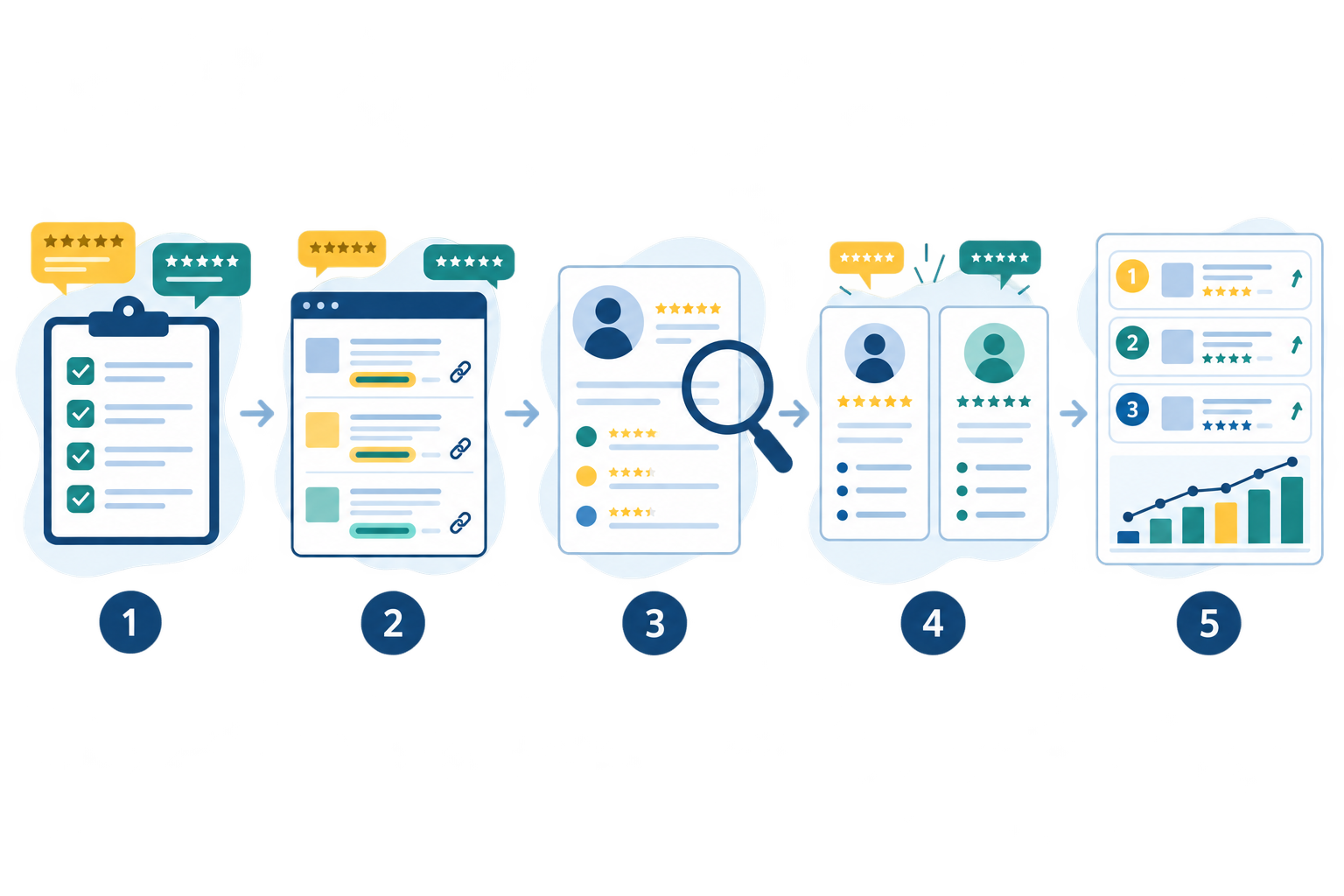
Step 1: Build a question set from real buyer queries
Use non-leading prompts that mirror how buyers actually ask. For SaaS, try 'best [category] tool for small teams' and 'compare [Product A] and [Product B] for a mid-sized business'. For DTC, try 'is [brand] legit' and 'is [brand] worth it'. Aim for 20 to 40 questions that cover discovery, comparison and trust intents.
Step 2: Record which review URLs AI answers cite
For every run, save the prompt, date, engine, region, whether search was enabled, the full answer, every cited URL and the page type (product review page, category comparison, company profile or third-party article). Note whether the review page belongs to you or a competitor, and where in the answer it appears. Run each question at least three times on different days, because answers vary between runs.
Step 3: Check each cited profile for clarity
Open the profiles that are actually being cited and read them as a retrieval system might. Look for the following:
- A plain-language product description that states what the product does and who it is for.
- Accurate category tags and, on G2, correct category placement.
- Current pricing, plan names and feature lists.
- Consistent brand naming across platforms, with no legacy product names.
- Public accessibility, meaning the page is indexable and not blocked.
Structured data is not a shortcut. Google's review snippet guidelines restrict self-serving reviews on pages controlled by the reviewed organisation, and eligibility for a snippet is not evidence that an AI answer will cite the page. Your own site deserves the same scrutiny as your review profiles.
Step 4: Compare your profile with the most-cited competitors
Place your profile beside the competitor profiles that surface most often. Compare review volume, how recent the latest reviews are, vendor response rate and the themes in review text. The aim is to understand what the cited profiles have in common, not to copy them.
Step 5: Prioritise profile fixes with a triage score
A simple score keeps prioritisation honest, provided you treat it as a triage heuristic and not a measurement of impact. Three rules make it more defensible.
- Normalise citations. Use citation rate, meaning the share of answers citing the profile, calculated across all runs of your question set, per engine and overall. Raw counts mislead when engines or query types are unevenly represented.
- Define severity before you score. Rate 1 for cosmetic issues (outdated screenshots), 2 for factual gaps (stale pricing, missing features), and 3 for material problems (wrong category, wrong product description, legacy name).
- Smooth out volatility. Use the average over at least three runs, and re-score after every re-run rather than acting on one day's results.
| Profile | Citation rate (illustrative) | Gap severity (1-3) | Triage score |
|---|---|---|---|
| G2 product page | 35% | 2 | 70 |
| Trustpilot profile | 15% | 3 | 45 |
| Capterra listing | 5% | 1 | 5 |
Triage score is citation rate (as a percentage) multiplied by severity. The figures above are invented to show the arithmetic and are not benchmarks. The profile that appears in the most answers gets attention first, even if another platform feels more prestigious.
How to audit AI review citations for UK buyers
A UK buyer may phrase a query differently and receive different sources from a US buyer. That is a hypothesis to test, not a rule. To test it:
- Write a UK variant of each question ('best CRM for a UK small business', 'is [brand] legit UK', 'does [brand] charge VAT') and a neutral or US variant.
- Run both sets with the region setting and logged-in state recorded, ideally from UK-based browsers and logged out where the product allows it.
- Compare the cited sources side by side, and log whether Trustpilot, G2 or UK-specific publishers dominate each set.
- Check that your profiles show GBP pricing, UK availability and UK delivery or support details where relevant.
Do you need more G2 reviews or better reviews?
No public rule says an AI assistant will recommend a product simply because it has more G2 or Trustpilot reviews. I find it helps to separate what is documented about human buyers from what is inferred about AI.
For human buyers, the evidence is solid. Northwestern's Spiegel Research Center report (2017) found that products with five reviews had a purchase likelihood 270% higher than products with none, rising to 380% for higher-priced products. It also found that purchase likelihood peaked at roughly 4.0 to 4.7 stars rather than a perfect 5.0. G2 has published research suggesting that a large majority of B2B buyers say trusted reviews influence their purchases. It is self-published, so treat it as vendor evidence, and check the current edition and its sample before quoting a figure.
For AI, we are inferring. None of that research measures AI citation behaviour. My reasoning is that volume plausibly helps establish you as a credible, real entity in a category, while specificity and recency are more likely to shape how you are described. You can test that. It is not a proven rule.
Why specific review details matter more than repetition
A review that names a use case, a team size and an outcome ('moved a 12-person support team off email in two weeks') gives a summariser far more to restate than a run of one-line five-star ratings. This fits how summarisation works, but I have not seen it proven for any specific engine.
Does review recency affect AI answers?
A stale profile may lose out to a competitor with fresher reviews. Suppose a rival with a newer review stream is cited in answers where you were previously present. That is a signal worth investigating, not a conclusion.
Collect reviews ethically and follow platform rules ⚖️
Do not buy reviews, offer incentives conditioned on sentiment, or manufacture reviews. The rules differ by jurisdiction, so I have separated law from good practice below. Take legal advice for your own situation.
- UK law. The Digital Markets, Competition and Consumers Act 2024 prohibits fake consumer reviews and commissioning misleading ones. The CMA can enforce directly, and fines can reach 10% of global turnover. The relevant provisions took effect on 6 April 2025.
- US law. The FTC's final rule on fake reviews and testimonials, effective October 2024, covers fake reviews, certain sentiment-conditioned incentives and review suppression.
- Platform policy. G2 and Trustpilot each publish their own guidelines on incentives and moderation, and these may be stricter than the law.
- Recommended practice. Tie requests to real customer milestones, such as a completed onboarding, a successful renewal or a delivered and used order. Ask every eligible customer rather than filtering for happy ones.
Review language that shapes AI summaries
AI-generated summaries may reflect recurring themes in review text, but a review being present does not guarantee it will be used or cited. What helps is a systematic comparison of what reviewers say with what AI says about you.
- Extract your themes. List the top positive and negative themes on each profile, such as 'easy onboarding', 'poor support response' or 'expensive for small teams', with rough counts.
- Compare with AI descriptions. Use prompts like 'What do users like and dislike about [product]?' and check whether the cited pages actually contain the language the answer summarises.
- Elicit specifics without scripting. Ask customers for the use case, the alternative they considered and the outcome: 'What problem were you solving, what else did you consider, and what changed after switching?' Scripted phrasing doesn't work and risks breaching platform moderation rules.
- Find the silent strengths. If your product excels at something, such as integrations or fast setup, and no reviewer mentions it, no answer built from reviews will reflect it. Target those gaps in your request prompts.
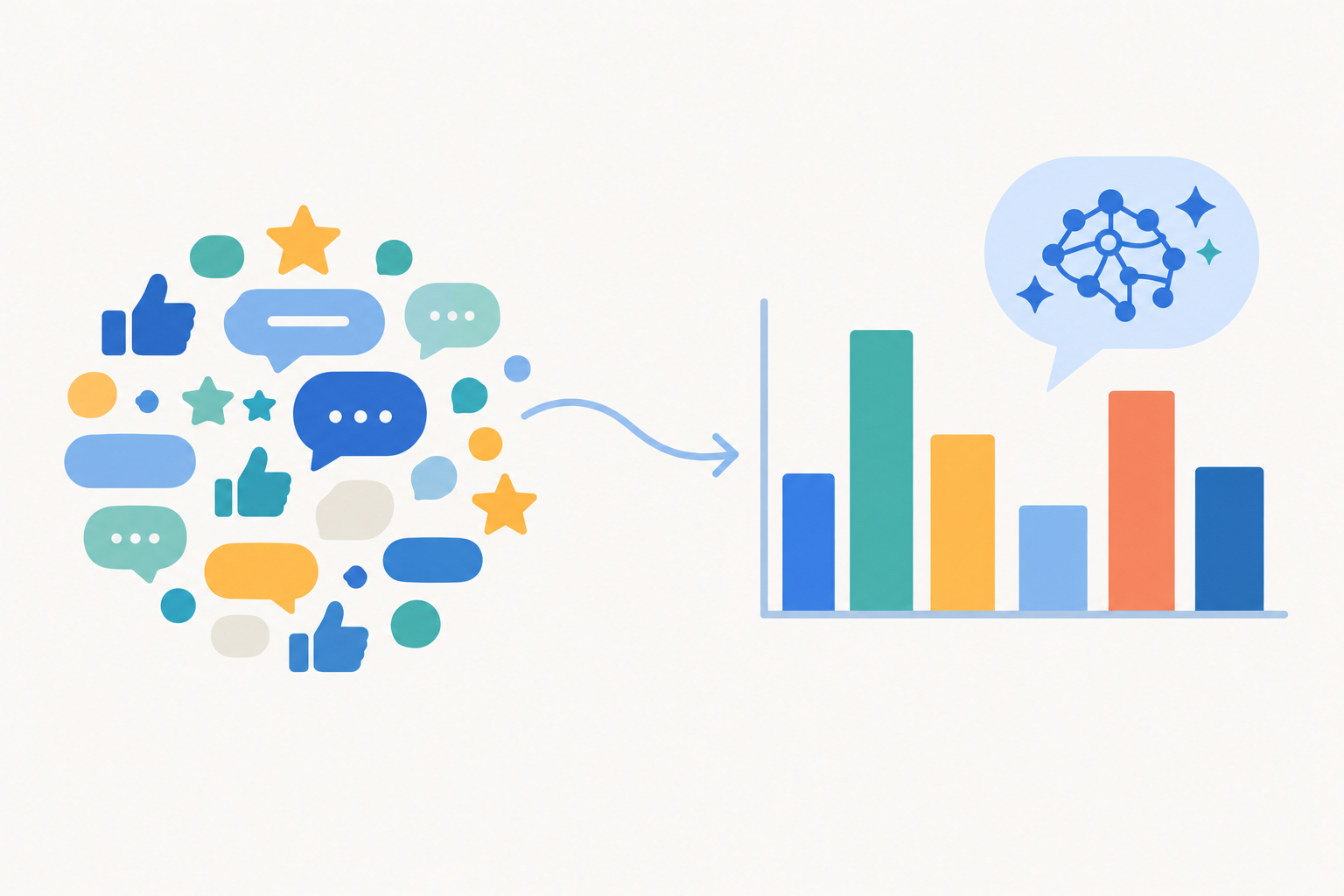
Worked example: how review themes may affect AI descriptions
Before: Of 60 reviews, the dominant themes are 'easy setup' (31 mentions) and 'support slow' (14). Almost nobody mentions reporting, the product's strongest feature. When the question set is run, answers describe the product as 'simple to set up, with mixed support experiences' and say nothing about reporting.
Action: Over a quarter, the team cuts support response times, replies publicly to the older complaints, and asks recently successful customers which reports they use and why.
After: New reviews mention specific reporting use cases, and 'support slow' falls as a share of recent reviews. The team re-runs the question set to see whether the AI descriptions shift. They may or may not. That is exactly why you measure rather than assume.
Responding to reviews with AI in mind
Public responses are page content too. A clear, factual reply can correct a misunderstanding and add context that a retrieval system may read alongside the review.
- Name the product and state the fix. Reference the specific feature or change that addresses the complaint, and skip defensive or boilerplate wording.
- Prioritise by citation data. Respond first on the profiles that appear most often in your audit, and commit to a consistent turnaround time.
- Write for the human first. Machine readability follows from clarity, and keyword stuffing makes replies worse for both audiences.
A four-part structure works well: acknowledge, clarify, resolve, invite follow-up.
SaaS billing complaint example:
Thanks for flagging this, and apologies for the confusion over your renewal. Your annual plan renewed on the date shown in your billing settings, which is where the charge came from. We have since added a renewal reminder email seven days beforehand. We have also refunded the difference, as you moved to a smaller team. If you email billing@yourcompany.com with your account name, we will confirm the details in writing.
DTC delivery complaint example:
We're sorry your order arrived late. The delay came from a courier backlog at our UK warehouse partner, and we should have told you sooner. We now send tracking updates at dispatch and again if a delay is detected. Your replacement has been prioritised, and if it does not arrive by Friday, message us and we will refund you in full.
Neither reply is defensive, and both give concrete facts the customer can check.
Monitoring sentiment and AI citations after profile updates
Profile work is only worth continuing if you can show it moves something.
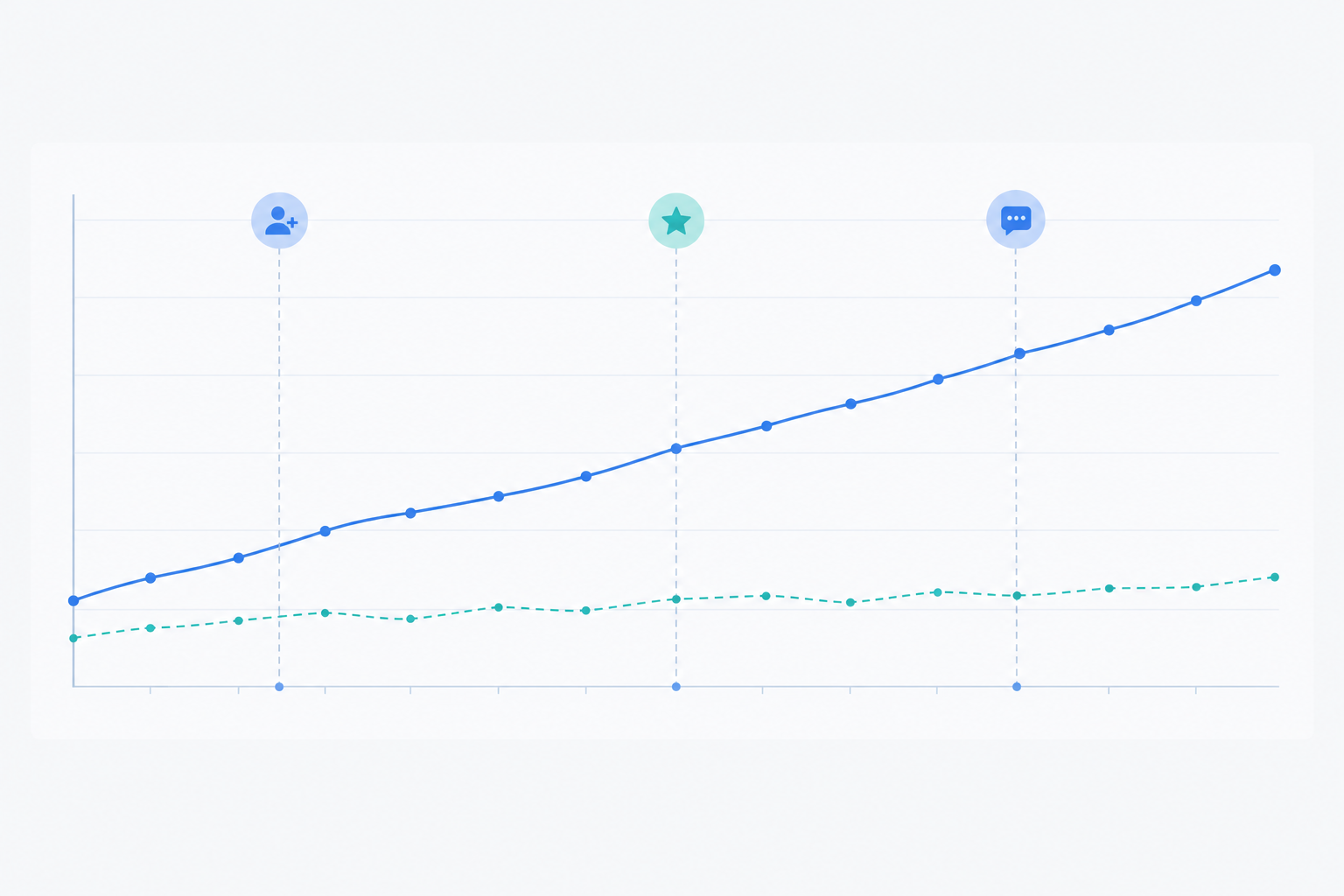
- Baseline first. Before changing anything, record citation rate per review platform, the sentiment of the descriptions, and how often you appear against named competitors (share of voice, meaning your share of all brand mentions across the question set).
- Log every change with a date, whether it is a description rewrite, a review campaign or a response sprint. Without a change log you cannot connect actions to outcomes.
- Re-run the same question set weekly, watching citation rate, position and tone. Results fluctuate day to day, so look at trends rather than individual answers.
- Watch competitors, and note when a rival's profile starts displacing yours in cited sources.
- Review monthly. Keep the changes that correlate with improvement, and do not infer causation from a single week of data.
Disclosure: I work on MentionOwl, which can automate this loop by running buyer-style questions daily across ChatGPT, Claude, Gemini, Copilot and Perplexity. Everything in this guide can be done manually with a spreadsheet and a consistent schedule. Automation mainly saves time as your question set grows.
A prioritised 30-day plan to audit G2 reviews and AI answers
- Week 1, audit. Run the citation audit and identify the three review sources that appear most often in your category's AI answers. Capture the baseline.
- Week 2, fix. Correct factual gaps and inconsistencies on the top-cited profile (description, categories, pricing, naming) and reply to outstanding reviews, starting with the most recent negatives.
- Week 3, ask. Launch an ethical, specific review-request campaign aimed at recently successful customers, using prompts that elicit use cases and outcomes without scripting them.
- Week 4, re-measure. Compare against the baseline, document what changed and decide where to invest next.
Review platforms are one slice of AI visibility. Generative engine optimisation works best when your profiles, your own site and third-party content tell a consistent story, and when citation data, not assumption, decides where the effort goes.
Frequently asked questions about G2 reviews and AI
Do AI engines quote G2 or Trustpilot directly?
Some can, particularly engines with live web retrieval such as Perplexity and ChatGPT with search enabled. They may link to a G2 or Trustpilot URL, or paraphrase its content without naming it. How often this happens is not publicly established, so run your own category questions and record which sources appear.
Do I need more reviews or better ones?
Probably both, in sequence, though that is my reasoning and not proof. A baseline volume makes your profile credible. After that, specific, recent reviews describing use cases and outcomes give engines richer material to summarise. Compare the volume and quality of the most-cited competitor profiles with yours before deciding.
Does review sentiment change how AI describes our brand?
It may, since recurring review themes can echo in AI-generated summaries, but the relationship is not guaranteed. Engines also draw on your website, editorial coverage and forums. Tracking the sentiment of AI descriptions before and after profile changes will show whether the link holds for your brand.
How do I track G2 and Trustpilot citations over time?
Fix a set of buyer-style questions, run them against the major AI engines on a regular schedule, and log citations, sentiment, position and competitor mentions with dates and regions. A spreadsheet is enough to start, and tools can automate the runs later.
Are review sites more important than my own website for AI recommendations?
Not necessarily. They do different jobs: your site supplies authoritative facts, while review platforms supply third-party validation and customer language. Audit both, and let citation data decide which deserves attention first.