ChatGPT vs Perplexity vs Gemini: How Each AI Engine Cites Sources and What It Means for Your Brand
ChatGPT vs Perplexity: compare how Gemini and other AI engines cite sources, shape answers and surface brands—with a UK guide to monitoring each platform.
ChatGPT vs Perplexity vs Gemini: How Each AI Engine Cites Sources (A UK Guide)
The short answer: ChatGPT, Perplexity and Gemini each retrieve, rank and display sources differently, so a brand can be recommended prominently in one engine and be invisible in another for the very same question. Perplexity is built around retrieval and shows numbered citations on typical answers. ChatGPT cites sources when it uses search and often names brands without links when it does not. Gemini can ground answers in Google Search, and otherwise relies on model knowledge. I therefore treat AI visibility as a per-engine measurement problem, not a single ranking to optimise once.
That matters for UK SaaS and DTC brands because the ChatGPT vs Perplexity question (and Gemini vs ChatGPT) is a commercial one. Purchase-decision queries such as 'best project management tool for small teams' are increasingly answered directly, and the brands named in that answer get the buyer's attention before they ever open a results page. Below, I set out how each engine behaves, which claims are documented and which are only my team's working observation, and how to build a monitoring routine that fits your resources. 🦉
Disclosure: I am part of the team that builds MentionOwl, an AI visibility monitoring tool, which comes up later in this article. I have kept product material in a clearly labelled section so you can read the comparison on its own.
Why ChatGPT, Perplexity and Gemini give different answers
Every AI answer is shaped by three layers, and the mix differs from engine to engine:
- Training data. This is what the model absorbed during training. Answers drawn purely from this layer often carry no citations, and a brand may appear only as a soft mention (named in the text with no link to its site).
- Retrieval. This is live web search. OpenAI's ChatGPT search documentation explains that ChatGPT may rewrite a prompt into one or more search queries, so the pages retrieved depend on that rewriting and not only on what the user typed.
- Answer-style rules. This is how the product presents sources, from numbered footnotes to a collapsible sources panel.
Two engines of similar capability can still diverge, because each uses a different search index, different ranking signals and a different citation policy. Perplexity describes itself as an answer engine that searches the web and links its sources. Gemini can use grounding (connecting a model's answer to live Google Search results), described in Google's Gemini API grounding documentation. ChatGPT Search uses its own retrieval pipeline. Grounding in Google's index doesn't mean Gemini and ChatGPT see the same results, and it doesn't mean they interpret a retrieved page the same way.
There is also a synthesis effect. Two platforms may retrieve overlapping sources and still select different details, resolve ambiguity differently or express different levels of certainty. OpenAI and Google both caution users to verify answers, and a citation list is not proof that every statement is fully supported by the pages linked.
Why AI search results vary between runs
The same prompt run on different days, or with slightly different phrasing, can return different brands. A single-snapshot check can mislead you, because you may have caught a good day or a bad one. Reliable measurement means repeated runs, with the answer, cited URLs, engine, product surface and date recorded each time.
Why AI citations matter to UK brands
The click economics are shifting. In a 2025 Pew Research Center analysis of US adults' browsing behaviour, users clicked a traditional result in 8% of visits to a results page that showed an AI summary, against 15% when there was no summary. They clicked a link inside the summary in about 1% of visits. That study concerns Google AI summaries, not the three engines compared here, and it is US data, so it shows direction and not a UK forecast. Still, it shows why being named in the answer can matter as much as being linked beneath it.
What we know about AI citation overlap
The obvious numbers for this article would be how far AI citations overlap with traditional top-10 Google results, and how often AI answers cite anything at all. I went looking for published analyses that met four criteria: a publication date within roughly the last two years, a disclosed number of prompts, a named set of engines and product surfaces, and an explained method for matching cited URLs to rankings. The analyses I found were mostly vendor-published, and they differed on all four. Prompt sets ranged from branded queries to broad informational ones, some tested API access while others tested consumer apps, and ranking data came from different tools and countries. Their headline percentages can't be compared with one another, and almost none were collected on UK searches.
So I can't responsibly give you a single overlap or citation-rate number, and this article should not be read as a statistical study. What I can offer is a method: run your own UK question set, record the cited URLs, and compare them with your own rank-tracking data. The result will be narrower than a headline statistic, but it will describe your category, your market and your dates.
ChatGPT vs Perplexity vs Gemini: citation behaviour at a glance
The table separates what public documentation states from patterns my team has seen while monitoring. (D) marks documented behaviour, with the source linked beneath the table. (O) marks an informal observation from our monitoring, not a controlled study. We have not published a fixed sample, run count or coding method for these cells, so treat them as hypotheses to test against your own queries.
| ChatGPT | Perplexity | Gemini | Claude / Copilot (secondary) | |
|---|---|---|---|---|
| Default citation display | Inline links and a Sources panel when search is used; no links in answers that do not search (D1) | Numbered inline citations and a source list on typical answers (D2) | Source links when Google Search grounding is used; varies by product and setting (D3) | Claude: citations when web search is used (D4). Copilot: links to supporting sources in web-grounded answers, varying by surface (D5) |
| When web search is triggered | Depends on the product, plan and settings: ChatGPT may decide to search based on the question, or the user can select search manually (D1) | Retrieval is central to the product (D2) | Grounding is applied to some requests, not all (D3) | Claude: availability varies by plan and settings (D4). Copilot: Bing-connected (D5) |
| Typical number of sources | A handful per search-enabled answer (O) | Often the most visible source list of the three (O) | Varies widely by query (O) | Varies (O) |
| Source types most often seen | Mixed: brand sites, editorial roundups, reviews (O) | Recent articles, review sites, forums, comparison pages, documentation (O) | Established, high-authority domains and Google-owned surfaces (O) | Review sites and publishers (O) |
| Unlinked brand mentions | Common where search is not used (O) | Less common, since most answers are retrieval-led (O) | Occur when answers rely on model knowledge (O) | Claude tends toward cautious brand naming (O) |
| UK-specific behaviour | Results may shift with locale and phrasing; test with UK wording (O) | As ChatGPT (O) | Likely to draw on Google's locale signals, to be confirmed by testing (O) | Copilot reach is strongest in Microsoft workplaces (D5) |
Documentation sources: (D1) OpenAI, ChatGPT search; (D2) Perplexity's own product descriptions and help centre at perplexity.ai; (D3) Google, Gemini API grounding; (D4) Anthropic, web search announcement; (D5) Microsoft Copilot documentation. Product interfaces change often, so check the current pages before acting on any cell.
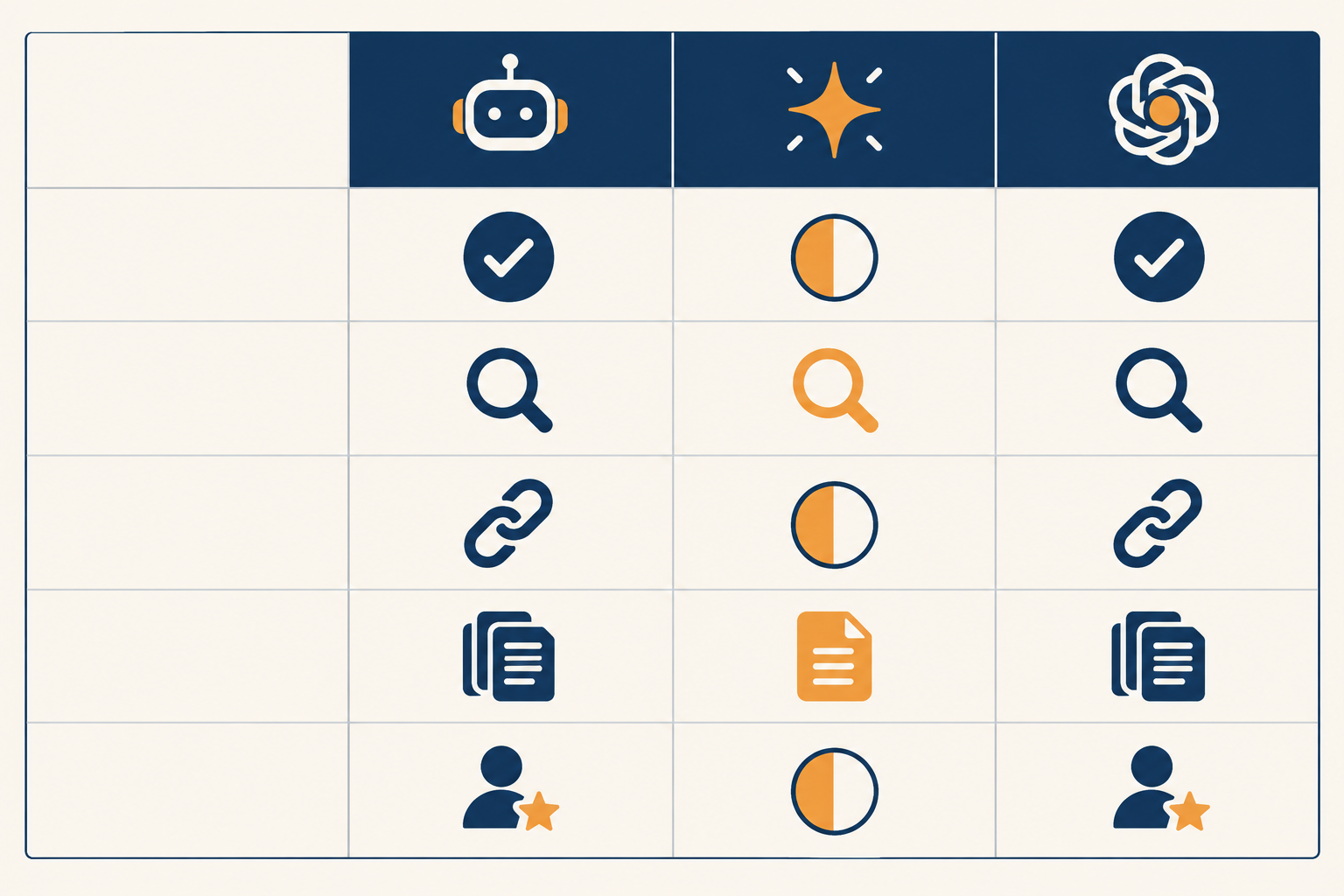
Takeaway: In our monitoring, Perplexity answers have often cited recent, clearly structured pages. ChatGPT answers have often reflected a broad footprint of third-party mentions, and Gemini answers have often resembled what already performs well in Google. These are correlations in what we have seen, not documented ranking factors, and no engine has said that following them guarantees a citation.
How Perplexity shows and cites its sources
Perplexity is built as an answer engine with retrieval first, so numbered, clickable citations sit beside answer passages on typical responses. Attribution is visible within the answer instead of being left to a separate list of results. Perplexity's CEO said in 2024 that the service had more than 10 million monthly active users, and the company reported handling over 100 million queries per week in March 2024. Those are company-reported figures from 2024. They measure scale, not citation frequency or referral traffic, but they explain why the engine earns its own line in your monitoring.
In our monitoring, the pages it cites include recent articles, review sites, forums such as Reddit, comparison pages and well-structured documentation. The sources vary by query, so no pattern guarantees a citation.
This makes Perplexity a useful engine for diagnosing why a competitor is being recommended, because you can often trace the exact page. If a rival is named in a comparison answer, open the numbered link and read what that page says that yours does not. In our experience the gap is often a missing pricing table, an outdated feature list or a lack of third-party validation, though you should verify this against the pages in your own category.
There is a limitation worth stating plainly. A citation is not a recommendation. Your page can be cited as a source while a rival is the brand named in the answer, and a brand can be discussed without its own site being linked. For that reason I suggest tracking citation share, mention share and the accuracy of attributed claims as three separate measures.
In practice, clear headings, visible dates and precise, extractable facts make a page easier for any retrieval system to use. We have seen these features on pages Perplexity cites, but I'd call that a hypothesis about correlation, not a confirmed ranking factor.
Gemini vs ChatGPT: how their sources differ
ChatGPT: model knowledge versus web search
The distinction that matters most in ChatGPT is between answers that use search and answers that don't. According to OpenAI's documentation, ChatGPT may choose to search the web depending on the question, and users can also select search manually. Whether search is available, and how it is presented, varies by product surface, plan and settings, so two people asking the same question may see different behaviour. When search is used, answers include inline links and a Sources panel. When it isn't, the answer comes from model knowledge, usually without links, and your brand may appear only as a soft mention. A brand shouldn't assume that every ChatGPT response will cite websites, and this is one reason ChatGPT citations are harder to predict.
On crawler access, OpenAI's bot documentation describes OAI-SearchBot as the crawler used to surface sites in ChatGPT search, and distinguishes it from GPTBot, which relates to model training. Read the current documentation before changing robots.txt rules, because blocking one bot does not necessarily affect the other.
Scale makes this hard to ignore: OpenAI said in February 2025 that ChatGPT had 400 million weekly active users.
Gemini: Google's search infrastructure
Gemini's link to Google Search is its defining feature. When it grounds an answer in Google Search, it can provide links to supporting pages, as set out in Google's grounding documentation. In our monitoring, Gemini answers have often leaned on established, high-authority domains and Google-style business signals, while ChatGPT answers have drawn on a wider mix that includes editorial listicles. That is an observation from our own runs, not a documented rule. Google's crawler documentation says the Google-Extended control relates to certain generative AI uses and does not affect inclusion in Search, so don't treat it as a lever for Gemini citations. Reuters reported in March 2025, citing a court filing, that Gemini had about 350 million monthly active users. That is a monthly measure and can't be compared directly with ChatGPT's weekly one.
ChatGPT vs Gemini: an illustrative example
The following is an illustrative, anonymised scenario built to show the audit method, not a reported result. Imagine the query 'best invoicing software for UK freelancers' run on both engines:
- ChatGPT (search enabled): names five tools, with Brand A first and your brand fourth. Links go to two editorial roundups and one vendor site. A sixth tool is mentioned in the text with no link.
- Gemini: names four tools, with your brand first. Links go to two established software directories and a vendor page.
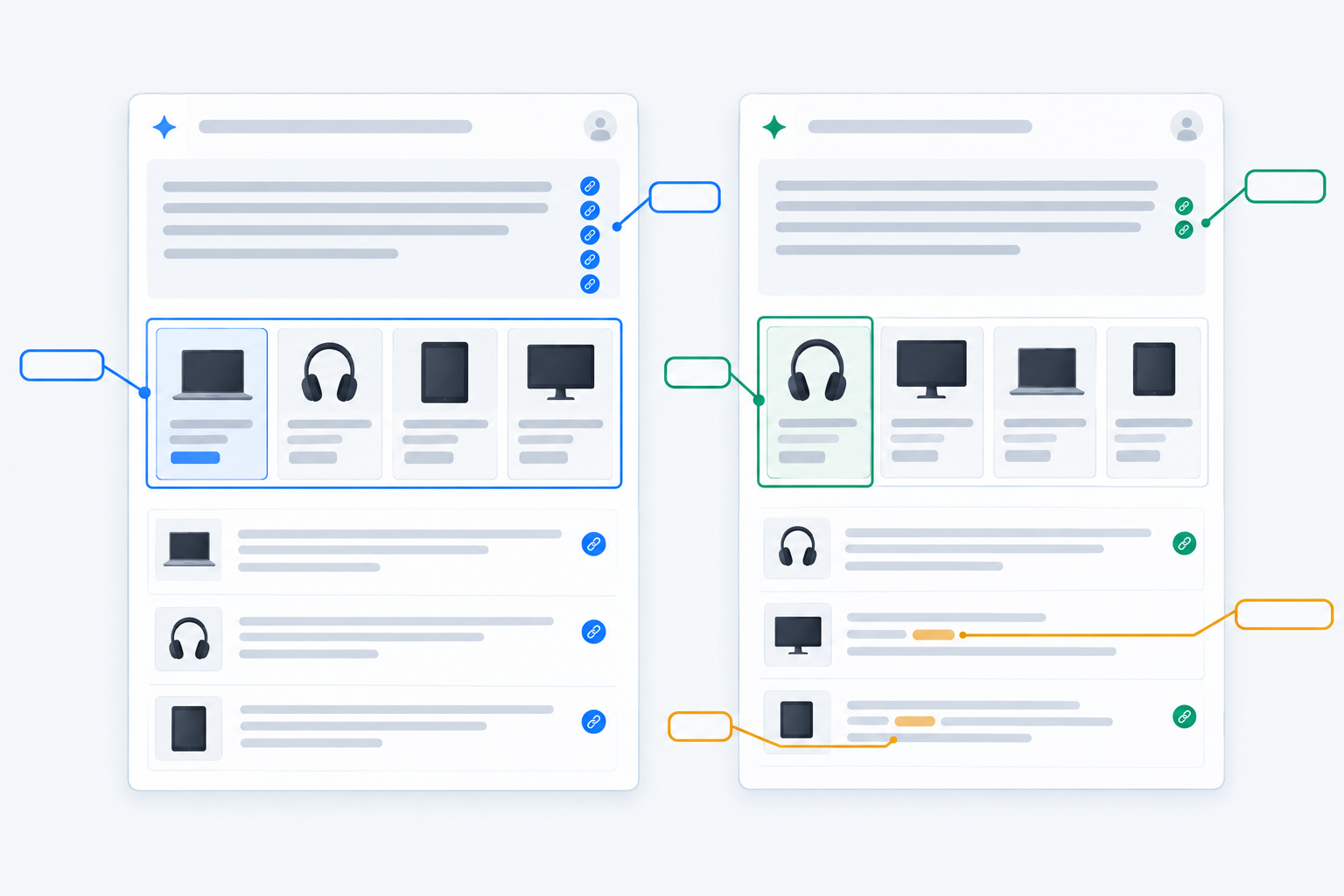
Same query, different brands, different order, different sources. Your brand would be well placed in one engine and weak in the other, and only per-engine tracking would show it.
Why brand position matters in AI answers
Being named first is plainly not worth the same as being named fourth, so many monitoring approaches weight mentions by position. Any such weighting is a modelling judgement, not a measured fact. As a simple illustration, you could score first position at 1.0, second at 0.7, third at 0.5 and later positions at 0.3 (these numbers are mine, for the example, not a standard). Weighting stops a flat mention count from flattering a brand that only appears at the end of a list. The risk is false precision, so compare scores over time within one method instead of treating them as absolute.
Where Claude and Copilot fit in AI search
These two engines are context for the multi-engine argument, not a deep dive, but you shouldn't ignore them.
- Claude can search the web, and Anthropic stated in its March 2025 announcement that web-search responses include citations linking to sources. In our experience it is more conservative about naming brands, so first-party and review-site citations deserve separate tracking. Availability varies by product, plan and settings.
- Copilot is closely tied to Bing and Microsoft products, and web-grounded responses can link to supporting sources. Bing indexing and Bing Webmaster Tools therefore matter for visibility there. Presentation varies across consumer Copilot, Edge and Microsoft 365, so test the surface your audience actually uses.
Audience mix differs by sector. Microsoft and LinkedIn's 2024 Work Trend Index, a survey of 31,000 people across 31 countries, found 75% of knowledge workers using AI at work, and 78% of those users bringing their own AI tools. These aren't Copilot-specific figures, but they suggest workplace buyers meet several assistants, not one.
Which AI engine matters most for your business?
The honest answer is 'it depends, and it changes'. The guidance below is provisional, because most public usage figures are global or US-based, and your own data should override it.
- Start with your own data. Use analytics referral data, 'how did you hear about us' fields and sales-call notes to see which engines already send visitors, then compare referrals, qualified leads and conversions by engine. Referral attribution from AI tools is imperfect, since some visits arrive without a clear referrer, so treat the numbers as a floor.
- B2B SaaS (a hypothesis): research-heavy buyers and workplace users may meet Copilot, ChatGPT and Perplexity most often, so test those first.
- DTC and consumer brands (a hypothesis): Gemini and ChatGPT have broad consumer reach, and Gemini benefits from Android and Google surface integration. Google said in May 2025 that AI Overviews had more than 1.5 billion monthly users, which makes Google-led AI discovery relevant even outside the Gemini app.
- UK specifics: most of the figures in this article are not UK-specific, and I haven't found a UK dataset that compares the three engines' citation behaviour. Ofcom's Online Nation research is a sensible place to look for UK usage trends. In your own testing, use UK spellings and terms, prices in pounds, and UK delivery and VAT context. Then check whether the cited sources are UK review sites, UK retailers and UK trade press, or US pages that don't apply to your customers.
Why your brand appears in one AI engine but not another
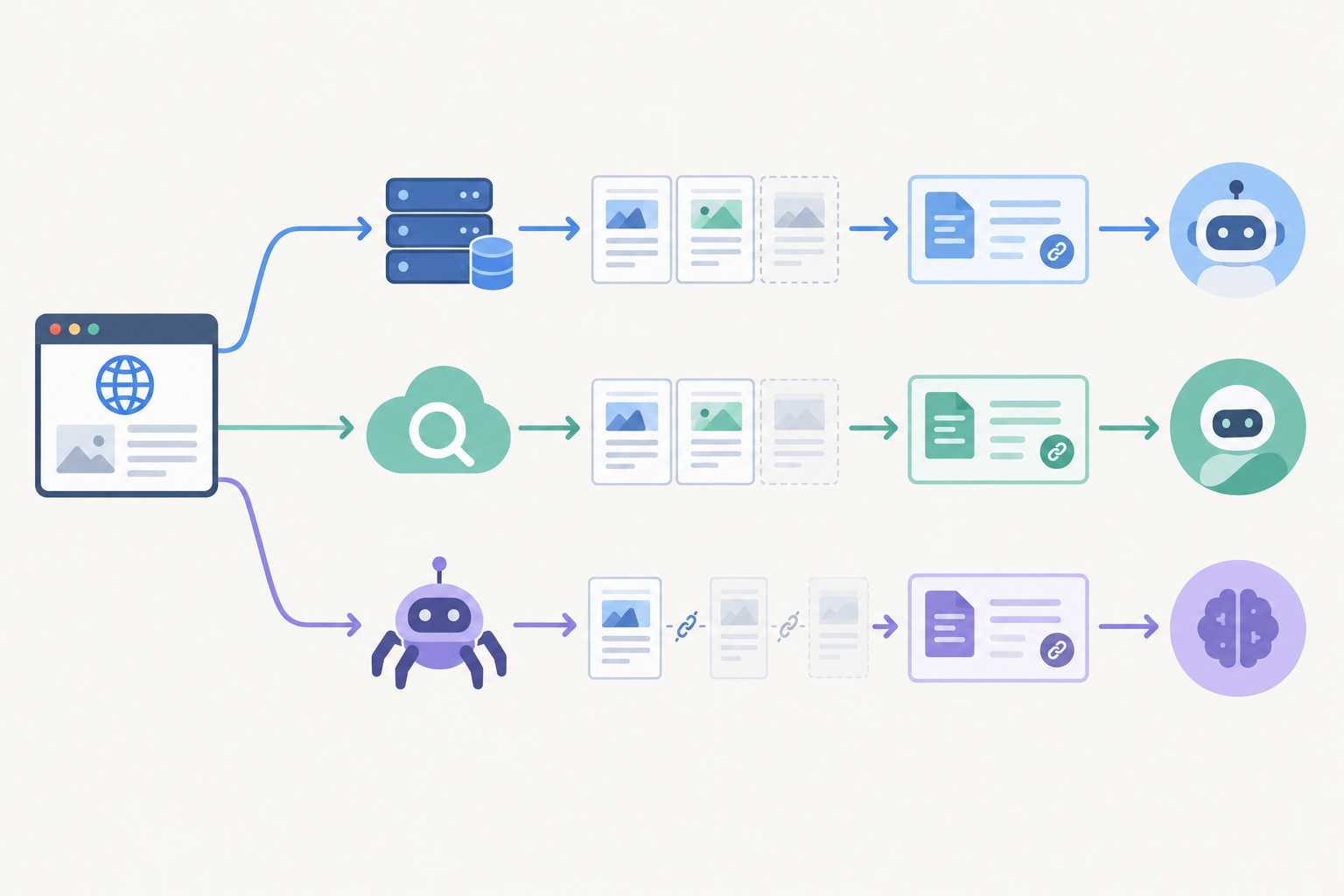
When a brand surfaces in ChatGPT but not Perplexity, or the reverse, the cause usually falls into one of five categories:
- Different retrieval sources. Bing-fed, Google-fed and independent crawlers each see a different version of the web.
- Crawler access. Robots.txt rules, bot blocking and JavaScript-heavy pages can make a site unreadable to some AI crawlers but not others. An AI legibility audit (a check of whether machines can access and parse your pages and entity information) is the quickest way to find this.
- Third-party presence. Engines may lean on review sites, forums and editorial roundups, so gaps in off-site mentions can hurt unevenly.
- Entity clarity. Inconsistent brand naming and thin 'about' or product pages can weaken how models recognise you.
- Recency and phrasing. Question wording and content freshness shift which brands are retrieved.
How to build a multi-engine AI monitoring routine
Here is the routine I recommend. It works with a spreadsheet, and you can automate it if volume demands.
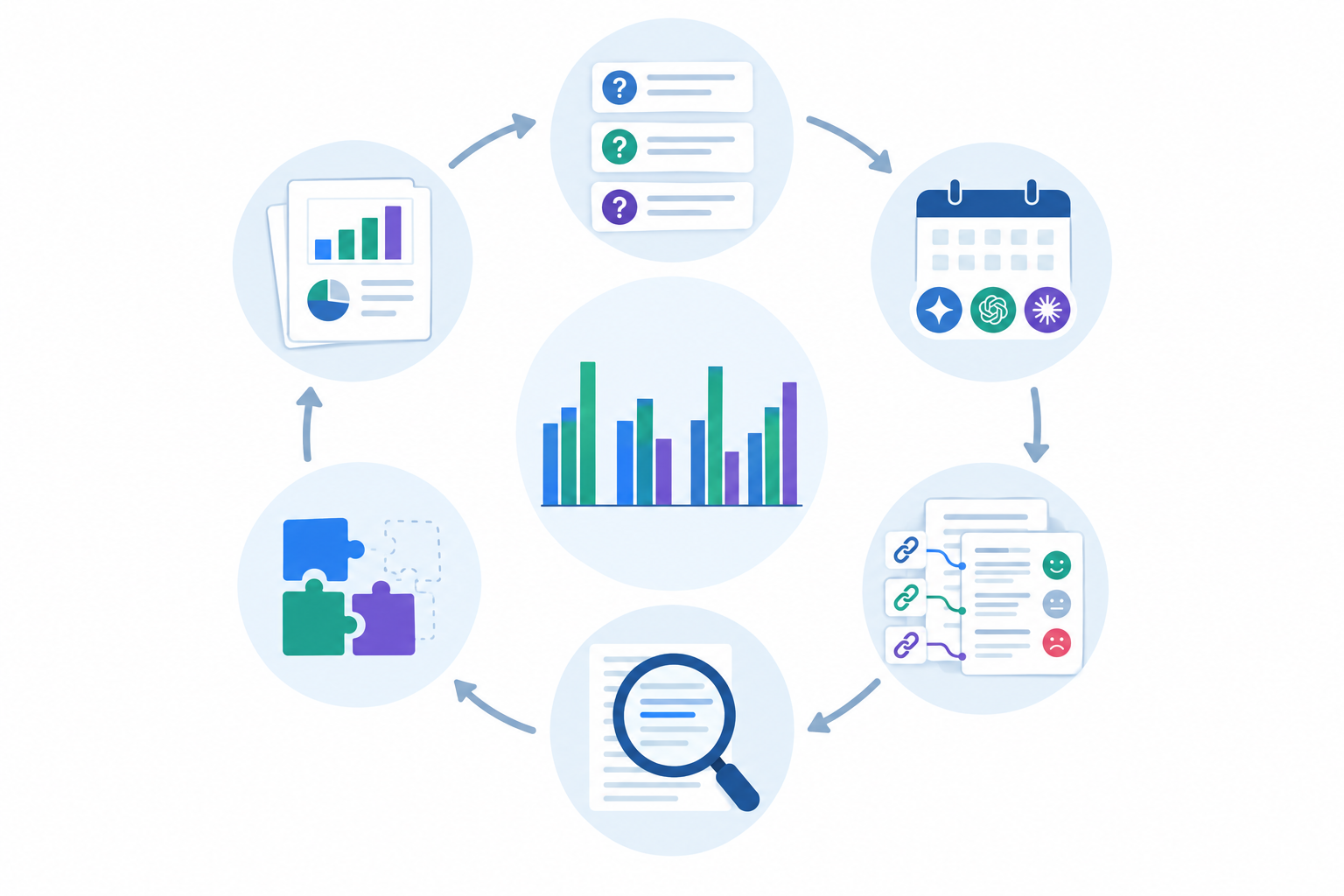
- Build a question set from real customer purchase-decision queries. Cover category, comparison, problem-led and brand queries, written the way UK customers phrase them.
- Fix the test conditions. Use the same wording, logged-out or consistently configured accounts, the same location settings and the same product surface for every run, and record the engine version or mode where it is shown. Without this, differences between engines may simply reflect differences in set-up.
- Choose a cadence by query value. Your highest-value 10 to 20 queries may justify daily or several-times-weekly runs, because AI answers vary between runs. Secondary queries can be checked weekly or fortnightly, and a small brand with a short sales cycle may find weekly checks for everything enough. The cost is staff time if you do it manually, or subscription cost if you automate, so scale frequency to the decisions the data will actually change.
- Record answers, citations, sentiment, position and competitor mentions. Track share of voice (your brand's share of all brand mentions across the question set) separately for each engine.
- Audit technical AI legibility. Check crawler access, structured data, clear page structure and consistent entity information.
- Read the cited pages. Find the gaps where competitors are cited and you are not, then prioritise content and PR to fill them.
- Review a digest on a regular schedule. Compare any composite score with the per-engine breakdown, and adjust.
Product note (commercial content): MentionOwl, the tool my team builds, automates this routine. It crawls your website, generates customer questions, and runs them across ChatGPT, Claude, Gemini, Copilot and Perplexity, recording answers, citations, sentiment and competitor mentions. It produces a 0-100 visibility score from four components: query coverage, position-weighted citations, share of voice and soft mentions. It also runs 16 technical AI legibility checks and tracks competitors. The weights behind that score are a modelling choice, not an industry standard, so use it to track your own trend over time and not as a benchmark against scores from other tools. A $1, seven-day trial is available if you want a per-engine baseline. I haven't published independent validation of the score, and you can run the manual routine above to cross-check it.
What this means for generative engine optimisation
There is no single AI SEO playbook with proven, engine-specific levers, because engines differ in retrieval, citation display and source preferences, and those behaviours aren't fully documented. Some fundamentals still apply. Clear, factual, well-structured content, accountable authorship, visible dates and credible third-party coverage make sense across all engines, even though none promises a citation for following them.
My recommendation is to measure per engine first, then optimise, and to revisit the data at a cadence your resources can sustain, because engine behaviour and interfaces shift. Brands that treat generative engine optimisation as ongoing monitoring rather than a one-off project will see earlier where they are gaining or losing share of voice.
FAQ: ChatGPT vs Perplexity and other AI engines
Do all AI engines show citations?
No. Perplexity shows numbered citations on typical answers, while ChatGPT and Gemini show sources mainly when web retrieval is used, which depends on the question, product and settings. Answers drawn from model knowledge may name brands with no link at all, which is why soft mentions are worth tracking alongside formal citations.
Which AI engine matters most for my business?
It depends on your audience, and public data is thin for the UK. B2B software buyers may meet ChatGPT, Perplexity and Copilot most, whereas consumer brands may see more exposure through Gemini and ChatGPT. Check your AI referral traffic, leads and conversions, and run the same customer questions on each engine to see where you and your competitors are being recommended.
Why does my brand appear in ChatGPT but not Perplexity, or the other way round?
Each engine uses different retrieval sources, ranking signals and citation rules. Differences in crawler access, third-party mentions, content freshness and entity clarity can all cause a brand to surface in one engine and be absent in another.
Is optimising for Perplexity the same as optimising for Gemini?
The fundamentals overlap: clear structure, factual content and credible third-party coverage help everywhere. Beyond that, Gemini can be grounded in Google's index, so Google visibility signals are a reasonable starting point, while in our observation Perplexity often cites fresh, easily extractable pages. Neither is a guaranteed lever, so test the effect on your own question set.
How often should I check how AI engines mention my brand?
Match frequency to value. Because answers vary between runs, a one-off check can misrepresent your visibility, but not every brand needs daily checks across every query. Run your most commercially important queries more often, keep test conditions consistent, and judge trends in share of voice and citations over weeks, not single results.