ChatGPT vs Perplexity vs Gemini: A Guide for Agencies Managing Brand Reputation in AI Search
A data-driven comparison of ChatGPT, Perplexity, and Gemini for agencies. Learn how each platform sources data, cites brands, and which content wins v
ChatGPT vs Perplexity vs Gemini: Which AI Search Platform Should Agencies Prioritise?
If you're advising clients on where to invest their AI search visibility budget, I'll save you the suspense: there is no universal playbook. ChatGPT, Perplexity, and Gemini pull from different data sources and reward different content strategies. The tactics that lift a brand's presence on one platform can do almost nothing on another.
Perplexity is the most citation-transparent and closest to real time. ChatGPT runs on a hybrid of training data and variable browsing behaviour. Gemini, in most practical respects, is an extension of Google's existing index and Knowledge Graph. For agencies managing brand reputation across all three at once — and increasingly across Claude and Copilot too — this isn't a small detail. It's the difference between a campaign that moves the needle and one that quietly fails while everyone assumes "AI visibility" is one single metric.
I've run the same client prompts across all three platforms enough times to know the gap between them isn't cosmetic. It's architectural. Below, I'll walk through how each platform sources information, how transparently each one cites its sources, which content formats each one actually rewards, and how I'd sequence a client's AI search priorities by industry.
How ChatGPT, Perplexity and Gemini source information
The biggest misconception I run into with new agency clients is the assumption that strong Google rankings automatically translate into strong AI visibility. That holds up reasonably well for Gemini. It doesn't hold up for ChatGPT or Perplexity, and treating all three as one undifferentiated "AI search" channel is the fastest way to misallocate a client's content budget.
ChatGPT is a hybrid system. It can answer purely from training data, which has a fixed knowledge cutoff, or it can trigger live browsing through Bing-powered search when OpenAI's search mode decides the query needs current information. OpenAI has said plainly that ChatGPT search may rewrite a user's original question into one or more reformulated search queries before pulling results. So a brand's visibility depends as much on matching likely query reformulations as it does on traditional keyword targeting.
Perplexity was built from the ground up as a real-time answer engine. It runs live web searches for nearly every query, pulls together information across multiple retrieved sources, and shows the citations it used directly in the response. Perplexity's own documentation confirms this behaviour changes between standard search, Pro Search, and Deep Research modes, so I never treat a single Perplexity response as a stable ranking. I test the same prompt several times before drawing conclusions for a client.
Gemini is the platform most tightly coupled to a system you already know: Google Search and the Knowledge Graph. When Search grounding is active, Gemini ties its output to current web information and, where available, shows supporting links. This is also why Google's AI Overviews — not identical to Gemini, but closely related — matter so much here. Google said AI Overviews had reached more than 100 countries and over 1 billion users globally by January 2025, and an Ahrefs study found AI Overviews appearing in roughly 12.4% of U.S. searches in its 2024 dataset. For a large share of commercial queries, your client's brand is being summarised by Google's generative layer before a user ever opens ChatGPT.
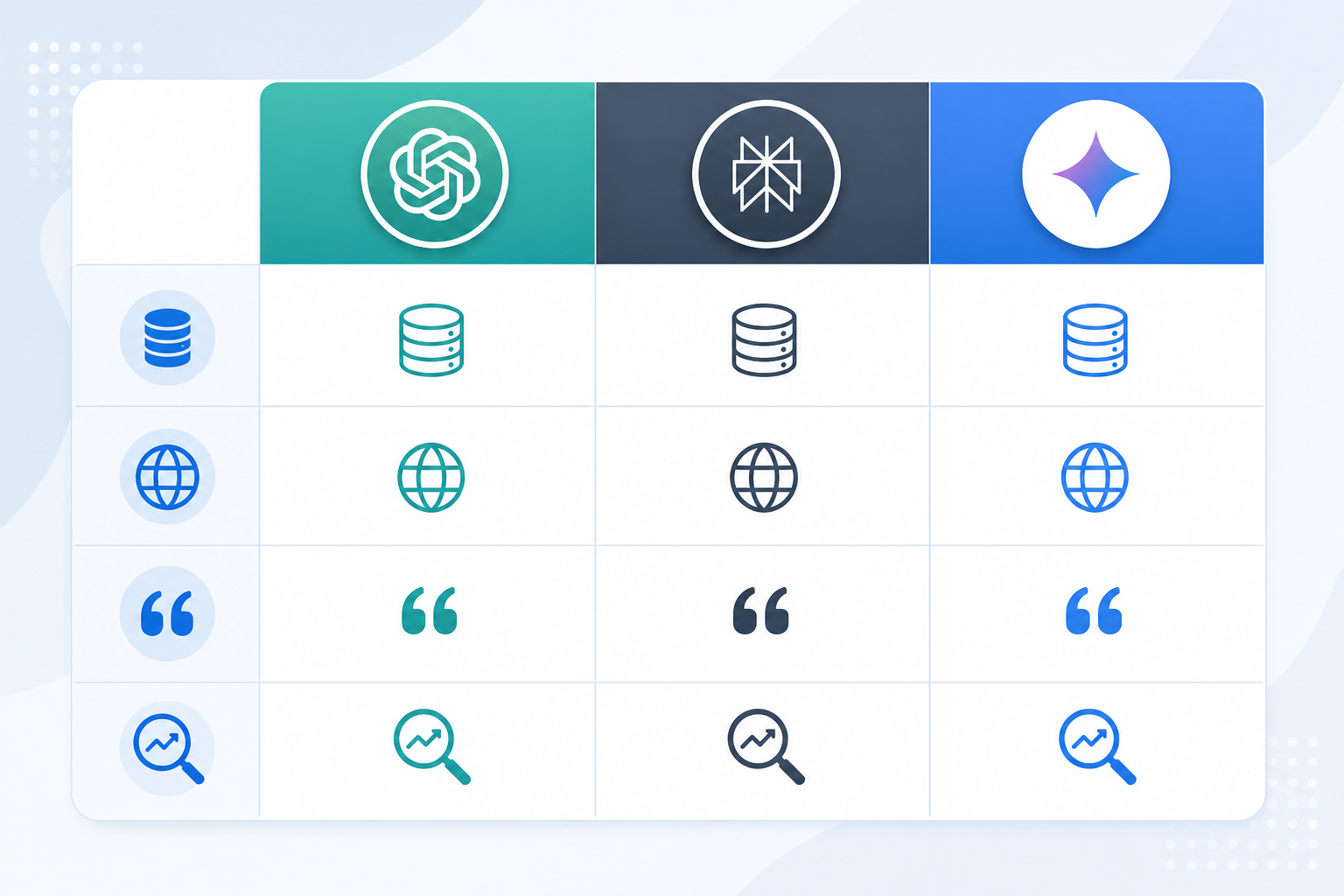
| ChatGPT | Perplexity | Gemini | |
|---|---|---|---|
| Primary data source | Training data + optional Bing-powered browsing | Live web search on nearly every query | Google Search index + Knowledge Graph |
| Real-time browsing | Conditional, triggered by query type | Default behaviour | Available via Search grounding |
| Citation frequency | Variable — none without browsing | Consistently high, numbered citations | Inconsistent in chat; stronger in AI Overviews |
| SEO overlap | Low to moderate | Low, favours freshness over rank | High — traditional SEO carries over |
What this means for agencies: a client's existing SEO investment gives them a real head start on Gemini, a partial advantage on ChatGPT when browsing is active, and not much structural advantage at all on Perplexity, where freshness and citation-worthiness matter more than domain authority.
Citation behaviour differences
If you're building a client-facing case for AI SEO investment, citation transparency is where the three platforms diverge most sharply, and it's also where I'd push back a little on what a citation actually proves.
- Perplexity leads clearly on transparency. Its interface shows numbered inline citations tied to source cards on nearly every response, which makes it comparatively easy for an agency to check which URL supported which claim by hand. This is the platform where tracking citation behaviour is fastest to do manually.
- ChatGPT cites sources when browsing is switched on, with clickable inline links and sometimes a dedicated sources panel. But non-browsing responses cite nothing — they come entirely from training data with zero attribution. A Tow Center for Digital Journalism study testing 200 news-related queries found roughly two-thirds of ChatGPT search responses had citation problems: inaccurate, incomplete, or mismatched sourcing. That's not a footnote. It's a reason to check every citation rather than assume its presence proves accuracy.
- Gemini is the most inconsistent in conversational mode, though Google's "double-check" feature can cross-reference a response against Search results where available. Worth flagging: Gemini's citation behaviour in chat is genuinely different from the link presentation inside Google's AI Overviews, which tend to be more visible — even though Pew Research found that when an AI Overview appeared, users clicked a cited link inside it only about 1% of the time.
This is exactly why we built position-weighted scoring into MentionOwl's visibility score rather than treating every citation as equally valuable. A citation buried at position eight of a Perplexity answer, or mentioned in passing three paragraphs into a ChatGPT response, carries far less real share of voice than one appearing first. Counting mentions without weighting position gives agencies a distorted picture of where a client stands against named competitors — and I've watched that distortion lead to some genuinely bad budget decisions.
Which content types do ChatGPT, Perplexity and Gemini favour?
Once you understand how each platform sources and cites information, the content implications follow pretty naturally. This is where AI legibility stops being a buzzword and becomes something you can actually act on.
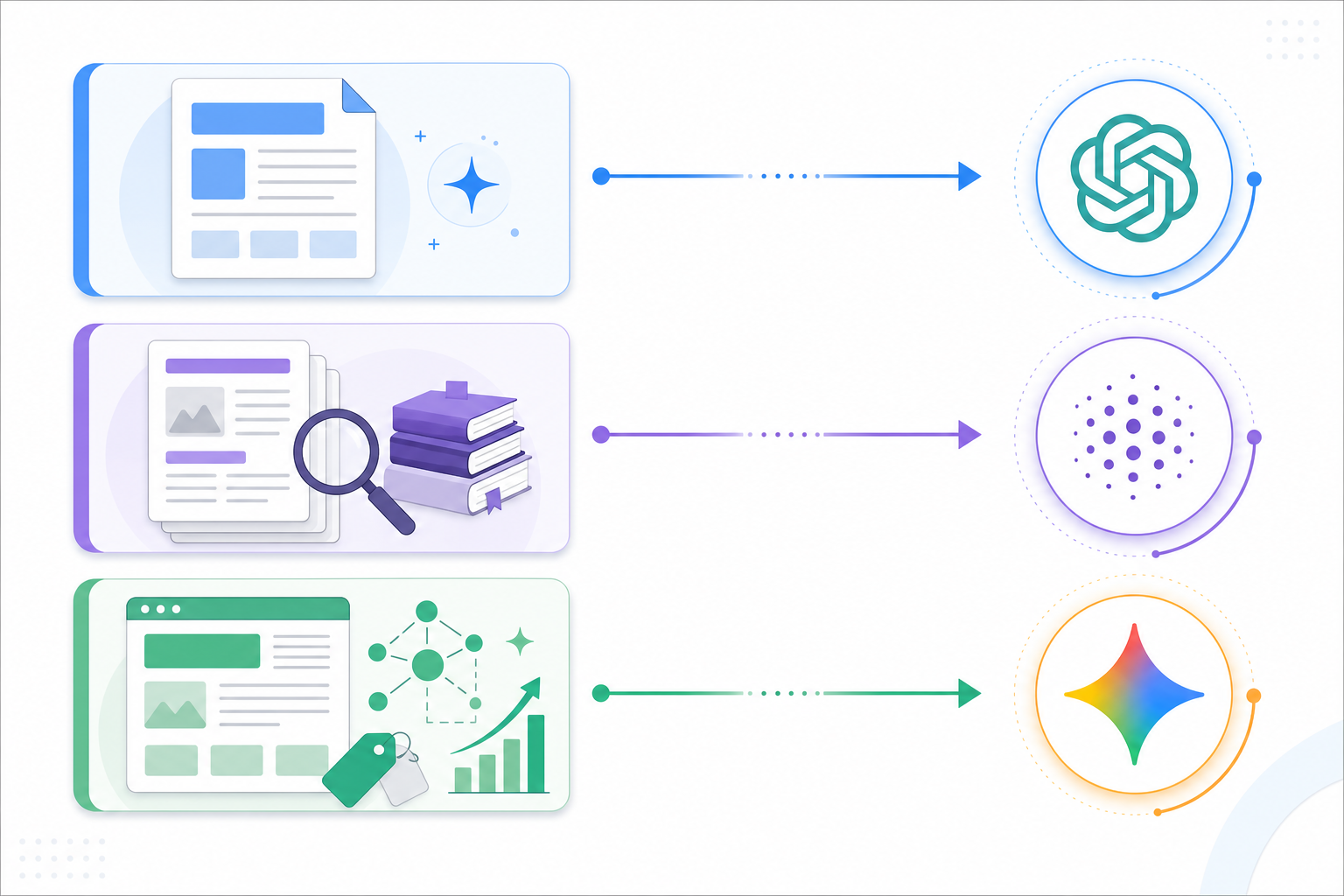
| Platform | Content it rewards | Why |
|---|---|---|
| Perplexity | Fresh, recently published, clearly structured content with quotable data points | Real-time retrieval favours recency and extractability over domain age |
| ChatGPT | Comprehensive, authoritative content likely represented in large training corpora, plus well-structured pages when browsing is active | Training-data exposure rewards depth and consistency; browsing rewards clean structure |
| Gemini | Content with strong schema markup, clear E-E-A-T signals, and technical SEO fundamentals | Deep integration with Google's existing ranking systems |
Perplexity has also made this preference official through publisher partnerships with outlets including TIME, Fortune, and Der Spiegel — a strong signal that licensed, attributable, clearly authored content with visible update dates carries more weight than anonymous web copy. ChatGPT's launch documentation for its search feature stresses inline links to relevant sources, which rewards agencies that maintain an authoritative source hub: current company facts, leadership bios, compliance documentation, and a visible corrections policy. Gemini's tie to Google's index means the traditional fundamentals — Organisation structured data, consistent NAP information, topical authority — carry over almost directly.
Here's the catch I see agencies miss constantly: a page can be genuinely well-written for a human reader and still be structurally invisible to how these engines parse and extract facts. That's the gap AI legibility audits are built to close — checking whether a crawler can actually access the page, whether facts sit in extractable formats, and whether structured data accurately describes the entity in question. Sixteen technical checks sounds like overkill until you've watched a client with beautifully written content simply fail to show up on any of the three platforms because a crawl directive quietly blocked it.
Client recommendations by industry
Given finite optimisation budgets, I generally sequence client priorities by industry rather than spreading effort evenly across all three platforms:
- Local service businesses (trades, healthcare, legal): Prioritise Gemini and traditional local SEO first. These queries often surface Google's AI Overviews before a user ever opens a standalone chatbot, and local entity consistency — matching name, address, and hours across the website, Google Business Profile, and directories — makes an outsized difference here.
- E-commerce and product comparison brands: Prioritise Perplexity. "Best X for Y" comparison queries are Perplexity's home turf, and its heavy reliance on citing product pages and independent review sites means fresh, well-structured comparison content pays off quickly.
- B2B SaaS and professional services: Prioritise ChatGPT. Decision-makers increasingly use it for vendor shortlisting, and it tends to surface brands with strong documentation, case studies, and thought-leadership content that likely made it into training data.
- Everyone, regardless of vertical: Don't write off any single platform completely. AI search behaviour shifts fast, and share of voice against named competitors can move within weeks as models update or browsing behaviour changes.
Monitoring all platforms at once
Here's the operational reality: manually checking ChatGPT, Perplexity, and Gemini every day across dozens of client queries doesn't scale once an agency is managing more than two or three accounts. I've watched teams try to do this with screenshots and spreadsheets, and the process collapses under its own weight within a month.
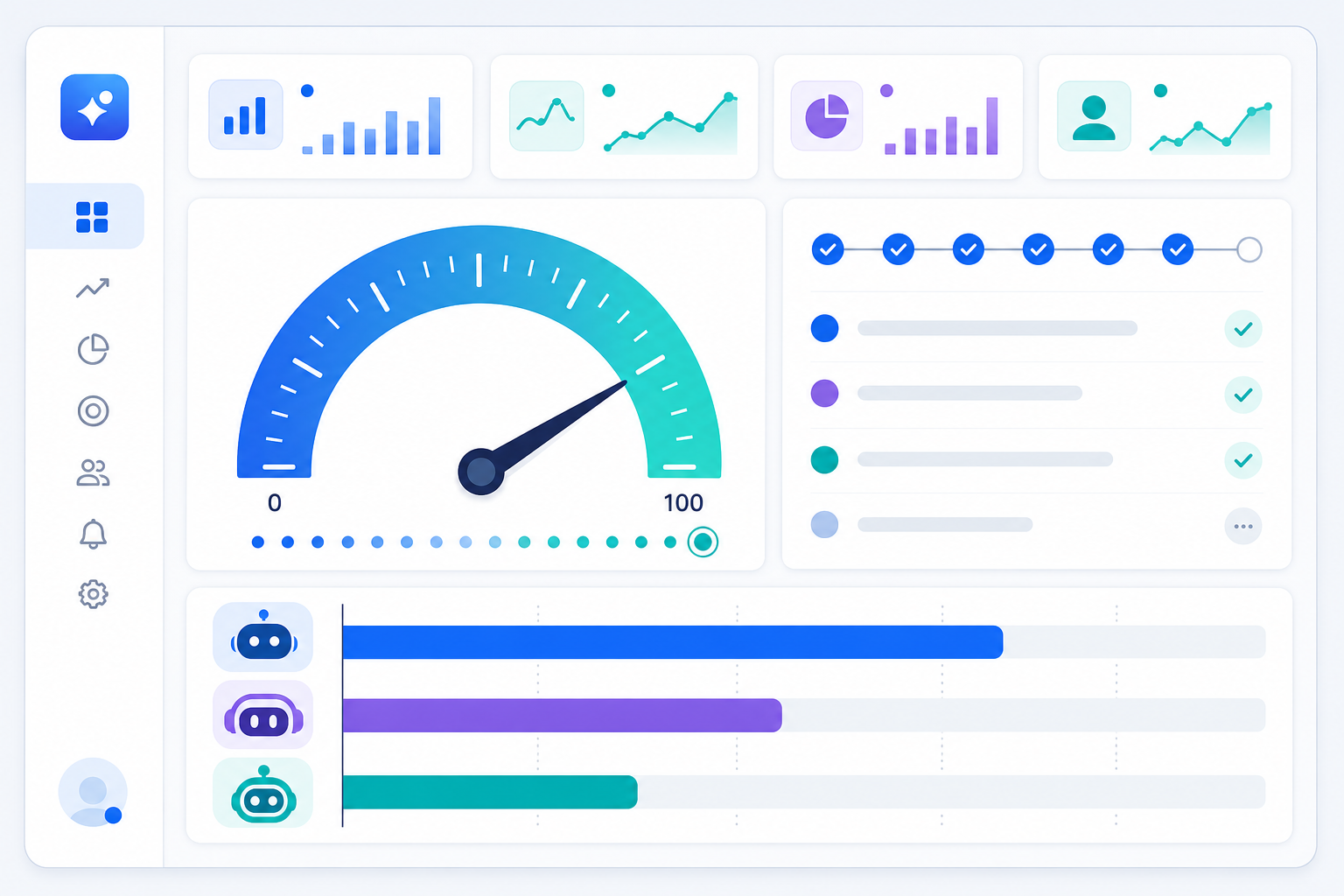
This is the exact problem MentionOwl was built to solve. We crawl a client's website, generate the realistic customer questions people actually type into these platforms, and run them daily against ChatGPT, Perplexity, Gemini, Claude, and Copilot at the same time. Instead of juggling five chat windows and hoping your manual sampling caught something representative, agencies get a single visibility score per client, built from query coverage, position-weighted citations, share of voice, and soft mentions — one number that reflects the multi-platform reality we've just walked through.
Weekly digests, competitor tracking, and sentiment analysis mean you can walk into a client review with hard numbers on where they're winning and losing against named competitors on each platform, instead of anecdotal impressions from a handful of manual checks last Tuesday. That gap between evidence and impression is, in my experience, exactly what separates agencies that keep AI visibility retainers from those that lose them.
Frequently asked questions about AI search platforms
Do ChatGPT, Perplexity and Gemini use the same underlying data sources?
No. ChatGPT combines training data with optional live browsing, Perplexity runs live web searches for almost every query, and Gemini is built on Google's own search index and Knowledge Graph. A brand can rank highly in one platform's answers and barely show up in another's.
Which AI platform cites sources most transparently?
Perplexity, generally, with numbered, clickable citations on nearly every response by default. ChatGPT only cites when browsing is active, and Gemini's conversational citations are less consistent than what shows up in Google's AI Overviews.
Should agencies prioritise one AI platform over the others for clients?
It depends on the client's industry and where their buyers actually search. Local and service businesses tend to see more impact from Gemini, e-commerce brands often gain more from Perplexity's comparison-style answers, and B2B and SaaS brands frequently benefit most from strong ChatGPT visibility. Most clients still need coverage across all three, just weighted differently.
How can an agency track brand visibility across AI search platforms for multiple clients?
Manual checking doesn't scale past a handful of clients. Tools like MentionOwl automate the process by running daily queries across ChatGPT, Perplexity, Gemini, Claude, and Copilot, then consolidating results into a single visibility score, sentiment data, and competitor comparisons per client.