How to Track Competitor Mentions in AI Answers Automatically: A Guide to AI Share of Voice
Track competitor mentions in AI answers, measure AI share of voice, and use their citations to find coverage opportunities and strengthen your brand’s visibility.

How to Track Competitor Mentions in AI Answers and Measure AI Share of Voice
The most reliable way to track competitor mentions in AI answers is to run a fixed set of buyer-style questions against each major AI engine, under controlled and documented conditions, and to sample each question repeatedly. For every answer, record which brands appear, in what position, with what sentiment, and which sources are cited. Then calculate your AI share of voice from that log. Much of the practical value sits in the citations. Pages an engine cites when it recommends a competitor are candidate places to earn coverage, which makes them hypotheses to test, not guarantees. 🦉
Below, I walk through how to build that system: why competitor tracking matters, how to run a reproducible collection protocol, how to find competitors you don't yet know about, what to record, how to calculate AI share of voice, and how to turn competitor citations into a coverage plan.
Why competitor tracking matters in AI search
Ask an AI assistant 'what is the best invoicing tool for a UK freelancer?' and it will typically name a handful of brands rather than ten blue links. Recommendation slots are scarcer than organic positions, and every slot a competitor holds is one you can't. That is a direct loss of consideration at the moment a buyer is building a shortlist.
The behavioural evidence points the same way, though I want to be precise about what each source does and does not show:
- Pew Research Center analysed the browsing of US Google users in March 2025 (Google users are less likely to click on links when an AI summary appears in the results, July 2025). AI summaries appeared in 18% of the searches examined. Users clicked a traditional result in 8% of visits with a summary versus 15% without, clicked a link inside the summary in about 1% of visits, and ended their session after 26% of searches with a summary versus 16% without.
- Ahrefs studied roughly 300,000 keywords and reported a 34.5% lower click-through rate for the top-ranking page when an AI Overview appeared (Ahrefs, 2025). That is one study's finding, not a law for every query.
- Google stated in October 2024 that AI Overviews were available in more than 100 countries and territories, with over 1 billion users a month (Google blog).
- Gartner forecast in February 2024 that traditional search engine volume would fall 25% by 2026 as users shift to chatbots and virtual agents (Gartner press release). It is a forecast, not a measured outcome.
Much of this is US-centric or directional, so treat it as context rather than a UK guarantee. The defensible conclusion is narrow. Being named and cited inside an answer is a visibility outcome distinct from ranking, and rank tracking alone won't reveal it. Google's own guidance says its AI features need no special optimisation beyond sound fundamentals (AI features and your website), so you need a competitive baseline before you judge any tactic.
Define AI share of voice and related metrics
Terminology causes most of the confusion here, so I use three distinct measures throughout:
- Mention rate is the percentage of valid answers in which a brand appears. It measures visibility rather than share, because an answer can name several brands and the rates therefore don't sum to 100%.
- Share of mentions is a brand's mentions divided by all mentions of tracked brands. It sums to 100% and is the simplest competitive share.
- AI share of voice (position-weighted) is a brand's position-weighted score divided by the total score for all tracked brands. This is the definition I use in this article, because a first-place recommendation influences a buyer more than a passing mention.
There is no universal standard for any of these, and Google's documentation doesn't define one. Every report should state its prompt set, engines, geography, date range, denominator and weighting. Without those, nobody can reproduce it.
A repeatable protocol for tracking AI answers
Manual spot-checking fails because answers vary between runs, engines and phrasings, and a single screenshot can mislead in either direction. Running each question once a day isn't enough on its own either. This is the protocol I recommend:
- Freeze the prompts. Store the exact wording and never edit it silently. If you add prompts, label them as a new cohort so the baseline stays comparable.
- Fix the conditions. Use UK English, a UK location where the engine allows it, and a clean or logged-out state without memory or personalisation. Record the model name or version and whether web search was enabled, since both change results.
- Sample repeatedly. Run each prompt several times per engine per period (three to five is a sensible starting point) rather than once, then pool the runs.
- Handle invalid answers explicitly. Log refusals, errors, and truncated or empty responses as invalid, exclude them from the denominator, and report the invalid rate.
- Report over a rolling window. Weekly, pooled results are far more stable than daily ones, and a one-day dip is usually noise.
- Respect the margin of error. With 200 valid answers, a 29% mention rate carries a rough margin of about plus or minus 6 percentage points. Repeated runs of one prompt are not independent, so the real uncertainty is somewhat larger. Don't celebrate a two-point move.
Buyer-intent questions to test across AI engines
Four high-intent prompt types cover most SaaS and DTC buying journeys:
- Best-for queries: 'Best project management software for a 10-person UK agency'
- Alternatives-to queries: 'Alternatives to [competitor] for small businesses'
- Comparison queries: '[Brand A] vs [Brand B] for ecommerce'
- Use-case queries: 'How do I reduce churn in a subscription skincare brand?'
Test ChatGPT, Claude, Gemini, Copilot and Perplexity separately. Their training data, retrieval behaviour and citation habits differ, so a brand that dominates one can be absent from another, and a blended number hides that. UK buyers add a further wrinkle. Spelling variants, GBP pricing, UK retailers and local review sources all influence which brands surface, so segment prompts and results by market.
Build your competitor list, including unknown competitors
Your sales team's list of rivals is rarely the list AI engines are using. Here is the process I recommend:
- Start with known direct competitors from sales calls, review sites and your positioning pages.
- Add indirect and substitute competitors. Engines sometimes recommend a different category of solution entirely, such as a spreadsheet template, an agency or a marketplace listing. For that query, those are competitors.
- Run open-ended, non-branded questions and harvest the brands that appear. This is how you find competitors you don't know about yet. You never search for them, and the answer data reveals them.
- Separate persistent competitors from one-off appearances. Apply a minimum frequency threshold over a rolling period, for example appearing in at least 5% of valid answers across 30 days. The threshold is a judgement call, so document it.
- Review and prune monthly, since recommendations shift as content is published and models are updated.
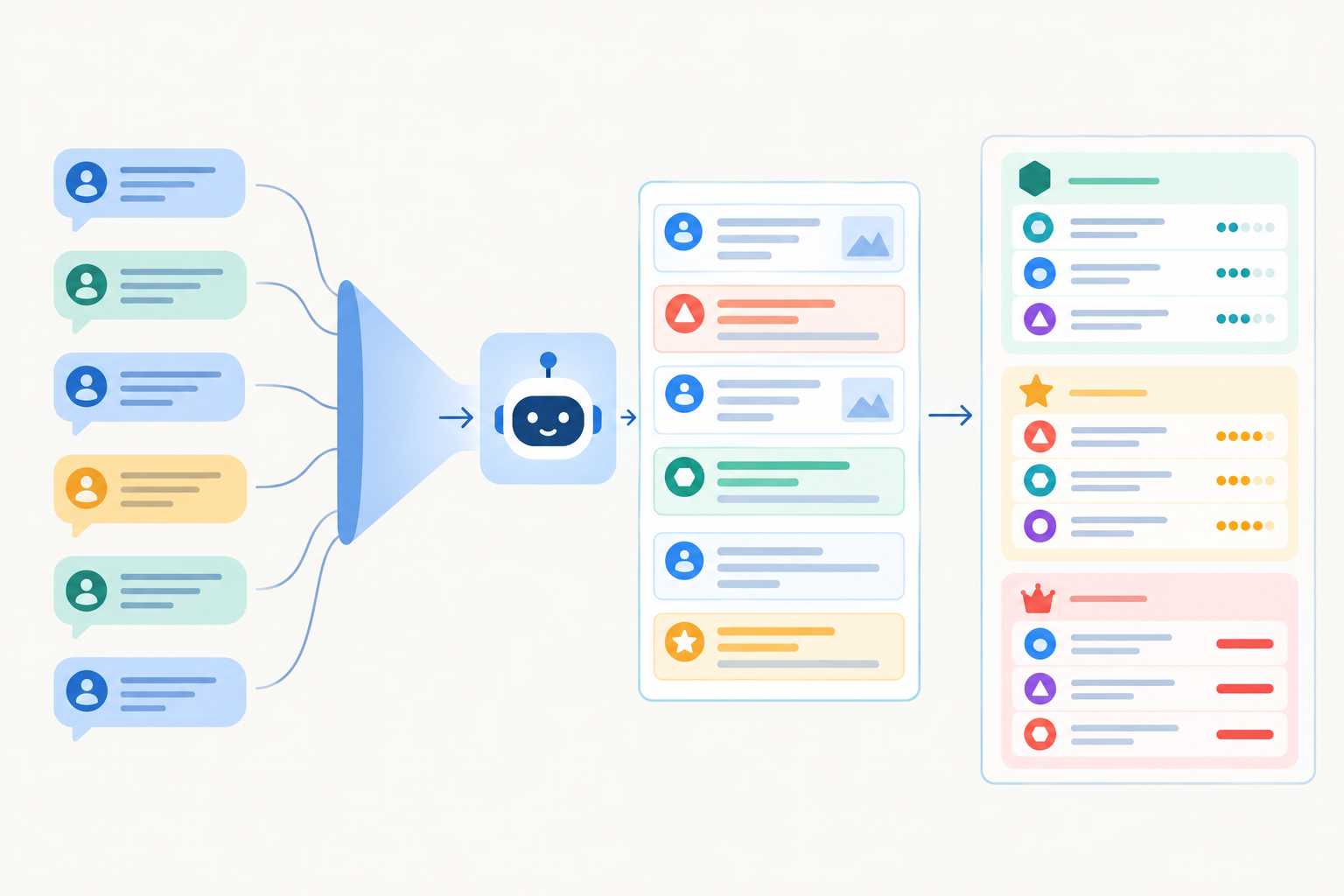
Normalise brand names and aliases before counting, and distinguish a genuine brand reference from an ambiguous common word. Keep the original answer text so any automated classification can be audited.
What to record for every AI answer
If the log is thin, the analysis will be too, and a yes-or-no mention isn't enough. This is the schema I use. The final column shows which components of MentionOwl's vendor-specific score each field feeds, for readers using that tool.
| Field | Why it matters | Feeds (MentionOwl score component) |
|---|---|---|
| Question text and intent (discovery, comparison, alternative, purchase-ready) | Lets you segment results like-for-like | Query coverage |
| Engine, model and date | Separates model-specific patterns from market-wide ones | Query coverage, share of voice |
| Brands mentioned, in order | Establishes who is named and who comes first | Share of voice, position-weighted citations |
| Position in the answer | First-named brands tend to carry more influence than the fifth | Position-weighted citations |
| Soft mentions (described without a link or explicit recommendation) | Can still shape perception without a formal citation | Soft mentions |
| Cited URLs and domains | Raw material for source analysis | Position-weighted citations |
| Sentiment per brand (recommended, neutral, caveated, discouraged) | A mention that discourages is not a win | Interpretation alongside all components |
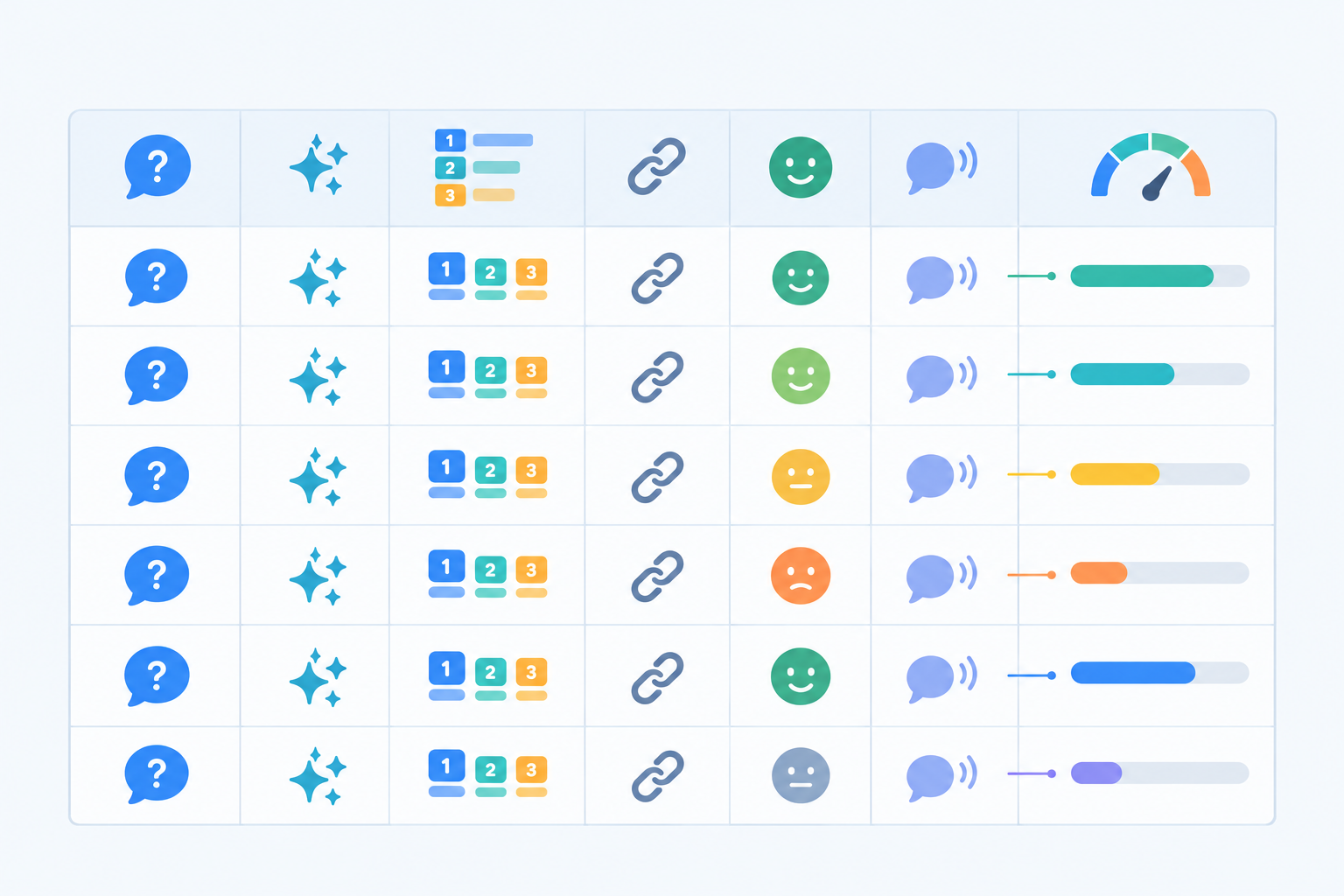
Track brand mentions separately from citations. An answer may name a brand without linking to its site, or cite a site without naming the brand, and reporting both rates gives a clearer picture.
How to calculate AI share of voice
- Keep the question set stable and apply the protocol above.
- Calculate mention rate: answers containing the brand, divided by total valid answers, multiplied by 100.
- Calculate share of mentions: the brand's mentions divided by all tracked-brand mentions.
- Apply position weighting to reach AI share of voice. The weights are your choice, so publish them.
- Segment by engine, topic cluster and intent to find where you are strongest and weakest.
- State your denominator every time. Total valid answers and total brand mentions give different percentages.
Worked example: position-weighted AI share of voice
The numbers below are illustrative only. Imagine a fictional UK accounting SaaS, LedgerLark, and three fictional rivals, BookBurrow, TallyTern and PennyPine, measured across 200 valid answers in one week.
| Brand | Answers mentioning brand | Mention rate (of 200) | Share of mentions (of 280) |
|---|---|---|---|
| LedgerLark | 58 | 29% | 20.7% |
| BookBurrow | 104 | 52% | 37.1% |
| TallyTern | 78 | 39% | 27.9% |
| PennyPine | 40 | 20% | 14.3% |
Mention rates sum to 140% because an answer can name several brands, whereas shares of mentions sum to 100% across the 280 total mentions. Now apply illustrative position weights of 1.0 for first-named, 0.6 for second and 0.3 for third or later:
- LedgerLark: first in 12 answers, second in 18, later in 28, giving 12 + 10.8 + 8.4 = 31.2
- BookBurrow: first in 52, second in 30, later in 22, giving 52 + 18 + 6.6 = 76.6
- TallyTern: first in 36, second in 22, later in 20, giving 36 + 13.2 + 6 = 55.2
- PennyPine: first in 10, second in 14, later in 16, giving 10 + 8.4 + 4.8 = 23.2
The total is 186.2, so the position-weighted AI share of voice is roughly 16.8% for LedgerLark, 41.1% for BookBurrow, 29.6% for TallyTern and 12.5% for PennyPine. LedgerLark's weighted share (16.8%) sits below its share of mentions (20.7%), which tells you the brand is being named but rarely first. That is a different problem from not being named at all, and it calls for different fixes. Over several weeks, I would watch whether that gap narrows after an intervention, keeping the margin of error noted earlier in mind.
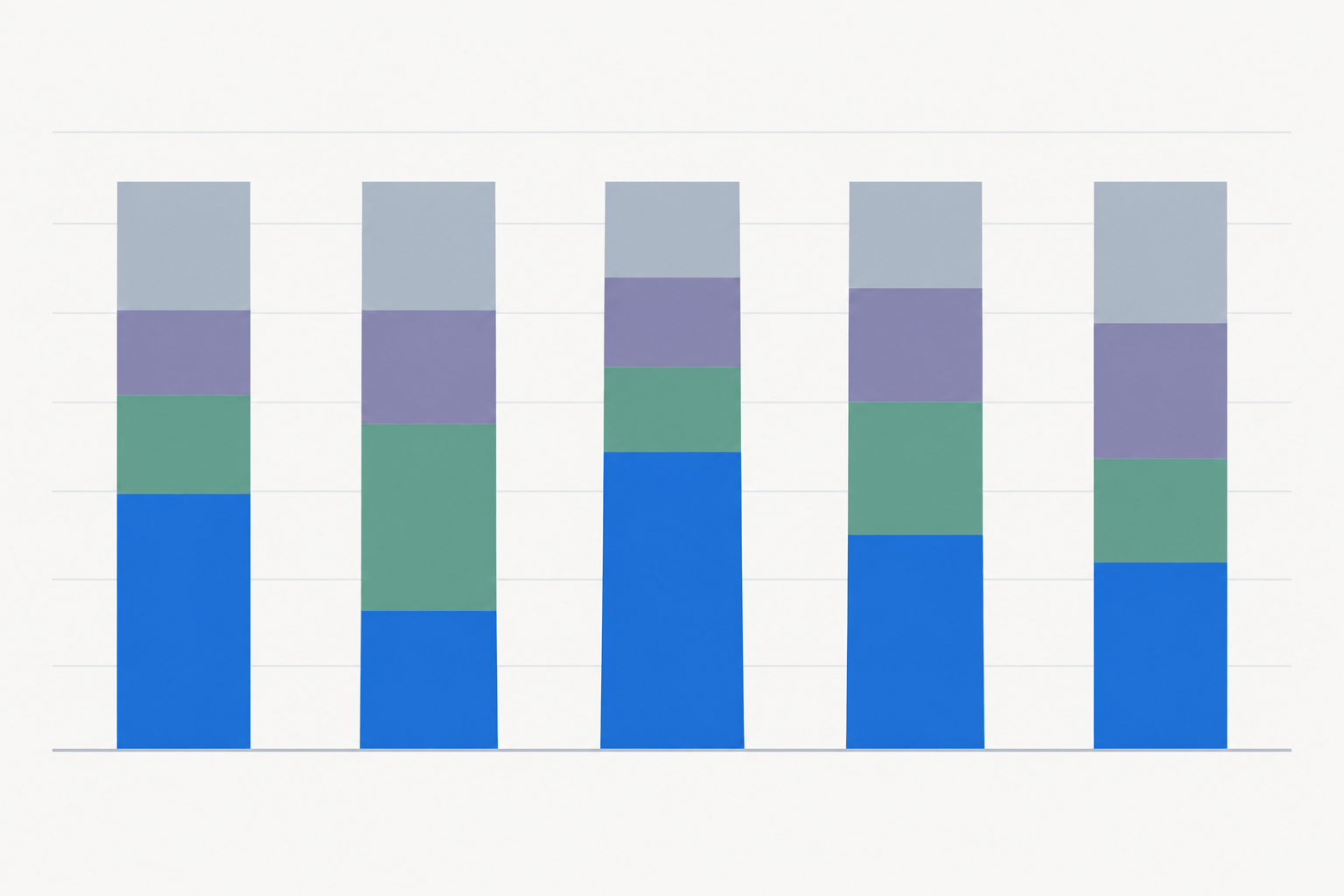
The graphic below breaks the same four hypothetical brands out by engine, which is where the segmentation step earns its keep.
Analyse the sources competitors win
This is where the project pays for itself. Citations show which pages an engine drew on in sampled answers. They don't prove that an engine 'trusts' a source or that outreach will secure inclusion, but they give you an evidence-based shortlist of places to test.
Categorise competitor citation sources
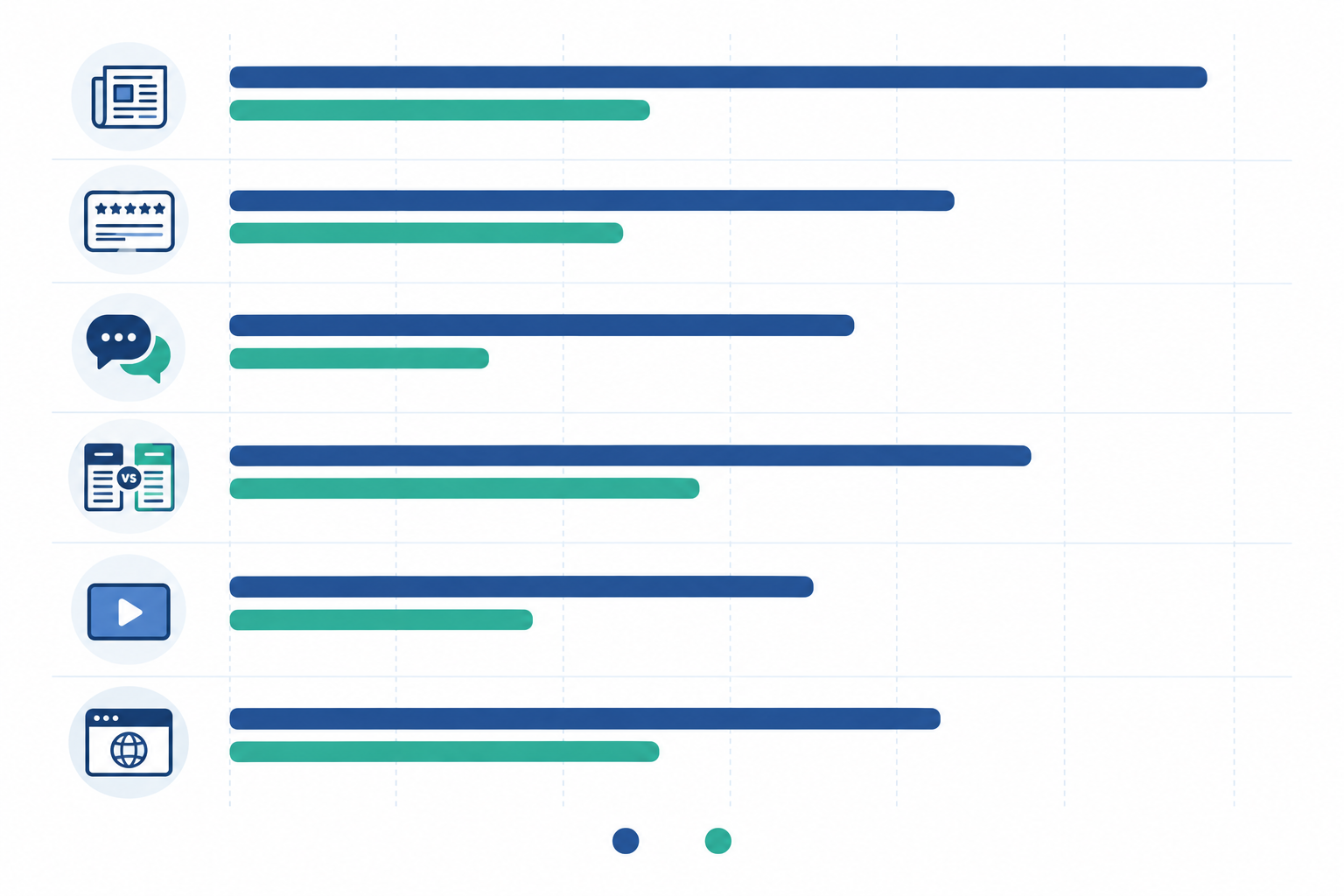
Record the URL and domain behind each answer, then classify by source type:
- Editorial roundups and trade publications
- Review platforms
- Community forums such as Reddit and Quora
- Comparison blogs
- Documentation and reference sources
- YouTube and video
- The competitor's own site
Compare citation frequency by prompt and topic cluster, never from a single answer. Remember the Pew finding that only about 1% of visits involved a click on a link inside an AI summary. Citation visibility often matters as influence on the shortlist rather than as referral traffic.
Find citation gaps and coverage opportunities
Domains that repeatedly appear in answers recommending your competitors, but never mention you, are your highest-priority hypotheses. In our fictional example, suppose a UK trade publication's 'best tools' roundup appears in a third of the answers recommending BookBurrow, and LedgerLark is absent from it. That gives you a specific target to test instead of a vague aspiration. Then measure: did LedgerLark's mention rate and weighted share move for the relevant prompt cluster over the following weeks?
Look for what makes a page citable
Across cited pages, look for pattern signals such as recency, listicle format, structured data and original statistics, and ask what the citations teach you:
- Which claims are repeated across answers, since those are the ideas the engines keep surfacing.
- Which proof points appear, such as named customers, pricing transparency or independent test results.
- Which formats recur, whether comparison tables, FAQs or documentation.
The Princeton-led research paper (Aggarwal et al., GEO: Generative Engine Optimization, KDD 2024) evaluated optimisation methods on a 10,000-query benchmark and reported visibility improvements of up to 40% for some methods, including adding clear evidence and attributable claims. It is a benchmark result, not a guaranteed lift for your brand, so use it to justify controlled tests rather than to promise outcomes. And don't simply copy a competitor's wording. Ask whether the opportunity is to earn coverage, improve independently verifiable product information, or make your own pages clearer and easier to quote.
Earn competitor citation opportunities ethically
Earn coverage by offering something real: original data, honest expert commentary and accurate product information. Manipulating editors, fabricating reviews or gaming forums tends to backfire, and it erodes the credibility that makes a source worth citing in the first place.
Turn competitor citation findings into a plan
- Rank source gaps by potential impact. Weight each domain by how many competitor citations and how many engines it appears in.
- Choose the tactic per source type. Pitch for inclusion in roundups, update review profiles, contribute expert commentary, or publish original data others will want to cite.
- Fix on-site fundamentals. Clear product, comparison and FAQ pages give engines something quotable, and Google's guidance is that strong fundamentals come first.
- Set targets per topic cluster, expressed as mention rate and AI share of voice, over a 60 to 90 day horizon. Treat that horizon as a hypothesis, not a promise.
- Review weekly. Check whether new coverage converts into mentions, and adjust.
- Connect visibility to outcomes. Compare visibility trends with visits and sign-ups in your own analytics. Google Search Console folds AI-feature traffic into its overall 'Web' search type, so it complements cross-platform answer monitoring but doesn't replace it.
Manual, spreadsheet or automated AI mention tracking?
| Approach | Coverage | Repeatability | Citation capture | Cost |
|---|---|---|---|---|
| Manual prompting | A few queries on one or two engines | Poor; depends on who ran it and when | Copied by hand, if at all | Free, but costly in time |
| Spreadsheets | Moderate, limited by effort | Better, if the process is documented | Manual entry | Free, with ongoing labour |
| Generic social listening | Mostly social and web mentions, rarely AI answers | Good for what it covers | Rarely captures AI citations | Varies by vendor |
| Dedicated LLM monitoring | Multiple engines, scheduled runs | High, with a stable question set | Automatic, with domains | Subscription |
Manual checks are enough in some cases. A solo founder validating five queries before committing to a tool can learn a lot from an afternoon of prompting, provided they note the engine, date and exact wording. Once you need trends, multiple engines or citation analysis, the labour outgrows the payoff.
Where a tool like MentionOwl fits (product-specific details)
This section describes one vendor's approach, separate from the general guidance above. I work with the MentionOwl team, so apply your own scrutiny. The details below are vendor-stated, and you should confirm them in the current documentation and pricing page before buying.
- Question generation and scheduling: MentionOwl crawls your website, generates customer questions from what you sell, and runs them daily against major engines, recording answers, citations, sentiment and competitor mentions. Ask how it handles repeated sampling, location and invalid answers, using the protocol above as a checklist.
- Visibility score (0 to 100): a proprietary index built from query coverage, position-weighted citations, share of voice and soft mentions. I have not seen its component weights published, so treat it as a directional, vendor-specific measure and don't compare it with other tools' scores. For reporting, I would still compute mention rate and share of voice yourself from the raw log.
- AI legibility audit: 16 technical checks of whether your site is crawlable and quotable. Find out what the 16 checks are, and treat the audit as a hygiene step, not a ranking guarantee.
- Integrations and analytics: a REST API and MCP server for feeding dashboards or AI agents, plus cookieless AI traffic analytics. Verify how visits are attributed to AI sources, since attribution from AI answers is inherently imperfect.
- Trial: a $1, 7-day trial is advertised. UK buyers should check the current GBP price and terms at checkout.
Frequently asked questions about AI share of voice
How do I see who AI recommends instead of me?
Ask the questions your customers ask, across several engines, under fixed conditions and repeatedly, then log every brand named and every source cited. Pool the results weekly and compare brands using a stated denominator.
Can I track competitors I do not know about yet?
Yes. Run non-branded, open-ended questions your customers would ask and log every brand that appears. Brands that show up repeatedly across engines and weeks belong on your list. Automated tracking makes this easier, because new names surface in the answer data without you having to search for them.
What can I learn from competitors' citations?
You learn which pages, source types and formats appear in answers that recommend them, and which repeated claims and proof points the engines surface. Treat these as hypotheses for where to earn coverage, then measure whether your own mentions change.
How often should I check AI answers?
Collect on a regular schedule, ideally daily, with several samples per prompt, but interpret results weekly or monthly. Trends across many valid answers are far more reliable than any single response.
Do different AI engines recommend different competitors?
Often, yes. ChatGPT, Claude, Gemini, Copilot and Perplexity use different training data and retrieval methods, so the brands and sources they favour can differ noticeably. Tracking each engine separately shows where you are strong and where you are overlooked.
What counts as a soft mention?
A soft mention is when an answer refers to your brand or offering without a formal link, citation or explicit recommendation. It can still shape perception, so record it alongside formal citations.
How long does it take to improve AI share of voice?
It depends on how quickly new coverage is published and picked up, particularly by engines that browse live sources. Some changes may appear within weeks, while others take longer. Treat any timeline as a hypothesis to test with your own data.