How Local Businesses Get Recommended by AI Assistants: A UK Guide to AI Local Search
Discover how AI local search uses local SEO signals, reviews and listings—and how UK businesses can track AI answers against nearby competitors.
AI assistants appear to recommend local businesses using many of the same signals that underpin good local SEO: consistent listings, credible reviews, clear service pages and mentions on trusted third-party sites. The difference is that the output is a generated answer, not a ranked list of links you can see. So you need to check what each assistant actually says about you and your rivals, because a strong Google position does not guarantee a mention.
I am a data analyst, so throughout this guide I separate three things: what the platforms have documented, what is plausible but unproven, and what nobody outside the AI companies can currently verify. Where the evidence is thin, I say so. The guide covers how AI local search works, which local SEO foundations still matter, and how to measure your standing against nearby competitors. Sources are at the end, and each claim is labelled as official guidance, survey data or my own observation.
AI local search: why it differs from the Google map pack 🦉
The worry that brings most small business owners to this topic is simple. A potential customer asks ChatGPT or Gemini for the best plumber, dentist or café nearby, and a competitor is named instead of you. You may rank well on Google and sit comfortably in the map pack, yet the assistant never mentions you.
The two formats behave differently. A traditional results page offers organic links plus a map pack, and the searcher chooses. An AI answer is a single synthesised response. In the answers I have reviewed, it commonly names a handful of businesses, often between two and five. That is my own observation, not a published statistic, and it varies with the prompt, the platform and the settings in use. Where it holds, the margin for being left out is narrow, and the answer reads more like a shortlist drawn up on your behalf.
The underlying logic differs too, though I would not overstate the contrast. Google states that local results are based mainly on relevance, distance and prominence. AI systems may retrieve and rank sources internally before synthesising them, so ranking has not disappeared. It has moved out of sight. Google's guidance on AI features in Search says the same fundamentals apply as for ordinary Search: pages generally need to be indexed and eligible to show a snippet, and no special markup guarantees inclusion.
That brings me to the idea the rest of this article rests on: AI visibility can be measured, even though it cannot be controlled. You can ask a defined set of questions, record who is named, and calculate your share of voice, meaning the proportion of relevant answers in which your business appears compared with the competitors you care about. Results vary by platform, by phrasing and by day, so anyone promising guaranteed recommendations is selling certainty that does not exist. What you can do is improve the accuracy and clarity of your information, then measure whether the picture changes.
How AI assistants handle local intent questions
AI search retrieval, web sources and training data
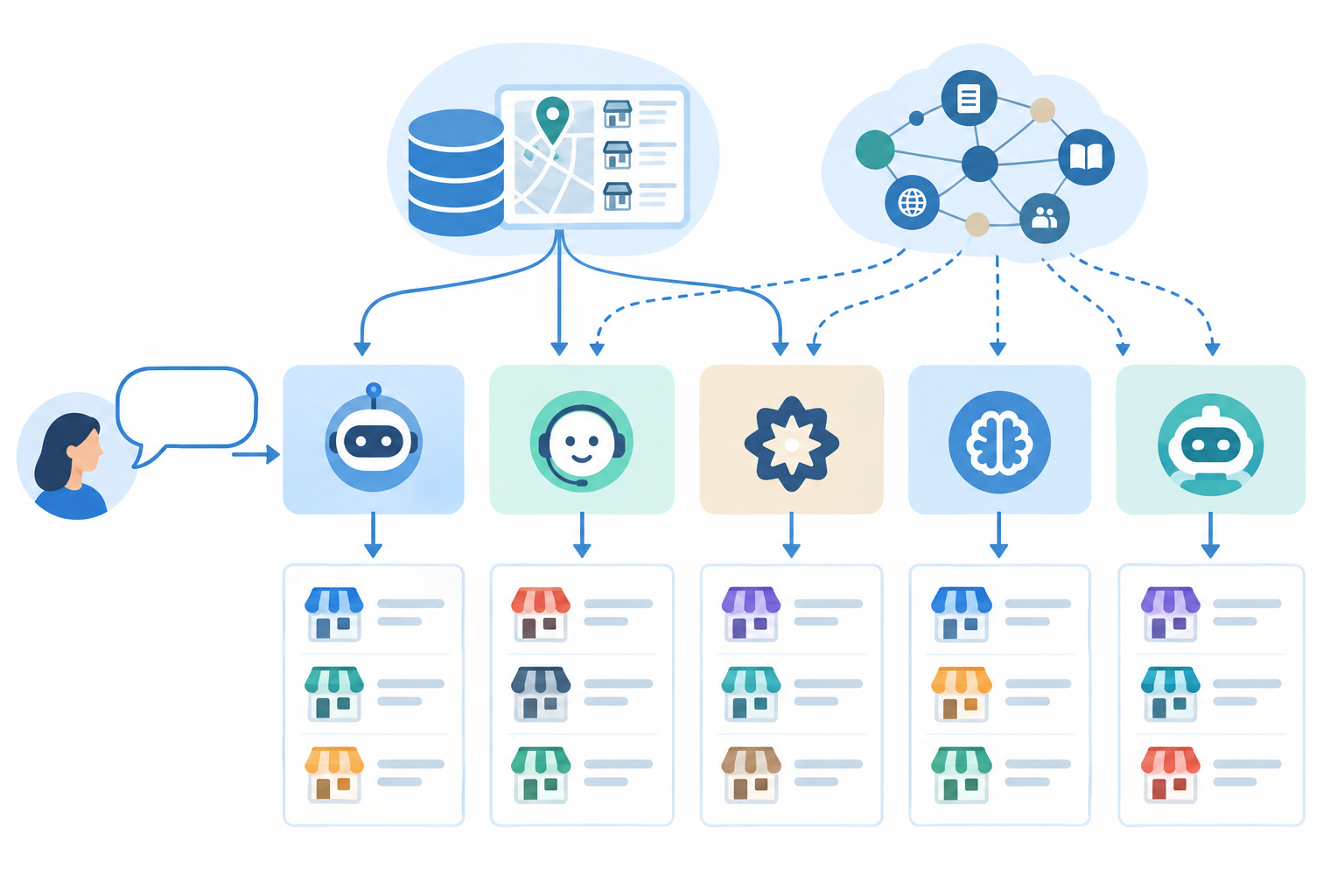
Assistants do not all find information the same way, and the same product can behave differently depending on settings and the query. Some products retrieve live web results and build answers from them, often with citations. OpenAI documents that ChatGPT search retrieves and cites web sources when it is used. Other responses lean on patterns learned during training, which can be months out of date. A café that opened last spring may simply be absent from that knowledge.
The distinction matters, but I would not present it as a clean two-way split. Which assistants browse, when they do so, and how often their sources refresh all depend on the platform, and I am not aware of any published, measured update intervals. A corrected listing or a new service page may show up in retrieval-based answers sooner than in training-based ones, but how soon depends on the platform and on how often the source is crawled. Treat any specific timeframe with caution.
How AI assistants infer location
Assistants appear to work out where 'local' is in three main ways:
- Explicit place names in the query, such as 'best plumber in Bristol'.
- Device or account location, where the product has access to it.
- Implied context, such as 'near me' or 'open now', which signals both place and urgency.
Where the place is unclear, an assistant may ask the user to specify it or may guess. Either way, your town and service area need to be unambiguous on your own website.
Why query phrasing changes local search results
Consider three questions a Leeds resident might ask about the same job:
- 'Best electrician in Leeds'
- 'Who should I call for a rewire in Leeds'
- 'Trusted electrician near Headingley'
Each emphasises something different: general reputation, a specific service, or a neighbourhood plus trust. In the checks I have run, different phrasings do produce different named businesses. An electrician with a dedicated rewiring page might surface for the second question and vanish from the first. One check therefore proves very little.
What the evidence says about AI local search
Published, independent data on how often local queries trigger named business recommendations in AI assistants is limited, and what exists is mostly vendor-run or US-centred. The most-cited figure around local discovery is BrightLocal's finding that 98% of surveyed consumers read online reviews for local businesses (2023 survey, US respondents). It is useful context for why reputation matters, but it is not a UK estimate and it does not measure AI assistant behaviour. Treat any precise UK recommendation rate with caution, including from vendors, until the methodology is transparent. The same caution applies to AI referral traffic. In most analytics I have seen it is growing from a small base, but attribution is difficult because many AI-influenced visits arrive as branded searches or direct traffic.
What soft mentions mean for local businesses
A soft mention is when an assistant names your business without a link, for example 'many people in Leeds speak well of Smith Electrical'. It sends no click and will not appear in referral analytics, yet it may prompt a customer to search your name afterwards. Any monitoring that ignores soft mentions will undercount your real presence.
Local business listings and consistency: the foundation of local SEO
Google recommends keeping your Business Profile complete and accurate. It promises nothing about AI recommendations, but this is still the most defensible foundation. My working hypothesis, a reasonable inference rather than a demonstrated rule, is that when your name, phone number or hours differ between sources, a retrieval-based assistant meets conflicting evidence and may favour a competitor whose information is cleaner.
What to get right in your local listings
- Google Business Profile: complete it with accurate primary and secondary categories, services, opening hours (including temporary changes), attributes and real photos. Do not stuff keywords into the business name, which Google's guidelines prohibit.
- Core details: keep your trading name, address or service area, phone number, website and category consistent across Bing Places, Apple Business Connect, Yell, Checkatrade, Trustpilot and any directories your sector genuinely uses.
- Addresses: if you serve customers at their homes, follow each platform's service-area rules rather than publishing an ineligible address. The aim is accurate representation, not forced uniformity.
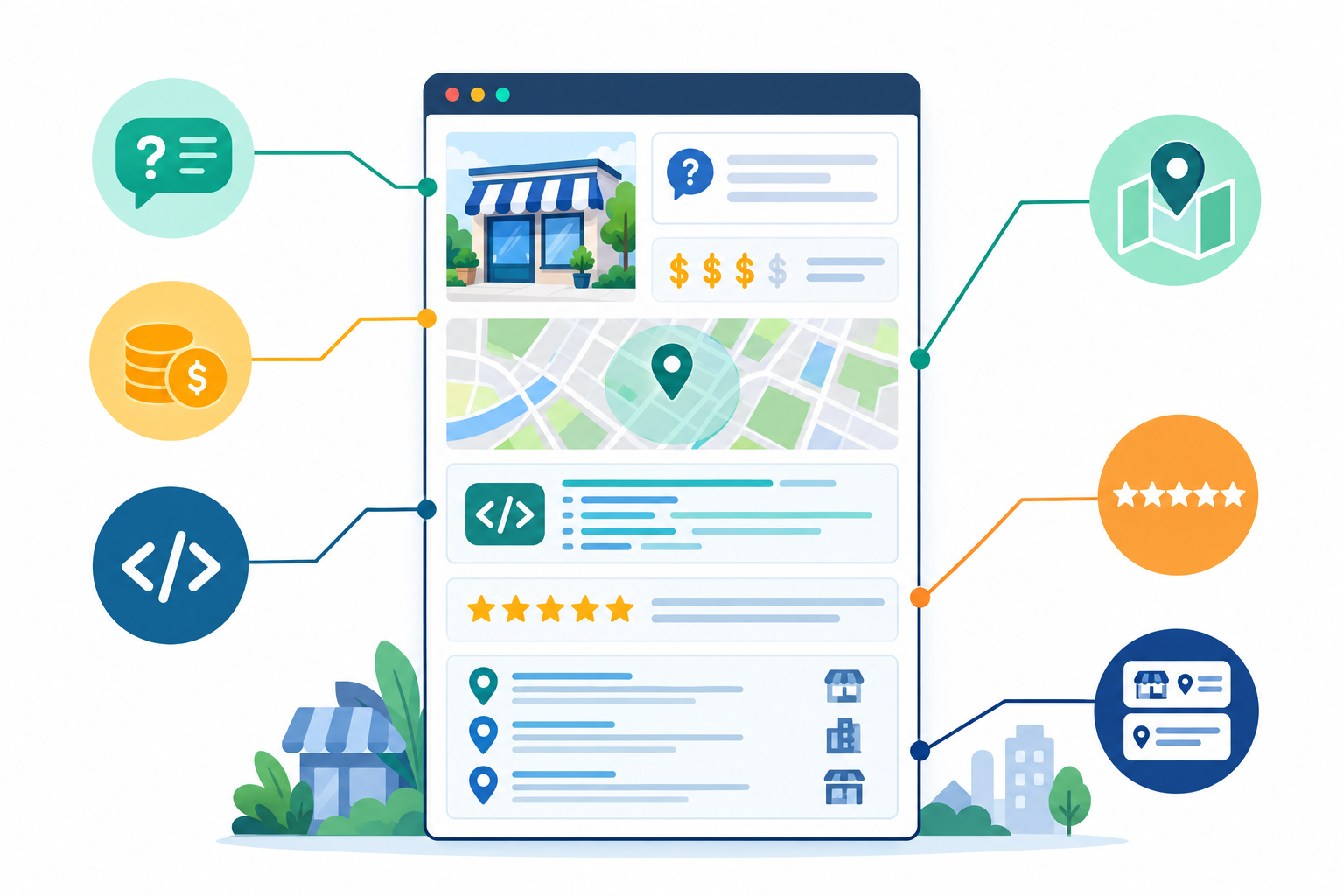
- Website: the details in your LocalBusiness structured data should match what is visible on the page and in your listings. Google states that structured data does not guarantee appearance in results, but it helps machines interpret a page.
- Bing Places: Microsoft Copilot is built around Microsoft's ecosystem, so Bing Places deserves more attention than many UK small businesses give it. It is frequently the least-maintained profile I see.
How to audit your business listings in under an hour
- Write down your canonical details: trading name, phone, address or service area, website, hours and categories.
- Search your business name and phone number on Google and Bing, noting every listing, including duplicates and old addresses.
- Check your top ten: Google Business Profile, Bing Places, Apple Business Connect, Yell, Trustpilot, your trade directory (Checkatrade or equivalent), Facebook, your chamber of commerce page and two sector directories.
- Mark each as matching, minor mismatch or wrong.
- Fix the wrong ones first, then duplicates, then minor mismatches.
Keep expectations proportionate. Whitespark's 2023 Local Search Ranking Factors survey attributed 7% of local pack weighting to citation signals. That is an expert-opinion estimate of Google's local ranking, not a measure of AI assistant behaviour, but it shows that citations matter without being decisive. Treat directories as supporting evidence and never as a substitute for your own website.
Reviews and reputation signals for local SEO and AI
Do Google reviews affect ChatGPT answers? Nobody outside the AI companies can confirm it. Google says review count and positive ratings can help local ranking, but that does not show its review data feeds ChatGPT. Where an assistant retrieves web sources, reviews may matter when they appear on pages it can access, or when they add to your wider prominence. Treat reviews as one plausible signal, not a confirmed ranking factor.
What information in a review is likely to matter?
- Volume and recency: a steady flow signals an active business, while a burst two years ago does not.
- Rating: it matters, though a 4.6 with detail often reads better than a flawless 5.0 with ten vague entries.
- Customer language: review text often contains phrases that match local questions, such as 'rewired our Victorian terrace in Headingley' or 'arrived within an hour for an emergency call-out'.
- Sentiment: an assistant may name you but hedge, saying 'it has mixed feedback about punctuality'. Being present with lukewarm framing is not the same as being recommended.
How to ask for reviews ethically in the UK
UK law and platform rules are not the same thing, so I treat them separately. Fake and misleading reviews are prohibited under the consumer protection regime, now strengthened by the Digital Markets, Competition and Consumers Act 2024 and enforced by the Competition and Markets Authority. Google's own contributor policies, meanwhile, prohibit fake engagement and restrict incentivised reviews. Sound practice looks like this:
- Ask every customer, not only those you expect to be happy. Selectively soliciting positive reviews is itself a problem.
- Offer no discounts, prizes or gifts in exchange.
- Never buy, write or have staff post reviews.
- Give customers a direct link, and ask consistently after each job.
Reply to reviews professionally. A response such as 'Thanks, we were glad to sort the fuse board in your Chapel Allerton flat' adds service and location detail and shows engagement. Keep it natural and don't stuff in keywords.
Local service pages that answer customer questions
Listings establish who you are. Service pages establish what you do and where. Google's guidance is to publish helpful, people-first content, and I would add that each page should be shaped as a direct answer.
- Create a distinct page for each core service and each area you genuinely serve. Avoid thin doorway pages that swap only the town name. If you cannot say something specific about work in an area, do not build the page.
- Lead each page with a plain-language answer to the question a customer would ask, including price ranges, timescales and coverage. 'A full rewire of a three-bedroom house typically takes four to six days; we cover Leeds and Wakefield' serves a machine and a person far better than a slogan.
- Add structured data, such as LocalBusiness and FAQ markup, and make sure it reflects visible content, as Google advises.
- Check for technical barriers: blocked crawlers, missing markup, slow rendering or content hidden behind scripts. OpenAI documents that site owners can allow its OAI-SearchBot crawler to access pages intended to appear in ChatGPT search, and this is often where the quickest wins sit.
- Earn corroborating mentions from local press, trade bodies, chambers of commerce and community sites. I cannot cite evidence that assistants verify claims across sources, but corroboration is sound trust-building practice, and a single self-published claim is weaker than one confirmed elsewhere.
Is local SEO still useful in the age of AI search?
Yes. Google states that the same foundational SEO practices apply to its AI features as to its other search experiences, with no separate AI-specific markup required. The sources and trust signals that feed AI answers plausibly overlap heavily with local SEO fundamentals, so I treat the two as one continuous effort.
| Carries over | New |
|---|---|
| Accurate listings | Answer-shaped content written around real questions |
| Genuine, recent reviews | Citation and soft-mention tracking across assistants |
| Relevant service content | Generative engine optimization (GEO) practices |
| Local authority and mentions | Share of voice measured across AI platforms |
Do not abandon established channels. BrightLocal's 2023 US survey found 87% of consumers used Google to evaluate local businesses. That is American data, though I have seen nothing to suggest the UK pattern is dramatically different. AI is an added layer, not a replacement.
How to track your visibility against nearby competitors
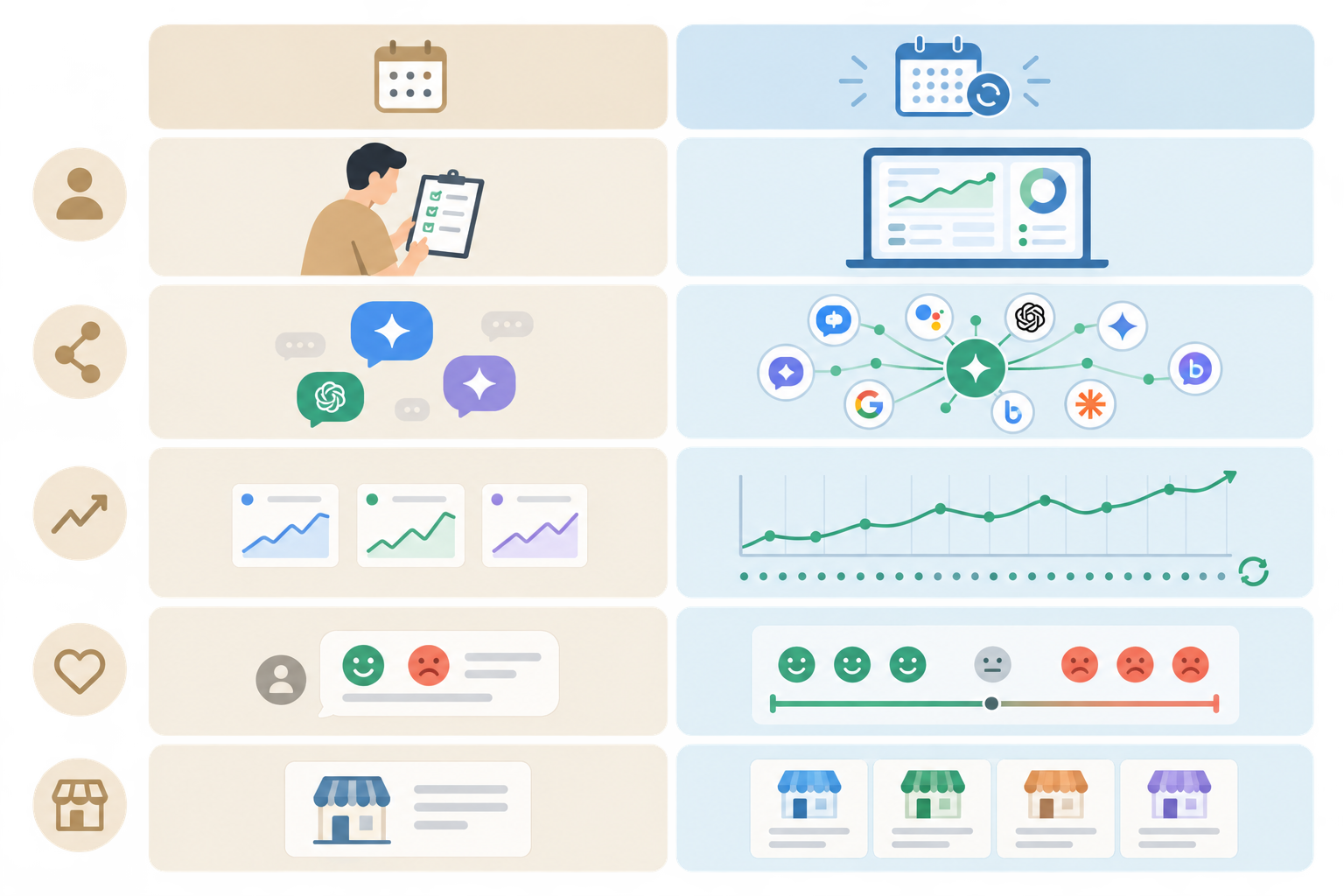
This is the part most businesses skip, and it is what turns opinion into evidence. The method works by hand:
- Build a list of 15 to 30 realistic local questions covering service, price, urgency, trust and comparison intent, including neighbourhood variants and the phrasing a customer would actually use.
- Run them across several assistants, such as ChatGPT, Claude, Gemini, Copilot and Perplexity, since each draws on different sources.
- Record which businesses are named, in what position, with which citations and with what sentiment.
- Repeat weekly, or daily if you can. The same prompt can yield different answers on different days, so a single snapshot is an anecdote, not a measurement.
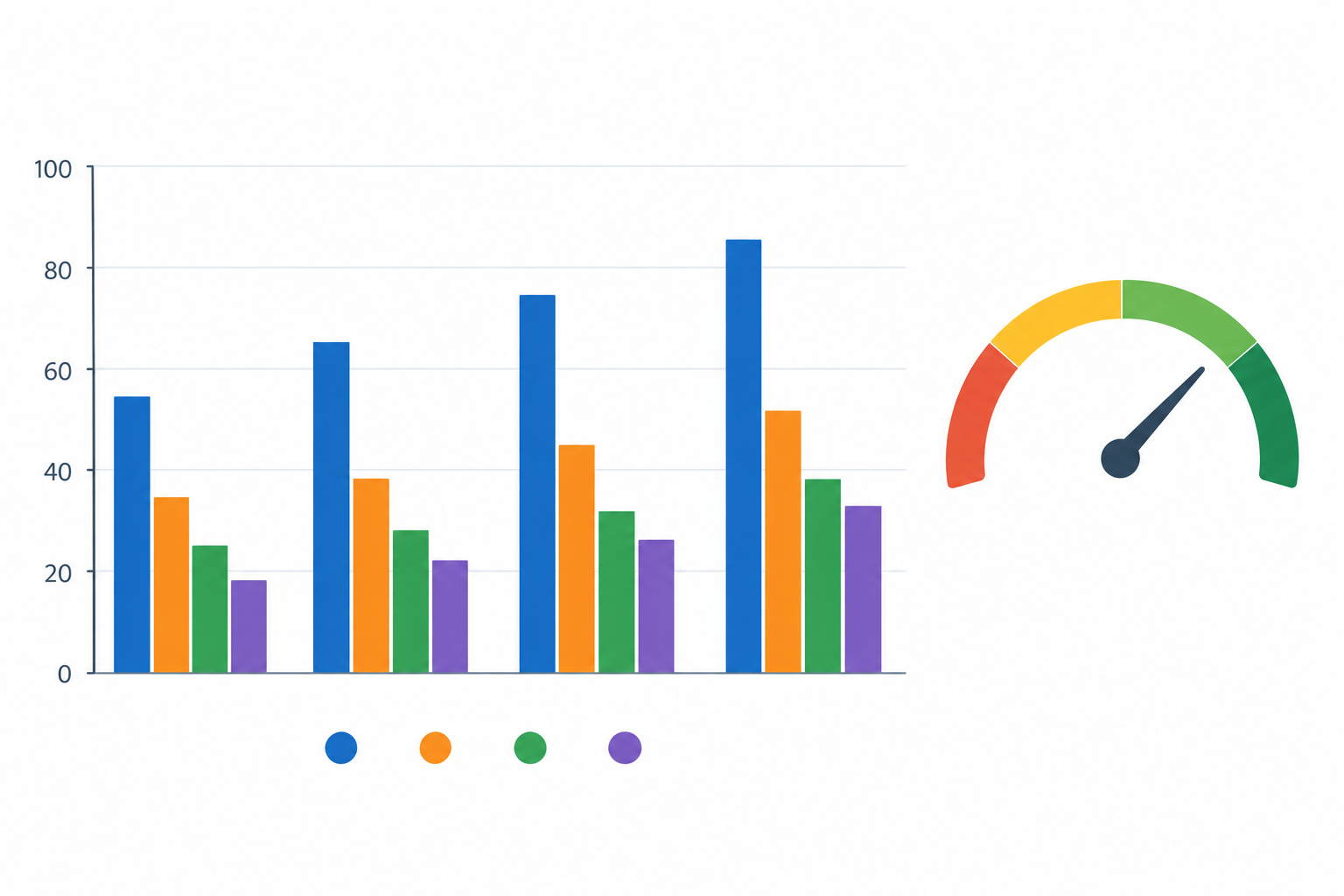
- Calculate share of voice against two or three direct competitors to see whether you are gaining or losing ground.
Here is an illustration, not client data. Imagine a Leeds electrician who is named in 3 of 20 answers while a rival is named in 11. The gap is concentrated in rewiring questions, and the rival has a dedicated rewiring page. That tells you which page to write first, and the next round of checks tells you whether it moved anything.
Manual or automated AI visibility tracking?
For a very small business with a handful of queries, manual checks are a sensible start. The trouble is scale. Twenty questions across five assistants is 100 responses per round, and a weekly round tends to get dropped. A spreadsheet with fixed questions, a fixed cadence and a column for sentiment will take you a long way.
Disclosure: MentionOwl is our product, so weigh this accordingly. It automates the process above, running generated customer questions daily against major assistants and recording answers, citations, sentiment and competitor mentions. It reports a 0-100 visibility score that combines query coverage, position-weighted citations, share of voice and soft mentions. That score is a proprietary, directional metric rather than an industry standard, so I would use it to track change over time and not to compare against other tools. A $1 seven-day trial is available if you want a baseline before deciding.
A realistic 30-day local SEO and AI search action plan
- Week 1, baseline and audit: record your current visibility across your question set, run the ten-listing audit, and note your top two or three rivals.
- Week 2, fix legibility and strengthen pages: resolve technical barriers, then rewrite or create core service pages with direct answers, prices, timescales and coverage.
- Week 3, reviews and citations: start a consistent, compliant review-request routine, reply to existing reviews, and pursue two or three local citations.
- Week 4, re-measure and prioritise: compare share of voice against rivals, identify the question types you still lose, and choose the next gap to close.
Be patient. How quickly web changes appear in AI answers varies by platform and source, and training-based responses may lag considerably. Treat the 30 days as the first pass through a loop, not a finish line.
Frequently asked questions about AI local search
Do Google reviews affect ChatGPT answers?
There is no public confirmation that they do. Reviews may help indirectly where assistants retrieve review platforms or summaries, so keep them recent, detailed and genuine, and track sentiment to see whether it shows up for you.
Is local SEO still useful now that people use AI assistants?
Yes. Accurate listings, genuine reviews and clear service pages remain the sensible foundation. Treat AI visibility as a layer you measure separately.
How do I compare myself with rivals in AI search?
Run the same set of realistic questions across several assistants on a regular schedule, record who is named, and calculate share of voice against two or three direct competitors.
Why does ChatGPT recommend a competitor with fewer reviews than me?
Review count is only one possible signal. The competitor may have cleaner listings, a page that matches the question more closely, or stronger third-party mentions. Comparing your answers against theirs shows which gap to close first.
How long does it take to improve AI local visibility?
It depends on the platform, the source and the change. I know of no published, measured update intervals, so track movement over several weeks rather than expecting a fixed timeline.
Sources and notes
Official platform guidance (check each page for its current version):
- Google Business Profile Help, Improve your local ranking on Google
- Google Business Profile, Guidelines for representing your business
- Google Search Central, AI features and your website
- Google Search Central, LocalBusiness structured data
- Google, Prohibited and restricted content for contributors
- OpenAI Help Centre, ChatGPT search
- OpenAI, Overview of OpenAI crawlers
Survey and research findings:
- BrightLocal, Local Consumer Review Survey (2023, US respondents)
- Whitespark, Local Search Ranking Factors (2023, expert opinion survey)
UK regulation:
- Competition and Markets Authority, guidance on fake and misleading online reviews under the Digital Markets, Competition and Consumers Act 2024
Author observations: the typical number of businesses named in an AI answer, the effect of phrasing on shortlists, and the inconsistent-listings hypothesis are my own working observations and inferences, not published findings.