Does ChatGPT Recommend Your Local Business? How to Check, Step by Step
Does ChatGPT recommend your business? Test real customer questions across AI assistants, check local AI visibility and track recommendations over time.

The practical answer to “does ChatGPT recommend my business?” is to ask it the questions your customers actually ask, repeat them across several AI assistants, and record which businesses are named, in what position, and with what sentiment. One check is a snapshot, not a verdict, because AI answers vary from run to run. Start with a simple tracking sheet, then move to automated monitoring once you want a trend you can trust. 📊
This guide sets out the process in five steps. It's written for UK small business owners, solo founders, and small marketing teams who want to check AI visibility properly rather than rely on a one-off screenshot.
Why searching for your business name tells you little about AI recommendations
The instinctive test is to type 'What is [my business]?' into ChatGPT. It's worth running, but it measures something narrow: whether the assistant recognises your business as an entity. It doesn't show whether the assistant will recommend you to a customer who has never heard of you.
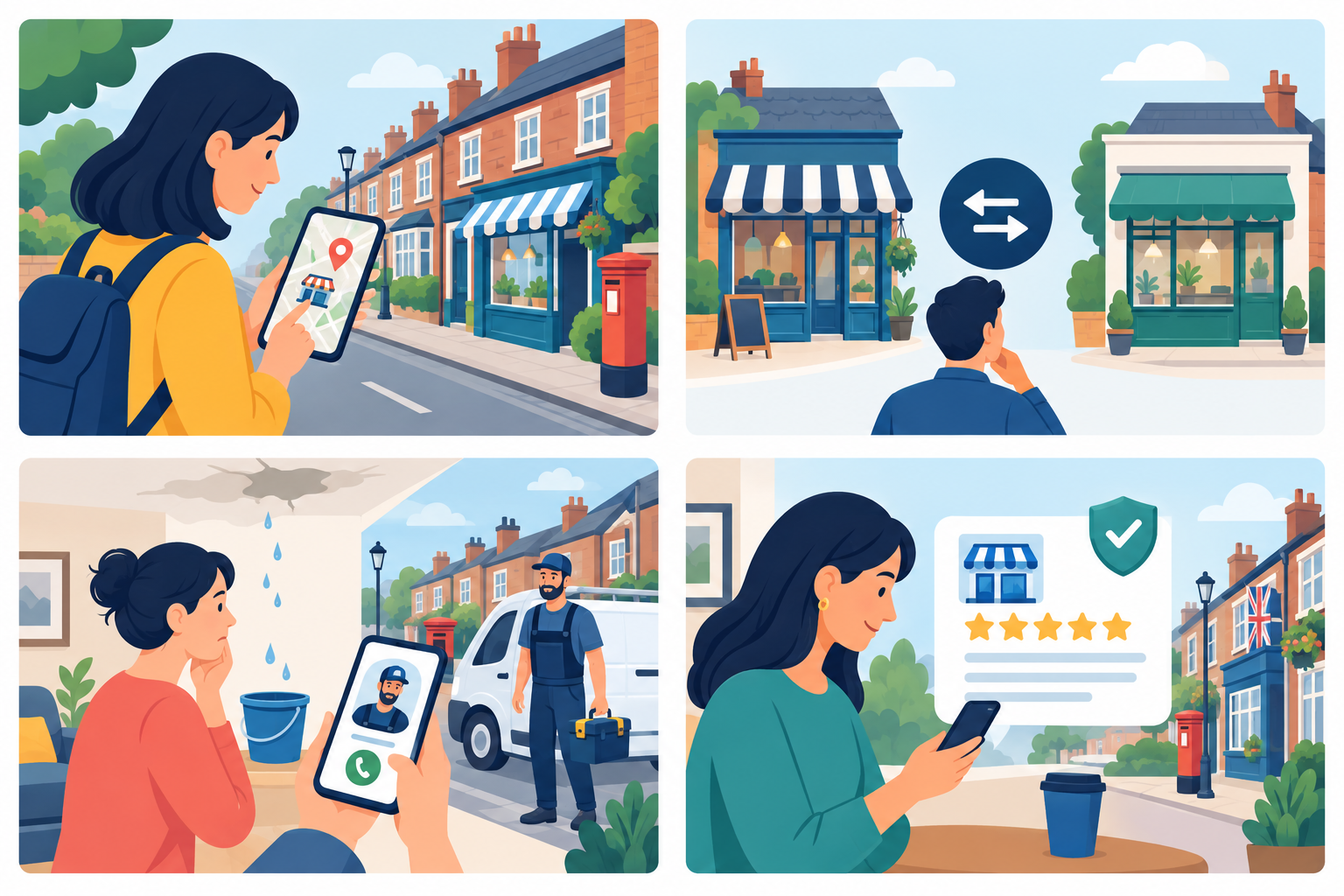
Customers rarely begin with your name. They ask things like 'best plumber in Leeds for emergency call-outs' or 'which dentist in Sheffield is taking new NHS patients?' These unbranded, purchase-decision queries are where local business AI search can influence revenue, because they test category, location, and suitability rather than brand recall. A business can pass 'Does [Business Name] offer weekend appointments?' and still fail 'Which nearby clinic offers weekend appointments?' A name-only check can therefore overstate, by a wide margin, how often you're surfaced to prospective customers.
Then there's variance. AI answers are probabilistic, so the same question can return different businesses on different days. OpenAI's own ChatGPT search documentation notes that results can vary and that location may be approximated from your connection. One result is an anecdote. Google's guidance on local ranking says results are based primarily on relevance, distance, and prominence. A branded query removes most of those variables, which is another reason it flatters you.
On adoption, the Pew Research Center found in 2025 that 34% of U.S. adults had ever used ChatGPT. That's American data on general use, not UK local recommendations, so treat it as background only. I haven't verified a comparable current UK figure, and I'd check Ofcom's latest online nation and media use reports before quoting one.
Step 1: Write the questions your customers actually ask
Your test is only as good as your questions. Build a list of 15 to 25 prompts drawn from real customer language, not your own marketing copy.
- Start from real sources. Mine enquiry emails, call notes, Google reviews, Google Search Console queries, and your site FAQs. The phrases customers repeat are the ones to test.
- Cover four intent types: discovery ('best family dentist in Sheffield'), comparison ('[your business] vs [competitor]'), problem-led ('my boiler keeps losing pressure, who should I call in Bristol'), and trust ('is private orthodontics in Manchester worth the cost').
- Write conversationally. People often type full sentences with context into AI assistants, so mirror that.
- Add UK location variants. Use town names, boroughs, and neighbourhoods (Crookes, Ecclesall, Hillsborough) alongside 'near me' phrasing, because each can produce different answers.
- Keep your brand out of most prompts. If your name appears in the question, you're no longer testing unprompted recommendation. Reserve a few branded prompts as a separate control group.
Example customer questions for a Sheffield dental practice
Imagine a fictional practice, Hillsborough Dental Care. A sensible starting set might look like this:
- Discovery: 'Which dentist in Sheffield is accepting new patients?'
- Discovery (local variant): 'Best family dentist near Crookes, Sheffield'
- Problem-led: 'I've chipped a tooth and need an emergency dentist in Sheffield this weekend'
- Comparison: 'Hillsborough Dental Care vs a larger chain for Invisalign in Sheffield'
- Trust: 'Is a private dentist in Sheffield worth the extra cost?'
Writing and maintaining this list is the most tedious part of the process. MentionOwl, the tool my team builds, can crawl your website and auto-generate customer questions as a starting set. You'd still refine them with your own knowledge of your customers.
Step 2: Test your local business across several AI assistants
If you only ask whether ChatGPT recommends your business, you'll miss most of the picture. Each assistant draws on different training data, retrieval systems, and sources, so appearing in one doesn't mean you appear in the others.
- Run every question in ChatGPT, Claude, Gemini, Copilot, and Perplexity. Use the same core wording first, then add natural variations such as 'Where can I find a [business type] in [city]?'
- Note which answer mode was active. As a simplification, some answers lean on a model's training data, a fixed snapshot of the past, while others use live web search and cite current pages. Behaviour varies by product, setting, and over time, so check each provider's documentation and record whether search was on. Search-enabled answers may be more sensitive to current, crawlable pages and third-party listings, but that's a hypothesis to test, not an established rule.
- Reduce personalisation. Use a logged-out or fresh session where possible. Settings differ across tools, so don't assume they behave alike.
- Repeat each question at least three times, on different days. This is the only way to capture variance. A business that appears once in three runs is in a very different position from one that appears in all three.
- Log the conditions. Record the date, model, mode, apparent location, and exact wording so results stay comparable later.
What is a practical manual baseline for checking AI visibility?
Twenty questions across five assistants, repeated three times, comes to 300 checks for one location. That's too heavy for most small teams, so scale down. Take your 10 highest-value questions, test them in two or three assistants, and repeat each three times over one to two weeks. You end up with roughly 60 to 90 checks, enough to see rough patterns but not enough to call a trend. A single monthly check remains a snapshot.
Step 3: Record which businesses AI assistants recommend
A spreadsheet is enough to start. Create one row per answer, with these columns:
| Question | Assistant | Date | Businesses named | Your position | Cited sources | Sentiment | Notes |
|---|---|---|---|---|---|---|---|
| Which dentist in Sheffield is accepting new patients? | ChatGPT (search on) | 3 June | Competitor A, Competitor B, Hillsborough Dental Care | 3rd | NHS directory, Competitor A site, Google Maps | Neutral | Listed without detail |
| Emergency dentist Sheffield weekend | Perplexity | 3 June | Competitor A, Competitor C | Not named | Local press article, Yell | n/a | Competitor C cited for weekend hours |
| Is private dentistry in Sheffield worth it? | Gemini | 4 June | Competitor B | Not named | Review site | Positive (for B) | Generic advice, one name |
Three distinctions make the sheet far more useful:
- A direct recommendation means the assistant endorses you for the stated need.
- A soft mention means you're named in passing, without endorsement, often inside a long list.
- A citation means the assistant links to or sources your own website, which is a different signal from being named.
Mention rate vs. share of voice in AI search
Track competitors by name so you can calculate two separate figures.
- Mention rate is the proportion of runs in which a business appears. If your practice appears in 6 of 30 runs, your mention rate is 6 ÷ 30 = 20%. If Competitor A appears in 21 of the same 30, theirs is 70%. These rates can add up to more than 100%, because one answer can name several businesses.
- Share of voice is a business's mentions divided by all mentions of every tracked business. Suppose that across the 30 runs you were named 6 times, Competitor A 21 times, Competitor B 12 times, and Competitor C 9 times. That's 48 mentions in total, so your share of voice is 6 ÷ 48 = 12.5%.
Both figures matter. Mention rate tells you how often you show up, while share of voice tells you how much of the conversation you hold against the competitors you chose to track. Whichever you use, fix the denominator and keep it the same from week to week.
Also capture the sources the assistant cites, whether directories, review sites, local press, or your own pages. This column shows where influence may be coming from, and it's arguably the most actionable data in the sheet.
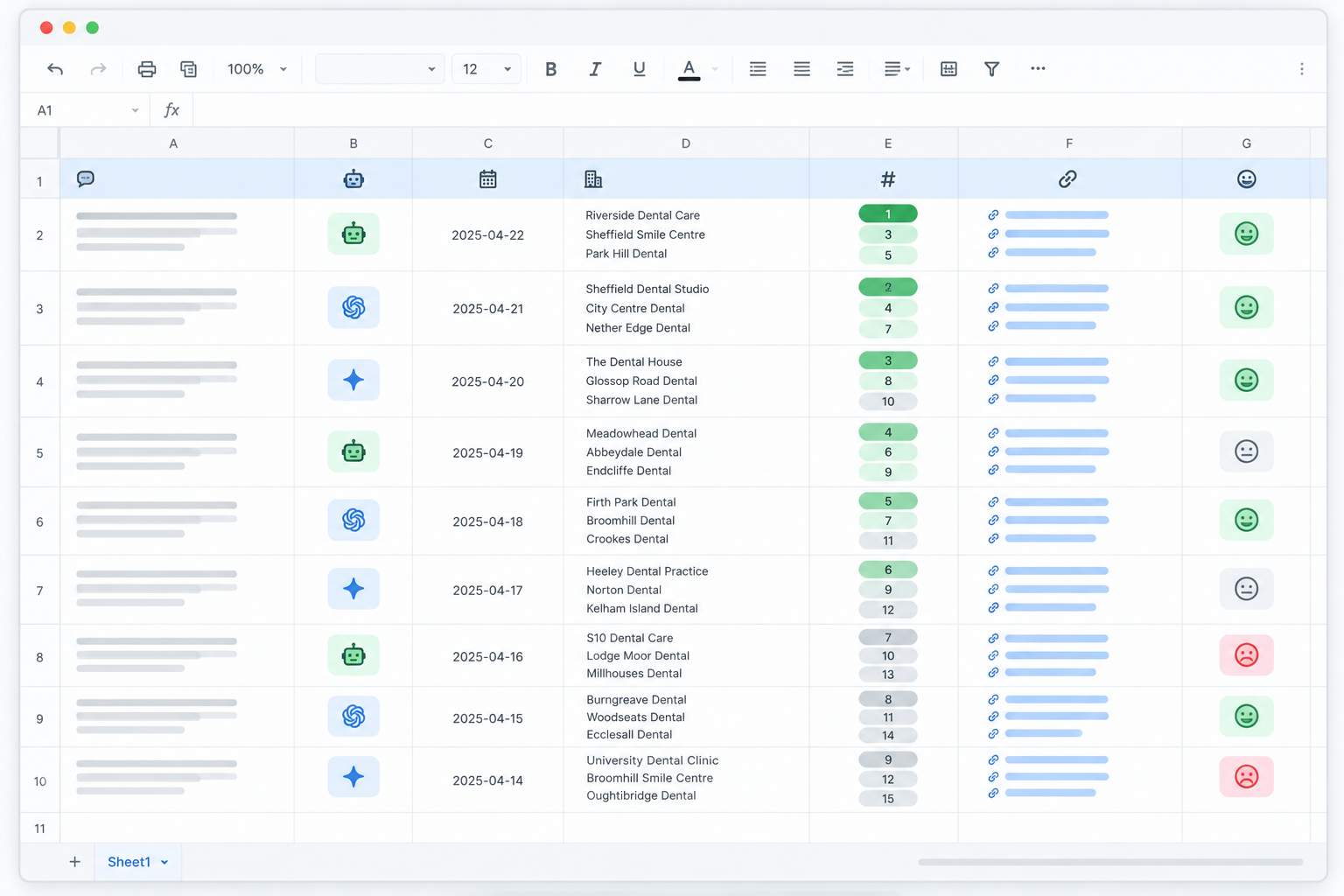
Be honest about the limits of doing this by hand. It's time-consuming, it's inconsistent between people, and it's poorly suited to spotting trends.
Step 4: Interpret AI visibility gaps against local competitors
Once you have a few weeks of data, read patterns rather than single answers. Which competitors recur, and in which question types? A rival might dominate emergency queries but be absent from trust queries, which tells you something specific about where their content or reputation is strongest.
Why do AI assistants recommend my competitor?
The likely drivers are stronger third-party mentions, richer review profiles, clearer service and location pages, consistent business details across directories, and content that directly answers the customer's question. These are hypotheses, not proven mechanics. Nobody outside the AI providers can claim to know the exact ranking logic, so every finding here is a correlation to test. A competitor appearing more often doesn't mean they're better, or that you're being excluded. Distance matters too, since some differences simply reflect geography.
The practical method is to compare like with like: same prompt, same location, same date. Take the second row of the sample sheet, where Competitor C was cited for weekend hours and Hillsborough Dental Care wasn't named. A sensible response would run in four steps:
- Open the cited page and note exactly how it states weekend availability.
- Check whether your own site and Google Business Profile state your weekend hours as clearly.
- Fix any gap, for example by adding a dedicated emergency and weekend appointments page.
- Re-run the same prompt over the following weeks and see whether your mention rate moves.
Do AI search answers differ by city?
Often, yes. Location cues in the prompt, and in the retrieval layer where live search is used, can shift recommendations towards businesses with strong local signals. OpenAI documents that ChatGPT search may use approximate location. Rigorous published evidence on how strongly each assistant responds to location is still limited, so treat this as a working assumption to verify against your own data. In practice, test each service area separately rather than assuming a result for Sheffield applies to Rotherham.
Check whether your website is easy for AI systems to understand
AI legibility describes how readable your website is to AI crawlers and retrieval systems. It covers robots rules that may block crawlers by accident, structured data, clean page structure, and clear name, address, and phone number details. You can begin by confirming that your key service pages are crawlable and that your details match across your site and listings.
Is your business absent or just weakly positioned?
These are different problems. Absence means you're never mentioned, which usually points to the foundations: missing information, thin pages, or poor third-party coverage. Weak positioning means you appear but are listed last, or with neutral or negative sentiment, which points to reputation, proof, and how clearly you differentiate yourself.
Use the cited sources column to work out which directories or publications you need to appear in. If three assistants repeatedly cite the same local directory and you're not listed there, you have a concrete, fixable lead.
What should I do if ChatGPT doesn't mention my business?
Resist the urge to look for a trick. The work is mostly unglamorous and cumulative:
- Fix the foundations. Make your business name, address, phone number, and opening hours accurate and identical across Google Business Profile, Bing Places, and the UK directories that matter in your trade.
- Answer your highest-value questions directly. Create pages that address the questions from Step 1, with service area, pricing guidance, and proof such as case studies or accreditations.
- Build third-party signals. Genuine reviews, local press, trade association listings, and partner mentions give assistants independent evidence to draw on.
- Improve AI legibility by adding structured data, keeping pages crawlable, and maintaining a clear site structure.
- Treat generative engine optimization as an extension of AI SEO, not a replacement. The fundamentals of good search practice still apply.
- Re-test, and be patient. Retrieval indexes and model updates take time to catch up, and anyone promising instant results is overselling.
Step 5: Move from one-off checks to ongoing AI visibility tracking
Manual checking breaks down quickly. Variance between runs means you need repeats, and five assistants, dozens of questions, and several locations multiply into hundreds of checks. Most small teams can't sustain that, and inconsistency creeps in just when you need clean data.
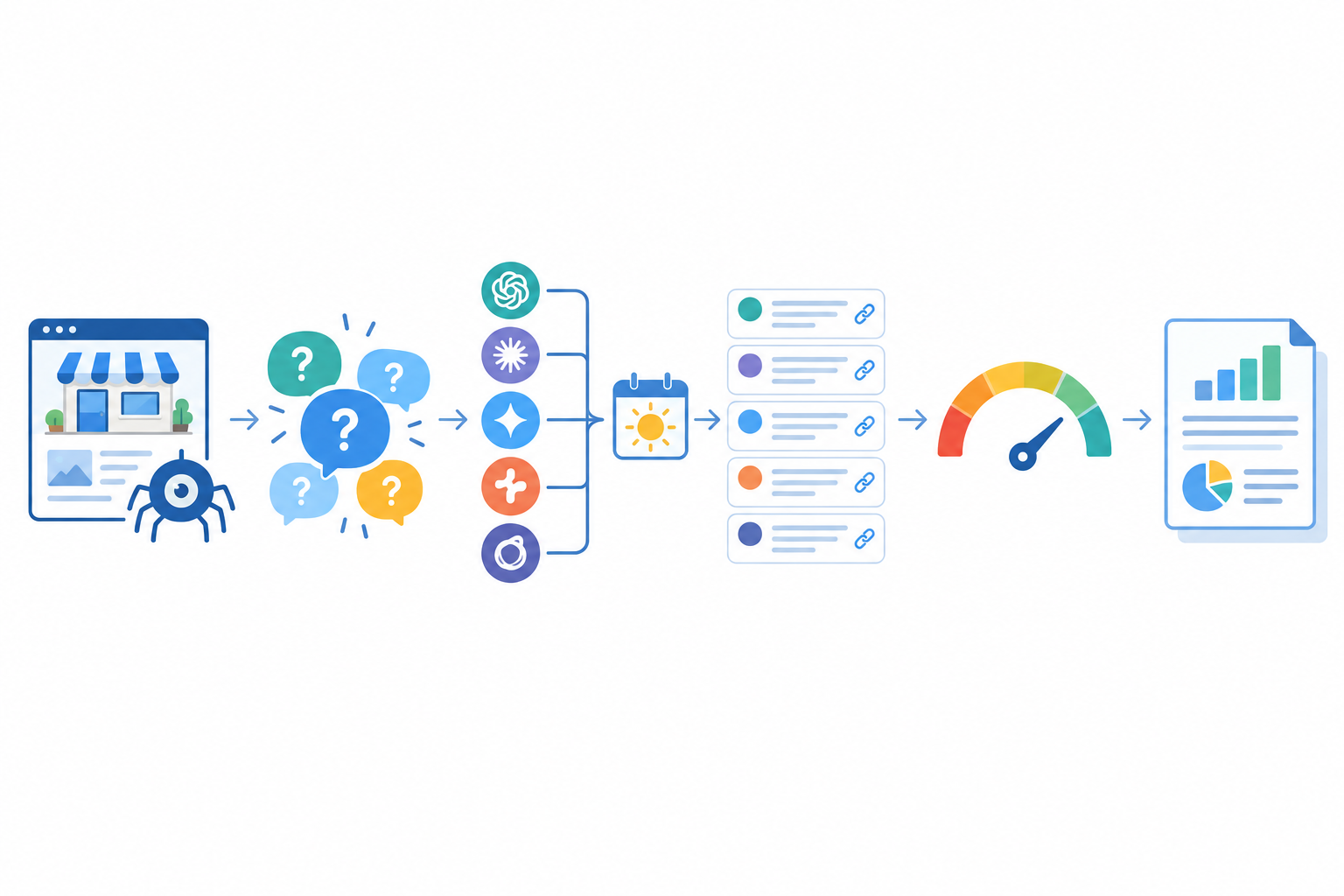
Continuous LLM monitoring adds what a spreadsheet can't: scheduled daily runs, recorded answers and citations, sentiment analysis, competitor tracking, and trend lines that show whether your actions are working.
A note on MentionOwl
I work on the MentionOwl team, so read this section as vendor-reported rather than independent. The details below come from our own product description, and you should confirm the current specifics on the MentionOwl website before buying. MentionOwl crawls your site, generates customer questions, runs them daily against ChatGPT, Claude, Gemini, Copilot, and Perplexity, and records answers, citations, sentiment, and competitor mentions. It also runs 16 technical AI legibility checks, sends weekly digests, offers cookieless AI traffic analytics, and provides a REST API and an MCP server.
How the MentionOwl visibility score works
MentionOwl condenses results into a proprietary visibility score from 0 to 100. It's a vendor-defined metric, not an industry standard, and it's built from four components:
- Query coverage: the share of your questions where you appear at all.
- Position-weighted citations: citations count for more when you're named earlier in the answer.
- Share of voice: your appearances relative to named competitors.
- Soft mentions: passing references that still contribute to awareness.
The component weightings and exact formula aren't set out here, so use the score as a directional trend indicator and judge the underlying mention data alongside it.
A practical AI visibility tracking workflow
- Benchmark manually with the sheet above, so you understand what the data looks like.
- Automate the same questions for consistent daily frequency.
- Review the weekly digest rather than checking dashboards constantly.
- Act on the biggest gaps, then watch the trend to see whether they close.
At the time of writing, MentionOwl's trial is listed at $1 for 7 days, which is under £1 at recent exchange rates, although your card provider's rate will vary. Check current pricing before signing up. It's a low-risk way to compare automated results against your manual sheet and see whether the two tell the same story.
Frequently asked questions about checking AI visibility
The questions about competitors, city differences, and what to do if you're not mentioned are answered in Step 4. Three more come up often.
How often should I check AI visibility?
A one-off or monthly check gives you a snapshot only. For a baseline you can lean on, repeat a smaller question set several times over one to two weeks, as described in Step 2. For trends, scheduled weekly or daily runs are far more reliable, because they smooth out run-to-run variance.
Is checking ChatGPT enough to measure local business AI search visibility?
No. Claude, Gemini, Copilot, and Perplexity use different data and retrieval approaches, so your visibility can differ between them. Start with the assistants your customers are most likely to use, and widen from there.
How many questions should I test?
Fifteen to 25 is a good full set. If time is tight, begin with the 10 questions closest to a purchase decision and expand later.
Does ChatGPT recommend my business? The practical answer
'Does ChatGPT recommend your business?' has no single answer, only a rate that moves over time and differs by assistant, question, and place. Run the scaled-down baseline from Step 2 for two weeks and see how much effort it takes. If the sheet is manageable and your results are stable, keep tracking by hand. If it feels unsustainable, or you need to cover several towns, that's your signal to automate. 🦉