AI Visibility Drop: A Step-by-Step Diagnosis for DTC Brands
AI visibility drop? This UK SaaS and DTC troubleshooting guide helps you spot model volatility, competitor gains, site changes and sentiment shifts.

A troubleshooting guide for UK SaaS and DTC brands: how to tell normal volatility, competitor gains, site or source changes and sentiment shifts apart before you rewrite a single page.
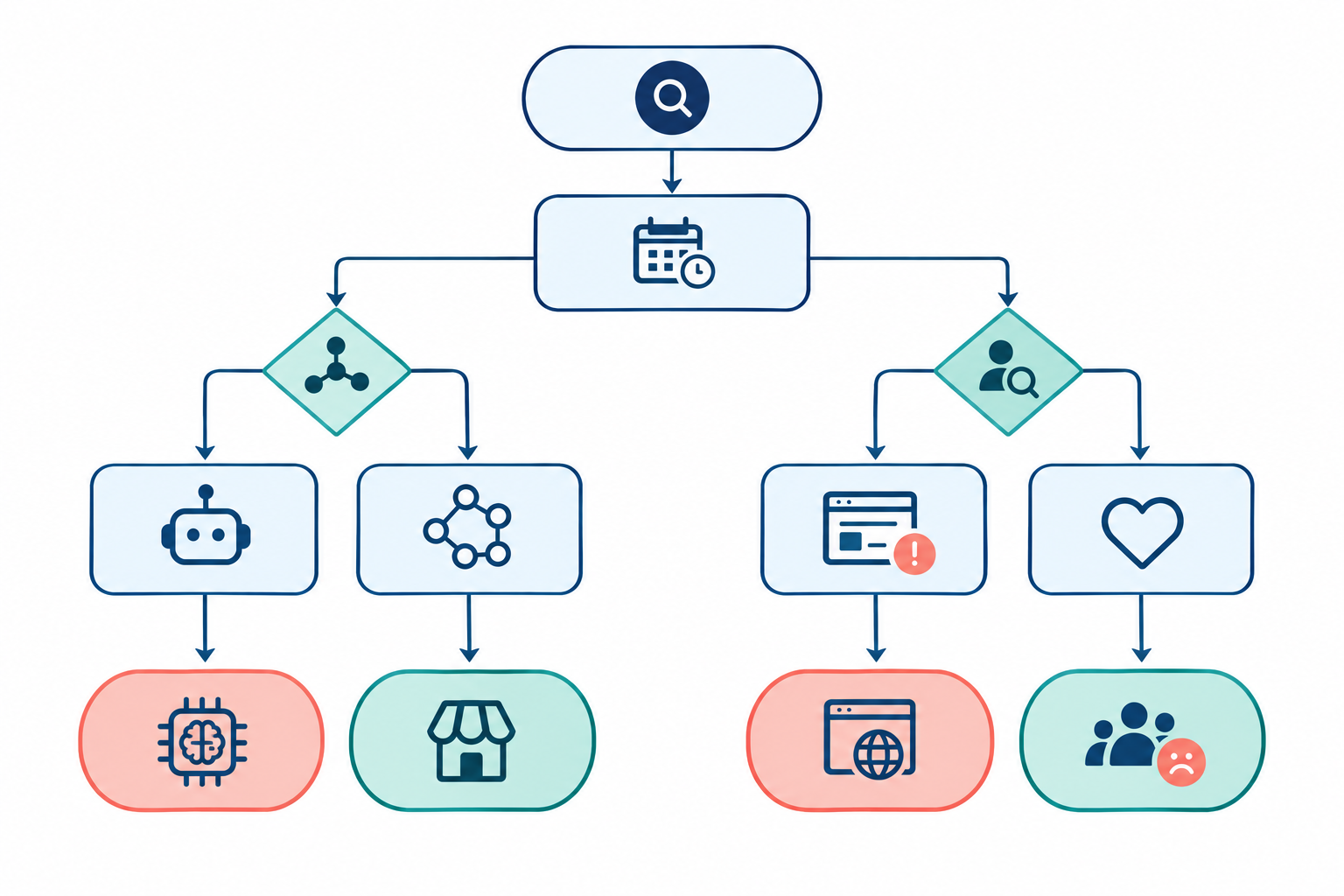
An AI visibility drop usually traces back to one of four causes: normal model volatility, a competitor gaining ground, a change on your site or in the sources AI engines draw on, or a shift in sentiment. In my experience, you can separate these by first confirming that the drop persists across repeated runs, then checking which engines and queries moved, and only then looking at competitors, site legibility and sources. Causes often overlap and can't always be isolated cleanly, but a sustained drop can usually be diagnosed within a week or two if you work through the steps in order. 🔍
This walkthrough is for brands that are being named or cited less often in ChatGPT, Claude, Gemini, Copilot or Perplexity answers, and that want evidence before they start rewriting pages or commissioning outreach.
Terms used in this guide:
- Query coverage: the share of your tracked prompts in which your brand appears at all.
- Position-weighted citation: how prominently, and where in the answer, your domain is cited.
- Soft mention: being named without a link.
- Share of voice: your mentions as a proportion of all brand mentions across the same prompt set.
There is no single standardised industry definition of 'visibility', so pick one measure and keep it consistent.
Example: a UK skincare brand that vanished from AI answers
To make the logic concrete, I will use a hypothetical brand throughout: Fernleaf, a London-based sustainable skincare label. Fernleaf is an illustration, not a real client case, and every number attached to it exists only to demonstrate the reasoning. Real diagnoses are rarely this tidy. Over three weeks, Fernleaf's AI visibility score falls from 62 to 41 on a 0-100 scale, and the founder's first instinct is to rewrite the homepage.
I want to talk people out of that instinct. There are four suspects, and we will test each in turn:
- The engine: a model or retrieval update changed how answers are produced.
- The competitor: a rival earned more coverage and took your slots.
- The site: something on your domain or in third-party sources made you harder to read, crawl or trust.
- Sentiment: you are still mentioned, but framed less favourably.
Order matters because each cause demands a different response. Rewriting product pages when the real culprit is a blocked crawler wastes weeks. Chasing press coverage when the problem is a single-engine update means spending effort on something that may stabilise on its own.
Step 1: Confirm the AI visibility drop is real
Generative answers are probabilistic. The same prompt can return different brands on different runs, so finding your brand missing from a single ChatGPT response is weak evidence. OpenAI's text generation documentation discusses reproducibility and output variability for exactly this reason. Here is how I establish whether a drop is genuine.
- Define the measure. Decide whether you are tracking mentions, domain citations or share of voice, and don't treat them as interchangeable.
- Set a baseline. Compare a window of daily runs, such as 14 days, against the preceding 14 to 28 days rather than yesterday against today. Annotate promotions, seasonality, launches, stock problems and site migrations, since a demand shift can look like an AI visibility drop.
- Split the score into components. Query coverage, position-weighted citation and soft mentions can each fall independently. Stable coverage with falling citations tells a different story from the reverse.
- Hold the test setup constant. Prompts, wording, platform, location, language and logged-in state should not change between periods, otherwise a change in setup can masquerade as a decline. UK regional variation matters here too.
- Cross-check conventional data. Compare branded and non-branded query groups in Google Search Console with your AI prompt set. If impressions are stable but AI mentions fall, investigate AI coverage separately. If both fall, look at demand, rankings or site changes first. Search Console data typically lags by a couple of days, so don't treat the newest days as a confirmed trend.
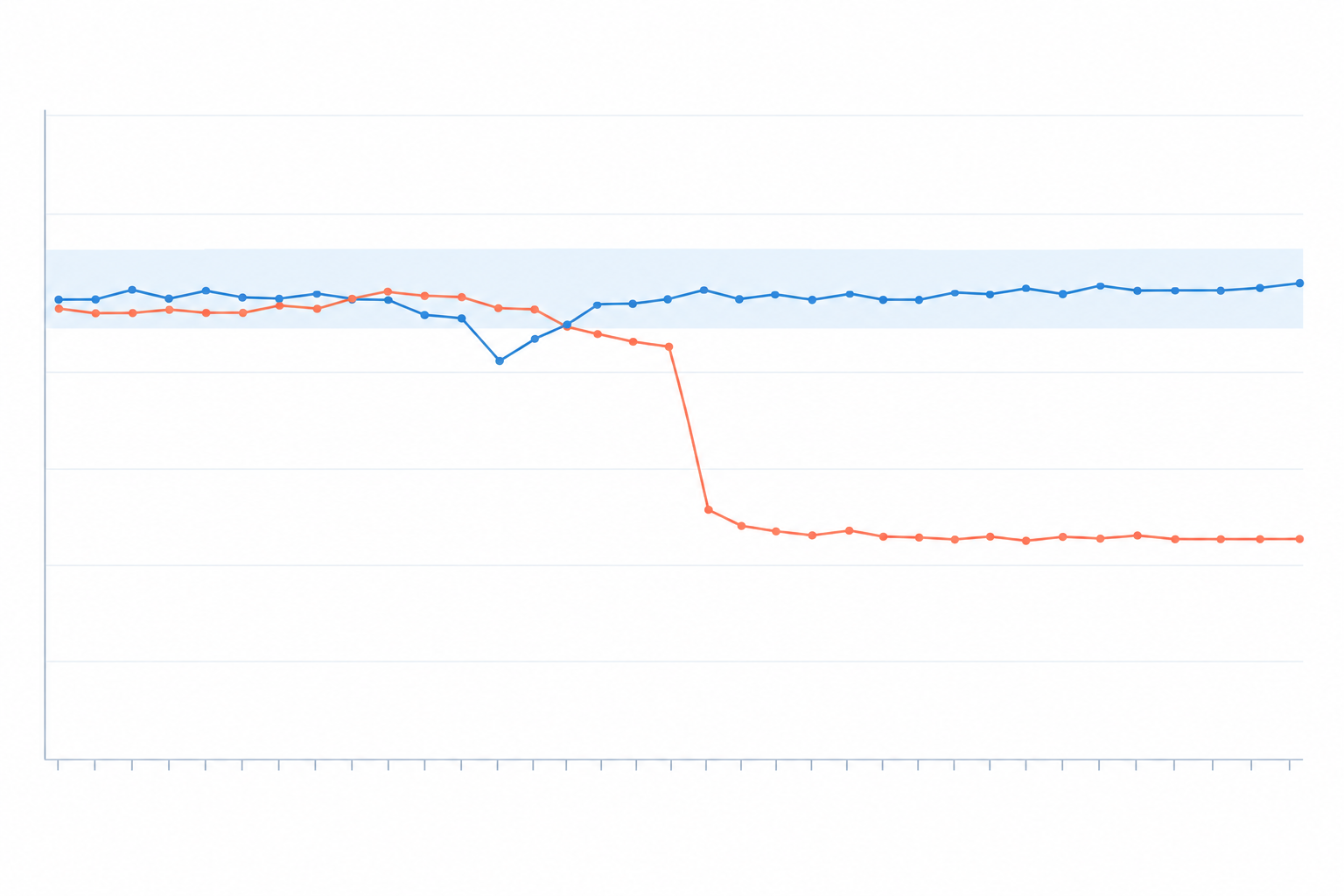
Is it a temporary fluctuation? What follows is a heuristic, not a test. The thresholds below are my own rules of thumb, not validated or industry-standard cut-offs. How much variation counts as normal depends on your prompt volume, how many runs you average and the platform, so calibrate against your own baseline. As a starting point, wait if a dip lasts three days or fewer and your seven-day average stays inside your normal band. Investigate if the 14-day average sits below the lowest point of that band, or if a step change appears on more than one engine and holds. Fernleaf's score sat at 41 for 16 consecutive days, so it clears this bar comfortably.
Whatever tool you use, it should record answers repeatedly rather than rely on one snapshot. It should also keep the cited URLs, mentioned brands and run dates, so you can see whether a movement is a blip or a trend.
Example: one prompt set, before and after an AI visibility drop
Fernleaf tracks 40 prompts daily across five engines. Here is the comparison between the 14 days before the drop and the latest 14 days:
| Measure | Before | After | What it suggests |
|---|---|---|---|
| Prompts naming Fernleaf | 25 of 40 | 16 of 40 | Real loss of coverage |
| Branded prompts naming Fernleaf | 10 of 10 | 10 of 10 | Brand still recognised |
| Discovery prompts naming Fernleaf | 15 of 30 | 6 of 30 | Loss is concentrated in discovery |
| Prompts where Fernleaf is cited first | 9 of 40 | 3 of 40 | Position is also slipping |
Each clue narrows the field. The loss is sustained, it isn't about brand recognition, and it sits in discovery queries. That points away from a pure engine blip and towards competitors or sources, which is where the next steps go.
Step 2: Check which AI engines and queries changed
Once the drop is confirmed, break the overall score down. The pattern across engines and query types narrows the suspects faster than any other single check.
- Segment by engine. Look at ChatGPT, Claude, Gemini, Copilot and Perplexity separately. A decline on one engine points towards a model or retrieval change. A decline across all of them suggests something about your brand, site or sources.
- Segment by query intent. Group queries into category discovery ('best vitamin C serum UK'), comparison ('X vs Y'), branded and problem-led, and note which clusters lost ground.
- Treat retrieval behaviour as a clue, not a diagnosis. Products with live web retrieval, such as Perplexity and Copilot, may react to source and crawl changes faster than answers drawn mainly from model knowledge. Most platforms blend the two, though, and the mix varies by product, query and configuration. If only retrieval-led answers moved, add sources and crawl access to your shortlist rather than concluding anything.
- Record what replaced you. Fernleaf falls out of 'best for sensitive skin' answers while holding its branded queries. People who already know the name still find it, but the engines no longer volunteer it.
- Check the calendar. Look at release notes and community reports for model updates in the same window. A coincidence of dates is not proof, but it keeps the engine hypothesis alive.
- Keep metrics distinct. Rankings, organic clicks, AI citations and referral visits are separate measures. Google states in its guidance on AI features that this traffic is counted within the overall Web search type in Search Console, so Search Console alone cannot isolate AI Overview performance. Bing Webmaster Tools offers an AI Performance report covering citations in Microsoft Copilot, which can help for that engine.
Citations and clicks behave differently, too. Pew Research Center's 2025 analysis of US adults found users clicked a link inside an AI summary in about 1% of visits. A stable referral count therefore doesn't prove stable citations, and the reverse is true as well. Track them separately.
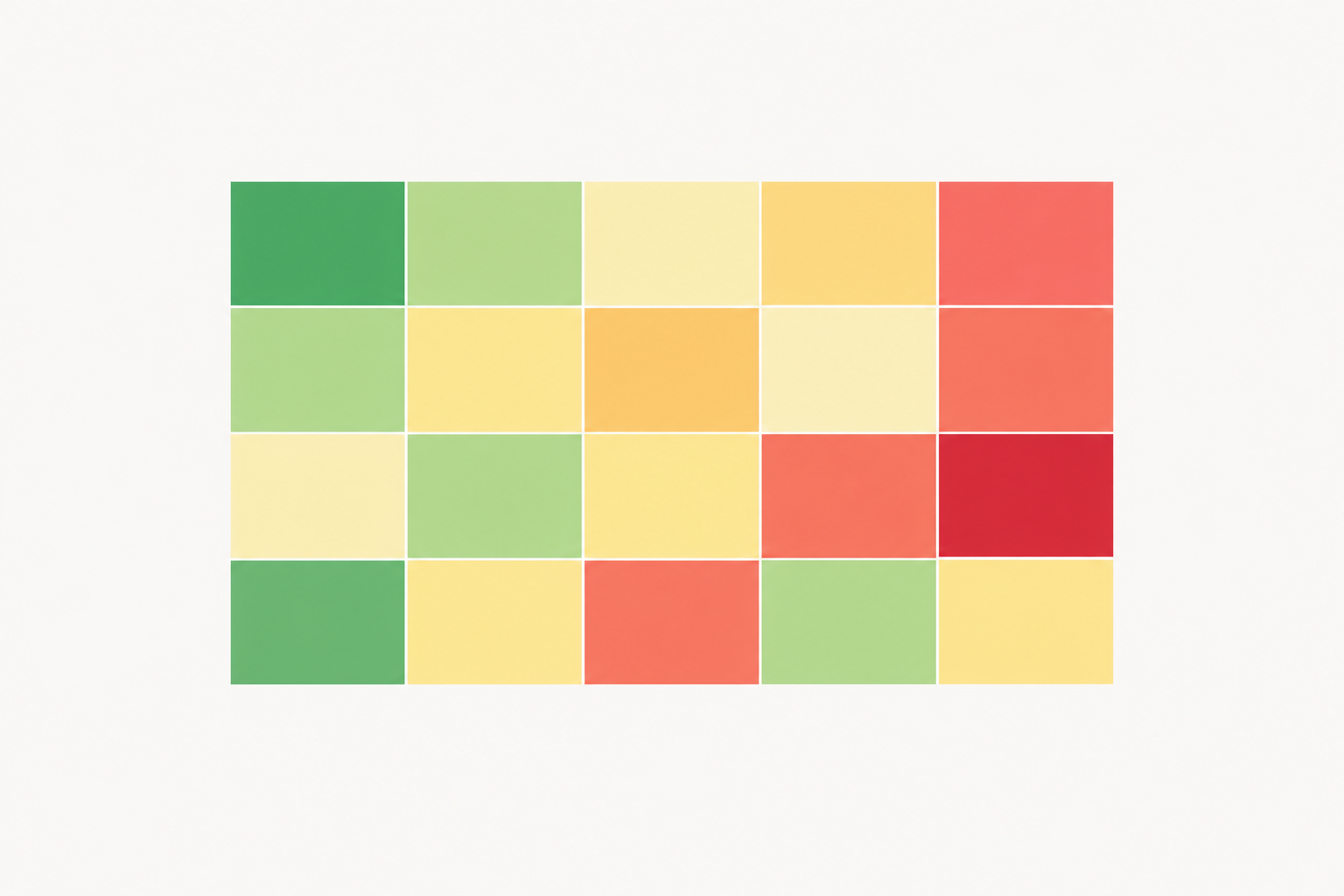
A simple triage table helps at this stage. Treat it as a set of hypotheses to test, not conclusions:
| Pattern observed | Hypothesis to test first |
|---|---|
| One engine down, others stable | Model or retrieval change |
| Retrieval-led answers down, others stable | Source or crawl change |
| All engines down, discovery queries only | Competitor gain or weaker third-party coverage |
| All engines down, all query types, sudden | Site or crawler access issue |
| Mentions persist, position and tone worsen | Sentiment |
Fernleaf's drop appears on every engine and is concentrated in discovery and 'best for' queries. A pure engine explanation looks unlikely, so we move on to competitors.
Step 3: Check competitor gains and AI share of voice
Visibility is relative. AI answers typically recommend only a handful of brands, so a competitor's gain is often your loss, and your absolute score can fall even when nothing about your own brand has changed.
Calculate share of voice across a consistent prompt set. For each prompt, record which brands are named, which are cited, in what position and which page is cited. That lets you tell a zero-sum shift (a rival rose by roughly what you lost) from a market-wide change in how engines answer, where every brand's numbers move together.
If a competitor did rise, ask what they did. The usual suspects are new review coverage, listicle placements, press features, product launches and refreshed comparison pages. Then inspect the sources cited alongside them: Reddit threads, publisher roundups, YouTube, review sites. These are the citation gateways you may be missing, and competitor tracking helps here because it surfaces brands that were never on your original watch list. Conventional rankings deserve a look as well. A rival's organic gains may help explain their citation gains, though the overlap between organic results and AI citations varies by engine and study.
In the scenario, a rival appears in four new UK 'best of' roundups and takes the top position in 11 of 40 tracked queries. Fernleaf's loss is almost exactly mirrored by that rival's gain. That is strong circumstantial evidence, though it doesn't prove the roundups caused it.
Step 4: Audit your website and the sources AI engines trust
Even with a competitor rising, I never stop here, because site problems often compound competitor gains. Work through this checklist:
- Crawler access. Review robots.txt and any CDN or security rules for accidental blocking, and scan for server errors. Different controls serve different purposes, so treat each separately and check the current documentation before changing anything. OpenAI's crawler documentation describes OAI-SearchBot for search features and GPTBot for potential model training, and blocking one does not block the other. PerplexityBot and ClaudeBot are likewise documented by their operators. Google-Extended is different again. It is a robots.txt control token, not a separate crawler, that governs whether content Google already crawls may be used for certain Gemini training and grounding purposes, and it does not affect inclusion in Google Search. Google's crawler overview explains the distinction.
- Rendering and structure. Look for content hidden behind JavaScript, broken schema, unclear product descriptions and removed or restructured pages. If ingredients or sizing appear only in an image or an interaction that doesn't render, add visible text. Use Product structured data only where values match what shoppers see. It helps interpretation but guarantees no citation.
- Recent site changes. Line up migrations, URL changes, redirects, pricing edits and deleted comparison or FAQ content against the date of the drop.
- Third-party sources. Review lost listings, delisted roundup mentions, broken backlinks and outdated directory data.
- Factual consistency. Compare your site with product feeds and prominent third-party sources. Conflicting ingredients, pricing or availability can make engines hesitant to recommend you.
- Traffic corroboration. Cookieless analytics can confirm or contradict the visibility data. A fall in AI referrals that matches the drop strengthens the case, while stable referrals suggest the problem may be narrower than it looks.
Google says there are no special technical requirements for AI Overviews or AI Mode beyond being indexed and eligible to appear with a snippet. The fundamentals matter more than any AI-specific trick.
Fernleaf's audit turns up something useful: a security update two weeks earlier added a rule that blocked one AI crawler. It isn't the whole story, but the timing lines up.
Step 5: Rule in or rule out a sentiment problem
Engines can mention a brand while framing it negatively, or recommend it with caveats. A negative tone in an answer is not, by itself, proof that sentiment caused the drop, so test the hypothesis rather than assuming it.
Compare a fixed set of branded and non-branded prompts over time. Record whether the brand appears, the tone and claims, the cited sources and which attributes are praised or criticised. Keep how often you appear separate from how you are described. Then look for new complaints surfacing in summaries, such as delivery, product quality, customer service or ingredients.
If you find negative framing, trace it to its source before concluding anything. It might be a review-site trend, a viral Reddit thread, a critical article or a product recall. Check whether the criticism is recent, representative and specific.
The distinction I rely on is simple. If mentions persist but sentiment and ranking drop, look to reputation. If mentions disappear altogether, look to legibility or competitors. The right response to genuine criticism is to fix the underlying issue, publish clear factual responses and encourage fresh, authentic reviews. Never try to bury it.
Fernleaf's sentiment is broadly neutral to positive, so this suspect is ruled out.
How to diagnose an AI visibility drop: the four likely causes
The four causes tend to leave distinct signatures. This table consolidates them:
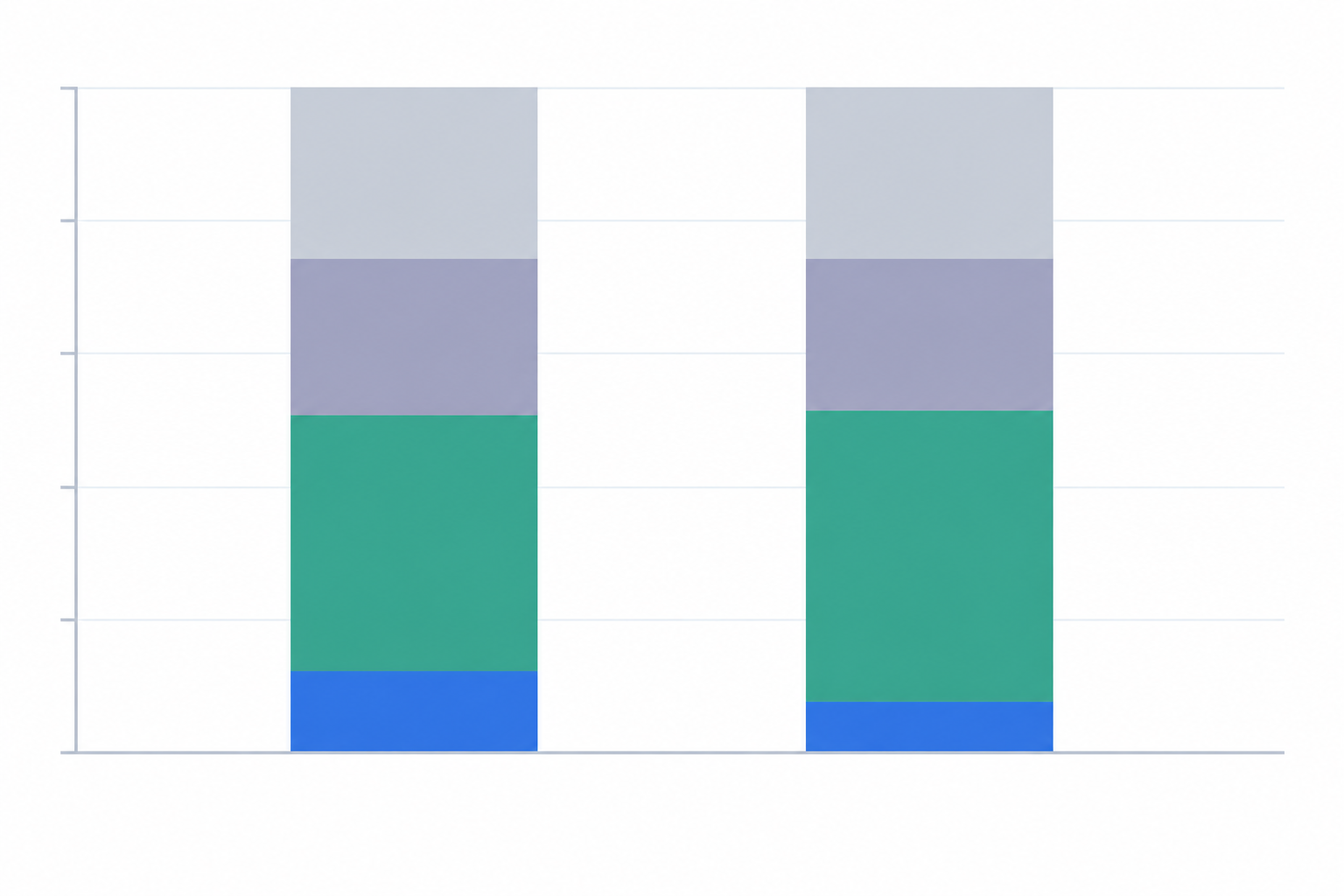
| Cause | Signature pattern | Confirming check | What may happen next (indicative) |
|---|---|---|---|
| Engine change | Single-platform drop, broad query movement, competitors also shift | Release notes, other brands' movements | May stabilise without direct action, but not always |
| Competitor gain | Your share of voice falls as a named rival rises, especially in comparison and 'best of' queries | Share of voice and cited sources | Often slower, depending on outreach and what you can earn |
| Site issue | Sudden step change across engines, crawler blocks, loss of citations to your own domain | Legibility audit, robots.txt review | Retrieval-led answers may respond sooner than model knowledge |
| Sentiment | Mentions persist but tone and position worsen, tied to identifiable negative sources | Source tracing of negative claims | Depends on fixing the root issue |
The right-hand column reflects my general expectations, not guarantees, and results vary by platform and circumstance. Causes can also overlap, and Fernleaf shows how. Its drop traces mainly to competitor gains in roundup sources, compounded by the robots.txt change that blocked an AI crawler. Neither plausibly explains 21 points alone, but together they may. In real accounts, attribution is rarely this clean, so treat the output as a ranked set of likely causes. Diagnosing in order is what stops you declaring victory after finding only the first one.
Recovery plan: how to win back AI citations and re-test
Once you know the likely cause, sequence the work from quickest wins to slowest.
- Fix technical blockers first. Restore crawler access after checking current platform documentation, repair schema, reinstate removed pages and correct factual inconsistencies between your pages and feeds such as Google Merchant Center.
- Strengthen the content the engines need. Publish answer-first pages, clear comparison content and honest 'best for' positioning. For Fernleaf, that means a comparison page covering specific ingredients, substantiated claims, suitability for sensitive skin and links to evidence.
- Target the sources competitors are cited from. Earn inclusion in relevant UK roundups, review platforms, forums and publisher lists through genuine outreach and product merit.
- Address sentiment at the source. Fix the issue, respond factually and build a steady flow of recent, authentic reviews.
- Re-test with discipline. Change one variable at a time where practical, hold the prompt set and conditions steady, allow at least two weeks of daily runs, and compare against the pre-drop baseline.
- Define success once. Track visibility score, query coverage, position-weighted citations, share of voice and AI-referred traffic, and keep citations and clicks separate.
- Set up early warning. Weekly digests and alerts help you catch the next drop within days rather than months.
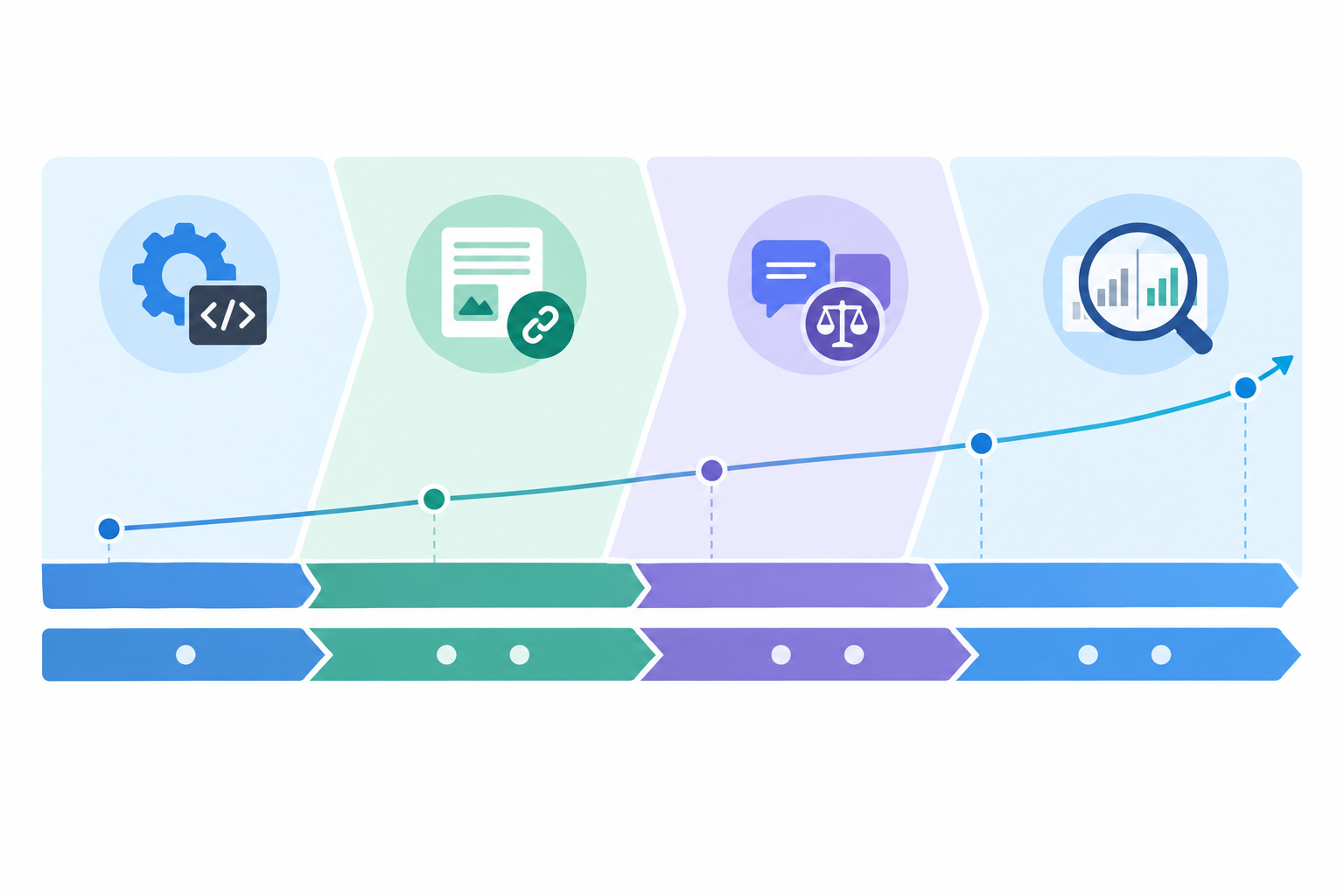
The timeline above is illustrative, not a forecast. Technical fixes may show up within days on retrieval-led answers, while changes in model-level knowledge can take months, and some will not move at all.
A note on tooling: to run this process repeatably you need daily multi-engine runs, stored answers and cited URLs, competitor and sentiment tracking, and a way to check crawler access. MentionOwl, the tool we build, covers those needs and offers a trial if you want to establish a baseline before committing. Any monitoring tool with equivalent records will let you follow the same steps.
Frequently asked questions about AI visibility drops
Why did my brand disappear from ChatGPT?
The usual reasons are a model or retrieval update, a competitor earning more third-party coverage, a technical change that blocked crawlers or removed key pages, or a negative shift in sentiment. Check that the drop persists across repeated runs, then see whether it hit one engine or all of them.
Is an AI visibility drop usually temporary?
Short dips of a few days are common because answers vary from run to run. A decline that holds for two weeks or more, or appears as a sudden step change, is less likely to be noise, though you should calibrate that against your own baseline.
How do I recover lost ChatGPT citations?
Remove technical barriers and correct inconsistent information first. Then earn mentions in the third-party sources engines already cite for your category, publish clear answer-first content, and re-test over at least two weeks.
How long does it take to recover AI visibility?
It depends on the cause. Crawler and content fixes may influence retrieval-led answers within days to weeks, whereas broader model knowledge and reputation typically take longer.
How can I tell a citation loss from a referral-traffic loss?
Check both separately. A citation loss shows up in recorded answers as your domain disappearing from cited sources. A referral loss shows up in analytics as fewer visits from AI platforms. Click-through from AI summaries is low, so citations can fall with little visible change in traffic, and traffic can fall for reasons unrelated to citations, such as demand or tracking changes.
Can I diagnose an AI visibility drop manually?
You can test a handful of prompts by hand, but results will be inconsistent and hard to compare over time. Systematic daily tracking, with recorded citations, sentiment and competitor mentions, gives you far stronger evidence.