Is Your Store Excluded From AI Shopping Shortlists? A Diagnostic Checklist for UK E-Commerce Brands
Find out why your products might be missing from ChatGPT, Perplexity, and Gemini shopping recommendations. A data-backed self-audit with 5 sections an
AI Shopping Shortlists: A UK E-Commerce Diagnostic Checklist
Meta description: Discover why AI shopping shortlists skip some UK e-commerce stores, how AI search evaluates product pages, and what to fix with a practical self-audit checklist.
I'm Marcus, and I spend most of my working week inside MentionOwl accounts trying to explain a pattern that's become impossible to ignore: brands with strong Google rankings that are functionally invisible when a customer asks an AI assistant for a recommendation. Before I go further, a caveat that matters more than most articles on this topic admit—AI visibility is platform-specific, query-specific, location-specific, and it shifts week to week as models are updated and re-crawl the web. Everything below should be read as a diagnostic starting point, not a universal law of how AI search works.
With that caveat in place, here's the pattern I keep seeing: thin or poorly structured product pages, weak third-party citation signals (reviews, comparison sites, marketplace listings), and low share of voice against competitors who've simply built a more citable evidence trail. None of this is random, and none of it requires guesswork to diagnose—it requires a proper audit of what happens when real shoppers ask AI search tools for recommendations in your category.
This matters more than most UK e-commerce teams currently appreciate, though I want to be precise about the evidence rather than just asserting scale. Adobe's 2025 holiday retail analysis reported triple-digit year-over-year growth in traffic to retail sites from generative-AI sources during the 2024 holiday shopping period, and Salesforce's own holiday shopping data release described similar order-of-magnitude growth over the same window—both organisations measure this differently (Adobe via its Analytics panel of retail sites, Salesforce via its Shopping Index), so treat the exact percentages as directional rather than interchangeable. Google has separately stated that AI Overviews now serves over a billion users monthly across Search, though Google hasn't published what share of that traffic involves shopping-intent queries specifically, or how it compares directly to AI chat assistants like ChatGPT or Perplexity. Taken together, the honest summary is this: AI-driven discovery is growing fast and is no longer a niche channel, but the precise size of the opportunity for any individual UK retailer is something you need to measure yourself, not infer from industry-wide averages.
What follows is the diagnostic checklist I use with clients before we discuss fixes. Worked through properly—which takes closer to an hour than a coffee break, for reasons I'll explain in the audit section—it tells you whether you have a genuine exclusion problem or just an unmeasured one.
Signs Your Store Is Missing From AI Shopping Shortlists
Most brands don't realise they're excluded until someone points it out. There's no notification, no Search Console equivalent flashing a warning. The signs tend to be indirect, and each one individually is easy to dismiss. Here's what to watch for:
- Healthy branded search volume, but no customers mentioning AI referrals. This is a weak signal on its own, since most analytics setups can't reliably attribute or identify traffic that originated from an AI assistant's recommendation rather than a subsequent Google search—but if support staff or reviews never mention arriving via ChatGPT or Perplexity in a category where you'd expect it, it's worth investigating alongside other signals.
- Competitors dominate generic category questions. Ask an AI assistant "best waterproof hiking boots UK" or your category equivalent, and if the same two or three competitor names appear across repeated attempts while you never do, that reflects a measurable gap in how that specific platform's retrieval process is weighing available evidence—not proof of a universal exclusion across every AI system.
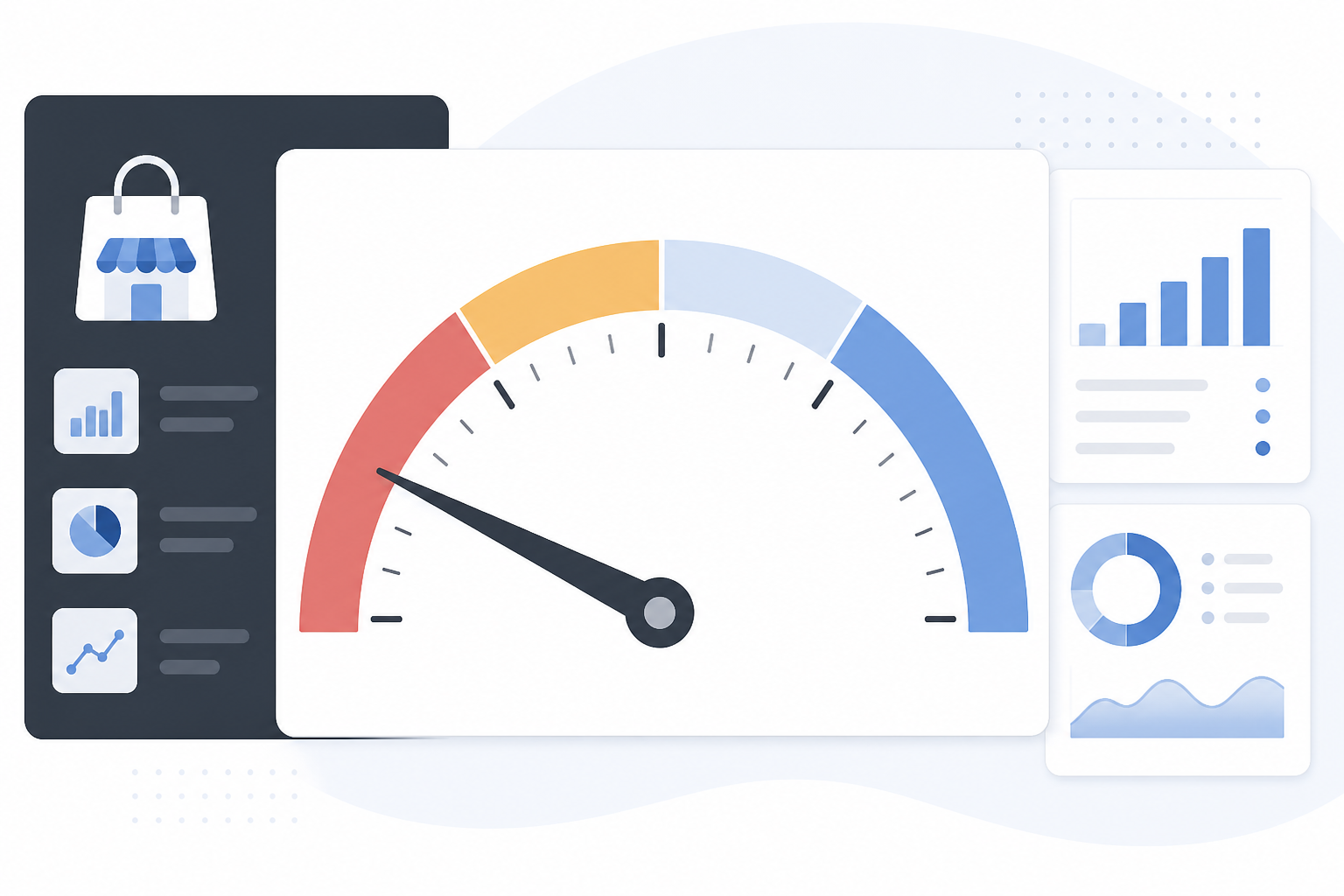
- Strong Google rankings paired with a low AI visibility score. When I measure this using MentionOwl's scoring model—built from query coverage, position-weighted citations, share of voice, and soft mentions—I regularly see brands ranking page one on Google sitting well below that platform's mid-range benchmark on AI visibility. I want to be clear that this score is tool-specific and illustrative, not an industry-standard benchmark; other measurement approaches would produce different numbers, though the underlying pattern—strong conventional SEO not translating into AI citations—tends to hold up across methodologies.
- Citations for blog content, but none for buying-intent queries. Some brands get quoted reliably for informational questions ("how does X material perform in rain?") but disappear the moment the query shifts to "which brand should I buy." That split suggests the model has encountered your expertise content somewhere in its training or retrieval sources, but hasn't found equivalent commercial evidence to cite.
- Support tickets showing AI got your pricing or stock wrong. If customers arrive confused about price, availability, or shipping because an AI assistant gave them outdated or fabricated information, you have both a visibility problem and an accuracy problem—and in the UK, inaccurate pricing or availability information reaching consumers can also intersect with obligations under consumer protection law, even when the error originates from a third-party AI tool rather than your own site.
Google's own Merchant Center and Search Central documentation explains why this happens on Google's own AI surfaces specifically: AI shopping shortlists there are typically assembled from product-feed availability, crawlable product pages, structured data, price and availability accuracy, merchant reputation, and supporting third-party content. That's documented guidance from Google about Google's systems. For other AI platforms—ChatGPT, Claude, Gemini's standalone assistant, Perplexity, Copilot—the exact retrieval and ranking mechanics aren't publicly documented in the same way, so what follows for those systems is informed inference based on observed behaviour, not confirmed methodology. A store can rank well in conventional search yet still be absent from an AI-generated recommendation set, because these are different systems solving different problems—one matches keywords against an index, the others are synthesising a trustworthy, comparable answer from whatever sources they can access and verify.
Why AI Search Skips Certain Product Pages
The underlying mechanics are worth understanding properly, because they explain most of the exclusion cases I've reviewed—though it's worth separating four distinct things that get blurred together in most discussions of this topic: whether a page is technically crawlable, whether a product is eligible to appear in a merchant feed, whether a page is retrievable at the moment a query is asked, and whether a page was present in whatever data a model was trained on. A page can be crawlable and still not selected in an answer. A few patterns show up repeatedly:
| Pattern | What it looks like | Why it matters |
|---|---|---|
| Structured data gaps | No schema markup, or prices/specs only visible in images or JS widgets | Google's Product structured data guidance says pages should communicate name, price, availability, brand, condition, and ratings in machine-readable format; its absence makes a page harder to trust, though not automatically excluded |
| Thin, adjective-heavy copy | "Premium," "stylish," "industry-leading" with no specifics | Gives a model nothing concrete and verifiable to cite, compared with a competitor listing hydrostatic-head ratings or exact dimensions |
| Rendering and consent barriers | Paywalls, cookie walls, login gates, JS-only rendering of key specs | Can limit what an AI system extracts in some environments; effects vary by crawler and aren't universal, so test your rendered HTML rather than assuming invisibility |
| No external validation | No reviews, comparison articles, or forum discussion corroborating page claims | Models trained to be cautious about brand-authored claims often lack external confirmation to lean on |
| Inconsistent product data | Site says "in stock," feed says otherwise; price differs across channels | When name, price, availability, or variant data conflicts across sources, systems tend to resolve toward whichever source appears more internally consistent |
UK Product Information That Supports AI Search Visibility
For UK brands specifically, there's an added layer that general AI-visibility advice often misses: GBP pricing displayed clearly and separately from any USD defaults, VAT treatment stated explicitly, UK delivery windows, and returns terms that meet UK consumer-law expectations around accurate pricing and availability. A page that's vague on these details, or that inherits US-style copy, is a weaker candidate for a UK-specific shopping prompt even when the underlying product is competitive. If you sell through Google Merchant Center, it's also worth checking feed diagnostics directly for disapprovals or warnings tied to missing GTINs, mismatched pricing, or product variant issues—these affect Google's own AI shopping surfaces in ways that are documented and fixable.
How Competitors Get Chosen in AI Recommendations Instead
It's rarely that a competitor has an objectively "better" product. More often, they've built a stronger evidence trail across the web, and the platforms I've observed tend to favour that kind of corroborated visibility—though I want to flag that "reward" is my interpretation of observed patterns, not a confirmed mechanism inside any specific model's architecture, since none of the major providers publish exactly how citation weighting works.
Here's what tends to separate brands that show up consistently from those that don't:
- Higher share of voice built from external mentions, not just their own domain. A brand mentioned across review sites, forums, and independent buying guides has a broader footprint of third-party evidence than one relying solely on its own product copy.
- Better AI legibility. Clean HTML, fast load times, and explicit answers to common buyer questions in visible page text—not buried in PDFs or images—make a page easier for a retrieval system to use with confidence.
- Marketplace presence, with caveats. Amazon, eBay, and category-specific marketplaces aggregate structured product data, seller information, and reviews in machine-readable form, and several AI platforms appear to treat established marketplace listings as a useful secondary source. This varies by category and platform, though, and a marketplace listing is a complement to a reliable first-party feed, not a substitute for one.
- Genuine participation in comparison and "best of" content. These formats already contain pre-digested, multi-product comparisons, which is exactly the shape of information these queries tend to draw on. The right way to build this is through genuine outreach to independent publishers and encouraging real customers to leave honest reviews—not incentivised or fabricated coverage, which risks violating platform policies and, in the UK, potentially the CMA's guidance on fake or misleading reviews.
- Positive independent sentiment. Position-weighted citation models—including the one MentionOwl uses—tend to weight genuinely positive third-party sentiment more heavily than neutral or self-promotional brand copy, on the theory that sentiment signals help a system judge which recommendation is safer to make. This is an inference about behaviour we've observed, not a disclosed ranking formula.
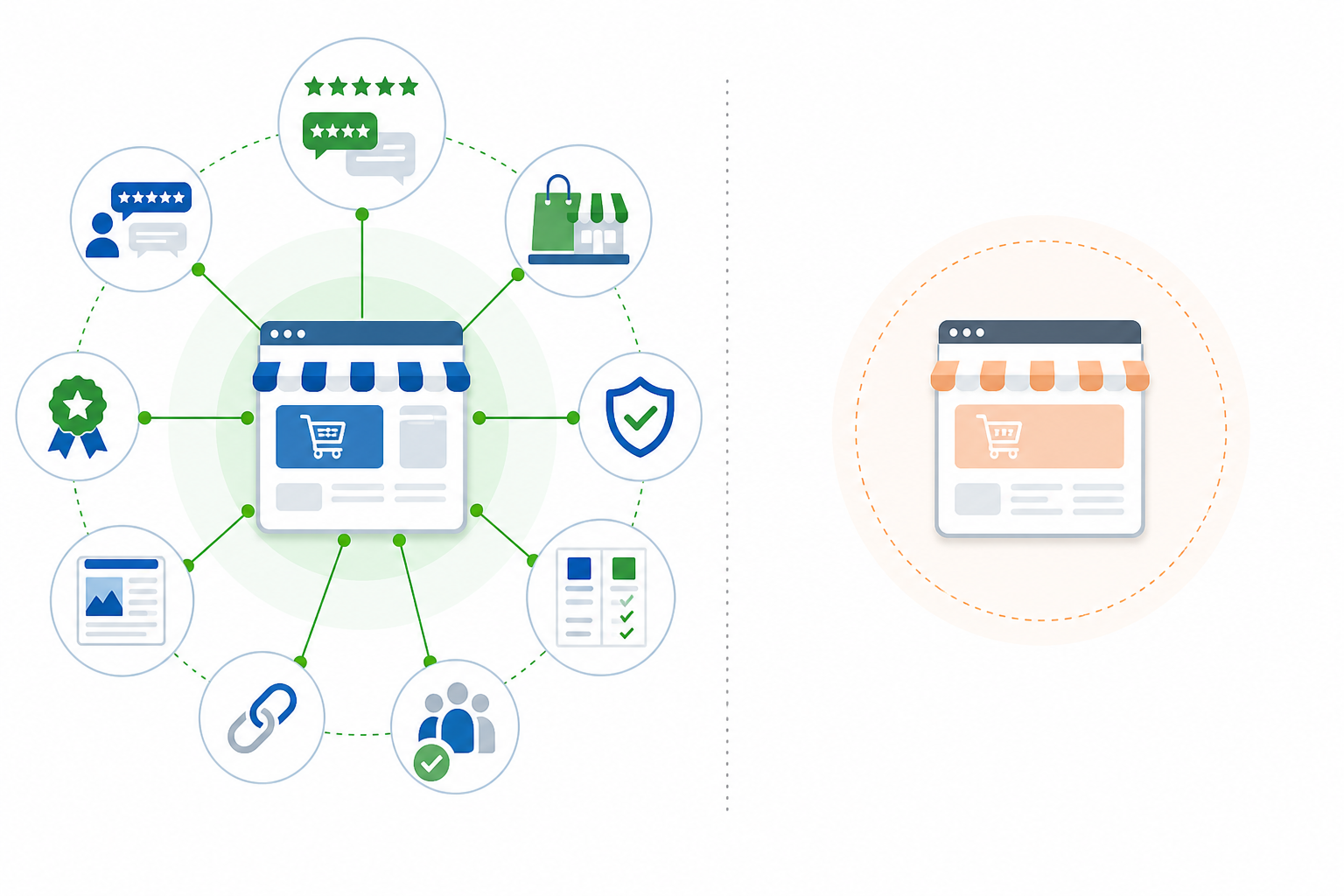
A concrete illustration: a UK outdoor retailer selling a generically titled "Men's Jacket" with no hydrostatic-head rating, no fit guidance, and inconsistent stock markup is easy for an AI system to pass over in favour of a competitor whose page explicitly states "3-layer waterproof shell, 20,000mm hydrostatic head, size-level UK stock, dispatched same day." The second brand isn't necessarily better—it's simply easier to verify and cite.
How to Audit Your AI Shopping Visibility Today
You don't need specialist tooling for a directionally useful read on where you stand, but I want to be realistic about what "quick" means here: a careful version of this, covering multiple queries across several platforms plus a technical check of three pages, realistically takes 60–90 minutes rather than 45. Treat the results as a snapshot, not a permanent verdict—re-run it periodically, since AI answers drift.
- Build a fixed prompt set of 5–10 buying-intent questions a real customer would ask in your category (e.g. "best running shoes for flat feet UK"), and write them down so you can repeat the exact same wording later.
- Run each prompt against ChatGPT, Claude, Gemini, Perplexity, and Copilot, noting that these platforms don't offer comparable shopping retrieval—some have live browsing or shopping features enabled by default, others don't, and citation behaviour differs meaningfully between them. Record which mode or feature set was active for each test.
- For each result, log: whether your brand appears, in what position, whether the citation is accurate on price and stock, and the date and country setting used—since UK results can differ from US ones.
- Separately run comparison-style prompts naming two or three competitors directly ("compare Brand A and Brand B for X"), rather than substituting names into the same generic question, since that produces more natural and comparable results.
- Check technical legibility on your three highest-traffic product pages: structured data present, pricing in plain visible text, key specs rendered without depending solely on JavaScript.
- Search your brand name alongside "reviews" or "vs" on Google to see what independent third-party content currently exists for AI systems to potentially draw on.
- Calculate a simple citation rate—the percentage of your prompt set where you appeared, accurately, across your tested platforms—rather than relying on an arbitrary pass/fail threshold. A citation rate under roughly 30–40% across a reasonably sized prompt set is a heuristic worth treating as a warning sign, not a diagnosis; the right threshold depends on your category and competitive density.
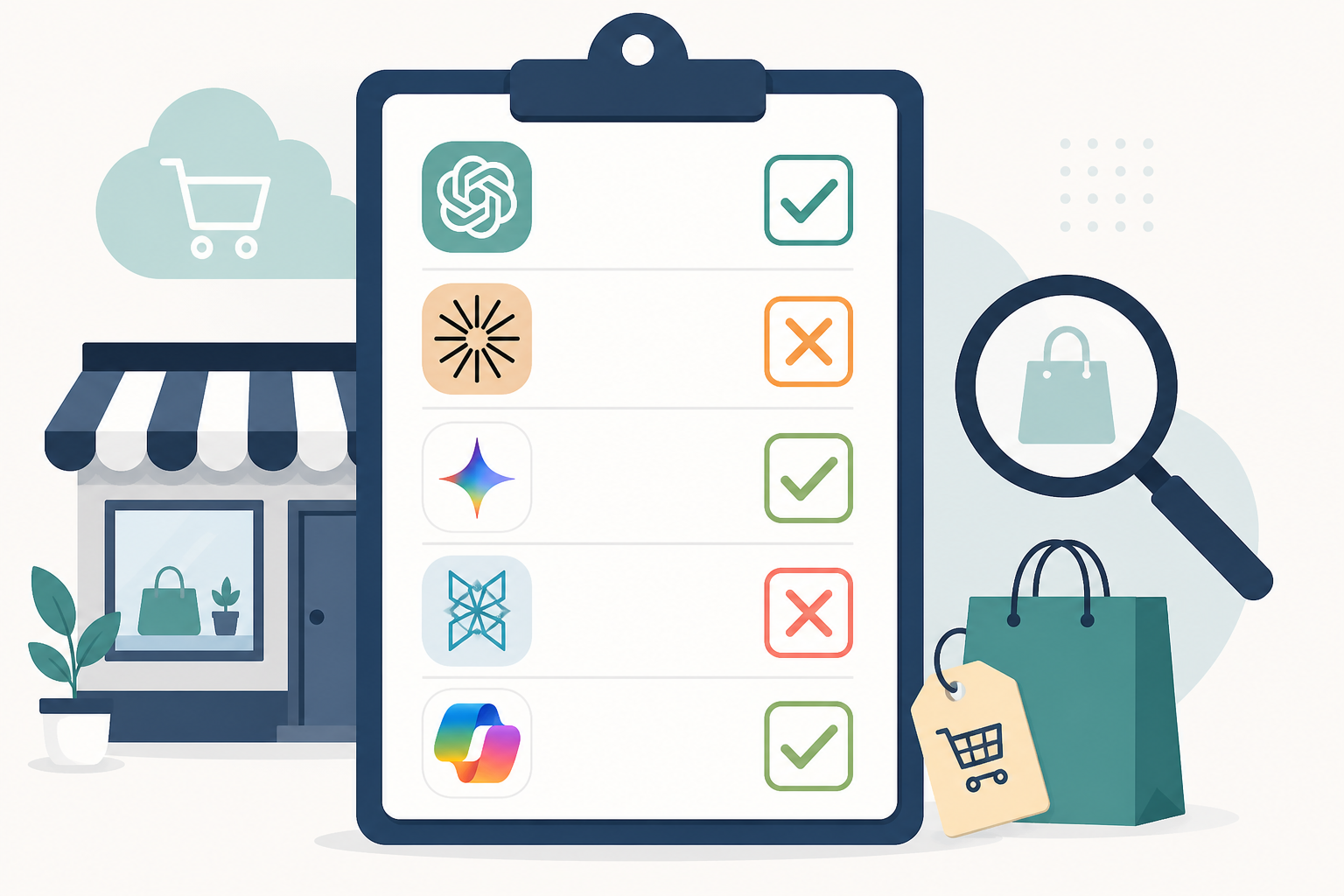
This manual version is genuinely useful for a one-off check, but it doesn't scale well—queries drift, answers change week to week, and repeating this by hand across five platforms isn't sustainable for most small teams. That's the specific gap tools like MentionOwl are built to close, by auto-generating relevant customer questions and running them against major engines on a recurring basis so you can see drift over time rather than relying on a single snapshot.
Fixing the Gaps That Keep Your Store Out of AI Shortlists
Once you know where the gaps are, prioritise by what you can control directly versus what depends on someone else's decision.
Highest control, fastest to action:
- Rewrite your highest-traffic product pages with explicit specifications, pricing, and stock status in plain visible text—not locked inside images or PDFs.
- Add or correct schema markup (Product, Offer, Review) so structured data is unambiguous for crawlers, and check Merchant Center feed diagnostics for disapprovals if you use Google Shopping surfaces.
- Remove rendering and access barriers: audit robots.txt, test what a non-JavaScript crawl actually sees, and check cookie/consent walls aren't hiding key product details.
Lower control, higher long-term value:
- Pursue genuine third-party coverage: reach out to independent comparison sites and reviewers, and make it easy for real customers to leave honest reviews. Avoid incentivised or fabricated reviews, which risk breaching platform policies and UK guidance on misleading reviews.
- Strengthen and keep consistent your marketplace listings, treating them as a complement to your own site's data rather than a replacement for it.
Ongoing measurement:
- Re-run your prompt set on a regular cadence to catch citation drift or inaccurate pricing before it costs you sales.
- Track which competitor pages or mentions are winning citations against you, and use that to prioritise what to fix next.
On timeline, I'd frame these as planning ranges rather than guarantees, since crawl frequency, feed eligibility, and each platform's own update cycle all affect the outcome: technical legibility fixes often show measurable movement within 4–8 weeks as pages get re-crawled and re-indexed, while citation and share-of-voice gains from third-party content typically take longer—often 2–4 months—since they depend on external publishers acting, which is outside your direct control but can be encouraged through genuine, policy-compliant outreach.
Frequently Asked Questions About AI Search and E-Commerce
How do I know if AI recommends my competitors instead of me?
Run a fixed set of buying-intent questions across ChatGPT, Gemini, Claude, Perplexity, and Copilot, noting that these platforms differ in browsing access and citation behaviour, so results won't be perfectly comparable across them. Track who gets named, in what position, and whether the information is accurate. A single check gives you a snapshot; the real value comes from repeating it over time, since AI answers change as platforms update and re-crawl the web.
What makes a product page more citable by AI?
Clear, text-based specifications, pricing, and stock information; correct structured data; rendering that doesn't hide key details behind JavaScript alone; and genuine third-party validation through independent reviews or comparison content. None of these guarantee inclusion in any specific AI answer, but their absence makes a page measurably harder for a retrieval system to trust and cite.
Does marketplace presence affect AI recommendations?
Often, yes, though it varies by platform and category. Several AI systems appear to treat established marketplaces like Amazon or eBay as a useful secondary source because they aggregate structured product and review data. Treat a strong marketplace listing as reinforcement for your own site's evidence, not a substitute for a reliable first-party product feed.
How quickly can I fix exclusion issues, and can it be guaranteed?
It can't be guaranteed, since AI platforms control their own crawling, indexing, and answer-generation processes. Technical legibility fixes—schema markup, clearer product copy, removing crawl barriers—tend to show measurable improvement within 4–8 weeks as pages are re-crawled. Citation gains from third-party content typically take 2–4 months, since they depend on external publishers, though structured, policy-compliant outreach can shorten that timeline.