10 Questions Customers Ask AI Before They Buy From You (and How to Track Them)
Explore 10 questions customers ask AI before buying, from best options and comparisons to pricing and fit, and learn how to track them consistently.

This guide, 10 Questions Customers Ask AI Before They Buy From You, groups the questions into ten repeatable patterns. Customers rarely ask an AI assistant about your brand by name. They ask category-level questions: who is the best option, how two suppliers compare, what the alternatives are, what something costs and whether it suits their situation. If you turn these patterns into a fixed tracking set and run them consistently, you can estimate whether ChatGPT, Gemini, Perplexity and other AI assistants recommend you, and see where competitors appear instead. This guide walks through each pattern with examples you can adapt, then sets out a method for tracking AI visibility, including a worked example of scoring a single answer.
Why customer questions matter more than keywords in AI search
For two decades, buying research meant typing a short phrase such as 'plumber Leeds' into Google and scanning ten blue links. Now the same buyer often opens ChatGPT, Gemini, Copilot, Claude or Perplexity and writes a full sentence with context: 'I need a boiler service in Leeds this week, who is reliable and not extortionate?' Google's documentation on AI features and your website describes AI search as supporting longer, more specific questions. Buyers can ask an assistant to compare options, explain trade-offs or recommend a supplier, and a list of keyword rankings may not capture any of that.
The adoption evidence points in one direction, but two caveats come first. Most published figures are US or global rather than UK-specific, and I did not find a directly comparable UK dataset for these measures. The numbers also move quickly, so treat everything below as a dated snapshot and check the original source before quoting it.
- Capgemini Research Institute (2024): 58% of surveyed consumers said they had replaced traditional search engines with generative AI tools for product or service recommendations, up from 25% in 2023. This is a global consumer survey, not a universal adoption rate. (Capgemini research library)
- Adobe Analytics (2024 holiday season): traffic to US retail sites from generative AI sources grew 1,300% compared with the 2023 holiday season. This measures referred traffic from a small base, not the share of all purchases. (Adobe announcement)
- Google (2025): the company reported that AI Overviews reached more than 1.5 billion monthly users across over 200 countries and territories. This is a company-reported figure for one product. (Google Search Central)
- Pew Research Center (browsing data collected March 2025, published July 2025): among US adults who use Google, people clicked a traditional result on 8% of visits when an AI summary appeared, against 15% when one did not. They clicked a link inside the summary on about 1% of visits. This does not prove the summaries caused every difference, but it shows why being in the answer matters. (Pew Research Center)
- Gartner (2024 forecast): traditional search engine volume would fall 25% by 2026. This is a projection, not a measurement. (Gartner press release)
The structure of the answer matters as much as the adoption data. An AI answer often names only a handful of businesses, typically two to five. That makes a recommendation closer to a shortlist than a page of results, and if you are left off it, you can lose the enquiry before you know it existed.
I call the measurable outcome AI visibility. It comes down to four plain questions: are you mentioned, are you cited with a source link, are you recommended, and in what position? Google also advises applying ordinary Search fundamentals (crawlability, helpful content and accurate structured data) rather than hunting for special AI markup. I keep coming back to that advice throughout this guide.
There is one limitation I want to state plainly. Search Console does not reveal the exact prompts people type into AI features, and no platform publishes complete prompt data. Prompt monitoring is therefore a directional sample, not a full record of demand. That is the case for a consistent, repeatable question set: it gives you comparable observations over time, even though it cannot show everything buyers ask.
Best-of and top-pick AI questions (Questions 1-3)
These are high-intent questions, and being absent from the answer can cost you real enquiries. Capgemini's research and tools such as Amazon's Rufus shopping assistant show customers using conversational AI for 'best for me' and 'how does it compare' queries. For each pattern below I give a local trades example and an online service example so you can see how to translate it.
Question 1: The local best-of query
Pattern: 'Who is the best [service] in [UK town or city]?'
- Trades: 'Who is the best electrician in Bristol for a rewire?'
- Online service: 'Who is the best bookkeeper for sole traders in Manchester?' (even remote firms get geography-tagged questions)
Geography modifiers matter a great deal for small businesses. Clear local evidence may give you a relevance edge over a national provider in a specific town, though nothing guarantees it. You can maintain service-area pages, current reviews and accurate directory listings.
Question 2: The qualified best-of query
Pattern: 'What is the best [product] for [specific need] under £[budget]?'
- Trades: 'What is the best loft conversion company for a terraced house under £50,000?'
- Online service: 'What is the best email marketing tool for a small shop under £30 a month?'
The qualifiers narrow the shortlist. A business that states its niche and price band explicitly gives an assistant something concrete to match against, which is likely to help.
Question 3: The trust-seeking query
Pattern: 'Which [business type] near me has the best reviews and is actually reliable?'
- Trades: 'Which roofer near me has good reviews and actually turns up?'
- Online service: 'Which website designer has genuine reviews and a good track record with small businesses?'
What AI assistants use to answer best-of questions
Assistants tend to blend reviews, directories, your own site content and third-party citations. As a result, ChatGPT citations often come from sources you do not control: a trade directory, a local press roundup or a review platform may be quoted in preference to your homepage. If you record the exact prompt, platform, date and cited sources, then repeat the check, you will see which sources appear most often in answers about your category. That points to influence, but it does not prove those sources caused the recommendation, because the models do not disclose their full reasoning.
Comparison and alternative AI questions (Questions 4-6)
Here buyers already have a candidate and are stress-testing it. This is where competitor tracking becomes essential, because the AI is naming your rivals in the same breath as you, or instead of you.
Question 4: The head-to-head comparison
Pattern: '[Your brand] vs [Competitor]: which is better for a small business?'
- Trades: 'Smith Heating vs Greenway Boilers: which is better for a landlord?'
- Online service: 'Xero vs FreeAgent: which is better for a small business?'
Question 5: The alternatives query
Pattern: 'What are good alternatives to [Competitor]?'
You want to appear as the alternative. If a well-known rival dominates your market, this is often a practical route onto the shortlist, so check it for every major competitor, not only the biggest.
Question 6: The switching query
Pattern: 'Is it worth switching from [Competitor] to something else?'
This signals dissatisfaction and high purchase readiness. The assistant's answer shows which pain points it associates with your rival, and that tells you something about how to position yourself.
How to track AI share of voice and sentiment
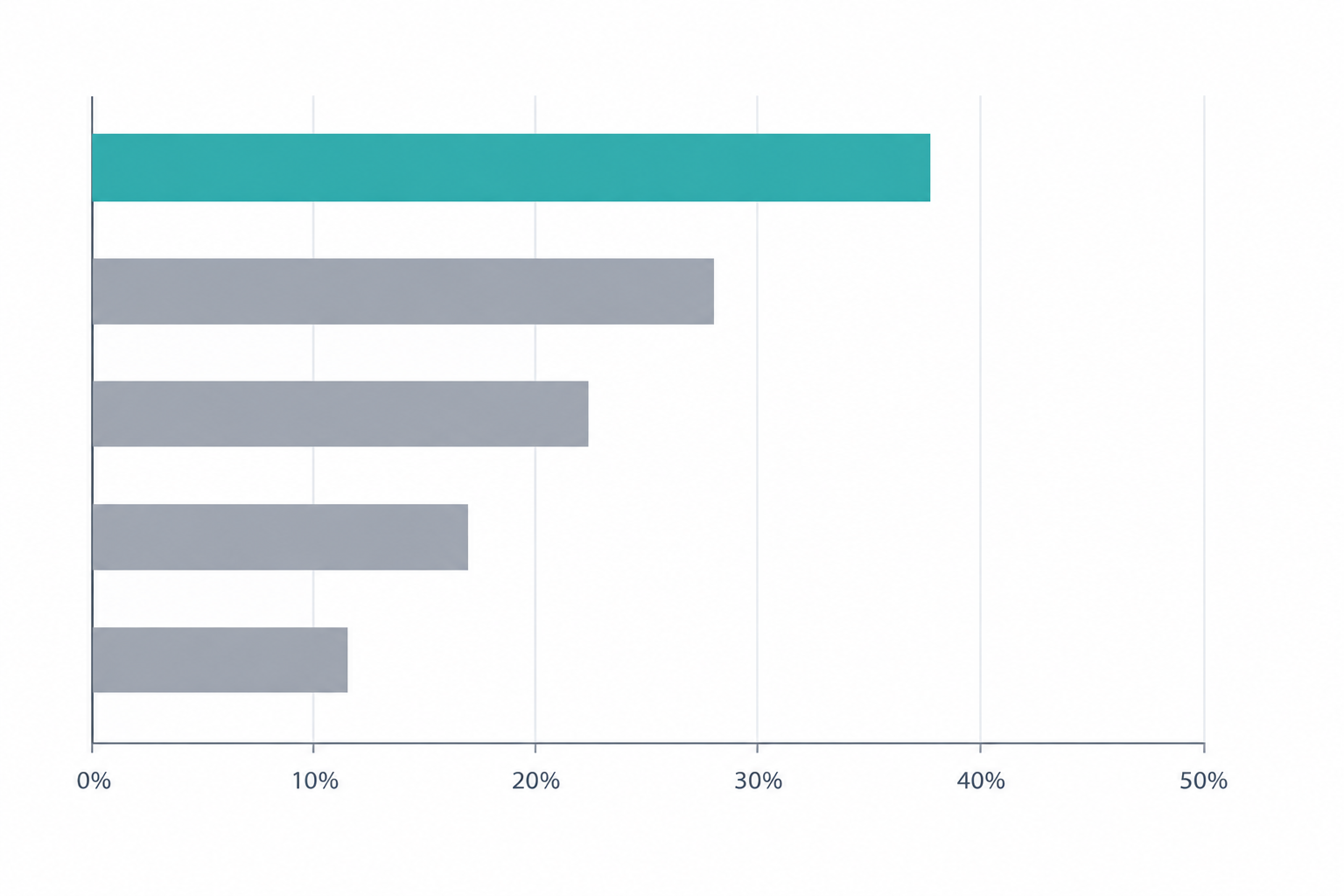
Across a fixed set of questions, share of voice is the proportion of answers in which you appear, compared with competitors. If you are named in 12 of 50 answers and your nearest rival in 31, that gap is a concrete number you can trend, not a hunch. Presence alone is not enough, though. A mention framed as 'cheaper but less reliable' is not a win, so sentiment (whether the answer describes you positively, neutrally or negatively) deserves equal weight in your analysis.
Pricing and value questions customers ask AI (Questions 7-8)
Price questions arrive late in the journey, and an inaccurate answer can lose a sale you never knew existed.
Question 7: The cost query
Pattern: 'How much does [service] cost in the UK?' or 'What is a fair price for [product]?'
- Trades: 'How much does a new combi boiler installation cost in the UK?'
- Online service: 'How much does a small-business website cost in the UK?'
Question 8: The value query
Pattern: 'Is [Your brand] worth the money?' or 'What is the cheapest reputable [provider]?'
How to prevent outdated or invented AI pricing
AI answers can repeat stale prices or fill gaps with plausible guesses. The practical fix is a clear, crawlable pricing page.
The evidence on buyer behaviour shows why price clarity matters. In the Baymard Institute's checkout research, 48% of US online shoppers who abandoned a cart cited extra costs such as shipping, taxes or fees, and 22% said they could not see or calculate the total cost upfront. Adobe's 2024 holiday survey, also US-based, reported that 39% of consumers had used generative AI for online shopping.
Make the total easy to verify. State the price, what is included, any required fees, renewal terms and any conditions that change the total.
What AI legibility means for your website
AI legibility is my shorthand for how easily a language model can read and quote your pages accurately. It depends on clear headings, text that is accessible rather than locked in images or scripts, and accurate structured data where appropriate. A technical audit can surface blockers such as content rendered only by JavaScript or crawlers blocked in robots.txt. MentionOwl's AI legibility audit runs 16 technical checks for this purpose, and you can run many of the same checks manually.
AI pricing page example: before and after
Before (vague): 'Affordable packages tailored to your needs. Contact us for a bespoke quote.'
After (explicit): 'Boiler servicing: £85 for a standard gas boiler, including safety check and written report. Annual cover from £14 a month. Call-out outside Leeds postcodes LS1-LS17 carries a £25 surcharge. Prices include VAT and were last updated 1 March.'
The second version gives an assistant something specific, dated and quotable. The first gives it nothing, so the assistant may borrow a figure from somewhere else.
Use-case and fit questions customers ask AI (Questions 9-10)
Fit questions expose gaps in your content. If an AI cannot confirm that you serve a niche, it is more likely to recommend someone who clearly states that they do.
Question 9: The scenario query
Pattern: 'What should a [type of customer] use for [specific job]?'
- Trades: 'What should a landlord use for annual gas safety certificates across five flats?'
- Online service: 'What should a freelance photographer use for invoicing and tax?'
Question 10: The suitability query
Pattern: 'Is [Your brand] suitable for [size, sector or requirement]?' or 'Does [Your brand] offer [feature or service]?'
How to measure soft mentions and position-weighted citations
Appearances differ in value. A soft mention means you are named in passing, perhaps in a longer list. A position-weighted citation means you are named high in the answer, ideally first, with a source link, so its value reflects where you appear. I track both. Soft mentions suggest you are within the consideration set, while a first-position cited recommendation is more likely to drive a visit, and watching both stops you overlooking slow progress.
How to write website pages that answer AI fit questions
For generative engine optimization, my advice is to state things directly. Create pages that say who you serve, which sectors, what sizes, which features and which areas, and support each claim with evidence. Avoid unsupported 'best' language, and explain suitability by need, budget and use case instead. This is ordinary helpful-content practice, applied with AI answers in mind.
10 Questions Customers Ask AI Before They Buy From You: the patterns at a glance
Use this as a quick-reference template and swap in your own services, locations and competitors.
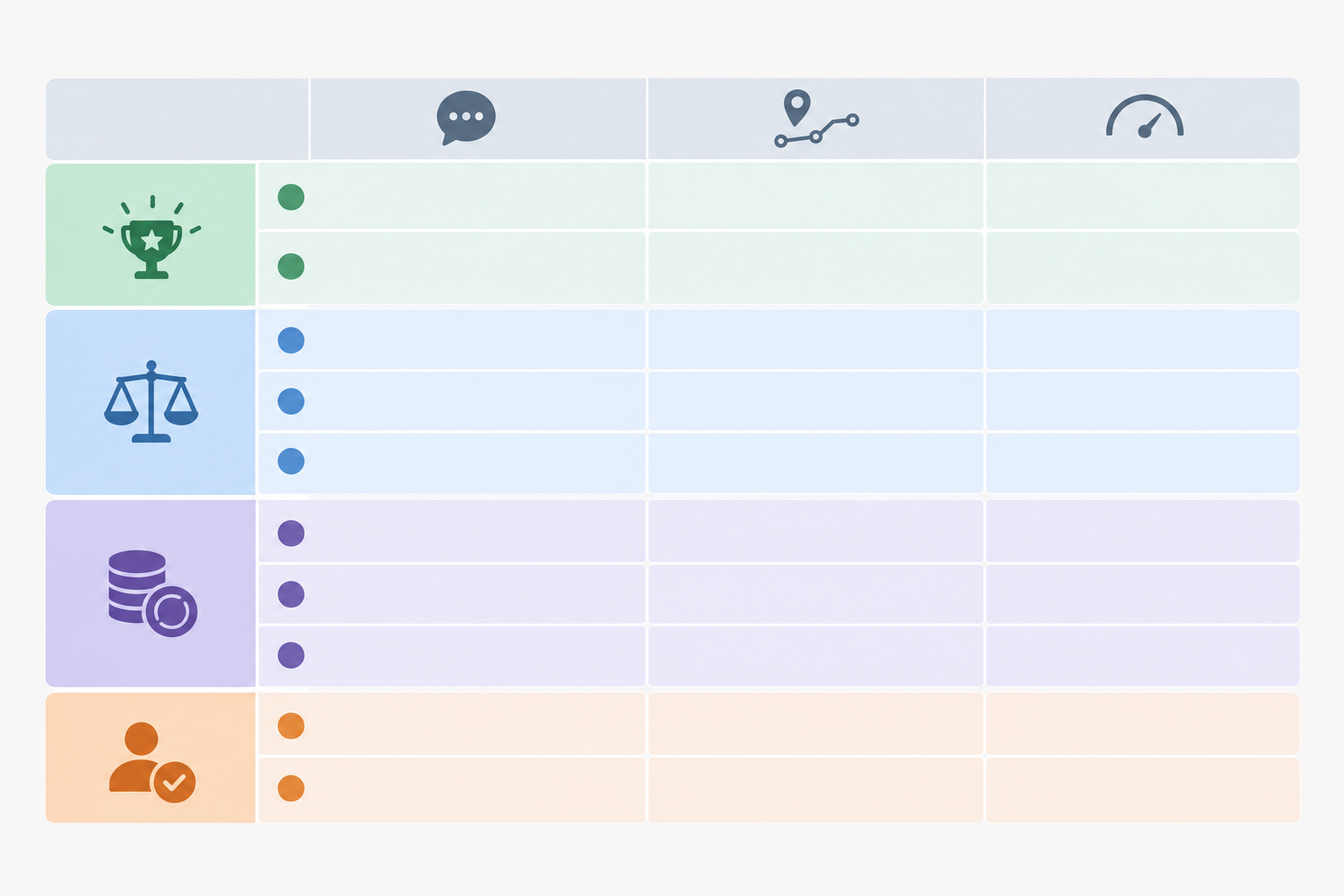
| # | Pattern | Intent stage | Example phrasing | What AI needs from you | Metric to watch |
|---|---|---|---|---|---|
| 1 | Local best-of | Discovery | Best [service] in [city] | Location pages, local reviews, directory listings | Query coverage |
| 2 | Qualified best-of | Consideration | Best [product] for [need] under £[budget] | Stated niche, price band, specifications | Position-weighted citations |
| 3 | Trust-seeking | Consideration | Which [business] near me is reliable? | Recent reviews, accreditations | Sentiment |
| 4 | Head-to-head | Evaluation | [You] vs [Competitor] | Comparison page, clear differentiators | Share of voice |
| 5 | Alternatives | Discovery | Alternatives to [Competitor] | Positioning against known rivals | Share of voice |
| 6 | Switching | Evaluation | Worth switching from [Competitor]? | Migration info, honest trade-offs | Sentiment |
| 7 | Cost | Decision | How much does [service] cost in the UK? | Explicit, dated pricing page | Accuracy of price |
| 8 | Value | Decision | Is [You] worth the money? | Outcomes, inclusions, guarantees | Sentiment |
| 9 | Scenario | Consideration | What should a [customer] use for [job]? | Use-case pages and examples | Soft mentions |
| 10 | Suitability | Decision | Does [You] offer [feature]? | Direct statements of who and what you serve | Mention accuracy |
How to turn the 10 question patterns into an AI tracking set
A single manual check is anecdotal. A fixed set, run under consistent conditions, is evidence, although AI answers vary enough that you should still treat it as a sample rather than a ranking. This is the method I recommend.
- Map each pattern to your business. Combine every pattern with your services, locations and named competitors to produce a first draft of 20 to 50 concrete questions. If you serve both local and national customers, keep those prompts in separate groups.
- Mix branded and unbranded questions. Branded questions ('Is [your business] any good?') test accuracy and sentiment. Unbranded ones ('best [service] in [city]') test discovery, and they usually reveal the bigger opportunity because that is where new customers first meet your competitors.
- Use real phrasing, not guesses. Mine customer emails, sales calls, reviews, Search Console queries and People Also Ask suggestions.
- Fix the wording and the conditions. Keep each prompt word-for-word identical between runs. Note the location setting you use (for example, a UK location or a UK-based device) and whether you are logged in, because personalisation and memory features can change answers. Where possible, use a fresh session or a temporary chat for each run, and write down the conditions if you cannot.
- Run each question across several engines and several times. ChatGPT, Gemini, Claude, Copilot and Perplexity often give different answers to the same prompt, and the same engine can vary between runs. As a starting point, I suggest running each prompt at least three to five times per engine per review period and reporting the proportion of runs in which you appear, not a single result.
- Record the model and the date. Platforms update their models without notice, and a change in results may reflect that and not anything you did. Log the platform and model or version where it is shown, and annotate your records when you change your own site.
- Record the evidence in a consistent log, then roll it into a score you can trend. The log below is one workable template.
| Field | Example entry |
|---|---|
| Prompt | Who is the best electrician in Bristol for a rewire? |
| Pattern number | 1 |
| Date and run number | 12 May, run 2 of 5 |
| Platform and model/version | ChatGPT, model as displayed |
| Location and session conditions | UK location, logged out, fresh chat |
| Businesses named (in order) | Rival A, Your Business, Rival B |
| Your position | 2 |
| Cited sources | Trade directory, review platform |
| Sentiment toward you | Positive: 'well reviewed for rewires' |
| Factual errors | None |
These controls reduce noise but do not remove it. Compare trends over weeks, not individual answers, and be wary of reading much into small changes.
Worked example: scoring one AI answer
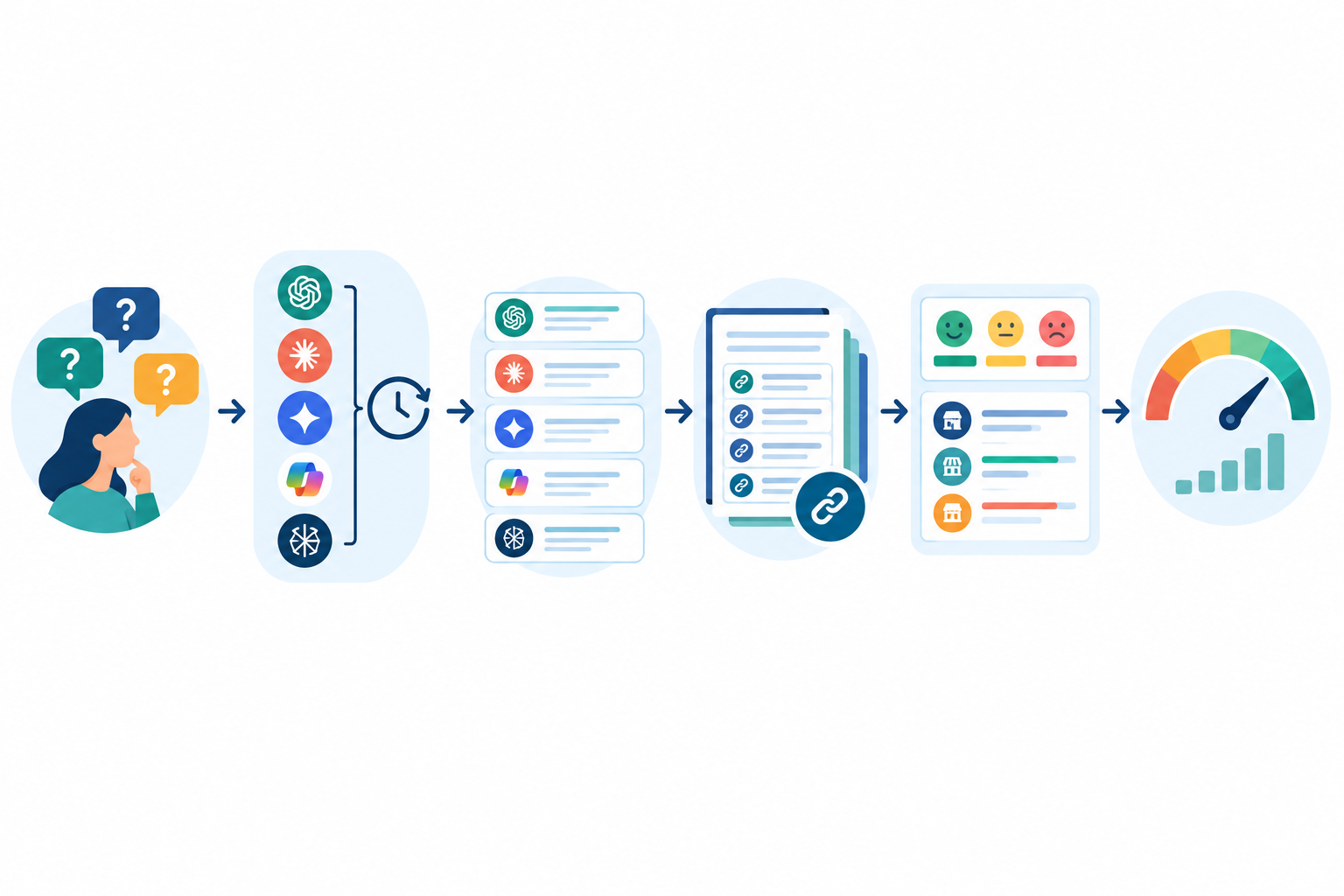
Here is a hypothetical illustration, using invented numbers, of how I would score one prompt: 'Who is the best electrician in Bristol for a rewire?' Suppose I run it five times on one platform under the same conditions.
- Mention rate: your business is named in 3 of 5 runs, or 60%.
- Position: when named, you appear first once, second once and fourth once.
- Citation: your own website is cited in 1 of the 3 mentions, and the others cite a directory.
- Sentiment: two mentions are positive and one is neutral.
- Competitors: Rival A appears in 5 of 5 runs, so its share of voice on this prompt is higher than yours.
The finding is specific and usable. You are visible but usually not first, and a directory is doing the citing for you. The next step is to check that your directory listing is accurate and that your own rewire page states your service area and pricing clearly. Repeat the same prompts a few weeks later and compare the proportions, with the model and date noted.
Automating AI question tracking: a product example
Doing this by hand is feasible for a week and tedious after that. I should be open that MentionOwl is the product my team built, so read this section as a description of one tool, not independent guidance. The method above works with a spreadsheet.
MentionOwl crawls your website, auto-generates candidate customer questions, and runs them daily across ChatGPT, Claude, Gemini, Copilot and Perplexity. It records answers, citations, sentiment and competitor mentions. It also offers weekly digests and cookieless AI traffic analytics, meaning estimates of visits arriving from AI assistants that do not rely on cookies to identify visitors.
It produces a proprietary visibility score from 0 to 100, built from four inputs: query coverage (how many of your tracked questions mention you), position-weighted citations, share of voice and soft mentions. The weighting is proprietary and is not an industry standard, so use the score as a directional measure of your own trend over time, not as a benchmark against other tools. The underlying counts (mention rate, position, share of voice, sentiment) are more transparent, and they are what I would check before drawing conclusions.
What to do after tracking your AI visibility
- Prioritise gaps where competitors are named and you are not, starting with the highest-intent best-of and alternatives patterns.
- Fix factual errors by updating pricing, service area and feature pages, then re-test to see whether the assistants reflect the changes. Allow time, because some systems update slowly.
- Strengthen the third-party sources that AI cites about your category, such as directories, review sites and industry publications.
- Run an AI legibility audit to remove technical blockers before you invest in more content.
- Review monthly, and track mention rate and share of voice rather than individual answers. Results move gradually, and no one can guarantee a particular recommendation.
Frequently asked questions about customer questions in AI
How do I find out what customers ask AI?
No platform publishes complete prompt data, so you have to triangulate. Start with the phrasing in your customer emails, sales calls, reviews and support tickets. Add Google Search Console queries and People Also Ask suggestions, then ask the AI assistants themselves for typical questions in your category. A tool such as MentionOwl can auto-generate questions from your website, but any list you build is a sample of likely questions, not a record of what customers actually typed.
Should I track branded and unbranded AI questions?
Yes, and for different reasons. Branded questions such as 'Is [your business] any good?' test accuracy and sentiment, while unbranded questions such as 'best [service] in [city]' test whether you are discovered at all. Most small businesses find the unbranded set more revealing, because that is where new customers meet your competitors first.
How many AI questions are enough to track?
A sensible starting point is 20 to 50 questions covering all ten patterns, your main services and your key locations. Fewer than that gives noisy results, since AI answers vary from run to run. You can add more later once you know which patterns matter most for your business.
Should I track local and national AI questions separately?
I would, if you serve both. A local question such as 'best electrician in Bristol' and a national one such as 'best electrician for rewires' can return very different shortlists, and a combined score would blur that difference. Keep separate groups, report each on its own, and use the same location settings for every run in a group.
Key takeaways: track the questions customers ask AI before they buy
Buyers ask AI assistants questions that fall into ten recognisable patterns: best-of, comparison, alternatives, pricing and fit. Turn those patterns into a fixed question set, run it repeatedly under documented conditions, and you get a defensible view of where you appear and where competitors do. Start with a spreadsheet and the log template above, fix factual gaps on your own pages, and review trends monthly. If the manual routine becomes too heavy, a tool such as MentionOwl can automate it, and it offers a $1 seven-day trial if you want to see your baseline.