How to Build a Content Strategy That Earns AI Citations: A Question-First Guide
Build a content strategy for AI citations: start with buyer questions, create answer-first pages with credible proof, and track queries to refine what AI engines cite.

How to Build a Content Strategy for AI Citations: A Question-First Guide
A content strategy for AI citations begins with the real questions buyers put to AI assistants. Each question maps to a page that opens with a direct, verifiable answer, backed by comparison and proof content that you keep current. I treat the whole programme as a measurement loop: publish, track the same questions on a fixed protocol across engines, and revise based on what is actually cited rather than what you assume will be.
The rest of this guide covers how to do that in practice, with the evidence that exists and some candour about where that evidence is thin. It is written for SaaS and DTC teams, particularly in the UK, who want to be named when someone asks an AI assistant which product to buy. Throughout, I separate findings (what a named source measured) from working hypotheses (what I recommend testing), because the two get blurred constantly in this field.
Why AI citations matter alongside search rankings 📊
Classic search presented ten blue links and let the reader decide. AI search increasingly presents a synthesised answer in which a handful of sources are named and the rest are effectively invisible. Google's documentation on AI features confirms that these features can show links to supporting pages, and it treats them as part of Search rather than as a separate system. Rankings and citations are different measures, and I would report both.
The click data shows what this costs. In July 2025, Pew Research Center reported, from browsing data of US adults, that users clicked a traditional result on 8% of visits when a Google AI summary appeared, against 15% when it did not. They clicked a link inside the summary on only about 1% of visits. Ahrefs reported a 34.5% lower average click-through rate for the first-ranking page when an AI Overview was present, based on its own keyword dataset. Both are observational and drawn largely from US or global data, so I would not assume the same magnitudes hold for UK queries, where AI feature availability and presentation differ. They do point the same way, though: being mentioned and being clicked are distinct outcomes, and you need to measure each.
AI citation, recommendation and soft mention
People use these three terms interchangeably, yet each calls for a slightly different content response. The mapping below is my working framework, not an established standard:
- Citation: your page is linked as a source. This is most likely when pages give clear, extractable, verifiable answers.
- Recommendation: your brand is named in the answer as a suggested option. Comparison content, proof points and third-party coverage are the natural levers.
- Soft mention: your brand is referenced without a link. This may mean the engine knows you exist but draws on other sources for facts about you, which points towards external coverage and entity clarity.
How GEO and AI SEO build on existing practice
Generative engine optimization (GEO) and AI SEO extend existing content discipline rather than replacing it. Google states that standard Search fundamentals apply to its AI features and that no special markup is required. Practitioners claim the emphasis shifts towards extractable passages, unambiguous entities and third-party corroboration. I treat that as a working hypothesis to test against your own tracked data, since I know of no study that isolates each factor across engines.
The most-cited academic study is Aggarwal et al., GEO: Generative Engine Optimization (KDD 2024). It tested a benchmark of 10,000 queries across multiple domains and reported visibility gains of up to roughly 40% for methods such as adding citations, quotations and statistics. That figure is a maximum across tested methods in a research benchmark, not a promised lift, and results varied by method and domain. It shows that attributable facts helped in that setting. It does not prove what any live engine will do for your site.
Building a content strategy for AI citations in the UK
Availability and presentation of AI features vary by country, language and query, so evaluate results in your actual market. For UK buyers, British spelling, prices in pounds sterling including VAT where relevant, UK retailers, delivery terms and regulation plausibly shape which sources are surfaced. A page quoting US dollar pricing and US shipping is, at minimum, a weaker answer to a UK-phrased question.
Start with the questions buyers ask AI
Every decision in this programme flows from the question set, so I would begin here rather than with a content calendar.
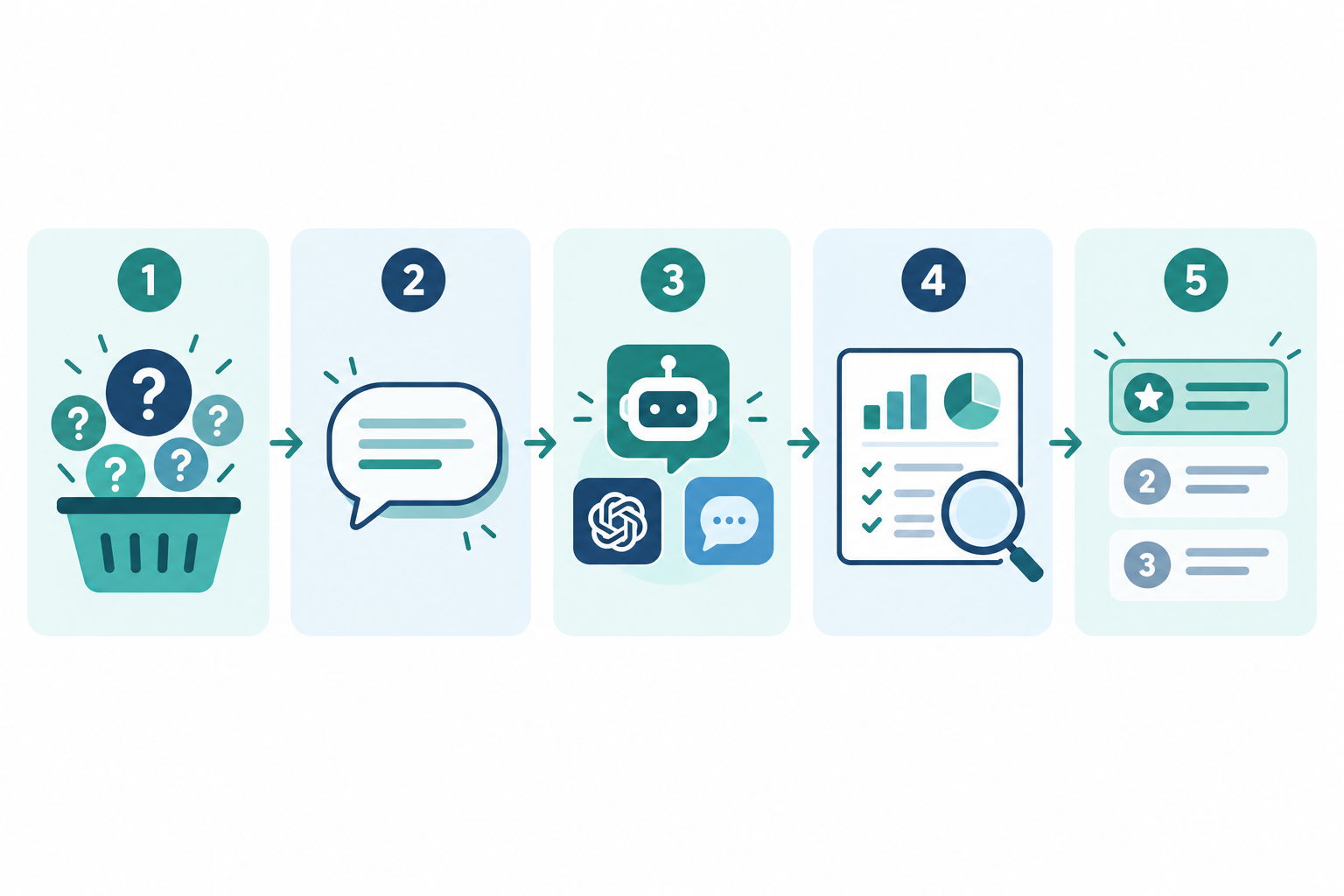
- Harvest questions from where buyers already speak. Use your own site search, sales calls, support tickets, reviews and community threads, then group them by buying stage: problem-aware, solution-aware, comparison and purchase.
- Rewrite them in conversational phrasing. People type long, specific prompts, such as 'best project management tool for a ten-person UK agency', not two-word keywords, and your tracked questions should look like that.
- Run them against several engines and record the baseline using the protocol below. Note who is cited, in what position and with what sentiment before you change anything. Without a baseline, you cannot attribute later movement.
- Score each question twice. Rate commercial value (how close to purchase) and citation gap (how often competitors appear and you do not). The highest combined scores are your priorities.
- Start with 20 to 30 questions, not hundreds. Effort concentrated where purchase decisions are made will teach you more than a sprawling set you cannot act on.
A worked example makes this concrete. Suppose a UK accounting-software company hears on sales calls: 'Which bookkeeping software works with Making Tax Digital for a sole trader?' That is a solution-aware question with high commercial value. If three competitors are cited and you are not, the citation gap is high, so it goes to the top of the list. The target page would open with a two-sentence answer naming the product, its MTD compatibility, the price in pounds and the date it was last checked.
A reproducible protocol for tracking AI citations
AI answers are probabilistic and change with model versions, location, account state and prompt wording, so an unstructured spot-check tells you very little. To make comparisons meaningful, I recommend fixing the following and writing it all down:
- Prompt wording: freeze the exact text of each question. If you test variants, track them as separate questions rather than editing the original.
- Market and location: run from a UK location with UK language settings, and note whether results come from a logged-out session or a personalised account. Keep that choice constant.
- Engine and version: record the product and, where the interface discloses it, the model version and whether web search or browsing was enabled.
- Repeat runs: run each question several times per collection period, since a single answer may not be representative.
- Collection frequency: daily collection is good for spotting changes, but daily results are noisy. Aggregate them into weekly figures (for example, the share of runs in which you are cited) before judging whether anything has moved.
- Variability log: record changes in the engine or interface as they happen, so a shift in results is not wrongly credited to a content edit.
A spreadsheet is enough for this. If you prefer automation, tools exist that run question sets on a schedule and log answers and citations. I work on one of them, MentionOwl, and I say so up front so you can weigh my view accordingly. The principle is the same either way: fix the question set, then measure it repeatedly under constant conditions.
What content do AI engines cite most?
The honest answer is that it depends on the engine and the query category, and no single public dataset settles it. I would therefore treat the following as content types worth testing against your own tracked data, not as settled rules:
- Answer-led explainers and definitions that resolve a single question cleanly. They are easy to lift as a passage.
- Comparison and 'best for' pages with explicit criteria. They mirror the shape of purchase-decision queries, which is why I expect them to matter for commercial visibility.
- Original data, benchmarks and survey findings that other sources reference. These can make you a primary rather than a secondary source. The GEO research supports the narrower point that attributable statistics and named sources improved visibility in its benchmark.
- Documentation, pricing and specification pages that state facts plainly. For SaaS in particular, a clear pricing page is the natural answer to a 'how much does X cost' question.
- Third-party corroboration such as reviews, directories, forums and press. Engines can cite these alongside or instead of brand-owned pages, so your own site is only part of the picture.
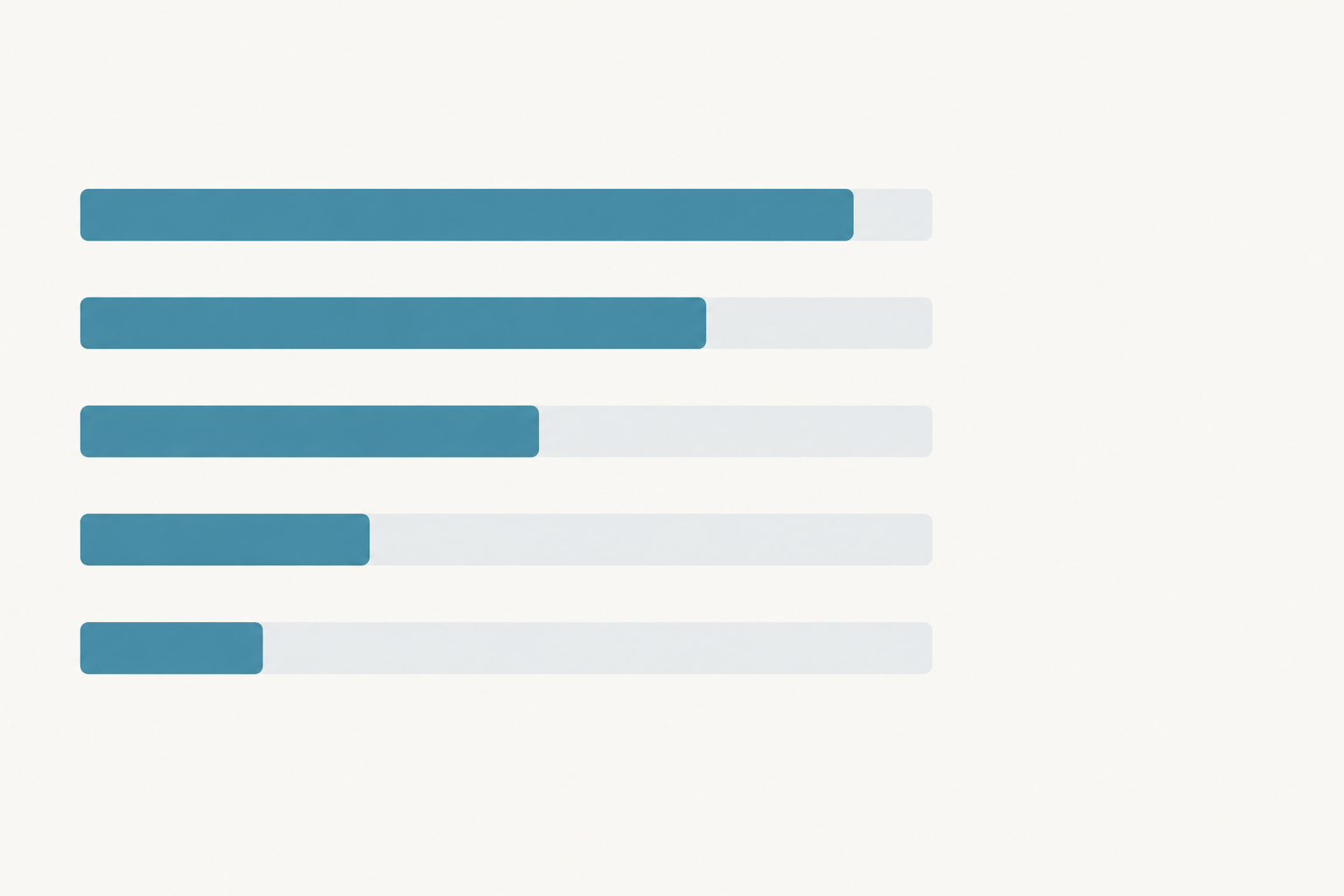
Chart note: the bars above are illustrative of the content types to test and are not measured data. Please do not read them as findings. The only way to learn the real ordering is to track your own question set.
There is one practical implication here. Google says no special schema types are required for its AI features, and OpenAI documents crawler controls for ChatGPT search (OAI-SearchBot). I read that as meaning useful, well-supported, accessible pages matter more than markup created solely for AI. Confirm that the bots can reach your pages, then spend your effort on substance.
How to structure answer-first pages for AI citations
Once you know the question, the page should make the answer unmissable. I split this into content structure and technical accessibility, because they fail in different ways.
Content structure for clear, extractable answers
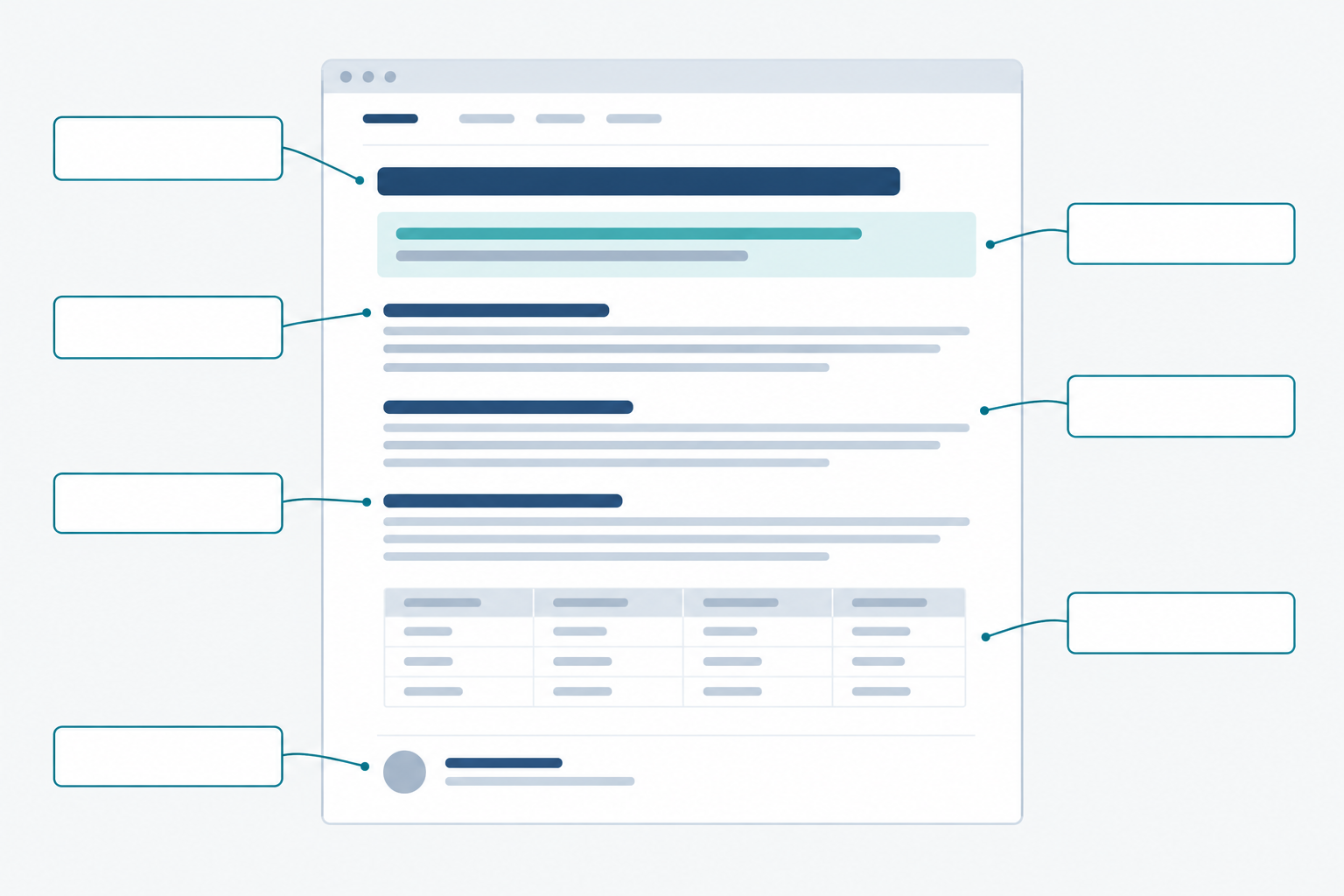
- Open with a direct answer. Put two to three sentences beneath the headline, using the inverted pyramid so the extractable passage is unambiguous.
- Use question-style subheadings that mirror buyer phrasing. Each section should answer one thing completely before moving on.
- Keep paragraphs self-contained. A passage should make sense when lifted out of context, so avoid dependencies such as 'as mentioned above'.
- Use lists and tables for comparison and prose for nuance. Format should follow the content, not the other way round.
- Show authorship and dates. A visible author, publication and updated dates, plus clear entity naming (brand, product, category), reduce ambiguity. Google's people-first content guidance asks publishers to make clear who created a page and why.
Technical accessibility for AI crawlers
- Make the page readable by bots. Check that the relevant crawlers are not blocked in robots.txt or by your CDN, that the main text is in the HTML rather than locked inside scripts or images, and that the page returns a clean status code.
- Use schema only to describe what is visible. Structured data should mirror the visible content (product, price, FAQ, author). It is not a shortcut to AI visibility, and Google does not require it for AI features.
- Audit before you write. A technical blocker can nullify excellent content, so run a crawlability and rendering check on priority pages first. Any decent site-audit tool, or a manual review, will do.
How long should pages be for AI citations?
Length should follow the complexity of the question, not a word-count target. A definitional answer may need 600 words, while a category comparison may need 2,000 or more. Google's guidance asks whether a page gives a substantial, complete description that helps the reader achieve their goal, and it prescribes no word count. The GEO research does not identify an optimal length either. Its gains came from adding citations, quotations and statistics, not from adding words.
The figure people usually quote comes from Backlinko's analysis of 11.8 million Google results, published in 2019, which found an average first-page length of 1,447 words. That is a correlation from traditional search, several years old, and it says nothing about AI citations. I would not build a strategy on it.
What I can say with more confidence is structural. The answer should appear on the first screen regardless of total length, with depth following for readers who want it. Padding is a genuine risk, since diluted passages are harder to extract. The GOV.UK content design principle of meeting a specific user need, and no more, is a useful model.
The practical approach is to test. Publish two or three length formats against the same tracked questions and compare citation rates over several weeks. Your own data will outweigh any general rule.
Build comparison and proof content for buyer questions
Comparison-stage questions are where recommendations are won, and they are also where promotional pages tend to perform worst. Google's product-review guidance recommends demonstrating first-hand knowledge, explaining what distinguishes products, covering benefits and drawbacks, and supporting assessments with evidence. Editorial publishers such as Consumer Reports and Wirecutter make the basis of their recommendations inspectable, and that is the quality to emulate.
What comparison and proof content to build
- Honest comparison pages that state criteria, include competitors fairly and say who each option suits. A concise verdict, a criteria-based table, then evidence for each criterion works well.
- 'Best for' and 'alternatives to' pages aligned to the comparison-stage questions from your baseline.
- Concrete proof points: pricing in pounds, feature specifications, customer numbers, case-study outcomes with figures, certifications and independent reviews. Date anything that changes.
- Original data with documented methodology, so claims are verifiable and other sites have a reason to cite you.
- Third-party corroboration through review platforms, industry directories, partnerships and digital PR, including UK publications where appropriate.
Disclosure and UK compliance ⚖️
Comparison and review content often involves commercial relationships, and the UK has specific rules. The ASA and CAP Code require marketing communications to be obviously identifiable as such. In practice that means labelling paid, sponsored and affiliate content clearly (for example 'Ad' or 'Affiliate link') before the reader reaches the recommendation. The Digital Markets, Competition and Consumers Act 2024 also strengthens consumer protection law on unfair commercial practices, including fake and misleading reviews, and the CMA enforces it. My advice is to disclose any material connection near the top of the page, never commission or publish reviews that conceal an incentive, and keep a record of how comparison rankings were decided. The FTC's endorsement guidance is a US rule, but it shows the same principle. I am not a lawyer, so confirm specifics with your own legal adviser.
Match content format to the buyer's question stage
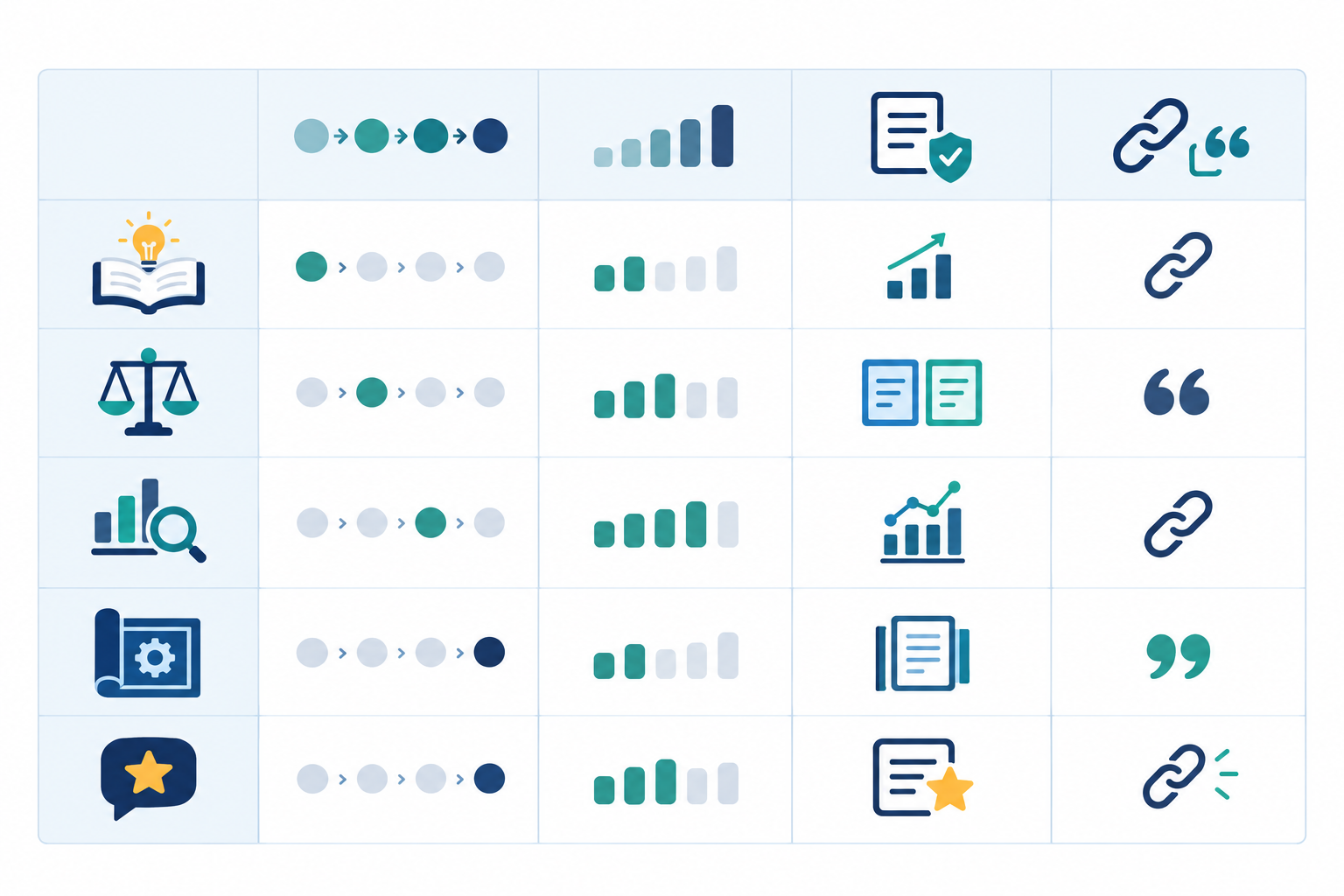
| Content format | Question stage served | Effort | Proof needed | Typical citation role |
|---|---|---|---|---|
| Answer-led explainer | Problem-aware | Low to medium | Named sources, dates | Cited source for definitions |
| Comparison page | Comparison | Medium to high | Criteria, specs, pricing, method | Recommendation and cited source |
| Original data study | Solution-aware to comparison | High | Methodology, sample, raw figures | Primary source others reference |
| Documentation and pricing | Purchase | Low to medium | Accurate, current facts | Factual source for specifics |
| Third-party reviews and press | All stages | Ongoing | Genuine customer experience | Corroboration, often preferred over brand pages |
One useful data source: Microsoft's Bing Webmaster Tools has introduced reporting on citations in Copilot and AI summaries, including cited pages and grounding queries, which can help you see which pages are already being referenced. Check which report features are available on your account.
Update content to stay current: do you need to rewrite old posts?
Do you need to rewrite old posts? Usually not wholesale. Audit first, then refresh the posts tied to high-value questions where you are currently absent or misrepresented. Sort everything into three groups:
- Keep as is: accurate, strong content that already earns its place.
- Restructure: add an answer-first opening, clearer headings and updated facts.
- Retire or consolidate: overlapping pages that compete with one another and dilute your passages.
Then update the facts engines are most likely to quote: pricing, features, statistics, dates and product names. Show a genuine 'last updated' date rather than a cosmetic one, because a refreshed date over stale content damages trust.
Set the review cadence by how fast the content goes stale. Quarterly suits pricing and comparison pages, and annually suits evergreen explainers. Also watch for outdated or incorrect statements about your brand in AI answers and trace them to the source pages that need correcting. A changed answer is often the trigger for a refresh.
Close the loop with tracked AI queries
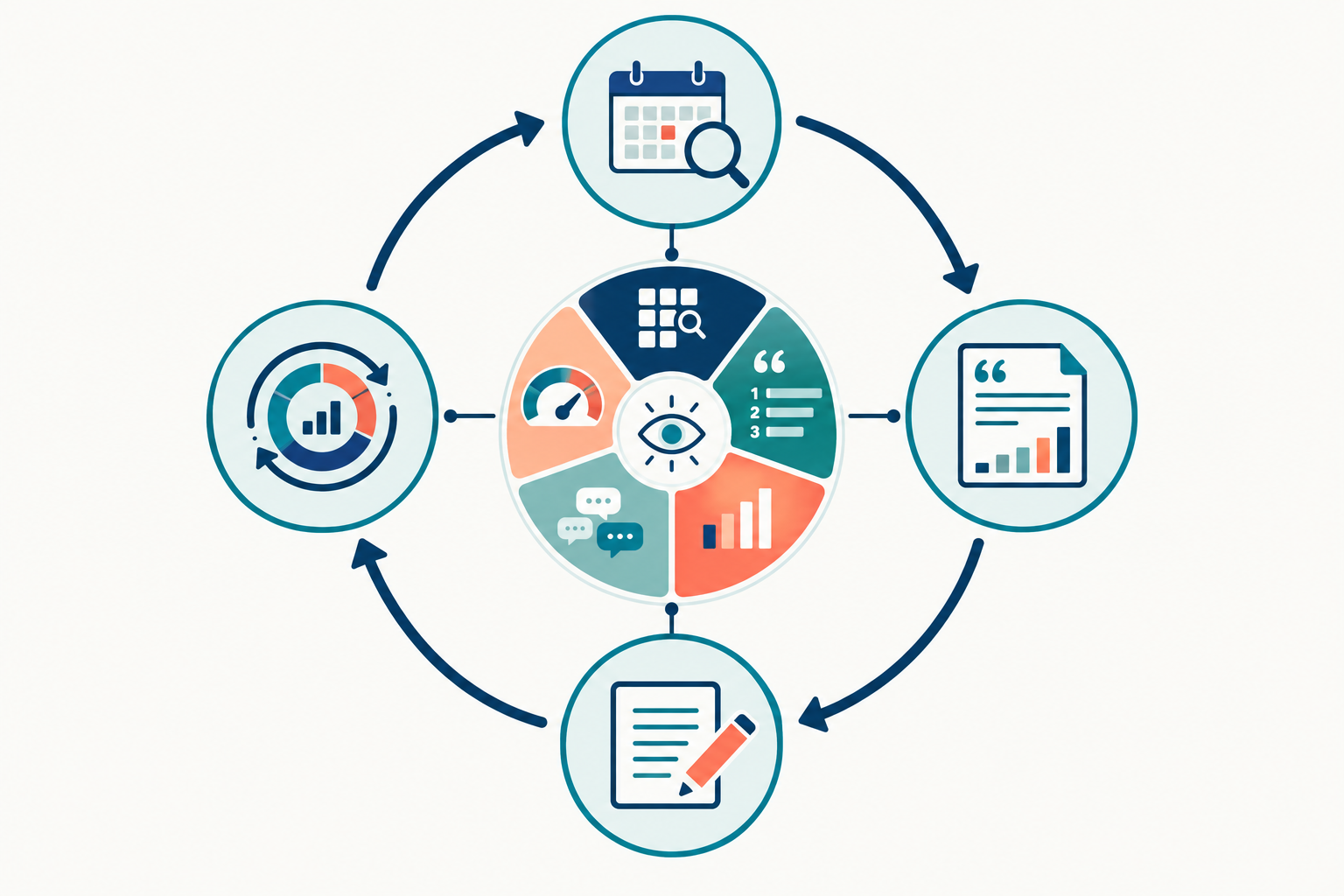
Publishing without measurement is guesswork. This is the loop I recommend:
- Define the metrics and keep them separate. Five measures cover most needs: query coverage, position-weighted citations, share of voice, soft mentions and sentiment. Each diagnoses a different problem, so combine them into one score only if you can explain the weighting.
- Track the same questions under the fixed protocol above. Collect daily if you can, but aggregate to weekly rates before drawing conclusions, since single snapshots mislead and each engine answers differently.
- Track competitors to see who displaces you and which sources the engines prefer for those queries.
- Connect visibility to outcomes. Segment referral traffic from AI engines in your analytics (referrer domains such as chatgpt.com and perplexity.ai) and watch conversions. Given the click data above, a citation that sends no visits is still useful, but you should know which is which.
- Run a simple test cycle. Change one page, wait a defined period, compare the tracked questions against baseline and record the result alongside your variability log.
- Be realistic about noise. Citation changes can be gradual and erratic, so trends over several weeks are more reliable than daily movements, and a single change rarely proves causation.
A 90-day content strategy for AI citations
- Days 1 to 14: build the question set, capture a baseline under the fixed protocol and check that AI crawlers can reach your priority pages.
- Days 15 to 45: rework the top 10 to 15 priority pages into answer-first formats and publish two or three comparison pages.
- Days 46 to 75: publish one piece of original data, pursue third-party mentions and refresh key facts across the site.
- Days 76 to 90: review aggregated results against baseline, double down on what moved and set the quarterly cadence.
Summary: your first actions for earning AI citations
If you do nothing else this week, do three things. Write down 20 to 30 real buyer questions in conversational phrasing. Record a baseline of who is cited for them, using fixed prompts, a UK location and repeated runs. Then rewrite the single page that best answers your highest-value question so it opens with a direct, dated, verifiable answer. Everything else in this guide builds on that loop of question, answer, proof and measurement.
Disclosure: I work on MentionOwl, which automates the question tracking described above. The framework in this guide works with a spreadsheet, and a seven-day trial is available at $1 for teams who want to establish a baseline without building the tooling themselves.
Frequently asked questions about content strategy for AI citations
What content do AI engines cite most?
Engines tend to cite content that answers a specific question directly: clear explainers, structured comparison pages, original data and factual documentation, along with third-party sources such as reviews and forums. No public dataset settles the ordering, and patterns differ between engines and categories, so I recommend confirming them against tracked queries for your own market.
How long should pages be?
Match length to the complexity of the question. Put the direct answer at the top, then add only as much depth as the topic needs. A focused answer can work well at a few hundred words, while category comparisons often need considerably more.
Do I need to rewrite old posts?
Rarely in full. Prioritise pages that map to high-value buyer questions, add an answer-first opening, refresh outdated facts and dates, and consolidate duplicates. Leave strong, accurate content alone.
How quickly can I expect to see changes in AI citations?
It varies by engine, topic and how often the sources are re-crawled or retrieved, so changes may appear within weeks or take longer. Track the same questions under a fixed protocol and judge weekly aggregated trends rather than reacting to single results.
Is this different from traditional SEO?
There is substantial overlap, including crawlability, authority and useful content. Google says standard Search fundamentals apply to its AI features. Whether extractable answers, clear entities and third-party corroboration deserve extra emphasis is a hypothesis worth testing, and success is best measured by citations and share of voice alongside rankings.