How to Monitor Claude, Gemini, and Copilot Brand Mentions: A Guide for Agencies
Track Claude, Gemini and Copilot brand mentions with AI brand monitoring. Unify daily LLM monitoring, citations and sentiment to save agency hours.

AI Brand Monitoring for Agencies: Tracking Claude, Gemini and Copilot Brand Mentions in One Daily View
The most reliable way to monitor Claude, Gemini and Copilot brand mentions is to run a fixed set of customer-style questions against each engine on a regular schedule. For every run, record the full answer, the citations, the sentiment and any competitor mentions, then consolidate it all into one view per client. Manual spot checks can't keep pace with how variable these engines are. A unified workflow, whether you build it in-house or buy a platform, gives you data that is comparable over time. The arithmetic later in this post shows how quickly manual monitoring becomes unmanageable at agency scale.
That is the short version. Below I set out why single-engine checks fail, how the three engines differ, what a defensible record looks like, and how to roll the process out across a client roster. Where a figure comes from a published source, I name the source and date. Where I am giving an operational recommendation rather than a research-backed benchmark, I say so.
A note on disclosure: I work with MentionOwl, and I use it below as a worked example of a dedicated platform. Product details are vendor-provided, so please verify features, scoring and pricing against the current MentionOwl documentation and pricing page. Everything in the method sections applies equally to a spreadsheet-and-scripts build.
Why AI brand monitoring across multiple engines matters
Your clients' customers are spread across several assistants, and each assistant can describe the same brand differently. Visibility in one engine tells you little about visibility in another, because the products, integrations, retrieval methods and answer presentation all differ.
Audience exposure differs too. Gemini is tied to Google's consumer products. Copilot is offered across Microsoft's consumer and commercial surfaces, including Microsoft 365. Claude is a separately operated assistant with its own user base. The published figures below were measured differently, in different years and regions, so they are not comparable with one another. All they show is that none of these audiences is small:
- Gemini (independent reporting of court-filing figures): Reuters reported in 2025, citing figures disclosed in a court filing, that the Gemini app had roughly 350 million monthly active users and 35 million daily active users as of March 2025.
- Copilot (vendor-reported, multi-product): Microsoft has said in earnings commentary that its Copilot products exceed 100 million monthly active users across consumer and commercial experiences. The figure combines several products, so don't read it as a count for one interface. Check the latest Microsoft earnings transcript for the precise date and wording.
- Google AI Overviews (vendor-reported): Google stated in 2025 that AI Overviews reached 1.5 billion monthly users. That measures an AI feature inside Search, not the Gemini chatbot, but it is a strong argument for treating AI search surfaces as their own monitoring target.
- ChatGPT (independent survey, US only): Pew Research Center reported in 2025 that 34% of U.S. adults had used ChatGPT. It is a U.S. figure for one product, which is exactly why ChatGPT adoption alone can't describe the whole market.
Wider market data points the same way. A 2024 SparkToro analysis, based on clickstream data from Datos, found that 58.5% of U.S. and 59.7% of EU Google searches ended without a click to the open web. Gartner's February 2024 forecast expects traditional search volume to fall 25% by 2026 as users move towards chatbots and virtual agents, though that is a prediction, not a measured outcome. Neither source is UK-specific.
What this means for UK agencies
I have not found robust, directly comparable UK-only usage data for each assistant, so none of the figures above should be taken as evidence of how many of a UK client's customers use a given engine. Treat them as directional. When you need UK reach, ask clients for their own evidence, such as analytics referrals from AI surfaces and customer survey responses. In practice, UK agencies should:
- Test with UK English prompts and UK-relevant phrasing (pounds, UK regions, UK regulators), and record the locale, language and approximate location used for each check.
- Run separate prompt variants for clients serving specific nations or regions, since local retrieval can differ.
- Document the account state (signed in or out, free or paid) and the product surface, because results can differ between them.
- Keep UK and non-UK runs out of the same trend line.
The risk of a single-engine blind spot is concrete. A client may be cited prominently in ChatGPT yet be absent from Gemini, or described with outdated pricing in Copilot. Where AI answers shape shortlists for everyday purchase decisions, an omission is a lost opportunity, and calling it a reporting gap undersells it.
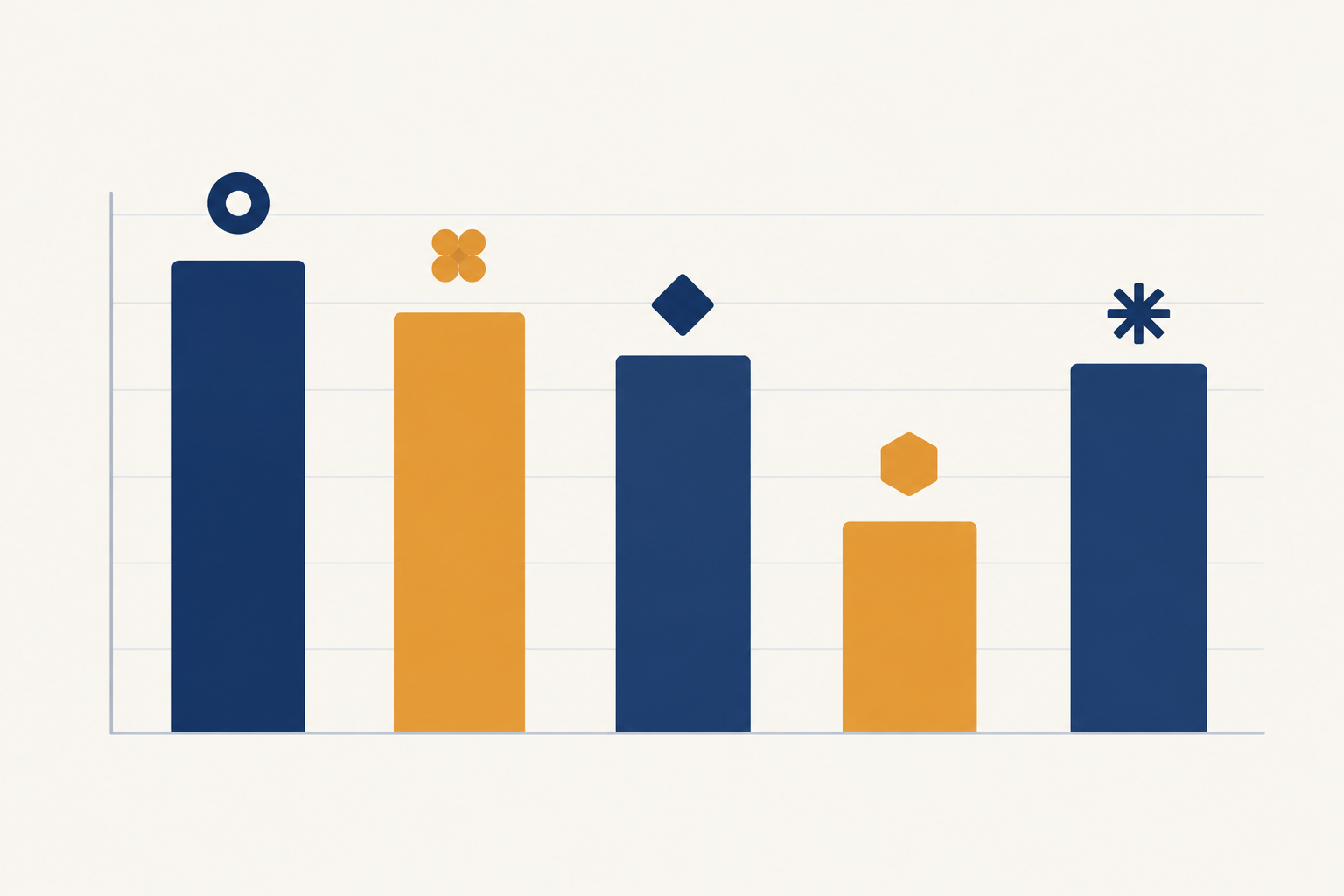
The chart is built on the following illustrative data (invented for explanation, not measured), based on 20 fixed prompts for one fictional client:
| Engine | Prompts where brand was mentioned (of 20) | Mentions with a cited link | Open factual errors |
|---|---|---|---|
| ChatGPT | 12 | 5 | 0 |
| Claude | 9 | 3 | 1 |
| Gemini | 4 | 3 | 0 |
| Copilot | 11 | 8 | 2 |
| Perplexity | 7 | 7 | 0 |
Look at the pattern rather than the numbers. A team watching only ChatGPT would report a healthy 12 of 20. They would miss that Gemini mentions the brand in just 4 of 20 prompts, and that Copilot carries two factual errors that need correcting at source.
Claude, Gemini and Copilot brand mentions: engine differences to track
Claude, Gemini and Copilot don't necessarily consult the web for every response. Depending on the product, settings and query, an answer may come from the model alone or be grounded in retrieved web content. A mention count that ignores whether the response was web-grounded, and whether it carried citations, can mislead. The notes below reflect vendor documentation and my own review of outputs as of this writing. These products change often, so check current documentation before building a methodology on them.
Start with Claude. Anthropic documents a web search tool that can return citations linked to the answer, but whether web access is active depends on the product and settings. In the outputs I have reviewed, Claude tends towards cautious, caveated recommendations. That is an observation from limited review, not an established finding, so test it on your own data. If it holds, your scoring rubric needs to separate a hedged mention from a negative one. A citation shows that a source was used, not that the source supports the claim made about your client, so check both.
Gemini is different. Google documents Search grounding for Gemini, which connects answers to Google's index. Through the API, grounding metadata can expose supporting sources and the search queries used, though you shouldn't assume that instrumentation describes every response in the consumer app. My working hypothesis is that Gemini brand mentions track traditional SEO strength more closely than other engines' do. I would treat that as something to test by comparing mention rates with organic rankings, and I wouldn't call it a rule.
Then Copilot. Microsoft describes Bing as the web-search foundation for its AI-powered experiences and emphasises links to sources, so Copilot brand mentions may reflect Bing's retrieved pages as well as generated synthesis. Copilot also varies by surface. Microsoft documents that Microsoft 365 Copilot can ground responses in work data a user is permitted to access, so results can differ by permissions and context. Always record which Copilot surface you tested.
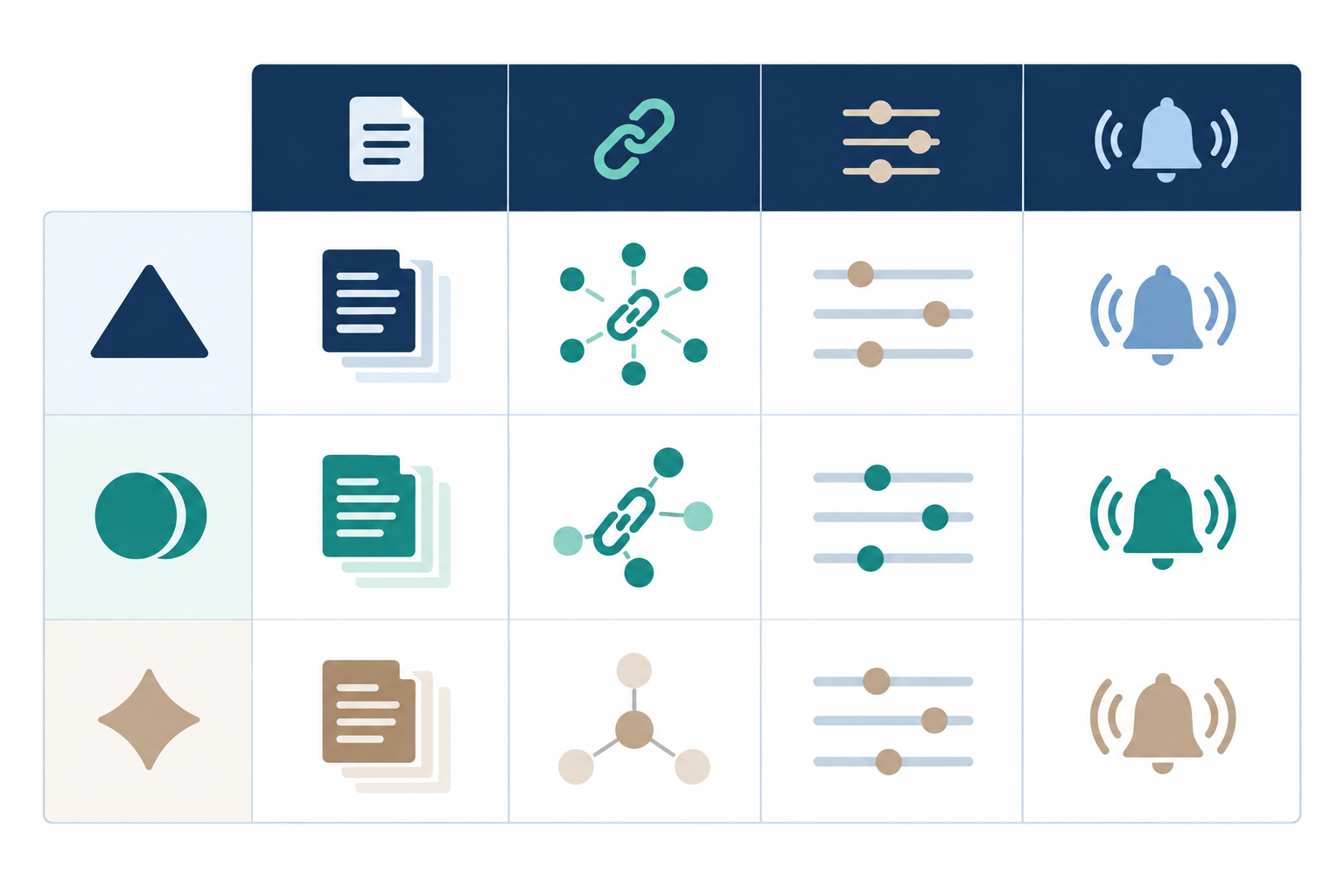
| Engine | Citation style (as documented, subject to change) | Source behaviour | Variability | Monitoring implication |
|---|---|---|---|---|
| Claude | Linked citations when web search is used | Web access depends on product and settings | Answers can differ between runs | Log whether web search was active; score hedged language separately from negative language |
| Gemini | Links in some answers; grounding metadata via API | Search grounding where enabled; varies by surface | May vary by day, locale and surface (app vs. AI Overviews) | Track the Gemini app and AI Overviews separately; compare against organic rankings as a hypothesis test |
| Copilot | Source links or footnotes in many answers | Web retrieval (documented as Bing-based) plus generated synthesis; work-data grounding in Microsoft 365 | Varies between consumer and Microsoft 365 contexts | Record surface and account context; capture cited URLs |
Table reflects vendor documentation and my own review as of this writing; product behaviour changes frequently and these are tendencies, not guarantees.
Variability and model updates in AI brand monitoring
Two things justify repeated sampling. First, the same prompt can produce different outputs on different runs. Vendors note that outputs aren't guaranteed to be identical, so a single check proves very little. Second, model and product updates can shift visibility without warning. Store every data point with its date and, where visible, its model or mode, so you can line up engine changes against historical data. When an answer shifts, find out whether it reflects a source update, a product change or ordinary variation before you propose any SEO or communications response.
My operational conclusion is to treat each engine as its own measurement environment. Report mention rate, citation presence, cited-source quality and sentiment per engine, and don't blend them into one figure.
Manual checks vs automated AI brand monitoring
Manual checks are good for exploration, but they don't scale into measurement. Here is a worked example, which is an illustrative calculation and not a benchmark. A 10-client agency tracks 20 customer-style prompts per client across five engines (ChatGPT, Claude, Gemini, Copilot and Perplexity). One full round is 10 × 20 × 5 = 1,000 checks. If each check takes 90 seconds to run, paste, log and tag (an assumption you should replace with your own timings), a single round takes about 25 hours. Run weekly, that is roughly 100 hours a month. Run daily, it isn't realistic by hand.
There is a consistency problem as well. Different team members phrase prompts differently, use different accounts and judge sentiment differently, so results can't be compared across people or weeks. Manual work still earns its place in exploratory prompt discovery and in qualitative review of edge cases, like an odd sentiment call or a confused brand identity. A sensible workflow is to discover and interpret manually, then automate repeated checks across a defined prompt set.
As one example of the automated approach, MentionOwl states that it crawls a client's website, generates relevant customer questions, runs them across the engines daily, and stores answers, citations, sentiment and competitor mentions for each run. I have not independently benchmarked its time savings, so use the 25-hour arithmetic above, with your own timings, to estimate the saving for your agency. One caveat applies to any tool: monitoring results are a sample of model responses, not a census of everything a model might say, so periodically validate captured answers against the live interface.
| Approach | Cost | Coverage | Repeatability | Reporting effort |
|---|---|---|---|---|
| Manual checks | Staff time only, but high (about 25 hours per round in the example) | Limited by hours available | Low; prompt wording and judgement drift | Heavy; compiled by hand |
| Spreadsheet plus scripts | Lower licence cost, but engineering and maintenance time | Good if scripts keep working | Medium; can break when interfaces change | Moderate; custom dashboards needed |
| Dedicated platform (e.g. MentionOwl) | Subscription; at time of writing MentionOwl advertises a $1 seven-day trial, so confirm on its pricing page | Depends on the platform; check which engines and surfaces are covered | Higher; fixed prompts, stored outputs | Lower; built-in views and digests, subject to your reporting needs |
What to record in a daily LLM brand monitoring check
An auditable record lets you tell a genuine change in recommendations from a change in prompts, model, locale or procedure. For every check, capture at least the following:
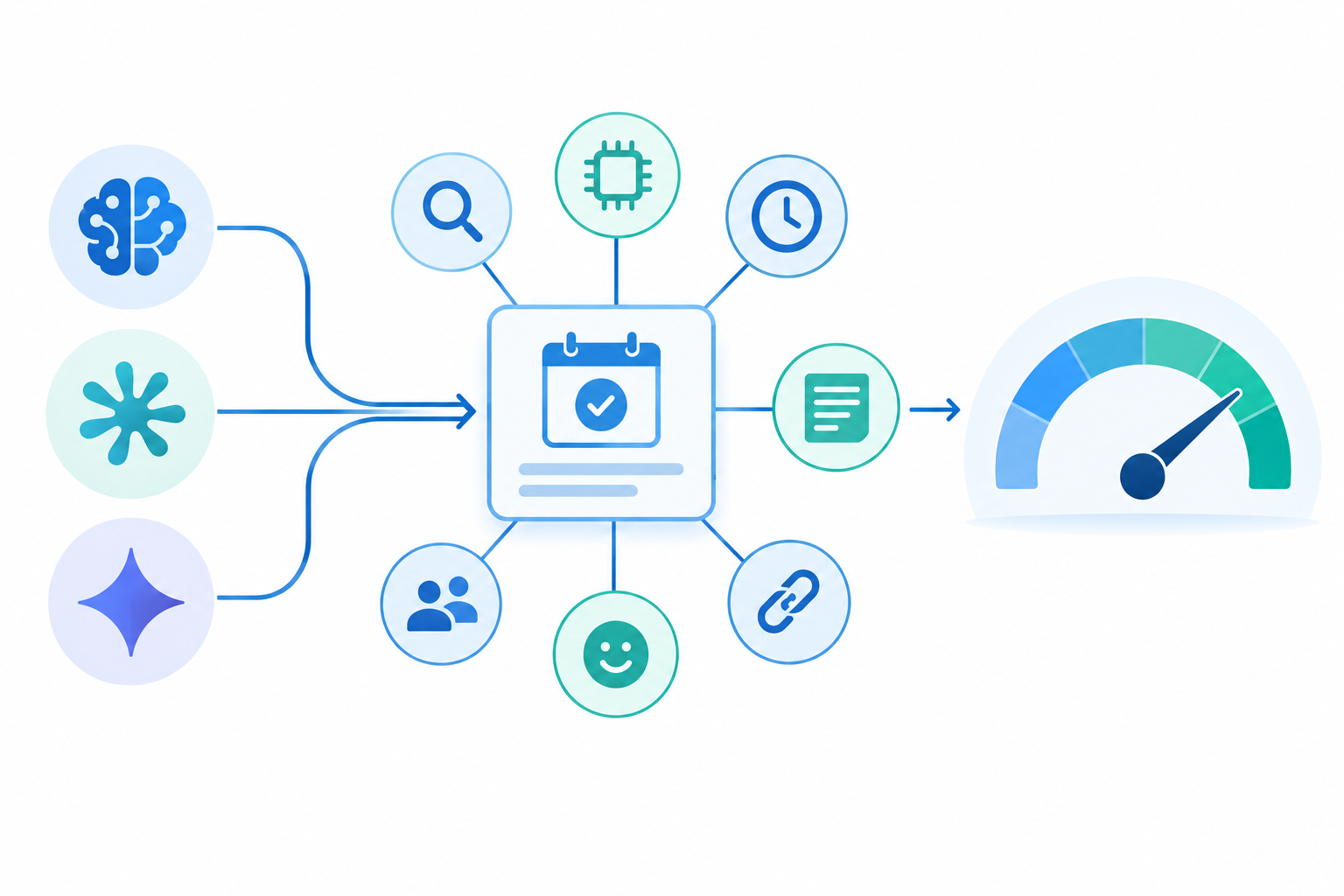
- Prompt, engine, date and time, and version: the exact prompt wording, the engine and product surface, a timestamp, the model or mode where visible, plus locale, language and account state so results are reproducible.
- The full answer text, and not just whether the brand appeared. Stored answers can be re-analysed later when you think of a new question.
- Every citation and source URL, with position. Record the order in which sources appear, and note whether the cited page supports the claim. Whether earlier citations influence readers more is an assumption, not an established finding, so store the position and test its value against your own click data.
- Brand mentions, split by type: explicit recommendations versus soft mentions, where the brand is named without clear endorsement. Code direct answers, comparisons and citations separately too.
- Sentiment and factual errors: the tone of each mention, plus wrong pricing, outdated services or confused identities.
- Competitor mentions, which you need to calculate share of voice per query set.
These inputs can roll up into a composite score. MentionOwl's visibility score runs from 0 to 100 and is built from query coverage, position-weighted citations, share of voice and soft mentions. As a generic illustration (not MentionOwl's actual formula), a composite might weight coverage at 40%, position-weighted citations at 30%, share of voice at 20% and soft mentions at 10%, so a brand with 50% coverage and middling scores elsewhere lands around 50. Check the vendor's documentation to see whether weights are published or configurable, and never compare scores across tools that use different formulas. Whatever the composite, keep the per-engine breakdown beside it.
On retention, keep raw answers long enough to show trends across quarters and to defend your reporting when a client asks why a number moved. Dated snapshots are the evidence base for every conclusion you present.
How often should you check AI brand mentions?
There is no established industry standard for checking frequency, and I have not found published research that validates a particular sampling cadence or prompt-set size for AI brand monitoring. What follows is an operational starting point to calibrate in a pilot, not a statistical standard.
I start with daily runs because answers fluctuate, and a single weekly snapshot can mistake noise for a trend. With 20 prompts, one prompt flipping from mentioned to not mentioned moves the mention rate by five percentage points. A client could appear to fall from four of five key prompts to two of five through ordinary variation. Daily data gives you more observations to work with, and it shows whether a change is sustained over several days or reverts. Daily is also the cadence at which automation becomes worthwhile. It does not, by itself, guarantee that a rolling average separates real change from noise, and I would not claim statistical confidence without a defined method.
To calibrate, do the following during the first two weeks of a pilot:
- Run the same fixed prompt set at the same time each day, and run a subset of prompts two or three times a day.
- Record run counts and, for each prompt, how often the brand appears. Prompts that flip frequently are high-variance, so weight them cautiously or report them separately.
- Use the observed day-to-day variation to decide what counts as a sustained change for that client, such as a drop that persists across several consecutive days.
- After a fixed period (I suggest four to six weeks), review whether the cadence is too high, too low or about right.
Run extra checks, or review more closely by hand, around product launches, PR incidents and known model updates.
For prompt-set size, my pilot starting assumption is roughly 15 to 30 core prompts per client. This is a pragmatic range, not a researched figure. With fewer, any single prompt becomes too influential, and with many more the review effort multiplies. Test the size against each client's needs and keep the core set fixed for trend comparisons. Add exploratory prompts during monthly reviews, mixing branded and non-branded questions, comparisons and different customer needs.
Consolidating AI brand monitoring results across clients
A repeatable workflow keeps results comparable as your roster grows:
- Define a consistent prompt framework per client. Cover category questions, comparison questions, problem-led questions and brand-specific questions, so every client is measured on the same four dimensions.
- Set up each client's competitor list. If competitor tracking is built in from day one, share of voice means something from the first run.
- Run every engine against the same prompt set. Like-for-like comparison is the only way to see which engine is the weak spot.
- Normalise outputs into shared metrics. Mention rate, share of voice, citation position and sentiment give every account manager the same vocabulary.
- Build a portfolio view that ranks clients by risk and opportunity. Account managers should see at a glance where a drop, a factual error or a rising competitor needs attention.
- Feed your existing tools through an API. Where your platform offers one (MentionOwl lists a REST API and an MCP server), data can flow into dashboards, BI tools or AI agents for client reporting instead of sitting behind yet another login.
A useful portfolio dashboard has one row per client. Its columns are overall score, per-engine scores for Claude, Gemini, Copilot, ChatGPT and Perplexity, seven-day change, share of voice against the top competitor, sentiment, and a flag for open factual errors. Sort by seven-day change to surface risk, and by gap to the leading competitor to surface opportunity.
Setting AI brand monitoring alerts and weekly digests
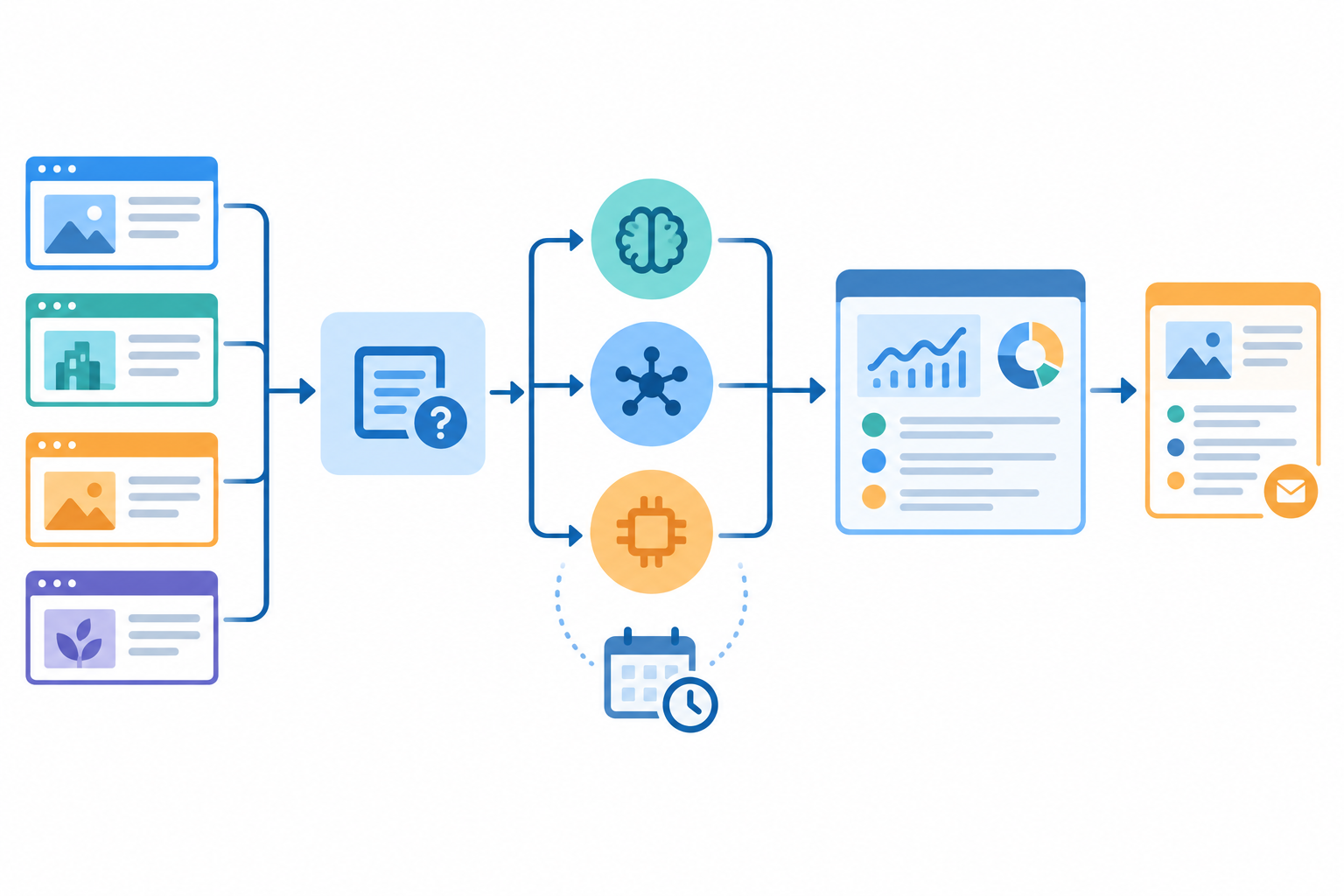
Not every fluctuation deserves attention, so decide in advance which events do. I would escalate on four: a sustained drop in visibility, a new competitor appearing in a client's query set, a turn towards negative sentiment, and a detected factual error. If your platform doesn't alert on an event natively, you can apply the same rules to data pulled via an API.
Threshold values should come from your pilot baseline, and no universal rule will do that job. Use the variation you observed in the first weeks to set a starting margin. For example, escalate when the seven-day average falls by more than the client's typical day-to-day swing, or when an error persists across consecutive runs. Then review the false alerts after a set period and adjust. Thresholds that fire on every wobble train people to ignore them.
Here is an example alert (illustrative): Client X, Gemini app, UK English: mention rate down from 6 of 20 prompts to 2 of 20 for three consecutive days; Copilot unchanged. Action: check whether the cited sources changed, then review the client's site for removed or restructured pages before proposing any content response.
Weekly digests give account teams a standard, client-ready summary without manual compilation, and that is where much of the time saving comes from. A workable rhythm is to review the digest internally each week and provide monthly commentary that interprets the trend instead of reciting numbers.
Turning AI brand monitoring data into action
Monitoring only pays for itself when it changes what the team does. These are the actions I would prioritise:
- Fix inaccuracies first. Deal with factual errors and negative sentiment before chasing incremental visibility gains. A wrong price in front of buyers does more damage than a missed mention.
- Study competitor sources. Identify which pages engines cite for competitors, then build a content or digital PR plan to earn similar placements.
- Audit technical legibility. Check for on-site issues that may stop engines reading and citing content. MentionOwl offers a 16-point technical audit for this, and a manual review of crawlability, structure and schema covers similar ground.
- Pair mentions with traffic data. Cookieless AI traffic analytics, or your existing analytics referral reports, show whether visibility translates into visits, which is the question clients ultimately ask.
- Connect to existing workstreams. Feed findings into the generative engine optimization and AI SEO work already in client retainers, so this extends current services.
Getting started: a low-risk AI brand monitoring pilot
You don't need to commit the whole roster to test this. A staged approach works well:
- Pick one or two representative clients and run a baseline across Claude, Gemini and Copilot, alongside ChatGPT and Perplexity.
- Compare the baseline against what your team finds by hand, noting time spent and any discrepancies.
- Review the first two weeks of data for surprises, particularly engines where the client is effectively invisible.
- If you are evaluating a platform, use a trial (MentionOwl advertises a $1 seven-day one; confirm current terms) to test the process before committing, and compare its output with your manual baseline.
Once the pilot holds up, use this checklist to roll out across the roster:
- Prompt framework agreed for each client
- Competitor lists confirmed
- Locale, language and location settings fixed and documented (UK English for UK clients)
- Account state and product surface recorded for each engine
- Scoring rubric for sentiment and errors documented
- Pilot-derived escalation thresholds and owners assigned
- Weekly digest review and monthly commentary scheduled
Frequently asked questions about AI brand monitoring
Can I monitor all AI engines in one place?
Yes, with either a dedicated platform or a scripted build. A platform such as MentionOwl runs the same question set across ChatGPT, Claude, Gemini, Copilot and Perplexity and presents answers, citations, sentiment and competitor mentions in one view. Check which engines and product surfaces any tool actually covers.
How often should AI answers be checked?
Daily is a sensible starting point for a pilot, though it hasn't been proven as a standard. Calibrate it against the variation you observe, and add extra checks around launches or reputation events.
What data should I store for each AI brand monitoring check?
Store the prompt, engine and surface, timestamp, locale, full answer text, citations with their positions, brand and competitor mentions, sentiment, and any factual errors. Raw answers allow re-analysis and support client reporting over time.
Are Gemini and Copilot brand mentions really different from ChatGPT ones?
Often, yes. Each engine draws on different sources and presents citations differently, so a brand can perform strongly in one and poorly in another, as the illustrative table above shows. That is why per-engine tracking matters.
Can I pull AI monitoring data into my own client reports?
If your tool offers an API or export, yes. MentionOwl lists a REST API and an MCP server for feeding dashboards, reporting tools or AI agents alongside its weekly digests; confirm availability on your plan.