How to Run an AI Visibility Audit for Your Brand in 5 Steps
Run an AI visibility audit in five repeatable steps to establish your brand’s baseline, track AI mentions and citations, compare competitors and prioritise fixes.


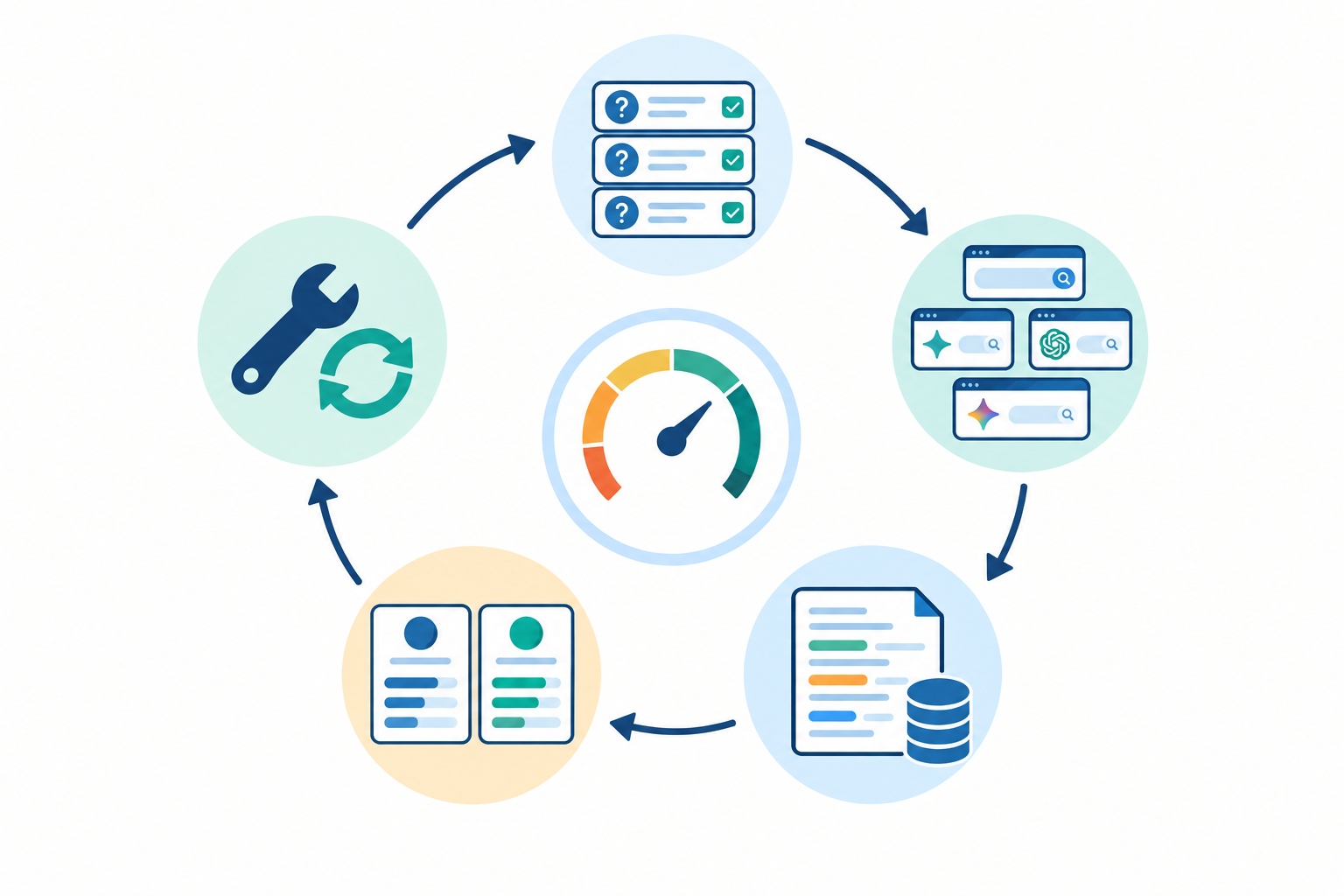
An AI visibility audit is a repeatable process. You ask generative AI engines the questions your customers ask, record whether and how your brand appears, and compare the results with competitors. There are five steps: build a question set, run it across engines, log mentions and citations, benchmark against rivals, then prioritise fixes and re-test. What you end up with is a baseline AI visibility measure that you can improve over time. Doing this by hand is feasible once. AI answers vary between runs, so only a consistent, repeated process keeps the baseline meaningful, and automation is one way to sustain it.
This guide is for solo founders and very small teams, particularly in the UK, who want to know how ChatGPT, Claude, Gemini, Copilot and Perplexity describe their business. I walk through the manual method first so you understand exactly what is being measured. After that comes a spreadsheet-ready scoring method, and then a look at where automation earns its keep.
Start here: a one-hour AI visibility audit pilot
Before committing to the full audit, run this small pilot. It gives you a rough look at the shape of the work. It is not a baseline, because one pass cannot show you how much answers vary.
- Questions: 10 buyer questions (3 awareness, 4 comparison, 3 decision; see Step 1).
- Engines: two, for example ChatGPT and Perplexity.
- Runs: one pass each, which gives 20 answers.
- Columns to log: question, engine, mode used (for example, web search on or off), date, brand mentioned (Y/N), your domain cited (Y/N), competitors named.
Everything else can wait: the other three engines, repeat runs, sentiment coding, position scoring and the weighted index. Once the pilot shows you what a logged answer looks like, scale up to the full baseline described below. That means 20 to 30 questions, all five engines and three passes on different days.
Why a manual AI brand audit breaks down for solo founders
AI answers are probabilistic. Ask the same question on Monday and Thursday and you may get different brands, a different order and different cited sources. OpenAI's documentation describes ChatGPT search as drawing on linked web sources (OpenAI Help Centre), so the answer depends partly on what is retrieved at the moment you ask. A single query is therefore a dated observation, not a ranking. I know of no definitive, vendor-neutral figure for how often answers change between runs, which is why I advise measuring that variance yourself.
The arithmetic is what makes a manual AI visibility audit hard. Take 25 buyer questions across five engines and you have 125 queries for one pass. Repeat each question three times to capture variance and you reach 375 queries before you have logged a single mention or checked a citation. For a founder who is also handling product, support and sales, that is not a routine you will keep up.
The effort is still worth it, because you cannot judge any generative engine optimization work without a starting point. A baseline turns 'I think ChatGPT mentions us sometimes' into a figure you can compare next month. Visibility inside the answer is also a different thing from website traffic. Pew Research Center's analysis of US Google browsing in March 2025 found that users clicked a traditional result in 8% of visits when an AI summary appeared, against 15% without one. They clicked a link inside the summary in about 1% of visits (Pew Research Center, July 2025). That is a US study of Google specifically, but it supports measuring what the answer says about you, not only who clicks.
Sources differ too. AI answers may cite reviews, directories, publisher coverage and community discussions as well as your own site, so an audit that only inspects your domain will miss influential material.
Step 1: Build your AI visibility audit question set
Your question set determines whether the baseline means anything. Five principles guide mine:
- Start from purchase-decision questions, not brand-name queries. Typing your own name into a chatbot flatters you. Buyers ask 'best [category] for [use case]', 'alternatives to [competitor]' and 'is [category] worth it for a small business'. Keep branded questions a minority.
- Mine real language. Website copy, customer emails, sales calls, support tickets and review sites contain the exact phrasing buyers use, so copy it verbatim.
- Group questions by funnel stage. Tag each one as awareness, comparison or decision so you can see where visibility drops off.
- Localise for the UK. Use British spelling, pricing in pounds and UK context such as HMRC, VAT, Making Tax Digital or UK GDPR where relevant. Local wording can change which providers and sources an engine surfaces.
- Keep the wording fixed. Save the exact phrasing so every later run is comparable.
If you would rather not start from a blank page, an hour spent reading your support inbox will produce a workable draft. Some monitoring tools can also suggest questions from your website, but you should still edit them against real customer language.
Example: 25 questions for a fictional UK SaaS
Imagine 'LedgerLark', an invoicing and expenses tool for UK freelancers and sole traders. A balanced full set has 8 awareness, 9 comparison and 8 decision questions. A sample from each stage shows the pattern.
Awareness:
- What is the best invoicing software for UK freelancers?
- Do I need accounting software as a sole trader?
- What software helps with Making Tax Digital for self-employed people?
Comparison:
- Cheapest invoicing software for sole traders in the UK
- Alternatives to [Competitor A] for freelancers
- [Competitor B] vs [Competitor C]: which suits a freelancer?
Decision:
- Is LedgerLark good for freelancers?
- LedgerLark vs [Competitor A]
- Is LedgerLark safe and UK GDPR compliant?
Only a handful of the 25 name the brand. Most mirror how an undecided buyer actually asks.
Step 2: Run your AI visibility audit questions across every major engine
Test ChatGPT, Claude, Gemini, Copilot and Perplexity separately. They differ in interface, retrieval and citation habits, and each can run in more than one mode. Some modes use live web search and show linked sources, while an answer produced mainly from model memory may name brands with no citation at all. Access to search, model versions and citations can also vary by plan and region. Record the exact mode you used for every answer, and don't treat one engine as a proxy for another.
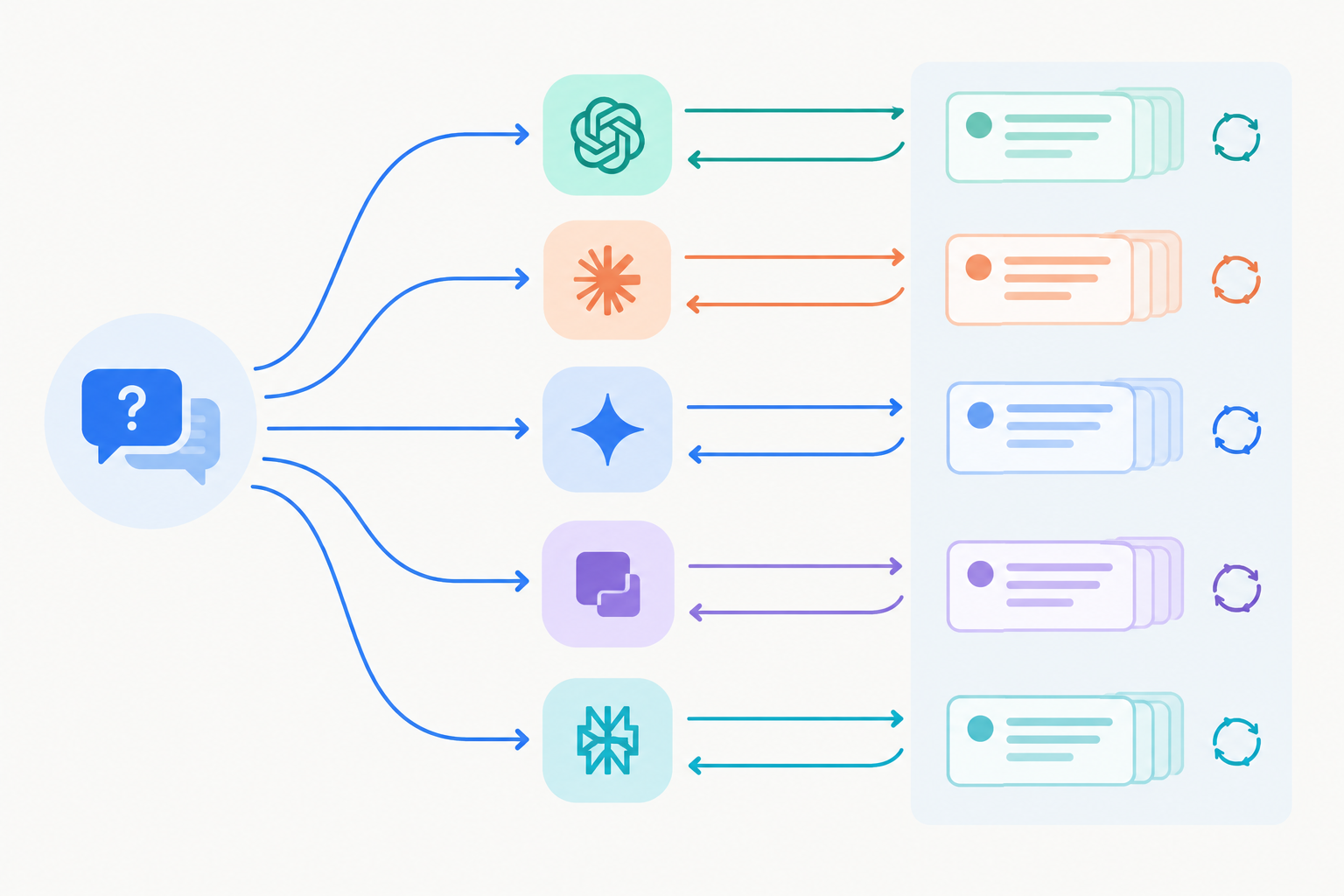
Here is the protocol I use by hand. There are five rules:
- Use clean sessions. Logged-out or fresh sessions are better, so that history and personalisation don't colour the answer.
- Use identical wording for every engine, copied from your master list.
- Run each engine's pass within the same day, so engines are compared under similar conditions.
- Log the essentials: date, engine, mode (web search on or off), exact prompt, and the full answer with any links shown.
- Repeat each question three times on different days. Then report counts such as 'named in 4 of 9 runs' rather than treating one result as the truth.
If you have time, add optional fields: model version where shown, country or language, signed-in status, and interface (app, browser or API).
One caution on interpretation. If a model update or a search-setting change occurs between runs, a shift in your results may reflect the platform rather than anything you did. Note any visible changes in your log, and treat movements smaller than the run-to-run variation in your own baseline as noise.
Check crawler access as well. OpenAI documents OAI-SearchBot as the crawler behind its search features (OpenAI crawler documentation), and a page that loads in your browser is not automatically available to every AI system.
Step 3: Log AI brand mentions, citations and sentiment
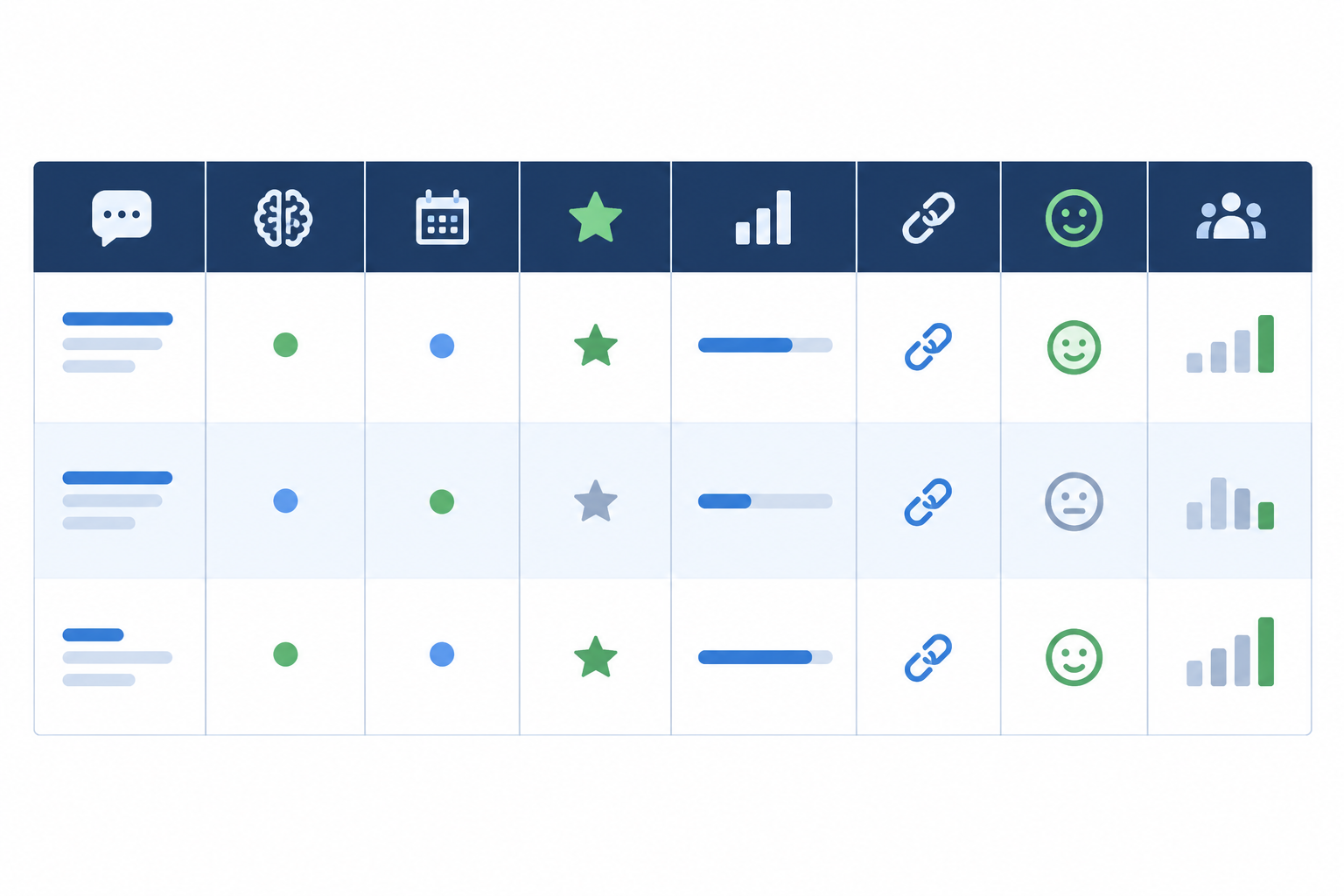
For every answer, record whether your brand is mentioned, whether a source link points to your domain, where you appear and how the passage describes you. These behave independently, so I define them separately:
- Citation: at least one URL on your domain appears as a linked source. If an answer links to several of your pages, count one citation for that answer and list every URL in the log.
- Direct mention: your brand is named in the text, with or without a link.
- Soft mention: your product is described but not named, for instance 'a UK-built invoicing tool aimed at freelancers'.
An answer can cite you without naming you, or name you without linking, so give each its own column.
| Question | Engine | Mode | Date | Mentioned (Y/N) | Position | Cited URL(s) | Sentiment | Competitors named |
|---|---|---|---|---|---|---|---|---|
| Best invoicing software for UK freelancers? | ChatGPT | Search on | 2025-06-02 | Y | 2 of 5 | ledgerlark.example/freelancers | Positive | Competitor A, B, C, D |
| Alternatives to Competitor A | Perplexity | Search | 2025-06-02 | N | n/a | none | n/a | Competitor B, C |
| Is LedgerLark good for freelancers? | Gemini | Search on | 2025-06-02 | Y | unranked | review-site.example | Mixed | Competitor A |
How to code subjective fields consistently
Write these rules down before you start and apply them identically every time.
- Soft mention: count it only if the description is recognisably yours and nobody else's. If you hesitate, don't count it. Keep soft mentions in their own column and out of the headline score.
- Position: record the rank in a list, or 1 of 1 if you are the only brand named. For prose with no ordering, record 'unranked'. Unranked answers are excluded from the position average, and you report how many there were.
- Sentiment: label the specific claim about your brand as positive, neutral, negative or mixed, not the tone of the whole answer. If a second person is available, have them code 20 answers and compare. Disagreements show where your rules are vague.
- Errors: flag factual errors and outdated information separately, with the exact wording and the cited source.
Calculate a baseline AI visibility score in a spreadsheet
To turn the log into one number, I use a 0-100 score with disclosed weights. The weights are my own illustrative choices, not an industry standard. What matters is that you fix them and leave them unchanged between audits.
| Component | How to calculate | Weight |
|---|---|---|
| Inclusion rate | Answers naming your brand ÷ total answers logged | 40% |
| Citation rate | Answers citing your domain ÷ total answers logged | 25% |
| Position score | Average across ranked answers where you appear: 1st = 100, 2nd = 80, 3rd = 60, 4th = 40, 5th or lower = 20 | 20% |
| Sentiment score | Average across mentions: positive = 100, neutral = 60, mixed = 40, negative = 0 | 15% |
A worked example makes this concrete. LedgerLark logs 125 answers (25 questions × 5 engines × 1 pass). It is named in 25 (inclusion rate 20%) and cited in 10 (citation rate 8%). Its position score averages 65 and its sentiment score averages 70. The calculation is (0.40 × 20) + (0.25 × 8) + (0.20 × 65) + (0.15 × 70) = 8 + 2 + 13 + 10.5 = 33.5, or about 34 out of 100.
There is also a rule for missing data. Don't score a component with no observations as zero. A brand with no mentions has no position or sentiment to judge, and a zero would punish it twice. Instead, calculate the score from the components that have data, divide by the sum of their weights, and report that coverage. If LedgerLark were never named, only inclusion and citation could be calculated, and the score would be (0.40 × 0 + 0.25 × 0) ÷ 0.65 = 0, reported as 'based on 65% of weight'. Only compare scores that share the same coverage.
This index is transparent but simplified, and it is comparable only with itself. Your 34 says nothing about someone else's 34 if they used different questions, engines or weights.
As you log, you will probably notice that engines often cite third-party sources such as reviews, directories, forums and publisher articles. When that happens, your fix list shifts from editing your own pages to earning presence elsewhere.
Step 4: Compare AI visibility with competitors
Two metrics are worth keeping separate, and each needs an explicit counting rule. In both, a brand counts once per answer, however many times that answer repeats its name.
- Answer inclusion rate: answers naming your brand ÷ total answers logged. In the Step 3 example, 25 of 125 answers gives 20%.
- Share of voice: answers naming you ÷ the sum, across all brands, of answers naming each brand. Suppose five brands together appear in 200 brand-answer pairs and you account for 25 of them. Your share of voice is 12.5%.
The first tells you how often you appear at all. The second tells you how you fare against the field, because it reflects how crowded each answer is. Use identical denominators for every competitor.
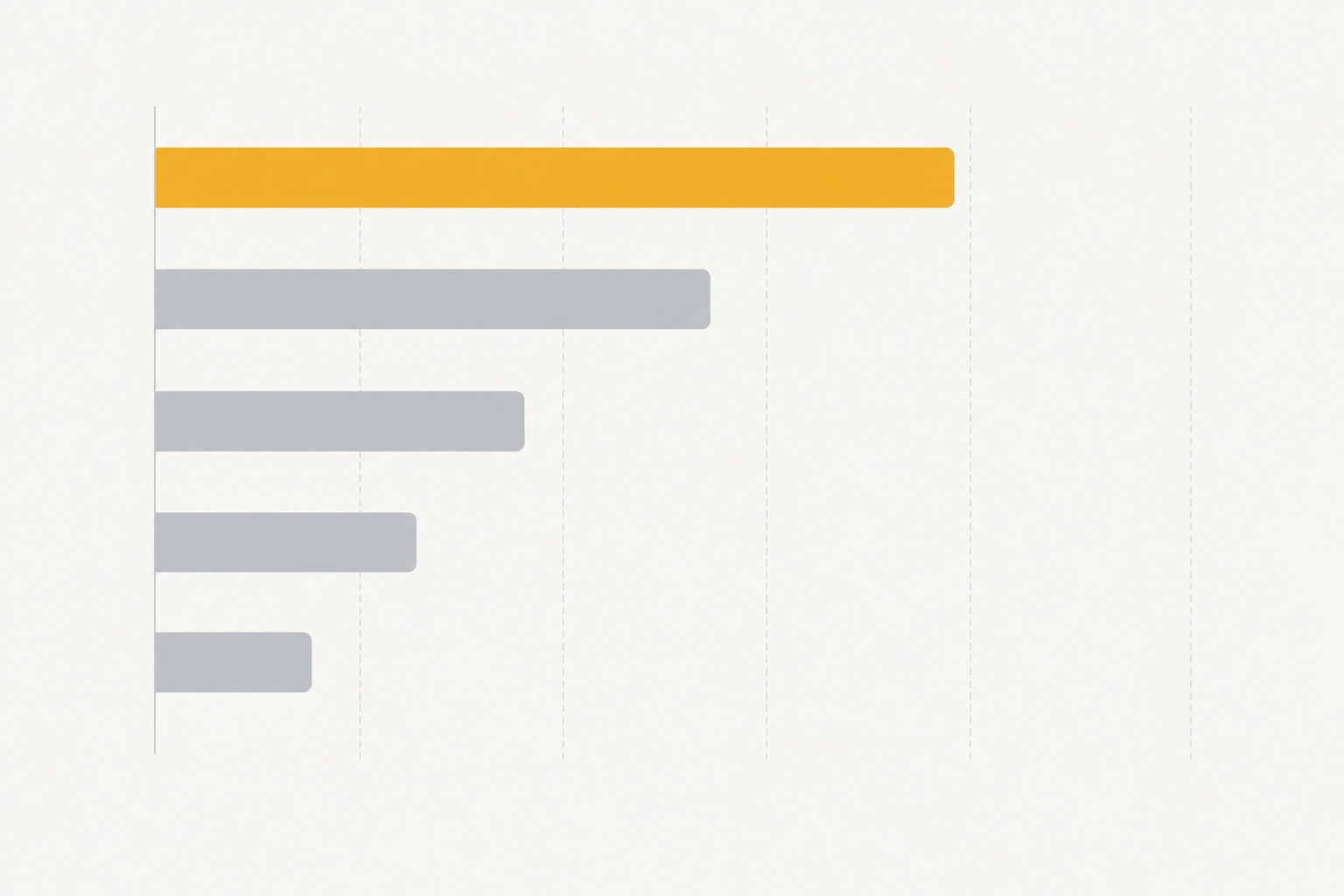
Identify three to five competitors from the answers themselves. Engines often surface rivals you didn't expect, such as a niche tool or an adjacent product. For a fair comparison, use the same prompts, engines, modes and observation period for every brand.
When reading the data, I look at four things:
- Where rivals are cited and you are not, and which URLs those are.
- Which sources recur. If one review site underpins several competitor recommendations, that is a concrete target.
- Descriptions and sentiment. Compare the attributes each engine assigns to each brand, and note inaccuracies.
- Mention versus citation share. A rival may be named often yet rarely linked, or the reverse.
Then sort results by funnel stage and topic. You will find the specific questions you are losing, such as 'cheapest option' or 'Making Tax Digital' queries, instead of a vague sense of underperformance.
Step 5: Prioritise AI visibility fixes and re-test
Rank fixes by likely business impact, confidence in the evidence and effort. A solo founder should be able to act in hours, not months. No checklist guarantees that an engine will name you, so I work in this order:
- Check the technical basics. Confirm that AI crawlers you wish to allow are not blocked, that priority pages are indexable, and that headings and structured data are clean. Google states there are no special technical requirements for its AI features beyond standard Search eligibility (Google Search Central), so treat these as sensible first checks, not a shortcut.
- Correct factual inaccuracies and any broken priority pages before polishing wording.
- Close content gaps. Create direct-answer, comparison and FAQ pages that match the questions you logged, with the answer stated plainly near the top.
- Build third-party presence on the sources engines already cite for your category. This step is the one most often neglected, and your Step 3 log tells you exactly where to go.
- Re-test on a schedule, keeping prompts, market, language, engines and method identical to the baseline. Compare inclusion rate, citation presence, accuracy and cited pages. You can't run a controlled experiment, so treat improvements as evidence, not proof of cause.
- Check whether visibility becomes visits. Google Search Console folds AI Overviews and AI Mode traffic into overall Web search data (Google Search Central), so it can't replace citation tracking. Referral data in your analytics, filtered for AI-engine referrers, gives a partial view.
A small before-and-after AI visibility audit example
Here is a hypothetical LedgerLark cycle. The baseline shows it absent from nearly every 'Making Tax Digital' answer, while one review site is cited in most competitor recommendations. The founder spends two hours on three actions: publishing a plain-language page answering 'Does LedgerLark support Making Tax Digital?', correcting an outdated pricing claim, and requesting an updated listing on that review site. Six weeks later, the same 25 questions run under the same conditions show the inclusion rate on the Making Tax Digital cluster moving from 0 of 15 answers to 4 of 15, and the overall score rising from 34 to 40. With only three runs per question, that gain is encouraging but not conclusive, which is why the next re-test matters.
Automating an AI visibility audit: from one-off snapshot to continuous monitoring
A manual audit gives you a snapshot. Scheduled runs turn it into a trend line, provided conditions stay recorded and consistent. You can complete everything above with a spreadsheet and no paid tool. The real question is how much of your time the repetition will eat.
| Spreadsheet workflow | Automated monitoring | |
|---|---|---|
| Best for | A baseline; fewer than about 20 questions; one or two engines | Ongoing tracking; 25+ questions; all five engines |
| Time cost | Several hours per pass, rising with each repeat | Minutes per week reviewing outputs |
| Strengths | Free, transparent, forces you to read the answers | Consistent schedule, stored answers, less typing |
| Limits | Repeat runs and competitor comparison outgrow a founder's spare time | Scores and settings may be proprietary; fixes still need your judgement |
Automation surfaces gaps, but it won't write a persuasive comparison page or earn a directory listing for you. When assessing any tool, ask which engines and modes it queries, how often, how it records model and search conditions, how its score is calculated, and whether you can export the raw answers.
Tool note (vendor information). I work with MentionOwl, one automated option. According to the company, it suggests questions from your site, runs them daily across ChatGPT, Claude, Gemini, Copilot and Perplexity, and records answers, citations, sentiment and competitor mentions. Its 0-100 visibility score is proprietary and is not the spreadsheet index above, so the two cannot be compared. Features and pricing change, so check the MentionOwl site for current details before relying on any of them.
FAQ: AI visibility audit questions
How many questions do I need for an AI visibility audit?
For a first full baseline, I recommend 20 to 30 questions that reflect real buying decisions, spread across awareness, comparison and decision stages. If you are unsure, begin with the 10-question pilot above. Larger catalogues or multiple product lines may justify 50 or more, which is where automation becomes more practical.
How often should I repeat an AI visibility audit?
Run a full audit at least quarterly, and re-test after any significant site or content change. More frequent tracking, by hand or automated, gives a better picture of variance, but only if you compare like with like under recorded conditions.
Can an AI visibility audit be automated?
Yes, in part. Monitoring tools can run your questions on a schedule and store answers, citations and competitor mentions. You still need to set your coding rules, review the results and decide which fixes to make.
Do I need to be technical to improve my AI visibility?
Not necessarily. Many high-impact fixes, such as answer-led content, accurate business information and a presence on trusted third-party sites, are editorial rather than technical. The technical checks are mostly one-off configuration tasks.
Sources
- OpenAI, ChatGPT search (Help Centre) and crawler documentation.
- Google, AI features and your website (Search Central).
- Pew Research Center, Google users are less likely to click on links when an AI summary appears (July 2025; US browsing data from March 2025).