Structured Data and Schema for AI Search: What Actually Helps (and What Doesn't)
Schema markup for AI search: a practical UK guide to Product, Organization and FAQ schema, testing structured data, and measuring visibility—without guarantees.

Schema Markup for AI Search: What Works for UK Online Stores (and How to Test It)
Disclosure: I work on the team behind MentionOwl, an AI visibility monitoring product. It appears once, near the end, as one option among several. Everything else here rests on public documentation, which I link throughout.
The query “schema markup AI search” gets at a practical question: can schema help AI systems understand your store? The short answer is that schema is a clarity aid, not a guarantee. No public evidence shows that adding it makes ChatGPT, Gemini or Perplexity cite your store. Accurate Product, Offer, Organization and FAQ markup does remove ambiguity about what you sell, what it costs and who you are. That helps search indexes, and plausibly the systems that feed AI answers too. My recommendation is to implement it carefully, validate it technically and measure whether your visibility shifts, rather than assuming it will. 🦉
If you run a UK online store and worry about being left off AI-generated shortlists, that should be reassuring and a little sobering at the same time. Below I cover what the evidence supports, which schema types matter, how to implement and test them, and how to run a measurement you can trust.
Schema markup and AI search: what it does and doesn't do
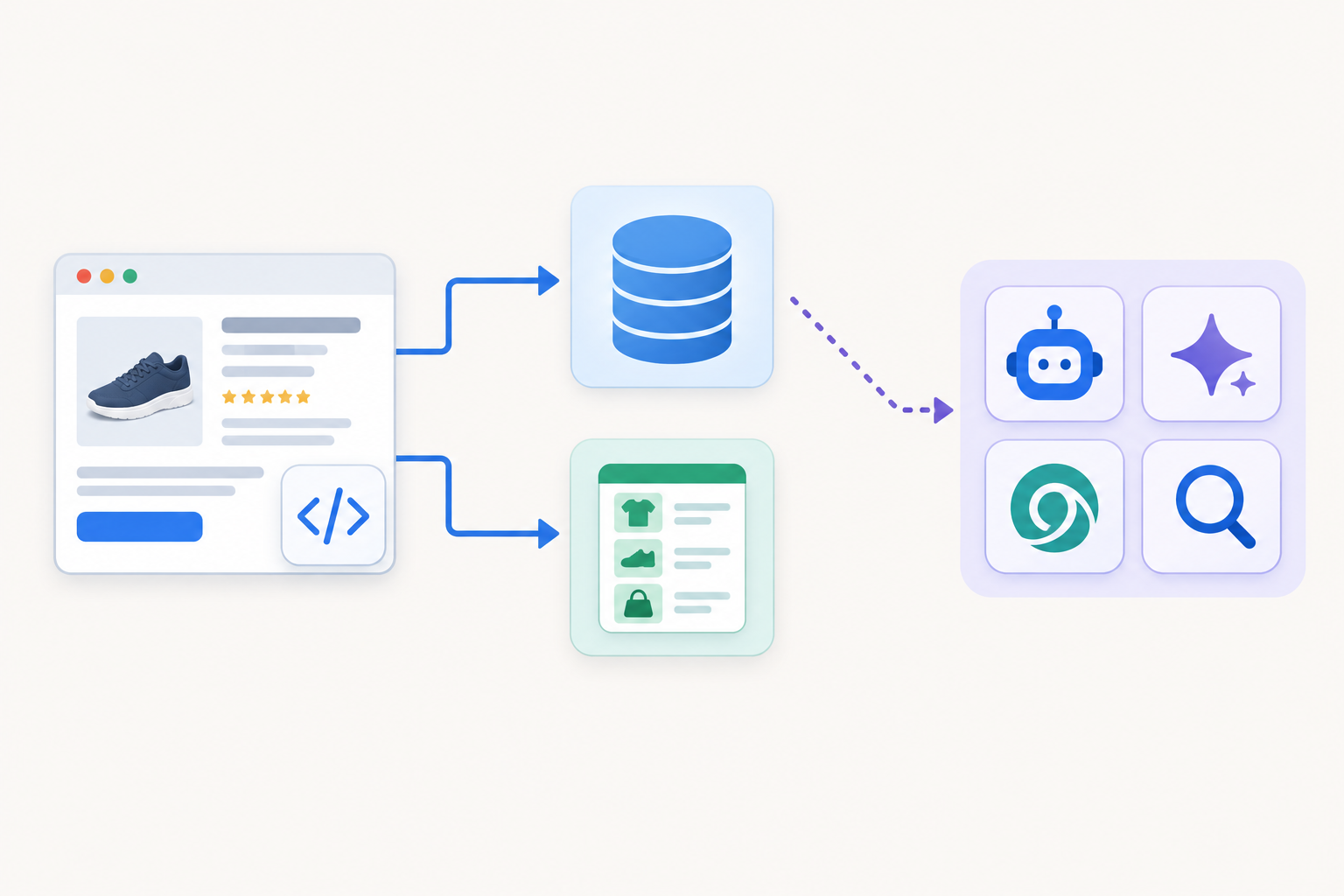
Schema.org is a shared vocabulary, and most retailers deliver it as JSON-LD, a block of structured code that labels facts shoppers can already see. It can say that a number is the price, that the currency is GBP, that an item is in stock, or that an organisation is the seller. Schema labels facts. It does not add new ones, and it cannot make a thin page persuasive.
What is documented about schema and search
The documented benefits sit with traditional search. Google states that structured data helps it understand page content and can make a page eligible for features such as merchant listings and product snippets. Eligibility is not a promise of crawling, indexing or a rich result. Google's guidance on AI features in Search says no special AI-specific markup is required. It points site owners back to ordinary Search fundamentals, including structured data that matches visible content.
FAQ markup shows who controls display. In August 2023 Google limited FAQ rich results to well-known government and health sites and reduced HowTo rich results. Plenty of valid markup stopped producing any visible benefit overnight. Valid schema and visible benefit are different things.
What is inferred about schema and AI answers
The plausible route to AI answers is indirect. Some AI products retrieve live results from indexes or product data systems (Copilot via Bing, Gemini via Google, and others), and those systems do consume structured data. Google has described its Shopping Graph as holding tens of billions of product listings, refreshed continuously. The figure it gave in 2023 was over 35 billion, so check the current number at the source. If your price, availability and brand identity are machine-readable and consistent, you are plausibly easier to ingest correctly. That is an inference, not a published finding. None of the major AI providers has said schema raises citation rates, and I know of no rigorous, large-sample public experiment that isolates schema as the cause. Vendor and agency correlations tend to rely on small samples and non-standardised prompts. AI answers also vary from run to run, so be wary of confident claims.
Is schema markup a ranking switch for AI search?
The most common misconception I encounter is that schema is a switch you flip to get recommended. It is better understood as a way of reducing ambiguity. The facts most worth getting right are price, availability and brand identity, because an assistant has to state those correctly when it builds a shortlist. Several other factors probably matter more than markup, though none has been proven either way:
- Crawlability: if bots cannot fetch the page, nothing on it can be used.
- Clear on-page copy: specifications, use cases and comparisons in plain language.
- Third-party reviews: independent ratings and write-ups that back up your claims.
- Mentions on trusted sites: press, comparison sites and forums that name your brand.
Which schema types matter most for UK online stores?
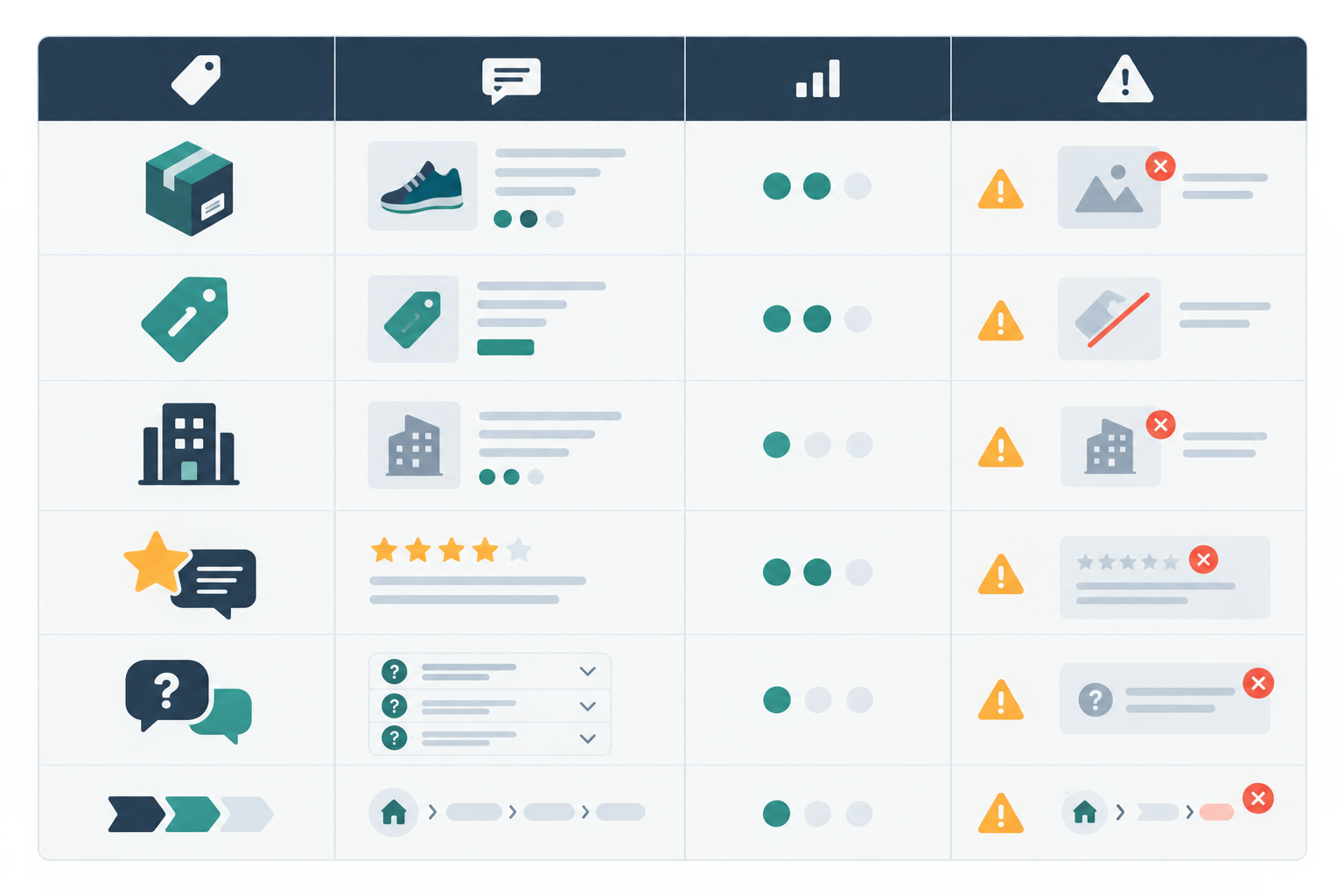
The priorities below are my practical recommendations, drawn from Google's documentation for product, merchant listing, review, organisation and breadcrumb markup. They follow where errors cost the most and where documented benefits exist. They are not a ranking proven to improve AI citations.
| Schema type | What it communicates | Priority for stores | Common mistakes |
|---|---|---|---|
| Product | Name, description, image, SKU, GTIN/MPN, brand; disambiguates near-identical items | High | Missing identifiers, generic descriptions, duplicate output from theme and plugin |
| Offer | Price, priceCurrency (GBP), availability, priceValidUntil, itemCondition | High | Price or stock status that differs from the visible page; stale values |
| OfferShippingDetails / MerchantReturnPolicy | Delivery costs and times, return window and method | Medium to high | Marking up a policy that is not shown to shoppers |
| Organization | Legal name, logo, URL, sameAs links, contact points; helps resolve your brand as a distinct entity | High | Inconsistent names across profiles; sameAs pointing to unverified or abandoned pages |
| AggregateRating / Review | Genuine customer ratings and review content | Medium (only if genuine) | Self-serving or invisible reviews; ratings not about that product |
| FAQPage | Question and answer pairs in machine-readable form | Low to medium | Expecting a rich result; marking up content not visible on the page |
| BreadcrumbList / WebSite | Site hierarchy and site identity | Low to medium | Breadcrumbs that do not mirror real navigation |
Product and Offer schema for product pages
Product is the central type, and Offer carries the commercial facts. Set priceCurrency to GBP and make availability reflect real stock. Include GTIN or MPN wherever you have them, because identifiers are what separate your 500ml navy bottle from a near-identical competitor's. Mark up the store-wide return policy at organisation level, and use offer-level details only where a product differs.
Review and AggregateRating schema
Use AggregateRating and Review only for genuine reviews that users can see on the page and that concern the product itself. Google treats invisible, self-serving or unrelated ratings as policy violations. You risk losing rich result eligibility and possibly a manual action. There is also the damage to your credibility if an assistant repeats a figure customers cannot verify.
Organization and FAQPage schema
Organization markup helps engines treat your brand as one entity. It carries your legal name, logo, URL and contact points, plus sameAs links to verified profiles such as your Companies House listing, social accounts and marketplace storefronts. That matters because an assistant has to decide whether 'Brand X' on a review site is the Brand X on your domain. FAQPage now offers machine-readable clarity rather than search result real estate. If your FAQs are useful and visible, marking them up costs little, but don't expect a visual payoff.
How to implement schema markup on an e-commerce site
Follow these steps in order. The early ones prevent the most expensive errors.
Audit what you already have. Shopify, WooCommerce, BigCommerce and Magento themes often output partial Product schema. Inspect the rendered page rather than assuming every field is correct.
Prefer JSON-LD. It is Google's recommended format and easier to maintain than Microdata woven through templates.
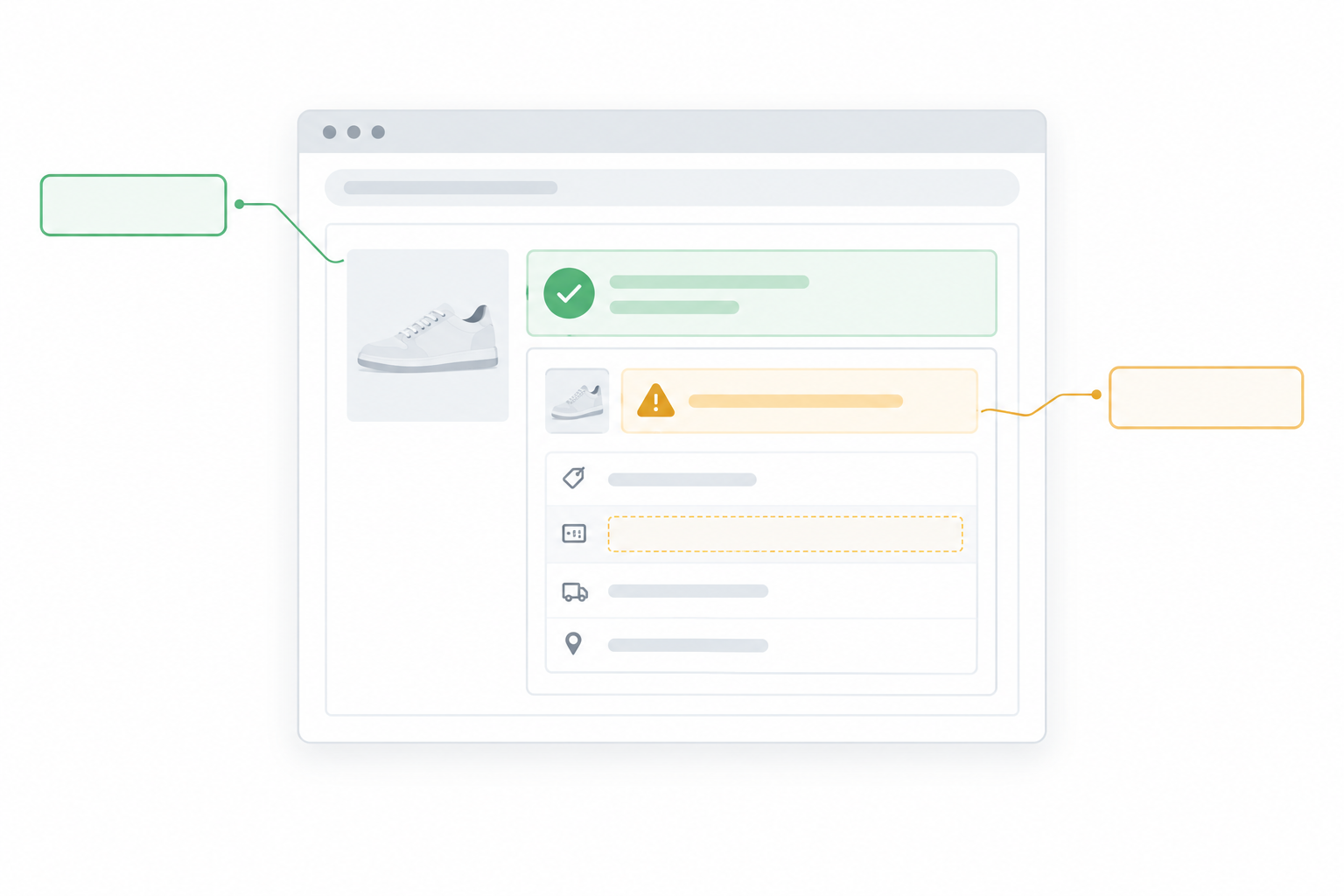
Match visible content exactly. Price and stock in the markup must equal what the shopper sees. The most reliable way to keep them aligned is to generate the JSON-LD from the same catalogue record that renders the page.
Avoid duplicate or conflicting markup. If a theme and a plugin both emit Product schema, you can end up with two prices or two availability values. Pick one source and disable the other.
Add identifiers and reconcile feeds. Include GTIN and MPN, and check price, availability and identifiers against your Merchant Center feed, since Google can compare the two.
Handle variants carefully. Use ProductGroup with hasVariant and variesBy, or separate URLs each with their own Offer, following Google's variant guidance.
Keep JSON-LD in the initial HTML. Some AI crawlers may not execute JavaScript, so server-rendered markup is the safer choice.
Make a deliberate decision on bot access. Different controls do different jobs, and mixing them up leads to mistakes. Names and purposes change, so check each provider's current documentation:
- OpenAI (documentation) lists separate user agents. OAI-SearchBot relates to surfacing sites in ChatGPT search, GPTBot relates to training generative models, and ChatGPT-User covers user-initiated fetches. Blocking GPTBot does not block OAI-SearchBot, and vice versa.
- Google (crawler overview) crawls with Googlebot. Google-Extended is a robots.txt control token rather than a separate crawler. It governs whether content is used for Gemini training and grounding, and it does not affect Search inclusion or ranking. Blocking Googlebot would remove you from Search.
- Anthropic (documentation) separates training crawling (ClaudeBot) from user-driven and search-related access.
- Perplexity (documentation) distinguishes PerplexityBot, used to surface sites in its results, from user-initiated requests.
- Bing: Copilot draws on Bing's index, so Bingbot access matters.
For each one, ask two questions. Do I want to appear in that product's answers? Do I want my content used for training? Then check CDN and firewall rules too, which can block bots even when robots.txt allows them.
Run a technical audit. Access, rendering and markup problems hide in different places. A crawler such as Screaming Frog, plus a look at the raw HTML with JavaScript off, will catch blocked bots and JavaScript-only prices.
How to validate schema markup
Validation confirms your syntax and your eligibility for supported features. It does not show that any AI engine will cite you.
- Run key pages through Google's Rich Results Test. A missing GTIN typically appears as a warning rather than an error.
- Use the Schema Markup Validator for general schema.org syntax.
- Monitor Search Console and Bing Webmaster Tools. The Enhancements and Merchant listings reports reveal site-wide issues. Microsoft has also announced an AI Performance report in Bing Webmaster Tools, which reports citations in Microsoft AI experiences (see the Bing Webmaster blog). It was introduced in public preview, so confirm its current status and availability before relying on it.
- View the raw HTML. Fetch the page without JavaScript to confirm the JSON-LD appears for crawlers. URL Inspection in Search Console shows how Google rendered it.
- Test templates, then crawl at scale. Check an in-stock product, an out-of-stock product, a variant page, a collection page and the homepage. After that, crawl the catalogue for inconsistencies.
- Keep a change log. Record the date and scope of every markup change, or later analysis has no clean before-and-after.
How to measure whether AI search visibility changes
Causality is unproven, so measuring is the only honest way to learn whether schema helped your store. Be realistic about what that can show. An uncontrolled before-and-after comparison cannot establish that schema caused a change, because AI answers vary between runs and may also differ by account history, personalisation, location and model updates. The aim is a protocol consistent enough that a large change stands out from noise.
A minimum viable AI visibility measurement protocol
- Fix a prompt set of 20 to 30 purchase-intent questions in the language your customers use, such as 'best waterproof walking boots UK'. Do not change it mid-test.
- Hold conditions constant: the same UK location, logged-out or a dedicated clean account, and the same platforms each time. Start with two or three (for example ChatGPT, Gemini and Perplexity) rather than all five.
- Sample repeatedly. Run each prompt three times per session, weekly, since a single run is an anecdote. Daily runs across five platforms multiply to thousands of answers a month, which is rarely sustainable by hand.
- Record everything in a spreadsheet: date, platform, prompt, whether you were mentioned, cited (linked) or only named in prose, which competitors appeared, and how you were described.
AI search visibility metrics worth tracking
- Query coverage: the share of tracked prompts where you appear at all.
- Citation position: being the first source cited counts for more than the fifth.
- Share of voice: your mentions relative to named competitors across the same prompts.
- Soft mentions: the brand named without a link, which is common in AI answers.
- Sentiment: whether the description is favourable, neutral or hedged.
Here is a worked example. With 25 prompts run three times each, you have 75 answers per platform per week. Say you appear in 15 of them in the baseline weeks (20%) and 18 after the change (24%). That gap sits well within normal run-to-run variation and proves nothing. If coverage reaches 40% and stays there for six weeks while competitors stay flat, you have something worth investigating. Composite scores can help with trend lines, but inspect the components anyway. A rise in soft mentions means something different from a rise in citations, and any score is only meaningful if its method is published.
A more rigorous schema markup test
If you have the resources, run a controlled rollout. Add Product and Offer schema to one category and leave a comparable category untouched, keeping copy, pricing and promotions steady. Then compare coverage for each category's prompts over at least eight weeks. Competitors act as a second, looser control: if their visibility rises by the same amount, suspect a platform-wide shift. The limits remain. Categories are never perfectly matched, sample sizes are small, and results from one store may not generalise.
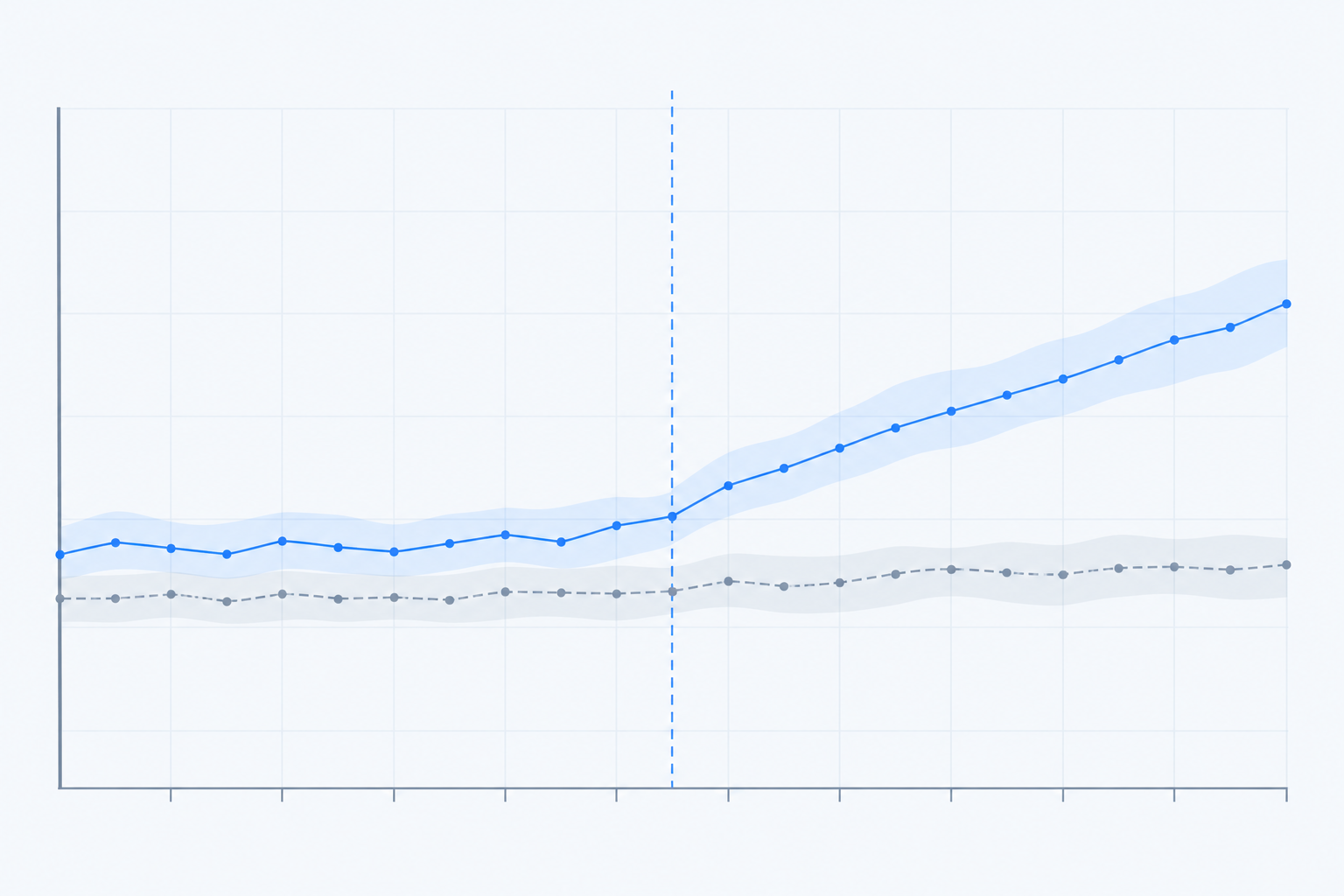
Before you look at results, write down what would convince you schema made no difference. For instance: no movement in coverage beyond the normal variation band after eight weeks. Setting that threshold in advance stops you reading a favourable story into noise.
Measure AI visibility separately from visits
A citation is not a click. A Pew Research Center analysis of the browsing of 900 U.S. adults in March 2025 found that users clicked a traditional result in 8% of visits when a Google AI summary appeared, versus 15% without one. They clicked a link within the summary in about 1% of visits. That is an association from one US study, not evidence about schema or UK shoppers, but it shows why visibility and traffic should be measured separately. Search Console folds AI feature traffic into the overall Web search type without a dedicated filter, and it retains 16 months of data, enough to annotate deployments and compare with last year. Analytics referral reports can show AI-assistant referrals directly.
If you would rather not log answers by hand, automated monitoring tools exist. MentionOwl, the product I work on, runs a customer-question set daily across the major assistants and offers a $1 seven-day trial (billed in US dollars). Alternatives include other AI visibility trackers or a disciplined spreadsheet like the one above. Whatever you use, check how it handles repeat sampling and location.
What to prioritise if you have limited time
If you only have an hour or two, do the first item. Then work down in order:
- Check crawler access and rendering. Nothing else works if bots cannot read your pages.
- Make Product and Offer markup accurate and consistent with visible prices and stock.
- Add a clean Organization entity with sameAs links.
- Strengthen the content around the markup: specifications, comparisons, delivery and returns policies, genuine reviews.
- Build off-site signals such as reviews, press and comparison-site mentions.
- Review results monthly and adjust, rather than treating schema as a one-off project.
Frequently asked questions about schema markup and AI search
Does schema markup improve ChatGPT citations?
There is no confirmed evidence that it does directly, and OpenAI has not said schema influences which sources ChatGPT cites. ChatGPT search relies on web indexes and crawlers, so well-structured pages may be easier to interpret, but that is an inference. The reliable way to find out for your store is to monitor citations before and after a change.
Which schema types matter most for UK online stores?
Product and Offer (with GBP pricing and accurate availability) come first, then Organization, then MerchantReturnPolicy and shipping details. Review and AggregateRating are appropriate only for genuine, visible reviews. FAQPage is optional and now mainly aids clarity.
How do I test schema markup?
Use the Rich Results Test and Schema Markup Validator for syntax. Check Search Console's enhancement and merchant listing reports for site-wide issues, and view your page source without JavaScript to confirm the markup is present for crawlers that do not render scripts.
How long before schema changes show up in AI answers?
It varies. Engines that retrieve live results may reflect changes within days or weeks once pages are recrawled, while model-based knowledge updates far more slowly. Track several weeks of data and treat early movements cautiously.
Can wrong or misleading schema hurt my store?
Yes. Markup that does not match visible content, such as incorrect prices or invented ratings, can breach guidelines, cost you rich result eligibility or trigger manual actions, and it erodes trust in your data. Accuracy matters more than volume.
The takeaway: treat schema as good data hygiene
Treat schema as good data hygiene with a plausible, not proven, upside for AI search. Get the facts right, make sure bots can read them, validate the result, and let consistent, repeated measurement tell you whether your visibility moved. A sensible first step today: pick one product page, run it through the Rich Results Test, and confirm the price in the markup matches the price on screen. 🦉