How AI Shopping Assistants Are Reshaping Ecommerce Product Discovery: A Guide for UK Stores
AI shopping assistants are reshaping product discovery. Learn why shoppers skip search results, how to track AI recommendations and improve your product pages.

AI shopping assistants compress the old routine of searching, clicking and comparing into one conversational answer that names only a handful of products. A store missing from that shortlist is invisible at the moment of decision. The practical response has three parts: measure how often and how favourably assistants mention your products, find out why competitors are chosen instead, and make your product pages easier for language models to read, verify and cite. I recommend starting with a baseline of buying-intent questions run across several assistants, then fixing the gaps it reveals.
This guide covers how AI product discovery works, why shortlists favour a few brands, which page features to prioritise, how to monitor your presence, and a four-week plan for UK stores. Disclosure: I am part of the team that builds MentionOwl, an AI visibility monitoring tool, which is mentioned once in the monitoring section. The workflow here works without it.
How shoppers use AI shopping assistants to build shortlists instead of browsing results pages
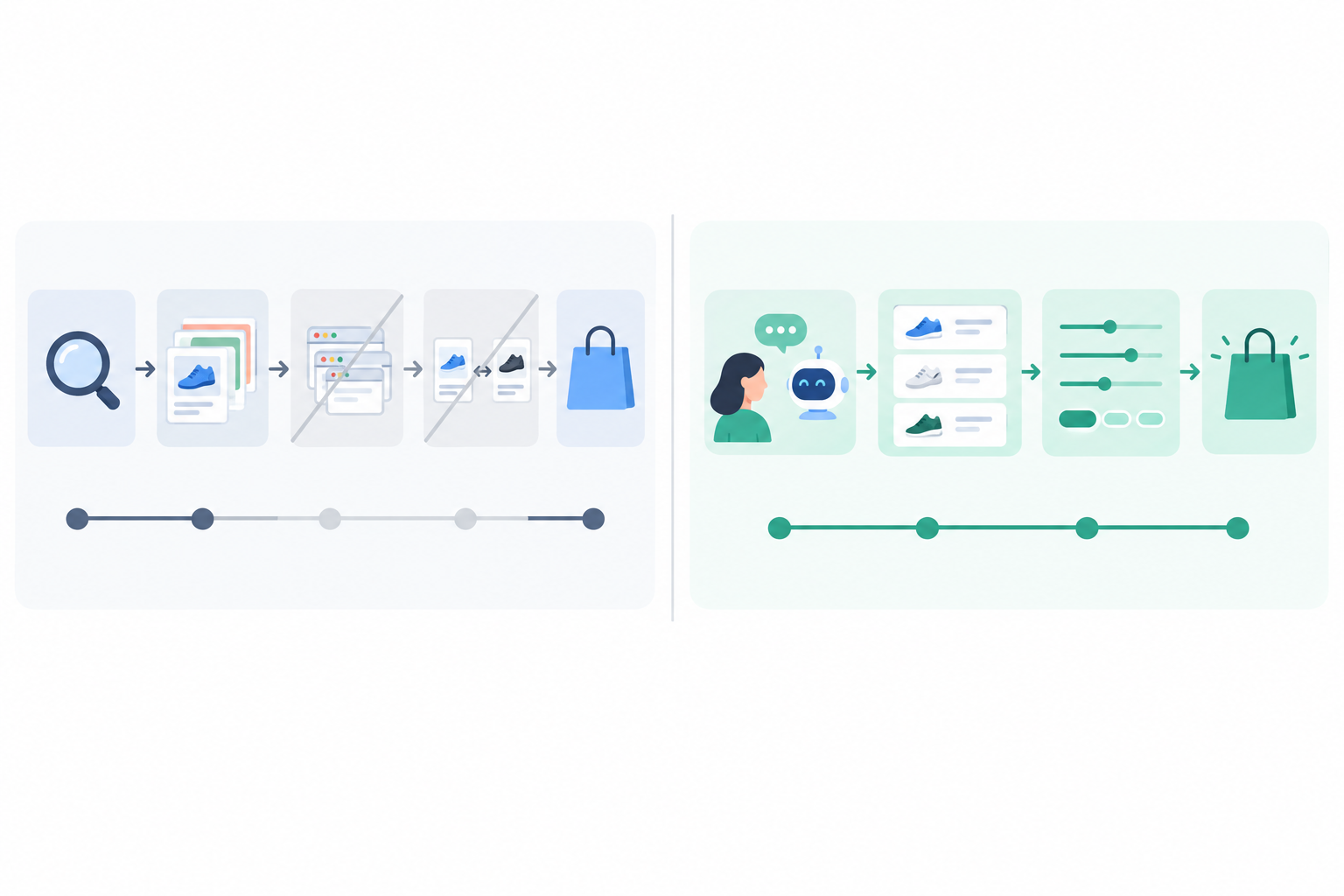
A shopper who once typed 'walking boots' into a search engine and opened eight tabs now writes something closer to 'best waterproof walking boots under £150 for wide feet' and receives a reasoned shortlist, with a sentence or two of justification for each option. There are no ten blue links to evaluate and no dozen retailer descriptions to reconcile by hand. The journey tends to follow four stages:
- Problem framing: the shopper describes a need, a budget and constraints in natural language.
- Shortlist generation: the assistant names a small set of products, usually with reasons.
- Refinement: follow-up questions narrow the field ('which is lightest?', 'any with free next-day delivery?').
- Final check: the shopper verifies price, delivery or reviews, often on a retailer's site, and then buys.
If this pattern spreads, the comparison phase that once generated many sessions on a store's own site moves inside the assistant. By the time a shopper reaches your product page, the field may already be cut to two or three names.
What does the adoption data say about AI shopping?
A caution first: none of the figures below measures UK shopping behaviour in AI assistants. They are global or US studies from 2024, and I have found no robust, recent UK study of generative AI use for product research. Ofcom and the ONS cover general technology use but not shopping inside assistants. I therefore treat these figures as context for a plausible trend, not proof that UK shoppers have already changed how they buy. Each is linked so you can check the methodology yourself.
- Capgemini Research Institute, 'Why consumers love generative AI' (2024): a survey of 10,000 consumers in 13 countries, in which 58% said generative AI had replaced traditional search engines for product and service recommendations. This is self-reported attitude data.
- Adobe Analytics, 2024 holiday season reporting: traffic from generative AI sources to US retail sites rose by roughly 1,300% year over year. That is growth from a very small base, not the share of shoppers using assistants.
- Salesforce, 2024 holiday shopping data: AI and AI-powered agents influenced an estimated 19% of global online orders, around US$229 billion. 'Influenced' includes recommendation engines and search features, not only standalone chat assistants.
- Gartner, February 2024 prediction: traditional search engine volume will fall 25% by 2026. It is a forecast, and I treat it as a scenario, not a result.
These studies measure attitudes, referral traffic, influenced orders and a projection respectively, so they cannot be combined into one adoption rate. Together they support a direction of travel and nothing more. The reliable UK evidence will be your own, which is why the baseline described below matters. Major retailers are also building assistant-led discovery into their own channels, such as Amazon's Rufus (announced in the US in February 2024), but these are US launches. They are design precedents, not evidence of UK adoption.
How do different AI search surfaces retrieve products?
Each surface retrieves and cites differently:
- Conversational assistants such as ChatGPT, Claude and Gemini, which blend training data with live retrieval in some modes.
- Answer engines such as Perplexity, which foreground citations.
- AI-generated summaries in search results and browsers, including Copilot.
- Retailer-owned assistants, which operate within a single catalogue.
In practice, ecommerce AI search means the discovery layer is shifting from ranking pages to composing answers.
Why AI shopping shortlists are winner-take-most
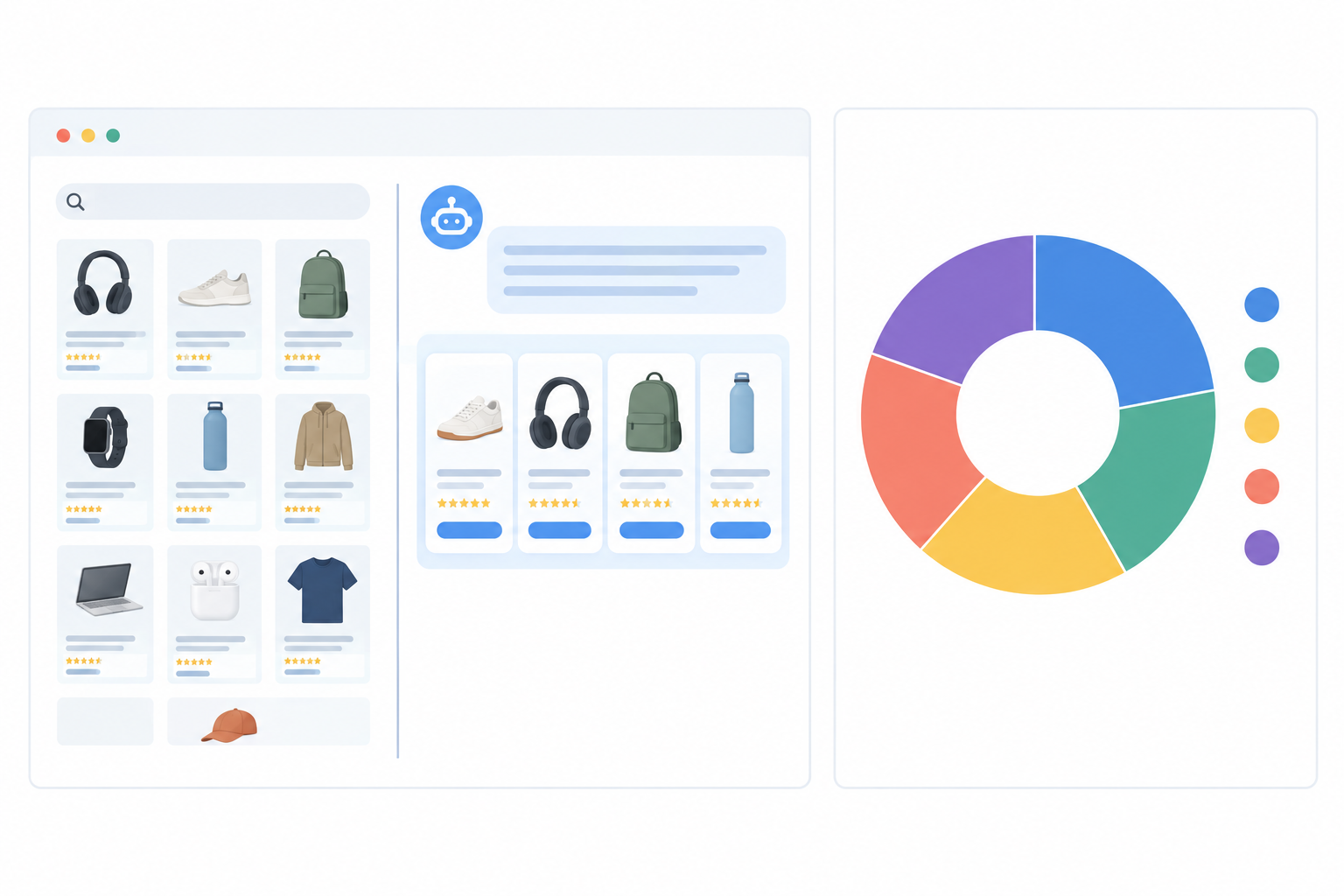
The structural reason is arithmetic. A results page offers dozens of positions across organic listings, ads and shopping units, whereas an AI answer typically names three to five products. My hypothesis is that brands named first receive disproportionate attention and trust. That is an inference from the interface, not proven sales concentration, and visibility share should not be confused with clicks, consideration or revenue. Still, a product that is never surfaced may never be compared.
The corroboration hypothesis for AI product discovery
From reviewing assistant answers, I suspect assistants favour products that are well cited, well reviewed and consistently described across the web. A brand that appears in editorial roundups, has a healthy volume of independent reviews and is described the same way on its own site, in marketplaces and in forums gives a model many corroborating signals. A brand with sparse or inconsistent coverage is harder to describe with confidence. Testing this requires tracking the same brands over many months to see whether those with more independent coverage gain and keep share of voice. Your baseline is where that measurement begins.
How to measure share of voice, position and soft mentions
A single ranking position is the wrong metric here. Share of voice is the better one: your brand's mentions as a proportion of all brand mentions across a fixed set of buying questions. Two refinements matter. First, weight position, because being listed first is worth more than appearing last. Second, count soft mentions, since a brand named without a link still shapes perception. The scoring method below builds both in.
What do AI shopping assistants look for in a product page?
No one publishes ranking factors for AI shopping answers. Google's guidance on AI features in Search says that following established Search technical and content guidelines is the recommended approach, and it promises no inclusion. The practices below are sound ecommerce hygiene that make a page easier to interpret, verify and quote. They are not known ranking factors. I have grouped them by priority.
Essentials:
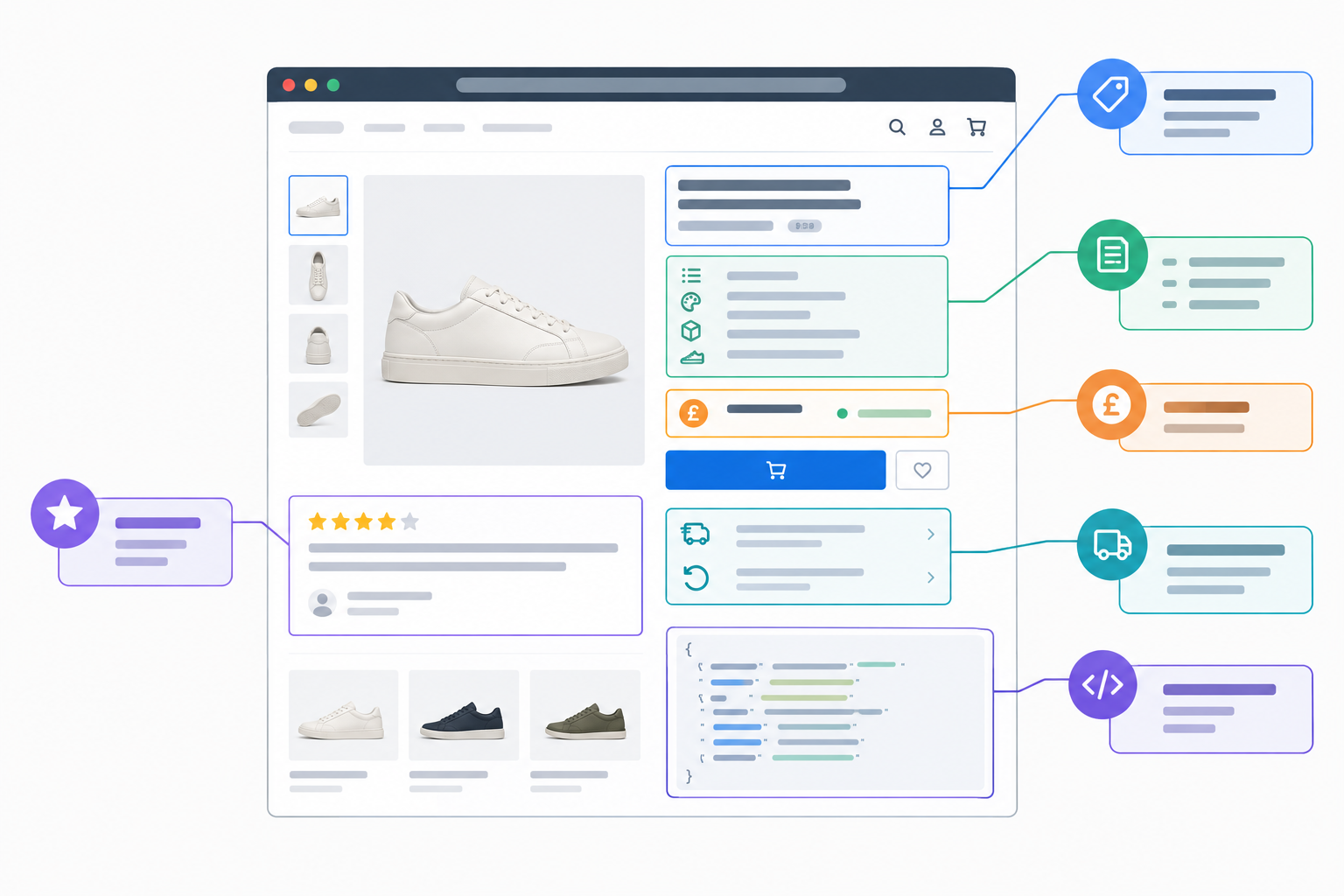
- Product facts in plain HTML. Materials, dimensions, compatibility, ingredients, sizing, price and availability should sit in page text, not in images, tabs that fail to render, or PDFs. Nielsen Norman Group's ecommerce product page research found inadequate product information behind roughly 20% of observed task failures. That is a 2015 usability finding, not an AI measurement, but the logic carries over: a model asked about suitability needs explicit facts to quote.
- Crawlability and rendering. Use sensible robots.txt and meta directives, render cleanly without heavy client-side JavaScript, and keep sitemaps and canonical URLs in order. Access matters only for systems that fetch live pages, and assistants differ in whether they use live access, partner feeds, search indexes or training data alone.
- Trust and policy information. Returns, UK delivery times and costs, VAT-inclusive GBP pricing and warranty details should be easy to extract.
- Clear identifiers. Use consistent naming plus GTIN, MPN and SKU.
Secondary experiments:
- Structured data. Product and Offer schema should match the visible page, including price and stock. Add AggregateRating or Review markup only where genuine customer reviews are displayed on that page and meet Google's review snippet guidelines; marking up invisible, self-written or third-party-sourced reviews breaches them. Google's product documentation describes eligibility for richer Search appearances, which is not evidence that any assistant reads the markup.
- Answer-shaped content. Write guides that answer 'which is best for X', 'is it suitable for Y' and 'how does it compare with Z'.
- Third-party corroboration. Independent reviews, roundups and comparison sites that describe your product consistently help here.
Two illustrations show what 'specific' means (both are best-practice examples, not measured results). A UK footwear retailer can give a trainer a precise model name, intended use, material, UK sizes, GBP price and per-variant stock, which gives an assistant firm evidence for 'waterproof walking shoes under £100 in size 8'. A UK electronics store can separate laptop configurations by processor, memory, storage and screen size instead of grouping them under a vague title.
How to monitor your presence in AI shopping answers
Answers differ by assistant, phrasing and day, and you might appear on Tuesday and vanish on Wednesday through sampling variation alone. Only repeated, structured sampling gives a trustworthy picture, and nobody outside the model providers can fully explain why one product is chosen over another. This is the protocol I recommend, and it is essentially what LLM monitoring means in practice.
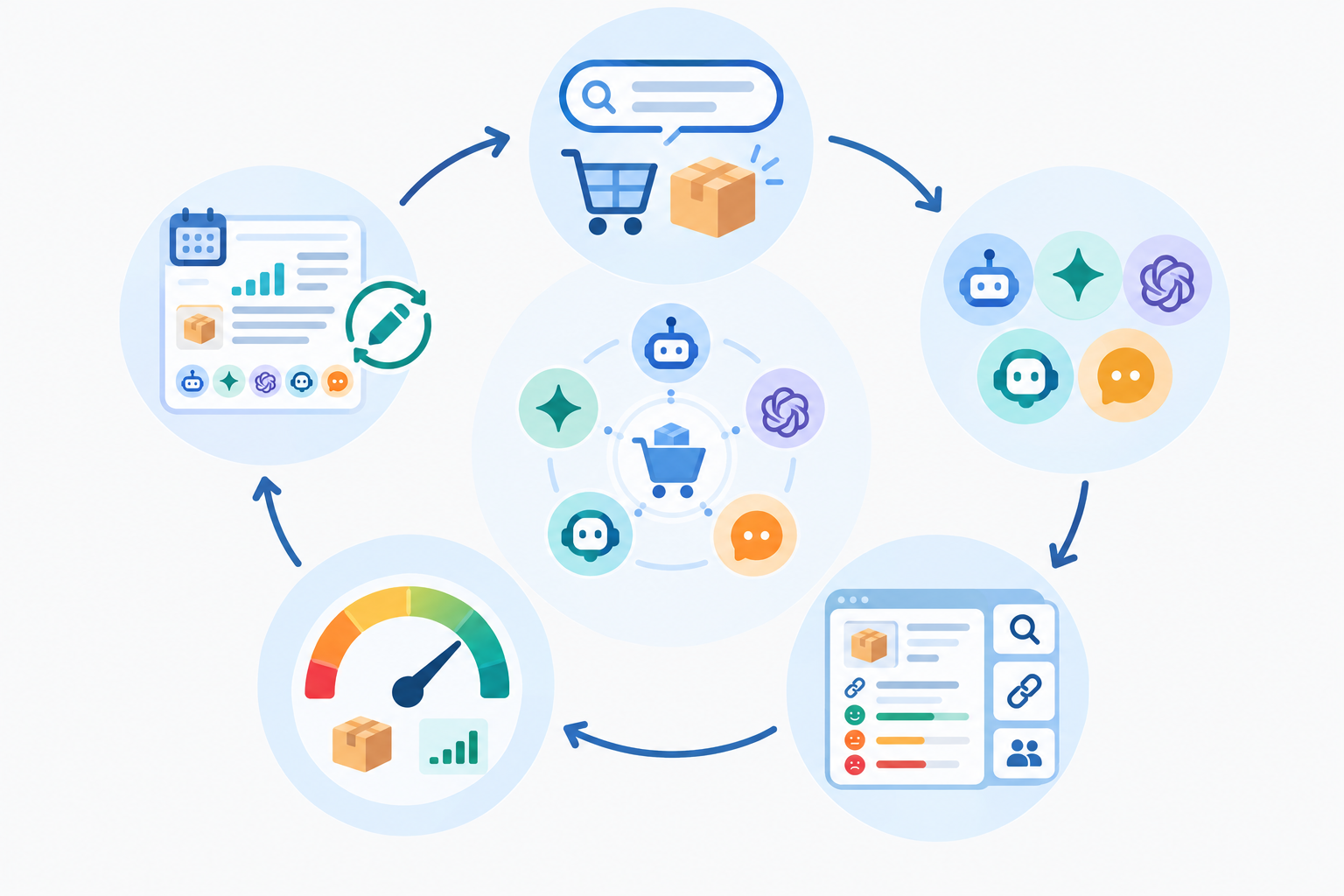
Fix the question set. Write 20 to 30 buying questions covering category, comparison, use-case, price-band and 'best for' queries, using British phrasing and UK constraints such as delivery and returns. Keep the wording identical from run to run, and change it only when you start a new baseline.
Control the conditions. Use logged-out or fresh sessions with memory and personalisation switched off, set to UK region and English language. Run at least three assistants, and log the date, assistant, model name or version shown, and whether web search or browsing was on, since retrieval mode changes answers. Repeat each question three times per assistant to average out variation. Re-baseline after a major model update, because results before and after are not strictly comparable.
Record each answer. Note whether you were mentioned, your position, the sources cited, the sentiment of the description and which competitors appeared.
Calculate a transparent score. The score is an index you define, not an industry standard, so consistency matters more than the exact formula. A simple version scores each run 3 points if you are named first, 2 if second, 1 if named later and 0 if absent, with linked and unlinked mentions counted equally. Then:
Visibility score = 100 × total points ÷ (3 × number of runs)
For example, 25 questions across 3 assistants with 3 repeats gives 225 runs and a maximum of 675 points. If you were named first in 12 runs, second in 14 and later in 14, you score 36 + 28 + 14 = 78 points, an index of about 11.6. Track share of voice (your mentions divided by all brand mentions) and sentiment separately, because blending them hides what is changing.
Identify who displaces you. Note which competitors appear, on which questions, and which cited sources seem to be doing the persuading.
Link visibility to outcomes cautiously. Where assistants pass referrer data, segment that traffic in analytics. Many assistant visits arrive without a referrer, so treat the numbers as a lower bound and look for correlation with visibility changes over several weeks.
Review weekly. Look for sustained movement, and save alerts for material shifts such as a sudden drop or negative sentiment.
A spreadsheet is enough for a pilot, and it teaches a great deal. Automating the daily runs is the main reason to use a tool. MentionOwl, which I work on, is one such option, and its features and trial terms are on its product page for you to assess independently. 🦉
Why isn't my product in AI recommendations?
Once you have a baseline, the pattern of absence usually points to a cause. These are hypotheses drawn from observation, so verify before investing.
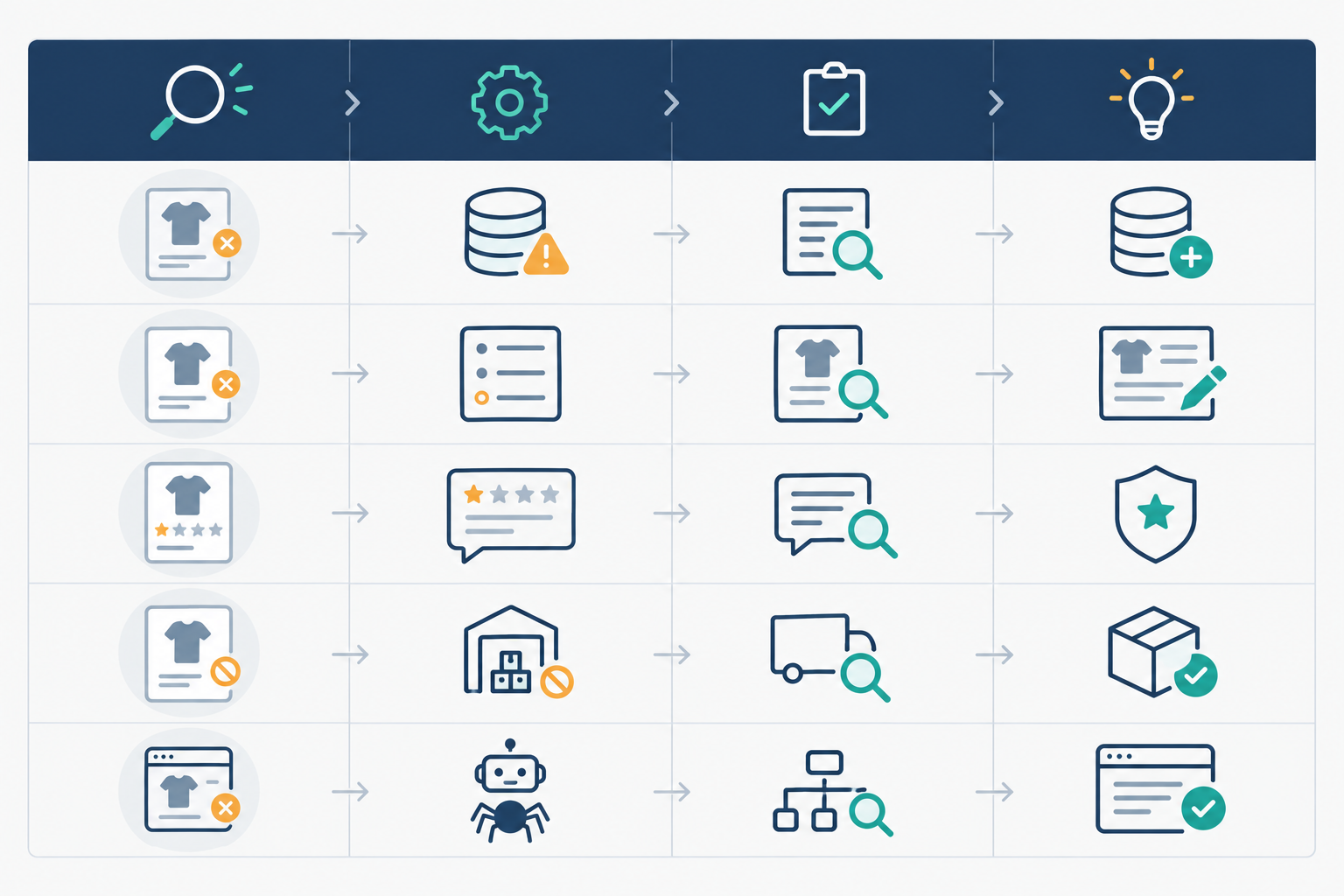
| Symptom | Likely cause | How to verify | Fix |
|---|---|---|---|
| Not mentioned for any category queries | Weak brand recognition, thin category content or, for systems that fetch live pages, blocked crawlers | Server log review; check whether the assistant cites live sources | Remove accidental crawler blocks; strengthen category pages; build independent coverage |
| Mentioned but described inaccurately | Outdated or conflicting third-party data | Inspect the cited sources | Correct listings; align structured data with visible content |
| Competitors dominate comparison queries | More review roundups and editorial coverage | Citation source analysis | Earn independent coverage; publish honest comparison content |
| Appears on one assistant only | Differing retrieval sources | Cross-platform tracking | Broaden source diversity |
| Mentioned with negative sentiment | Recurring complaints in reviews or forums | Read the cited sources | Resolve the issue and respond publicly |
Here is a hypothetical illustration, not a client result. A UK walking-boot retailer tests 25 questions across three assistants and is named in 4 answers, while two competitors appear in more than half. The cited sources show those competitors in several outdoor-magazine roundups, while the retailer lists boot widths only in a downloadable PDF. So the problem had two parts, a missing fact and missing third-party coverage, and only a baseline exposed both. AI SEO rests on sound technical and content fundamentals, and clever prompt tactics will not rescue thin product copy.
First steps for UK store owners: a four-week checklist
This four-week plan is modest enough for a small team to complete alongside normal trading. Owners can be merged if one person does everything.
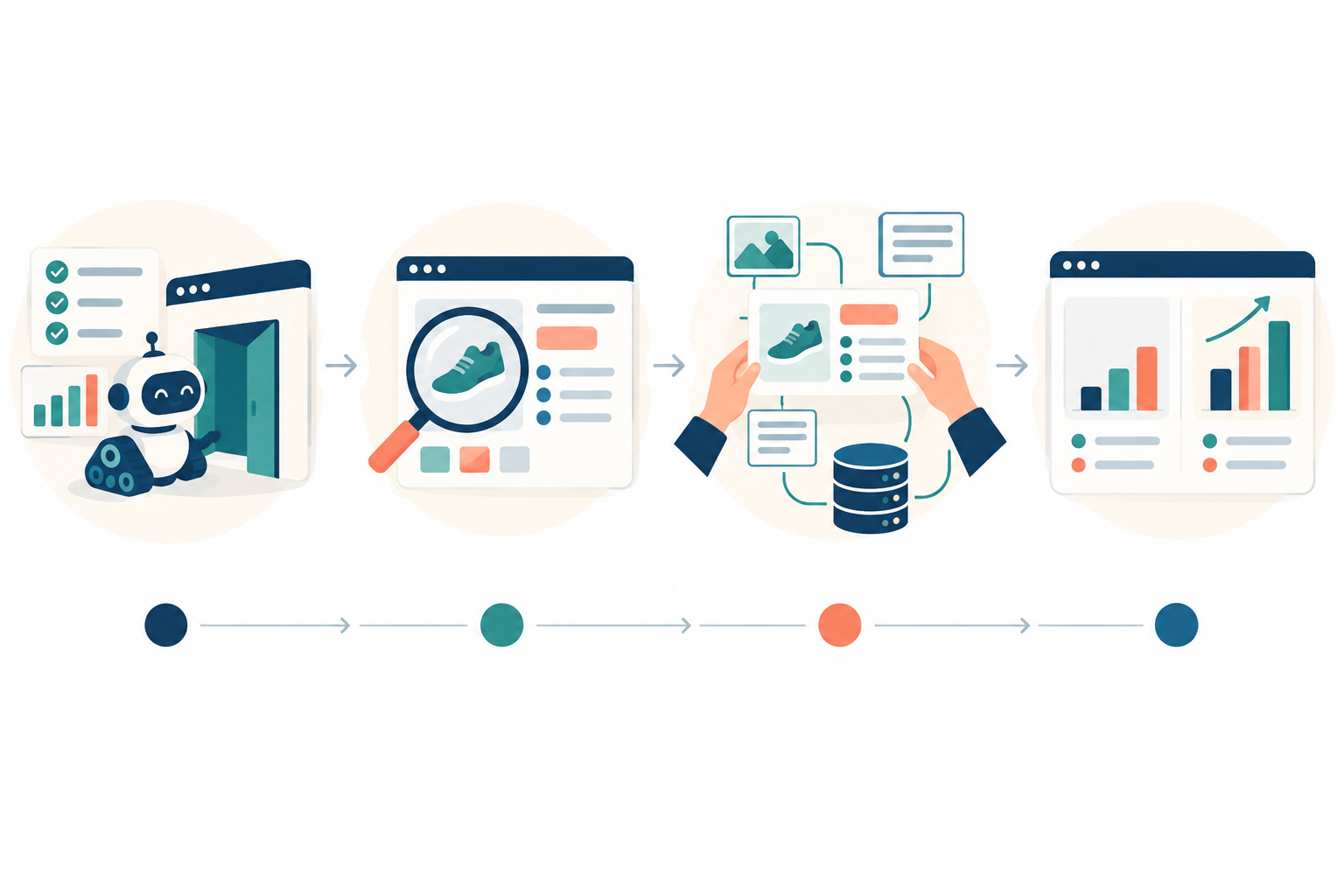
| Week | Action | Suggested owner | Success measure |
|---|---|---|---|
| 1 | Run the monitoring protocol above to set a baseline score and share of voice | Marketing lead | Baseline recorded in one spreadsheet |
| 1 | Check AI crawlers are not blocked in robots.txt, by your CDN or by your firewall, and that key pages render without JavaScript | Developer or agency | Key pages readable as plain text |
| 2 | Audit your top ten product pages for complete specifications, visible pricing, delivery and returns information, and valid schema | Ecommerce manager | Ten pages with no missing core facts |
| 2 | List factual errors in what assistants say about your brand, with the source of each | Marketing lead | Error list with sources |
| 3 | Identify the five sources most cited in your category and plan accurate representation there | Marketing or PR lead | Five target sources with outreach plan |
| 3 | Publish or improve two or three answer-led buying guides where you are absent | Content owner | Pages live and indexed |
| 4 | Re-run the identical question set and compare with the baseline | Marketing lead | Change documented, next three actions chosen |
Afterwards, review a weekly digest and treat AI visibility as a metric alongside rankings and conversion.
One warning: avoid manipulative prompt-stuffing and fake reviews. The Digital Markets, Competition and Consumers Act 2024 prohibits fake reviews and gives the CMA direct enforcement powers, including fines, so beyond reputational damage the legal risk is real. Check the CMA's current guidance on online reviews before you plan any review programme.
What AI shopping assistants mean for UK stores over the next 12 months
Discovery is moving, at a pace we cannot yet measure for the UK, from page rankings towards answer composition. If the corroboration hypothesis holds, brands that measure and shape their presence early gain an advantage. The evidence base is young and assistant features change quickly, so I would neither panic nor shrug. Establish a baseline, learn from the data and fix what it shows. A spreadsheet pilot or a tool such as MentionOwl can both get you there, because the method of repeated structured observation followed by targeted fixes works with any tooling.
Frequently asked questions about AI shopping assistants
Will AI replace Google Shopping?
Not outright, on current evidence. Google Shopping remains a feed-driven marketplace with enormous reach, while assistants add a conversational layer on top of discovery. Coexistence is more plausible, with more early-stage research happening in assistants and purchases still routed through feeds, retailer sites and marketplaces. Keeping your product feed accurate stays valuable, and it gives AI systems clean data too.
Why isn't my product in AI recommendations?
The most common causes I see are thin product information, a lack of independent reviews or editorial mentions, inconsistent descriptions across the web and, for assistants that fetch live pages, crawler access problems. Use the diagnostic table above to match your symptom to a cause.
How can I see which competitors appear instead of me?
Run the monitoring protocol above and record every brand named, its position and the sources cited. Manual tracking works for a pilot, and automation helps once you need daily coverage at scale.
Can I pay to be included in AI shopping answers?
Not in organic answers, as far as I am aware. Some platforms have tested sponsored placements and shopping integrations, and these change quickly, so check each platform's current advertising documentation. Accurate data, strong content and independent corroboration remain the more durable route.
How often should I check my AI visibility?
Sample daily or several times a week, and review trends weekly. A single check tells you little, whereas weekly review smooths out noise while still surfacing real changes.
Sources
All figures were checked against the publishers' pages at the time of writing; please consult the current versions, as reports and guidance are updated. Capgemini Research Institute (2024); Adobe Analytics holiday season reporting (2024); Salesforce holiday shopping data (2024); Gartner press release (19 February 2024); Nielsen Norman Group ecommerce product page research (2015); Google Search Central documentation on AI features, product structured data and review snippets; Digital Markets, Competition and Consumers Act 2024 (legislation.gov.uk).