AI Shopping Assistants Are Reshaping Product Discovery: How to Avoid the Shrinking Shortlist
AI shopping assistants like ChatGPT and Gemini now curate product shortlists before shoppers see a search results page. Here's how UK e-commerce brand
AI Shopping Assistants Are Reshaping Product Discovery: How UK E-Commerce Brands Can Avoid the Shrinking Shortlist
AI shopping assistants are changing how products get found online. Instead of a search results page with ten links, shoppers increasingly get a synthesised answer naming three to five products, built from citation frequency, structured data quality, and sentiment signals rather than paid placement alone. For UK e-commerce brands, the risk is straightforward: if you're not in that shortlist, you're not part of the decision at all — regardless of how well you'd rank on a traditional search page.
This is not a replacement for search. It's a discovery layer sitting on top of it, growing faster than most retail teams have noticed, and governed by rules that don't map cleanly onto a decade of SEO experience. The data I track at MentionOwl — across a running panel of roughly 4,000 category queries per month spanning ChatGPT, Google's AI Overviews, Perplexity, and Amazon Rufus, refreshed weekly since early 2024 — shows a widening gap between brands that have adapted their content for these systems and brands that haven't. That gap, and what to do about it, is what this article covers.
I want to be upfront about the evidence base before I go further, because I think brands get burned by trend pieces that overstate certainty. Adobe Analytics reported a 1,300% year-over-year increase in traffic referred from generative-AI services to US retail websites during the November–December 2024 holiday period, with AI-referred visitors converting at a rate roughly 9% higher than other channels. That's a genuinely striking figure, but two caveats matter. First, the starting base of AI-referred traffic was small relative to total site traffic, which makes percentage growth look more dramatic in isolation than the absolute numbers would suggest. Second, it's US-specific data — I haven't seen a methodologically comparable figure published for UK retail traffic, so I won't claim the UK saw the same 1,300% shift. What I can say with confidence is directional: something new is forming above traditional search, and UK brands dismissing it because the headline statistic is American are making a costly assumption.
What Are AI Shopping Assistants? Definition and Examples
AI shopping assistants are conversational systems, built on large language models, that help shoppers discover, evaluate, and compare products using natural-language prompts rather than keyword searches or category filters. The category includes ChatGPT's shopping research features, Google's AI Overviews and AI Mode, Microsoft's Copilot for Shopping, Perplexity's answer engine, and retail-native tools like Amazon's Rufus.
It's important not to treat these as one interchangeable "AI search" layer, because they pull from meaningfully different sources and use different mechanisms to decide what to show a shopper:
| Platform | Primary data source | Typical use case | Key limitation |
|---|---|---|---|
| ChatGPT | Web content, live product feeds via plugins/partnerships | Broad research and comparison queries | Coverage depends heavily on which retailers have integrated feeds |
| Google AI Overviews / AI Mode | Search index + Shopping Graph + merchant feed data | Everyday commercial queries inside Google Search | Strongly favours brands with clean Google Merchant Center data |
| Perplexity | Real-time web retrieval and citation | Research-style comparison questions | Citations skew toward publishers with strong existing search visibility |
| Microsoft Copilot for Shopping | Bing index + Microsoft Merchant Center feeds | Comparison shopping inside Bing/Edge | Smaller UK user base than Google-based surfaces |
| Amazon Rufus | Amazon's own catalogue, reviews, and Q&A data | In-marketplace product questions | Effectively invisible to brands without a strong Amazon listing, regardless of website quality |
A concrete example makes the difference less abstract. Imagine a UK shopper typing: "Which waterproof running shoes under £120 are best for wide feet?" A traditional search engine returns a page and lets the shopper do the comparison work — scrolling, opening tabs, and cross-referencing spec sheets. An AI shopping assistant instead collapses that into a single answer, typically naming two or three products with a short justification for each: this one for a wider toe box, this one for grip on wet pavement, and this one for value at the lower end of the budget.
That answer draws on whatever mix of product-detail pages, structured merchant data, customer reviews, and third-party comparison content the platform has access to for that query. A brand absent from that underlying data pool is very unlikely to be surfaced — though I should be precise here: most platforms don't publish exactly how their candidate sets are formed, so "never considered" is my working interpretation of observed patterns rather than a confirmed mechanism disclosed by any of these companies.
This matters more now than eighteen months ago because Google confirmed AI Overviews had expanded to more than 100 countries and territories by October 2024, including the UK, having launched first in the US in mid-2024. I want to be careful about what that rollout timeline does and doesn't prove: geographic availability tells us the feature exists in the UK market, not how many UK shoppers actively use it, how often it appears for commercial queries, or how it's changing UK purchase behaviour specifically. I haven't seen robust, publicly available UK adoption data for AI shopping assistants at the time of writing, and I'd rather flag that gap plainly than manufacture false precision. What the rollout does tell us is that this is becoming an increasingly common feature in UK search results, not an experimental novelty — reason enough to start paying attention even without UK-specific usage statistics.
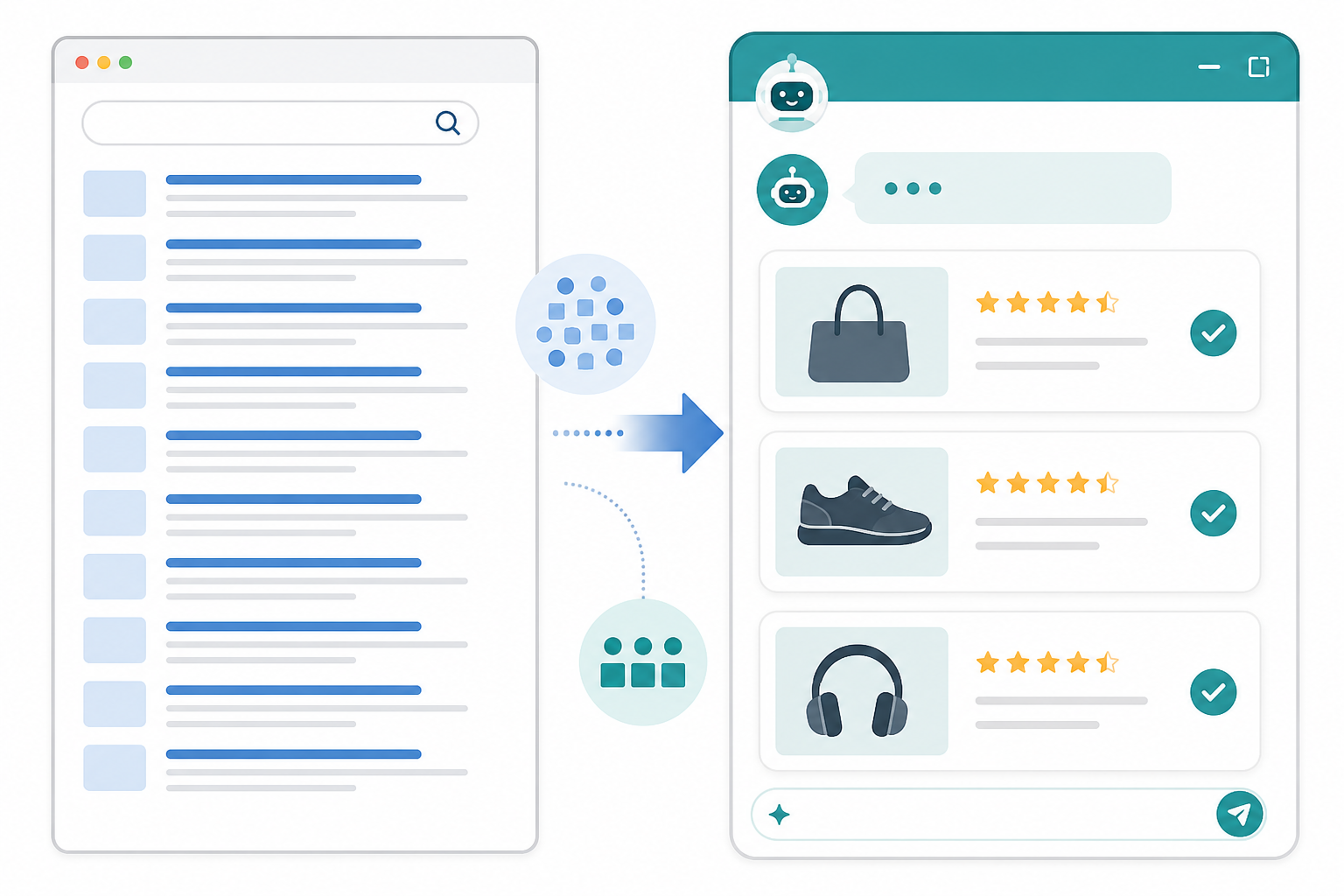
One more distinction worth making: these recommendations generally aren't paid placements, at least not yet on most platforms. A product gets selected because the model interprets it as a strong fit for the stated criteria, drawing on structured merchant feeds, product-detail pages, reviews, and third-party content. The inputs shaping AI shortlists overlap substantially with the inputs that have long shaped organic visibility — they're just weighted and synthesised differently, and considerably less forgiving of gaps in your product data.
How AI Shopping Shortlists Are Built
Most brand owners assume AI recommendation works like SEO with better manners. It doesn't. What follows is a practical measurement framework we've developed at MentionOwl by observing patterns across our tracked query panel — it's an evidence-informed model built from correlation, not a confirmed, universal ranking algorithm published by OpenAI, Google, or Amazon. No platform has disclosed its exact weighting formula, and I'd be sceptical of anyone who claims otherwise.
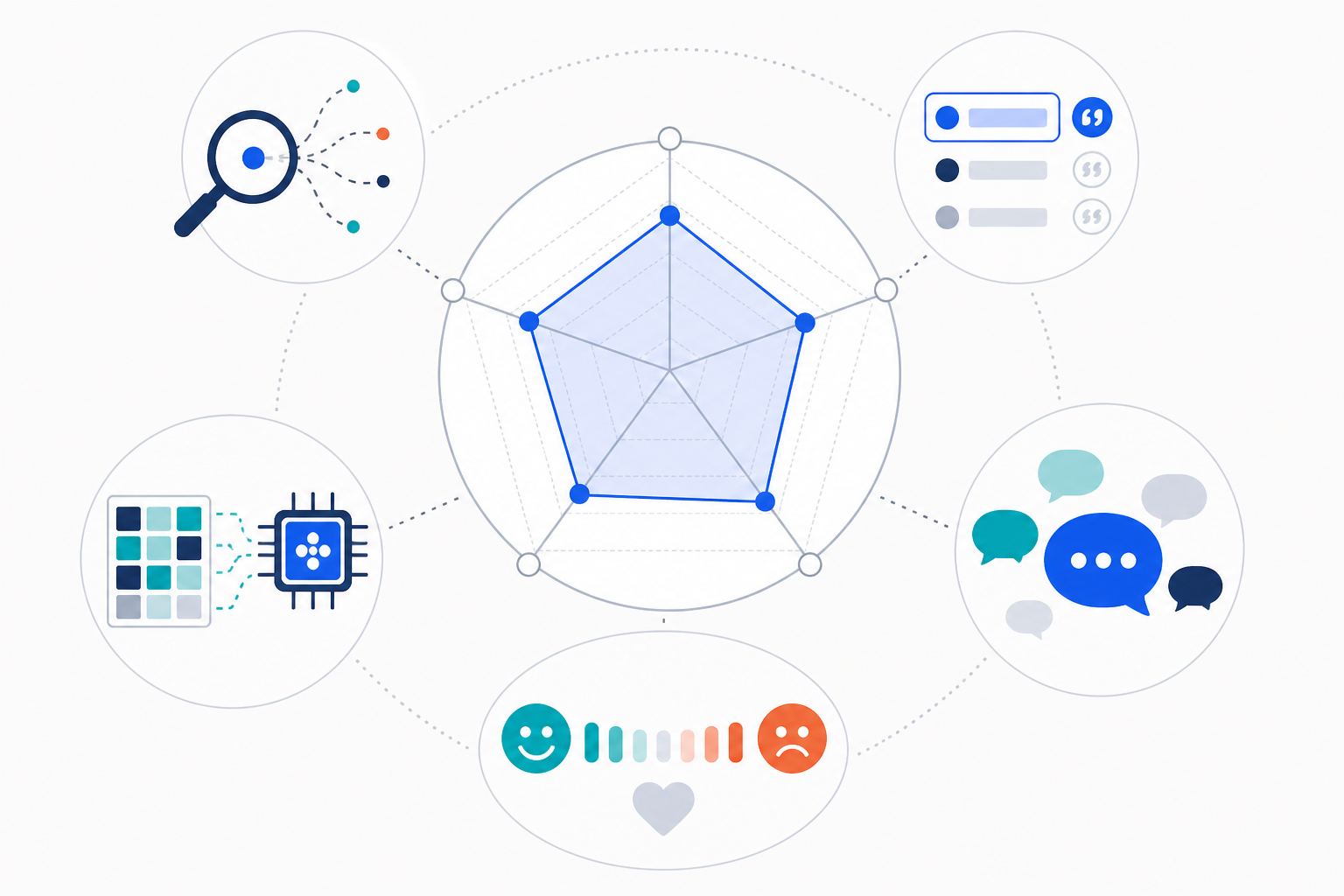
With that distinction on the table, here are the five signals our framework tracks, and the same five signals behind our internal 0–100 AI visibility score. I'm deliberately using five rather than collapsing them into four, because in our data sentiment behaves as a distinct, separately measurable dimension rather than a sub-component of share of voice — a brand can have strong share of voice and still be framed negatively, which a four-factor model would obscure.
- Query coverage — whether a brand appears across enough relevant question variants ("best running shoes for flat feet," "most durable running shoes under £100," "running shoes for marathon training") to be treated as a credible, repeatable answer rather than a one-off mention. We estimate this by running a representative basket of prompts for a category and tracking how often a brand appears at all.
- Position-weighted citations — being named first or second in a response correlates, in our tracked data, with higher click-through than appearing fourth or fifth. I want to flag this as an observed association rather than a confirmed causal ranking factor, since we can't see the platforms' internal logic. Position within the answer functions a little like rank on a search page, except the visible "page" is only three to five slots long, so the gap between first and last matters disproportionately.
- Share of voice relative to competitors — if a competitor is cited in four out of five relevant queries in a category and you're cited in one, that's a meaningful signal worth investigating, though we can't rule out that stable catalogue coverage or prompt phrasing, rather than deliberate ranking, explains part of the gap.
- Structured data and AI legibility — schema markup, clear specifications, consistent titles and identifiers (GTINs, MPNs), and crawlable content that make it straightforward for a system to parse your pages accurately. This behaves more like a technical prerequisite than a ranking factor in the SEO sense: incomplete or inconsistent product data doesn't just lower visibility, it can make retrieval-based systems unable to confidently attribute a review or spec sheet to your product at all.
- Sentiment signals — reviews, forum threads, comparison articles, and editorial mentions that shape whether an assistant frames a brand positively, neutrally, or not at all when it does cite it. In our observation, consistently negative or contradictory sentiment across sources correlates with reduced citation frequency, even when a brand technically qualifies on the other four signals — though again, this is a pattern we've observed, not a mechanism any platform has confirmed.
A quick methodology note, since I think transparency here matters more than the framework itself: our panel currently covers around 4,000 queries per month across four major assistants, weighted toward UK and US retail categories, refreshed weekly. "Visibility" in our score means a brand is named in the assistant's direct answer, not merely present in a linked source. It's a directional measurement tool for prioritising your own work, not a scientific model of how any platform's algorithm actually functions internally.
What I find most instructive here is research from Princeton and collaborators on generative engine optimization, published in 2023 as a peer-reviewed benchmark study, which found that applying specific GEO methods — such as adding citations, statistics, and quotations to source content — improved visibility in generative-engine responses by up to 40% within their experimental benchmarks. I want to be precise about the limits of that finding: it was measured against a specific set of synthetic queries and generative engine configurations built for the study, not against every live commercial shopping assistant in production today, and the researchers themselves framed it as an experimental result rather than a guarantee. But it does support something we see reflected in our own monitoring: visibility in these systems responds to deliberate, measurable intervention, much as organic search rankings responded to SEO work over the past two decades, even though the specific levers differ.
Why Being Left Off an AI Shortlist Matters
The mechanics of exclusion here are structurally different from the mechanics of poor search ranking, and I think that difference is underappreciated.
On a traditional search results page, ranking eighth instead of first is a visibility problem — you get less traffic, but you still get some, and a determined shopper can scroll to find you. On an AI shortlist, there is frequently no eighth position. When an assistant returns three to five named products, exclusion is binary rather than gradual: you either appear in the answer the shopper actually sees, or your product doesn't factor into that decision at all. I think of this as compressed shelf space — a category that might have accommodated dozens of visible competitors on a search page now effectively has room for a handful of names.
The second risk compounds the first: share-of-voice gaps appear, in our tracked data, to widen rather than self-correct over time. If a competitor is consistently cited across a category's query variants while you're cited occasionally, that asymmetry can reinforce itself as more reviews and citations accumulate around the incumbent. I'd frame this as a plausible risk pattern based on what we've observed longitudinally in a subset of tracked categories, rather than a proven law — but it's a pattern worth taking seriously given the commercial stakes.
The third risk is quieter and, in my experience, more commercially damaging: silent revenue leakage that doesn't show up cleanly in your analytics. AI referral traffic is often under-tracked or misattributed — a shopper might get a recommendation from an AI assistant, then open a new tab and search your brand name directly, showing up in your analytics as "direct" or "branded organic" with no trace of the AI touchpoint that actually drove the decision. You can be losing sales to an exclusion problem while your dashboards look perfectly normal. It's worth being honest that this is hard to prove with certainty from the outside — it's an attribution gap inferred from how these referral pathways behave, not something we can measure directly without platform-side data.
The fourth risk is reputational: being mentioned inaccurately or unfavourably. An assistant pulling from outdated specifications, an unresolved negative review thread, or a discontinued price can present a distorted picture of your brand to a shopper who never visits your site to correct the impression, because the assistant's summary is the only touchpoint they needed.
How to Improve E-Commerce AI Visibility and Earn Product Recommendations
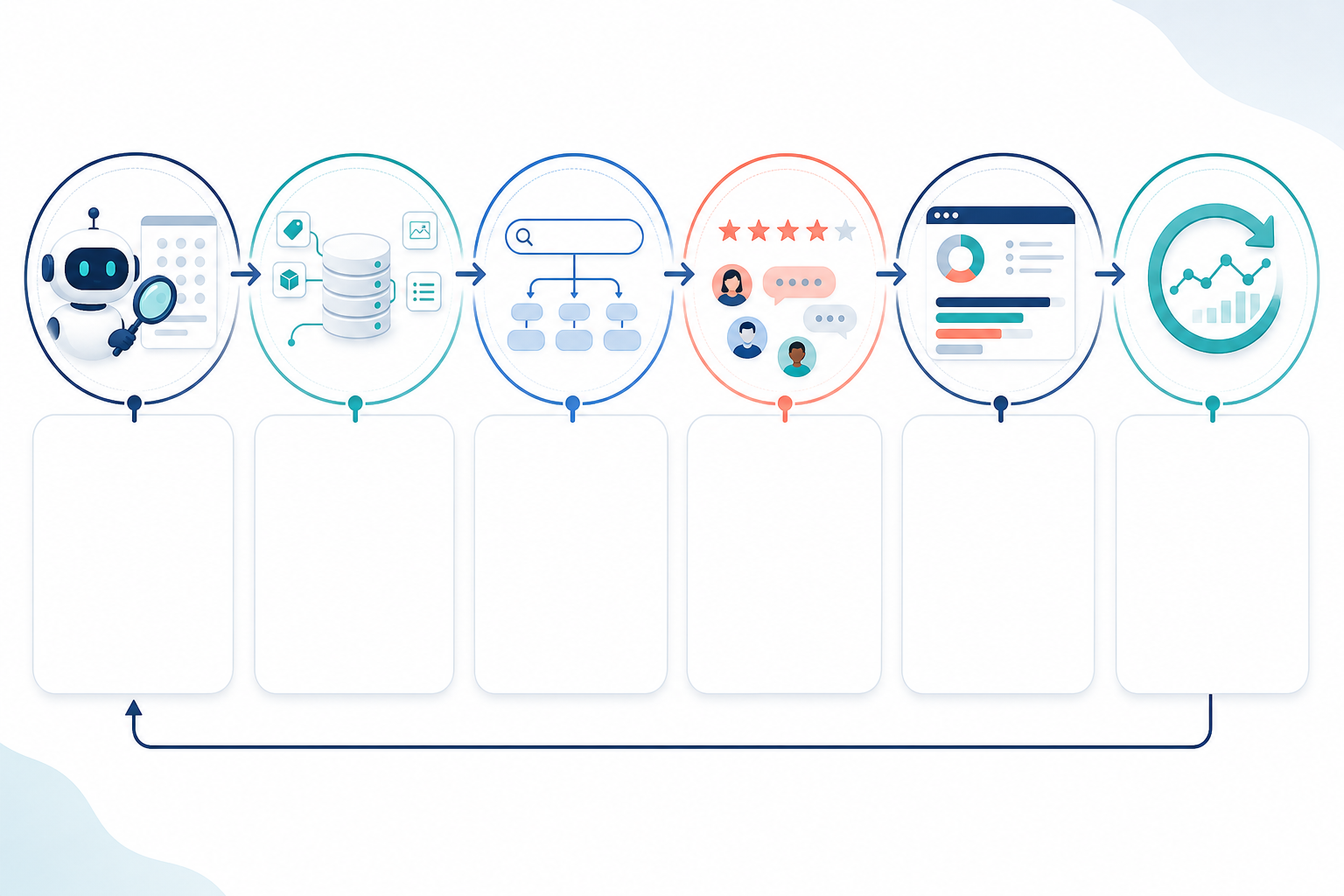
Here's the practical sequence I'd recommend, in priority order. Notice that it starts with measurement, not fixes — you need a baseline before you know which fixes matter for your category.
- Audit your current AI visibility first. Before changing anything, run a representative set of category queries across ChatGPT, Google's AI Overviews, Perplexity, Copilot for Shopping, and Amazon Rufus if you sell there. Record whether you appear, in what position, what's said about you, and which competitors show up instead. This baseline tells you whether your problem is coverage, position, sentiment, or technical legibility — and there's no point fixing structured data if your real issue is a lack of third-party reviews.
- Fix structured data and product identifiers. Confirm schema markup for products, pricing, availability, and reviews is present, valid, and consistent across your site and any feeds submitted to Google Merchant Center, Microsoft Merchant Center, or marketplace platforms. Ensure GTINs, MPNs, and product titles match across your own site, your feed, and any third-party retailers listing your product. Mismatched identifiers are one of the most common reasons a technically good product never gets surfaced. For UK sellers, this also means keeping GBP pricing, UK availability, and delivery/returns information accurate and synchronised across every feed.
- Build genuine query coverage. Identify the realistic natural-language questions your category attracts — not just head-term keywords — and make sure your product pages and supporting content answer them directly, with specific numbers and comparisons rather than vague marketing language.
- Cultivate third-party sentiment properly. Reviews, comparison articles, and editorial mentions on sites you don't control carry real weight in how assistants frame a brand. This means genuine customer review requests, transparent editorial outreach, and honest comparison content — not incentivised, fabricated, or undisclosed paid reviews, which risk both platform penalties and UK consumer protection issues around misleading endorsements.
- Monitor competitors' share of voice, not just your own visibility. Track how often competing brands appear across the same query set you're targeting. A static or slowly improving visibility score can still mean you're losing ground if competitors are improving faster.
- Re-measure on a cadence that matches your category. These systems retrain and re-index on different cycles than traditional search, so a single audit goes stale quickly. I'd suggest weekly checks for fast-moving, high-competition categories with frequent pricing or stock changes, and monthly checks for more stable categories — the right cadence depends on price volatility, inventory turnover, and how commercially important the category is to you.
Preparing for the Next Wave of AI Commerce
Looking ahead, the more speculative but increasingly plausible development is agentic commerce — AI systems that don't just recommend a product but are authorised to complete the purchase on a shopper's behalf, checking availability, comparing shipping timelines, and executing the transaction with minimal human intervention. I want to separate prediction from current capability here: as of now, most consumer-facing agentic purchasing remains limited, experimental, or confined to specific retailer partnerships rather than being mainstream shopping behaviour.
But the direction of travel — from Amazon's Rufus taking on more transactional functions, to emerging standards for machine-readable commerce data, to early infrastructure like MentionOwl's own MCP server that lets AI agents query structured product data directly — suggests that accurate, structured, machine-accessible information about your inventory, shipping options, and returns policy will matter even more once agents, not just answer engines, are making purchasing decisions on a shopper's behalf. Brands treating their product data as a compliance afterthought today are likely to find that gap more costly once agentic systems start transacting directly against it.
Frequently Asked Questions About AI Shopping Assistants
What are AI shopping assistants exactly?
They're conversational tools built on large language models — including ChatGPT, Google's AI Overviews and AI Mode, Microsoft Copilot for Shopping, Perplexity, and Amazon Rufus — that help shoppers research and compare products through natural-language questions rather than keyword searches, typically returning a short list of named recommendations instead of a full page of links. Availability and behaviour vary by platform, country, and even whether the shopper is logged in, so what appears for one UK shopper may not appear for another asking the same question.
How do I get my products included in AI shortlists?
Start with a baseline audit of where you currently stand across the major platforms, then fix the fundamentals: accurate, consistent structured data and product identifiers across your site and merchant feeds, genuine content answering the specific questions shoppers ask in your category, and a deliberate, compliant effort to build positive third-party reviews and mentions. These are the same raw materials most assistants draw on when constructing a recommendation, though each platform weights them differently.
Will AI shopping assistants replace traditional product search?
Not entirely, based on the evidence available now. Traditional search results pages still handle the majority of purchase-research queries, and AI shopping assistants are best understood as an additional, fast-growing discovery layer sitting above search rather than a full replacement for it. That said, the share of queries resolved entirely within an AI answer, without a click to a search results page at all, is a trend worth watching closely rather than dismissing.
How can I track if I'm being excluded from AI recommendations?
Run a representative set of category queries across the major assistants your customers are likely to use, log which brands appear and in what position, and repeat the exercise regularly. Standard analytics tools generally won't capture AI-influenced traffic that arrives disguised as direct or branded search, so visibility monitoring and revenue attribution are two separate exercises — being cited doesn't automatically mean you can prove which sales it drove, and you should treat the two as complementary rather than interchangeable measurements.
A 30-Day Starting Point for AI Search Visibility
If you take one thing from this article, let it be this: don't start with a redesign, start with a measurement. In the next 30 days, I'd suggest running a representative basket of 20–30 natural-language queries for your category across at least three major assistants, logging who appears, in what position, and how accurately they're described. That single exercise will tell you more about where you actually stand than any amount of speculation about ranking factors — and it's the only reliable way to know whether your priority is technical data, third-party sentiment, or simple absence from the conversation. The teams that treat this as an ongoing measurement discipline now, rather than a curiosity to revisit later, are the ones I'd expect to still be visible when the shortlist shrinks further. 📊