AI Visibility Tools Compared: What to Look for Before You Buy
Compare AI visibility tools for UK founders: check engine coverage, automated queries, citations, sentiment, exports and pricing before you buy.
AI Visibility Tools Compared: What Solo Founders in the UK Should Check Before Buying
The best AI visibility tool for a solo founder covers the five major engines and generates customer questions automatically. It also returns citations, sentiment and competitor mentions in a form you can act on, at a price you can test for pounds rather than hundreds. 🦉 In my analysis, five criteria separate useful tools from expensive dashboards: engine coverage, automated query generation, data depth, reporting and exports, and transparent pricing with a low-risk trial.
This guide takes each criterion in turn, gives you a weighted scorecard with a worked example, and sets out a seven-day trial plan. I work at MentionOwl, so I use it as an occasional illustration. Every MentionOwl detail in this article is vendor-reported, so verify it against current product documentation, as you would for any vendor. The checklist is vendor-neutral by design, and I have not ranked or scored real competitors. You can apply it to any AI visibility tool on your shortlist.
Who needs an AI visibility tool (and who can wait)?
The case for monitoring starts with a change in behaviour. More purchase research now begins with a conversational question to an AI assistant rather than a page of search results, and a brand that is absent from those answers can lose consideration before a visitor ever reaches its website. The evidence is directional rather than conclusive, so I have separated forecasts from measured usage and labelled each figure's geography and date.
Forecast:
- Gartner predicted in a February 2024 press release that traditional search engine volume would fall 25% by 2026 as users move to chatbots and virtual agents. That is a forecast, not a measured outcome.
Measured usage (all US data):
- Pew Research Center reported in June 2025 that 34% of U.S. adults had ever used ChatGPT, rising to 58% among those aged 18 to 29 (Pew Research Center, 2025).
- Adobe reported that AI-driven traffic to U.S. retail sites over the 2024 holiday season was up 1,300% year on year, although from a small base.
None of these figures is UK-specific, but together they explain why the channel deserves attention. Read the original publications for the full methodology before quoting any of them yourself.
A few terms need defining plainly:
- AI visibility is how often, how prominently and how favourably AI assistants mention, cite and recommend your brand.
- LLM monitoring is the repeated, systematic measurement of that visibility across large language model products.
- Generative engine optimization (GEO) is the practice of improving your content and technical setup so those engines represent you accurately and cite you more often.
AI SEO tools are related to traditional rank trackers, but their outputs differ. A rank tracker reports your position among ten blue links. An AI visibility tool reports what an answer said, which sources it cited, and which competitors it recommended instead. You will probably want both, since neither replaces the other.
Why manual AI visibility checks fail
Answers vary by session, wording and model version, so a single query tells you almost nothing statistically. Thirty realistic questions across five engines means 150 queries per run, and each one needs its answer captured, its citations logged and its sentiment judged. No solo founder can sustain that alongside running a business. And a query you did not record cannot show you a trend anyway.
Does your business need AI visibility monitoring?
The tools help most when buyers in your category ask comparison or recommendation questions, such as best, alternatives or is it worth it. They help less, at least for now, if you have no web presence, no repeatable customer questions, or no capacity to act on what you learn. Google states that its AI features need no special markup, and that traffic from them is included in the overall Web search data in Search Console (Google Search Central). A tool is therefore a monitoring and workflow choice, not an eligibility requirement. If your fundamentals are not yet in place, fix those first.
One caveat applies to every product in this market: tools measure and diagnose, but none of them can guarantee you will be recommended.
Five criteria for comparing AI visibility tools
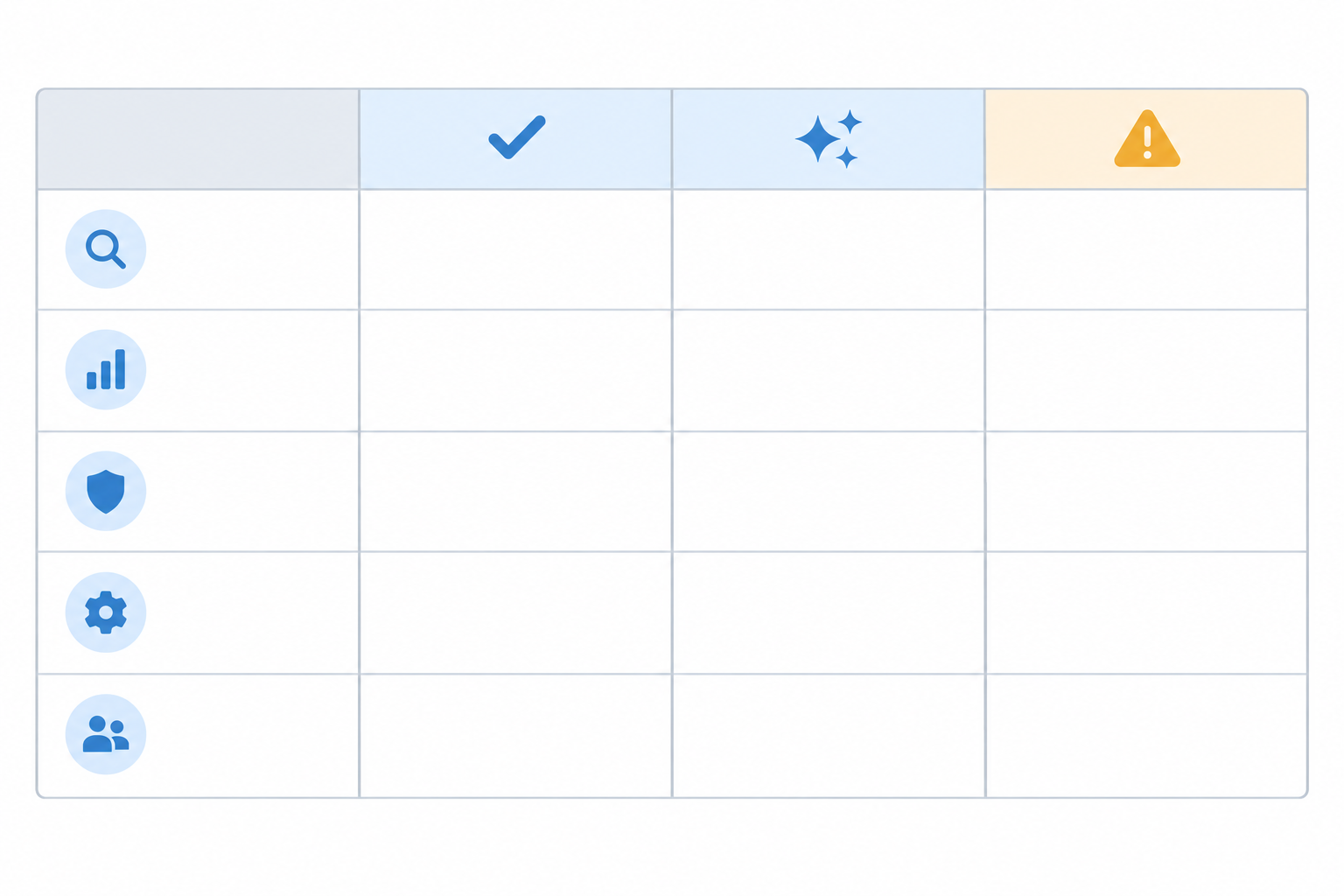
The scorecard below lets you evaluate any vendor consistently. I have kept it generic so you can score two or three tools against identical standards during their trials, and I have split what a solo founder needs from what is merely nice to have.
| Criterion | Must-have | Nice-to-have | Red flag |
|---|---|---|---|
| Engine coverage | ChatGPT, Claude, Gemini, Copilot and Perplexity | Regional or language settings per engine | Only one or two engines, or a single model standing in for all |
| Query generation | Auto-generated questions from your website, visible and editable | Bulk import of your own prompts | You must write every prompt yourself, or questions are hidden |
| Data returned | Full answer text, citations, sentiment, competitor mentions | Position-weighting, soft mentions, AI legibility audits, AI traffic analytics | A bare mention yes/no flag or an unexplained score |
| Reporting and export | Weekly digest and CSV export | REST API, MCP server (only if you want automation) | No export on any plan; data behind sales calls |
| Pricing and trial | Small-business pricing, monthly billing, cheap real-data trial | Pricing shown in GBP including VAT | Annual-only billing, per-engine add-ons, demo-only evaluation |
How to score and weight AI visibility tools
For a one-person business, setup time and cost matter more than enterprise governance features such as seat management, approval workflows or bespoke reporting. Engine coverage and query generation carry the most weight, because they decide whether the data is representative at all. This is the weighting I recommend:
| Criterion | Weight |
|---|---|
| Engine coverage | 25% |
| Query generation | 25% |
| Data returned | 20% |
| Pricing and trial | 20% |
| Reporting and export | 10% |
Score each tool from 0 to 2 per row during its trial (0 = misses the must-have, 1 = partly meets it, 2 = fully meets it). Multiply each score by half its weight, then add the results for a total out of 100. If you prefer something simpler, add the raw scores for an unweighted total out of 10. Treat that as a first-pass filter only.
Worked example: comparing two hypothetical AI visibility tools
The table below uses two invented tools, Tool A and Tool B. They are not real products. They exist to show how the arithmetic works and why weighting changes the picture.
| Criterion (weight) | Tool A | Tool B |
|---|---|---|
| Engine coverage (25%) | 2: all five engines | 1: three of five engines |
| Query generation (25%) | 2: auto-generated and editable | 1: auto-generated but not editable |
| Data returned (20%) | 1: citations, no sentiment | 2: full answers, citations, sentiment, competitors |
| Reporting and export (10%) | 1: CSV only | 2: weekly digest and CSV |
| Pricing and trial (20%) | 2: monthly billing, paid trial | 0: annual-only billing, demo only |
| Weighted total (out of 100) | 85 | 55 |
| Unweighted total (out of 10) | 8 | 6 |
Tool B has the richer data and reporting, yet Tool A wins clearly. It covers every engine, lets you edit its questions and lets you test cheaply. Here the unweighted score points the same way but understates the gap, and with closer scores it could point the other way.
Engine and query coverage: what do AI visibility tools check?
Coverage determines whether the numbers you see resemble what your customers see. Work through these checks with every vendor.
- Engine coverage: confirm the tool tracks ChatGPT, Claude, Gemini, Copilot and Perplexity. Each draws on different sources and cites differently, so a tool covering one or two gives a skewed picture. Ask whether the vendor measures the actual products, such as ChatGPT with search, Copilot Search or Perplexity, rather than only a bare language model, because these present answers and sources differently.
- Query generation: check whether the tool crawls your site and generates realistic customer questions, or leaves you to write every prompt. For solo founders, automatic generation removes the biggest setup barrier.
- Query realism: look for everyday purchase-decision language (best, alternatives, is X worth it) rather than branded queries that merely confirm you exist. A large prompt count tells you little if the prompts do not reflect real buyer questions.
- Frequency and sample size: AI answers are non-deterministic, so repeated runs matter. Daily runs are ideal, but a solo founder reviewing a weekly digest can get useful trends from less frequent runs if the sample is large enough. Ask how many queries run per engine and how variance is handled, and treat any single snapshot as directional.
- UK relevance: ask whether you can use British spelling, local context and GBP pricing. A US-English result is not a reliable proxy for what a UK buyer receives.
- Transparency: put one question to every vendor. Can I see the exact questions being run, and can I edit them?
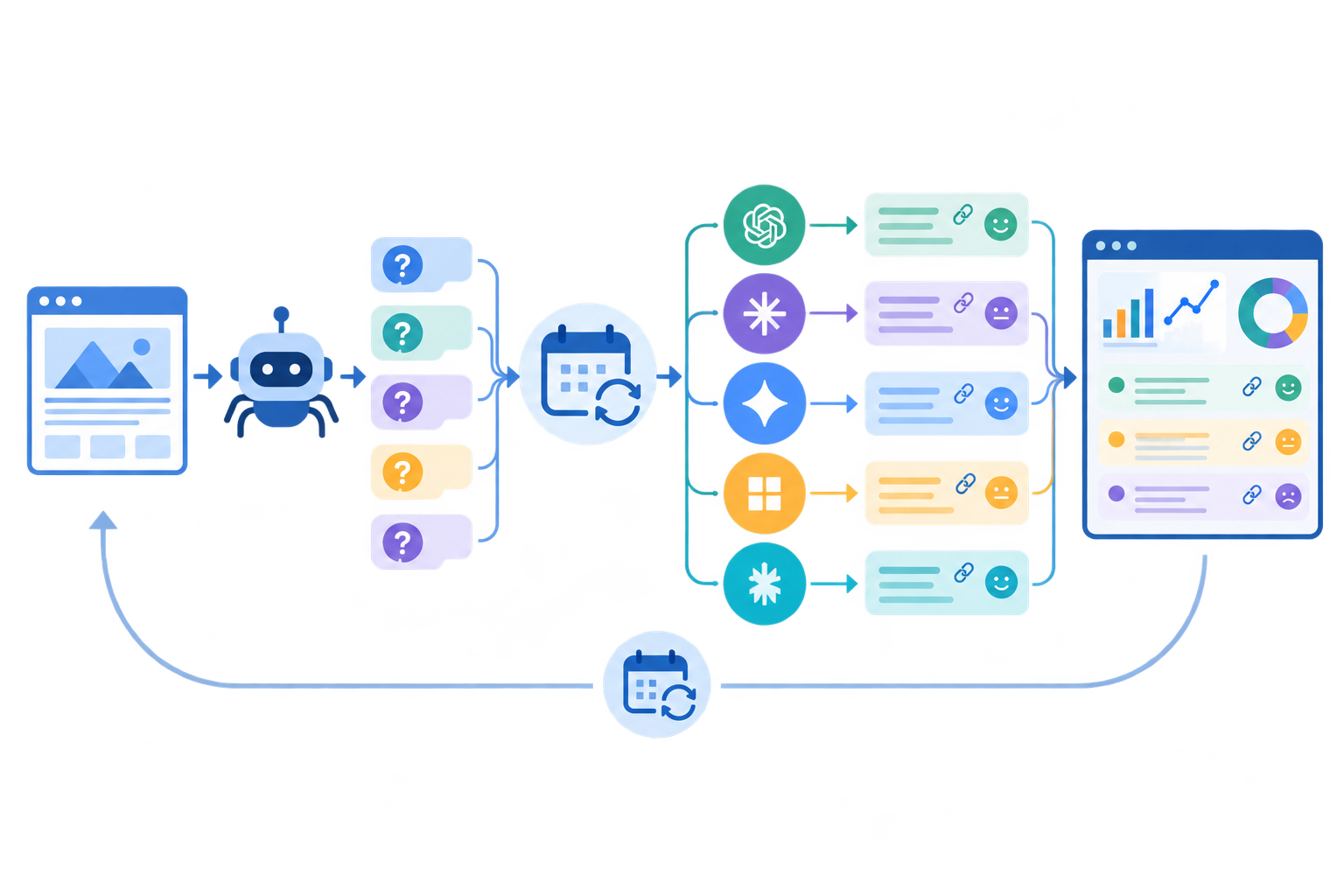
For scale, OpenAI said in 2025 that ChatGPT had 400 million weekly active users, and Google said in 2025 that AI Overviews were reaching over 1 billion monthly users across more than 100 countries and territories. Both are company-reported global figures, and neither measures your category. Still, they show why tracking a single engine leaves large blind spots. The diagram above shows the workflow to look for. MentionOwl, for instance, describes crawling your site, generating questions and running them against all five engines, but check any vendor's claim against your own trial data.
What data should an AI visibility tool return?
A dashboard is only as good as the evidence behind it. A useful report shows the exact prompts tested, the platform, the date of the run and the answer captured. Without those details you cannot tell a real change from a difference in wording or sampling.
The essentials for a solo founder are:
- Full answer text, not just a mention flag, so you can read how your brand is framed.
- Citations and source URLs across engines, showing which of your pages and which third-party sites the AI relies on in your category. Make sure the tool distinguishes a brand mention from a linked citation, because being named is not the same as being cited as evidence.
- Share of voice and competitor tracking, showing who is recommended instead of you and for which queries.
- Sentiment analysis that separates positive, neutral and negative framing and flags inaccuracies.
The following are worth having but optional, and I would not pay a premium for them on day one:
- Position-weighted citations, because being the first recommendation carries more influence than appearing fourth in a list.
- Soft mentions, where your brand is described without a link. Simpler tools miss these.
- AI legibility audits, which are technical checks on crawlability, structured data and page clarity that explain why engines may struggle to read your site. Vendors count checks differently (MentionOwl reports 16), so compare what each check covers rather than the headline number. Crawl access alone does not prove you are cited, and OpenAI documents separate crawlers for search and for training, so a good audit should treat them differently.
- Cookieless AI traffic analytics, to connect visibility with actual visits from AI assistants.
What should an AI visibility score include?
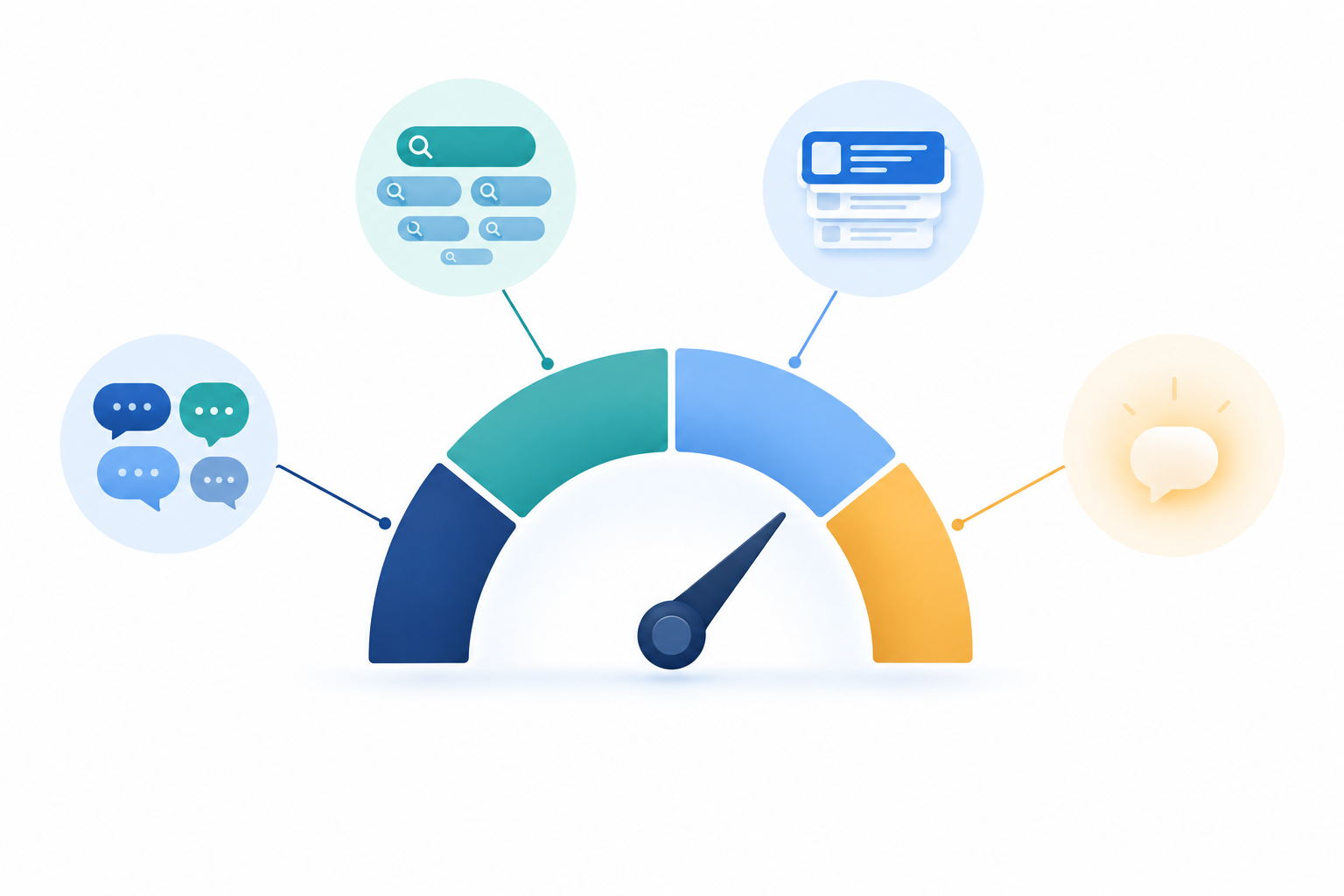
A single number makes trends easy to read, but only if you can see how it is built. MentionOwl, for example, describes a 0-100 visibility score combining query coverage, position-weighted citations, share of voice and soft mentions. That methodology is vendor-reported, so read its documentation rather than taking my summary as given. Whatever tool you choose, ask for the methodology in writing and request platform-level breakdowns, so a blended figure cannot hide where visibility is moving. Prompt-level scores are sampled estimates, not a census of everything users see.
This matters because click-based metrics are changing. Pew Research Center analysed US Google searches in March 2025 and found that AI summaries appeared in 18% of them. Users clicked a traditional result in 8% of visits with a summary versus 15% without one, and only about 1% clicked a link inside the summary (Pew Research Center, July 2025). These are US figures, but they show why answer presence and citations need measuring separately from conventional organic clicks.
How to turn AI visibility data into action: a hypothetical example
Imagine a UK founder selling project-management software for architects. The trial shows that when buyers ask for the best tool for small practices, three AI engines recommend a competitor and cite the same two review sites, and none of them mention the founder's brand. The action is concrete: add a clear comparison page, then ask for a listing on those two review sites. That is the kind of insight I mean when I say a trial should surface something actionable.
Reporting, exports and integrations: making AI visibility data usable
A solo founder will not log into another dashboard every morning, so the most useful reporting is the kind that arrives unprompted. A weekly digest summarising movement in your score, new citations and competitor changes turns monitoring into a five-minute Monday habit instead of a chore.
Exports matter for two reasons. They protect you from lock-in, and they let you share results with a freelancer or adviser without handing over your login. CSV is enough for most small businesses, which is why a missing export is the more serious red flag.
An API only matters if you want automation. If you are technical, a REST API lets you pipe data into spreadsheets, dashboards or workflows. An MCP server goes a step further and lets your own AI agents query your visibility data conversationally, so you could ask which competitor overtook you this week. If you have no plans to automate anything, treat the lack of an API as a neutral point, not a dealbreaker.
Watch for these red flags:
- No export of any kind
- Data locked behind sales calls
- No API, but only if you know you need automation
Here is a simple test I recommend: can you get last week's data into a spreadsheet in under ten minutes? If not, the tool will probably gather dust.
AI visibility tool pricing and trial considerations: how much should you pay?
I cannot give you a verified, current UK price list, and I would be wary of anyone who claims one without a date. Most vendors publish prices in US dollars and change plans frequently. What follows comes with caveats.
The publicly advertised entry plans I reviewed in 2025 ranged from roughly $29 to $99 per month, and one was priced in euros. At 2025 exchange rates that is very approximately £25 to £80 per month, though rates move and these are indicative snapshots, not quotes. Enterprise contracts are custom-quoted and cost many times more. A realistic first budget for a solo founder is therefore a low double-digit to low three-figure monthly sum in pounds, and anything well above that needs a clear justification.
VAT deserves its own check. UK VAT is 20%, and some vendors show prices excluding it, so a plan advertised at £40 could cost £48 including VAT. If you are VAT-registered you may be able to reclaim it, but confirm how an overseas supplier will invoice you.
Monthly price alone is not comparable, because plans differ in what they count as a tracked prompt, which engines and regions they cover, and how often they refresh. Start with the lowest plan that tracks a representative question set across all five engines, and upgrade only if a higher tier offers something you can act on. Packages built around seats, governance and custom reporting are poor value for one person.
Hidden costs to check before buying
- Per-engine add-ons
- Query caps that quietly limit coverage
- Paid exports or API surcharges
- Annual-only billing
- Prices shown in dollars with no VAT or currency conversion clarity for UK buyers
Can I try an AI visibility tool cheaply first?
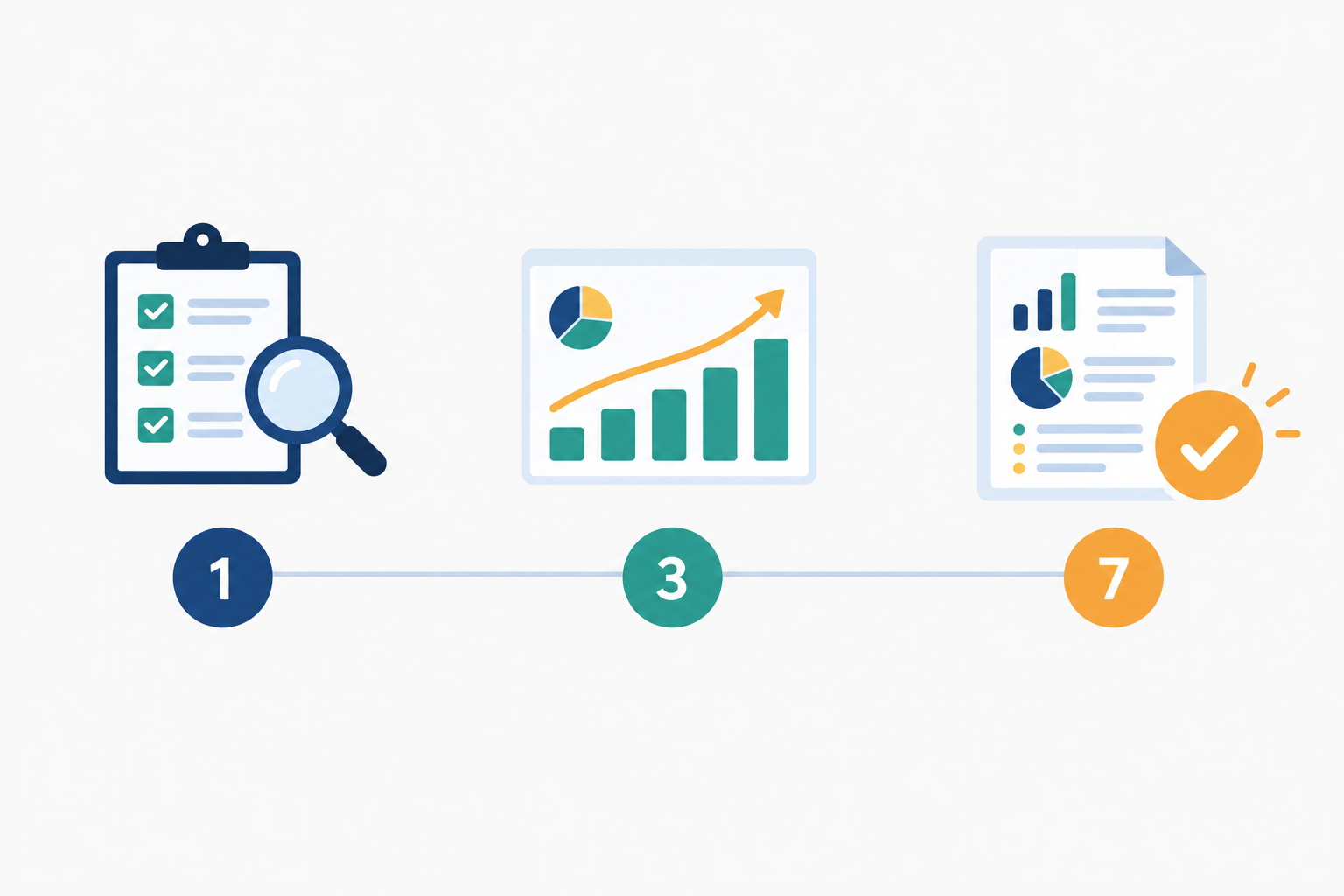
Yes, and you should test with real data rather than watch a demo video. Low-cost trials exist: MentionOwl, for example, advertises a 7-day trial from $1. A trial price is a one-off charge, not the ongoing subscription, so check the recurring monthly cost, whether it renews automatically and how to cancel before you start. This is how I would use any trial week:
- Day 1: set up within the first hour and review the auto-generated questions.
- Day 3: check the first results across engines.
- Day 7: judge the weekly digest and make your decision.
My decision rule is simple: pay only if the trial surfaced at least one insight you can act on, such as a missing citation source or a competitor consistently preferred over you. Think in terms of cost per useful decision rather than the subscription fee alone.
How to evaluate and choose an AI visibility tool
- Write down the five to ten questions your customers genuinely ask before buying.
- Shortlist two or three tools that meet your must-have criteria.
- Start trials in the same week so results are comparable.
- Compare the auto-generated questions against your own list for relevance.
- Check engine coverage, citation detail and sentiment output on identical topics.
- Test export and digest using the ten-minute spreadsheet test, and test the API only if you need it.
- Score each tool with the weighted checklist and weigh cost against the value of the insights.
- Commit monthly rather than annually until you have seen at least a month of trend data.
What to do with AI visibility data once you have it
Monitoring only pays off when it feeds action. Fix AI legibility issues first, since they are usually the cheapest wins. Then strengthen the pages that already earn citations. After that, go after the gaps where competitors dominate the answers, often by writing clearer comparison content or earning mentions on the third-party sites the engines already trust.
Keep your expectations realistic. AI visibility shifts gradually and varies by engine, so judge progress over weeks, not days. Generative engine optimization works best as an ongoing habit backed by a weekly review, not a one-off project. 📈
Frequently asked questions about AI visibility tools
How much should an AI visibility tool cost for a solo founder?
Look for plans priced for small businesses, not enterprise tiers. In 2025, advertised entry plans were roughly $29 to $99 a month, which is very approximately £25 to £80 before any VAT. Compare what each plan includes, particularly the monthly query allowance and whether it covers all five engines. Add 20% if the price excludes VAT, and confirm current pricing directly with the vendor.
Can I try an AI visibility tool cheaply first?
Yes. Look for a paid trial or free tier that gives you real data on your own brand rather than a canned demo, and confirm what the plan costs once the trial ends. The seven-day plan above shows how to use that week.
What features are must-haves in AI visibility tools?
For a solo founder: coverage of ChatGPT, Claude, Gemini, Copilot and Perplexity; automatic, editable question generation from your website; full answers with citations and sentiment; competitor and share-of-voice data; and some form of export. Daily runs, APIs, MCP servers and technical audits for AI legibility are useful extras, not essentials.
How do I compare monthly query allowances between tools?
Divide the allowance by the number of engines and by the refresh frequency. A plan with 150 tracked prompts across five engines run weekly is a much smaller sample than 150 prompts per engine run daily. Ask each vendor what counts as one query.
What counts as a meaningful AI visibility trend?
One week of data is a snapshot. Before changing your content strategy, I would want to see consistent movement across at least four weekly readings, ideally on more than one engine.
Is an AI visibility tool the same as a traditional SEO tool?
No. Traditional SEO tools track rankings in search results, whereas AI visibility tools track whether and how AI assistants mention, cite and recommend your brand in generated answers. Many AI SEO tools sit alongside conventional ones rather than replacing them.
SEO CONTENT CONTRACT
- Primary topic: AI visibility tools
- Supporting concepts: AI SEO tools
- Dominant search intent: commercial
- Target search market: United Kingdom
- Content angle: A criteria-based checklist covering engine coverage, query generation, citation and sentiment data, pricing and exports, without naming rivals unfairly.
- Suggested sections: Who needs an AI visibility tool; Engine and query coverage; Data you should get back; Reporting, API and integrations; Pricing and trial considerations
- Reader questions: How much should an AI visibility tool cost?; Can I try one cheaply first?; What features are must-haves?
Treat these as reader and topic guidance, not a phrase quota. Never force exact phrases, repeat keywords mechanically, or sacrifice clarity to a density target.