Generative Engine Optimization: The New Growth Channel SaaS Teams Can't Afford to Ignore
GEO is behaving like SEO did in 2004 — early, underpriced, and easy to dominate. Here's how SaaS and DTC brands should budget, build, and measure it.
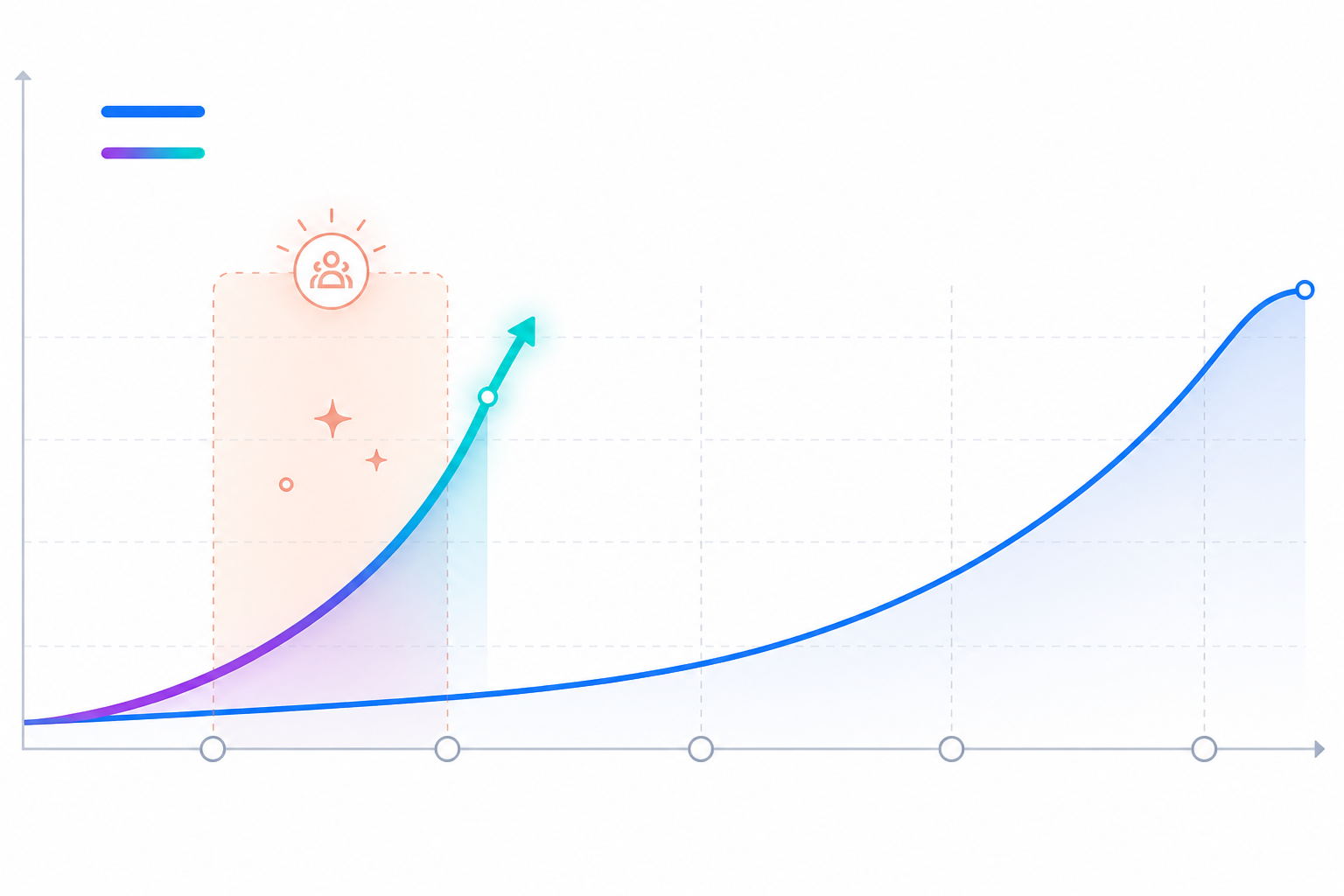
Generative Engine Optimization (GEO): An Early, Unproven Growth Lever Worth Testing Now
Generative engine optimization (GEO) is the practice of earning visibility, citations, and favourable mentions inside AI assistants such as ChatGPT, Claude, Gemini, Copilot, and Perplexity. Sometimes called AI SEO, GEO is becoming increasingly relevant to SaaS and DTC growth teams as more buyers use AI tools to research products, compare providers, and shape their consideration set.
I've spent the last twelve weeks running a small tracking exercise — 40 buyer-intent prompts across seven SaaS and DTC categories, checked weekly against five engines — and I want to be upfront that this is a modest, first-party sample, not a scientific study. It's enough to convince me the channel is worth a pilot budget. It is not enough to prove the kind of compounding return that SEO delivered between 2003 and 2007, and I'll flag that distinction throughout rather than blur it.
Here's the evidence I'm working from, with dates and caveats attached rather than asserted as settled fact. Pew Research Center reported that AI-generated summaries appeared on roughly 18% of Google searches conducted by US adults it sampled in March 2025, and that when a summary appeared, users clicked through to a traditional result in about 8% of those visits versus 15% when no summary showed (Pew Research Center, March 2025). That's a US adult sample on Google specifically — not a global or UK-specific figure, and not evidence about ChatGPT, Claude, or Perplexity behaviour. Gartner has separately forecast a 25% decline in traditional search-engine volume by 2026 as AI chatbots absorb more discovery behaviour; it's a forecast, not an observed outcome, and I'd treat it as directional rather than precise.
Taken together, these figures don't prove GEO compounds the way indexed SEO links do. They do suggest that a meaningful slice of purchase-decision research is moving into a surface most SaaS and DTC teams aren't measuring at all, which is reason enough to start watching it closely.
What Is Generative Engine Optimization (GEO)?
GEO is sometimes described as "AI SEO," and that shorthand is useful but imprecise — the terms overlap without being interchangeable, for reasons I'll get into below. At its core, generative engine optimization is the discipline of improving how often, how accurately, and in what context your company is represented in answers generated by systems like Google AI Overviews, ChatGPT, Perplexity, Copilot, and Gemini. That's a different target than ranking a page among blue-link results, and it's worth being precise about why.
A frequently cited academic paper from researchers at Princeton, Georgia Tech, the Allen Institute for AI, and IIT Delhi — generally credited with coining the term GEO — ran controlled experiments and found that specific content changes (adding quotations, statistics, and clearer structural markers) increased a page's visibility inside generative-engine responses by up to 40% in their test conditions. I want to flag the limits of that finding clearly: it was measured inside a controlled research environment against the researchers' own query set, not across live commercial traffic. A 40% lift in a lab test is a meaningful signal that these techniques matter. It is not proof that the same intervention will move real citations, real clicks, or real revenue for your brand at the same magnitude — treat it as directional evidence, not a guaranteed multiplier.
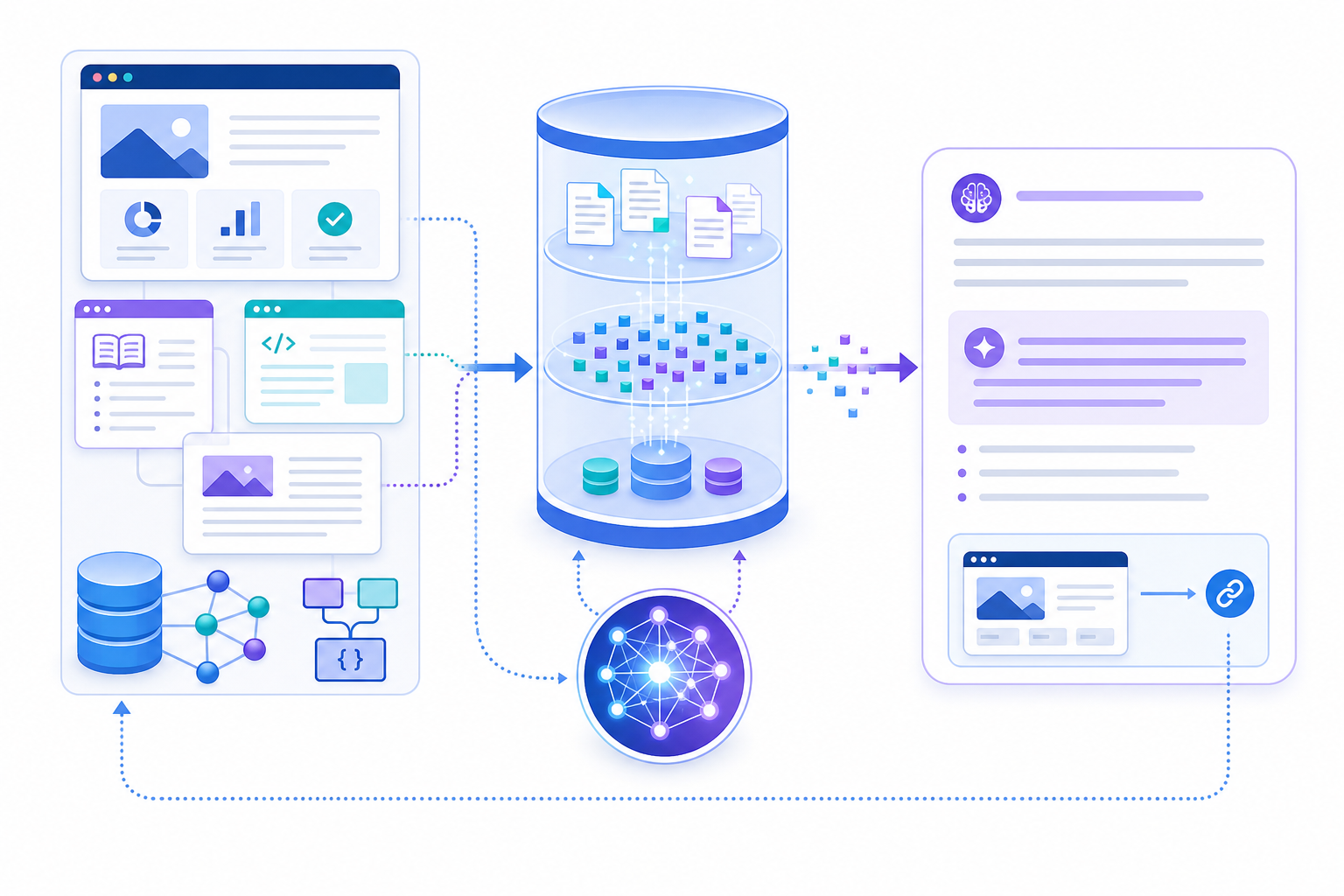
The mechanics explain why the old SEO playbook only partially transfers. Large language models pull from indexed web content, structured data, review sites, and — for many production systems — a retrieval-augmented generation (RAG) layer. RAG is simply a mechanism that fetches relevant external documents at the moment a question is asked and feeds them into the model alongside its own training data.
Rather than presenting a ranked list, the engine synthesizes a single answer and decides, source by source, whether your brand earns a mention, a citation, or silence. It's also worth being honest that these engines don't behave identically: Google AI Overviews, ChatGPT's browsing mode, Perplexity, and Copilot each use different retrieval methods, freshness windows, and citation conventions. A gain in one engine won't necessarily show up in another.
For SaaS teams, this connects to product-led growth and category education. A prospect asking an assistant for "the best tool for a distributed engineering team" or "alternatives to [named competitor]" is having their consideration set shaped before they reach a conventional results page. If your brand isn't part of that answer, you're not part of the conversation at that moment — though, importantly, you may still reach that buyer later through search, referral, or a sales conversation, so I'd resist framing this as a single make-or-break moment.
Is GEO Just a Rebrand of SEO or Something Different?
The honest answer is: related, but not interchangeable. There's real overlap. Google states that the same foundational SEO practices — crawlability, indexability, useful content, and clear structure — remain the basis for appearing in AI Overviews and AI Mode, and that no special markup is required. If your technical SEO is weak, your GEO will be too, because the retrieval layer still has to find and parse your content before any model can cite it.
Where it diverges is in what gets rewarded once you're found. Traditional SEO optimizes for a ranked index; GEO optimizes for representation inside a synthesised response, and there's no single "position 1" to fight for in the way there was with organic search. Google's AI Mode uses a technique it calls "query fan-out": rather than answering your exact question, it breaks a complex query into subtopics and runs several related searches simultaneously, pulling from multiple sources to build one answer.
Practically, this means you can earn relevance for supporting subtopics without ever ranking first for the original phrase — a meaningfully different game from classic keyword ranking.
What I'd call AI legibility — how clearly a machine can extract accurate, unambiguous facts from your site — matters more here than keyword density ever did in SEO. Structured data, explicit comparison criteria, clearly stated pricing logic, and consistent factual claims across your website, documentation, and third-party review profiles all feed into whether an engine trusts your source enough to cite it.
I'd stop short, though, of claiming sentiment is a proven ranking factor in the way backlinks were for classic SEO — there's no public research establishing that AI engines algorithmically penalise negative sentiment. What's true is simpler and still important: being described inaccurately or unfavourably inside an AI answer is a reputation and accuracy problem worth monitoring on its own terms, independent of whether it demonstrably affects visibility.
Why Generative Engine Optimization Behaves Differently From SEO and Paid Ads
It helps to place GEO alongside the two channels most SaaS and DTC teams already know well — with the caveat that the categories below are my working assessment from a small tracking sample, not an industry-validated model.
| Channel | Speed | Compounding Potential | Current Competitive Saturation |
|---|---|---|---|
| Paid Ads | Instant | None observed — stops the moment spend stops | Extremely high; bidding wars in most SaaS categories |
| Traditional SEO | Slow (months to years) | Documented, though increasingly squeezed by AI Overviews reducing click-through | High in most established categories |
| Generative Engine Optimization | Variable — shifts can appear week to week, and can also reverse without warning | Plausible but not yet independently demonstrated at scale | Low to moderate, based on limited sampling — most brands haven't started actively managing this |
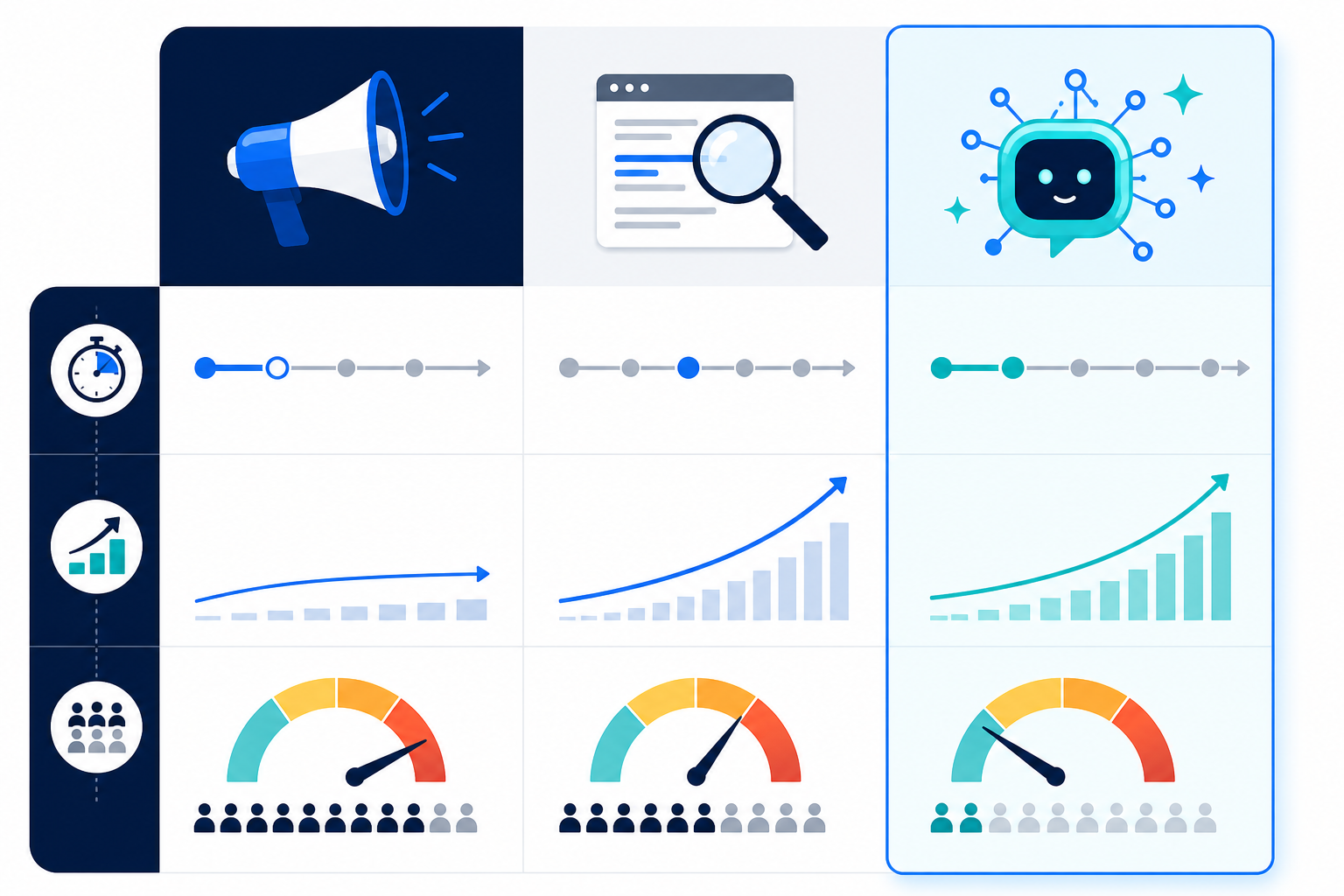
The saturation column is the one I'd pay most attention to, with a caveat attached. Paid ads deliver immediate reach but leave no residual asset once budget stops. Traditional SEO compounds over time but is being squeezed on the click-through side: Ahrefs' analysis of over 300,000 keywords (published 2024) estimated that AI Overviews can reduce click-through to the top organic result by roughly 34.5% when an overview appears, and SparkToro/Datos data has put the zero-click share of US Google searches at around 58.5% in recent estimates.
Both figures describe US search behaviour specifically; I haven't seen an equivalent UK-specific breakdown, so treat the direction as informative and the exact percentages as US-context numbers. GEO, by contrast, appears — based on the limited evidence available so far — to remain under-competed territory, simply because most competitors haven't built a process for managing their AI presence yet. I want to be careful here: "under-competed" is an observation about current market behaviour, not proof that early GEO gains will compound the way early backlinks did.
There's a structural quirk worth flagging honestly: answer generation happens continuously across five or six major engines, which means your visibility can shift without you touching a single page — sometimes because a competitor published something new, sometimes because a model itself changed. That volatility is precisely why I'd treat continuous, lightweight monitoring as more valuable than a one-off audit, even before you're confident about ROI.
Early Signals That GEO Investment Is Paying Off
Because GEO outcomes are probabilistic rather than fixed rankings, I look for a cluster of leading indicators rather than a single metric. To be transparent about where these come from: my tracking covers 40 prompts across seven SaaS categories, refreshed weekly against ChatGPT, Claude, Gemini, Copilot, and Perplexity. It's a small, self-run sample — useful for spotting patterns, not a substitute for your own testing.
A few terms are worth defining precisely, since they get thrown around loosely elsewhere:
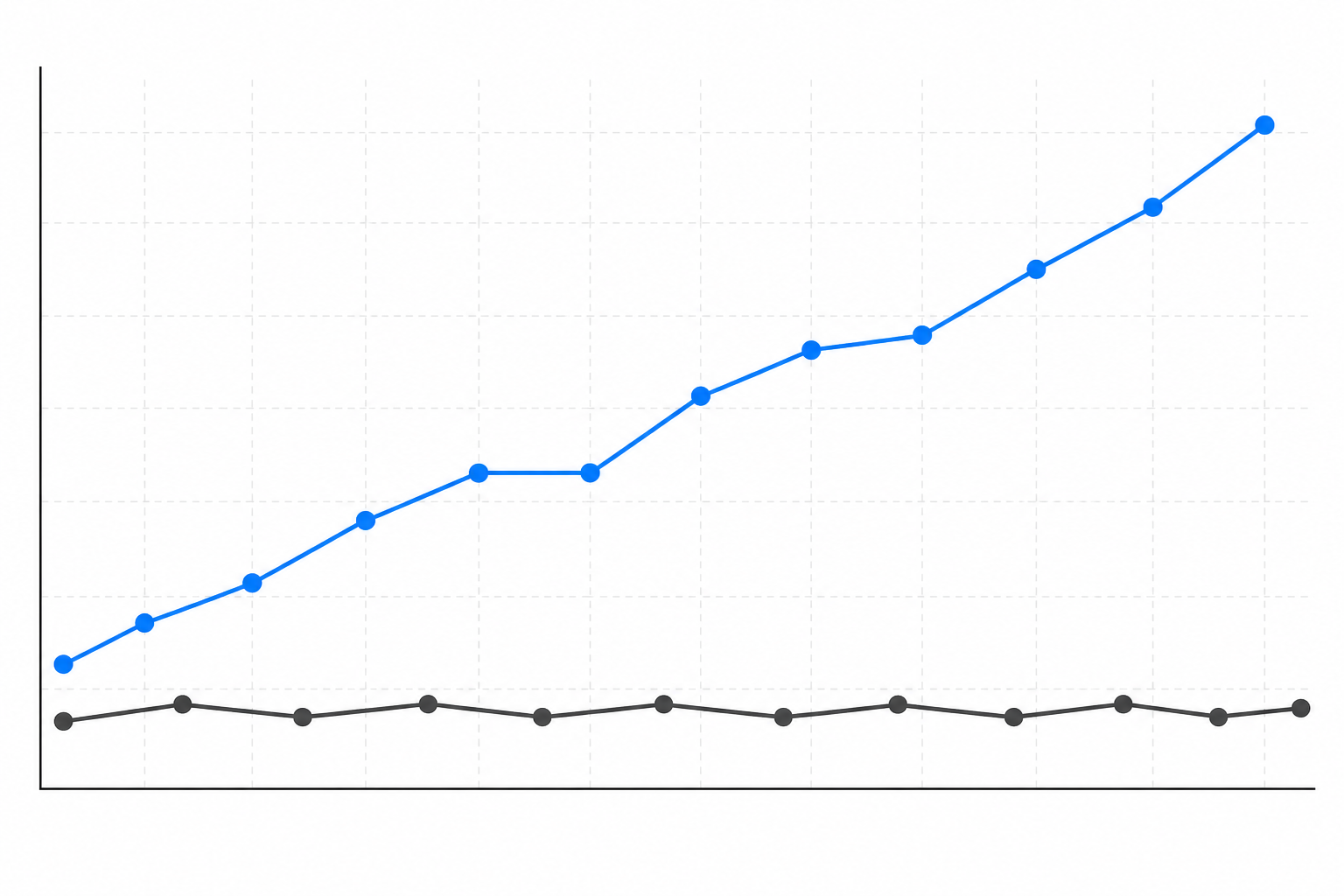
- A rising AI visibility score — a composite I build from three things: how many of your target queries return any mention of your brand (query coverage), whether mentions appear earlier or later in the answer (position-weighted citations), and how often you appear relative to named competitors (share of voice). I look for this trending upward across consecutive weekly checks, not a single spike.
- Soft mentions converting to hard citations — a "soft mention" is your brand named in an answer without an attributed source link or explicit reference; a "hard citation" is when the engine explicitly attributes a claim to your site or content. Moving from the former to the latter over time is a meaningful signal.
- Sentiment trend relative to named competitors — tracked qualitatively, by reading how your brand is described versus rivals in the same answers, rather than via a validated sentiment-scoring model.
- Measurable AI referral traffic — sessions with a referrer of chatgpt.com, perplexity.ai, or similar, visible in standard analytics referral reports. This isn't a special "cookieless AI analytics" category; it's ordinary referral tracking, with the usual limitation that many AI-influenced visits arrive as direct traffic with no referrer at all, which understates the true number.
- Disproportionate share of voice in niche categories — often simply because competitors haven't optimised their AI legibility yet, based on what I've seen in the categories I track.
A concrete example from my own tracking: for one SaaS category I follow, the prompt "best project management tool for remote teams under 50 people" initially returned zero mentions of a mid-market vendor I was watching, across all five engines, in week one. After that vendor published a structured comparison page with explicit pricing tiers and named alternatives, it appeared as a soft mention in Perplexity within three weeks and as a hard citation in Perplexity and Copilot by week nine — but never appeared in ChatGPT's responses to the same prompt during the tracking period. That's a real, if small and anonymised, illustration of both the opportunity and the unevenness across engines.
On broader evidence: Adobe reported a 1,300% year-over-year increase in generative-AI-referred traffic to US retail sites during the 2024 holiday period, with those visitors converting at rates roughly 9% higher than other traffic (Adobe Analytics, cited December 2024). Retail isn't SaaS, and holiday shopping behaviour isn't a proxy for B2B purchase cycles, but it's useful evidence that AI-referred users can arrive with real commercial intent, and that the channel can scale quickly from a low base.
How to Build GEO Into Your Existing Growth Stack
I don't think GEO should live as an orphaned side project. Here's the sequence I'd follow, with ownership attached at each step so it doesn't stall:
- Audit your AI legibility (owner: SEO/content lead). Check whether your site's structure, schema, and factual clarity make it easy for models to extract accurate information — consistent entity naming, clear pricing statements, and unambiguous product descriptions. Deliverable: a scored gap list, reviewed monthly.
- Map the actual questions buyers ask AI assistants (owner: product marketing, with input from sales and support). These tend to be longer, more comparative, and more conversational than typical search keywords. Deliverable: a living prompt list of 30–50 queries, reviewed quarterly.
- Assign clear ownership and a weekly reporting cadence (owner: whoever already owns SEO or content), rather than a quarterly check-in that misses week-to-week volatility.
- Set a visibility baseline and track it against named competitors (owner: analytics/SEO), because winning here is relative, not absolute.
- Feed learnings back into content and product marketing (owner: content team, with legal/product sign-off on factual claims). If AI engines consistently misstate your pricing, positioning, or integrations, that's a content gap to close, not a curiosity to note.
- Treat AI agent access — via APIs or MCP servers — as part of your technical SEO checklist (owner: engineering/SEO jointly), since a growing share of buying research will be agent-mediated rather than human-typed, though I'd size this as a smaller, forward-looking line item rather than a near-term priority.

A disclosure, since I mentioned tooling earlier: I've used MentionOwl to automate steps 1, 2, and 4 above — it generates candidate buyer questions and runs them daily against ChatGPT, Claude, Gemini, Copilot, and Perplexity, then flags AI legibility gaps against a 16-point checklist covering things like schema completeness, pricing clarity, and named-entity consistency. I have a relationship with the product and I'm noting that plainly.
You don't need it to run this workflow — a spreadsheet, a weekly manual prompt run across the five engines, and a shared tracker will get you the same visibility at a slower pace, and that's a reasonable starting point before you decide whether a dedicated tool earns its cost.
How to Measure ROI From Generative Engine Optimization
ROI here has to be treated as a funnel, not a single number, because AI visibility and traffic aren't the same thing — a brand can be mentioned or cited without generating a click. The components I track are:
- Visibility score trendlines (0–100), as defined above, as a leading indicator
- Competitor-relative share of voice, since the goal isn't absolute presence, it's presence relative to who else shows up in the same answers
- Sentiment trend, read qualitatively rather than through a validated score
- AI-attributed referral traffic and conversions, using standard referral tracking, with the explicit caveat that a large share of AI-influenced visits will show up as unattributed direct traffic
- Correlation checks between weeks of higher visibility scores and subsequent branded search or trial sign-up upticks, treated as a pattern to watch rather than a proven causal link
The attribution challenge is real and worth stating plainly: Pew's March 2025 research found that when an AI summary appeared, only about 1% of visits resulted in a click on a source link inside the summary itself. That's a specific finding about Google's AI summaries in a US sample, not a universal figure across all AI assistants — but it points at something true more broadly. A near-zero click-through rate doesn't mean the mention had no value; it means last-click attribution is the wrong lens for this channel, and incrementality or branded-search lift are likely more informative, even if they're harder to measure cleanly.
How Much Should You Budget for GEO Compared With SEO or Paid Ads?
Most of the hard evidence I've cited above is US or global, and I don't have UK-specific search-behaviour data to point to — worth saying plainly rather than dressing up in pounds sterling. What I can offer is a testable starting point rather than a market-wide claim: if your UK SaaS or DTC team currently has no dedicated GEO tracking (which, anecdotally, describes most teams I talk to), a reasonable pilot is reallocating 10–15% of your existing content or SEO budget for 90 days, rather than treating this as a permanent commitment before you've seen your own data.
A sample 90-day allocation: roughly a third of that budget on monitoring (weekly prompt runs across the major engines, either manual or tool-assisted), and two-thirds on production — closing the AI legibility gaps you find, with particular attention to UK-specific factual accuracy: GBP pricing and VAT treatment, UK availability, and any UK review platforms or directories that inform how models describe your product regionally.
Set success criteria before you start — for example, a defined lift in query coverage or a move from soft mentions to hard citations across a fixed prompt set — so the pilot has a clear pass/fail read at day 90, rather than drifting into an open-ended initiative.
Is It Too Early to Invest in GEO or Already Too Late to Wait?
I'd resist the temptation to borrow a precise number from the early SEO adoption curve of 2003–2007 and apply it here as if it were a documented law — I don't have evidence that first-mover windows in a new discovery channel reliably last a fixed 18 to 36 months, and I'd be overstating my case if I presented that range as settled.
What I can say with more confidence: Google's AI Overviews reportedly reached more than 1.5 billion users across 200+ countries and territories by May 2025, which tells you the surface itself is now large, even if its influence on any single purchase decision is still hard to measure precisely.
The more honest framing is this: test now because buyer research behaviour is visibly changing, not because a proven countdown clock is running out. The realistic cost of waiting isn't a missed 18-month window — it's the practical difficulty of displacing a competitor who becomes an AI engine's default answer in your category before you've started tracking whether you're even in the conversation. Unseating an established default is harder than establishing one from a blank slate, and that's true regardless of exactly how long the current opportunity lasts.
Generative Engine Optimization FAQ
Is GEO Just a Rebrand of SEO or Something Genuinely Different?
Related, not identical. Both reward clear, well-structured, accurate content, but GEO adds synthesis instead of ranking, engine-specific retrieval behaviour, and volatility that classic SEO didn't have to manage.
How Much Should We Budget for GEO Compared With SEO or Ads?
Most teams are starting from zero, so a modest reallocation — I'd suggest testing at 10–15% of existing content or SEO spend — is enough to establish whether the channel is worth a larger commitment. Use a 90-day pilot with defined success criteria before increasing the budget.
How Do We Measure ROI From Generative Engine Optimization?
Treat it as a funnel rather than one number: track AI visibility, competitor-relative share of voice, qualitative sentiment, referral traffic, conversions, and changes in branded search or trial sign-ups. Use correlation and incrementality testing rather than relying only on last-click attribution.
Is It Too Early to Invest in GEO or Already Too Late to Wait?
Neither framing is fully right. There's no proven fixed window, but buyer behaviour is measurably shifting now, which is reason enough to run a bounded pilot rather than wait for certainty that may not arrive in time to matter.