A Guide to Managing Client Brand Reputation in AI Search
AI search reputation guide for agencies: audit brand monitoring, LLM citations and sentiment across ChatGPT, Claude and Gemini to protect clients.
AI Search Reputation: A Brand Monitoring Guide for Agencies
Managing client brand reputation in AI search means treating LLM citations, sentiment, and share of voice as seriously as you'd treat Google rankings or social mentions—because ChatGPT, Claude, Gemini, and Perplexity are increasingly the first (and sometimes only) touchpoint in a buyer's research journey. I've found the agencies moving fastest on this are running structured AI visibility audits, tracking sentiment across platforms weekly, and folding the data into existing client reporting rather than treating it as a bolt-on experiment. What follows is the operational detail I wish someone had handed me eighteen months ago: how to audit, how to track sentiment properly, how to report on it in a way clients actually understand, and how to price it as a retainer rather than a one-off favour.
Why AI Search Reputation Is the Next Frontier for Agencies
The numbers here are stark enough that I don't think agencies can afford to treat this as speculative. Gartner has predicted that traditional search-engine volume could fall by as much as 25% by 2026 as consumers shift toward AI chatbots and virtual agents for tasks they'd previously have typed into Google. Separately, Adobe Analytics reported that traffic from generative-AI sources to US retail websites increased by 1,200% in February 2025 compared with July 2024—and that visitors arriving via those AI referrals converted at a rate roughly 9% higher than traffic from other channels. Put those two data points together and the implication is unavoidable: AI search isn't a niche channel worth monitoring occasionally, it's rapidly becoming a primary research surface with commercially meaningful downstream effects.
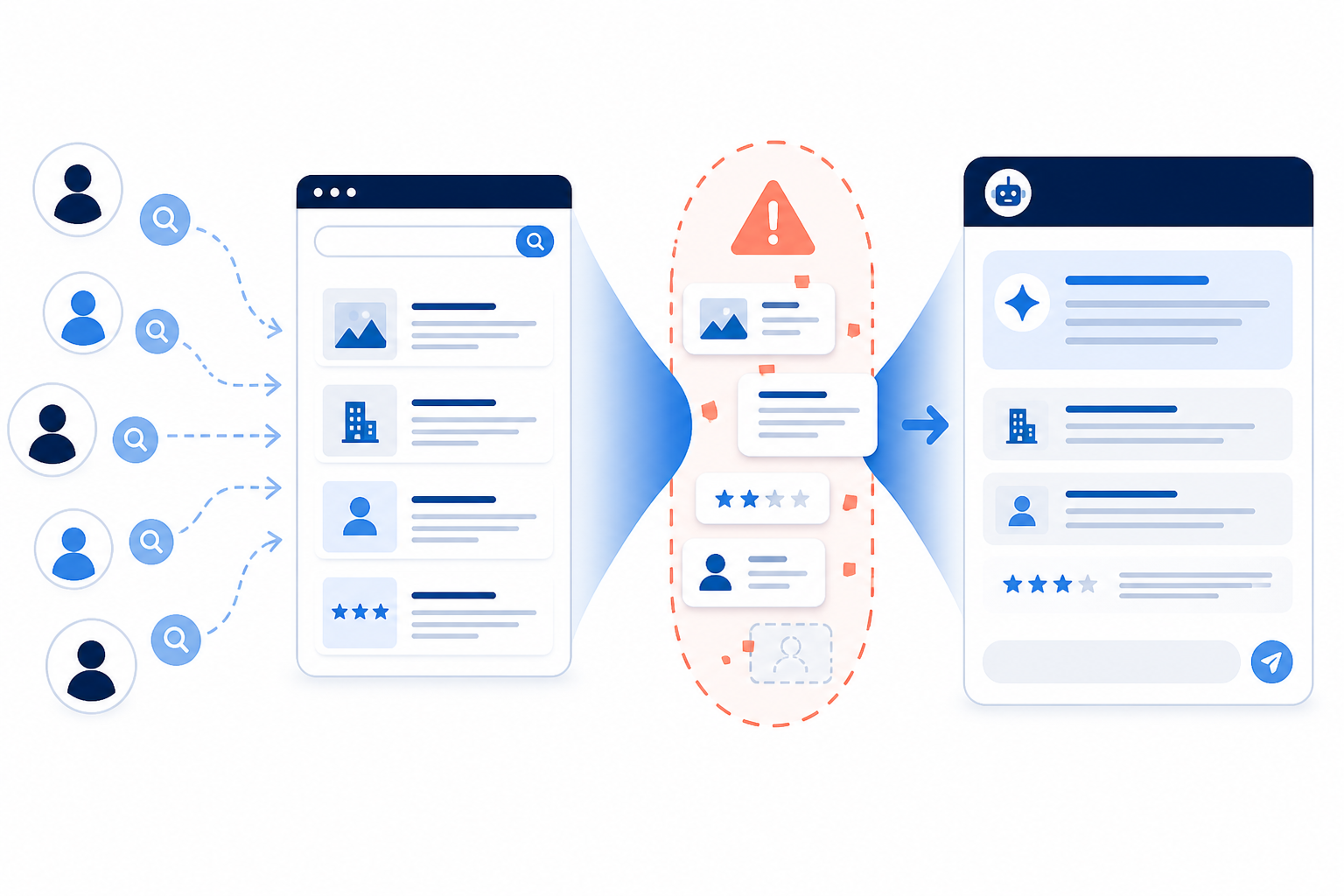
The risk profile is also fundamentally different from anything agencies have managed before. When a client controls their Google Business Profile, their website copy, and their social channels, they have direct editorial control over the narrative. AI engines don't work that way. They synthesise brand descriptions from scattered, sometimes contradictory sources—old press releases, outdated pricing pages, a competitor's aggressive content marketing, a three-year-old forum thread—and present the result with the flat, confident authority of fact. Google's own guidance on AI features acknowledges that generated answers are probabilistic and can combine outdated or incorrectly attributed information, which means a client can be actively misrepresented without a single person on their team having done anything wrong.
The Air Canada case is the example I keep returning to when I'm explaining this risk to sceptical account directors. In Moffatt v. Air Canada, a British Columbia tribunal held the airline liable after its own chatbot gave a customer incorrect information about bereavement fare policy—the airline argued the bot was a separate legal entity, and the tribunal firmly rejected that. It's a narrow legal precedent, but the reputational lesson generalises well beyond chatbots the client built themselves: AI-generated statements about your business carry real consequences, whether you authored them or not.
This is precisely why proactive monitoring, rather than reactive damage control, is the only defensible position for an agency to take. By the time a client notices that ChatGPT is quoting last year's pricing, or that Perplexity keeps recommending a rival ahead of them for a core category query, some proportion of the buyers who saw that answer have already made a decision. There's no retrospective fix for a conversation that already happened inside someone else's chat window. I'd also push back gently on the idea that this needs to be sold as a brand-new speciality. It sits naturally alongside the SEO, digital PR, and reputation management work most agencies already run—technical SEO, structured data, review management, and factual consistency across the web are exactly the inputs AI systems draw on when constructing an answer, so the skillset extension is smaller than it might first appear.
How to Audit a Client's AI Search Visibility
Before any monitoring programme can run, you need a baseline. I'd resist the temptation to skip straight to tooling here—understanding the manual process first means you'll interpret automated data correctly later.
Generate realistic buyer questions. Don't just query the brand name. The prompts that matter are category and comparison questions: "best accounting software for freelancers in the UK," "is [competitor] better than [client] for X," "cheapest option for Y near me." These are the queries that reveal whether a client exists in the AI's mental model of the category at all.
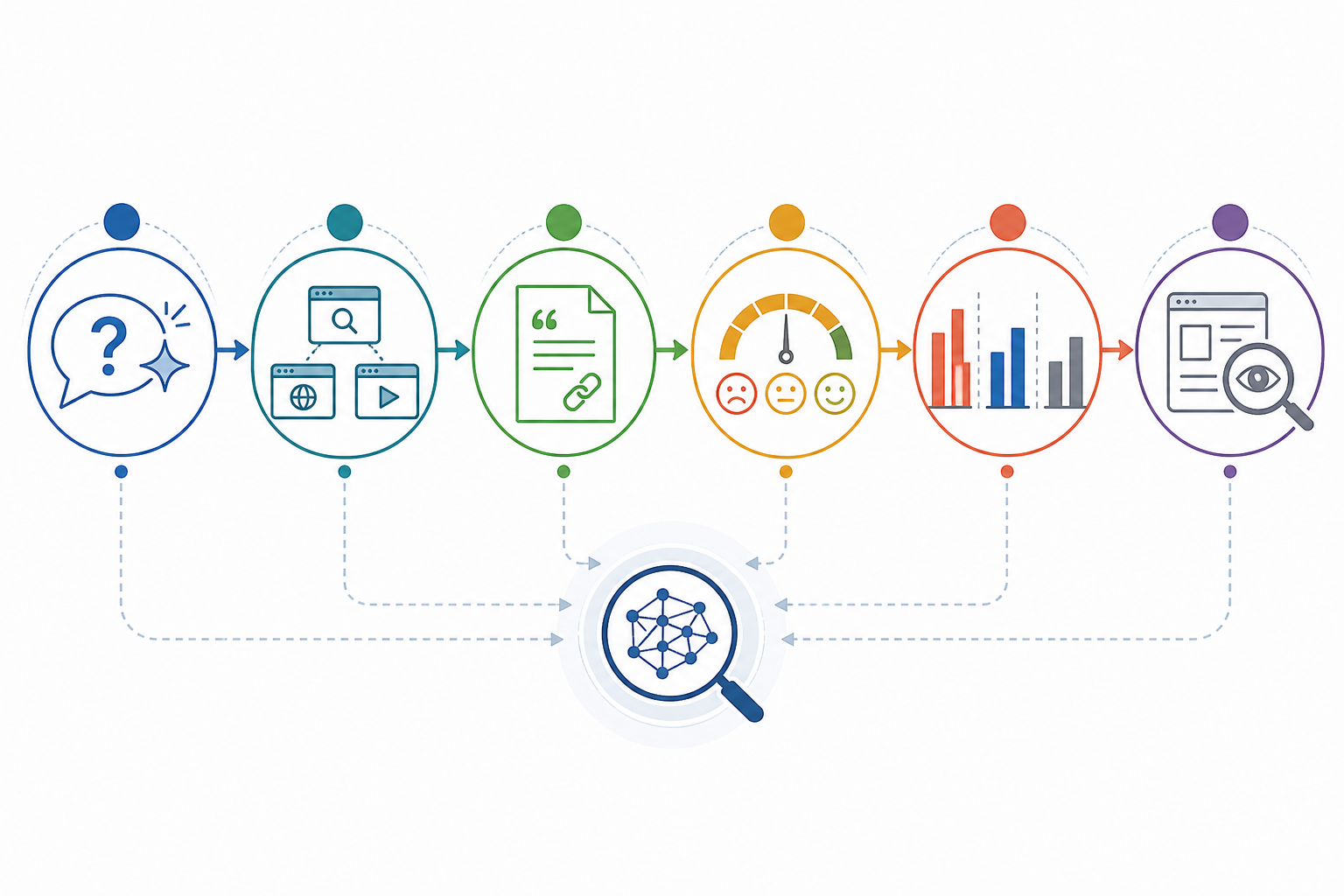
Run those queries systematically across AI search platforms. ChatGPT, Claude, Gemini, Copilot, and Perplexity each pull from different training data and browsing behaviour, so a query set run only on one platform gives you a partial and potentially misleading picture. Start manually to get a feel for the landscape before automating.
Record mention type and prominence. Was the client named at all? Cited with a clickable source link? Mentioned in passing with no attribution? Note position too—being first-recommended carries very different value from being fourth in a list of five.
Assess sentiment and factual accuracy together. This is the step agencies most often shortcut, and it's the one where errors hide. A single spot-check will catch an obviously wrong answer but will miss the subtler damage of outdated pricing or a comparison framed to favour a competitor.
Benchmark against named competitors. A visibility score in isolation tells a client very little. What they actually want to know is whether they're winning or losing share of voice against the two or three rivals they think about every day.
Run an AI legibility check on the client's site. Schema markup, crawlability, clean content structure, and clear entity signals all determine whether an AI engine can parse and cite the site accurately in the first place. A brand can have excellent products and still be invisible to AI search because the underlying site is technically illegible to a crawler.
This is essentially the process MentionOwl automates end to end: it crawls a client's website, auto-generates the relevant customer questions based on what's actually on the site, and runs them daily against ChatGPT, Claude, Gemini, Copilot, and Perplexity, so agencies aren't rebuilding this manually every reporting cycle. Given that manually querying five platforms daily for even a handful of clients quickly becomes unsustainable, I think this is where the practical ceiling on manual auditing gets hit fast.
How to Track Brand Sentiment Across ChatGPT, Claude, and Gemini
One pattern I've seen consistently enough to call it a rule: a client can look genuinely strong on Perplexity, where citation-heavy answers tend to favour well-structured, recently updated content, while appearing almost invisible on Claude, which weights things differently again. Single-platform monitoring creates a false sense of security precisely because it hides this divergence.
Sentiment Categories for AI Brand Monitoring
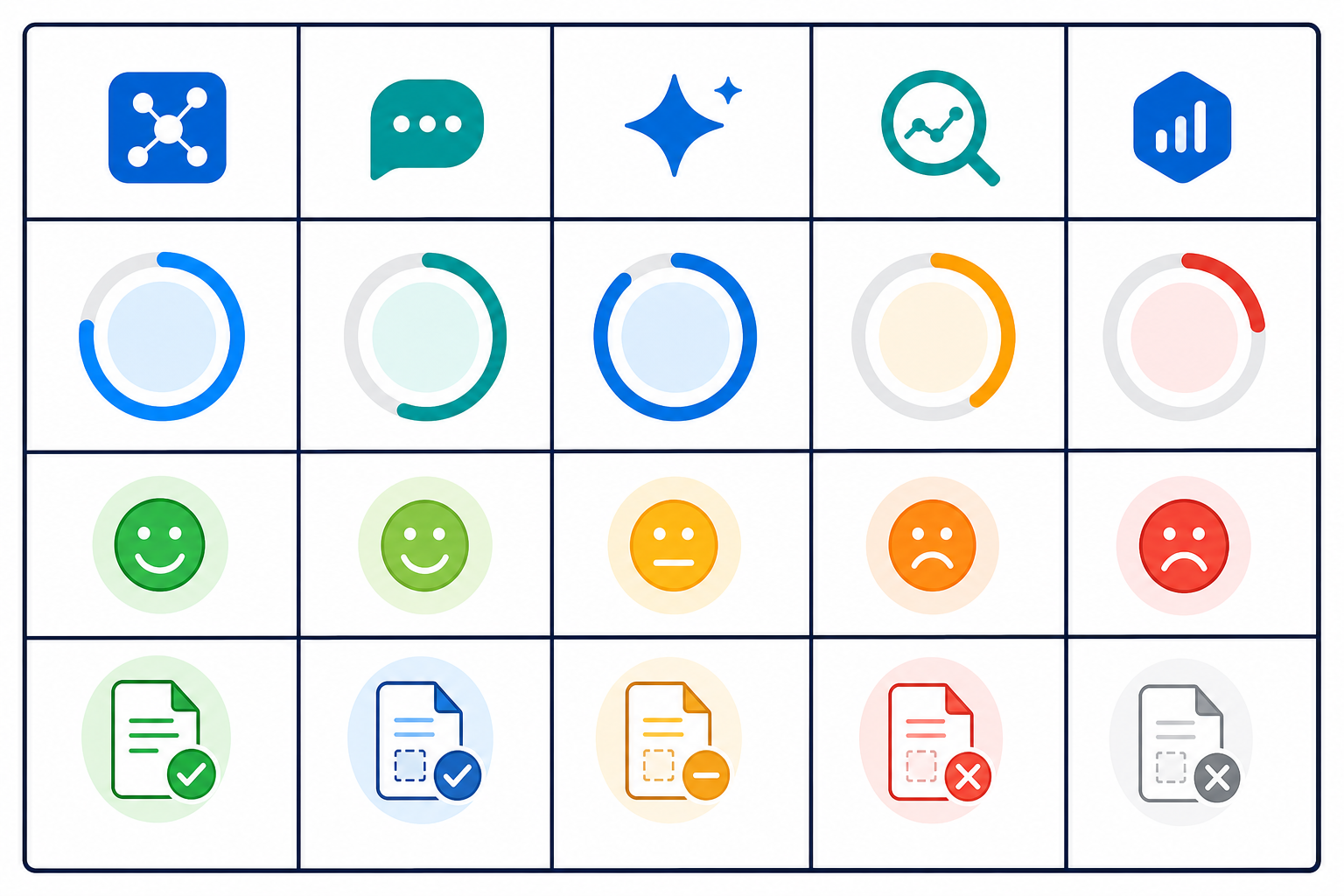
Sentiment itself needs finer-grained treatment than a simple positive/negative/neutral split. In practice I'd separate it into at least three categories:
- Neutral factual mentions — the brand is named accurately but without any editorial framing.
- Enthusiastic recommendations — the brand is positioned as a leading or preferred option.
- Subtly damaging comparisons — the kind of answer that reads as balanced but quietly steers the buyer elsewhere, such as "X is cheaper but Y has better support," which sounds neutral while nudging price-sensitive buyers towards a competitor.
Position-weighting matters just as much as sentiment classification. Being cited third in a five-brand list is a meaningfully different outcome from being the sole named recommendation, even though a crude "mentioned: yes/no" metric would record both identically.
AI Search Monitoring vs Social Listening
It's also worth being explicit with clients about how this differs from social listening, because the instinct is to assume it's the same discipline with a new data source. Social listening tracks opinions people have actively chosen to share. AI search sentiment tracks synthesised, authoritative-sounding answers presented as settled fact—often to users who never encounter a human opinion in their research at all. That changes both the risk profile (an AI hallucination reads as more credible than a stray tweet) and the remediation approach, since you're not managing public opinion, you're fixing the underlying content and structured data the model is drawing from.
On cadence: I'd argue for weekly sentiment digests over monthly ones, because drift compounds. A model update, a new competitor blog post that gets crawled and cited, or a client's own outdated pricing page can shift an answer within days, and catching that in week one rather than week four is the difference between a five-minute content fix and a client asking why they've been losing consideration for a month. That logic is exactly why MentionOwl runs daily queries and pushes a weekly digest rather than waiting for a monthly reporting cycle to surface problems.
How to Build AI Monitoring Into Client Reporting
Clients—particularly non-technical stakeholders on the client side—respond best to a single number they can watch move over time, alongside context that explains the movement. Here's how I'd structure the reporting layer:
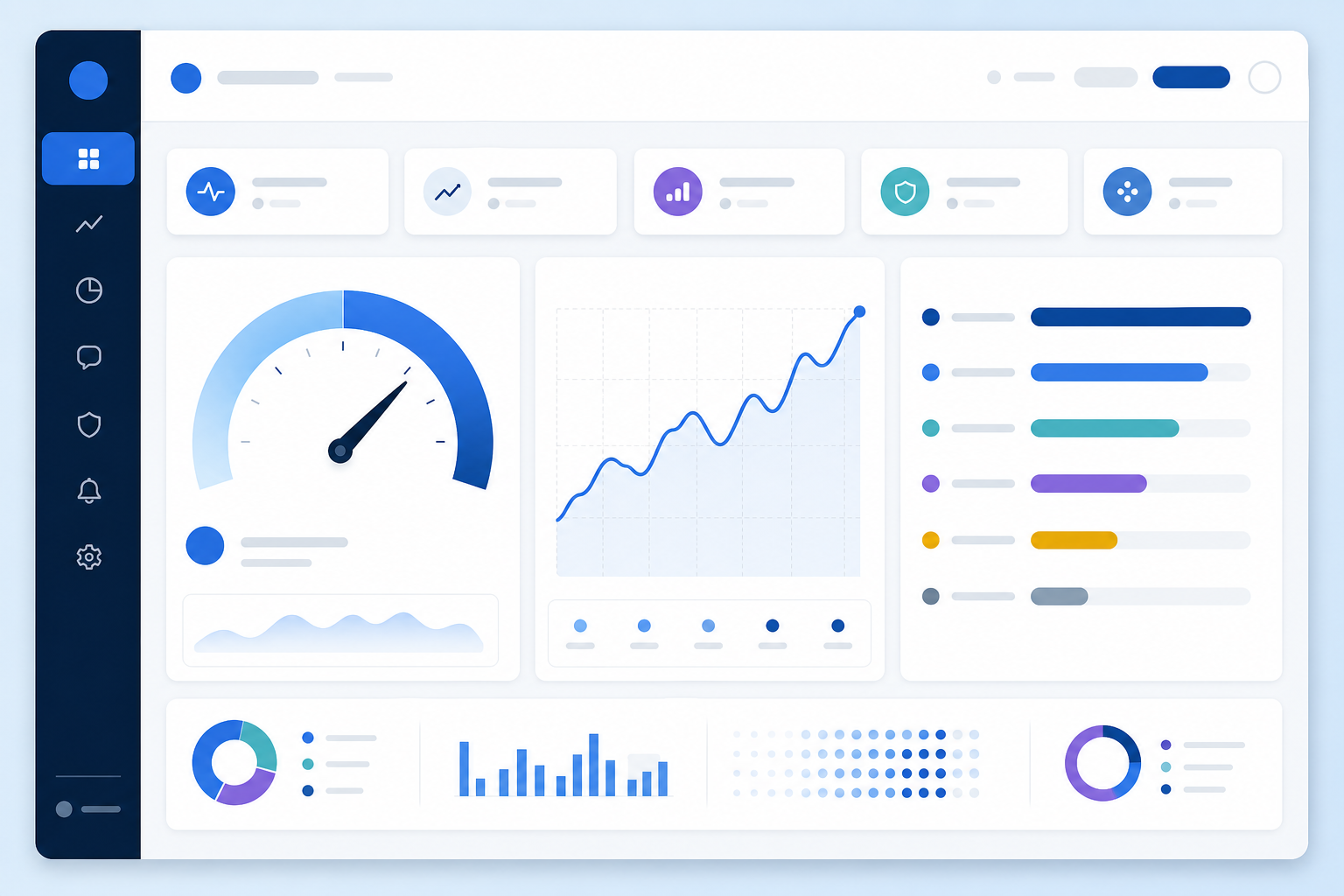
- Lead with a visibility score. A 0–100 score built from query coverage, position-weighted citations, share of voice, and soft mentions (this is how MentionOwl constructs its score) gives clients one trend line to anchor to, similar to how they've learned to watch domain authority or a rankings dashboard.
- Pair the number with narrative. What changed this period, why it likely changed, and what action the account team is taking. Numbers alone rarely land with a marketing director who's never opened an AI chat interface professionally.
- Always include named competitor tracking. In my experience clients care far less about their own isolated score than whether they're gaining or losing ground against the two or three rivals they think about daily.
- Add a citation log. Showing exactly which pages and sources AI engines are pulling from is often the single most actionable part of the report—it frequently reveals a fixable content gap the client didn't know existed.
- Show the downstream commercial effect. Cookieless AI traffic analytics can demonstrate whether AI-referred visitors are actually landing on site and converting, which is the data point that turns a monitoring conversation into a revenue conversation.
- Set a two-tier cadence. Monthly summary reports for client stakeholders, weekly digests for the internal account team, so problems get caught before they reach the monthly review.
How to Pitch AI Visibility as a Brand Monitoring Retainer
I'd frame this as risk management first and growth opportunity second, because that's the order clients actually respond to. "Here's what AI is currently saying about you that you don't control" lands far harder in a pitch meeting than an abstract promise of incremental traffic from generative engine optimisation.
A low-cost trial audit removes the internal budgeting friction that usually stalls a new service line before it starts. A $1, seven-day trial tool—which is how MentionOwl is priced precisely for this use case—lets you generate a first snapshot report the client can react to emotionally before you've asked them to sign anything. Once that audit surfaces gaps, AI legibility fixes—schema, structured content, clearer entity signals—become natural billable technical work, creating a built-in upsell path from monitoring into implementation.
Ongoing monitoring is where the recurring revenue actually sits: a monthly retainer covering continuous tracking, sentiment alerts, competitor movement, and quarterly strategy reviews. For larger clients, the API and MCP server angle is worth raising explicitly—feeding AI visibility data directly into a client's own dashboards or AI agent workflows can justify a meaningfully higher-tier retainer than basic reporting alone.
One caution I'd give any agency pitching this: don't oversell certainty. Generative engine optimisation is still maturing as a discipline, and I think the honest position is to set client expectations around directional improvement and risk reduction rather than guaranteed rankings or citation placement. That honesty, in my experience, is what makes the retainer sustainable past the first renewal.
Frequently Asked Questions About AI Search and Brand Monitoring
How do I explain AI search reputation to clients who've never heard of it?
I usually start with a live demo rather than a slide deck: ask ChatGPT or Perplexity a real buying question about their category in front of them. Seeing their brand missing, misdescribed, or losing to a named competitor in real time makes the risk tangible far faster than any explanation of generative engine optimisation theory.
What tools can help agencies track AI search visibility at scale?
Manually querying five AI platforms daily for every client isn't sustainable past two or three accounts. Purpose-built monitoring platforms like MentionOwl automate the question generation, daily querying, sentiment scoring, and competitor tracking, and expose the data via API so it can be pulled straight into your own client dashboards.
How is AI search monitoring different from social listening?
Social listening tracks opinions people are choosing to share. AI search monitoring tracks synthesised answers that AI engines present with an air of neutral authority—often to users who never see a human opinion at all. The remediation is also different: you're not managing public sentiment, you're managing the underlying content and structured data the AI is drawing from.
Can AI visibility monitoring become a recurring revenue service?
Yes, and I think it's one of the clearer recurring-revenue opportunities in agency services right now precisely because AI answers change continuously as models update and new content gets crawled. A single audit is a snapshot; the value clients actually pay for is the ongoing weekly tracking, sentiment alerts, and competitor share-of-voice trend that only a monitoring retainer can provide.